Ethereum Q1 Report: On-chain Activity Hits Record High, Tokenized Assets Lead the Industry

marsbitPubblicato 2026-06-19Pubblicato ultima volta 2026-06-19

Introduzione

Ethereum Q1 2026 Report: On-chain activity hits record high, tokenized assets lead the industry. In Q1 2026, Ethereum's network experienced a unique divergence: on-chain activity soared while USD-denominated metrics declined. Monthly active users reached 13.2 million, transactions hit 200.4 million, and TPS averaged 25.78, all setting new highs. However, total value locked (TVL) fell 11.0% to $316.2B, DEX volume dropped 24.0% to $134.5B, and ETH's fully diluted market cap fell 30.3% to $290B. A key driver was the Blob Parameter Fork (BPO#2) in January, which increased data capacity and caused a sharp 47.9% drop in layer-1 transaction fees despite higher usage. Etherean's tokenized asset market cap reached $203.4B, up 42.9% year-over-year. While stablecoins ($178.9B) saw a slight dip, tokenized funds ($19.4B, +73.1% YoY), commodities ($4.7B, +325.9% YoY), and stocks ($365.1M) grew strongly. Ethereum dominates cross-chain comparisons, holding 71% of TVL, 79.2% of active loans, 61.8% of stablecoins, and 73% of tokenized funds among top chains. The report highlights a "Jevons Paradox" scenario: network expansion reduces per-transaction costs but unleashes latent demand, driving long-term growth. Ethereum's strategy mirrors Amazon's early focus on scale over profit. Its open, neutral foundation is seen as critical for institutional adoption, as evidenced by growing activity from firms like BlackRock and JPMorgan. The roadmap targets further scalability, aiming for thousands of ...

Author:Token Terminal

Translation:Saoirse,Foresight News

Ethereum is the core underlying settlement network for on-chain assets, relying on ETH to pay transaction fees and secure the network through staking. Traditional finance suffers from slow settlement, numerous intermediaries, and high counterparty risks, whereas tokenized assets and stablecoins offer on-chain solutions. As relevant regulations mature from 2025 to 2026, institutional deployment of on-chain business formally meets implementation conditions.

Various stablecoins, tokenized funds, commodities, and on-chain stocks are issued and settled on Ethereum, with layer-2 networks diverting transactions before ultimately returning to layer-1 for validation, allowing ETH to continuously accumulate value. By market capitalization, Ethereum remains the world's largest platform for tokenized assets, jointly operated by the Ethereum Foundation and the developer community. Teams like Etherealize specialize in connecting with traditional financial institutions, driving institutional capital inflow. In Q1 2026, the Ethereum ecosystem presented a divergent trend, analyzed in detail below using complete data from Token Terminal.

The market in Q1 2026 displayed a distinct two-sided dynamic: On-chain usage scale reached a historical high—monthly active users, total transaction volume, and throughput all set new records; however, dollar-denominated asset scale and fee metrics contracted simultaneously, with fully diluted market cap, total value locked (TVL), trading volume, and two types of fee data all declining sequentially. Key events this quarter profoundly shaped this unique market condition:

In January, the second round of the Fusaka upgrade cycle, the Blob Parameter Fork (BPO#2), was implemented, significantly enhancing data storage capacity.

In February, the ERC-8004 standard launched on mainnet, becoming the universal standard for AI agent identity and credit ratings.

The Ethereum Foundation finalized the three core goals for the 2026 protocol: scaling, optimizing user experience, and strengthening layer-1 foundational security.

In March, the Institutional Ethereum Forum was held, with participation enthusiasm from traditional financial institutions notably increasing.

Q1 2026 Key Metrics Overview

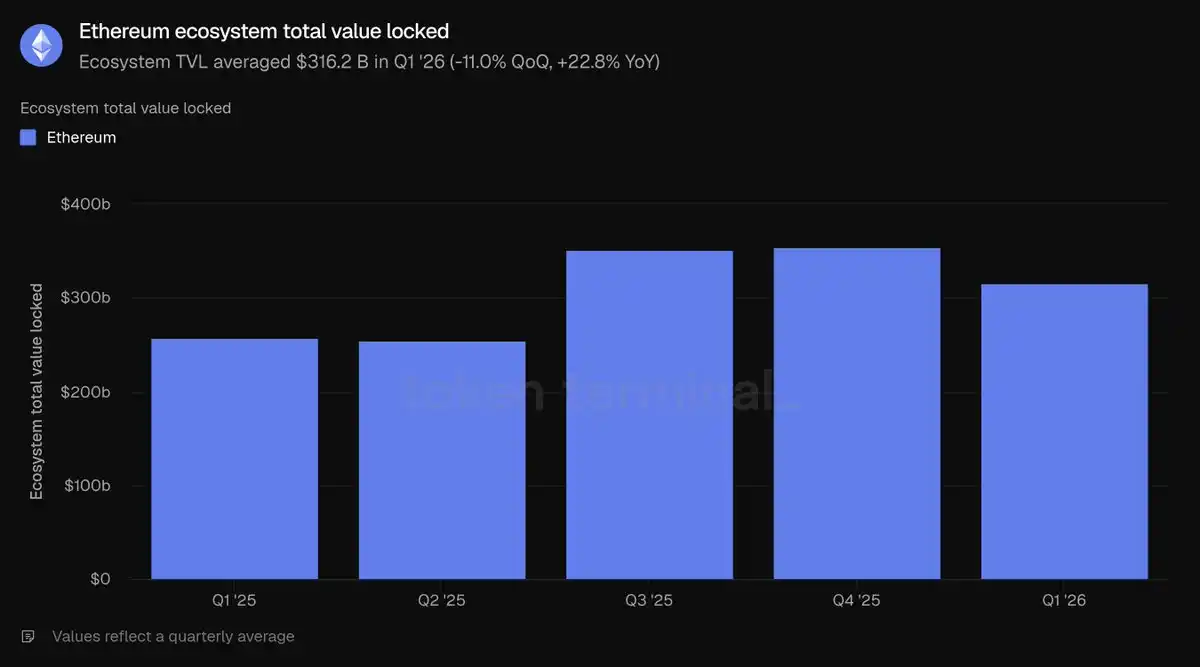
Ecosystem Total Value Locked: $316.2 billion (QoQ -11.0%, YoY +22.8%)

Ecosystem Outstanding Active Loans: $21.8 billion (QoQ -16.6%, YoY +39.0%)

Ecosystem Decentralized Exchange Total Volume: $134.5 billion (QoQ -24.0%, YoY -31.2%)

Full Ecosystem Application Fee Revenue: $2.0 billion (QoQ -16.9%, YoY -7.8%)

On-chain Tokenized Asset Total Market Cap: $203.4 billion (QoQ -0.7%, YoY +42.9%)

Stablecoins: $178.9 billion (QoQ -2.3%, YoY +37.6%)

Tokenized Funds: $19.4 billion (QoQ +4.9%, YoY +73.1%)

Tokenized Commodities: $4.7 billion (QoQ +60.0%, YoY +325.9%)

Tokenized Stocks: $365.1 million (QoQ +16.5%)

Monthly Active User Addresses: 13.2 million (QoQ +53.5%, YoY +85.9%)

Layer-1 Total Transactions: 200.4 million (QoQ +38.0%, YoY +81.5%)

Average Transactions Per Second (TPS): 25.78 (QoQ +41.2%, YoY +81.7%)

Layer-1 Mainnet Transaction Fee Revenue: $39.9 million (QoQ -47.9%, YoY -81.9%)

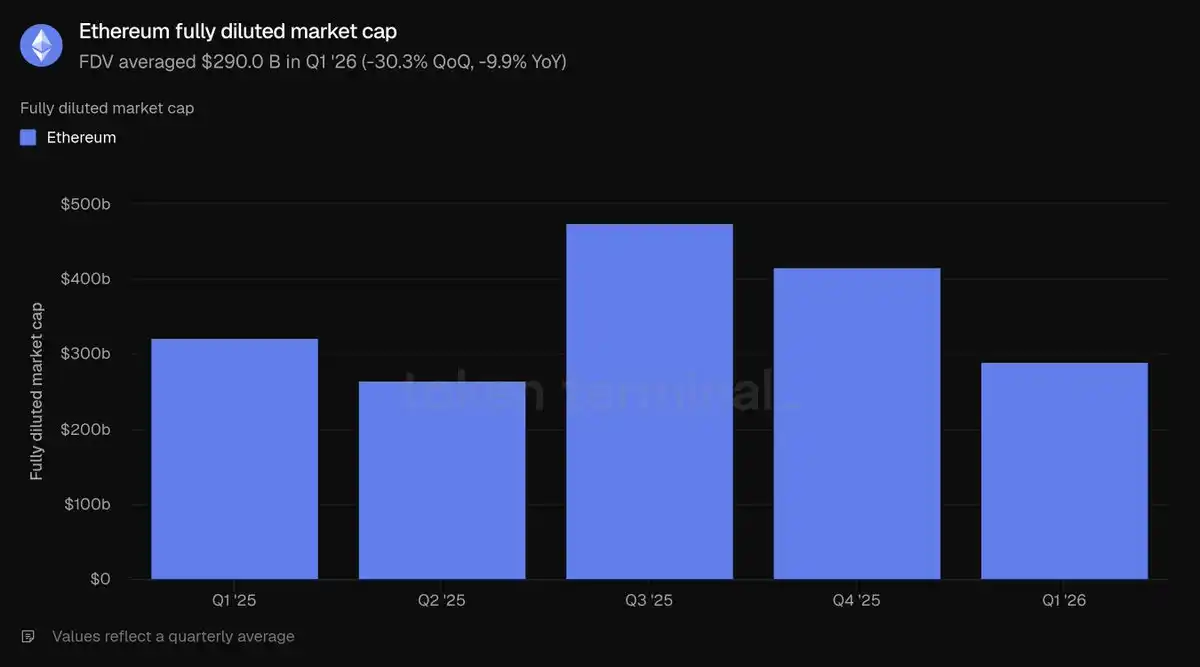
ETH Fully Diluted Market Cap: $290.0 billion (QoQ -30.3%, YoY -9.9%)

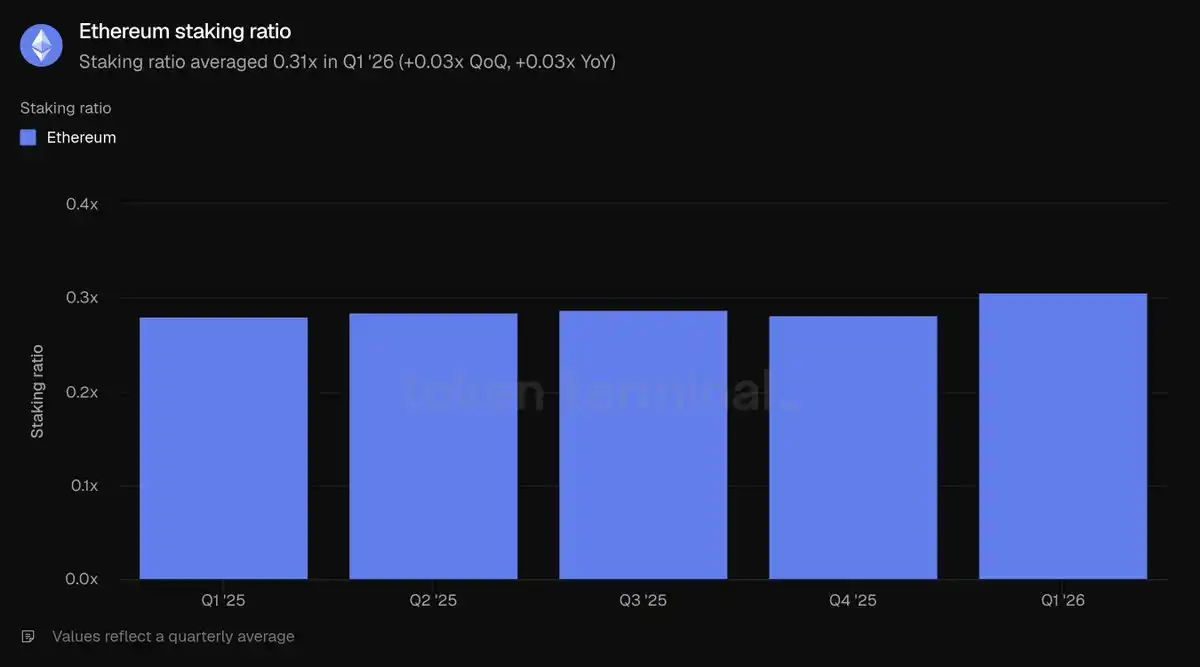
ETH Staking Ratio: 0.31 (Increased 0.03 QoQ and YoY)

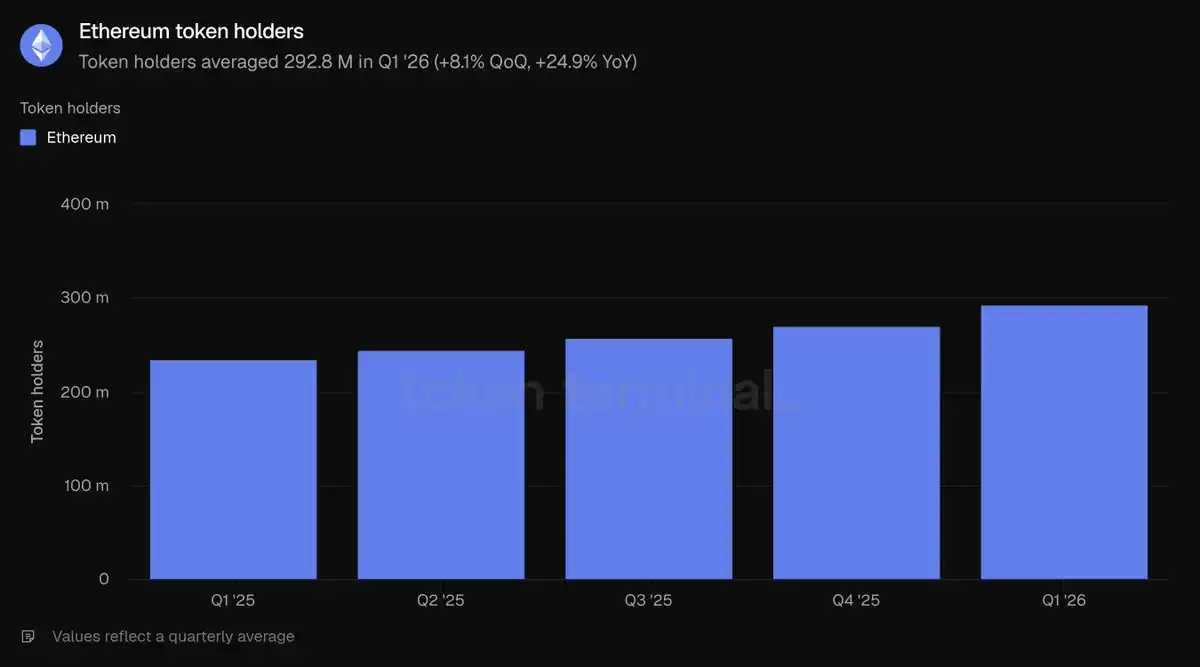
Total ETH Holding Addresses: 292.8 million (QoQ +8.1%, YoY +24.9%)

Note: This report's statistical scope includes only the Ethereum Layer-1 mainnet; layer-2 networks are considered independent blockchains, and their data is not included in Ethereum statistics.

Overall Ecosystem Development

Total Value Locked refers to the total USD value of assets deposited into various on-chain applications, a leading indicator for revenue-generating activities like lending, trading, and staking; here it represents the on-chain, user-withdrawable funds settled across the entire Ethereum ecosystem. In Q1 2026, the average TVL for the Ethereum ecosystem reached $316.2 billion, down 11.0% quarter-over-quarter but up 22.8% year-over-year. The sequential contraction stemmed from a general price correction in crypto assets, while the substantial year-over-year growth demonstrates a real expansion in ecosystem scale compared to the same period last year.
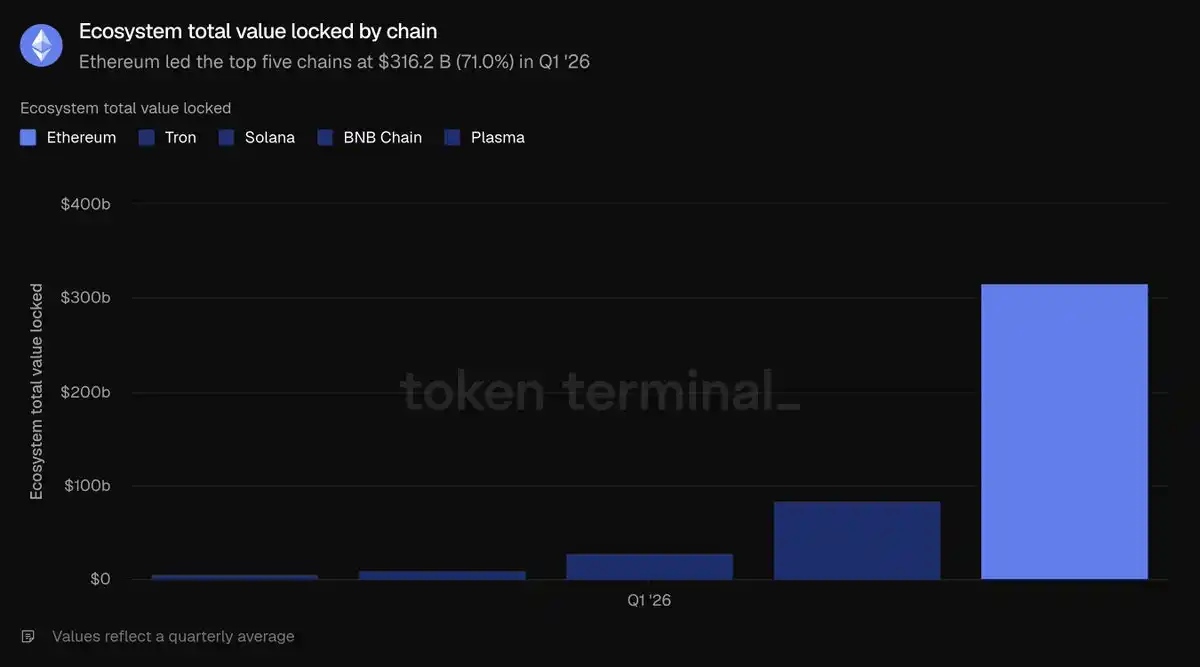
Among the top five blockchains by TVL, Ethereum leads by a wide margin: $316.2 billion far exceeds the sum of Tron ($84.5B), Solana ($28.8B), BNB Chain ($10.3B), and Plasma ($5.7B), accounting for 71% of the total TVL across these five chains. Funds are concentrated in two major sectors: the liquid staking sector led by Lido, and the lending sector centered around Aave; restaking protocols like EigenLayer and ether.fi, as well as synthetic dollar platforms like Ethena and Sky, also hold significant capital. High concentration of funds is Ethereum's most prominent structural advantage.
The Active Loans metric represents the scale of deposits that are lent out and generate interest income, directly reflecting lending business revenue; here it is the total outstanding borrowing across all Ethereum lending applications. In Q1, the average active loan scale in the ecosystem was $21.8 billion, down 16.6% QoQ but up 39.0% YoY. The contraction in loan balances alongside TVL reflects a cooling overall market risk appetite, but the scale remains significantly higher than the same period last year.
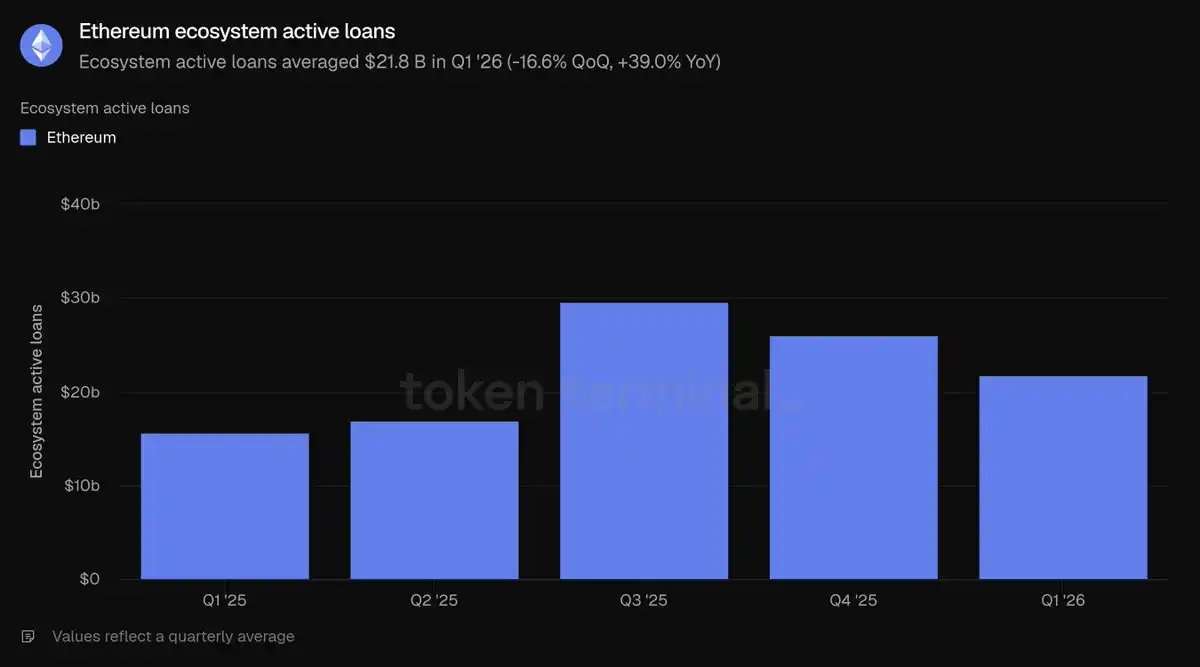
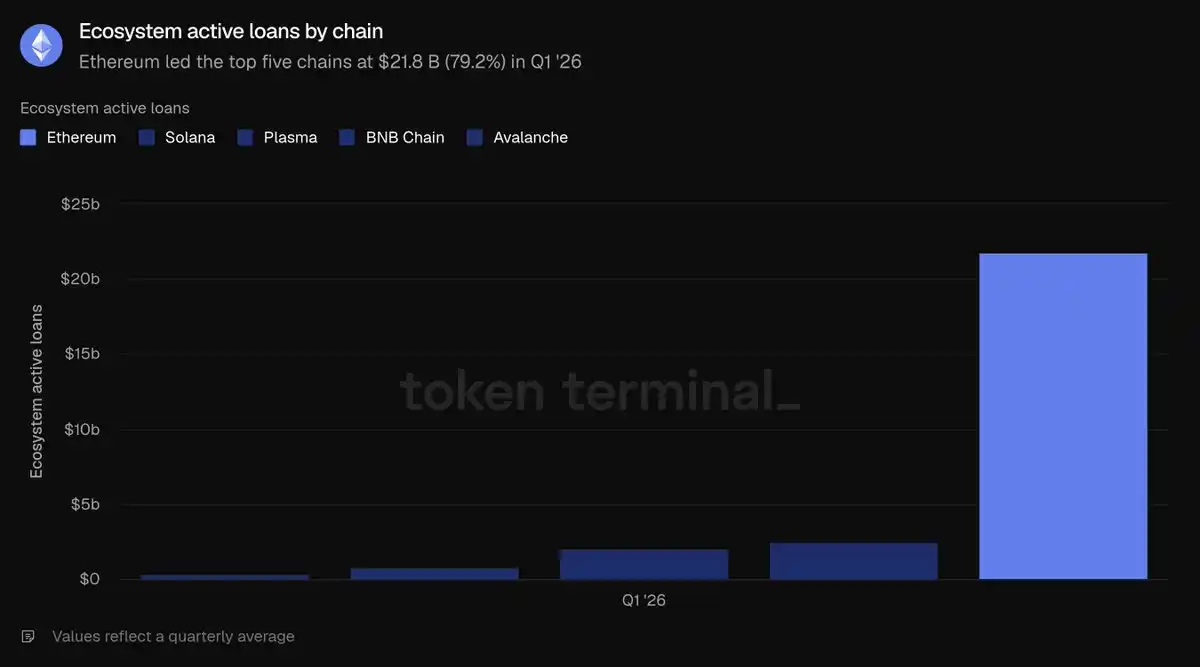
Ethereum's lending market is concentrated in a few pools, with Aave dominating: its active loan scale at quarter-end was approximately $13.5 billion, capturing the vast majority of the ecosystem's share; followed by Morpho (~$1.9B), Spark under Sky (~$1.0B), and Maple (~$840M). The contraction this quarter was primarily driven by Aave, as declining crypto asset prices led to cooler borrowing demand, with its total loan volume shrinking by about 24%. Comparing the top five chains, Ethereum's $21.8 billion in active loans significantly leads Solana ($2.5B), Plasma ($2.1B), BNB Chain ($760.8M), and Avalanche ($392.4M), accounting for 79.2% of the total lending volume across these five chains, making this the sector where Ethereum holds its highest share among the measured sectors.
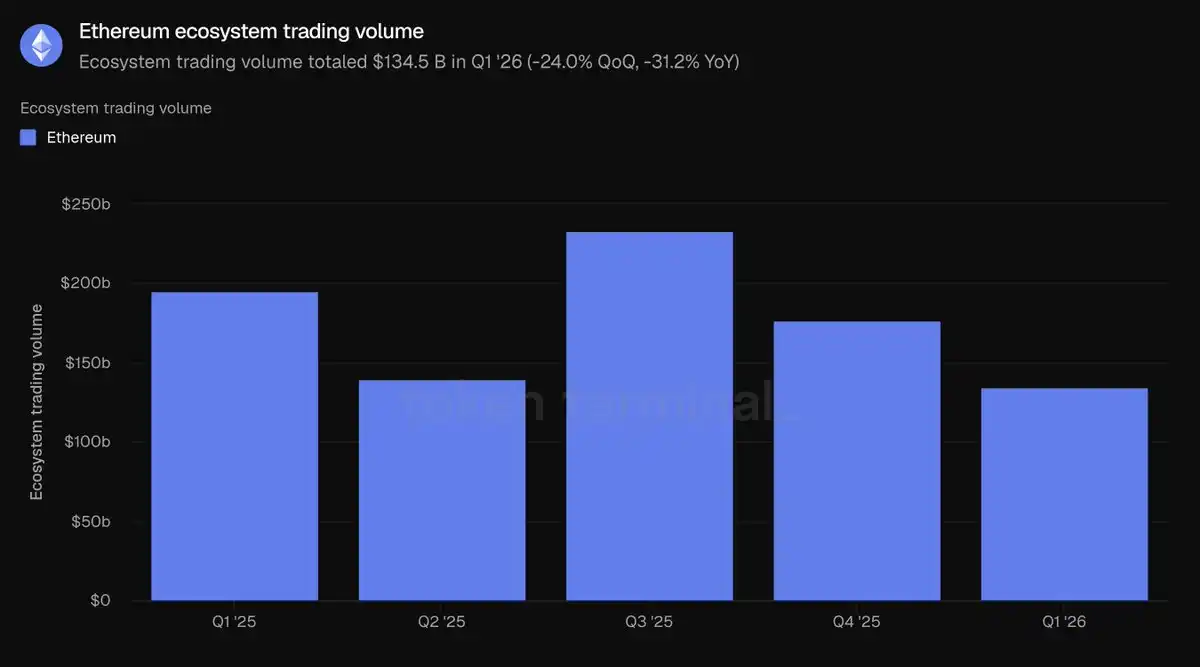
Decentralized Exchange Volume refers to the total transaction value completed on on-chain spot exchanges; traders pay fees during transactions, making volume highly correlated with platform revenue. This data aggregates all DEX trading within the Ethereum ecosystem. In Q1, total ecosystem trading volume was $134.5 billion, down 24% QoQ and 31.2% YoY. The decline in trading volume was steeper than the contraction in TVL, confirming a significant reduction in market risk appetite during this quarter's asset downtrend.
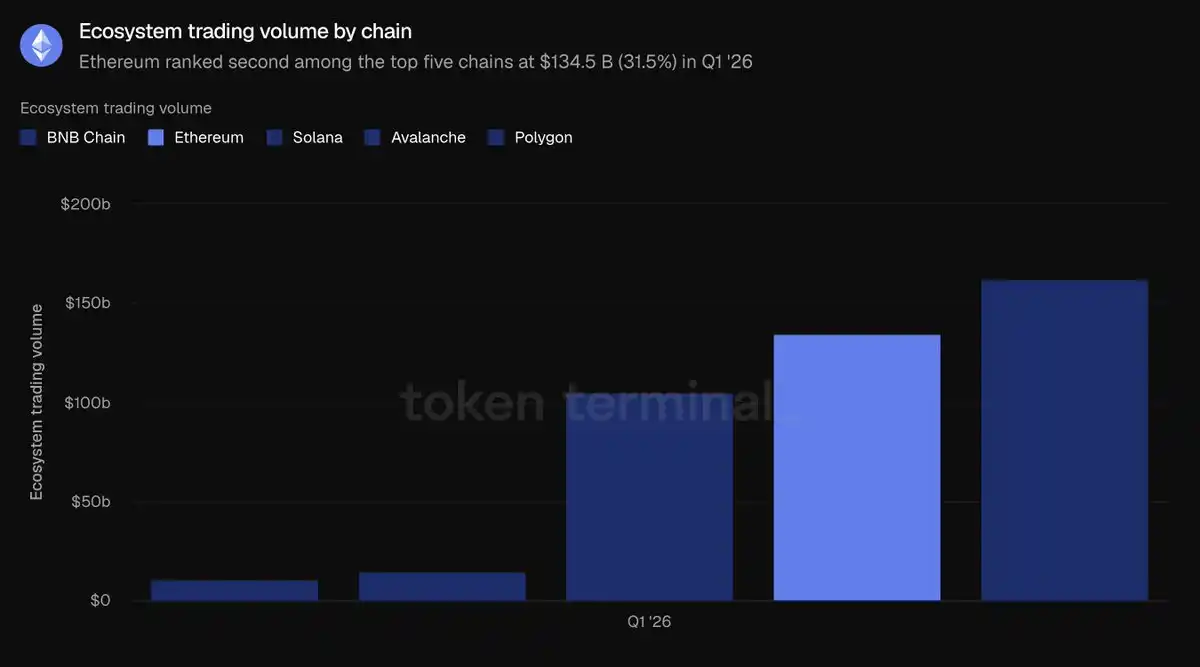
Ethereum DEX trading flow is highly concentrated among leading platforms: Uniswap's Q1 volume was approximately $85.5 billion, accounting for two-thirds of the ecosystem total; followed by Curve (~$22.1B) and CoW Swap (~$12.4B). Trading volume is the only metric where Ethereum does not top the five major chains: BNB Chain's total volume of $162.5 billion exceeded Ethereum's $134.5 billion, followed closely by Solana ($104.9B), with Avalanche ($14.5B) and Polygon ($10.7B) ranking lower. Ethereum's volume constitutes 31.5% of the total across the five chains, second to BNB Chain's 38%.
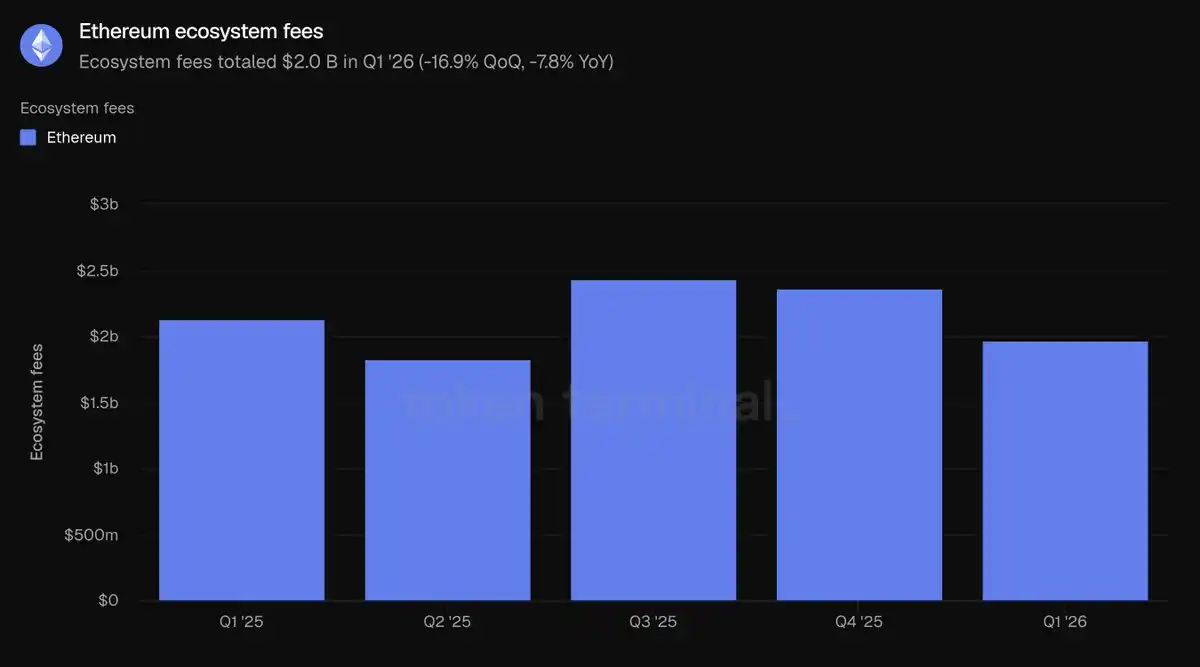
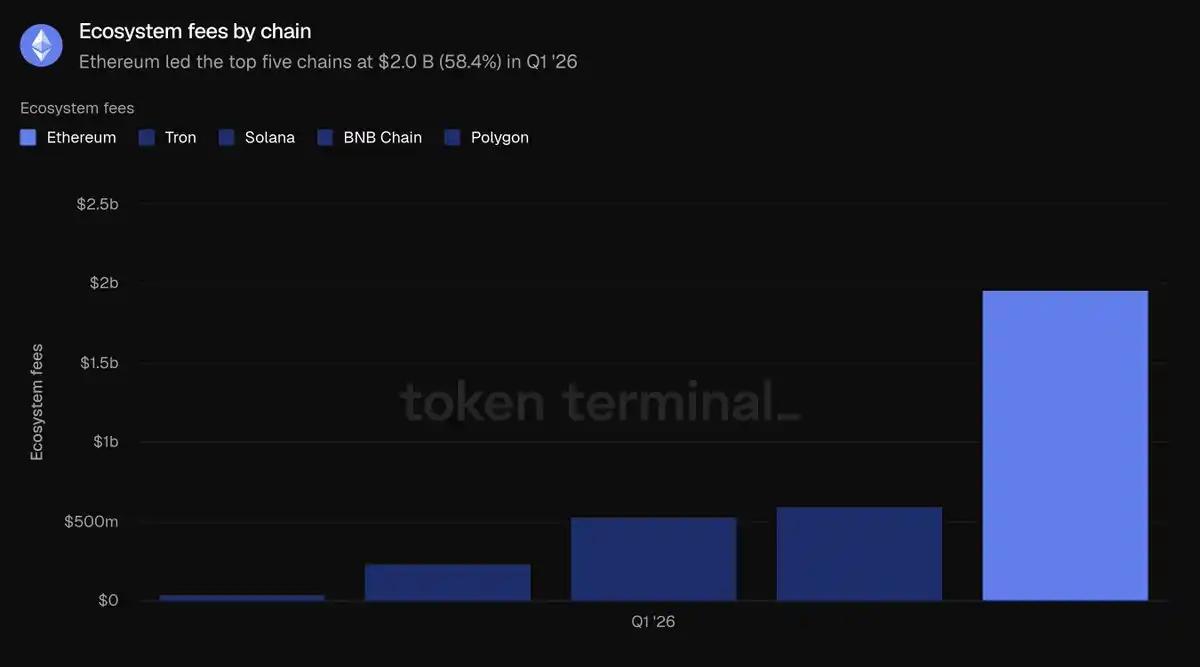
Ecosystem Fees refer to all fees generated by users using various applications, including borrower interest and trader transaction fees, directly reflecting the economic value created by the ecosystem; this sums all application fees across Ethereum. In Q1, total ecosystem fees amounted to $2.0 billion, down 16.9% QoQ and 7.8% YoY, declining alongside reduced trading and lending activity.
Ethereum's $2.0 billion in ecosystem fees far surpasses Tron ($599.3M), Solana ($532.5M), BNB Chain ($231.9M), and Polygon ($38.8M), accounting for 58.4% of the total fees across the top five chains. Even with the Q1 decline, Ethereum remains the number one source of application fees in the industry. Summarizing all indicators in this section: Ethereum leads the industry in TVL, lending scale, and ecosystem fees, trailing only in DEX volume behind BNB Chain.
Tokenized Assets Sector

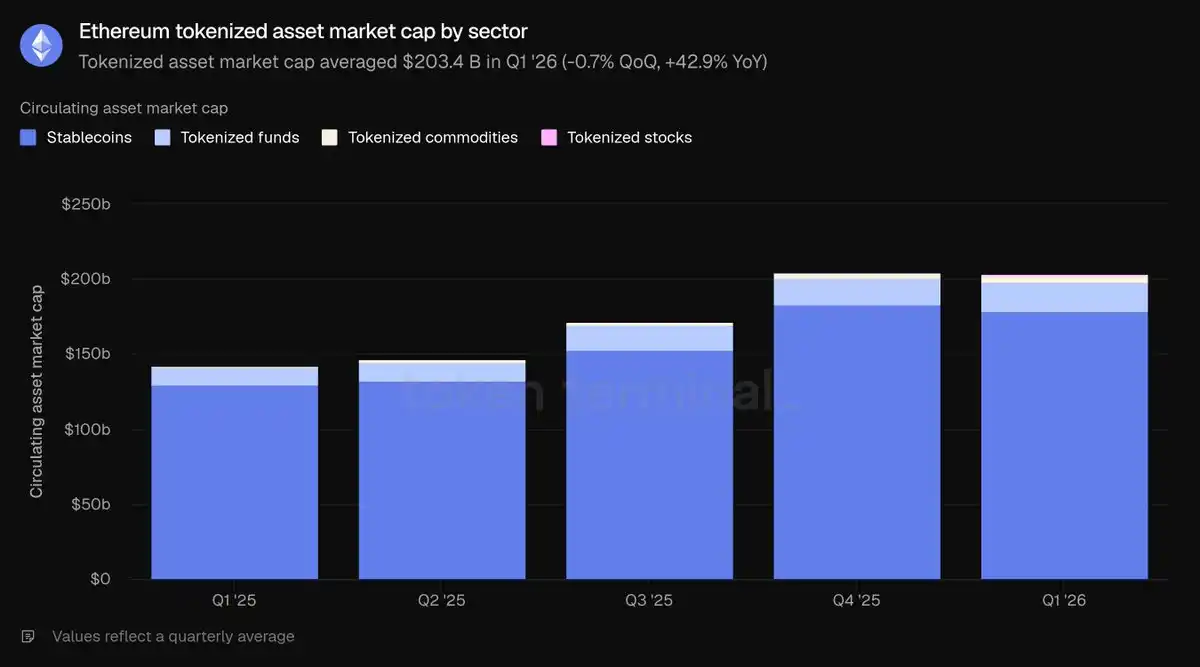
Circulating Asset Total Market Cap refers to the total value of on-chain tokenized assets, calculated as circulating supply multiplied by the daily closing price; for stablecoins, it's the total circulation, for tokenized funds, it's the on-chain assets under management, and for tokenized stocks, it's the total value of issued on-chain shares. This section only counts assets issued on Ethereum.

In Q1, the average total market cap of Ethereum tokenized assets was $203.4 billion, essentially flat QoQ (only down 0.7%), but up significantly by 42.9% YoY. Stablecoins accounted for 87.9% of the total, with the remaining share divided among tokenized funds, commodities, and stocks.
Stablecoins

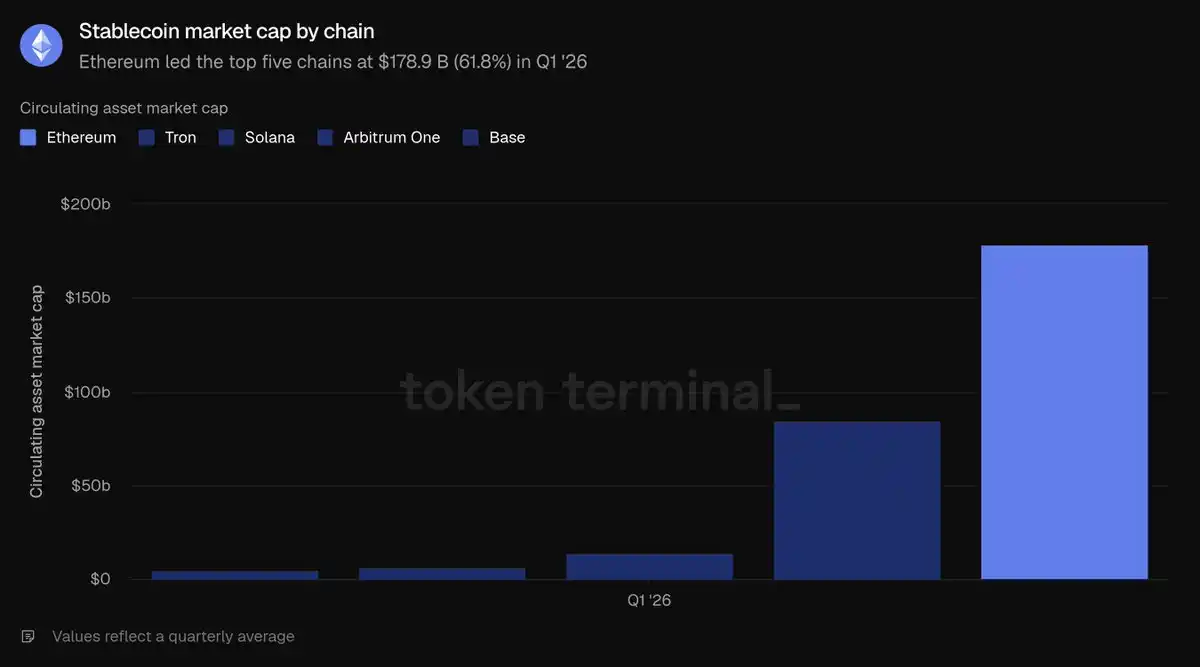
In Q1, the average Ethereum stablecoin scale was $178.9 billion, down slightly by 2.3% QoQ but up 37.6% YoY, making it the only tokenized sub-sector to contract sequentially this quarter. The market is dominated by two major issuers: at quarter-end, Tether USDT ($94.1B) and Circle USDC ($54.5B) combined held the vast majority of Ethereum stablecoin market cap; other leading products include Sky USDS ($12.4B), Ethena USDe ($5.9B), and PayPal PYUSD ($2.9B); new compliant tokens like Ripple's RLUSD ($1.1B) have also launched. Comparing the top five chains, Ethereum's $178.9 billion stablecoin scale leads Tron ($84.5B), Solana ($14.5B), Arbitrum One ($6.8B), and Base ($4.7B), accounting for 61.8% of the total stablecoin value across these five chains.
Tokenized Funds

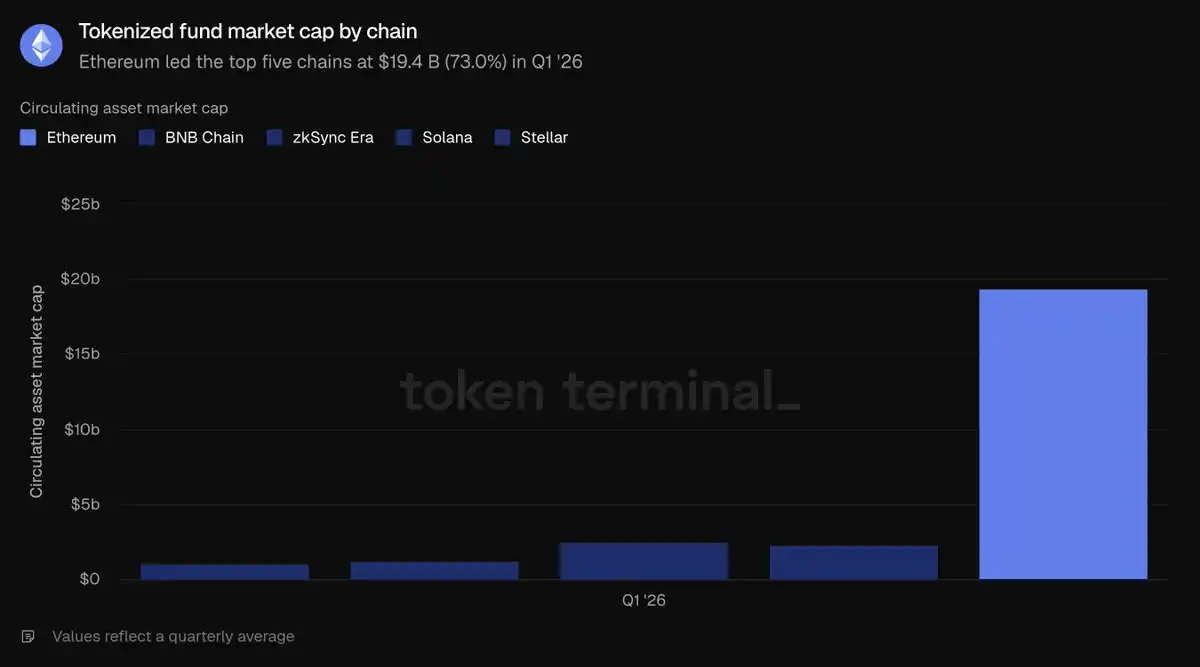
In Q1, the average scale of Ethereum tokenized funds was $19.4 billion, up 4.9% QoQ and surging 73.1% YoY. This sector divides into two main types:

Yield-generating on-chain USD products (largest by scale): Sky sUSDS (~$6.4B) and Ethena sUSDe (~$3.5B);

Traditional finance compliant funds (core vehicles for institutional narrative): BlackRock BUIDL (issued via Securitize, ~$1.0B), WisdomTree Government Money Fund (~$815M), Superstate USTB (~$620M), with Ondo OUSG (~$320M) following closely. Comparing the top five chains, Ethereum's $19.4 billion in tokenized funds significantly leads ZKsync Era ($2.5B), BNB Chain ($2.3B), Solana ($1.3B), and Stellar ($1.1B), accounting for 73% of the total, making this Ethereum's second most dominant tokenized asset sector.
Tokenized Commodities

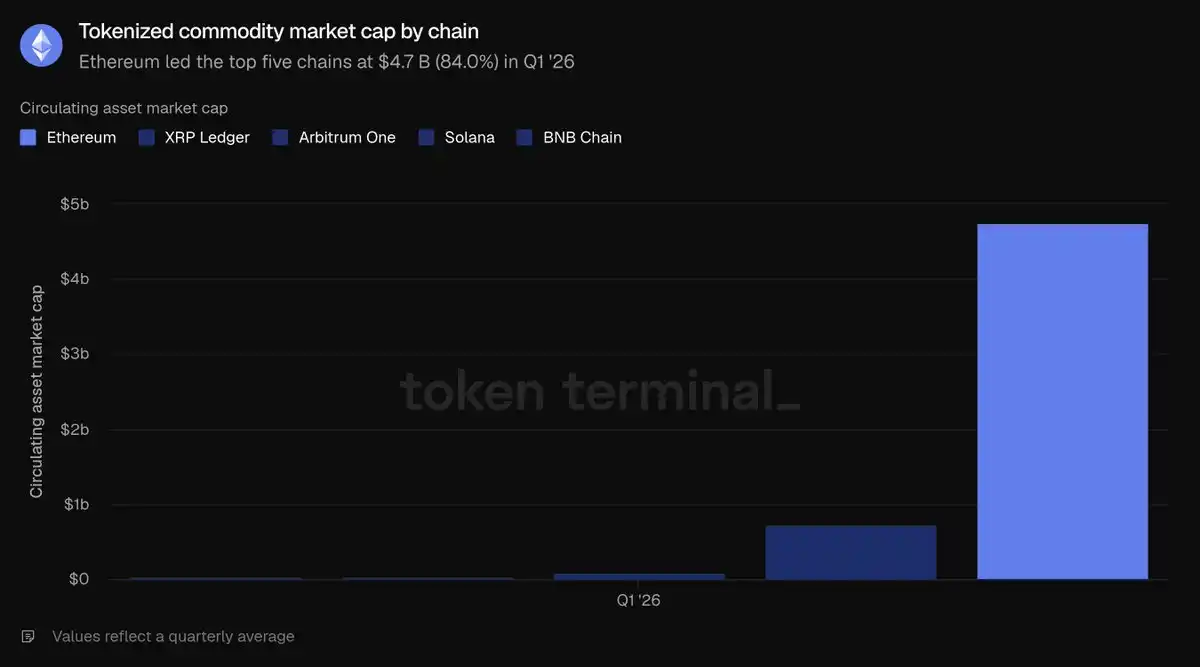
In Q1, the average scale of Ethereum tokenized commodities was $4.7 billion, up 60% QoQ and soaring 325.9% YoY, making it the fastest-growing tokenized category. This sector is almost entirely composed of on-chain gold: Tether Gold XAUT (~$2.6B) and Paxos Gold PAXG (~$2.4B) together account for nearly all of the sector's share. Comparing the five relevant public chains, Ethereum's $4.7 billion scale far exceeds Ripple ($736.6M), Arbitrum One ($95.9M), BNB Chain ($38.4M), and Solana ($29.8M), accounting for 84% of the total, making this Ethereum's most dominant sub-sector.
Tokenized Stocks

Tokenized stocks are the smallest sub-category. In Q1, the average Ethereum scale was $365.1 million, nearly zero a year ago, up 16.5% QoQ. This sector is almost entirely monopolized by Ondo Finance, which issues S&P 500, Nasdaq 100 broad-based indices, and dozens of individual stock tokens on-chain, constituting the vast majority of Ethereum's tokenized stock market cap. Comparing the top five chains, Ethereum's $365.1M slightly leads Solana ($249.0M), BNB Chain ($150.5M), Arbitrum One ($29.0M), and Stellar ($4.2M), but only accounts for 45.8% of the total tokenized stock value across these five chains, making it the only tokenized asset sector where Ethereum does not hold an absolute majority share.
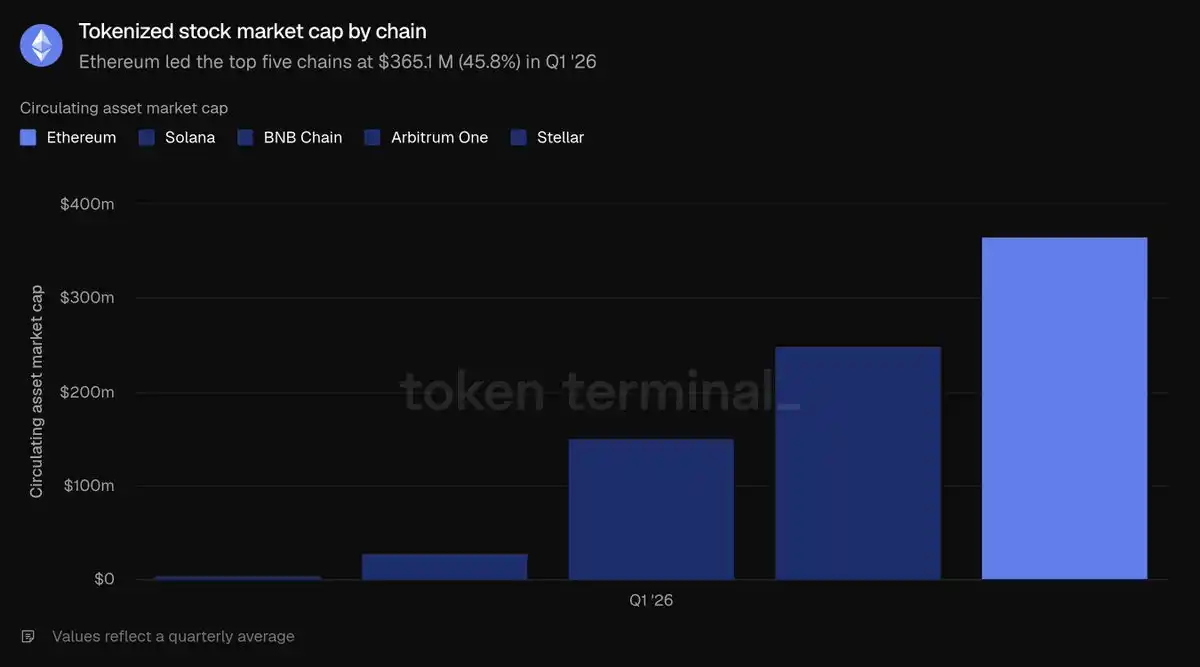
Summarizing the tokenized assets sector: Q1 saw a slight decline in stablecoin supply, but Ethereum's monopoly positions in tokenized funds and commodities were further solidified.

On-chain Usage Activity

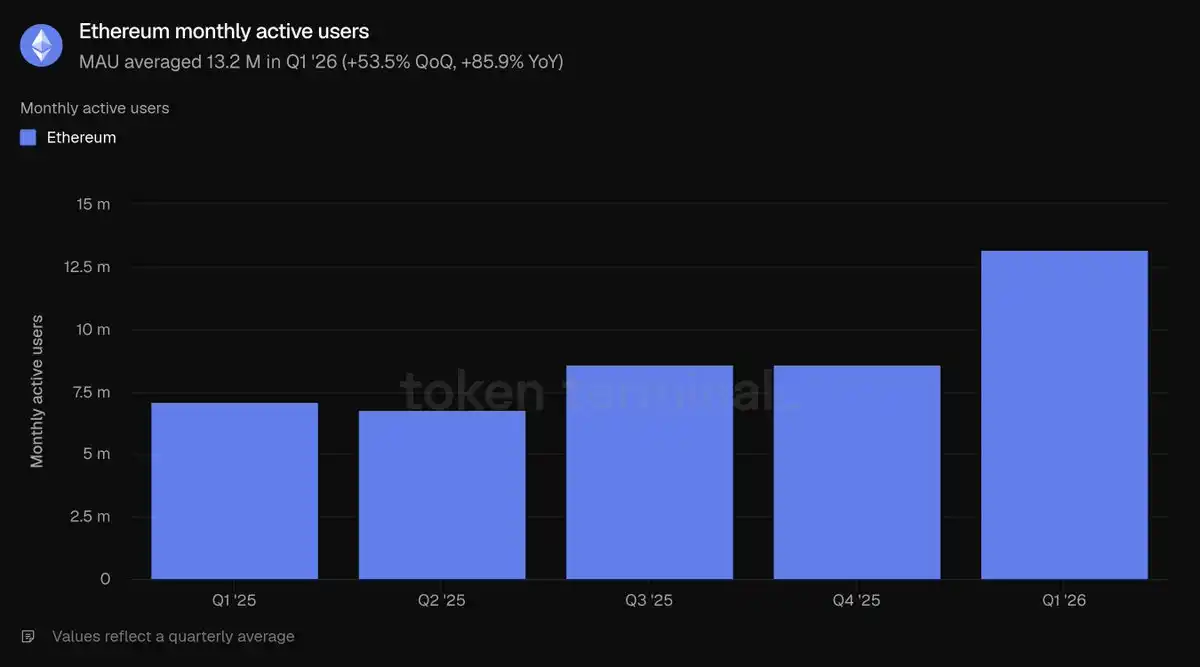
Monthly Active Users are defined as unique addresses that generate revenue-generating on-chain transactions each month; this metric only counts interaction addresses on the Ethereum Layer-1 mainnet. In Q1, the average monthly active users were 13.2 million, surging 53.5% QoQ and up 85.9% YoY, setting a historical record and ending the slow growth trend of previous quarters, with user growth accelerating significantly.
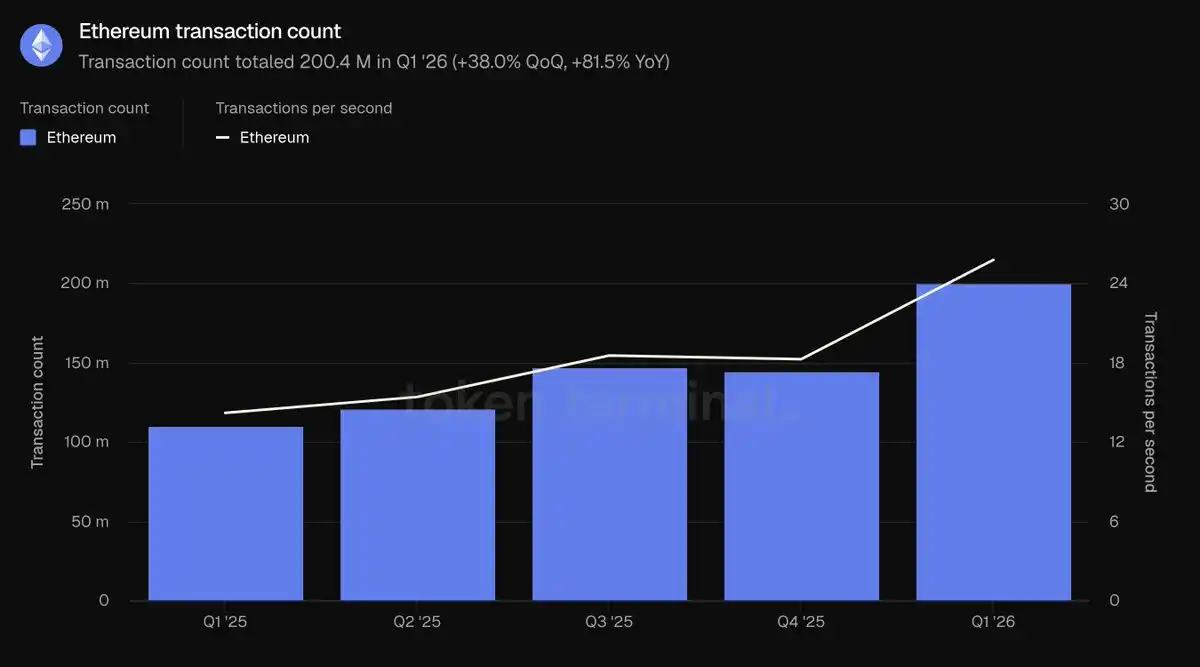
Total Transaction Volume refers to the number of transactions written to and confirmed on the blockchain, reflecting user engagement; Transactions Per Second (TPS) is the average confirmation rate during the period, measuring the network's real-time capacity. Both metrics are for the Ethereum Layer-1 mainnet only. In Q1, layer-1 total transactions were 200.4 million, up 38% QoQ and 81.5% YoY; average TPS increased to 25.78, up 41.2% QoQ. Both data points set new historical highs, proving that user growth has translated into real on-chain business activity increments.
Fees here specifically refer to the base network cost users pay to initiate transactions on Ethereum Layer-1, distinguished from the full ecosystem application fees in section two. In Q1, layer-1 total transaction fees were $39.9 million, plummeting 47.9% QoQ and down sharply 81.9% YoY. Rising activity paired with drastically falling fees is the quarter's core data paradox: transaction volume increased 38%, yet total fees fell by nearly half. The core reason is that Blob scaling significantly increased block storage capacity, making block space more abundant and thus significantly reducing the cost per transaction.
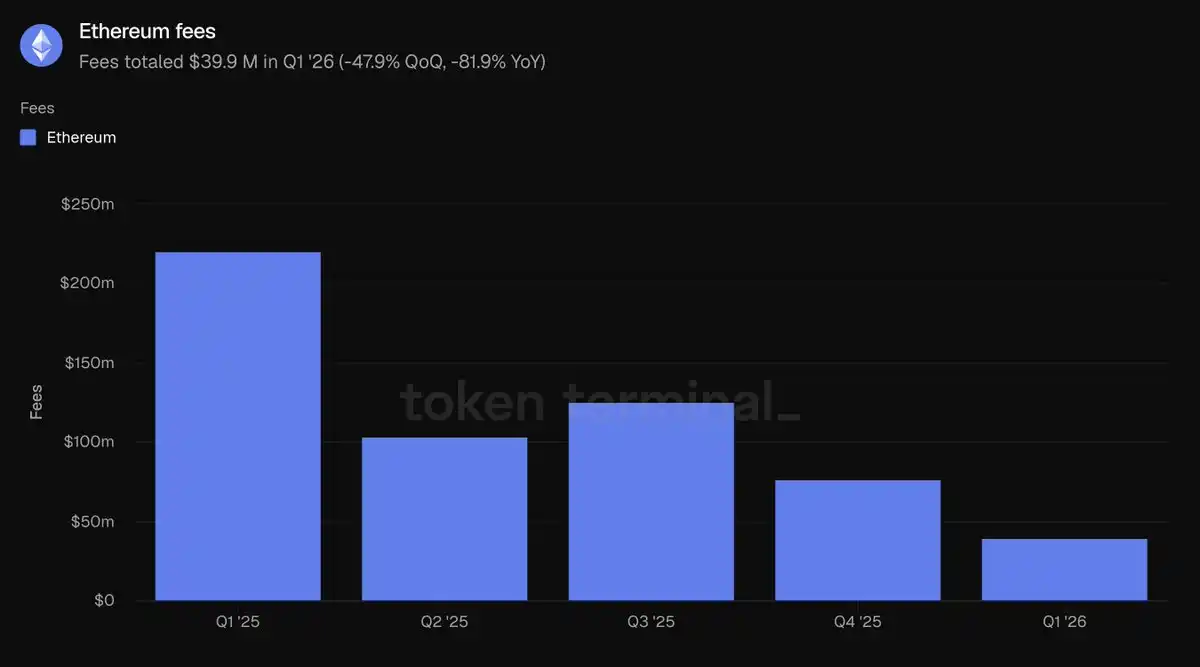
The core conclusion of this section is that scaling benefits have materialized: users and transaction counts have simultaneously hit record highs, while overall network usage costs have declined. When network throughput expansion outpaces the growth rate of market transaction demand, it results in the characteristic "activity up, fees down."

Native Token ETH Fundamentals

Fully Diluted Market Cap calculation: ETH token price × total supply under the current tokenomics model (including circulating, locked, unlocked, and to-be-issued tokens). In Q1, ETH's average fully diluted market cap was $290.0 billion, down sharply 30.3% QoQ and 9.9% YoY. This is the largest sequential decline among all valuation metrics in the report and the core factor driving the decline in USD-denominated asset scale across the ecosystem.
Staking Ratio: The total value of ETH staked to secure the Proof-of-Stake network, divided by ETH's overall market cap; 0.31 indicates approximately 31% of ETH's market cap is participating in staking. In Q1, the average staking ratio was 0.31, higher than 0.28 in the previous quarter and the same period last year. Despite ETH's overall market cap correcting significantly, the proportion of tokens participating in network security staking increased, indicating stable long-term staking intentions among users even during price downturns.
Token Holder Metric: The total number of unique wallet addresses holding ETH. In Q1, the average number of ETH holding addresses was 292.8 million, up 8.1% QoQ and 24.9% YoY, marking a steady increase for five consecutive quarters. Against the backdrop of a continuously declining fully diluted market cap, the expansion of holding addresses represents a further dispersion of the ETH holder base, with ordinary users' willingness to acquire not cooling with short-term market trends.
Etherealize Team Commentary and Analysis

The quarter's core paradox: Ethereum's Layer-1 mainnet on-chain usage scale hit a historical high, yet network transaction fees declined simultaneously. Ethereum proactively advances network scaling, willingly sacrificing short-term fee revenue. The long-term logic is: cheaper block space will unleash a massive wave of latent market demand, ultimately driving long-term growth in overall network revenue.

Data from Token Terminal's "Ethereum Q1 2026 Report" proves this long-term logic is being realized: on a YoY basis, monthly active users grew 85.9%, total transaction volume rose 81.5%, and network throughput increased 81.7%. This is a typical manifestation of the Jevons Paradox. The team predicts that the long-term increase in total network transaction demand will fully offset the short-term revenue loss from lower per-transaction fees. Drawing an analogy to the semiconductor industry: When Gordon Moore proposed Moore's Law in 1975, industry revenue was limited. Today, industry revenue has grown by several orders of magnitude. Scaling benefits are not yet fully realized: The Glamsterdam upgrade scheduled for Q3 plans to increase the gas limit more than threefold; Ethereum's long-term roadmap envisions achieving tens of thousands of TPS by 2029, building a high-speed Layer-1 blockchain with second-level finality.

The team agrees with BlackRock CEO Larry Fink's view from December last year: The current stage of the tokenization industry is equivalent to the internet in 1996—when Amazon's online book sales were only $16 million. At that time, the market generally believed Amazon was merely surviving on the internet bubble, a continuously loss-making online bookstore. But Jeff Bezos predicted the internet would completely reshape retail, abandoning short-term profits to fully build network effects and scale advantages. Ethereum is now making the same trade-off to solidify its position as the global financial settlement layer.

The development of the internet offers another crucial insight: Open, permissionless networks will ultimately triumph over closed, private networks. In 1995, Bill Gates predicted in "The Road Ahead" that digital commerce would rely on corporate proprietary private networks, "information superhighways," not the open internet. At the time, Microsoft built MSN, and services like America Online, CompuServe, and Prodigy operated closed walled gardens, boasting millions of paying users; France's Minitel terminal system even had more users globally than the entire internet until late 1996. Yet all these closed systems ultimately failed. No major legitimate corporation is willing to build its business on a network controlled by a competitor; more crucially, no single company can perpetually keep pace with the innovation speed of a permissionless, open ecosystem. History repeatedly confirms this pattern: Linux overtaking proprietary Unix systems, the open web replacing corporate intranets, Wikipedia superseding the Encyclopædia Britannica. In each transformation's early stages, proprietary products hold an initial advantage due to more refined features, ample marketing, and business resources. But once the open ecosystem accumulates sufficient development tools, developers, and neutral, trustworthy attributes, the first-mover advantage rapidly erodes.

This industry pattern is now replaying in financial infrastructure, as all data in this report demonstrates that Ethereum has crossed the ecosystem critical point: it holds dominant market share in all core sectors. Institutions choosing Ethereum for tokenized finance is not based on ideological preference, but because ecosystem liquidity, composability, and mature institutional use cases are concentrated here. Report data shows: Ethereum holds 79.2% of DeFi active lending, 61.8% of stablecoins, 73% of tokenized funds, and 84% of tokenized commodities market share among the top five chains. Each new class of tokenized assets further deepens ecosystem liquidity, continuously attracting more institutions. A neutral, unbiased foundation is the only stable equilibrium solution for the industry—major financial institutions will never uniformly choose a competitor's private chain for asset settlement. Moreover, institutions are gradually realizing that private interactions, access restrictions, KYC compliance, and asset transfer controls can all be implemented via privacy-preserving computational environments and permissioned token standards on top of Ethereum, while fully accessing the public network's vast liquidity; conversely, closed private chains cannot tap into the open ecosystem's massive liquidity and diverse applications.

Following the quarter-end, institutional deployment has accelerated further, with multiple significant developments in May alone: Asset Management: BlackRock filed for two additional tokenized funds; JPMorgan issued its second Ethereum on-chain money market fund, JLTXX; Fidelity International launched the Moody's AAA-rated dollar liquidity fund FILQ, launched as an ERC-20 token. Stablecoin Sector: The Japanese Blockchain Association's yen-pegged stablecoin EJPY is set to deploy on Ethereum; a European alliance of 12 major banks (including BNP Paribas, ING, UniCredit, BBVA, etc.) is preparing a compliant Euro stablecoin.

The internet seemed distant in 1990, but by 2005 it had become a societal necessity. If Fink's assessment of the tokenization industry's development stage is accurate, the next few years may be the most opportune period in Ethereum's development history. The team's previous "Efficient Money" report posited a core view: Network fees establish an intrinsic value floor for ETH; the long-term optimistic logic is that, with more robust monetary properties, ETH has the potential to absorb the premium from the combined monetary storage value of gold and Bitcoin, exceeding $30 trillion. Ethereum can establish industry leadership without relying on high transaction fees.

Crypto di tendenza

Letture associate

Behind the AI Scorecards Lies a Chinese 'Question Setter'

Behind the AI scorecards that dominate industry discussions—benchmarks like MMLU-Pro, MMMU, and MMMU-Pro—stands a Chinese-Canadian researcher: Wenhu Chen. As an assistant professor at the University of Waterloo and founder of the TIGER Lab, Chen has become a key "exam-setter" for evaluating large language and multimodal models. Chen first gained broader recognition with MMLU-Pro, a more challenging and stable update to the popular MMLU benchmark. As top models like OpenAI’s o3 began achieving near-perfect scores on the original MMLU, it became difficult to distinguish their true capabilities. MMLU-Pro introduced more complex reasoning questions, expanded answer choices, and filtered out ambiguous or simple items, effectively reintroducing differentiation among state-of-the-art models. His work on MMMU addressed the evaluation of multimodal models, requiring them to integrate visual information (like charts, diagrams, or tables) with textual knowledge across diverse academic subjects. Even the strongest models initially scored only around 56-59%, highlighting significant room for improvement in genuine multimodal reasoning. MMMU-Pro further refined this by preventing models from bypassing visual cues. Chen’s research focus has long been on complex information understanding and reasoning. His background—including a PhD at UC Santa Barbara, research at Google/DeepMind on Gemini, and now a role in Meta’s superintelligence lab—provides deep insight into model development and their potential weaknesses. His TIGER Lab also builds models (e.g., for video understanding and generation), ensuring his evaluation benchmarks are grounded in practical challenges. While AI headlines often spotlight company leaders and product launches, Chen’s work exemplifies the critical, behind-the-scenes contributions of researchers crafting the rigorous standards that define and drive progress in AI capabilities.

marsbit30 min fa

Behind the AI Scorecards Lies a Chinese 'Question Setter'

marsbit30 min fa

STRC Unpegged by 11%, Can Strategy's Perpetual Motion Machine Keep Turning?

STRC, the perpetual preferred stock of MicroStrategy, is experiencing a persistent de-pegging from its target par value of $100, with the discount recently widening to over 11%. This de-anchoring challenges the core design of STRC, which was intended as a stable, income-oriented security operating near $100. As a crucial funding engine for MicroStrategy's Bitcoin acquisition strategy, STRC's price reflects market confidence in the company's entire capital model. The company's "capital flywheel" relies on issuing STRC at or above $100 via an At-the-Market (ATM) program to raise cash for buying Bitcoin, thereby boosting company equity and theoretically supporting STRC's value. A monthly adjustable dividend mechanism was designed to maintain this peg. Despite raising the dividend to 11.5% and increasing payment frequency, the de-pegging persists. Market concerns extend beyond technical factors like leveraged arbitrage unwinding. Analysts point to MicroStrategy's limited cash reserves relative to its ~$1.7 billion annual dividend obligation for preferred shares. While the company counters that its vast Bitcoin holdings could cover decades of payments, this argument hinges on the potential need to sell Bitcoin—a shift from its longstanding "hodl" narrative. The company's recent sale of a small amount of BTC, framed as a test, amplified these liquidity and strategy concerns. If STRC remains discounted, impairing MicroStrategy's ability to raise cheap capital, fears may grow that the company could sell more Bitcoin to meet obligations. This scenario could transform MicroStrategy from a major market buyer into a potential seller, posing significant downside risk for Bitcoin. The re-pegging of STRC is thus a key indicator for the health of MicroStrategy's capital structure and its market impact.

Odaily星球日报44 min fa

STRC Unpegged by 11%, Can Strategy's Perpetual Motion Machine Keep Turning?

Odaily星球日报44 min fa

Silicon Valley's Most Sought-After New Role Has Emerged

Silicon Valley's New Most Wanted Job: The Rise of the Forward Deployment Engineer The AI industry is witnessing a significant shift. The focus has moved from developing cutting-edge models to deploying them effectively within enterprises. This has made the "Forward Deployment Engineer" (FDE) a critical and highly sought-after role at major firms like OpenAI, Anthropic, and Google. For the past three years, the industry prioritized model scientists. However, companies are now facing a harsh reality: purchasing powerful AI tools does not guarantee productivity gains or organizational change. The biggest hurdle is not the technology itself, but integrating it into complex legacy systems, workflows, and corporate cultures. This includes challenges like data silos, compliance requirements, and internal resistance. The FDE role, pioneered by Palantir Technologies, addresses this "last-mile" problem. FDEs are deployed on-site with clients for extended periods. Their job is to deeply understand the client's specific organizational structure, processes, and pain points, then tailor and implement the AI solution accordingly. They combine skills in technology, project management, and organizational change. A clear signal of this trend emerged in May 2026 when three AI giants made major moves. Anthropic launched a $1.5B joint venture for enterprise deployment. OpenAI formed an independent deployment subsidiary, DeployCo, with over $4B in commitments and acquired a deployment consultancy. Google Cloud's CEO publicly announced a large-scale recruitment drive for FDEs. This shift represents a fundamental change in the software business model: from selling tools to selling guaranteed outcomes. FDEs are the agents of this change, responsible for delivering a working system within the production environment, not just a demo. Real-world cases, such as challenges at Goldman Sachs (compliance barriers) and Target (internal cultural resistance), illustrate that the primary obstacles to AI adoption are organizational, not technical. An FDE's value lies in navigating these human and procedural complexities to facilitate a successful "AI migration." In essence, as core AI technology becomes more accessible and affordable, the true premium is shifting to the human expertise required to understand organizations and drive change—making the FDE role pivotal for the next phase of the AI revolution.

marsbit44 min fa

Silicon Valley's Most Sought-After New Role Has Emerged

marsbit44 min fa

When the World Cup Collides with Agents: From Web2 to Web3, How Are Wallets Evolving into Agentic Wallets?

World Cup as a Catalyst for Agentic Wallets: From Web2 to Web3 This article explores how the World Cup provides a real-world scenario for observing the evolution of digital wallets from simple asset managers towards "Agentic Wallets"—intelligent, AI-powered interfaces. Using the example of prediction markets like Polymarket, it illustrates how AI Agents can lower the barrier to Web3 interaction. Instead of navigating complex DApps, users can express intent in natural language (e.g., "I think Portugal will win") within platforms like Discord or web pages. The Agent then interprets this intent, finds the relevant market, and seamlessly guides the user through the on-chain transaction via their wallet. The core shift is from wallets as mere "function menus" for signing transactions to "intent interpreters" that understand user goals. The article highlights parallel developments in traditional finance, such as Mastercard's "Agent Pay" and WeChat Pay's AI tests, which focus on granting AI controlled, authorized, and auditable payment capabilities. This underscores a broader trend of AI entering the financial layer. However, the article emphasizes that the primary challenge for Agentic Wallets in Web3 is not automation but establishing clear security boundaries. Unlike traditional systems with chargebacks, on-chain transactions are often irreversible. Therefore, future wallets must ensure users retain ultimate control and comprehension. They need to transparently communicate an Agent's permissions, spending limits, authorized durations, and provide easy ways to pause or revoke access. The World Cup experiments represent early steps toward wallets that are not just applications but ubiquitous, intelligent interfaces that simplify Web3 while keeping users securely in control.

marsbit2 h fa

When the World Cup Collides with Agents: From Web2 to Web3, How Are Wallets Evolving into Agentic Wallets?

marsbit2 h fa

Options Don't Work in DeFi? Vitalik Might Not Agree

For years, the prevailing view has been that options struggle to gain traction in DeFi due to complexity, fragmented liquidity, and lack of natural demand compared to products like perpetual futures. However, a recent algorithmic stablecoin design proposed by Vitalik Buterin presents a different perspective, using options not as a standalone trading product, but as foundational infrastructure for other financial instruments. In this design, one unit of ETH is split into two components: a "stable" side (P) that retains value up to a specified strike price, and an "upside" side (N) that captures all appreciation above that strike. Combined, they always equal one ETH, eliminating debt, margin, and liquidation risks inherent in typical collateralized debt position (CDP) stablecoins. The stable component essentially mimics the payoff of a covered call option. To function as a stablecoin, this structure requires continuously rolling deep in-the-money calls, which introduces challenges like rollover slippage, predictable transaction flow vulnerable to front-running, and persistent liquidity needs. A core hurdle is finding consistent buyers for the leveraged ETH upside exposure (N). While it offers leverage without funding rates or liquidation, it must compete with simpler alternatives like direct call options or perpetuals. The system's scalability depends on a sustained demand for this specific form of leverage. The author draws parallels to their experience with Rysk, where earlier versions of DeFi options protocols struggled. The breakthrough came with Rysk V12, which aligns incentives: asset holders generate yield by selling covered calls against their holdings, while market makers efficiently acquire the desired option exposure. This demonstrates that options can find product-market fit when embedded as a risk distribution and pricing engine within structured products, stablecoins, or yield-generating assets, rather than marketed as a complex direct trading instrument. Vitalik's proposal reinforces this architectural approach—using fully collateralized, non-custodial, and physically settled options as a fundamental building block. The real opportunity for options in DeFi may lie not in becoming the next perpetual swap, but in powering the next generation of on-chain financial products.

marsbit2 h fa

Options Don't Work in DeFi? Vitalik Might Not Agree

marsbit2 h fa

Trading

Spot
Futures

Articoli Popolari

Cosa è ETH 3.0

ETH3.0 e $eth 3.0: Un'Analisi Approfondita del Futuro di Ethereum Introduzione Nel panorama in rapida evoluzione delle criptovalute e della tecnologia blockchain, ETH3.0, spesso indicato come $eth 3.0, è emerso come un argomento di considerevole interesse e speculazione. Il termine comprende due concetti principali che warrantono chiarimenti: Ethereum 3.0: Questo rappresenta un potenziale futuro aggiornamento volto ad aumentare le capacità dell'attuale blockchain di Ethereum, concentrandosi principalmente sul miglioramento della scalabilità e delle prestazioni. ETH3.0 Meme Token: Questo progetto di criptovaluta distinto cerca di sfruttare la blockchain di Ethereum per creare un ecosistema incentrato sui meme, promuovendo il coinvolgimento all'interno della comunità delle criptovalute. Comprendere questi aspetti di ETH3.0 è essenziale non solo per gli appassionati di criptovalute, ma anche per coloro che osservano tendenze tecnologiche più ampie nello spazio digitale. Che cos'è ETH3.0? Ethereum 3.0 Ethereum 3.0 è pubblicizzato come un aggiornamento proposto per la rete Ethereum già stabilita, che è stata la spina dorsale di molte applicazioni decentralizzate (dApps) e contratti smart sin dalla sua nascita. I miglioramenti previsti si concentrano principalmente sulla scalabilità, integrando tecnologie avanzate come lo sharding e le prove a conoscenza zero (zk-proofs). Queste innovazioni tecnologiche mirano a facilitare un numero senza precedenti di transazioni al secondo (TPS), potenzialmente raggiungendo milioni, affrontando così una delle limitazioni più significative della tecnologia blockchain attuale. Il miglioramento non è meramente tecnico, ma anche strategico; è volto a preparare la rete Ethereum per un'adozione e un'utilità diffuse in un futuro contrassegnato da un aumento della domanda di soluzioni decentralizzate. ETH3.0 Meme Token Al contrario di Ethereum 3.0, l'ETH3.0 Meme Token si avventura in un dominio più leggero e giocoso, combinando la cultura dei meme di internet con la dinamica delle criptovalute. Questo progetto consente agli utenti di acquistare, vendere e scambiare meme sulla blockchain di Ethereum, fornendo una piattaforma che promuove il coinvolgimento della comunità attraverso la creatività e interessi condivisi. L'ETH3.0 Meme Token mira a dimostrare come la tecnologia blockchain possa intersecarsi con la cultura digitale, creando casi d'uso che siano sia divertenti che finanziariamente praticabili. Chi è il Creatore di ETH3.0? Ethereum 3.0 L'iniziativa verso Ethereum 3.0 è principalmente propulsa da un consorzio di sviluppatori e ricercatori all'interno della comunità di Ethereum, tra cui Justin Drake. Conosciuto per le sue intuizioni e contributi all'evoluzione di Ethereum, Drake è stato una figura di spicco nelle discussioni riguardanti la transizione di Ethereum verso un nuovo livello di consenso, chiamato “Beam Chain.” Questo approccio collaborativo allo sviluppo significa che Ethereum 3.0 non è il prodotto di un creatore singolo, ma piuttosto una manifestazione di ingegno collettivo focalizzato sul progresso della tecnologia blockchain. ETH3.0 Meme Token I dettagli riguardanti il creatore dell'ETH3.0 Meme Token sono attualmente non rintracciabili. La natura dei token meme conduce spesso a una struttura più decentralizzata e guidata dalla comunità, il che potrebbe spiegare la mancanza di attribuzione specifica. Questo si allinea con l'etica della comunità crypto più ampia, dove l'innovazione spesso nasce da sforzi collaborativi piuttosto che individuali. Chi sono gli Investitori di ETH3.0? Ethereum 3.0 Il supporto per Ethereum 3.0 proviene principalmente dalla Ethereum Foundation insieme a una comunità entusiasta di sviluppatori e investitori. Questa associazione fondamentale fornisce un considerevole grado di legittimità e migliora le prospettive di implementazione di successo poiché sfrutta la fiducia e la credibilità costruite nel corso degli anni di operazioni della rete. Nel clima in rapida evoluzione delle criptovalute, il supporto della comunità gioca un ruolo cruciale nello sviluppo e nell'adozione, posizionando Ethereum 3.0 come un serio contenditore per i futuri progressi della blockchain. ETH3.0 Meme Token Sebbene le fonti attualmente disponibili non forniscano informazioni esplicite riguardo ai fondamenti o alle organizzazioni di investimento che sostengono l'ETH3.0 Meme Token, ciò è indicativo del modello di finanziamento tipico per i token meme, che spesso si basa sul supporto di base e sul coinvolgimento della comunità. Gli investitori in tali progetti sono tipicamente individui motivati dal potenziale per innovazioni guidate dalla comunità e dallo spirito di cooperazione trovato all'interno della comunità crypto. Come Funziona ETH3.0? Ethereum 3.0 Le caratteristiche distintive dell'Ethereum 3.0 risiedono nella sua proposta di implementazione della tecnologia di sharding e zk-proof. Lo sharding è un metodo di partizionamento della blockchain in pezzi più piccoli e gestibili o “shard,” che possono elaborare transazioni in modo concorrente piuttosto che sequenziale. Questa decentralizzazione dell'elaborazione aiuta a prevenire la congestione e garantisce che la rete rimanga reattiva anche sotto un carico pesante. La tecnologia delle prove a conoscenza zero (zk-proof) contribuisce con un ulteriore livello di sofisticazione consentendo la validazione delle transazioni senza rivelare i dati sottostanti coinvolti. Questo aspetto non solo migliora la privacy, ma aumenta anche l'efficienza complessiva della rete. Si parla anche di incorporare una macchina virtuale Ethereum a conoscenza zero (zkEVM) in questo aggiornamento, amplificando ulteriormente le capacità e l'utilità della rete. ETH3.0 Meme Token L'ETH3.0 Meme Token si distingue capitalizzando sulla popolarità della cultura dei meme. Stabilisce un mercato per gli utenti che desiderano partecipare al trading di meme, non solo per divertimento, ma anche per potenziale guadagno economico. Integrando funzioni come lo staking, la fornitura di liquidità e meccanismi di governance, il progetto promuove un ambiente che incentiva l'interazione e la partecipazione della comunità. Offrendo una miscela unica di intrattenimento e opportunità economica, l'ETH3.0 Meme Token mira ad attrarre un pubblico variegato, che va dagli appassionati di crypto ai semplici intenditori di meme. Timeline di ETH3.0 Ethereum 3.0 11 Novembre 2024: Justin Drake accenna al prossimo aggiornamento ETH 3.0, incentrato sui miglioramenti della scalabilità. Questo annuncio segna l'inizio delle discussioni formali riguardo l'architettura futura di Ethereum. 12 Novembre 2024: La proposta attesa per Ethereum 3.0 dovrebbe essere svelata a Devcon a Bangkok, preparando il terreno per un feedback più ampio della comunità e potenziali passi successivi nello sviluppo. ETH3.0 Meme Token 21 Marzo 2024: L'ETH3.0 Meme Token viene ufficialmente elencato su CoinMarketCap, segnando il suo ingresso nel dominio pubblico delle criptovalute e aumentando la visibilità per il suo ecosistema basato sui meme. Punti Chiave In conclusione, Ethereum 3.0 rappresenta una significativa evoluzione all'interno della rete Ethereum, concentrandosi sul superamento delle limitazioni riguardanti scalabilità e prestazioni attraverso tecnologie avanzate. I suoi aggiornamenti proposti riflettono un approccio proattivo alle future esigenze e usabilità. D'altra parte, l'ETH3.0 Meme Token incarna l'essenza della cultura guidata dalla comunità nello spazio delle criptovalute, sfruttando la cultura dei meme per creare piattaforme coinvolgenti che incoraggiano la creatività e la partecipazione degli utenti. Comprendere gli scopi e le funzionalità distinte di ETH3.0 e $eth 3.0 è fondamentale per chiunque sia interessato ai continui sviluppi nello spazio crypto. Con entrambe le iniziative che tracciano percorsi unici, esse sottolineano collettivamente la natura dinamica e multifacetica dell'innovazione blockchain.

180 Totale visualizzazioniPubblicato il 2024.04.04Aggiornato il 2024.12.03

Cosa è ETH 3.0

Cosa è ETHEREUM

HarryPotterTrumpHomerSimpson777Inu: Panoramica di un Progetto Crypto Web3 Introduzione Nel mondo in rapida evoluzione delle criptovalute e della finanza decentralizzata, progetti innovativi emergono frequentemente, catturando l'interesse della comunità degli investitori e degli appassionati di crypto. Uno di questi progetti è HarryPotterTrumpHomerSimpson777Inu, una criptovaluta che si trova all'incrocio tra cultura popolare e tecnologia blockchain. Questo token guidato dalla comunità mescola personaggi e figure politiche ben noti, con l'obiettivo di creare una piattaforma coinvolgente e promuovere un'adozione diffusa. Che cos'è HarryPotterTrumpHomerSimpson777Inu? HarryPotterTrumpHomerSimpson777Inu è un token costruito sulla blockchain di Ethereum, progettato per essere accessibile e divertente per un pubblico diversificato. L'unicità di questo progetto deriva dal suo approccio tematico, che intreccia elementi di fantasia, politica e intrattenimento. Sfruttando il fascino nostalgico di personaggi amati, il progetto cerca di creare un'esperienza di criptovaluta coinvolgente, incoraggiando il coinvolgimento e la partecipazione della comunità. L'obiettivo principale di HarryPotterTrumpHomerSimpson777Inu è stabilire un token che risuoni con gli utenti a livello personale, promuovendo sia il divertimento che il coinvolgimento nell'ambito crypto. Questo branding distintivo mira ad attrarre individui che in precedenza potrebbero non essersi interessati alle criptovalute, facilitando un nuovo punto di ingresso per utenti potenziali. Creatore di HarryPotterTrumpHomerSimpson777Inu L'identità del creatore dietro HarryPotterTrumpHomerSimpson777Inu rimane sconosciuta. Questa non è una pratica rara nel dominio delle criptovalute, dove l'anonimato è spesso preferito dai fondatori come mezzo di protezione della privacy e promozione di un ethos decentralizzato. Questa oscurità non diminuisce il valore del progetto; al contrario, riflette una tendenza più ampia all'interno del settore, dove molti progetti di successo sono emersi da origini anonime. Investitori di HarryPotterTrumpHomerSimpson777Inu Le informazioni pubbliche riguardo agli investitori di HarryPotterTrumpHomerSimpson777Inu sono limitate. La natura del progetto, incentrata sul coinvolgimento della comunità, suggerisce una dipendenza da investimenti di piccole dimensioni da parte di singoli appassionati piuttosto che da sostegni sostanziali da fondazioni di investimento consolidate o corporation. Questo livello di trasparenza nel finanziamento è tipico di molti progetti di criptovaluta guidati dalla comunità, dove il supporto spesso proviene da movimenti di base piuttosto che da investitori istituzionali. Come Funziona HarryPotterTrumpHomerSimpson777Inu? Operando sulla blockchain di Ethereum, HarryPotterTrumpHomerSimpson777Inu sfrutta la sua solida infrastruttura per facilitare transazioni e promuovere interazioni tra gli utenti all'interno della comunità. Ciò che distingue questo progetto è il suo posizionamento tematico: canalizzando il carisma di personaggi iconici provenienti da diversi ambiti culturali, crea un'identità di marca distintiva. Questo approccio non solo attrae gli utenti, ma coltiva anche una comunità fedele attorno al token. Le meccaniche operative del progetto si concentrano sul coinvolgimento della comunità. Adotta un modello decentralizzato che incoraggia la partecipazione, consentendo agli utenti di interagire attraverso vari canali mentre promuovono lo scambio di idee e esperienze. Inoltre, il progetto abbraccia i principi del Web3, privilegiando la sovranità degli utenti e la decentralizzazione, che sono i pilastri del futuro di Internet. Timeline di HarryPotterTrumpHomerSimpson777Inu La storia di HarryPotterTrumpHomerSimpson777Inu è segnata da diversi eventi decisivi: 12 agosto 2023: L'inizio di HarryPotterTrumpHomerSimpson777Inu, segnando il suo ingresso nell'ecosistema delle criptovalute. Fase di Sviluppo: Un periodo focalizzato sulla costruzione di una strategia completa per stimolare la crescita guidata dalla comunità e il coinvolgimento degli utenti. Listing sugli Scambi: Sebbene i dettagli specifici di listing non siano stati divulgati, il progetto è stato reso accessibile su vari scambi di criptovalute, migliorando la sua visibilità nel mercato. Coinvolgimento della Comunità: Sforzi continui per coinvolgere attivamente la comunità, stabilendo canali di dialogo e promuovendo la partecipazione attraverso varie attività, tra cui concorsi, discussioni e votazioni comunitarie. Aspetti Chiave di HarryPotterTrumpHomerSimpson777Inu Focus sulla Comunità Un tratto distintivo di HarryPotterTrumpHomerSimpson777Inu è la sua forte enfasi sul coinvolgimento della comunità. Il progetto incoraggia attivamente gli utenti a partecipare a discussioni, condividere idee e contribuire all'evoluzione del progetto. Questa interazione coltiva un senso di appartenenza e di ownership tra i membri della comunità, essenziale per la sostenibilità a lungo termine del token. Utilizzo della Blockchain di Ethereum La scelta di costruire sulla blockchain di Ethereum consente a HarryPotterTrumpHomerSimpson777Inu di sfruttare le sue caratteristiche di sicurezza ben consolidate e architettura decentralizzata. Questa base garantisce affidabilità per le transazioni e fornisce un framework affidabile su cui sviluppare varie funzionalità. Approccio Tematico Unico Fusione di elementi della cultura pop nella sua identità, HarryPotterTrumpHomerSimpson777Inu crea una narrazione coinvolgente che lo differenzia da altre criptovalute. L'amalgama di personaggi e temi genera riconoscimento e intrigo immediati, rendendo il token relazionabile a un'ampia gamma di utenti potenziali. Anonimato nello Sviluppo Il creatore anonimo del progetto rimane una caratteristica ricorrente in molte iniziative di criptovaluta. Questo aspetto evidenzia un ethos di decentralizzazione, introducendo anche un livello di mistero che potrebbe affascinare un segmento della comunità crypto, attirando l'attenzione sul progetto e invitando l'impegno da parte di utenti che supportano l'idea di un'iniziativa decentralizzata e gestita dalla comunità. Conclusione HarryPotterTrumpHomerSimpson777Inu si presenta come un'aggiunta distintiva al panorama delle criptovalute, combinando il fascino della cultura popolare con le meccaniche innovative della tecnologia blockchain. Sebbene i dettagli riguardanti il creatore e gli investitori specifici rimangano non divulgati, il focus del progetto sulla comunità e il suo approccio tematico lo contraddistinguono come un potenziale attore influente nel contesto del Web3 e delle criptovalute. Man mano che l'ecosistema delle criptovalute continua ad espandersi, iniziative come HarryPotterTrumpHomerSimpson777Inu ci ricordano le molteplici modalità in cui la blockchain può connettere le comunità globali attraverso narrazioni e valori condivisi.

941 Totale visualizzazioniPubblicato il 2024.04.06Aggiornato il 2024.12.03

Cosa è ETHEREUM

Come comprare ETH

Benvenuto in HTX.com! Abbiamo reso l'acquisto di Ethereum (ETH) semplice e conveniente. Segui la nostra guida passo passo per intraprendere il tuo viaggio nel mondo delle criptovalute.Step 1: Crea il tuo Account HTXUsa la tua email o numero di telefono per registrarti il tuo account gratuito su HTX. Vivi un'esperienza facile e sblocca tutte le funzionalità,Crea il mio accountStep 2: Vai in Acquista crypto e seleziona il tuo metodo di pagamentoCarta di credito/debito: utilizza la tua Visa o Mastercard per acquistare immediatamente EthereumETH.Bilancio: Usa i fondi dal bilancio del tuo account HTX per fare trading senza problemi.Terze parti: abbiamo aggiunto metodi di pagamento molto utilizzati come Google Pay e Apple Pay per maggiore comodità.P2P: Fai trading direttamente con altri utenti HTX.Over-the-Counter (OTC): Offriamo servizi su misura e tassi di cambio competitivi per i trader.Step 3: Conserva Ethereum (ETH)Dopo aver acquistato Ethereum (ETH), conserva nel tuo account HTX. In alternativa, puoi inviare tramite trasferimento blockchain o scambiare per altre criptovalute.Step 4: Scambia Ethereum (ETH)Scambia facilmente Ethereum (ETH) nel mercato spot di HTX. Accedi al tuo account, seleziona la tua coppia di trading, esegui le tue operazioni e monitora in tempo reale. Offriamo un'esperienza user-friendly sia per chi ha appena iniziato che per i trader più esperti.

2.9k Totale visualizzazioniPubblicato il 2024.12.10Aggiornato il 2026.06.02

Come comprare ETH

Discussioni

Benvenuto nella Community HTX. Qui puoi rimanere informato sugli ultimi sviluppi della piattaforma e accedere ad approfondimenti esperti sul mercato. Le opinioni degli utenti sul prezzo di ETH ETH sono presentate come di seguito.

活动图片