Author: Eric, Foresight News
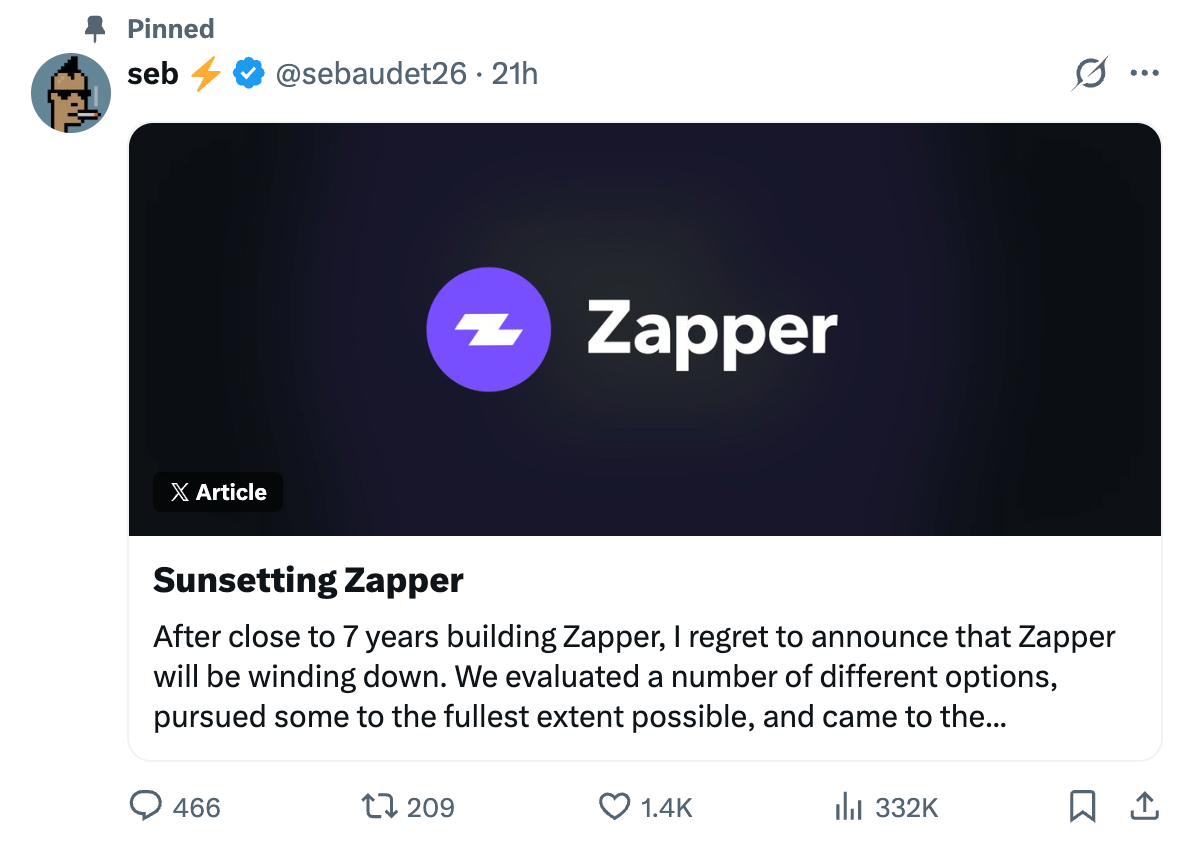
On July 8, 2026, Zapper co-founder Seb Audet posted a brief announcement on X: the platform will be completely shut down on August 3, with its official website, mobile app, and API services all going offline.
Last November, news of DappRadar's closure evoked sighs from countless crypto veterans. Now, a once-star project boasting 2 million monthly active users, over $13 billion in cumulative transaction volume processed, and $16.5 million in total funding has also reached a dead end.
In 2019, Zapper's predecessor, DeFiZap, won a DeFi hackathon hosted by Kyber. DeFi was still in its infancy back then, with the entire sector's TVL around $667 million. In May 2020, DeFiZap merged with DeFiSnap, officially giving birth to Zapper. As Seb put it, he was exploring DeFi at the time, and Zapper's creation initially stemmed from his own desire to develop a simple portfolio tracker; he never imagined it would grow to such a scale.
In June 2020, Compound launched the COMP token, kickstarting the "DeFi Summer" that changed the industry landscape. Within three months, DeFi's TVL skyrocketed from about $700 million to over $13 billion, as retail users flooded into yield farming. In an era where capital was scattered across various protocols, the demand for a unified dashboard to view positions naturally arose. Zapper, which allowed users to monitor cross-protocol holdings, LP positions, and yields in real-time after connecting their wallets, quickly gained traction within the community.
The DeFi boom fueled Zapper's rapid growth. In early 2020, it completed a $1.5 million seed round with participation from institutions like Framework Ventures and ParaFi Capital. In May 2021, at the peak of market frenzy, Zapper raised $15 million in a Series A round, led again by Framework Ventures, with notable investors like Mark Cuban, Sound Ventures (by Ashton Kutcher), and Coinbase Ventures joining the round.
At its peak, Zapper covered 14 blockchains, over 450 DeFi protocols, and more than 7,000 tokens, with monthly active users exceeding 2 million and cumulative transaction volume surpassing $13 billion. Its "Zap" feature, which allowed users to complete complex multi-step DeFi operations with a single transaction, was once the core differentiating selling point of the product.
The problem, however, was that traffic did not translate into sustainable revenue. Zapper's monetization model primarily relied on taking a small fee from DEX aggregated trades, but competition in the aggregator space was brutal, with fee margins constantly being compressed. Meanwhile, maintaining a data indexing and real-time update system covering multiple chains and hundreds of protocols required continuous significant investment in engineering resources and infrastructure costs.
On the other hand, while DeFi continued to develop, the trend was not towards diversification but rather the concentration of capital and traffic towards leading protocols. After a brief low in 2022, DeFi has continued to advance significantly in recent years. However, due to a lack of attractive yield rates and airdrop expectations, the user base has not grown. Zapper's features leaned more towards consumer-facing (2C) use, the number of users declined, DeFi operations became less complex, and DEX aggregator competition became excessively fierce. At that point, the demand behind Zapper's strongest moat had clearly weakened.
Zapper was not unaware of the ceiling of a pure tool-based product. It made multiple attempts at pivoting, but none succeeded. In September 2021, Zapper launched an on-chain interaction-based points system where users earned points through actions like check-ins, cross-chain transfers, and trading, which could be exchanged for NFTs. Over 100,000 addresses participated in minting. According to OpenSea data, this NFT series generated over 1200 ETH in cumulative trading volume, worth approximately $5 million at the time. However, over time, the price of this NFT series eventually plummeted to zero, and the points system was not continued.
In October 2023, Zapper launched Chainchat, an on-chain social application where users needed to buy "shares" of a channel to join group chats. The subsequent V2 version repositioned the product as a "Web3 exploration tool," attempting to expand its scope from DeFi to NFTs, DAOs, and on-chain accounts. In June 2024, Zapper announced the launch of Zapper Protocol, planning to issue the ZAP token with the goal of building an open protocol to incentivize users to interpret and annotate on-chain information.
Yet, none of these attempts ultimately altered its fate. The ZAP token was never officially issued, the protocol plan was shelved as the market turned bearish, and Chainchat quietly faded from users' sight.
Many tool-based products born in 2019 and 2020 have reached their end in recent years. These products "died in their own ways." DappRadar is a classic example of being left behind by the times. When all resources shift towards leading protocols, lacking an environment of a hundred flowers blooming, having a comprehensive list of projects becomes irrelevant.
While Zapper was also affected by changes in the sector's landscape, its failure stemmed more from its own strategic mistakes in pivoting.
A portfolio tracker is not a product with a high barrier to entry, but the underlying data costs are a hard expenditure. Without the ability to charge for the service itself, there must be a strongly related product that can generate revenue. DEX aggregators and the "Zap" feature that enables one-click multi-step operations were inherently choices with solid demand. However, Zapper did not seem to focus enough on revenue-generating products, instead putting more effort into the cost center.
Using the portfolio tracking feature to funnel users towards revenue-generating features made sense early on. But as user capital gradually concentrated in a few protocols and competition increased (including from rivals like DeBank), Zapper failed to adapt its mindset promptly. Subsequent attempts clearly showed that Zapper never broke out of the 2C mindset, persistently circling in the "dead end" of using blockchain ideology to build consumer products.
These 2C products sounded grand in narrative but didn't target existing pain points; instead, they tried to create demand out of thin air. The fact that they persisted in the wrong direction for years also indirectly illustrates how significant the DeFi红利 (windfall) was back then. As Seb wrote in the farewell letter, "We evaluated multiple options and pursued some of them fully, ultimately realizing that an orderly wind-down is the best path forward." This indicates that even its once-proud portfolio tracking feature had no takers in the current market. Even pivoting towards a direction similar to Nansen or Arkham might have resulted in a neutral outcome like an acquisition.
DeBank, mentioned earlier, has also scaled back its asset tracking support, cutting off support for low-activity chains. But DeBank has a strong product like Rabby Wallet, coupled with twice the funding amount of Zapper, giving it more chips and more stable revenue. If you look at reviews for Rabby Wallet on X, you'll find that in the EVM-compatible chain space, many consider its experience and functionality superior to MetaMask.
In the author's view, Zapper's departure wasn't entirely due to being "mindless"; it was more about an excessive belief in blockchain fundamentalism. In the arena of business, being overly immersed in one's own world while ignoring objective shifts in the market environment is fatal. Zapper serves as a warning bell for surviving tool-based products in the market: DappRadar couldn't broaden its revenue channels due to sector limitations, but if there's a chance to pivot, don't cling to past glory.