Author: Golem
Original Title: U.S. Government Shutdown Is Difficult Because Both Parties Have Already Calculated the Cost
A major macroeconomic event this month is whether the U.S. government will shut down at the end of January. Last October, the U.S. government shut down for 43 days, and it has been operating since then only after the passage of a temporary funding bill. January 30 is the expiration date of the temporary funding bill. If Congress fails to pass a formal funding bill or if there is no new temporary bill to extend it, the U.S. government will shut down again.
This time, the dispute between the two U.S. parties is mainly over funding for the Department of Homeland Security (DHS). Democrats believe that ICE (Immigration and Customs Enforcement) has problems with law enforcement in Minnesota, resulting in two deaths, and they want to strictly restrict funding and related operations. However, Republicans disagree, arguing that ICE is a key force in combating illegal immigration and welfare fraud. As a result, the two sides are at a stalemate. (For details on the dispute between the two U.S. parties, please read: "U.S. Government Shutdown Storm Is Brewing Again, Will the Crypto Circle Repeat the Crash Script?")
It is this confrontational state and the approaching expiration date of the temporary funding bill that caused the probability of a U.S. government shutdown at the end of January to rise sharply on prediction markets. However, this morning, Polymarket data showed that the probability of the U.S. government shutting down at the end of January has continued to decline and currently stands at 42%, down from a previous high of 80%.
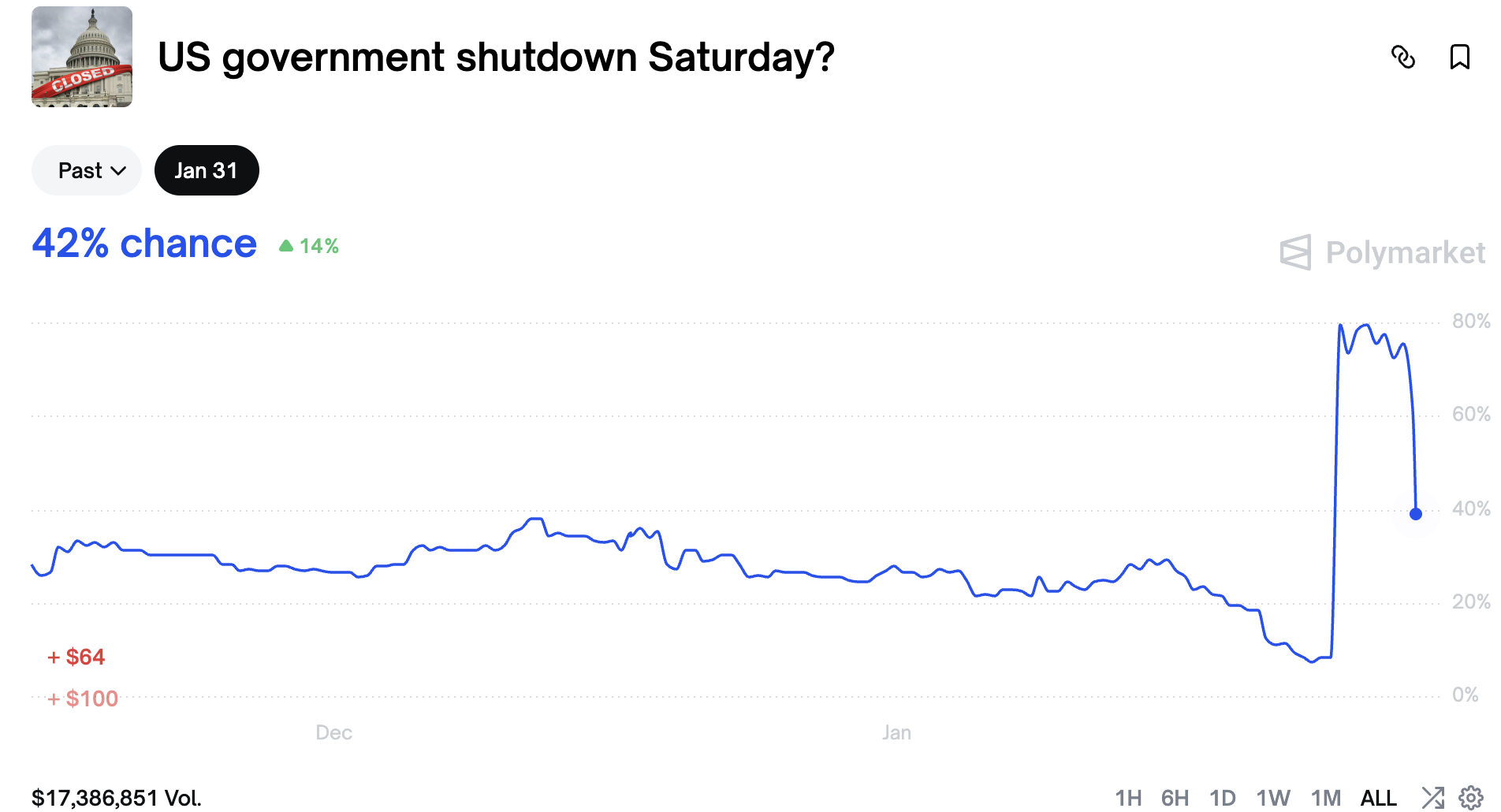
Price changes in prediction markets reflect the results of collective wisdom and博弈. The rising probability that the U.S. government will not shut down at the end of January indicates that people believe the high certainty of a government shutdown suggested by the prediction market probability no longer exists under the current U.S. political situation.
Midterm Elections Are the Key Focus for Both U.S. Parties
On January 28, regarding the risk of another possible U.S. government shutdown, U.S. Treasury Secretary Besant said the situation is still unclear but emphasized that President Trump has urged the Democratic side to avoid this outcome.
This government shutdown crisis is essentially because the Republicans were caught by the Democrats with a political counterattack handle. The shooting death of a U.S. citizen by ICE law enforcement officers in Minnesota on January 24 was essentially a result of the Trump administration's increased immigration enforcement efforts, which also led to large-scale public protests expressing dissatisfaction with the Trump administration. The Democrats reasonably seized this opportunity and used it as an excuse to block the passage of the funding bill in the Senate. Because it reflects the demands of voters, the Democrats' counterattack has taken the political initiative.
The Republicans have thus been put in a passive position. If the U.S. government does shut down as a result, the Democrats could blame all subsequent economic and livelihood problems caused by the shutdown (delayed release of economic data, large-scale flight delays at airports, etc.) on the incompetence of the Republican government.
And this series of possible chain reactions will also affect the issue that both U.S. parties truly care about this year: the U.S. midterm elections.
The U.S. "midterm elections" are held in the second year of a presidential term. All 435 seats in the House of Representatives will be re-elected, and approximately one-third of the seats in the Senate are usually re-elected. Currently, the Republicans hold a majority in both the House (218 seats) and the Senate (53 seats). For the Republicans to maintain their seat advantage after the midterm elections at the end of the year and reduce governance difficulties, they cannot accumulate too many "stains" politically this year.
At the same time, although the midterm elections do not involve the U.S. presidential election, they are also regarded as a "midterm referendum" on the incumbent president, which will affect the president's policy orientation in the latter two years and also reshape the intra-party power structure and the candidate landscape for the next presidential election. Therefore, it is extremely important for Trump as well.
From the above analysis, it can be seen that this government shutdown is no longer a simple funding issue but a political battlefield set up in advance by both U.S. parties for the midterm elections at the end of the year. The Republicans, who are in a passive position, are highly likely to compromise to resolve the crisis and矛盾.
For the Democrats, if the Republicans compromise, it would also be a political victory.
Compromise Is Already Underway
This U.S. government shutdown crisis will not be a "full shutdown" like last October (when all 12 funding bills expired). The scale of the shutdown may be much smaller. Funding for the Commerce Department (responsible for releasing GDP and other data) and the Agriculture Department (responsible for food benefits) has already been secured, but about 78% of federal government functions—involving the remaining 6 funding bills—may face funding cuts.
The Democrats have actually already given the Republicans a way out. Senate Minority Leader Chuck Schumer (D-N.Y.) said on January 28 that Senate Democrats are "prepared to quickly advance five funding bills by the January 30 deadline, separate from the Department of Homeland Security funding bill," which could be a way to avoid a large-scale government shutdown. However, Senate Republicans have not yet agreed to separate the DHS bill from the overall funding package.
On the other hand, it is unrealistic to demand changes to the DHS funding before January 30, as any changes to the remaining six funding bills must be submitted to the House of Representatives for approval, and the House will not reconvene until February 2.
For the Democrats, forcing the U.S. government into a shutdown state by being too rigid about amending the funding bill would not be of much benefit, and the "offensive and defensive态势" with the Republicans could even reverse. Therefore, the current consensus between the two U.S. parties may be to pass a temporary funding bill to first solve the potential government shutdown problem and postpone the矛盾 between the two parties.
And just as Odaily was writing this article speculating that the two parties might compromise to avoid a government shutdown, The New York Times also reported that Trump is reaching a possible agreement with Chuck Schumer to avoid a U.S. government shutdown.
According to two informed officials, under the plan being developed, the Senate would separate one bill from the six spending bills, which is intended to fund the Department of Homeland Security to maintain funding for the military, medical programs, and other federal agencies for the remainder of the fiscal year. The Senate will pass these bills by the Friday midnight deadline, and Congress will also consider a short-term extension of homeland security operations to prevent service disruptions at the TSA, Coast Guard, and Federal Emergency Management Agency.
It is still unclear how this potential agreement will affect this week's funding bill vote, but it at least indicates that the White House and the Senate are working towards resolving the crisis.
Twitter:https://twitter.com/BitpushNewsCN
Bitpush TG Discussion Group:https://t.me/BitPushCommunity
Bitpush TG Subscription: https://t.me/bitpush