
Primitive Ventures: Why Are We Bullish On On-Chain Perpetual U.S. Stocks?

marsbitPubblicato 2026-01-30Pubblicato ultima volta 2026-01-30

Introduzione

Primitive Ventures argues that on-chain perpetual contracts for US equities represent a pivotal convergence point for crypto and traditional finance, poised to absorb global liquidity. The trend is driven by crypto's innate preference for volatility and key infrastructure upgrades: crypto in-kind margin acceptance by CBOE/CME, DTCC's potential on-chain settlement integration, and the emergence of tokenized equities as collateral enabling systematic basis farming. The dynamic involves "onshore issuance, offshore distribution." While entities like Ondo focus on compliant tokenized stock issuance, demand flows to platforms with superior distribution and trading interfaces, predominantly on BNB Chain. On-chain perps attract global professional traders seeking 24/7 access, high leverage, cross-margin efficiency, and DeFi composability, bypassing traditional broker limitations. The stack is maturing with infrastructure (HIP-3/HyperCore, Orderly, Chainlink), trading platforms (Trade.xyz, Ostium), and terminal frontends (Based, Phantom). The future is a unified global "margin network" where diverse assets serve as interoperable collateral. However, the window is narrowing. The primary threat is not demand but regulatory approval of onshore products, which could rapidly shift activity back to established brokers (e.g., Robinhood with 0DTE options). With the SEC/CFTC actively studying perps and compliant entrants like Bitnomial emerging, offshore/on-chain players must quickly captur...

Author: YettaS, Investment Partner at Primitive Ventures

As gold and silver continue to hit new highs, Trade.xyz's daily trading volume approaches $2 billion, and Binance lists TSLA perpetual contracts with little hesitation, the trend is hard to ignore: Traditional financial assets are becoming the new gateway for the crypto market to absorb global liquidity.

Just a year ago, most CEX operators probably couldn't accept this fact: An on-chain trading venue is actually using TradFi assets as a wedge to begin eroding and reshaping the core territory of centralized exchanges.
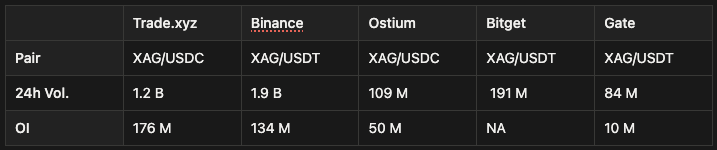
We all know that crypto capital inherently prefers volatility; from a product structure perspective, equity perps are precisely at the convergence point of several key upgrades, which is the fundamental reason they stand out in this cycle:

  • As CBOE / CME gradually accept crypto in-kind margin this year, the liquidity and availability of crypto assets as collateral will significantly improve.

  • Once the DTCC establishes a direct on-chain connection, the settlement layer will begin to permeate on-chain, and stock assets will gain a native on-chain settlement channel from the source.

  • The truly interesting part then emerges: Tokenized stocks as collateral → Perpetual contract exchanges accept them → Institutions begin systematic basis farming.

Onshore Issuance, Offshore Distribution

The U.S. exports finance not by exporting financial institutions themselves, but by exporting "access." The petrodollar system distributed dollars globally, externalizing inflationary pressure; stablecoins replicated this logic by wholesale purchasing of U.S. Treasuries, turning the whole world into new dollar holders without the need for banks or brokers. On-chain stocks are the next step in this logic. From unbanked to unbrokered, dollar assets will once again complete their global倾销 (dumping).
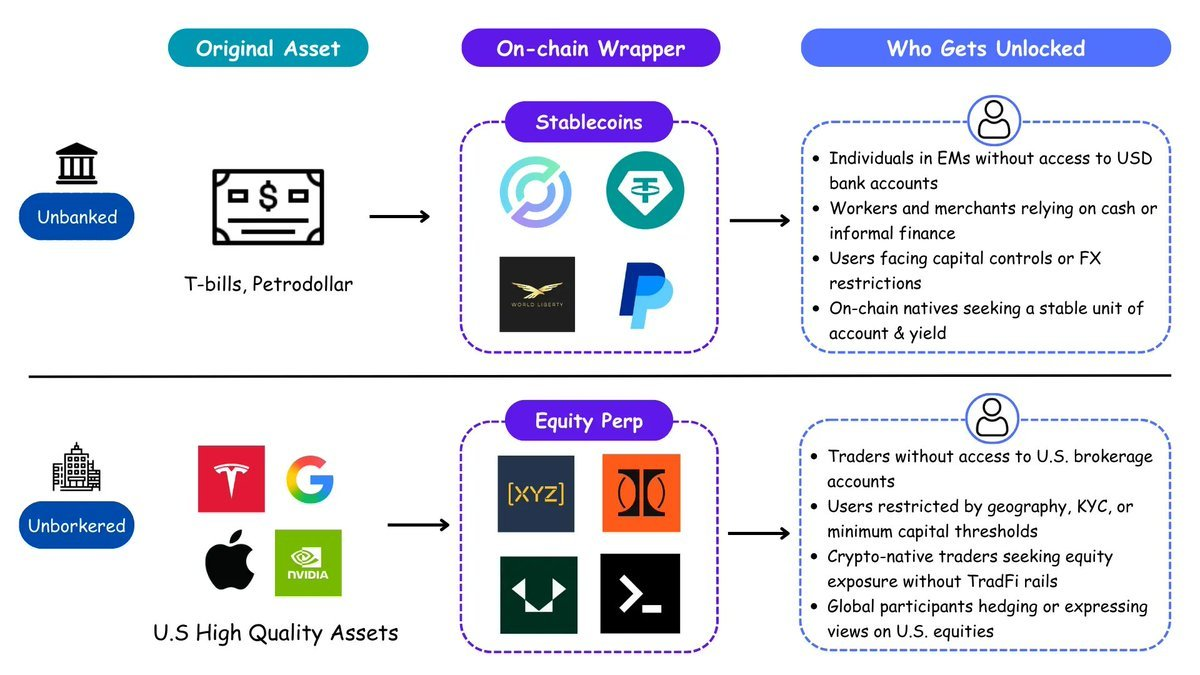
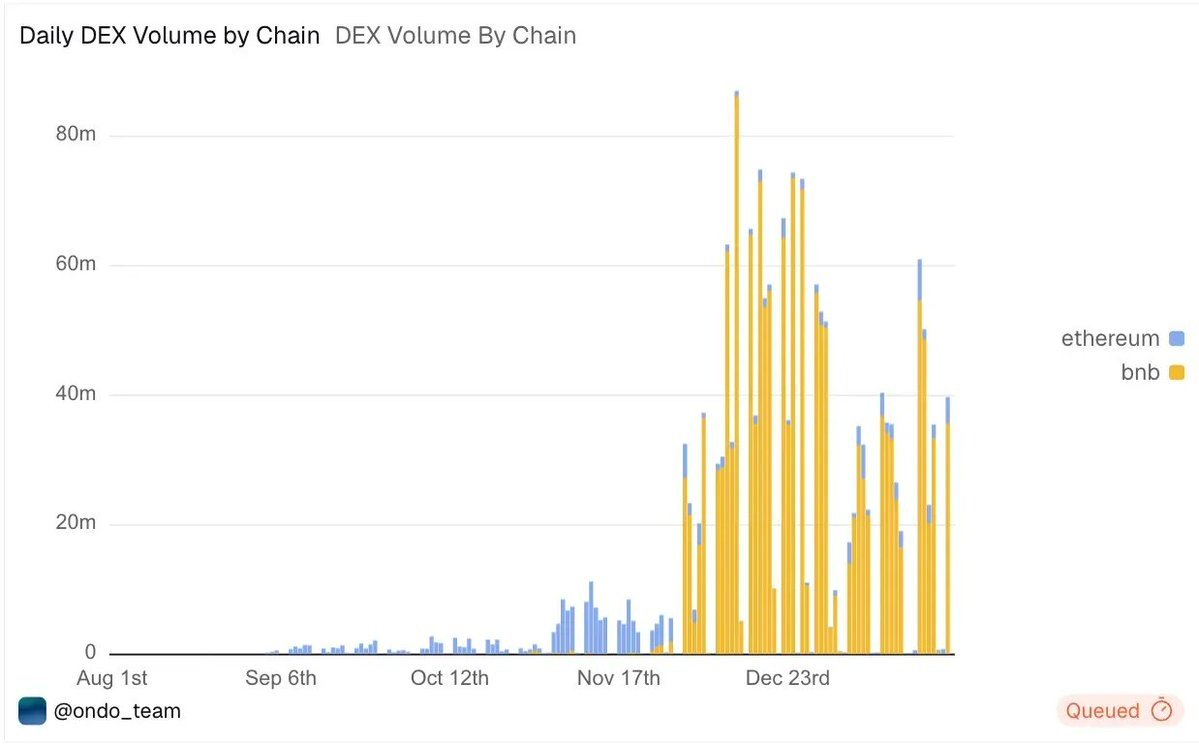
CEXs saw the opportunity and potential threat early on, so they chose to expand first. Ondo and xStocks focused on the issuance side—connecting with brokers, custodying real stocks, minting 1:1 tokenized stocks on multiple chains—but it turned out that issuance itself doesn't automatically create a market.

The first wave of real demand came from traders unable to access the U.S. brokerage system and crypto-native users seeking exposure to U.S. stocks without relying on TradFi infrastructure. The issuers handled the heaviest compliance and custody work, but the flow of funds went to the side that truly controls trading attention and distribution capabilities. Offshore platforms embedded the products directly into their trading interfaces, and trading volume naturally aggregated there. Ultimately, we see the vast majority of tokenized stock trading volume concentrated on BNB Chain, accounting for over 80%.
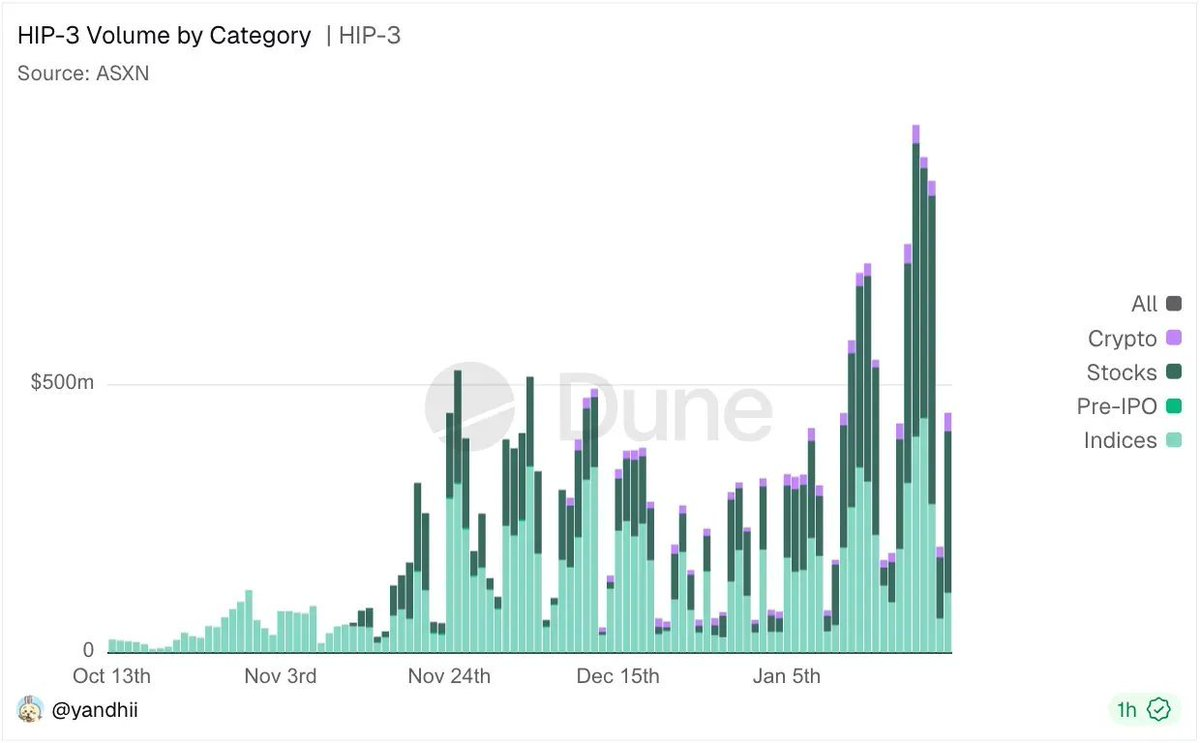
If offshore spot unlocked retail demand, on-chain equity perps further attracted the flow of professional traders. These users are global trading participants who want to trade or hedge U.S. stocks without being constrained by broker access, trading hours, or jurisdictional limits.

Take HIP-3 as an example; it provides professional traders with a trading interface to systematically conduct basis trading, capture cross-market dislocations, and cover stocks, crypto assets, and indices simultaneously. With the叠加 (overlay) of potential airdrop incentives, trading volume continues to刷新 (refresh) new highs.
The Golden Window for On-Chain Stock Perpetuals

Once a现货锚点 (spot anchor) exists, perpetual contracts almost always become the most efficient trading tool, for reasons that are as direct as ever:

  • 7×24 hour trading,不受 (not subject to) market hour restrictions

  • Cross-margin with all assets, extremely capital efficient

  • High leverage allows true risk appetite to be释放 (released)

  • Composable into DeFi strategies

  • Provides a clear collateral path for RWA / tokenized assets

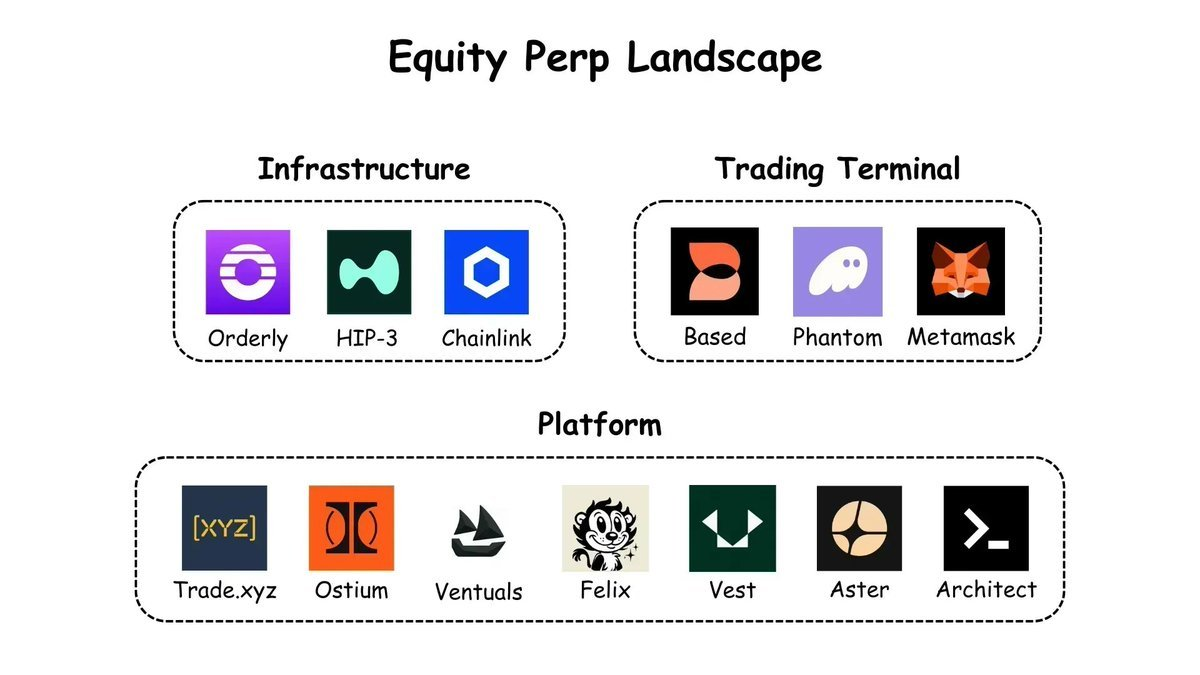
The entire tech stack is rapidly taking shape:
Infrastructure

  • HIP-3 / HyperCore: High-performance orderbook engine, supports any perp market

  • Orderly: Unified omnichain orderbook, anyone can launch a perp with no code

  • Chainlink: Stock price oracle (core data layer)

Platforms (Where trading happens)

  • Trade.xyz: Based on HIP-3, currently the largest equity perp DEX

  • Ostium: FX / Commodities / Stocks,偏向 (leaning towards) CFD structure

  • Ventuals: pre-IPO market (HIP-3)

  • Felix / Vest / Aster / Architect: Each has its focus on settlement, coverage, and distribution

Terminals (Current upstream traffic entry points)

  • Based: Multi-asset interface aggregating Hyperliquid, HIP-3, and prediction markets

  • Phantom / Metamask-like frontends: Convert wallet traffic into trading behavior

Looking forward, the focus is shifting from "tokenization" to "monetary velocity." The real on-chain GDP will be generated here. The ultimate winners won't just be players who can mint on-chain wrapped assets, but those trading venues that, at scale, can convert any asset into usable collateral and provide the deepest liquidity and the cleanest matching / risk engine.

Imagine the future as a globally unified "collateral network": Bitcoin, U.S. stocks, gold, U.S. Treasuries are no longer locked in their respective systems but can be used as collateral like building blocks at any time; perpetual contracts become the most universal risk expression tool; stablecoins play the role of cash; various trading and arbitrage strategies run automatically 7×24 on-chain, constantly combining. Assets are no longer "held" but are continuously called upon.

Racing Against Time

The window is open, but time is not on the side of on-chain equity perps. The biggest threat is not demand, but the formal approval of onshore products. History has repeatedly shown that once regulators nod, distribution回流 (flows back) to the existing brokerage system in an extremely short time. 0DTE options are the most direct example: after approval, they were quickly absorbed and dominated by Robinhood.

More importantly, the countdown has begun. The SEC and CFTC are systematically studying perpetual derivatives and their market structure and risks, which usually means regulatory boundaries are being actively defined. Meanwhile,

  • Bitnomial became the first CFTC-compliant perp

  • Coinbase also launched 5-year futures with a funding mechanism,几乎 (almost) indistinguishable in trading behavior from perps.

The reason offshore and on-chain players can still lead is simply that the products haven't been standardized yet. Once the rules take shape, the advantage will quickly disappear. Those who truly have a chance are not those waiting for certainty, but those who, while the window is still open, quickly lock in users and liquidity, and shape the rules while running and coordinating with regulators. Time is not a background variable but the core constraint determining victory or defeat, and the countdown has already begun.

Just as Tether used crypto's distribution power to quietly push the dollar globally back in the day, today's on-chain economy is essentially doing the same thing—leveraging the liquidity and trading tools of the crypto market to deliver U.S. stocks and American assets in a form with higher frequency, higher leverage, and higher liquidity to a broader set of participants. On-chain is not对抗 (fighting against) off-chain; it is rewriting the operating methods of the existing system with faster speed and stronger capital efficiency. The real watershed lies in whether one can timely capture this mechanism and complete the cognition and layout of the new continent on-chain.


Domande pertinenti

QWhy does Primitive Ventures believe on-chain perpetuals for US stocks are gaining traction in the crypto market?

APrimitive Ventures attributes the rise of on-chain perpetuals for stocks to crypto's inherent preference for volatility, key infrastructure upgrades like CBOE/CME accepting crypto in-kind margin, and the potential for DTCC to establish direct on-chain connections. These factors enable tokenized stocks to be used as collateral, attracting institutional basis farming and global liquidity.

QWhat is the significance of the 'offshore distribution' model for tokenized stocks mentioned in the article?

AThe 'offshore distribution' model refers to platforms outside strict US jurisdiction that focus on distributing and trading tokenized stocks, capturing demand from users unable to access US brokerages or seeking crypto-native exposure. This model has concentrated over 80% of trading volume on BNB Chain, demonstrating that distribution, not just issuance, drives market growth.

QWhat advantages do on-chain equity perpetuals offer over traditional trading methods?

AOn-chain equity perpetuals offer 24/7 trading unrestricted by market hours, high capital efficiency with cross-margin across all assets, high leverage to match risk appetite, composability into DeFi strategies, and a clear path for using RWA/tokenized assets as collateral.

QWhat are the main threats to the growth of on-chain equity perpetuals according to the article?

AThe primary threat is the potential approval and rapid adoption of onshore regulated products by established brokers, as seen with 0DTE options on Robinhood. Regulatory bodies like the SEC and CFTC are already studying perpetual derivatives, and once rules are standardized, the current advantage could quickly diminish.

QHow does the article describe the future vision of a 'global margin network'?

AThe future is envisioned as a globally unified 'margin network' where assets like Bitcoin, US stocks, gold, and US Treasuries are not siloed but can be used interchangeably as collateral. Perpetual contracts serve as the universal tool for risk expression, stablecoins act as cash, and various trading/arbitrage strategies operate 24/7, continuously composing and utilizing assets rather than just holding them.

Letture associate

North Korean Hackers Loot $500 Million in a Single Month, Becoming the Top Threat to Crypto Security

North Korean hackers, particularly the notorious Lazarus Group and its subgroup TraderTraitor, have stolen over $500 million from cryptocurrency DeFi platforms in less than three weeks, bringing their total theft for the year to over $700 million. Recent major attacks on Drift Protocol and KelpDAO, resulting in losses of approximately $286 million and $290 million respectively, highlight a strategic shift: instead of targeting core smart contracts, attackers are now exploiting vulnerabilities in peripheral infrastructure. For instance, the KelpDAO attack involved compromising downstream RPC infrastructure used by LayerZero's decentralized validation network (DVN), allowing manipulation without breaching core cryptography. This sophisticated approach mirrors advanced corporate cyber-espionage. Additionally, North Korea has systematically infiltrated the global crypto workforce, with an estimated 100 operatives using fake identities to gain employment at blockchain companies, enabling long-term access to sensitive systems and facilitating large-scale thefts. According to Chainalysis, North Korean-linked hackers stole a record $2 billion in 2025, accounting for 60% of all global crypto theft that year. Their total historical crypto theft has reached $6.75 billion. Post-theft, they employ specialized money laundering methods, heavily relying on Chinese OTC brokers and cross-chain mixing services rather than standard decentralized exchanges. Security experts, while acknowledging the increased sophistication, emphasize that many attacks still exploit fundamental weaknesses like poor access controls and centralized operational risks. Strengthening private key management, limiting privileged access, and enhancing coordination among exchanges, analysts, and law enforcement immediately after an attack are critical to improving defense and fund recovery chances. The industry's challenge now extends beyond secure smart contracts to safeguarding operational security at the infrastructure level.

marsbit12 min fa

North Korean Hackers Loot $500 Million in a Single Month, Becoming the Top Threat to Crypto Security

marsbit12 min fa

Circle CEO's Seoul Visit: No Korean Won Stablecoin Issuance, But Met All Major Korean Banks

Circle CEO Jeremy Allaire's recent activities in Seoul indicate a strategic shift for the company, moving away from issuing a Korean won-backed stablecoin and instead focusing on embedding itself as a key infrastructure provider within Korea’s financial and crypto ecosystem. Despite Korea accounting for nearly 30% of global crypto trading volume—with a market characterized by high retail participation and altcoin dominance—Circle has chosen not to compete for the role of stablecoin issuer. Instead, Allaire met with major Korean banks (including Shinhan, KB, and Woori), financial groups, leading exchanges (Upbit, Bithumb, Coinone), and tech firms like Kakao. This approach reflects a broader industry transition: the core of stablecoin competition is shifting from issuance rights to systemic positioning. With Korean regulators still debating whether banks or tech companies should issue stablecoins, Circle is avoiding regulatory uncertainty by strengthening its role as a service and technology partner. The company is deepening integration with trading platforms, building connections, and promoting stablecoin infrastructure. This positions Circle to benefit regardless of which entity eventually issues a won stablecoin. Allaire also noted the potential for a Chinese yuan stablecoin in the next 3–5 years, underscoring a regional trend of stablecoins becoming more regulated and integrated with traditional finance. Ultimately, Circle’s strategy highlights that future influence in the stablecoin market will belong not necessarily to the issuers, but to the foundational infrastructure layers that enable cross-system transactions.

marsbit39 min fa

Circle CEO's Seoul Visit: No Korean Won Stablecoin Issuance, But Met All Major Korean Banks

marsbit39 min fa

SpaceX Ties Up with Cursor: A High-Stakes AI Gambit of 'Lock First, Acquire Later'

SpaceX has secured an option to acquire AI programming company Cursor for $60 billion, with an alternative clause requiring a $10 billion collaboration fee if the acquisition does not proceed. This structure is not merely a potential acquisition but a strategic move to control core access points in the AI era. The deal is designed as a flexible, dual-path arrangement, allowing SpaceX to either fully acquire Cursor or maintain a binding partnership through high-cost collaboration. This "option-style" approach minimizes immediate regulatory and integration risks while ensuring long-term alignment between the two companies. At its core, the transaction exchanges critical AI-era resources: SpaceX provides its Colossus supercomputing cluster—one of the world’s most powerful AI training infrastructures—while Cursor contributes its AI-native developer environment and strong product adoption. This synergy connects compute power, models, and application layers, forming a closed-loop AI capability stack. Cursor, founded in 2022, has achieved rapid growth with over $1 billion in annual revenue and widespread enterprise adoption. Its value lies in transforming software development through AI agents capable of coding, debugging, and system design—positioning it as a gateway to future software production. For SpaceX, this move is part of a broader strategy to evolve from a aerospace company into an AI infrastructure empire, integrating xAI, supercomputing, and chip manufacturing. Controlling Cursor fills a gap in its developer tooling layer, strengthening its AI narrative ahead of a potential IPO. The deal reflects a shift in AI competition from model superiority to ecosystem and entry-point control. With programming tools as a key battleground, securing developer loyalty becomes crucial for dominating the software production landscape. Risks include questions around Cursor’s valuation, technical integration challenges, and potential regulatory scrutiny. Nevertheless, the deal underscores a strategic bet: controlling both compute and software development access may redefine power dynamics in the AI-driven future.

marsbit1 h fa

SpaceX Ties Up with Cursor: A High-Stakes AI Gambit of 'Lock First, Acquire Later'

marsbit1 h fa

Trading

Spot
Futures
活动图片