Bitnomial gains CFTC approval to launch prediction markets in the US

cointelegraphPubblicato 2025-12-12Pubblicato ultima volta 2025-12-12

Introduzione

Bitnomial Clearinghouse LLC has obtained approval from the U.S. CFTC to clear fully collateralized swaps, enabling its parent company, Bitnomial, to launch prediction markets and provide clearing services to external platforms. The prediction markets will cover crypto and economic events, allowing traders to take positions on outcomes like token prices and macroeconomic data. This expands Bitnomial’s existing suite of Bitcoin and crypto derivatives products. The company’s operates as an infrastructure-only clearing provider, offering margin and settlement systems with support for both USD and cryptocurrency collateral. The approval follows recent regulatory clearance for Bitnomial to operate a CFTC-regulated spot crypto exchange. The article also notes the growing momentum of prediction markets in the U.S., highlighting platforms like Kalshi and Polymarket, the latter of which recently received CFTC approval for intermediated trading platform operations.

Bitnomial Clearinghouse LLC received approval from the US Commodity Futures Trading Commission (CFTC) to clear fully collateralized swaps, enabling its parent company, Bitnomial, to launch prediction markets and offer clearing services to other platforms.

According to Friday’s announcement, Bitnomial’s prediction market will cover crypto and economic events, alongside its existing Bitcoin (BTC) and crypto derivatives products. The contracts are designed to allow traders to take positions on outcomes, such as token price levels and macroeconomic data.

The approval expands the umbrella of the trading products offered by Bitnomial. Based in Chicago, the company’s exchange and clearing arms offer perpetuals, futures, options contracts and leveraged spot trading. The company’s clearinghouse also supports crypto-based margin and settlement, allowing approved products to be margined and settled directly in digital assets.

Bitnomial president Michael Dunn said the approval allows the company to serve “both our own exchange and external partners, building a clearing network that strengthens the entire prediction market ecosystem.”

Bitnomial Clearinghouse operates as an infrastructure-only clearing provider, rather than a retail competitor, giving approved partners access to its margin and settlement systems and allowing collateral to be converted between US dollars and cryptocurrency.

The approval follows a recent green light to launch a CFTC-regulated spot cryptocurrency trading platform in the US, allowing customers to buy, sell and trade leveraged and non-leveraged crypto products on a federally supervised exchange.
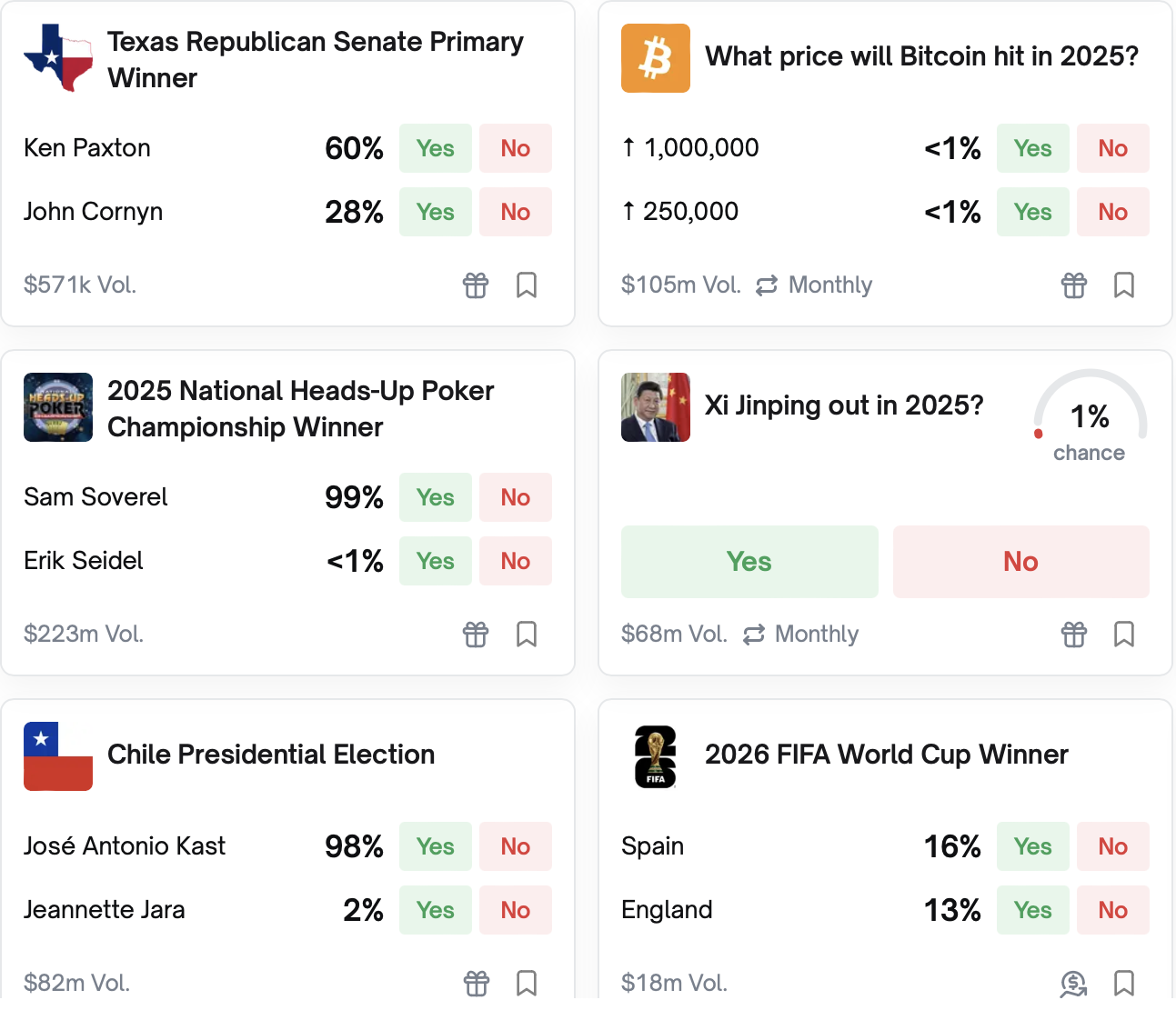
Event contracts on Polymarket. Source: Polymarket

Related: Coinbase may debut prediction markets, tokenized stocks on Wednesday: Report

Polymarket gains momentum in the US

Prediction markets have emerged as a major trend in 2025. According to DefiLlama data, prediction market Kalshi has generated $5.27 billion in trading volume over the last 30 days, while blockchain-based Polymarket recorded just under $2 billion over the same time period.
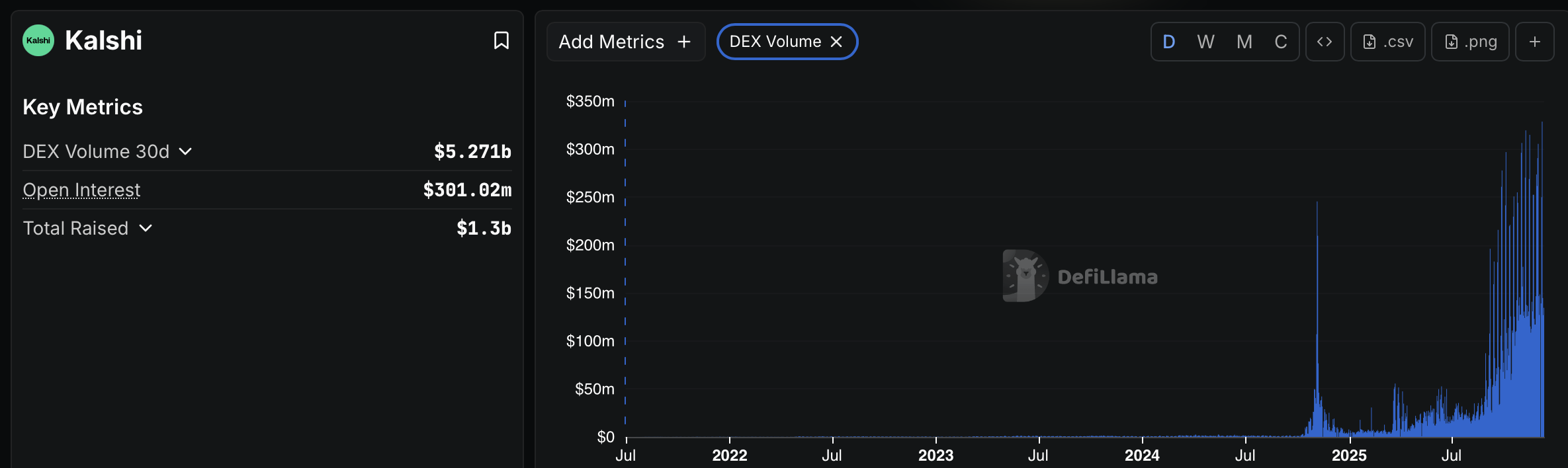
Kalshi trading volume. Source: DefiLlama

In November, Polymarket received regulatory approval from the CFTC to operate an intermediated trading platform, allowing access through registered brokers under the rules governing US markets.

The approval followed the closure of an investigation in July led by the CFTC and US Department of Justice into whether Polymarket had allowed trading by US users, a probe that included an FBI search of founder Shayne Coplan’s home.

Polymarket, which settles contracts on the Polygon blockchain using the USDC (USDC) stablecoin, has also secured several partnerships in recent months, including the UFC and Zuffa boxing and fantasy sports operator PrizePicks in November.

Magazine: Meet the onchain crypto detectives fighting crime better than the cops

Letture associate

BIT Research: If It Followed Nasdaq, Bitcoin Should Be Close to $140,000

BIT Research: Bitcoin Price Analysis Under Inflation Re-pricing The market is currently undergoing a macro adjustment phase dominated by inflation re-pricing. Analysis suggests that if Bitcoin had continued to follow Nasdaq's trajectory, its theoretical price would be near $140,000. However, a significant divergence between the two assets has emerged since October 2025. The core reason is the resurgence of US inflation, which has led to a reversal in market expectations for the Federal Reserve's rate-cut path. Recent data shows US CPI rising to 3.8% and PPI to 6.0%, prompting markets to scale back expectations for 2026 rate cuts. For Bitcoin, the previous supportive narrative of anticipated loose liquidity is weakening. Concurrently, escalating tensions involving Iran have driven oil prices up approximately 40% since late February 2026, heightening inflation concerns through rising energy costs. While the market currently views this inflation surge as a temporary pressure point, the interplay between energy, interest rates, and risk appetite is prompting a reassessment of the potential for a prolonged high-rate environment. In this context, Bitcoin has begun to underperform tech stocks, which can benefit from nominal inflation. The divergence stems from a key distinction: Bitcoin's past rallies were driven by loose liquidity and rate-cut expectations, not inflation itself. As a long-duration asset, Bitcoin is highly sensitive to interest rate paths. When expectations for rate cuts are withdrawn, its valuation faces pressure. Unlike equities, which can benefit from increased nominal revenues and reduced real debt burdens during inflation, Bitcoin possesses neither debt that inflates away nor cash flows that expand with inflation, offering no direct structural benefit from rising prices. Looking ahead, the critical question is whether high inflation will force the Fed to maintain elevated rates for longer. The BIT model anticipates US CPI could potentially rise further to 6.0%. Additionally, factors like AI infrastructure expansion—driving data center construction and power demand—may sustain energy price pressures and extend the period of above-target inflation. In such an environment, tech stocks gain from order growth and improved earnings expectations, while Bitcoin remains susceptible to high-rate pressure. In summary, the current shift does not invalidate Bitcoin's long-term thesis but reflects a market re-evaluation of interest rate and liquidity paths amid resurgent inflation. In the short term, a high-inflation environment may continue to suppress Bitcoin's performance relative to Nasdaq. This represents a slowdown in its upward momentum rather than a bearish turn. Bitcoin could regain support once markets begin to reprice expectations for future liquidity easing.

marsbit24 min fa

BIT Research: If It Followed Nasdaq, Bitcoin Should Be Close to $140,000

marsbit24 min fa

Bankless Interview: Private Equity Insiders Reveal the Inside Story of Anthropic's Primary Market Trading

**Bankless Interview: A Private Equity Veteran Exposes the Dark Side of Anthropic's Pre-IPO Trading** In a Bankless podcast, Patagon founder Dio Casares reveals the opaque inner workings of the massive secondary market for shares in pre-IPO giants like Anthropic. The market, driven by private SPVs (special purpose vehicles), brokers, and even informal networks, sees hundreds of billions in notional value changing hands, with single-deal fees as high as 10%. However, an estimated 10-20% of transactions involve fraud or fabricated share certificates. Intermediaries often profit more from these deals than from their core investment businesses. Two types of "secondary" exist: company-sanctioned trades (like employee tender offers) that bring new money to the company, and disruptive "gray market" trades on platforms like Hive or Forge, which companies like Anthropic actively fight. The latter creates pricing chaos and complicates primary fundraising. A major risk involves multi-layered, nested SPV structures. When a company like Anthropic finally IPOs, delays in distributing shares down these chains, combined with discretionary powers of fund managers (GPs) to hold or sell, could trigger a wave of lawsuits and settlement nightmares lasting years. For small investors in "tokenized" versions of these assets, transparency is minimal, and due diligence is often impossible. Casares advises extreme caution, suggesting investors trust their gut and exit if something feels wrong. He warns that the post-IPO period will be a major "reckoning" for this wild and largely unregulated market.

marsbit46 min fa

Bankless Interview: Private Equity Insiders Reveal the Inside Story of Anthropic's Primary Market Trading

marsbit46 min fa

Is Elon Musk Actually the Victim?

"Victim or Vindicator? Inside the OpenAI Trial That Shattered the Myth." In May 2026, the federal court in Oakland became the stage for deconstructing the carefully curated narrative of OpenAI. The trial revealed a complex reality far removed from its founding ideals. The core dispute centered on whether OpenAI, founded in 2015 as a non-profit dedicated to benefiting "all of humanity," had betrayed its mission by shifting towards a lucrative commercial structure, particularly after its 2019 capped-profit affiliate (OpenAI LP) was established and Microsoft invested $13 billion. Elon Musk, a co-founder and early funder, sued, claiming the organization was "stolen" and turned into a de facto Microsoft subsidiary for private gain. OpenAI countered that Musk's funds were unconditional donations and his lawsuit was driven by a desire for control and regret after leaving to found his own AI venture, xAI. The trial exposed early fractures. Evidence from 2017, years before ChatGPT's success, showed the founders were already grappling with the immense financial demands of pursuing Artificial General Intelligence (AGI). Musk himself had proposed having Tesla fund OpenAI. The court scrutinized whether the founders knowingly crossed a moral line. Greg Brockman's personal diary, entered as evidence, contained entries about wealth goals and anxieties over the company's revenue path, alongside self-reminders about the moral bankruptcy of "stealing" the non-profit. Brockman later testified his OpenAI stake was worth nearly $30 billion. The character of CEO Sam Altman was a key battleground. Musk's legal team cited five individuals, including co-founder Ilya Sutskever and former board members, who had described Altman as dishonest. This highlighted a recurring "trust debt" within OpenAI's leadership, exemplified by the chaotic 2023 boardroom coup and subsequent reinstatement. Altman defended his position, arguing Musk sought to absorb OpenAI into Tesla and that commercial success amplified OpenAI's charitable impact. Testimony from Microsoft CEO Satya Nadella underscored how commercial realities now dominated. While framing Microsoft's massive investment as a way to enlarge the non-profit's funding "pie," texts revealed Nadella pressuring Altman to launch ChatGPT's paid version quickly. Nadella also revealed that during the 2023 crisis, Microsoft was prepared to hire Altman and his team, showcasing the board's diminished power against the gravity of capital, talent, and infrastructure. Ultimately, the trial depicted OpenAI not as a singular act of betrayal but as a gradual, systemic transformation. Its grand AGI mission required a "heavier machine" to sustain it—a machine of computing power (largely from Microsoft), capital, and commercial obligations that inevitably reshaped its priorities. The non-profit board, tasked with guarding the mission, found itself unable to control the commercial juggernaut it had enabled. For the public, the proceedings served as a sobering window into the making of a foundational technology. The AI tools increasingly integrated into daily life—from writing and coding to customer service—are not born from a transparent, purely altruistic process. They emerge from a tangled web of personal ambitions, private negotiations, control struggles, and cloud computing bills. The trial's legacy is the stark realization that as AI becomes societal infrastructure, its steering wheel remains in very few, and very human, hands.

marsbit1 h fa

Is Elon Musk Actually the Victim?

marsbit1 h fa

Trading

Spot
Futures

Articoli Popolari

Come comprare US

Benvenuto in HTX.com! Abbiamo reso l'acquisto di Talus Network (US) semplice e conveniente. Segui la nostra guida passo passo per intraprendere il tuo viaggio nel mondo delle criptovalute.Step 1: Crea il tuo Account HTXUsa la tua email o numero di telefono per registrarti il tuo account gratuito su HTX. Vivi un'esperienza facile e sblocca tutte le funzionalità,Crea il mio accountStep 2: Vai in Acquista crypto e seleziona il tuo metodo di pagamentoCarta di credito/debito: utilizza la tua Visa o Mastercard per acquistare immediatamente Talus NetworkUS.Bilancio: Usa i fondi dal bilancio del tuo account HTX per fare trading senza problemi.Terze parti: abbiamo aggiunto metodi di pagamento molto utilizzati come Google Pay e Apple Pay per maggiore comodità.P2P: Fai trading direttamente con altri utenti HTX.Over-the-Counter (OTC): Offriamo servizi su misura e tassi di cambio competitivi per i trader.Step 3: Conserva Talus Network (US)Dopo aver acquistato Talus Network (US), conserva nel tuo account HTX. In alternativa, puoi inviare tramite trasferimento blockchain o scambiare per altre criptovalute.Step 4: Scambia Talus Network (US)Scambia facilmente Talus Network (US) nel mercato spot di HTX. Accedi al tuo account, seleziona la tua coppia di trading, esegui le tue operazioni e monitora in tempo reale. Offriamo un'esperienza user-friendly sia per chi ha appena iniziato che per i trader più esperti.

381 Totale visualizzazioniPubblicato il 2025.12.11Aggiornato il 2025.12.11

Come comprare US

Discussioni

Benvenuto nella Community HTX. Qui puoi rimanere informato sugli ultimi sviluppi della piattaforma e accedere ad approfondimenti esperti sul mercato. Le opinioni degli utenti sul prezzo di US US sono presentate come di seguito.

活动图片