Trading Volume of Crypto Company Preferred Shares Soars to $13 Billion, with Strategy and Alphabet Leading the Breakout of a 'New Financing Tool'

marsbitPubblicato 2026-07-15Pubblicato ultima volta 2026-07-15

Introduzione

In June 2026, trading activity in crypto company preferred shares surged dramatically, with monthly volume reaching approximately $13 billion when standardized to par value. This acceleration, primarily driven by STRK and a growing number of new preferred share listings, has transformed a niche, custom financing tool once dominated by financial institutions into a broader, more liquid, and increasingly evergreen asset class. Key indicators point to the market's maturation, with improved efficiency in pricing, secondary market depth, and persistent investor demand. Notably, this evolution is extending beyond crypto. In the same month, Alphabet launched its first convertible preferred share offering as part of a funding round exceeding $80 billion for AI infrastructure. Similarly, Super Micro Computer announced a $3.75 billion convertible preferred share issuance within a $7 billion capital raise for AI expansion, highlighting the growing role of preferred shares as a scalable financing tool across industries.

Author: Jeff Park

Compiled by: Shenchao TechFlow

Shenchao Introduction: Preferred shares were once exclusive financing tools for banks and insurance companies. Today, crypto companies like Strategy have transformed them into a highly liquid and sustainably tradable asset class. More critically, this path has evolved from crypto to traditional tech—Alphabet and Super Micro Computer are using it to finance AI infrastructure, with individual deal sizes reaching $80 billion. This is no longer a niche game.

In 2026, trading activity for crypto company preferred shares accelerated sharply, with monthly trading volume standardized at par value reaching approximately $13 billion in June. This surge was primarily driven by STRC and the increasing number of new preferred share listings, transforming a once-customized financing niche dominated by financial institutions (banks and insurance companies) into a broader, more liquid, and increasingly evergreen asset class.

Beyond higher trading volume, a key signal is the maturity of the preferred share market itself. As liquidity deepens, these instruments have become more efficient not only in terms of coupon rates and issuer quality but also in secondary market depth, relative value, and the persistence of investor demand. This evolution is beginning to extend beyond crypto: in June, Alphabet launched its inaugural convertible preferred share issuance as part of an equity financing exceeding $80 billion to fund AI infrastructure; meanwhile, Super Micro Computer announced the issuance of $3.75 billion in convertible preferred shares within a $7 billion capital raise for AI expansion, highlighting the increasingly vital role of preferred shares as a scalable financing tool across industries.
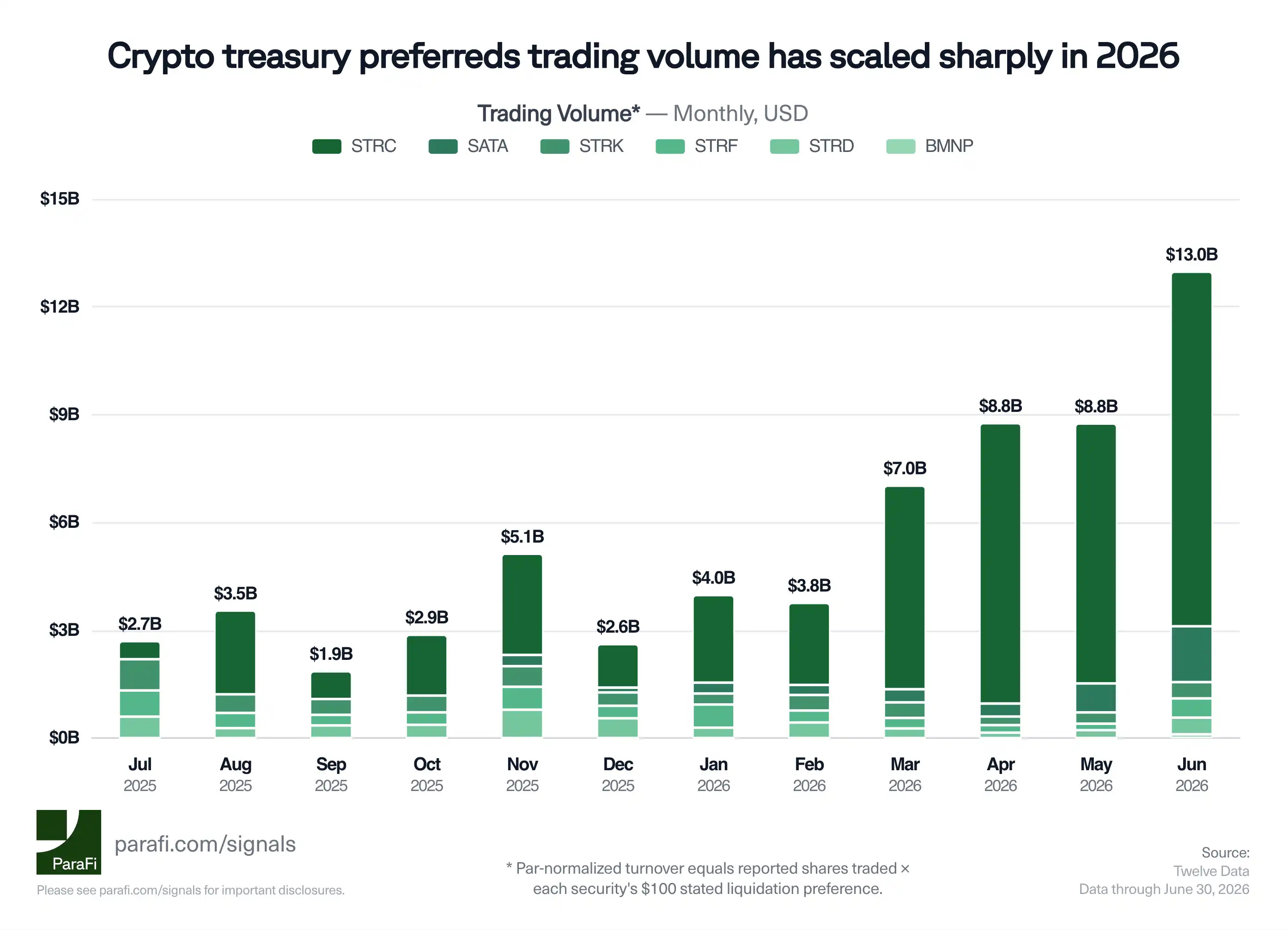
Note: The selected scope includes trading volume for STRK, STRF, STRD, STRC, SATA, and BMNP standardized on a par value basis. Par-value standardized turnover is calculated as reported traded share count multiplied by the $100 per share stated liquidation preference for each security. It does not represent actual dollar trading volume and, viewed alone, cannot establish market liquidity. Source: Twelve Data. Data as of June 30, 2026.

Important Disclosure: ParaFi Signals are for informational purposes only and should not be considered or construed as financial, legal, tax, or investment advice. The information above should not be regarded as a recommendation to buy or sell any particular security.


Domande pertinenti

QAccording to the article, what was the approximate monthly trading volume of crypto enterprise preferred shares (normalized by par value) in June 2026?

AAccording to the article, the monthly trading volume of crypto enterprise preferred shares normalized by par value reached approximately $13 billion in June 2026.

QWhich two companies are highlighted in the article as using preferred shares for AI infrastructure funding?

AThe article highlights Alphabet and Super Micro Computer (SMCI) as using preferred shares for AI infrastructure funding.

QWhat is the primary historical user group of preferred shares as mentioned in the article?

AThe article states that preferred shares were historically a customized financing niche dominated by financial institutions, specifically banks and insurance companies.

QBesides higher trading volume, what key signal indicates the maturity of the preferred share market as described in the article?

AThe key signal of the market's maturity is that these instruments are becoming more efficient not only in terms of coupon rates and issuer quality, but also in secondary market depth, relative value, and the durability of investor demand.

QWhat should the 'Par Value Normalized Turnover' metric mentioned in the note NOT be interpreted as on its own?

AThe 'Par Value Normalized Turnover' metric alone should not be interpreted as establishing market liquidity, as it represents reported traded share numbers multiplied by a $100 liquidation preference per security and does not represent actual dollar trading volume.

Letture associate

Only 67 of Top 1000 Crypto Projects Have Wikipedia Pages, ChatGPT's 'Understanding' of Crypto Industry Being Distorted

A study by crypto communications firm Chainstory reveals a significant information gap: only 67 of the top 1,000 cryptocurrencies by market capitalization have a Wikipedia page, representing less than 7% coverage. This includes major projects like the $15 billion Hyperliquid and the $5 billion Sui. The coverage rate declines sharply from 80% for the top 10 assets to near zero for those ranked 1,001 to 10,000. This gap is critical because Wikipedia is the single most cited source for AI models like ChatGPT, accounting for approximately 7.8% of all its citations. Consequently, AI tools have a systemic blind spot and lack authoritative, foundational information for the vast majority of crypto projects, often leading to factual errors when discussing them. The low coverage stems from Wikipedia's strict notability guidelines for cryptocurrencies, which deem crypto-native media outlets like CoinDesk and Cointelegraph as "generally unreliable." Instead, Wikipedia requires coverage from mainstream financial publications like Reuters or Bloomberg, which rarely report on many niche crypto sectors. This creates a catch-22 where the media covering the industry aren't trusted, and the trusted media don't cover it. The cumbersome Wikipedia article creation and review process, where projects have no right to appeal deletions, further exacerbates the problem.

marsbit34 min fa

Only 67 of Top 1000 Crypto Projects Have Wikipedia Pages, ChatGPT's 'Understanding' of Crypto Industry Being Distorted

marsbit34 min fa

Hyperliquid Pre-IPO Contract Priced CXMT at $7.2, Foreign Capital Engaging with China's Storage Narrative via DeFi

Hyperliquid, a blockchain-based perpetual contracts platform, has launched a pre-IPO contract for Chinese memory chipmaker Changxin Technology (CXMT) ahead of its STAR Market debut. Priced at 7.2 USDC (approx. $7.2) per share, the contract implies a market cap of about $500 billion, exceeding the official IPO valuation of roughly $80 billion and sitting at the upper end of analyst estimates. This marks the first time such a crypto derivative has targeted a STAR Market listing. It provides global investors, particularly those unable to meet China's 500,000 yuan ($69,000) investment threshold for the STAR Market, a direct avenue to gain exposure to the "China storage substitution" narrative. The 24/7 tradable, leveraged contract also fills a gap for those seeking to hedge or speculate around the A-share listing, which operates under T+1 settlement and restricts short-selling. Changxin Technology, the world's fourth-largest DRAM supplier, is raising nearly $8 billion in one of Asia's largest IPOs this year, buoyed by a DRAM super-cycle and strategic shifts by major competitors. While the Hyperliquid contract offers a novel parallel pricing mechanism, the lack of direct arbitrage with the underlying A-shares may lead to persistent price divergence. Nevertheless, its emergence underscores significant international interest in China's key semiconductor players.

marsbit1 h fa

Hyperliquid Pre-IPO Contract Priced CXMT at $7.2, Foreign Capital Engaging with China's Storage Narrative via DeFi

marsbit1 h fa

Trading

Spot
活动图片