Robinhood Chain Comprehensive Review: Beyond Meme Coins like cashcat, What Other Projects Are Worth Watching?

marsbitPubblicato 2026-07-15Pubblicato ultima volta 2026-07-15

Introduzione

A two-week review of Robinhood Chain (RHC), an Ethereum L2, reveals an initial meme-driven surge led by CASHCAT—which briefly propelled daily active addresses to 193k—now giving way to utility-focused projects. Chain-native projects like Arrow Finance (ARROW), a CDP protocol accepting tokenized stocks/ETFs as collateral, and INDEX, a fee-redistribution token for stock token holders, have seen significant price appreciation despite the broader meme downturn. The ecosystem includes established partners like Lighter (LIT, integrated for perps trading), Morpho (MORPHO, dominant in TVL for lending), Chainlink (LINK, oracle provider), and Arbitrum (ARB, the underlying stack). Key projects yet to launch tokens offer interaction opportunities: Arcus (a dYdX-incubated stock token/RWA platform likely to airdrop to dYdX and early Arcus users) and Rialto (a multi-asset DEX with a proprietary PropAMM engine, running a referral program). However, structural concerns remain: TVL is overly concentrated in Morpho, DEX volume heavily relied on meme trading, and real on-chain activity for the flagship stock tokens is currently minimal (~0.27% of ERC-20 transfers). The sustainability of activity after the initial 90-day gas fee subsidy period is a critical watchpoint.

Author: Curry, Shenchao TechFlow

Shenchao Introduction: Two weeks after the Robinhood Chain mainnet launch, its TVL has surpassed $160 million, stablecoin market cap exceeds $327 million, and cumulative DEX trading volume has reached $4 billion. The meme coin CASHCAT has corrected from its peak market cap of $170 million to around $138 million, and the on-chain speculative trend is shifting from memes towards utility-based projects. Among the list of ecosystem partners, Arcus (by the dYdX team) and Rialto (a multi-asset DEX) have not yet issued tokens, presenting early interaction opportunities; on-chain native projects like Arrow Finance and INDEX have surged against the meme market downturn.
On July 1st, Robinhood launched the public mainnet of Robinhood Chain at the "The World is Flat" event in London. Two weeks later, this Arbitrum tech stack-based Ethereum L2 has gone through a standard cycle of "meme ignition, data peaking, and hype cooling down," and is now entering a critical window for ecosystem development.

According to DeFiLlama data, as of July 15th, Robinhood Chain TVL is approximately $161 million, stablecoin market cap around $327 million (USDG accounts for 68.2%), cumulative DEX trading volume about $3.9 billion, and RWA active market cap roughly $12.4 million. For a two-week-old L2, these figures are not bad, but the structure requires closer examination.

CASHCAT Ignites the First Week, Stories of $85 Turning into $2 Million Drive Daily Active Users to 193,000

The first week's activity on Robinhood Chain was almost entirely driven by a single token: CASHCAT.

The name CASHCAT originates from the alternative name founders Vlad Tenev and Baiju Bhatt once considered for their company. This token was deployed before the mainnet launch. On July 8th, it contributed approximately $98 million in daily DEX volume, with its market cap once surging to $150-170 million. That day, Robinhood Chain's total 24-hour DEX volume reached $560-570 million, briefly surpassing Hyperliquid.

Typical early wealth-creation stories emerged on-chain: one wallet bought CASHCAT for about $85 (0.05 ETH), with its holdings' value peaking at over $2 million; another wallet started with $838, achieving a return exceeding 1180x. These on-chain data, tracked by Lookonchain and Bubblemaps, quickly spread and became the main narrative driving new wallet inflows. On July 8th, there were 141,000 new active wallets, with total daily actives nearing 193,000.

Tenev himself joined the hype. He posted on X platform that Robinhood Chain was "built for RWA, but memes work too."

However, as of July 15th, according to GMGN market data, CASHCAT's market cap has fallen back to around $138 million, down 12% in 24 hours. Other meme coins like HOODRAT and JUGGERNAUT have fallen over 25%. The meme retreat has begun.

Utility-Based Projects Rise Against the Trend: ARROW and INDEX Become New Focal Points

While memes recede, some on-chain native projects with practical product logic are beginning to attract capital.

Arrow Finance (ARROW) is a native CDP (Collateralized Debt Position) protocol on Robinhood Chain. Users can deposit collateral to mint the aUSD stablecoin. Its core difference from typical CDP protocols lies in its collateral scope: besides mainstream crypto assets and stablecoins, Arrow Finance is the first CDP protocol to accept tokenized public stocks and ETFs as collateral. Holders of tokenized stocks can borrow liquidity without selling their stock positions, avoiding taxable events and the need to leave Robinhood Chain.

According to CoinGecko data, ARROW's current market cap is approximately $16 million, with a price of around $1.79, marking an over 10x increase from its starting price of about $0.15 on July 7th. CoinMarketCap shows a higher price of around $2.26. ARROW has launched staking functionality (LP Staking), with trading mainly concentrated on Uniswap V2/V3/V4 (Robinhood Chain).

INDEX is another utility token gaining attention. Public data shows that INDEX surged 160% on the evening of July 14th after gaining attention from Robinhood team members. At the time of writing, its market cap is around $7.36 million. The project's core mechanism involves using trading fees to purchase on-chain stock tokens and distributing them to INDEX holding addresses. This "trading fees → buy stock tokens → distribute" flywheel structure essentially builds a revenue distribution layer on top of Robinhood Chain's stock token ecosystem.

It's important to emphasize that both INDEX and ARROW are extremely early-stage on-chain native projects, with thin liquidity, highly volatile prices, and project information primarily from on-chain data and community dissemination, lacking institutional-level due diligence verification.

Ecosystem Projects with Tokens Issued: Fundamentals vs. On-Chain Performance

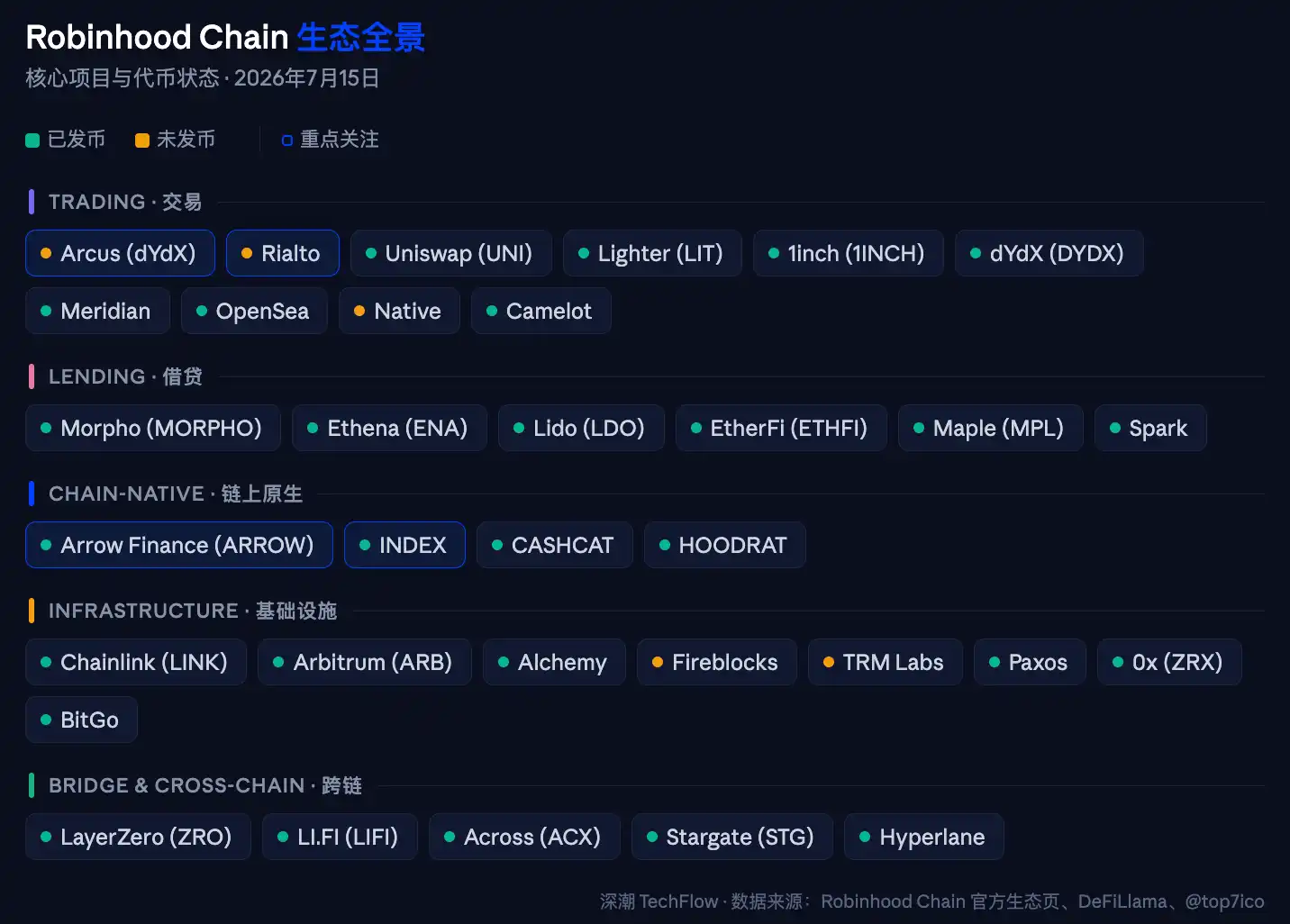
Robinhood Chain's initial partner list covers 16 projects. Most already have tokens. For these projects, investor focus lies in their fundamentals and the token's actual utility on Robinhood Chain.

Lighter (LIT): A ZK-powered perpetuals and spot DEX, directly integrated into the Robinhood Wallet. Eligible users can trade perpetual contracts within the wallet. Lighter has committed $11 million worth of LIT tokens to the Robinhood community. Trading earns points (double points for trading via Robinhood Wallet), which can later be converted to LIT. This is currently the most direct points farming channel on Robinhood Chain.

Morpho (MORPHO): A lending protocol hosting the majority of the chain's TVL. In its first week, around $90 million TVL concentrated in Morpho, serving as the underlying infrastructure for the Robinhood Earn product (estimated 7% APY USDG lending). It has insurance coverage from Lloyd's of London and RELM. High TVL concentration in a single protocol is a risk, but also indicates lending demand is not purely speculative.

Chainlink (LINK): As Robinhood Chain's official oracle and cross-chain infrastructure, it provides price data for all Stock Tokens. CCIP, Data Streams, and Data Feeds were deployed on the mainnet from day one.

Arbitrum (ARB): The underlying tech stack for Robinhood Chain. Offchain Labs simultaneously launched a revenue-sharing model: 10% of Robinhood Chain's net protocol fees flow back to the Arbitrum ecosystem (8% to the DAO Treasury, 2% to the Developer Guild). ARB rose about 7.6% after the mainnet launch.

Other partners with existing tokens include Uniswap (UNI), LayerZero (ZRO), 1inch (1INCH), etc. These projects have real deployments on Robinhood Chain, but their token price drivers are not primarily from Robinhood Chain.

Projects Without Tokens: Interaction Paths and Airdrop Expectations

Four projects on the partner list have not yet conducted a TGE. Among them, TRM Labs (compliance & risk control) and Fireblocks (MPC infrastructure) are more B2B-focused, offering little participation entry for retail users. The real interaction opportunities lie with Arcus and Rialto.

Arcus: Incubated by dYdX Labs and co-built with Robinhood Crypto, which has also invested an undisclosed amount. CEO is Eddie Zhang, previously founder of social trading app Pocket Protector (acquired by dYdX Labs in July 2025). dYdX founder Antonio Juliano has joined Arcus's board.

Arcus currently offers zero-fee spot trading for 95 Stock Tokens, operating 24/7 across 120+ countries (excluding the US, Canada, UK). 35 RWA perpetual contracts are still in a waitlist stage, with plans to open a Pre-IPO market.

Regarding tokens, dYdX explicitly stated in its announcement: future Arcus tokens will be prioritized for distribution to users who trade, stake, or validate on dYdX. In other words, there are two potential interaction paths for an Arcus airdrop. One is accumulating trading, staking, and validation history on dYdX Chain; the other is directly trading Stock Tokens on Arcus (currently zero fees, making interaction cost extremely low). The issuance timeline is undetermined.

Market reaction to the Arcus launch was mixed: DYDX token fell about 23% in 24 hours (traders concerned about resource diversion), while Robinhood stock (HOOD) rose over 10% during the same period.

Rialto: A stealth-mode launched, all-asset-class on-chain spot exchange supporting 24/7 trading of cryptocurrencies, Stock Tokens, ETFs, commodities, and Pre-IPO assets. The team has backgrounds in hedge funds, HFT, and market making.

Rialto's core differentiation is its PropAMM (Proactive Automated Market Maker) engine "Rivo Altus." Unlike passive AMMs, PropAMM is powered by the team's own inventory and proprietary pricing logic for on-chain market making. Using Arbitrum's Stylus infrastructure, it deploys the market-making logic directly on-chain, aiming for execution quality close to centralized exchanges.

Rialto has no token plans announced yet, but has launched a referral program: unlock a referral code after reaching $10,000 in cumulative trading volume; referrers earn 10% of the referee's fees. New exchanges on fresh chains using referral programs and volume accumulation to filter early users before a potential token launch is a common pre-airdrop signal. Initial listing covers 90+ Robinhood Stock Tokens and mainstream crypto assets.

Structural Issues with Robinhood Chain

Two weeks of data reveal a hard-to-ignore fact: on-chain TVL is highly concentrated in Morpho, DEX volume heavily relies on meme speculation, and RWA active market cap is only about $12.4 million. Robinhood Chain's narrative is "financial infrastructure," but so far, the most actively traded asset on-chain is a cat meme coin.

The actual on-chain activity of Stock Tokens also falls far below expectations. According to SQD's on-chain data analysis, during the mainnet's early stages, only 24 Stock Tokens and ETF tokens had any on-chain transfers, totaling 313 transactions, accounting for a mere 0.27% of all ERC-20 transfers on the chain. The real trading demand for tokenized stocks on-chain has yet to be validated.

The 90-day gas fee waiver period is another variable. The current trading activity on Robinhood Chain benefits from gas subsidies. The retention rate after the subsidy ends will be a key window to judge the ecosystem's true stickiness.

Crypto di tendenza

Domande pertinenti

QWhat is the current focus of activity on Robinhood Chain after the initial meme coin frenzy subsided?

AAfter the meme coin (e.g., CASHCAT) frenzy subsided, activity on Robinhood Chain is shifting towards utility-focused projects. Examples include Arrow Finance (ARROW), a CDP protocol that accepts tokenized stocks as collateral, and INDEX, a token that allocates trading fees to purchase and distribute stock tokens to holders.

QWhich two key projects in the Robinhood Chain ecosystem have not yet launched a token, presenting potential early interaction and airdrop opportunities?

ATwo key projects in the Robinhood Chain ecosystem that have not yet launched a token are Arcus (a stock/RWA trading platform incubated by dYdX Labs) and Rialto (a multi-asset spot DEX with a proprietary PropAMM engine). These represent potential early interaction and airdrop opportunities for users.

QWhat are the structural issues highlighted for Robinhood Chain after its first two weeks of operation?

AKey structural issues highlighted for Robinhood Chain include: highly concentrated TVL in the Morpho lending protocol, DEX trading volume heavily dependent on meme coin speculation, and low actual on-chain activity for its flagship Stock Tokens (only 0.27% of ERC-20 transfers). The chain's real-world asset (RWA) narrative is not yet matched by significant on-chain trading demand for tokenized stocks.

QHow did the launch of Arcus affect the prices of DYDX and HOOD (Robinhood stock)?

AThe market reaction to the Arcus launch was divergent. The DYDX token price dropped approximately 23% within 24 hours, likely due to trader concerns about resource diversion from the dYdX chain. Conversely, Robinhood's stock (HOOD) rose over 10% in the same period.

QWhat is the unique mechanism of the INDEX token on Robinhood Chain?

AThe INDEX token's core mechanism involves using trading fees generated from its associated platform to purchase on-chain stock tokens. These purchased stock tokens are then distributed to INDEX token holders. This creates a 'flywheel' effect where trading activity funds the acquisition and distribution of real-world asset (RWA) exposure.

Letture associate

Japan RWA, Stablecoin, and BNB Ecosystem Closed-Door Exchange Meeting Held in Tokyo

On July 13, 2026, during WebX, the "Japan RWA, Stablecoin, and BNB Ecosystem Closed-Door Exchange" was held in Tokyo. Organized by ASIAN STAR and co-hosted by Hash Global, with BNB Chain as the blockchain ecosystem partner, the event brought together Japanese traditional financial institutions, listed companies, real asset holders, stablecoin issuers, and Web3 infrastructure teams. Discussions centered on tokenizing real-world assets (RWA), stablecoin settlement, global distribution, and institutionalized on-chain finance. Speakers highlighted Japan's high-quality assets, such as real estate and REITs, and emphasized that RWA success depends on compliance, governance, valuation, and investor protection—not just tokenization. The industry is shifting from defining RWA to achieving scale, where tokenized assets must enable real financial activities like collateralization and lending. BNB Chain was presented as providing global distribution, stablecoin ecosystems, and on-chain liquidity infrastructure. A key synergy framework was proposed: combining Japanese asset quality and compliance with dollar/yen stablecoins and BNB Chain's global network. While Japan's security token market has seen issuance, greater connection to global Web3 liquidity is needed. Panels agreed that liquidity stems from trusted underlying assets, clear regulation, licensed partners, and robust distribution—not from tokenization alone. Compliance enables institutional capital entry. Stablecoins were identified as a crucial settlement layer for connecting Japanese assets to global capital, requiring trust, licensing, and reliable fiat channels. For initial RWA pilots, key elements include licensed partners, compliance tools, custody, investor suitability checks, stablecoin settlement, and real global distribution plans. The event concluded with ASIAN STAR and Hash Global signing a strategic MOU to collaborate on a Japanese real estate fund project within the BNB Chain ecosystem, exploring compliant issuance, on-chain settlement, and liquidity. The discussion marks a step towards building institutional-grade financial infrastructure for Japanese assets in the global Web3 space.

marsbit8 min fa

Japan RWA, Stablecoin, and BNB Ecosystem Closed-Door Exchange Meeting Held in Tokyo

marsbit8 min fa

Trading

Spot

Articoli Popolari

Cosa è MEME 2.0

Memecoin 2.0: L'Ascesa di $MEME 2.0 nel Mondo delle Criptovalute Introduzione Nel panorama in continua evoluzione delle criptovalute, è emerso un nuovo contendente. Memecoin 2.0, simboleggiato come $MEME 2.0, porta il concetto di meme coin a un livello emozionante. Come prodotto derivato dal Memecoin originale, questo progetto ha catturato l'attenzione della comunità crypto spostando il focus da incentivi finanziari tipici a un'esperienza coinvolgente e divertente. Operando sulla blockchain di Ethereum, Memecoin 2.0 ridefinisce audacemente l'impegno della comunità nella sfera crypto. Che cos'è Memecoin 2.0, $MEME 2.0? Alla base, Memecoin 2.0 è un progetto di criptovaluta che dà priorità allo spirito di comunità e al divertimento associato alla cultura meme. A differenza delle criptovalute convenzionali, che si concentrano su casi d'uso pratici e benefici tangibili, Memecoin 2.0 si distingue abbracciando il lato più leggero della moneta digitale. Il progetto esiste senza promesse di utilità, una roadmap strutturata o ritorni finanziari, concentrandosi invece sulla creazione di una comunità vibrante incentrata sui meme e sul divertimento condiviso. Facendo così, attinge alla crescente tendenza della cultura meme nello spazio online, rendendola un giocatore unico nel mondo degli asset digitali. Creatore di Memecoin 2.0, $MEME 2.0 Nonostante ricerche approfondite sulle origini di Memecoin 2.0, l'identità esplicita del suo creatore rimane sconosciuta. Questa anonimità non è rara nella comunità crypto, dove molti progetti sono guidati da individui o gruppi che preferiscono rimanere dietro le quinte. La mancanza di informazioni pubblicamente disponibili sul creatore potrebbe essere vista come una mossa strategica, mettendo in evidenza l'impegno della comunità piuttosto che la notorietà individuale all'interno dello spazio. Investitori di Memecoin 2.0, $MEME 2.0 Le informazioni riguardanti gli investitori o il supporto finanziario per Memecoin 2.0 sono scarse. Questa assenza di dettagli potrebbe suggerire che il progetto sia autofinanziato o che il suo focus sulla comunità piuttosto che sulle strutture d'investimento tradizionali abbia attratto un tipo diverso di sostenitore. Poiché il mondo delle meme coin coinvolge tipicamente un maggior coinvolgimento di base piuttosto che investimenti istituzionali, questo approccio si allinea con l'etica dei progetti guidati dalla comunità. Come funziona Memecoin 2.0, $MEME 2.0? Memecoin 2.0 opera interamente sulla blockchain di Ethereum, capitalizzando le sue robuste caratteristiche di sicurezza e scalabilità. Sfruttando i punti di forza di Ethereum, Memecoin 2.0 può offrire un ambiente sicuro per le interazioni degli utenti garantendo che le transazioni siano sia efficienti che convenienti. Uno degli attributi unici di Memecoin 2.0 risiede nella sua struttura guidata dalla comunità. Il valore e la popolarità del token $MEME 2.0 derivano dalla partecipazione attiva dei suoi utenti, piuttosto che dalla utilità intrinseca. Questo design rinforza il focus del progetto sull'aspetto dell'intrattenimento delle criptovalute, implicando che la risata e l'impegno della comunità siano le vere monete che guidano il suo successo. Inoltre, il progetto si inserisce all'interno dell'ecosistema più ampio delle meme coin, dove il valore di ciascuna meme coin oscilla in base alla cultura, alle tendenze e all'impegno della comunità piuttosto che ai principi economici tradizionali. Cronologia di Memecoin 2.0, $MEME 2.0 Per comprendere meglio l'evoluzione e le pietre miliari di Memecoin 2.0, ecco una cronologia che evidenzia eventi significativi nella sua storia: 2024: L'inizio di Memecoin 2.0 è riconosciuto come un ramo del Memecoin originale, affermandosi all'interno del contesto fiorente delle meme coin mentre opera sulla blockchain di Ethereum. 13 luglio 2024: Memecoin 2.0 si posiziona ufficialmente come una meme coin incentrata sulla comunità sulla rete Ethereum, enfatizzando il suo approccio centrato sull'intrattenimento che invita gli utenti a impegnarsi e partecipare alla sua crescita. Punti Chiave su Memecoin 2.0, $MEME 2.0 Diverse caratteristiche critiche definiscono Memecoin 2.0: Approccio Centrico alla Comunità: La missione principale di Memecoin 2.0 è creare un'esperienza comunitaria divertente e coinvolgente, capitalizzando il piacere collettivo derivante dalla cultura memetica. Costruita su Ethereum: Operare sulla blockchain di Ethereum fornisce al progetto un'infrastruttura essenziale che garantisce sicurezza e scalabilità. Mancanza di Utilità o Roadmap: In una marcata deviazione dalle criptovalute tradizionali, Memecoin 2.0 non promette alcuna caratteristica utilitaria o ritorni finanziari, riaffermando il suo impegno per il coinvolgimento della comunità e l'impegno sociale. Focus sulla Cultura Memetica: Abbracciando gli aspetti umoristici e culturali del fenomeno meme, Memecoin 2.0 offre una piattaforma per gli utenti per interagire con la crypto offline e online. Ulteriore Contesto: L'Importanza delle Meme Coin Le meme coin sono emerse come una classe distinta di criptovaluta, spesso guidata dall'umorismo e da un approccio spensierato al trading. Queste monete generalmente mancano di significative utilità o roadmap di sviluppo, attirando gli utenti con la promessa di divertimento, interazione comunitaria e rilevanza culturale. Nel panorama del più ampio ecosistema crypto, le meme coin rianimano l'importanza dell'impegno della comunità, opponendosi ad approcci esclusivamente orientati al profitto. Progetti come Memecoin 2.0 danno il via a un'era in cui l'intrattenimento può armonizzarsi con le aspirazioni finanziarie, trasformando la blockchain in un parco giochi per la creatività e l'interazione sociale. Conclusione Memecoin 2.0, o $MEME 2.0, incarna una nuova ondata di criptovaluta che dà priorità all'impegno della comunità rispetto a rigidi strutture finanziarie. Con un focus sull'umorismo e l'interazione sociale, capitalizza sulla fascinazione circondante la cultura meme. Operando sulla blockchain di Ethereum, Memecoin 2.0 sfrutta le capacità della tecnologia mantenendo fermo il suo impegno per il valore ricreativo della valuta digitale. Mentre lo spazio delle criptovalute continua a evolversi, Memecoin 2.0 serve come testimonianza della nozione che il futuro degli asset digitali potrebbe ben dipendere da esperienze condivise, risate e solidi legami comunitari. Nel mondo imprevedibile delle crypto, forse la gioia può essere altrettanto preziosa quanto il guadagno finanziario tradizionale.

120 Totale visualizzazioniPubblicato il 2024.04.04Aggiornato il 2024.12.03

Cosa è MEME 2.0

Come comprare MEME

Benvenuto in HTX.com! Abbiamo reso l'acquisto di Memeland (MEME) semplice e conveniente. Segui la nostra guida passo passo per intraprendere il tuo viaggio nel mondo delle criptovalute.Step 1: Crea il tuo Account HTXUsa la tua email o numero di telefono per registrarti il tuo account gratuito su HTX. Vivi un'esperienza facile e sblocca tutte le funzionalità,Crea il mio accountStep 2: Vai in Acquista crypto e seleziona il tuo metodo di pagamentoCarta di credito/debito: utilizza la tua Visa o Mastercard per acquistare immediatamente MemelandMEME.Bilancio: Usa i fondi dal bilancio del tuo account HTX per fare trading senza problemi.Terze parti: abbiamo aggiunto metodi di pagamento molto utilizzati come Google Pay e Apple Pay per maggiore comodità.P2P: Fai trading direttamente con altri utenti HTX.Over-the-Counter (OTC): Offriamo servizi su misura e tassi di cambio competitivi per i trader.Step 3: Conserva Memeland (MEME)Dopo aver acquistato Memeland (MEME), conserva nel tuo account HTX. In alternativa, puoi inviare tramite trasferimento blockchain o scambiare per altre criptovalute.Step 4: Scambia Memeland (MEME)Scambia facilmente Memeland (MEME) nel mercato spot di HTX. Accedi al tuo account, seleziona la tua coppia di trading, esegui le tue operazioni e monitora in tempo reale. Offriamo un'esperienza user-friendly sia per chi ha appena iniziato che per i trader più esperti.

316 Totale visualizzazioniPubblicato il 2024.12.12Aggiornato il 2026.06.02

Come comprare MEME

Discussioni

Benvenuto nella Community HTX. Qui puoi rimanere informato sugli ultimi sviluppi della piattaforma e accedere ad approfondimenti esperti sul mercato. Le opinioni degli utenti sul prezzo di MEME MEME sono presentate come di seguito.

活动图片