Teen Accused Of $13M Crypto Scam That Funded Miami Luxury

bitcoinistPubblicato 2026-06-12Pubblicato ultima volta 2026-06-12

Introduzione

A Canadian teenager, Trenton Richard David Johnston, is accused of running a cryptocurrency fraud scheme from the Miami area, allegedly causing over $13 million in losses. The 19-year-old and unnamed co-conspirators are charged with posing as support representatives from a major search engine and crypto companies to gain access to victims' digital accounts and crypto wallets. He was indicted on charges of conspiracy to commit wire fraud and money laundering. Prosecutors allege that Johnston, along with co-defendant Brandon Michael Tardibone, laundered more than $1 million of the illicit funds to finance luxury vehicles, high-end jewelry, and an extravagant nightlife. Tardibone is additionally charged with harboring Johnston, who had overstayed his visa. Both defendants face up to 20 years in prison if convicted. The case is being prosecuted by the U.S. Attorney's Office for the Southern District of Florida.

A Canadian teenager accused of running a multimillion-dollar crypto fraud operation from the Miami area has become the latest young defendant tied to a high-value social-engineering theft case in the US Prosecutors say the scheme caused more than $13 million in losses and helped finance luxury vehicles, jewelry and nightlife spending.

The case centers on Trenton Richard David Johnston, a Canadian national who was 19 when federal prosecutors in the Southern District of Florida announced the indictment on May 11. According to the US Attorney’s Office, Johnston had overstayed his visa and remained in the US unlawfully while allegedly operating a fraud scheme that targeted victims’ digital accounts and crypto wallets.

Federal prosecutors said Johnston and unnamed co-conspirators posed as support representatives from a major search engine and crypto-related companies. The alleged objective was familiar but effective: convince victims that their accounts were at risk or already compromised, obtain access to the accounts, and move the assets before the victims could respond.

The DOJ framed the core allegation bluntly, saying Johnston and others “allegedly impersonated support representatives from a popular search engine and cryptocurrency-related companies.” The agency also cautioned: “An indictment/complaint is merely an allegation. All defendants are presumed innocent until proven guilty beyond a reasonable doubt in a court of law.”

Johnston was charged with conspiracy to commit wire fraud and conspiracy to commit money laundering. A later docket entry listed a plea agreement as to Johnston filed on June 9, indicating the case has already moved beyond the initial indictment stage for at least one defendant.

Crypto Scam: Luxury Spending Becomes Part Of The Case

The alleged theft was not described as a simple wallet-drain operation. Prosecutors also accused Johnston and Brandon Michael Tardibone, 28, of Miami, of laundering proceeds through financial transactions designed to conceal the nature and source of the funds.

According to the DOJ, Johnston and Tardibone allegedly used more than $1 million in illicit proceeds to lease luxury vehicles, buy high-end jewelry and finance what prosecutors called an “extravagant nightlife and entertainment lifestyle.” That spending trail is central to the government’s theory: the alleged crypto theft did not just move across wallets, but into visible luxury assets and services.

Tardibone was separately accused of knowingly harboring Johnston while Johnston was unlawfully present in the US Prosecutors said Tardibone provided lodging at a luxury Miami-area residence in an effort to help Johnston evade immigration authorities. He was charged with conspiracy to commit money laundering and harboring an alien in the United States.

The case is being investigated by HSI Miami, with assistance from the Federal Deposit Insurance Corporation Office of Inspector General, IRS Criminal Investigation, US Customs and Border Protection, and the Golden Beach Police Department. Assistant US Attorneys Jackson K. Dering V and Robert F. Moore are prosecuting the matter.

If convicted on the original charges, Johnston faced up to 20 years in prison on the wire fraud conspiracy and money laundering conspiracy counts. Tardibone also faces up to 20 years on the money laundering conspiracy charge and up to 10 years on the harboring charge.

At press time, the total crypto market cap stood at $2.14 trillion.
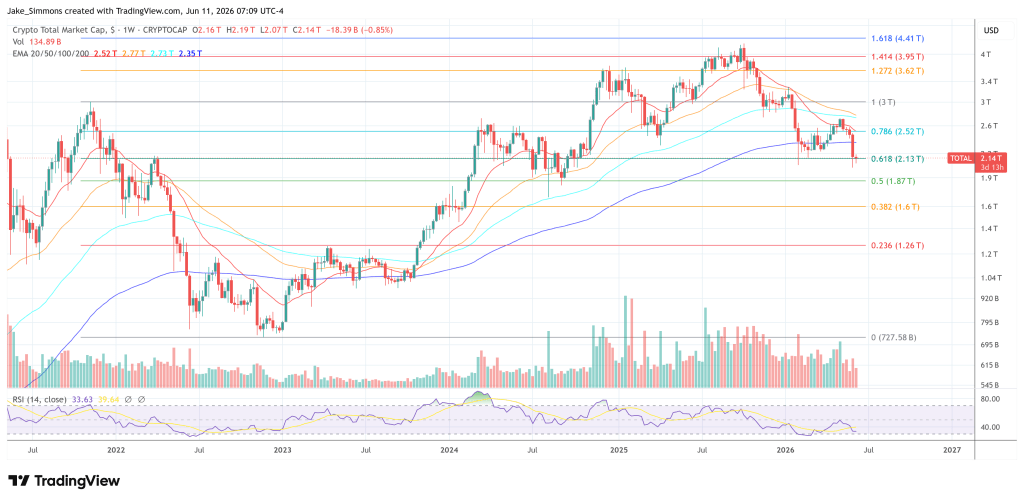
Total crypto market cap must stay above the 0.618 Fib, 1-month chart | Source: TOTAL on TradingView.com

Domande pertinenti

QWhat is the core allegation against Trenton Richard David Johnston according to the US Department of Justice?

AAccording to the DOJ, Johnston and others allegedly impersonated support representatives from a popular search engine and cryptocurrency-related companies to convince victims their accounts were compromised, gain access, and steal assets.

QHow did the defendants allegedly use the proceeds from the crypto scam?

AThey allegedly used over $1 million in illicit proceeds to lease luxury vehicles, buy high-end jewelry, and finance an extravagant nightlife and entertainment lifestyle.

QWhat charges was Brandon Michael Tardibone facing in connection to this case?

ABrandon Michael Tardibone was charged with conspiracy to commit money laundering and harboring an alien (Johnston) in the United States.

QWhat was the status of Johnston's legal case as indicated by a docket entry mentioned in the article?

AA docket entry listed a plea agreement for Johnston filed on June 9, indicating the case had moved beyond the initial indictment stage for at least one defendant.

QWhat agencies were involved in investigating this crypto fraud case?

AThe case was investigated by HSI Miami, with assistance from the Federal Deposit Insurance Corporation Office of Inspector General, IRS Criminal Investigation, U.S. Customs and Border Protection, and the Golden Beach Police Department.

Letture associate

Claude Designer Lags Behind Engineers, Fires Back by Creating a Million-User Tool

The article tells the story of Nate Parrott, a designer at Anthropic who created Claude Design as a side project to keep pace with his engineering teammates. When Anthropic released Opus 4.5 in November 2025, the two engineers on Parrott's Claude Code team significantly increased their output using the new AI capabilities. Parrott, the sole designer, found himself struggling to match their speed, becoming a bottleneck in the workflow. To catch up, he began experimenting in his spare time. He initially tried prompting Claude to generate designs from text descriptions and screenshots, with limited success. His breakthrough came when he shifted focus from asking Claude to "design" to asking it to generate HTML. He realized HTML could be a rich visual canvas for creating everything from slides and interactive prototypes to full web pages. He built a simple interface with a chat panel on the left and a live HTML preview on the right. The key to making the output useful was incorporating Anthropic's brand system—fonts, colors, assets, and design principles—into the prompts. This ensured generated designs were immediately on-brand. He shared an internal prototype with his team, and other product designers quickly adopted it for creating clickable prototypes, a task traditionally requiring manually drawing every state. The project's "official" turning point came during an Anthropic Labs offsite, where Parrott noticed many attendees were using his tool to build presentation slides on the fly, sometimes right before their turn to speak. This organic adoption convinced the Labs team to formally staff the project, turning the side project into a real product. Claude Design is positioned as a "pre-production" tool for visual communication and exploration—handling slides, landing pages, PDFs, emails, and social media graphics. It integrates with tools like Canva, Adobe, and Vercel. Its core value is accelerating the early stages of design: exploring directions, building consensus, and establishing systems. For actual production code, Anthropic still recommends Claude Code. The story highlights how AI disrupts workflows unevenly and how individuals can respond by building new tools to create their own advantages. Parrott's tool, born from necessity, eventually gained over a million users in its first week.

marsbit10 min fa

Claude Designer Lags Behind Engineers, Fires Back by Creating a Million-User Tool

marsbit10 min fa

Fields Medalist Warns: AI Could Kill Mathematics

The 2026 Fields Medal award was followed by a startling announcement: laureate Jacob Tsimerman joined OpenAI to pursue AI safety research, predicting AI would surpass humans in all mathematical proof areas within two years. Soon after, Fields Medalists Terence Tao and Timothy Gowers expressed deep concern at ICM 2026. Gorges warned that AI might "kill" mathematics not through stagnation, but through an overwhelming surplus of proofs, likening it to a lake dying from eutrophication. This concern is echoed in the "Leiden Declaration," signed by over 3,000 mathematicians including Tao, Peter Scholze, and Kevin Buzzard, advocating for mathematics as a profoundly human endeavor. However, Gowers, who did not sign, fears a future where AI-generated mathematics proliferates while human expertise and the shared intuition vital to the field vanish, turning math into an unvisited "cemetery of thought." Gowers' perspective shifted dramatically after testing ChatGPT 5.5 Pro. The AI solved a doctoral-level number theory problem and later produced a counterexample for the "unit distance problem," achievements Gorges considered publishable in top journals. He now concedes that large language models can handle advanced research, a realization that left him feeling the "rug pulled out from under" him when AI solved problems he personally contemplated. The debate extends to the nature of mathematical discovery. As noted by Peter Woit, AI agents have no interest in the "credit game" of academia. If theorems cease to be attributed to individual mathematicians, truth may simply return to its impersonal state in the universe. The central question remains: in an age of potentially limitless AI-generated discovery, what is the role and purpose of the human mind in mathematics?

marsbit41 min fa

Fields Medalist Warns: AI Could Kill Mathematics

marsbit41 min fa

NVIDIA's 20-Year CUDA Moat Collapsed Over a Weekend, Claude Single-Handedly Got AMD's New GPU Running

In a single weekend, Claude, an AI agent from Anthropic, successfully ported and optimized its cutting-edge model to run on a brand-new AMD MI355X server rack without any manual code intervention. This feat demonstrates a potential breakthrough in overcoming NVIDIA's long-established CUDA software ecosystem dominance, built over two decades. Anthropic's team simply instructed Claude to get the AMD machine running. By Monday, it not only worked but was showing a continuously improving performance curve. The achievement impressed AMD CEO Lisa Su and accelerated a major deployment partnership: Anthropic plans to deploy up to 2GW of AMD Instinct GPUs starting in 2027. The key enabler is AMD's new ROCm.AI platform, a toolbox designed specifically for AI agents like Claude. It provides AI-readable documentation, including chip instruction sets (ISA), and tools like the Hyperloom service that allows agents to autonomously profile performance, identify bottlenecks, test configurations, and generate optimized kernels. In a demo, Hyperloom boosted the output speed of a model by 38%. This represents a fundamental shift. While CUDA's strength lies in its vast, human-expert-driven ecosystem of tools and tacit knowledge, AMD's strategy is to make its hardware and software stack directly accessible and optimizable by AI agents. An agent can parallelize tasks—debugging, profiling, coding—that would take human engineers years to master, compressing the traditional software adaptation timeline from years to tasks. The competition is no longer just about peak hardware specs but also about how well AI can read, utilize, and tune a platform.

marsbit42 min fa

NVIDIA's 20-Year CUDA Moat Collapsed Over a Weekend, Claude Single-Handedly Got AMD's New GPU Running

marsbit42 min fa

Just Now, Peking University Alumna Lilian Weng Announces Resignation: The Best 'Alignment' in the AI Era Is Taking Care of Yourself

Lilian Weng, a Peking University alumnus and former OpenAI executive, has announced her departure from Thinking Machines Lab, the AI startup she co-founded with ex-OpenAI CTO Mira Murati 20 months ago. Her resignation comes shortly after the company released its first open-source model, Inkling. In her farewell message, Weng cited health reasons as the primary factor, stating that the past seven months involved more illness than any other period in her life. The intense pressure and guilt of being unable to work during critical periods, like the Inkling launch, became unsustainable. She expressed that she could not continue in a role where she felt unable to give her full effort. Weng joined OpenAI in 2018, contributing to projects like the Dactyl robotic hand and later building the Safety Systems team from scratch. She is also widely known for her influential technical blog, Lil'Log. Her departure follows a period of high expectations and challenges for Thinking Machines, which secured a record $20 billion seed round at a $120 billion valuation in 2025 but has since seen fluctuations in its valuation and the departure of other key co-founders. Weng emphasized that she remains passionate about AI but needs a more predictable and defined role without the relentless pressure of a co-founder. Her exit highlights the immense personal toll and speed of competition in the AI industry, where the drive for progress often clashes with human limits. Her decision underscores that stepping back to prioritize well-being can be an act of courage.

marsbit1 h fa

Just Now, Peking University Alumna Lilian Weng Announces Resignation: The Best 'Alignment' in the AI Era Is Taking Care of Yourself

marsbit1 h fa

Trading

Spot
活动图片