Wall Street's Most Mysterious Money Machine: Dumping Bitcoin at 10 AM Sharp Every Day

marsbitPubblicato 2026-02-26Pubblicato ultima volta 2026-02-26

Introduzione

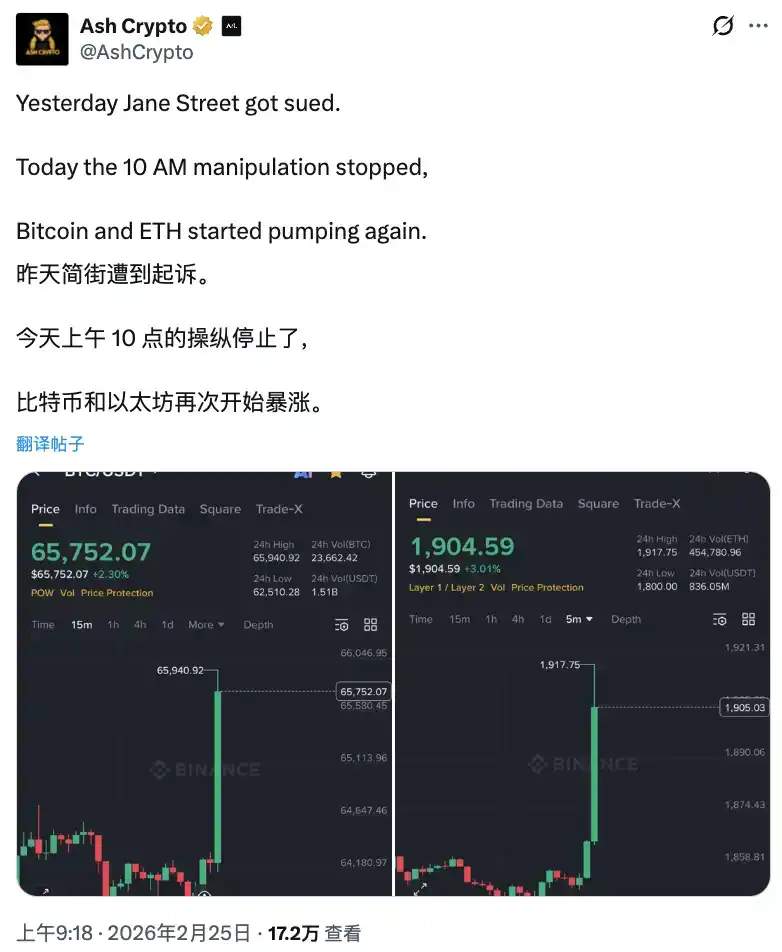
A mysterious pattern dubbed the "Jane 10 AM Dump" has been observed in Bitcoin markets, where prices drop sharply each day at 10 AM EST, coinciding with the US stock market open. Traders and media, including ZeroHedge, point to Jane Street, a major market maker and large holder of BlackRock's Bitcoin ETF (IBIT), as the likely orchestrator—selling at 10 AM to then buy back at lower prices. This theory gained traction amid a lawsuit from Terraform Labs' bankruptcy estate. The suit alleges Jane Street used insider information to exit TerraUSD (UST) positions just before its May 2022 collapse, avoiding $40 billion in losses. Key to the case is a former Terra intern, Bryce Pratt, who joined Jane Street and allegedly ran a secret chat group ("Bryce's Secret") to funnel non-public information from Terraform insiders. The complaint details that Jane Street, which had a prior trading relationship with Terraform, withdrew 85 million UST from a liquidity pool minutes after Terraform secretly pulled 150 million UST—before public panic began. Chain analysis suggests Jane Street systematically reduced exposure pre-collapse. Further supporting the pattern of misconduct, India's regulator SEBI fined Jane Street a record $570 million for a "pump-and-dump" scheme manipulating banking index options, exploiting retail investors. While unproven, the cases depict Jane Street as a powerful, secretive firm adept at leveraging information advantages, now under scrutiny for practices that blur eth...

Once might be a coincidence, three times might be luck, but what about the 10th time?

Starting in the second half of 2025, some traders following Bitcoin's movements on Twitter noticed something strange. They reviewed the intraday charts from the past six months and grew increasingly suspicious: almost every day around 10 AM, just as the U.S. stock market opened and market sentiment was most active, Bitcoin would experience a sharp, clean drop, precisely erasing its earlier gains.

He posted this discovery on Twitter, and unexpectedly, the comments section exploded with others who had noticed the same thing: "I noticed it too," "It's been going on for months," "This is definitely not a coincidence."

Financial media outlet ZeroHedge was even more direct, tweeting one message after another since last July, pointing the finger squarely at one of the main market makers for the spot Bitcoin ETF: Jane Street. After the 10 AM dump, Jane Street quietly accumulates, holding over $2.5 billion in BlackRock's Bitcoin ETF, IBIT.
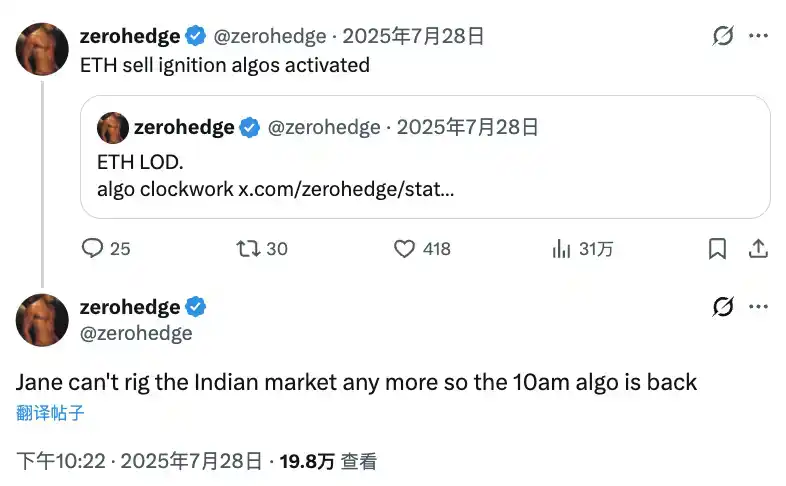
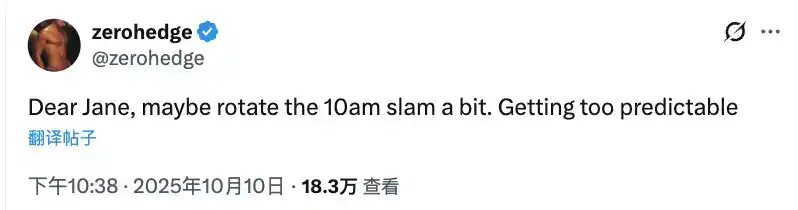
They even gave this phenomenon a name: the "Jane 10 AM Dump Strategy." And what recently brought this rumor back into widespread circulation was a lawsuit from Terra.

An Intern Named Bryce

Recently, the bankruptcy administrator for Terraform Labs filed a lawsuit in court. The defendants are Jane Street, Jane Street's co-founder Robert Granieri, and two traders, Bryce Pratt and Michael Huang.
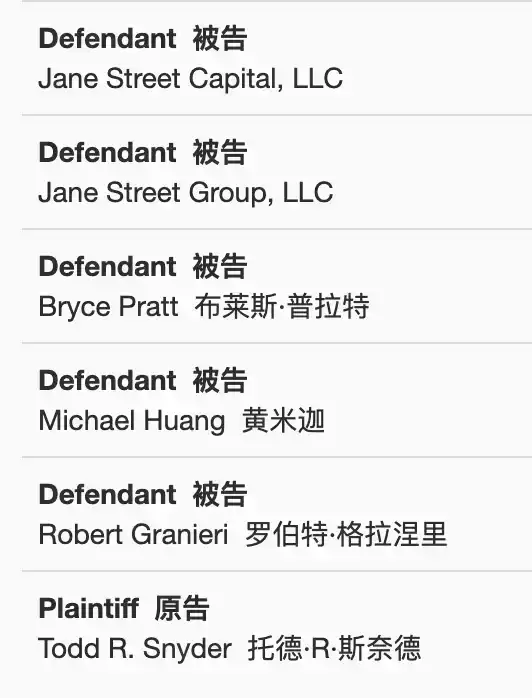
This is an extremely low-profile company on Wall Street. It never gives media interviews, never brags about its profits publicly, and for a long time, people outside the circle didn't even know it existed. But within the financial industry, the name Jane Street is almost universally known—it's an institution that has made tens of billions of dollars through quantitative trading and market making, with annual profit per employee unmatched anywhere else on Wall Street.

The core allegation in the lawsuit is, in essence, not complicated: on the eve of the collapse of UST (TerraUSD) in 2022, Jane Street used non-public information obtained from insiders to exit their positions early, quietly getting out unscathed before the entire $40 billion Terra ecosystem turned to dust.

And the starting point of this "insider information" trade was a young man named Bryce Pratt.

Bryce Pratt had previously interned at Terraform and later joined Jane Street. Under normal circumstances, a previous internship would be just an insignificant line on a resume. But the court complaint spends a full three pages, from page 29 to 31, describing him for one reason only: after leaving Terraform, he didn't really leave.

He created a private group chat, adding a Terraform software engineer and the head of business development. The group was named "Bryce's Secret."

The name was rather blunt, and rather bold. According to the lawsuit, the function of this group chat was to continuously funnel internal information from Terraform back to Jane Street. At the same time, Bryce also acted as a bridge, introducing Terraform's head of business development to the leader of Jane Street's "DeFi department," and the two sides began regular communications under the guise of "exploring strategic investment cooperation."

From the lawsuit's perspective, Jane Street effectively turned this communication channel into a backdoor for continuously obtaining material non-public information.

Jane and Terraform Have a Little-Known History

Rewind a bit further.

The relationship between Jane Street and Terraform didn't start with Bryce Pratt's group chat; it started earlier. In May 2021, during the first de-pegging of UST.

That time, UST briefly deviated from its dollar peg, causing panic throughout the Terra ecosystem. To stabilize the situation, Terraform Labs began contacting institutional trading partners for large-scale over-the-counter (OTC) arrangements. Jane Street was one of them.
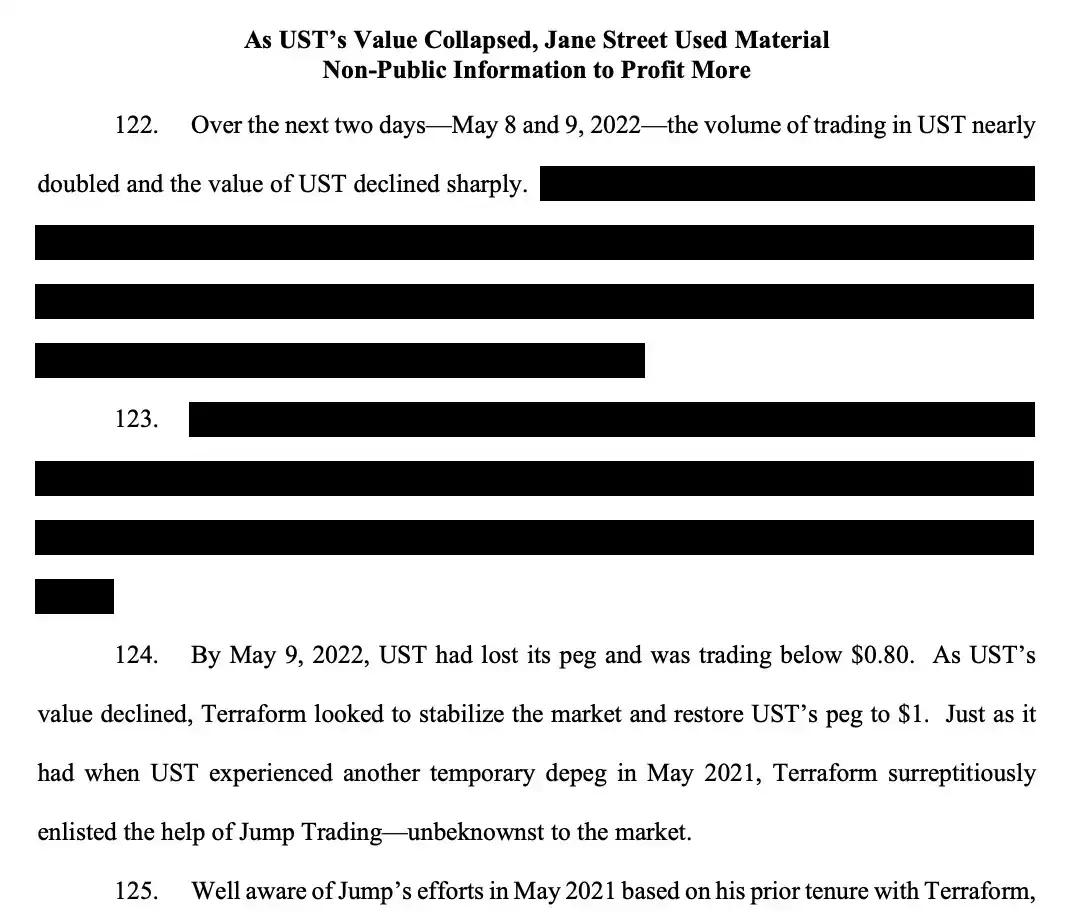
According to the lawsuit, in this relationship, Terraform provided Jane Street with large trading allocations for UST and Luna, and at certain stages offered discounts or structural incentives in exchange for their providing support during critical moments. These terms were never disclosed to the public.

This means the relationship between the two companies was not ordinary market trading from the start, but a contractual, interest-aligned bond. It is this layer of relationship that makes the insider trading allegations harder to dismiss legally—when you have a secret agreement with the other party and simultaneously hold their non-public internal information, any trade you make appears highly unusual.

Time moved to early 2022. On the surface, the Terra ecosystem was at its peak: the Luna Foundation Guard (LFG) had just been established, absorbing reserves of Luna worth approximately $5.5 billion, and used $3 billion to purchase other assets, presenting an image of an impregnable fortress. However, beneath this glossy surface, signs of trouble were emerging: deposit sizes on the Anchor protocol began to face pressure, UST's reliance on the peg rate intensified, and the rate of LFG's reserve consumption quietly accelerated.

Not many people knew this. But Jane Street happened to be one of them.

10 Minutes Before a $40 Billion Empire Collapsed

May 7, 2022, Eastern Time, 5:44 PM.

Terraform quietly withdrew 150 million TerraUSD from the Curve 3pool—a liquidity pool specifically for swapping dollar stablecoins. No announcement, no warning, no public statement.

This operation was completely unknown to the outside world at the time.

Yet, less than ten minutes after these funds were withdrawn, a wallet identified by on-chain analysts as associated with Jane Street withdrew 85 million TerraUSD from the same liquidity pool.

The lawsuit further alleges that Jane Street's unusual actions did not stop there. Before the de-pegging of UST became apparent and public panic began to spread, addresses associated with Jane Street had already systematically de-risked—large-scale selling of UST, adjusting related positions, reducing their net exposure to the Terra ecosystem to a minimum. Some specific figures are redacted in the lawsuit, usually indicating commercial confidentiality or evidence not yet public, but the fund flow trajectories tracked by on-chain analysts are sufficient to tell the story.

Meanwhile, Terraform and LFG were doing the exact opposite.

On May 7, Terraform bought over 250 million UST. On May 8, it bought another over 200 million. In the following days, cumulative purchases exceeded 1.9 billion UST, plus over 90 million Luna. As for LFG, by May 16, its UST holdings soared from about 700,000 to over 1.8 billion, an increase of over 1.7 billion; its Luna holdings surged from 1.7 million to over 222 million.

Another piece of evidence is a report published by on-chain data analysis firm Nansen on May 27, titled "On-Chain Forensics: Unraveling the Mystery of TerraUSD's Depegging." The report did not directly name Jane Street but detailed several wallets that played key roles during the de-pegging, including one later alleged to be associated with Jane Street. The report's conclusions were two-fold: first, these fund movements occurred before the market panic became apparent; second, there was a significant time gap between these operations and the publicly visible crash timeline.
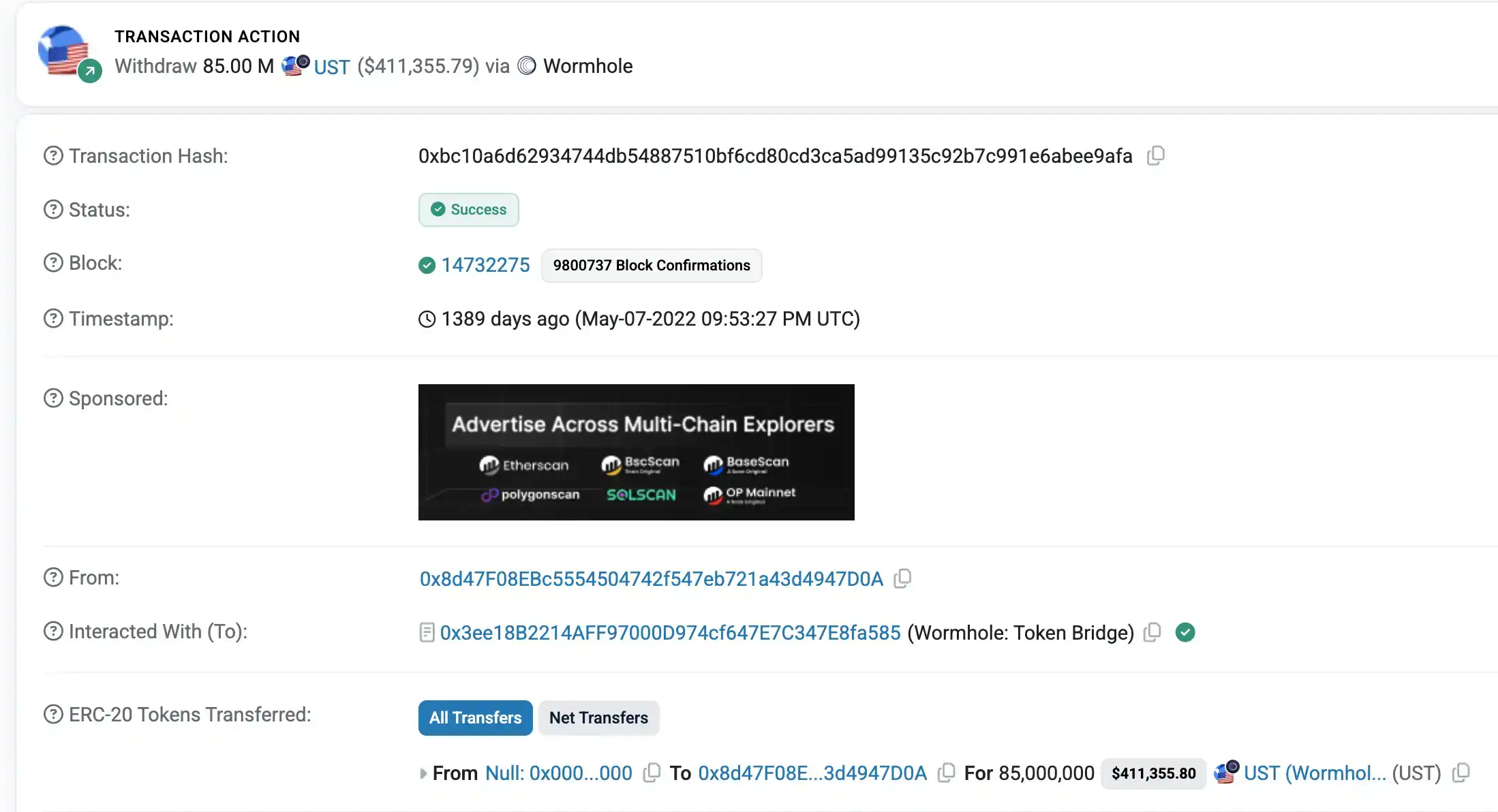
Suspected Jane Street-associated address withdrew 85 million TerraUSD

The lawsuit also mentions that after the trades on May 7 were completed, Jane Street did not stop. They allegedly continued to use confidential information obtained from Jump Trading to further trade TerraUSD and amplify their gains. Jump Trading had previously secretly agreed with Terraform to intervene and support the price, ultimately profiting billions from the collapse.

In India, They Did the Same Thing

Now, attentive researchers have noticed that after Jane Street was sued by Terra, the 10 AM dumps disappeared. This seems to further confirm the rumors of the "Jane 10 AM Dump Strategy."
On the other side of the world in India, regulators had already formed their own judgment about Jane Street.

The Securities and Exchange Board of India (SEBI) issued a provisional order, 105 pages long, imposing a record fine of 48.43 billion rupees—approximately $570 million. This figure is unprecedented in Indian regulatory history, and SEBI's findings read remarkably similar to the allegations in the Terra Luna case.

SEBI believes Jane Street implemented a carefully designed "pump and dump" strategy in the Indian market.

The logic is as follows: First, use large-scale directional buy orders in the relatively illiquid spot and futures markets to artificially push the Nifty Bank Index (BANK NIFTY) up or down; after the price is pushed to the desired level, immediately execute reverse operations in the highly liquid options market, harvesting retail traders who followed the trend; finally, systematically dump the previously built spot positions, causing the index to fall back, rendering the options held by retail traders worthless, while the value of their own reverse positions soars.

SEBI's report cited a specific example: on January 17, 2024, Jane Street built a long position of approximately $67 million in just 8 minutes. Their trading volume was more than three times that of the market's second-largest participant, and this single buy order alone pushed the index up over 1%.

The regulator's wording was毫不客气 (unsparing),称 (calling) Jane Street's actions "trading to influence the price, not being guided by the price to trade," constituting a "deliberate, well-planned, sinister scheme and artifice" with the sole intention of misleading the market, particularly by exploiting the vast number of inexperienced retail participants.

Jane Street was for a long time a classic case of this narrative. The company is known for being extremely low-profile, never giving media interviews, never boasting to the outside world. It amassed astonishing wealth through quantitative trading and market making, achieving a near-mythical status within the circle. Every recruitment season, the salary figures it offers drive Wall Street's new graduates crazy, with competition as fierce as any top-tier institution.

However, starting from a certain point, the stories about this company began to become more complex.

In the Terra Luna case, it is accused of using insider information to escape early, completing its retreat while Terraform and LFG were desperately propping up the market with billions. In the Indian market, it was identified by regulators as systematically manipulating spot and derivative prices to harvest ordinary investors. Alameda Research—the core team behind FTX, which dragged the entire crypto industry into its darkest hour—had many members from Jane Street, and its founder, SBF, admitted that his market thinking framework was learned at Jane Street. Additionally, Jane Street is known for aggressively suing former employees, its维权 (rights protection/legal action) being notably vigorous even by Wall Street standards. An earlier investigative report even linked it to weapon procurement funds in a coup attempt in South Sudan, although the details remain disputed.

Information is power; information represents hierarchy.

Jane Street's "track record" seems to be more extensive than we imagined, and Jane Street's reputation has indeed taken a hit in recent years. Although the lawsuit against Jane Street has not yet reached a conclusion.

But for one company to appear in so many negative stories simultaneously, is itself a signal.

Domande pertinenti

QWhat is the 'Jane 10 a.m. Dump Strategy' mentioned in the article?

AThe 'Jane 10 a.m. Dump Strategy' refers to the alleged pattern where Jane Street, a major market maker, would consistently cause a sharp drop in Bitcoin's price around 10 a.m. EST, coinciding with the U.S. stock market opening, and then buy back the dip.

QWho is Bryce Pratt and what role did he play in the Terra lawsuit?

ABryce Pratt is a former intern at Terraform Labs who later joined Jane Street. The lawsuit alleges he created a private chat group called 'Bryce's Secret' with Terraform employees to funnel non-public internal information to Jane Street, which the firm then used to exit its positions before the UST collapse.

QWhat specific action did Jane Street allegedly take just before the UST collapse in May 2022?

AAccording to the lawsuit, within ten minutes of Terraform Labs secretly withdrawing 150 million UST from the Curve 3pool on May 7, 2022, a wallet linked to Jane Street withdrew 85 million UST from the same pool. Jane Street then systematically reduced its exposure to the Terra ecosystem before the public panic began.

QWhat was the outcome of the regulatory action against Jane Street in India?

AThe Securities and Exchange Board of India (SEBI) issued a record fine of approximately $570 million (48.43 billion rupees) against Jane Street. The regulator accused the firm of a 'pump and dump' scheme, manipulating the BANK NIFTY index through large directional trades in the spot market to profit from opposite positions in the options market, misleading retail investors.

QWhat is the broader implication of Jane Street's involvement in multiple high-profile incidents according to the article?

AThe article suggests that Jane Street's repeated involvement in controversies—including the Terra insider trading allegations, the Indian market manipulation case, its connection to FTX's Alameda Research, and its aggressive litigation against former employees—signals a pattern of behavior where the firm uses its access to information and market power to its advantage, often at the expense of other market participants.

Letture associate

Tracking 'Insider Signals' from Public Data: Screening Strategies for High-Win-Rate Addresses on Polymarket

Title: Tracking "Insider Signals" from Public Data: Strategies for Identifying High-Accuracy Addresses on Polymarket Polymarket, a blockchain-based prediction market platform, offers fully transparent on-chain data, enabling users to analyze trading behaviors and identify addresses with potentially significant informational advantages. Unlike traditional financial markets, all transactions, positions, and timing are publicly accessible, but the key challenge lies in interpreting meaningful signals from vast datasets. High-performing addresses often exhibit distinct patterns: - New addresses making large, concentrated bets in low-liquidity markets. - Specialization in specific sectors (e.g., politics, crypto) rather than diversified trading. - Sudden increases in position sizes, indicating heightened conviction. - Repeatedly accurate timing, entering positions hours before major public news breaks. A systematic approach to identifying such addresses involves: 1. **Screening via Polymarket Analytics**: Filter addresses with consistent 30-day profitability, >55% win rates, and significant net gains in liquid markets. 2. **Analyzing Event-Specific Holdings**: Examine top holders in active markets, focusing on addresses that repeatedly build large positions before full market pricing. 3. **Scrutinizing Trading Behavior**: Assess entry timing (pre-news vs. post-news), concentration of buys, holding duration, and sector focus. Advanced strategies include monitoring exit behaviors (e.g., pre-emptive selling), clustering related addresses via fund flows and gas usage patterns, tracking unusual volume spikes in niche markets, and cross-referencing on-chain activity with external data (e.g., social media, real-world events). By leveraging public blockchain data and behavioral analysis, users can systematically identify and track addresses that may possess informational edges, transforming raw data into actionable insights.

比推16 min fa

Tracking 'Insider Signals' from Public Data: Screening Strategies for High-Win-Rate Addresses on Polymarket

比推16 min fa

Trading

Spot
Futures

Articoli Popolari

Cosa è $S$

Comprendere SPERO: Una Panoramica Completa Introduzione a SPERO Mentre il panorama dell'innovazione continua a evolversi, l'emergere delle tecnologie web3 e dei progetti di criptovaluta gioca un ruolo fondamentale nel plasmare il futuro digitale. Un progetto che ha attirato l'attenzione in questo campo dinamico è SPERO, denotato come SPERO,$$s$. Questo articolo mira a raccogliere e presentare informazioni dettagliate su SPERO, per aiutare gli appassionati e gli investitori a comprendere le sue basi, obiettivi e innovazioni nei domini web3 e crypto. Che cos'è SPERO,$$s$? SPERO,$$s$ è un progetto unico all'interno dello spazio crypto che cerca di sfruttare i principi della decentralizzazione e della tecnologia blockchain per creare un ecosistema che promuove l'impegno, l'utilità e l'inclusione finanziaria. Il progetto è progettato per facilitare interazioni peer-to-peer in modi nuovi, fornendo agli utenti soluzioni e servizi finanziari innovativi. Al suo interno, SPERO,$$s$ mira a responsabilizzare gli individui fornendo strumenti e piattaforme che migliorano l'esperienza dell'utente nello spazio delle criptovalute. Questo include la possibilità di metodi di transazione più flessibili, la promozione di iniziative guidate dalla comunità e la creazione di percorsi per opportunità finanziarie attraverso applicazioni decentralizzate (dApps). La visione sottostante di SPERO,$$s$ ruota attorno all'inclusività, cercando di colmare le lacune all'interno della finanza tradizionale mentre sfrutta i vantaggi della tecnologia blockchain. Chi è il Creatore di SPERO,$$s$? L'identità del creatore di SPERO,$$s$ rimane piuttosto oscura, poiché ci sono risorse pubblicamente disponibili limitate che forniscono informazioni dettagliate sul suo fondatore o fondatori. Questa mancanza di trasparenza può derivare dall'impegno del progetto per la decentralizzazione—un ethos che molti progetti web3 condividono, dando priorità ai contributi collettivi rispetto al riconoscimento individuale. Centrando le discussioni attorno alla comunità e ai suoi obiettivi collettivi, SPERO,$$s$ incarna l'essenza dell'empowerment senza mettere in evidenza individui specifici. Pertanto, comprendere l'etica e la missione di SPERO rimane più importante che identificare un creatore singolo. Chi sono gli Investitori di SPERO,$$s$? SPERO,$$s$ è supportato da una varietà di investitori che vanno dai capitalisti di rischio agli investitori angelici dedicati a promuovere l'innovazione nel settore crypto. Il focus di questi investitori generalmente si allinea con la missione di SPERO—dando priorità a progetti che promettono avanzamenti tecnologici sociali, inclusività finanziaria e governance decentralizzata. Queste fondazioni di investitori sono tipicamente interessate a progetti che non solo offrono prodotti innovativi, ma contribuiscono anche positivamente alla comunità blockchain e ai suoi ecosistemi. Il supporto di questi investitori rafforza SPERO,$$s$ come un concorrente degno di nota nel dominio in rapida evoluzione dei progetti crypto. Come Funziona SPERO,$$s$? SPERO,$$s$ impiega un framework multifunzionale che lo distingue dai progetti di criptovaluta convenzionali. Ecco alcune delle caratteristiche chiave che sottolineano la sua unicità e innovazione: Governance Decentralizzata: SPERO,$$s$ integra modelli di governance decentralizzati, responsabilizzando gli utenti a partecipare attivamente ai processi decisionali riguardanti il futuro del progetto. Questo approccio favorisce un senso di proprietà e responsabilità tra i membri della comunità. Utilità del Token: SPERO,$$s$ utilizza il proprio token di criptovaluta, progettato per servire varie funzioni all'interno dell'ecosistema. Questi token abilitano transazioni, premi e la facilitazione dei servizi offerti sulla piattaforma, migliorando l'impegno e l'utilità complessivi. Architettura Stratificata: L'architettura tecnica di SPERO,$$s$ supporta la modularità e la scalabilità, consentendo un'integrazione fluida di funzionalità e applicazioni aggiuntive man mano che il progetto evolve. Questa adattabilità è fondamentale per mantenere la rilevanza nel panorama crypto in continua evoluzione. Coinvolgimento della Comunità: Il progetto enfatizza iniziative guidate dalla comunità, impiegando meccanismi che incentivano la collaborazione e il feedback. Nutrendo una comunità forte, SPERO,$$s$ può affrontare meglio le esigenze degli utenti e adattarsi alle tendenze di mercato. Focus sull'Inclusione: Offrendo basse commissioni di transazione e interfacce user-friendly, SPERO,$$s$ mira ad attrarre una base utenti diversificata, inclusi individui che potrebbero non aver precedentemente interagito nello spazio crypto. Questo impegno per l'inclusione si allinea con la sua missione generale di empowerment attraverso l'accessibilità. Cronologia di SPERO,$$s$ Comprendere la storia di un progetto fornisce preziose intuizioni sulla sua traiettoria di sviluppo e sui traguardi. Di seguito è riportata una cronologia suggerita che mappa eventi significativi nell'evoluzione di SPERO,$$s$: Fase di Concettualizzazione e Ideazione: Le idee iniziali che formano la base di SPERO,$$s$ sono state concepite, allineandosi strettamente con i principi di decentralizzazione e focus sulla comunità all'interno dell'industria blockchain. Lancio del Whitepaper del Progetto: Dopo la fase concettuale, è stato rilasciato un whitepaper completo che dettaglia la visione, gli obiettivi e l'infrastruttura tecnologica di SPERO,$$s$ per suscitare interesse e feedback dalla comunità. Costruzione della Comunità e Prime Interazioni: Sono stati effettuati sforzi attivi di outreach per costruire una comunità di early adopters e potenziali investitori, facilitando discussioni attorno agli obiettivi del progetto e ottenendo supporto. Evento di Generazione del Token: SPERO,$$s$ ha condotto un evento di generazione del token (TGE) per distribuire i propri token nativi ai primi sostenitori e stabilire una liquidità iniziale all'interno dell'ecosistema. Lancio della Prima dApp: La prima applicazione decentralizzata (dApp) associata a SPERO,$$s$ è stata attivata, consentendo agli utenti di interagire con le funzionalità principali della piattaforma. Sviluppo Continuo e Partnership: Aggiornamenti e miglioramenti continui alle offerte del progetto, inclusi partnership strategiche con altri attori nello spazio blockchain, hanno plasmato SPERO,$$s$ in un concorrente competitivo e in evoluzione nel mercato crypto. Conclusione SPERO,$$s$ rappresenta una testimonianza del potenziale del web3 e delle criptovalute di rivoluzionare i sistemi finanziari e responsabilizzare gli individui. Con un impegno per la governance decentralizzata, il coinvolgimento della comunità e funzionalità progettate in modo innovativo, apre la strada verso un panorama finanziario più inclusivo. Come per qualsiasi investimento nello spazio crypto in rapida evoluzione, si incoraggiano potenziali investitori e utenti a ricercare approfonditamente e a impegnarsi in modo riflessivo con gli sviluppi in corso all'interno di SPERO,$$s$. Il progetto mostra lo spirito innovativo dell'industria crypto, invitando a ulteriori esplorazioni delle sue innumerevoli possibilità. Mentre il percorso di SPERO,$$s$ è ancora in fase di sviluppo, i suoi principi fondamentali potrebbero effettivamente influenzare il futuro di come interagiamo con la tecnologia, la finanza e tra di noi in ecosistemi digitali interconnessi.

75 Totale visualizzazioniPubblicato il 2024.12.17Aggiornato il 2024.12.17

Cosa è $S$

Cosa è AGENT S

Agent S: Il Futuro dell'Interazione Autonoma in Web3 Introduzione Nel panorama in continua evoluzione di Web3 e criptovalute, le innovazioni stanno costantemente ridefinendo il modo in cui gli individui interagiscono con le piattaforme digitali. Uno di questi progetti pionieristici, Agent S, promette di rivoluzionare l'interazione uomo-computer attraverso il suo framework agentico aperto. Aprendo la strada a interazioni autonome, Agent S mira a semplificare compiti complessi, offrendo applicazioni trasformative nell'intelligenza artificiale (AI). Questa esplorazione dettagliata approfondirà le complessità del progetto, le sue caratteristiche uniche e le implicazioni per il dominio delle criptovalute. Cos'è Agent S? Agent S si presenta come un innovativo framework agentico aperto, progettato specificamente per affrontare tre sfide fondamentali nell'automazione dei compiti informatici: Acquisizione di Conoscenze Specifiche del Dominio: Il framework apprende in modo intelligente da varie fonti di conoscenza esterne ed esperienze interne. Questo approccio duale gli consente di costruire un ricco repository di conoscenze specifiche del dominio, migliorando le sue prestazioni nell'esecuzione dei compiti. Pianificazione su Lungo Orizzonte di Compiti: Agent S impiega una pianificazione gerarchica potenziata dall'esperienza, un approccio strategico che facilita la suddivisione e l'esecuzione efficiente di compiti complessi. Questa caratteristica migliora significativamente la sua capacità di gestire più sottocompiti in modo efficiente ed efficace. Gestione di Interfacce Dinamiche e Non Uniformi: Il progetto introduce l'Interfaccia Agente-Computer (ACI), una soluzione innovativa che migliora l'interazione tra agenti e utenti. Utilizzando Modelli Linguistici Multimodali di Grandi Dimensioni (MLLM), Agent S può navigare e manipolare senza sforzo diverse interfacce grafiche utente. Attraverso queste caratteristiche pionieristiche, Agent S fornisce un framework robusto che affronta le complessità coinvolte nell'automazione dell'interazione umana con le macchine, preparando il terreno per innumerevoli applicazioni nell'AI e oltre. Chi è il Creatore di Agent S? Sebbene il concetto di Agent S sia fondamentalmente innovativo, informazioni specifiche sul suo creatore rimangono elusive. Il creatore è attualmente sconosciuto, il che evidenzia sia la fase embrionale del progetto sia la scelta strategica di mantenere i membri fondatori sotto anonimato. Indipendentemente dall'anonimato, l'attenzione rimane sulle capacità e sul potenziale del framework. Chi sono gli Investitori di Agent S? Poiché Agent S è relativamente nuovo nell'ecosistema crittografico, informazioni dettagliate riguardanti i suoi investitori e sostenitori finanziari non sono documentate esplicitamente. La mancanza di approfondimenti pubblicamente disponibili sulle fondazioni di investimento o sulle organizzazioni che supportano il progetto solleva interrogativi sulla sua struttura di finanziamento e sulla roadmap di sviluppo. Comprendere il supporto è cruciale per valutare la sostenibilità del progetto e il suo potenziale impatto sul mercato. Come Funziona Agent S? Al centro di Agent S si trova una tecnologia all'avanguardia che gli consente di funzionare efficacemente in contesti diversi. Il suo modello operativo è costruito attorno a diverse caratteristiche chiave: Interazione Uomo-Computer Simile a Quella Umana: Il framework offre una pianificazione AI avanzata, cercando di rendere le interazioni con i computer più intuitive. Mimando il comportamento umano nell'esecuzione dei compiti, promette di elevare le esperienze degli utenti. Memoria Narrativa: Utilizzata per sfruttare esperienze di alto livello, Agent S utilizza la memoria narrativa per tenere traccia delle storie dei compiti, migliorando così i suoi processi decisionali. Memoria Episodica: Questa caratteristica fornisce agli utenti una guida passo-passo, consentendo al framework di offrire supporto contestuale mentre i compiti si sviluppano. Supporto per OpenACI: Con la capacità di funzionare localmente, Agent S consente agli utenti di mantenere il controllo sulle proprie interazioni e flussi di lavoro, allineandosi con l'etica decentralizzata di Web3. Facile Integrazione con API Esterne: La sua versatilità e compatibilità con varie piattaforme AI garantiscono che Agent S possa adattarsi senza problemi agli ecosistemi tecnologici esistenti, rendendolo una scelta attraente per sviluppatori e organizzazioni. Queste funzionalità contribuiscono collettivamente alla posizione unica di Agent S all'interno dello spazio crittografico, poiché automatizza compiti complessi e multi-fase con un intervento umano minimo. Man mano che il progetto evolve, le sue potenziali applicazioni in Web3 potrebbero ridefinire il modo in cui si svolgono le interazioni digitali. Cronologia di Agent S Lo sviluppo e le tappe di Agent S possono essere riassunti in una cronologia che evidenzia i suoi eventi significativi: 27 Settembre 2024: Il concetto di Agent S è stato lanciato in un documento di ricerca completo intitolato “Un Framework Agentico Aperto che Usa i Computer Come un Umano”, mostrando le basi per il progetto. 10 Ottobre 2024: Il documento di ricerca è stato reso pubblicamente disponibile su arXiv, offrendo un'esplorazione approfondita del framework e della sua valutazione delle prestazioni basata sul benchmark OSWorld. 12 Ottobre 2024: È stata rilasciata una presentazione video, fornendo un'idea visiva delle capacità e delle caratteristiche di Agent S, coinvolgendo ulteriormente potenziali utenti e investitori. Questi indicatori nella cronologia non solo illustrano i progressi di Agent S, ma indicano anche il suo impegno per la trasparenza e il coinvolgimento della comunità. Punti Chiave su Agent S Man mano che il framework Agent S continua a evolversi, diversi attributi chiave si distinguono, sottolineando la sua natura innovativa e il potenziale: Framework Innovativo: Progettato per fornire un uso intuitivo dei computer simile all'interazione umana, Agent S porta un approccio nuovo all'automazione dei compiti. Interazione Autonoma: La capacità di interagire autonomamente con i computer attraverso GUI segna un passo avanti verso soluzioni informatiche più intelligenti ed efficienti. Automazione di Compiti Complessi: Con la sua metodologia robusta, può automatizzare compiti complessi e multi-fase, rendendo i processi più veloci e meno soggetti a errori. Miglioramento Continuo: I meccanismi di apprendimento consentono ad Agent S di migliorare dalle esperienze passate, migliorando continuamente le sue prestazioni e la sua efficacia. Versatilità: La sua adattabilità attraverso diversi ambienti operativi come OSWorld e WindowsAgentArena garantisce che possa servire un'ampia gamma di applicazioni. Man mano che Agent S si posiziona nel panorama di Web3 e delle criptovalute, il suo potenziale per migliorare le capacità di interazione e automatizzare i processi segna un significativo avanzamento nelle tecnologie AI. Attraverso il suo framework innovativo, Agent S esemplifica il futuro delle interazioni digitali, promettendo un'esperienza più fluida ed efficiente per gli utenti in vari settori. Conclusione Agent S rappresenta un audace passo avanti nell'unione tra AI e Web3, con la capacità di ridefinire il modo in cui interagiamo con la tecnologia. Sebbene sia ancora nelle sue fasi iniziali, le possibilità per la sua applicazione sono vaste e coinvolgenti. Attraverso il suo framework completo che affronta sfide critiche, Agent S mira a portare le interazioni autonome al centro dell'esperienza digitale. Man mano che ci addentriamo nei regni delle criptovalute e della decentralizzazione, progetti come Agent S giocheranno senza dubbio un ruolo cruciale nel plasmare il futuro della tecnologia e della collaborazione uomo-computer.

284 Totale visualizzazioniPubblicato il 2025.01.14Aggiornato il 2025.01.14

Cosa è AGENT S

Come comprare S

Benvenuto in HTX.com! Abbiamo reso l'acquisto di Sonic (S) semplice e conveniente. Segui la nostra guida passo passo per intraprendere il tuo viaggio nel mondo delle criptovalute.Step 1: Crea il tuo Account HTXUsa la tua email o numero di telefono per registrarti il tuo account gratuito su HTX. Vivi un'esperienza facile e sblocca tutte le funzionalità,Crea il mio accountStep 2: Vai in Acquista crypto e seleziona il tuo metodo di pagamentoCarta di credito/debito: utilizza la tua Visa o Mastercard per acquistare immediatamente SonicS.Bilancio: Usa i fondi dal bilancio del tuo account HTX per fare trading senza problemi.Terze parti: abbiamo aggiunto metodi di pagamento molto utilizzati come Google Pay e Apple Pay per maggiore comodità.P2P: Fai trading direttamente con altri utenti HTX.Over-the-Counter (OTC): Offriamo servizi su misura e tassi di cambio competitivi per i trader.Step 3: Conserva Sonic (S)Dopo aver acquistato Sonic (S), conserva nel tuo account HTX. In alternativa, puoi inviare tramite trasferimento blockchain o scambiare per altre criptovalute.Step 4: Scambia Sonic (S)Scambia facilmente Sonic (S) nel mercato spot di HTX. Accedi al tuo account, seleziona la tua coppia di trading, esegui le tue operazioni e monitora in tempo reale. Offriamo un'esperienza user-friendly sia per chi ha appena iniziato che per i trader più esperti.

360 Totale visualizzazioniPubblicato il 2025.01.15Aggiornato il 2025.03.21

Come comprare S

Discussioni

Benvenuto nella Community HTX. Qui puoi rimanere informato sugli ultimi sviluppi della piattaforma e accedere ad approfondimenti esperti sul mercato. Le opinioni degli utenti sul prezzo di S S sono presentate come di seguito.

活动图片