From Speculation to Risk Management: Predictive Markets Are Filling the Gap in Commercial Insurance

marsbitPubblicato 2026-08-17Pubblicato ultima volta 2026-08-17

Introduzione

From Speculation to Risk Management: Predictive Markets Filling the Commercial Insurance Gap The emergence of AI risk management tools like Blanket is exploring the potential of predictive markets as a genuine insurance tool for businesses. These markets, with their simple contract structure—paying $1 if an event occurs, $0 if not—allow the real-time market price to reflect collective probability assessments. Businesses can use them to hedge against operational risks (e.g., abnormal weather, energy price fluctuations) that are often not covered by traditional business interruption insurance, which typically requires physical damage. A key question is whether these markets are genuinely used for hedging or remain primarily speculative. Analysis of Kalshi markets from August 2025 to August 2026 compared weather contracts (a potential hedge instrument) against sports contracts (largely speculative) and traditional CME grain futures. Three behavioral metrics were examined: 1. **Daily Turnover Rate:** Weather contracts showed the lowest rate (0.210), lower than corn futures (0.266) and significantly lower than sports contracts (0.315), suggesting longer holding periods. 2. **Hold-to-Expiry Ratio:** Weather contracts had a much higher ratio (over 0.5) compared to near-zero ratios for sports contracts, indicating a stronger tendency to hold positions until settlement, consistent with hedging behavior. 3. **Position Buildup Timing:** Weather market positions reached 50% of their...

Written by: G_Gyeomm

Compiled by: AIdidiaoJP, Foresight News

I. A New Type of Insurance Directly Priced by the Market

The recently launched AI risk management tool Blanket is attempting to turn predictive markets into a genuine insurance tool usable by businesses. The logic is straightforward: a business inputs its operational information, the system automatically diagnoses its main risk exposures, and then recommends corresponding Kalshi event contracts to help the business hedge against these risks.

The hedging mechanism itself is not complex. The contract structure of a predictive market is extremely clear — it pays $1 if an event occurs and $0 if it doesn't. The contract's real-time price represents the market's collective judgment on the probability of that event occurring.

It is precisely this simple structure that gives predictive markets the potential to become real hedging tools. Businesses can preemptively purchase contracts for events that could impact their operations, such as abnormal weather, energy price volatility, or tariff policy changes. If these risks materialize, the contract payouts can partially or fully offset the operational losses.

A specific example: an ice cream shop that would lose about $20,000 in revenue if the summer is unusually cool.

The hedging operation is as follows: buy 20,000 temperature contracts at $0.30 each. If the average summer temperature falls below a preset threshold, each contract pays out $1. The total cost is $6,000.

There are only two possible outcomes:

  • Cool Summer: The temperature is below the threshold, revenue is down $20,000, but the contracts pay out $20,000 in total. The net loss is locked at $6,000 — exactly the initial cost of buying the contracts.
  • Hot Summer: The temperature is above the threshold, revenue is unaffected, but the contracts expire worthless, and the $6,000 cost is completely lost.

Regardless of the outcome, the final loss is firmly locked at $6,000. This $6,000 is essentially the insurance premium. And the rate for this premium is not set by an insurance company's actuary or any traditional underwriting institution, but by the market itself — the price quoted in real-time by countless buyers and sellers with real money.

II. Is the Hedging Market Really Functioning?

Predictive markets have already accumulated enough speculative demand. They first gained fame through election predictions, then smoothly expanded into the sports arena, largely solving the volume problem. The industry generally believes the next growth space lies in expanding more practical use cases, with hedging needs repeatedly mentioned as one of the most promising directions.

In principle, its value is indeed significant. The gaps not covered by existing hedging tools are quite broad. Traditional business interruption insurance in commercial insurance typically requires physical damage as a precondition. A ski shop losing revenue because there was hardly any snow all winter — this kind of pure "operational risk" — is almost impossible to find suitable insurance products to cover on the market.

There are mature hedging tools in the futures market, but the barriers are high: requiring an ISDA agreement, opening a specialized futures account, posting margin, and minimum contract size limits. These are not issues for large institutions, but are almost unattainable for ordinary small and medium-sized enterprises. Goldman Sachs can maintain a professional derivatives trading team, but the cafe on the corner obviously cannot.

The problem is, there has always been a clear chasm between theoretical rationality and actual use. Predictive markets have long carried the label of "gambling," and whether they can truly operate as an independent hedging market — rather than just a speculative tool — has never been systematically verified.

The real question that needs answering is: Are predictive markets actually being used for hedging? Does real hedging demand exist? Trading behavior itself can provide clues. We selected three sets of data for comparison.

The first set is CME grain futures — a typical traditional hedging market, primarily used to mitigate losses from price fluctuations in agricultural and livestock products.

The second set is the Kalshi sports market — where hedging demand is extremely limited, and trading is almost entirely driven by speculation.

The third set is the Kalshi weather market — it handles weather risk in a manner similar to CME weather futures, while sharing the exact same event contract structure and trading environment with the Kalshi sports market. This makes it an excellent test sample — to see which side its trading behavior is closer to.

Hedging and speculation typically exhibit different trading characteristics. Hedgers tend to establish positions well before the actual risk window arrives and hold them until expiration; speculators move in and out more frequently, chasing prices, with noticeably higher turnover rates.

If the Kalshi weather market's turnover rate and holding behavior are closer to traditional hedging markets than to the sports market, then hedging demand is real.

Conversely, if it's not much different from the sports market, then actual usage is closer to pure speculation. In that case, tools like Blanket might be responding to a nice industry hypothesis, not a real demand confirmed by data.

The dataset for this analysis covers 1,265 Kalshi markets settled between August 2025 and August 2026. The screening criteria were: cumulative trading volume of at least 500 contracts, and trading lasting at least three days.

III. Data Point 1: Average Daily Turnover Rate

First, look at how frequently positions are traded in each market. Turnover rate is defined as daily trading volume divided by open interest (OI) for that day. We calculated the daily turnover rate for each contract in each market and then took the median for the entire trading cycle.

The results are clear: Kalshi weather contracts have the lowest turnover rate, only 0.210. The traditional hedging product corn futures is 0.266, and Kalshi sports contracts are the highest at 0.315.
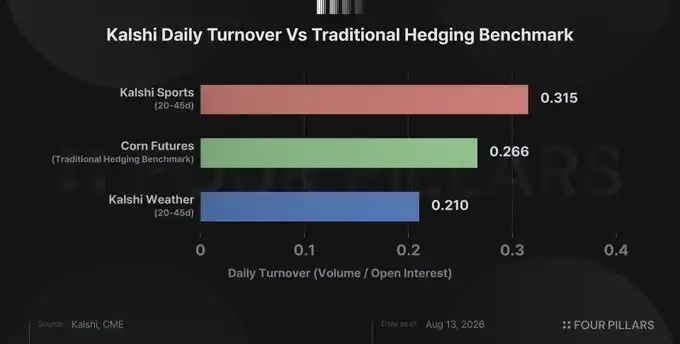
Sports contracts turn over about 1.5 times faster than weather contracts. This indicates a relatively longer holding tendency for weather contracts, initially suggesting the possible existence of real hedging demand.

However, a caveat: Corn futures' turnover rate sits in the middle, and the differences among the three data sets are not particularly stark. Based on turnover rate alone, we cannot fully confirm the existence of hedging demand in the weather market. What this data can definitively tell us so far is only that weather contract turnover is significantly lower than sports contract turnover.

IV. Data Point 2: Hold-to-Expiration Ratio

The second key metric is the hold-to-expiration ratio — measuring how many positions remain untouched in the market at settlement. It is calculated as the final open interest for each contract divided by the cumulative trading volume. A higher value indicates more positions were firmly held until the expiration date.
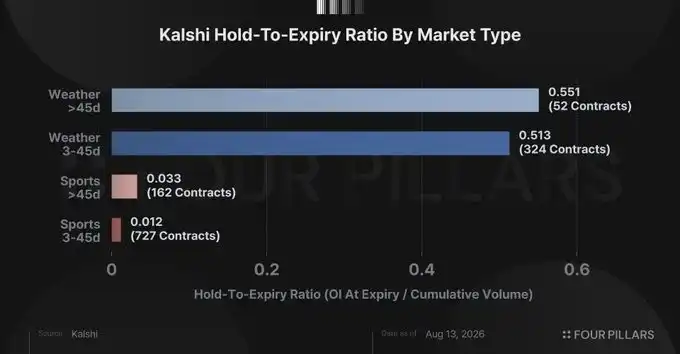
The difference in results is very striking: regardless of trading duration, the hold-to-expiration ratio for weather contracts exceeds 0.5. In contrast, sports contracts are only 0.012 and 0.033 respectively. In the 3 to 45-day trading interval, weather is 42.8 times that of sports; in the over 45-day interval, the gap is still 16.7 times.

This clearly shows: Weather contracts are far more inclined to "buy and hold" than sports contracts. Hedgers hold contracts to receive payouts if the risk materializes, not to chase price differences. Therefore, a high hold-to-expiration ratio strongly supports the judgment that there is real hedging demand in the weather market.

Of course, this cannot be directly interpreted as the entire weather market being used for hedging. This data does not track the identities of individual position buyers and sellers, so it cannot be simply equated with the proportion of original buyers holding to expiration. What can be confirmed at present is that the holding behavior of weather contracts is distinctly different from that of sports contracts.

V. Data Point 3: When Were Positions Established?

The final question is: When were these positions established? We divided the daily open interest for each contract by that contract's peak open interest, converted the time from launch to expiration into a progress bar from 0% to 100%, and then plotted the median curve.

The criterion for judgment is the point at which half of the peak open interest is reached. If half is reached when there is still more time until expiration, it means positions were built earlier — which is more in line with the behavior pattern of hedgers.
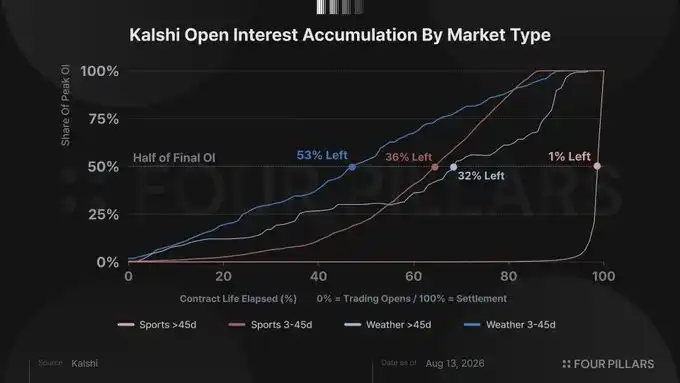
For weather contracts trading for 3 to 45 days, they had already reached half their peak open interest when their lifecycle was at 47%, leaving 53% of the time until expiration. Sports contracts in the same interval didn't reach half until 65%, with only 36% of the time remaining.

For contracts over 45 days, the difference is even more astonishing. Weather contracts reached half when there was still 32% until expiration, while sports contracts had only 1.3% left. Regardless of the interval, weather positions were established much earlier than sports positions.
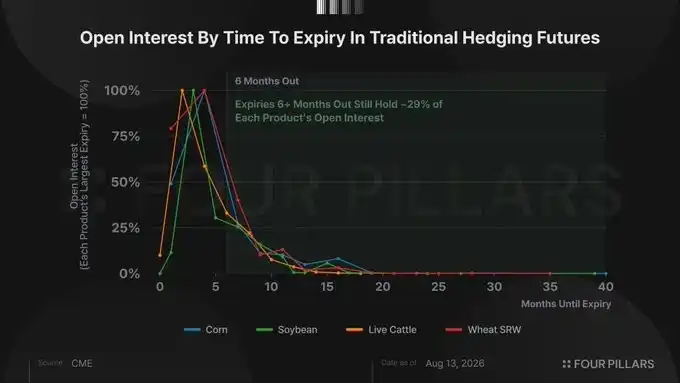
This behavior of "early positioning" is precisely a typical characteristic of traditional hedging markets. As of August 11, 2026, CME grain and livestock futures contracts expiring in six months had already accumulated massive open interest. Corn futures even held 65,127 positions on contracts expiring 16 months later.

This reflects the tendency to act well before the risk actually materializes. And the behavioral pattern of Kalshi weather contracts is clearly closer to traditional hedging markets than to sports markets.

VI. Hedging Relies on Liquidity Built by Speculation

Conclusion first: The Kalshi weather market is neither a purely hedging market nor a purely speculative one like sports. Speculative demand still contributes a significant portion of the liquidity, but on top of that, hedging demand has also emerged relatively clearly.

The three indicators point in the same direction: weather contracts trade less frequently, retain more positions at settlement, and positions are established earlier. No single indicator can confirm trading intent with 100% certainty, but the high consistency of these behaviors collectively supports a judgment — there indeed exists a holding demand in the Kalshi weather market distinct from sports, and a considerable part of it is likely real hedging demand.

More importantly, speculative demand is not so much a weakness of predictive markets as it is a prerequisite for the hedging function to exist. A market with only hedgers and no speculators would struggle to find sufficient counterparties and continuous liquidity.

In predictive markets, speculators are responsible for pricing and providing liquidity, while hedgers transfer the risks they do not wish to bear on this foundation. The risk is no longer directly underwritten by an insurance company but is naturally dispersed among market participants through trading.

Therefore, the next phase of growth for predictive markets is not about "squeezing out" speculation and shifting entirely to hedging. What truly matters is: How much real corporate hedging demand can be layered on top of the liquidity base already built by speculation? This is the core variable that determines whether it can upgrade from an "interesting speculative tool" to a "usable risk management infrastructure."


Crypto di tendenza

Domande pertinenti

QWhat is the main difference between using a prediction market and traditional insurance for business risk management?

AThe main difference is that in prediction markets, the insurance premium (price of the contract) is determined collectively by market participants based on their assessment of the event's probability, whereas in traditional insurance, the premium is calculated by the insurer's actuaries.

QWhat are the three data points used to analyze whether the Kalshi weather market is used for hedging?

AThe three data points are: 1) Average daily turnover rate, 2) Hold-to-expiration ratio, and 3) The timing of when positions are established (measured by the time it takes to reach 50% of peak open interest).

QAccording to the analysis, how does the trading behavior of Kalshi weather contracts compare to its sports contracts?

AThe analysis shows that Kalshi weather contracts have a lower turnover rate, a significantly higher hold-to-expiration ratio, and positions are established much earlier compared to Kalshi sports contracts. This suggests behavior more consistent with hedging.

QWhat is the primary role of speculators in a prediction market that aims to serve hedging purposes?

ASpeculators provide the necessary liquidity and price discovery in the prediction market, which creates a functional trading environment that allows hedgers to enter and exit positions to transfer their risks.

QWhat example is given to illustrate how a business could use a prediction market contract to hedge against operational risk?

AThe example given is an ice cream shop that could hedge against a cool summer. It could buy 20,000 temperature contracts at $0.30 each (total cost $6,000). If the summer is cool and average temperature falls below a threshold, each contract pays $1, offsetting the estimated $20,000 revenue loss, thereby locking the net loss at the initial $6,000 cost. If the summer is hot, the contracts expire worthless, and the shop loses the $6,000 premium but enjoys full revenue.

Letture associate

Tiger Research: How Far Can the On-Chain Foreign Exchange Settlement Layer Go?

"Tiger Research: How Far Can On-Chain FX Settlement Layers Go?" The article examines KiiChain, a startup aiming to create an on-chain foreign exchange settlement layer, focusing on its potential to address inefficiencies in cross-border payments, especially for emerging markets. The core problem is the slow, costly, and fragmented traditional FX infrastructure, where bank hours, regulations, and thin liquidity for local currencies create delays. KiiChain, founded by OTC veterans, proposes aggregating USD and local currency stablecoin liquidity on one chain to enable 24/7 settlement. The platform consists of four components: 1) The KiiChain App uses an Atomic Quote Network (RFQ-style price discovery with on-chain settlement) to tackle settlement delays, but not underlying liquidity scarcity. 2) The RWA Protocol tokenizes collateral using compliant standards (like ERC-3643), shifting trust from bank relationships to coded rules, though regulatory anchors remain. 3) Kii Oracle uses a decentralized validator network to create consensus pricing from fragmented data, improving transparency but not market depth. 4) KiiChain Pay bundles fiat on/off-ramps and swap services; only the DEX swap bypasses banking bottlenecks, while others still rely on licensed operators. The analysis concludes KiiChain doesn't eliminate intermediaries but creates a unified settlement layer where they can interact without geographic or time constraints. It streamlines the process—three of eight traditional steps are removed—by moving infrastructure on-chain, improving speed and accessibility for digital asset swaps. However, fiat entry/exit points remain subject to off-chain service limitations. Current metrics show over $500M in transaction volume. The future depends on ecosystem growth—attracting liquidity partners and users—to evolve beyond settlement into a broader financial hub. Ultimately, the on-chain structure currently solves settlement friction and time, not liquidity depth. Success will be determined by execution in building partnerships and market presence, not by architectural design alone.

marsbit27 min fa

Tiger Research: How Far Can the On-Chain Foreign Exchange Settlement Layer Go?

marsbit27 min fa

Trading

Spot

Articoli Popolari

Cosa è G$

Comprendere GoodDollar ($G$): Un Progetto per il Reddito Universale di Base Decentralizzato Introduzione Nel panorama in continua evoluzione delle criptovalute e della tecnologia blockchain, le iniziative che cercano di affrontare questioni sociali urgenti hanno attirato crescente attenzione. Uno di questi progetti è GoodDollar ($G$), una soluzione di reddito universale di base (UBI) basata su Web3. GoodDollar si impegna a combattere le disuguaglianze e colmare il divario di ricchezza creando e distribuendo risorse economiche accessibili a coloro che ne hanno più bisogno. Attraverso il suo utilizzo innovativo della finanza decentralizzata (DeFi), GoodDollar propone un modello unico che potrebbe potenzialmente rimodellare il modo in cui l'assistenza finanziaria è percepita e fornita a livello globale. Che cos'è GoodDollar ($G$)? GoodDollar è un protocollo di criptovaluta che facilita l'emissione e la distribuzione di token digitali, denominati $G$, ai suoi utenti registrati su base giornaliera. Questi token funzionano come una forma di reddito universale di base, promuovendo l'empowerment finanziario per individui provenienti da vari contesti, specialmente quelli tradizionalmente esclusi dal sistema finanziario. Operando sulla blockchain, GoodDollar utilizza più catene, tra cui Ethereum, Celo e Fuse, garantendo ampia accessibilità e usabilità. L'obiettivo fondamentale di GoodDollar è rendere le criptovalute accessibili e vantaggiose per tutti, indipendentemente dal loro punto di partenza economico. Il Creatore di GoodDollar ($G$) I dettagli riguardanti il creatore di GoodDollar rimangono piuttosto oscuri. Tuttavia, è significativamente evidenziato che il progetto ha il forte sostegno di eToro, una piattaforma di investimento ampiamente riconosciuta che ha fornito il finanziamento iniziale e il supporto fondamentale per lo sviluppo di GoodDollar. La visione dietro il progetto non è esclusivamente orientata al profitto, ma tende fortemente verso l'imprenditorialità sociale, puntando a un cambiamento sistemico nell'accessibilità economica. Investitori di GoodDollar ($G$) GoodDollar gode del supporto finanziario e operativo di eToro. Questa partnership ha svolto un ruolo significativo nel lancio del protocollo e nei suoi sviluppi successivi. Sebbene eToro sia stato determinante nell'estableire le basi del progetto, GoodDollar prevede di passare a un modello finanziato dalla sua comunità a lungo termine. Questo spostamento verso il finanziamento comunitario è in linea con l'impegno di GoodDollar verso la decentralizzazione, consentendo ai suoi utenti di avere una partecipazione diretta nel futuro del progetto. Come Funziona GoodDollar ($G$)? Il framework operativo di GoodDollar si basa fortemente sui principi della DeFi per generare interessi dalle criptovalute staked. Questo meccanismo consente al progetto di coniare e distribuire token $G$ come reddito base digitale per utenti in tutto il mondo. Diverse caratteristiche chiave contribuiscono all'unicità e all'innovazione di GoodDollar: Reddito Universale di Base (UBI): Ogni giorno, gli utenti registrati ricevono token gratuiti, stabilendo un flusso di reddito automatico destinato ad alleviare le pressioni finanziarie. Modello Economico Sostenibile: La tokenomica del progetto mira a bilanciare domanda e offerta di token $G$, assicurando che il valore rimanga stabile nel tempo. Token Sostenuti da Riserva: Ogni token $G$ è sostenuto da una riserva di criptovalute, fornendogli un valore intrinseco e affidabilità, un aspetto cruciale per mantenere la fiducia degli utenti. Governance Decentralizzata: GoodDollar incorpora un approccio democratico al processo decisionale attraverso una governance decentralizzata alimentata dai token. Questo consente ai membri della comunità di partecipare attivamente alla definizione della traiettoria del progetto, rendendolo veramente guidato dalla comunità. Accessibilità Globale: GoodDollar ha stabilito un notevole footprint comunitario, vantando oltre 640.000 membri provenienti da 181 paesi. Tale portata diffusa è strumentale nel facilitare l'UBI su scala globale. Timeline di GoodDollar ($G$) L'evoluzione di GoodDollar è segnata da diversi traguardi significativi nella sua storia: 2019: Il lancio del portafoglio GoodDollar ha segnato il primo passo nella operativizzazione della sua visione di fornire UBI attraverso le criptovalute. 2020: Dopo il successo del portafoglio, il protocollo GoodDollar ha debuttato ufficialmente. Questo ha segnato una fase cruciale nella sua missione di fornire reddito distribuito giornalmente. 2021: Il progetto è avanzato ulteriormente con l'introduzione della sua Organizzazione Autonoma Decentralizzata (DAO), favorendo un maggiore livello di coinvolgimento e governance della comunità. 2022: GoodDollar ha svelato la sua versione DeFi-friendly 2 (V2), mirando a un coinvolgimento degli utenti e a un'efficienza operativa migliorata. Lo stesso anno ha visto anche la transizione a una struttura di governance decentralizzata tramite GoodDAO. 2022: È stata concettualizzata una nuova roadmap, focalizzata su iniziative come un programma di sovvenzioni progettato per promuovere iniziative imprenditoriali legate a $G$ e un mercato GoodDollar aggiornato. Caratteristiche Chiave di GoodDollar ($G$) Il progetto GoodDollar introduce numerose caratteristiche critiche tese a ridefinire il panorama del reddito di base: Reddito Universale di Base: La consegna diaria di token gratuiti ai suoi utenti sottolinea fondamentalmente la sua missione di eliminare la precarietà economica. Operazione Multi-Chain: Sfruttare più reti blockchain migliora l'accessibilità e la scalabilità, garantendo una partecipazione più ampia. Engagement con la Finanza Decentralizzata: L'uso della DeFi consente un finanziamento sostenibile del modello UBI, rafforzandone la fattibilità come soluzione economica. Coinvolgimento e Governance della Comunità: GoodDollar prevede un modello in cui la comunità influenza le operazioni attraverso la partecipazione democratica, promuovendo trasparenza e responsabilità. Comunità Globale: Vantare una comunità globale diversificata consente al progetto di implementare soluzioni UBI adattate a vari contesti culturali ed economici. Conclusione GoodDollar rappresenta un salto trasformativo verso l'integrazione dei principi del reddito universale di base attraverso l'innovativo obiettivo della tecnologia blockchain. Sfruttando la finanza decentralizzata, il progetto non solo fornisce una soluzione all'ineguaglianza finanziaria, ma coinvolge attivamente gli utenti nella sua governance e nelle sue operazioni. Con una comunità in crescita e una roadmap in evoluzione, GoodDollar si afferma come un attore significativo nell'intersezione tra criptovaluta e bene sociale, aprendo la strada a un futuro finanziario più equo. Continuando a evolversi, il percorso di GoodDollar potrebbe infine ispirare altre iniziative a considerare modelli simili, promuovendo ulteriormente la causa dell'empowerment economico per tutti.

186 Totale visualizzazioniPubblicato il 2024.04.05Aggiornato il 2024.12.03

Cosa è G$

Come comprare G

Benvenuto in HTX.com! Abbiamo reso l'acquisto di Gravity (G) semplice e conveniente. Segui la nostra guida passo passo per intraprendere il tuo viaggio nel mondo delle criptovalute.Step 1: Crea il tuo Account HTXUsa la tua email o numero di telefono per registrarti il tuo account gratuito su HTX. Vivi un'esperienza facile e sblocca tutte le funzionalità,Crea il mio accountStep 2: Vai in Acquista crypto e seleziona il tuo metodo di pagamentoCarta di credito/debito: utilizza la tua Visa o Mastercard per acquistare immediatamente GravityG.Bilancio: Usa i fondi dal bilancio del tuo account HTX per fare trading senza problemi.Terze parti: abbiamo aggiunto metodi di pagamento molto utilizzati come Google Pay e Apple Pay per maggiore comodità.P2P: Fai trading direttamente con altri utenti HTX.Over-the-Counter (OTC): Offriamo servizi su misura e tassi di cambio competitivi per i trader.Step 3: Conserva Gravity (G)Dopo aver acquistato Gravity (G), conserva nel tuo account HTX. In alternativa, puoi inviare tramite trasferimento blockchain o scambiare per altre criptovalute.Step 4: Scambia Gravity (G)Scambia facilmente Gravity (G) nel mercato spot di HTX. Accedi al tuo account, seleziona la tua coppia di trading, esegui le tue operazioni e monitora in tempo reale. Offriamo un'esperienza user-friendly sia per chi ha appena iniziato che per i trader più esperti.

545 Totale visualizzazioniPubblicato il 2024.12.10Aggiornato il 2026.06.02

Come comprare G

Cosa è @G

Rete Graphite, $@G: Colmare il divario tra TradFi e Web3 Introduzione alla Rete Graphite, $@G Nel vivace mondo delle criptovalute e dei progetti web3, la Rete Graphite emerge come un faro di innovazione. Con il suo token nativo, $@G, questa blockchain Layer-1, Proof-of-Authority (PoA) è progettata per colmare il divario tra la finanza tradizionale (TradFi) e l'ecosistema Web3 in rapida evoluzione. Mentre le valute digitali guadagnano terreno, la Rete Graphite si impegna a offrire una piattaforma blockchain che prioritizza sicurezza, conformità e velocità, presentandosi come un facilitatore di fiducia e responsabilità. Cos'è la Rete Graphite, $@G? La Rete Graphite non è semplicemente un altro progetto blockchain; mira a ridefinire come la decentralizzazione, la sicurezza e la responsabilità degli utenti siano percepite nel regno della finanza digitale. Il progetto vanta una serie di caratteristiche distintive: Blockchain Basata sulla Reputazione: Al suo interno, la Rete Graphite implementa una politica di uno-utente, uno-account, rafforzata con meccanismi integrati di Know Your Customer (KYC) e sistemi di punteggio. Questo design garantisce un equilibrio tra privacy degli utenti e trasparenza—un aspetto critico delle operazioni finanziarie nel mondo digitale odierno. Entrate dai Noduli di Accesso: La rete incentiva gli utenti a impostare noduli di accesso, consentendo agli operatori di guadagnare ricompense dalle transazioni di rete. Questo modello di generazione di reddito non solo aumenta il coinvolgimento degli utenti, ma rafforza anche la salute e la decentralizzazione della rete. Compatibilità EVM: Con una macchina virtuale (VM) compatibile con Ethereum, la Rete Graphite consente un'integrazione senza soluzione di continuità delle applicazioni decentralizzate (dApps) e dei contratti smart esistenti in Solidity, invitando così gli sviluppatori a sfruttare le sue capacità senza modifiche estensive. Integrazione KYC: In un'era in cui la conformità è fondamentale, il framework KYC integrato con più livelli di verifica migliora il controllo sulle operazioni finanziarie senza partecipazione obbligatoria, stabilendo un precedente per l'autonomia degli utenti. Chi è il Creatore della Rete Graphite, $@G? La Rete Graphite nasce dagli sforzi della Graphite Foundation, un'organizzazione non profit dedicata allo sviluppo, alla manutenzione e all'evoluzione della Rete Graphite. L'impegno della fondazione sottolinea la visione del progetto di creare un ambiente blockchain sicuro e sostenibile, focalizzato sul coinvolgimento autentico degli utenti e sulla conformità. Chi sono gli Investitori della Rete Graphite, $@G? Attualmente, ci sono informazioni limitate disponibili sugli investitori specifici che sostengono l'iniziativa della Rete Graphite. L'organizzazione fondatrice, la Graphite Foundation, opera in modo indipendente per promuovere la crescita del progetto, cercando al contempo partnership che risuonino con la sua visione di una piattaforma blockchain conforme e accessibile. Come Funziona la Rete Graphite, $@G? Il funzionamento della Rete Graphite si basa sul suo unico meccanismo di consenso Proof-of-Authority, che trova un impressionante equilibrio tra elevata capacità di elaborazione e decentralizzazione. Approfondiamo i vari componenti che definiscono il suo funzionamento: Nodi di Trasporto: Servendo come nodi di accesso, questi sono critici per l'ecosistema. Gli operatori possono guadagnare entrate dalle transazioni che attraversano la rete, il che non solo potenzia gli utenti individuali ma rafforza anche la decentralizzazione della rete. Nodi Autorizzati: Al centro della Rete Graphite ci sono i validatori principali che sottopongono a rigorosi test di conformità, comprendenti una robusta verifica KYC insieme a valutazioni tecniche. Questo strato di fiducia è essenziale per garantire che le transazioni all'interno della rete mantengano un elevato livello di integrità. Sistema di Ticker: La Rete Graphite impiega un sistema di ticker distintivo per i suoi token avvolti, denotati come @G. Questa caratteristica migliora la chiarezza nell'integrazione degli asset, rendendo le transazioni degli utenti comprensibili e dirette. L'approccio innovativo della Rete Graphite riflette un passo significativo nell'affrontare le questioni cruciali della finanza digitale, posizionandosi favorevolmente per il futuro mentre sempre più utenti transitano dalle forme tradizionali di finanza al mondo delle applicazioni decentralizzate. Cronologia della Rete Graphite, $@G Per comprendere la progressione e le tappe della Rete Graphite, è utile rivedere eventi chiave nella sua cronologia: 2021: L'inizio della Rete Graphite da parte della Graphite Foundation segna l'inizio di un nuovo capitolo nello sviluppo blockchain, focalizzandosi sulla conformità e sull'empowerment degli utenti. Sviluppi Chiave: Dopo il suo lancio, l'introduzione delle entrate dai nodi di accesso, l'istituzione di un modello basato sulla reputazione, la verifica KYC integrata e la fornitura di compatibilità EVM rappresentano progressi significativi nel progetto. Attività Recenti: I continui sforzi di sviluppo e cura della Graphite Foundation si sono concentrati sull'aumento delle funzionalità della rete, mentre si promuoveva la crescita dell'ecosistema, dimostrando un impegno a lungo termine per la sostenibilità e l'innovazione. Ulteriori Punti Chiave Oltre ai suoi componenti fondamentali, la Rete Graphite comprende diversi strumenti e funzionalità che ne rafforzano l'usabilità: Graphite Wallet: Un'estensione di Chrome user-friendly che facilita l'accesso a varie funzionalità e applicazioni della rete su catene compatibili con Ethereum, migliorando la comodità per gli utenti. Graphite Bridge: Questo strumento consente trasferimenti senza soluzione di continuità di asset Graphite tra diverse reti, promuovendo un ecosistema integrato e interoperabile. Graphite Explorer: Servendo come uno strumento essenziale all'interno dell'ecosistema, questa funzionalità consente agli utenti di visualizzare e verificare il codice sorgente dei contratti smart, tracciare le transazioni e esplorare altre informazioni vitali in tempo reale. Graphite Testnet: Il progetto fornisce un robusto ambiente di test per gli sviluppatori, consentendo loro di garantire stabilità e scalabilità prima del deployment sulla mainnet. Questa iniziativa non solo potenzia gli sviluppatori ma migliora anche l'affidabilità dell'intera rete. Conclusione La Rete Graphite, con il suo token nativo $@G, rappresenta un passo significativo verso il collegamento tra la finanza tradizionale e la tecnologia blockchain all'avanguardia. Concentrandosi su sicurezza, conformità e decentralizzazione, questa piattaforma innovativa è pronta a guidare la transizione nell'era Web3. Man mano che il coinvolgimento degli utenti cresce e sempre più progetti sfruttano le sue capacità, la Rete Graphite è destinata a dare contributi duraturi al panorama digitale in rapida evoluzione. In conclusione, la Rete Graphite è una testimonianza di ciò che può essere realizzato quando il pensiero innovativo incontra le crescenti esigenze della finanza e della tecnologia moderne. Mentre il mondo esplora il potenziale della finanza decentralizzata, la Rete Graphite rimarrà senza dubbio un attore notevole in questo campo.

79 Totale visualizzazioniPubblicato il 2025.01.06Aggiornato il 2025.01.06

Cosa è @G

Discussioni

Benvenuto nella Community HTX. Qui puoi rimanere informato sugli ultimi sviluppi della piattaforma e accedere ad approfondimenti esperti sul mercato. Le opinioni degli utenti sul prezzo di G G sono presentate come di seguito.

活动图片