State Street, Galaxy and Ondo join tokenized cash race with 24/7 sweep fund

cointelegraphPubblicato 2025-12-11Pubblicato ultima volta 2025-12-11

Introduzione

State Street Investment Management, Galaxy Asset Management, and Ondo Finance are launching a tokenized liquidity fund called the State Street Galaxy Onchain Liquidity Sweep Fund (SWEEP). The fund will use PayPal’s PYUSD stablecoin to allow accredited investors to move cash "sweep" balances onto public blockchains, enabling 24/7 onchain liquidity. Ondo will seed the fund with $200 million. State Street will serve as custodian, while Galaxy provides digital asset infrastructure. The fund is set to launch on Solana in early 2026, with plans to expand to Stellar and Ethereum using Chainlink’s CCIP. This move places SWEEP in a growing race among institutions like BlackRock and Franklin Templeton to define onchain cash and tokenized real-world assets (RWA). The partnership highlights the convergence of traditional finance and crypto, with each firm contributing regulatory oversight, infrastructure, and distribution networks. Solana was chosen for its low fees and fast settlement, appealing to large institutions adopting blockchain for digital assets.

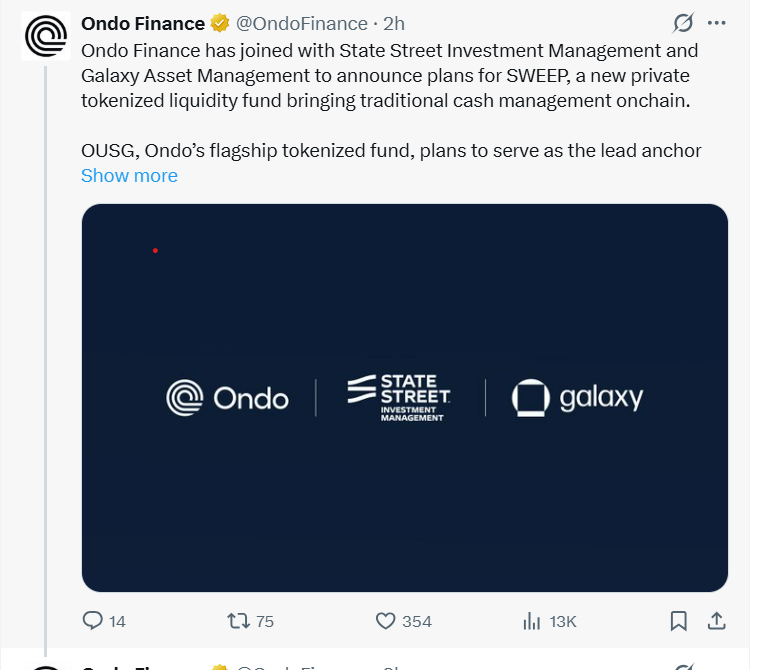
State Street Investment Management and Galaxy Asset Management are joining forces with Ondo Finance on a tokenized liquidity fund that pushes cash “sweep” balances directly onto public blockchains, opening up a source of potential 24/7 onchain liquidity.

The planned State Street Galaxy Onchain Liquidity Sweep Fund, or SWEEP, is designed to take in and pay out PayPal’s (PYUSD) stablecoin for accredited investors, the companies said Tuesday.

Ondo is expected to seed the fund with $200 million, tying a major tokenized real-world asset (RWA) issuer directly into State Street’s tokenization stack. The fund will be powered by Galaxy Digital infrastructure, and State Street Bank and Trust Company, an affiliate of State Street Investment Management, will act as custodian.

SWEEP is set to launch on Solana in early 2026, with rollouts on other networks, including Stellar and Ethereum, to follow, using Chainlink’s Cross-Chain Interoperability Protocol (CCIP).

Related: Solana and Coinbase’s Base connect together using Chainlink

Race to define onchain cash

The move drops another heavyweight into an increasingly crowded race to define what “onchain cash” looks like for institutions. BlackRock and Franklin Templeton already run tokenized cash‐management vehicles, including money‐market and other short‐term fixed‐income funds, on public blockchains. For its part, Ondo has built a business around wrapping Treasurys and other credit exposures into onchain vehicles that can plug into crypto markets.

“By partnering with Galaxy, we will push the envelope together and drive the evolution of the TradFi landscape onchain,” said Kim Hochfeld, global head of cash and digital assets for State Street Investment Management.

“Tokenization is rapidly becoming the connective tissue between traditional finance and the onchain economy,” said Ian De Bode, president of Ondo Finance. “Our planned investment would not only anchor this innovative fund – but also supports the continued growth of Ondo’s fund that offers institutional investors exposure to short-term US Treasuries with 24/7 instant mints and redemptions.”
Source: Ondo Finance

Related: Blockchain trial on Canton Network tests collateral reuse with tokenized US Treasurys

Building an onchain capital markets stack

The launch comes as tokenized funds and tokenized equities are starting to resemble components of an emerging onchain capital markets stack more than isolated pilots.

Superstate opened up onchain capital raising for US Securities and Exchange Commission‐registered public companies via its Direct Issuance Programs on Ethereum and Solana Wednesday, targeting the equity side of that stack by letting issuers sell new stock directly for stablecoins and settle immediately to investor wallets.

State Street’s partnership with Galaxy and Ondo also highlights how the roles are shaping up as traditional finance and crypto firms share the same products. State Street brings Big Four regulatory cover and custody, Galaxy contributes digital‐asset infrastructure and tokenization expertise, and Ondo provides both capital and an existing RWA distribution network.

Related: Galaxy expands into UAE as part of Middle East push

Solana’s role in the tokenization race

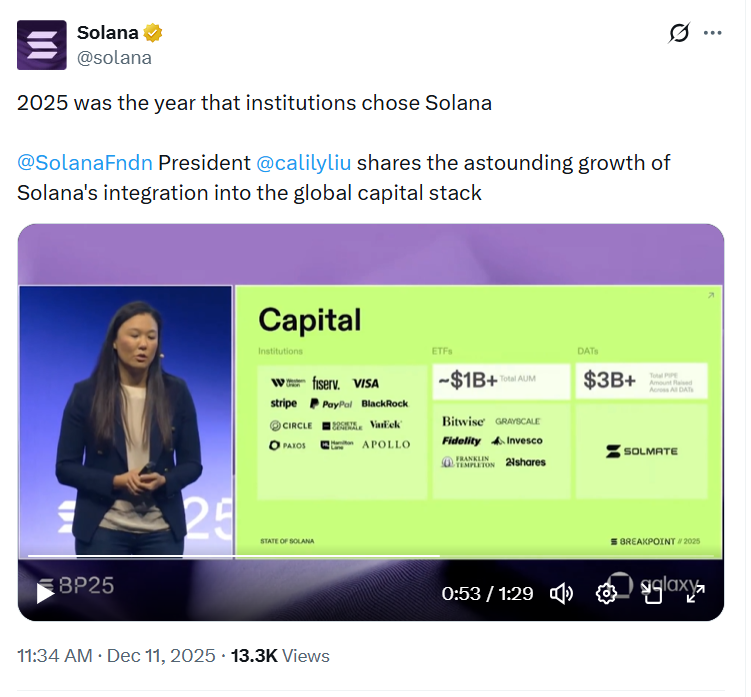
Solana’s role as the initial venue highlights a second competitive race unfolding beneath the product arms race. The chain has become a favored home for tokenized assets and high‐throughput trading, from tokenized public shares to experiments in onchain liquidity funds, as issuers look for lower fees and fast settlement.
Source: Solana

Some of the largest institutions in the world have chosen the Solana blockchain for their digital assets play, including Western Union, which processes over $100 billion in remittance volume every year, and Pfizer, which processes $2 trillion of merchant payment volume annually. Physical staked exchange-traded funds (ETFs) on Solana have also almost reached $1 billion in assets under management.

Launching on Solana first, with plans to expand to Stellar and Ethereum, allows SWEEP to tap into multiple ecosystems where stablecoins and RWA tokens are already part of the infrastructure.

Letture associate

BIT Research: If It Followed Nasdaq, Bitcoin Should Be Close to $140,000

BIT Research: Bitcoin Price Analysis Under Inflation Re-pricing The market is currently undergoing a macro adjustment phase dominated by inflation re-pricing. Analysis suggests that if Bitcoin had continued to follow Nasdaq's trajectory, its theoretical price would be near $140,000. However, a significant divergence between the two assets has emerged since October 2025. The core reason is the resurgence of US inflation, which has led to a reversal in market expectations for the Federal Reserve's rate-cut path. Recent data shows US CPI rising to 3.8% and PPI to 6.0%, prompting markets to scale back expectations for 2026 rate cuts. For Bitcoin, the previous supportive narrative of anticipated loose liquidity is weakening. Concurrently, escalating tensions involving Iran have driven oil prices up approximately 40% since late February 2026, heightening inflation concerns through rising energy costs. While the market currently views this inflation surge as a temporary pressure point, the interplay between energy, interest rates, and risk appetite is prompting a reassessment of the potential for a prolonged high-rate environment. In this context, Bitcoin has begun to underperform tech stocks, which can benefit from nominal inflation. The divergence stems from a key distinction: Bitcoin's past rallies were driven by loose liquidity and rate-cut expectations, not inflation itself. As a long-duration asset, Bitcoin is highly sensitive to interest rate paths. When expectations for rate cuts are withdrawn, its valuation faces pressure. Unlike equities, which can benefit from increased nominal revenues and reduced real debt burdens during inflation, Bitcoin possesses neither debt that inflates away nor cash flows that expand with inflation, offering no direct structural benefit from rising prices. Looking ahead, the critical question is whether high inflation will force the Fed to maintain elevated rates for longer. The BIT model anticipates US CPI could potentially rise further to 6.0%. Additionally, factors like AI infrastructure expansion—driving data center construction and power demand—may sustain energy price pressures and extend the period of above-target inflation. In such an environment, tech stocks gain from order growth and improved earnings expectations, while Bitcoin remains susceptible to high-rate pressure. In summary, the current shift does not invalidate Bitcoin's long-term thesis but reflects a market re-evaluation of interest rate and liquidity paths amid resurgent inflation. In the short term, a high-inflation environment may continue to suppress Bitcoin's performance relative to Nasdaq. This represents a slowdown in its upward momentum rather than a bearish turn. Bitcoin could regain support once markets begin to reprice expectations for future liquidity easing.

marsbit28 min fa

BIT Research: If It Followed Nasdaq, Bitcoin Should Be Close to $140,000

marsbit28 min fa

Bankless Interview: Private Equity Insiders Reveal the Inside Story of Anthropic's Primary Market Trading

**Bankless Interview: A Private Equity Veteran Exposes the Dark Side of Anthropic's Pre-IPO Trading** In a Bankless podcast, Patagon founder Dio Casares reveals the opaque inner workings of the massive secondary market for shares in pre-IPO giants like Anthropic. The market, driven by private SPVs (special purpose vehicles), brokers, and even informal networks, sees hundreds of billions in notional value changing hands, with single-deal fees as high as 10%. However, an estimated 10-20% of transactions involve fraud or fabricated share certificates. Intermediaries often profit more from these deals than from their core investment businesses. Two types of "secondary" exist: company-sanctioned trades (like employee tender offers) that bring new money to the company, and disruptive "gray market" trades on platforms like Hive or Forge, which companies like Anthropic actively fight. The latter creates pricing chaos and complicates primary fundraising. A major risk involves multi-layered, nested SPV structures. When a company like Anthropic finally IPOs, delays in distributing shares down these chains, combined with discretionary powers of fund managers (GPs) to hold or sell, could trigger a wave of lawsuits and settlement nightmares lasting years. For small investors in "tokenized" versions of these assets, transparency is minimal, and due diligence is often impossible. Casares advises extreme caution, suggesting investors trust their gut and exit if something feels wrong. He warns that the post-IPO period will be a major "reckoning" for this wild and largely unregulated market.

marsbit51 min fa

Bankless Interview: Private Equity Insiders Reveal the Inside Story of Anthropic's Primary Market Trading

marsbit51 min fa

Is Elon Musk Actually the Victim?

"Victim or Vindicator? Inside the OpenAI Trial That Shattered the Myth." In May 2026, the federal court in Oakland became the stage for deconstructing the carefully curated narrative of OpenAI. The trial revealed a complex reality far removed from its founding ideals. The core dispute centered on whether OpenAI, founded in 2015 as a non-profit dedicated to benefiting "all of humanity," had betrayed its mission by shifting towards a lucrative commercial structure, particularly after its 2019 capped-profit affiliate (OpenAI LP) was established and Microsoft invested $13 billion. Elon Musk, a co-founder and early funder, sued, claiming the organization was "stolen" and turned into a de facto Microsoft subsidiary for private gain. OpenAI countered that Musk's funds were unconditional donations and his lawsuit was driven by a desire for control and regret after leaving to found his own AI venture, xAI. The trial exposed early fractures. Evidence from 2017, years before ChatGPT's success, showed the founders were already grappling with the immense financial demands of pursuing Artificial General Intelligence (AGI). Musk himself had proposed having Tesla fund OpenAI. The court scrutinized whether the founders knowingly crossed a moral line. Greg Brockman's personal diary, entered as evidence, contained entries about wealth goals and anxieties over the company's revenue path, alongside self-reminders about the moral bankruptcy of "stealing" the non-profit. Brockman later testified his OpenAI stake was worth nearly $30 billion. The character of CEO Sam Altman was a key battleground. Musk's legal team cited five individuals, including co-founder Ilya Sutskever and former board members, who had described Altman as dishonest. This highlighted a recurring "trust debt" within OpenAI's leadership, exemplified by the chaotic 2023 boardroom coup and subsequent reinstatement. Altman defended his position, arguing Musk sought to absorb OpenAI into Tesla and that commercial success amplified OpenAI's charitable impact. Testimony from Microsoft CEO Satya Nadella underscored how commercial realities now dominated. While framing Microsoft's massive investment as a way to enlarge the non-profit's funding "pie," texts revealed Nadella pressuring Altman to launch ChatGPT's paid version quickly. Nadella also revealed that during the 2023 crisis, Microsoft was prepared to hire Altman and his team, showcasing the board's diminished power against the gravity of capital, talent, and infrastructure. Ultimately, the trial depicted OpenAI not as a singular act of betrayal but as a gradual, systemic transformation. Its grand AGI mission required a "heavier machine" to sustain it—a machine of computing power (largely from Microsoft), capital, and commercial obligations that inevitably reshaped its priorities. The non-profit board, tasked with guarding the mission, found itself unable to control the commercial juggernaut it had enabled. For the public, the proceedings served as a sobering window into the making of a foundational technology. The AI tools increasingly integrated into daily life—from writing and coding to customer service—are not born from a transparent, purely altruistic process. They emerge from a tangled web of personal ambitions, private negotiations, control struggles, and cloud computing bills. The trial's legacy is the stark realization that as AI becomes societal infrastructure, its steering wheel remains in very few, and very human, hands.

marsbit1 h fa

Is Elon Musk Actually the Victim?

marsbit1 h fa

Trading

Spot
Futures

Articoli Popolari

Come comprare ONDO

Benvenuto in HTX.com! Abbiamo reso l'acquisto di OndoFinance (ONDO) semplice e conveniente. Segui la nostra guida passo passo per intraprendere il tuo viaggio nel mondo delle criptovalute.Step 1: Crea il tuo Account HTXUsa la tua email o numero di telefono per registrarti il tuo account gratuito su HTX. Vivi un'esperienza facile e sblocca tutte le funzionalità,Crea il mio accountStep 2: Vai in Acquista crypto e seleziona il tuo metodo di pagamentoCarta di credito/debito: utilizza la tua Visa o Mastercard per acquistare immediatamente OndoFinanceONDO.Bilancio: Usa i fondi dal bilancio del tuo account HTX per fare trading senza problemi.Terze parti: abbiamo aggiunto metodi di pagamento molto utilizzati come Google Pay e Apple Pay per maggiore comodità.P2P: Fai trading direttamente con altri utenti HTX.Over-the-Counter (OTC): Offriamo servizi su misura e tassi di cambio competitivi per i trader.Step 3: Conserva OndoFinance (ONDO)Dopo aver acquistato OndoFinance (ONDO), conserva nel tuo account HTX. In alternativa, puoi inviare tramite trasferimento blockchain o scambiare per altre criptovalute.Step 4: Scambia OndoFinance (ONDO)Scambia facilmente OndoFinance (ONDO) nel mercato spot di HTX. Accedi al tuo account, seleziona la tua coppia di trading, esegui le tue operazioni e monitora in tempo reale. Offriamo un'esperienza user-friendly sia per chi ha appena iniziato che per i trader più esperti.

273 Totale visualizzazioniPubblicato il 2024.12.12Aggiornato il 2025.03.21

Come comprare ONDO

Discussioni

Benvenuto nella Community HTX. Qui puoi rimanere informato sugli ultimi sviluppi della piattaforma e accedere ad approfondimenti esperti sul mercato. Le opinioni degli utenti sul prezzo di ONDO ONDO sono presentate come di seguito.

活动图片