The Calculation Behind Plasma's U Card with Free Claude Membership

Foresight NewsPubblicato 2026-06-16Pubblicato ultima volta 2026-06-16

Introduzione

Plasma has launched a three-tiered "U Card" (Visa stablecoin debit card) system, introducing a new demand mechanism for its XPL token through membership lock-ups. The cards offer increasing benefits: * **Lite:** Free, 2% cashback, no lock-up. * **Core:** Costs $120/year or requires locking 10,000 XPL for 12 months. Offers 3% cashback, 5% AI spending cashback (on up to $500/month), and a ChatGPT Go subscription. * **Platinum:** Requires locking 100,000 XPL for 12 months. Offers 4% cashback, 10% AI cashback, Claude Pro & ChatGPT Plus subscriptions, and extensive travel/insurance benefits. The analysis suggests Lite is for trialing, Core's value depends on substantial AI spending, and Platinum is mainly for existing large XPL holders due to the significant lock-up value and price volatility risk. The primary impact is creating a non-speculative use case for XPL. Locking XPL for card tiers can reduce circulating supply, helping counter future token unlocks and inflation. However, the system's success depends on real user adoption for daily spending, not just acquiring cards for rewards. The program expands Plasma's reach from a pure stablecoin transfer chain into consumer finance, tying XPL's utility to real-world payment frequency.


By: KarenZ, Foresight News


As the U Card trend extends to AI subscriptions, Plasma has found a new avenue for asset staking.


On June 12th, Plasma launched three tiers of U Cards, which will become available to all users this week.


On the surface, this is a stablecoin debit card membership system. What users see are base cashback, AI benefits, airport rebates, and Visa spending scenarios. What the project is focused on is longer-term spending frequency, token holdings, and staking.


How are the three tiers differentiated: Lite for onboarding, Core targets AI users, Platinum locks in large holders


Before dissecting the benefits, it's necessary to clarify the product scope of Plasma One. According to the official website, the Plasma One global account service is provided by Bridge, while the Plasma One card is issued by Rain, a principal member of Visa, under Visa's authorization, and is usable in countries and with merchants that accept Visa. In other words, Bridge focuses more on the account service layer, Rain on card issuance and the Visa payment channel layer, and the end-user experience is a stablecoin spending card connected to the Visa network.


Lite is the lowest barrier to entry. The website states the Lite card cost is $0, with a base cashback of 2% and 1 free virtual card. It's suitable for users who just want to try a stablecoin card and are not ready to buy or stake XPL yet.


Core targets regular AI users. It offers 3% base cashback, 5% AI spending cashback, a ChatGPT Go subscription, and up to 2 free virtual cards. Core is accessible through an annual fee of $120 or by staking 10,000 XPL for 12 months. It's important to note: The Core page specifies the 5% AI cashback applies to up to $500 in AI spending per month. This $500 is the spending cap for the cashback calculation, not the cashback amount cap.


Platinum is more akin to a premium spending card. The official page states it's designed for major XPL holders, accessible by staking 100,000 XPL for 12 months, with no additional fee. Benefits include 4% base cashback, 10% AI spending cashback, Claude Pro and ChatGPT Plus subscriptions, up to $600/year in flight ticket rebates, lounge access, Visa concierge service, car rental insurance, travel insurance, baggage delay & loss coverage, and global eSIM, among others.


The Platinum product page also promotes annual cashback and benefit values exceeding $10,000, including $7,500 in base cashback, $1,400 in AI credit, $600 in airline credit, etc. However, these are closer to marketing assumptions and do not equate to guaranteed, unconditional maximums for users.


Is it worth it: Lite is for trying, Core depends on AI spending, Platinum depends on tolerance for asset volatility


First, Lite. Its advantage is simplicity: $0 card fee, 2% base cashback, no staking. Its disadvantage is also clear: no additional category bonuses, no AI subscriptions, and no travel benefits. For most regular users, Lite is the most suitable tier for testing the waters, as it doesn't immediately expose you to XPL price volatility.


The key question for Core is: Can the $120 annual fee or the staking of 10,000 XPL be covered by actual spending? Calculating based on XPL at $0.088 (as of writing on June 15th), 10,000 XPL is roughly $880.


If not staking XPL, one needs $120 to register for the Core card. Comparing only ordinary spending between Lite and Core, Core offers 3% base cashback vs. Lite's 2%, a difference of 1 percentage point. To cover the $120 annual fee with this 1% difference, requires approximately $12,000 in annual eligible spending.


If focusing primarily on AI spending, Core's benefits should be calculated separately: The website states Core offers 5% AI cashback, applicable to up to $500 in AI spending per month; Lite explicitly has no AI cashback. Therefore, based on this specific AI cashback, covering the $120 annual fee requires $2,400 in annual eligible AI spending, roughly $200 per month. If maxing out the monthly $500 AI spending cap, Core can yield about $25 monthly in AI cashback, or $300 annually. Combined with the ChatGPT Go subscription benefit, Core is more suitable for users who already have ongoing AI tool expenses.


However, if a user chooses to stake 10,000 XPL instead of paying the annual fee, the calculation changes. The real cost of the staking-based Core version comes from XPL price volatility and the 12-month liquidity lockup; it shouldn't be simply viewed as getting the card for free.


Platinum's threshold is higher. 100,000 XPL is approximately $8,800 and requires a 12-month lockup. It suits three types of people: users already heavily invested in XPL, those with high AI and travel spending, and large holders who can accept a one-year lockup and price volatility.


Platinum's AI benefits are also weightier: Beyond 10% AI spending cashback, it includes Claude Pro and ChatGPT Plus subscriptions. For users already long-term subscribers of Claude Pro and ChatGPT Plus, these subscriptions can be considered as actual cost offsets. But for those staking temporarily just to get the card, they are more like add-on benefits that don't offset the price volatility risk associated with locking up 100,000 XPL for a year.


To achieve the advertised $7,500 value from the 4% base cashback alone requires about $187,500 in eligible spending; the maximum $600 flight ticket rebate, calculated at 10%, also corresponds to roughly $6,000 in eligible flight ticket spending. For an ordinary user buying 100,000 XPL temporarily just for the benefits, the risk-reward ratio isn't attractive.


Another layer of risk comes from the terms. Plasma One cashback is first denominated in USD, then converted to XPL at the XPL/USD price at the time of distribution. Rewards may undergo a pending period, and transactions involving refunds, chargebacks, abnormal spending, or arbitrage-like card usage may trigger forfeiture or clawbacks. The terms also state that Plasma may adjust reward rates, monthly caps, eligibility, excluded transactions, distribution cycles, and referral reward structures. Before valuing benefits at their full-cash hypotheticals, it's wise to discount these variables.


What is the impact on XPL?


The most direct impact of Plasma U Cards on XPL is adding a membership qualification attribute to the token. Previously, XPL's narrative primarily stemmed from the Plasma chain itself and zero-fee USDT transfers. Now, Core and Platinum tie XPL to spending benefits, motivating users to hold XPL for AI subscriptions, cashback, travel perks, and card tier status.


Plasma documentation shows an initial XPL supply of 10 billion, with 10% public sale, 40% ecosystem & growth, 25% team, and 25% investors. Within the ecosystem & growth portion, 800 million tokens unlock at the Mainnet Beta on September 25, 2025, with the remaining 3.2 billion released linearly over 3 years.


Let's examine staking effects with a few scenarios:
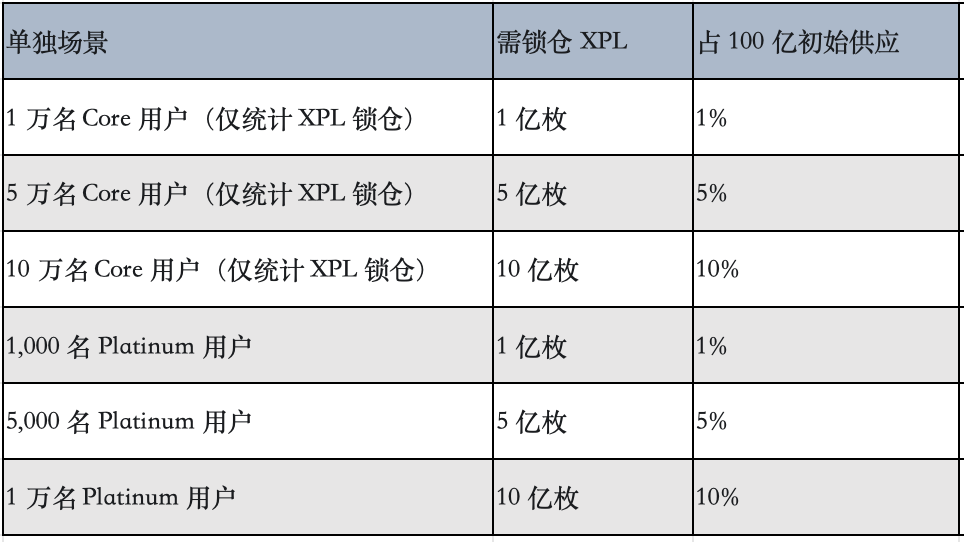


The implication of this table is straightforward: Core needs scale, Platinum needs large holders. With just 1,000 Platinum users, 100 million XPL can be locked; with 10,000 Platinum users, 1 billion XPL can be locked, accounting for 10% of the total initial supply.


More crucially, compare this to the unlock schedule. From the ecosystem & growth allocation, the remaining 3.2 billion tokens will be released over 3 years (fully unlocked by September 25, 2028), averaging about 88.89 million per month. To absorb one month's ecosystem release, approximately 8,889 Core users staking XPL, or 889 Platinum users, would be needed.


The team and investor allocations total 5 billion tokens, with a one-year cliff unlocking one-third (~1.667 billion) on September 25, 2026. To fully offset this amount with card staking would require about 166,667 Core users staking XPL, or 16,667 Platinum users. This number is already substantial, indicating that Plasma One card tiers can improve the circulating structure but are unlikely to single-handedly absorb future large-scale unlocks.


Another variable is inflation. Plasma plans to initiate validator rewards after external validators and delegated staking go live, starting with 5% annual inflation, decreasing by 0.5 percentage points each year until reaching a long-term baseline of 3%; simultaneously, a base fee burn mechanism similar to EIP-1559 aims to counteract new issuance.


Roughly calculating based on the 10 billion initial supply, 5% annual inflation corresponds to 500 million XPL. Covering this annually would require staking from 50,000 Core users or 5,000 Platinum users.


Data from a Dune dashboard built by Sumcap shows Plasma One currently has 24,000 cardholders, with 8,884 cards activated.
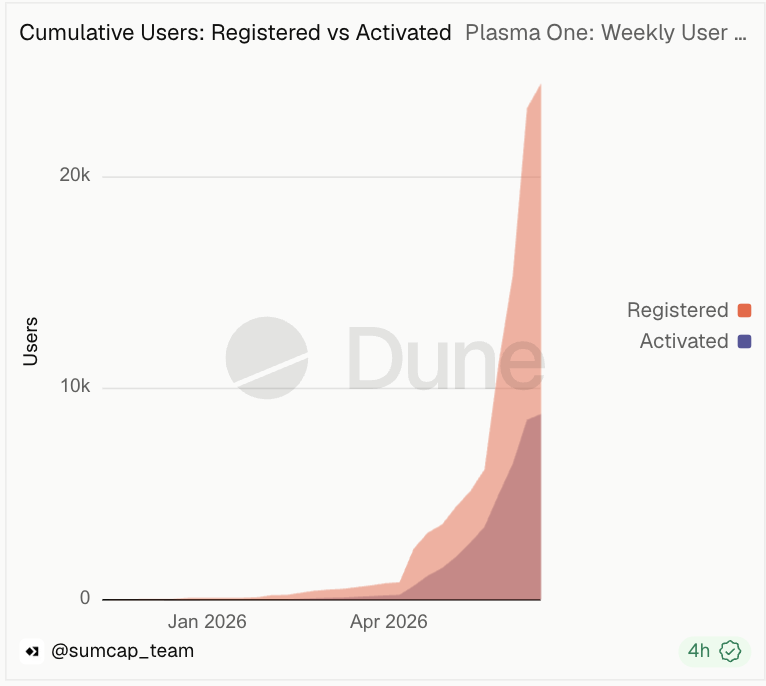


The positive effect of Plasma's latest move on the token lies in: Adding non-speculative reasons to hold XPL, reducing part of the circulating supply, and expanding XPL's reach.


The negative effects are also clear: Cashback is distributed in XPL, and if users treat it as cash-equivalent, they might sell immediately upon receipt. Of course, this is digested gradually.


Another point is that the official sources have not yet disclosed the specific origin of the reward XPL, which determines whether it ultimately constitutes a net buy pressure, a net distribution, or a mix of both.


Plasma's Real Experiment


The counter-intuitive aspect of Plasma is here: The smoother the zero-fee USDT transfers, the less ordinary users need to actively hold XPL to pay for Gas. The membership staking adds another demand curve for XPL. It brings users from exchanges, airdrops, and staking pages into more everyday scenarios: swiping a Visa card, receiving cashback, subscribing to AI tools, etc.


This is good for the project itself. Stablecoin Layer 1s are easily evaluated by the market based on TVL and subsidies. Plasma One provides it with a consumer finance entry point and also links XPL to real-world payment frequency. However, this path is also more challenging. Users won't swipe their cards daily because of a Layer 1 narrative; they will stay for fees, currency exchange, risk controls, customer service, regional coverage, and benefit fulfillment.


For XPL, Plasma One Tiers is a useful experiment for staking and distribution, but it cannot replace real transaction volume, stablecoin liquidity, and subsequent unlock management.


It's more like a door, handing on-chain assets to everyday spending. The door is open; the next step is to see how many people actually walk through it every day.


Domande pertinenti

QWhat are the three tiers of Plasma U Card and their primary target audiences?

AThe Plasma U Card has three tiers: 1) Lite Card, designed for users who want to try stablecoin cards without buying or staking XPL. 2) Core Card, targeting daily AI users, requiring an annual fee of $120 or staking 10,000 XPL for 12 months. 3) Platinum Card, aimed at high-consumption users and XPL whales, requiring the staking of 100,000 XPL for 12 months.

QAccording to the article, is the Platinum Card's advertised annual value of over $10,000 guaranteed for users?

ANo, the advertised annual value of over $10,000 for the Platinum Card is not guaranteed. The article states this figure is closer to a marketing assumption and does not equal an unconditional payout. It's based on hypothetical maximum spending levels for cashback and benefits, which most users are unlikely to fully achieve.

QWhat is the main financial consideration for a user choosing the Core Card via XPL staking instead of paying the annual fee?

AThe main financial consideration is not just the cashback benefits but the real cost associated with locking 10,000 XPL for 12 months. This cost stems from the potential price volatility of XPL and the loss of liquidity for one year, meaning it cannot be simply viewed as getting the card for free.

QWhat potential impact does the Plasma U Card program have on the XPL token's circulating supply?

AThe Plasma U Card program adds a membership utility to XPL, creating a new demand curve by incentivizing users to hold and stake XPL for card benefits. This can potentially lock up a portion of the circulating supply. For example, 1,000 Platinum users would lock 100 million XPL. However, the article suggests the program alone is unlikely to fully absorb future large token unlocks from the team and investors.

QWhat does the article identify as the broader strategic significance of the Plasma U Card for the Plasma project?

AThe article identifies that the Plasma U Card provides a consumer finance gateway for the project, moving beyond typical blockchain metrics like TVL. It connects the XPL token to real-world payment frequency and daily spending scenarios (like using a Visa card, getting cashback, subscribing to AI tools), which is a more sustainable but challenging path that depends on user experience with fees, exchange rates, and customer service.

Letture associate

SpaceX's Trillion-Dollar Valuation Base: Who's Sharing in Musk's Annual Tens of Billions in Capital Expenditure?

**Title: The Foundation of SpaceX's Trillion-Dollar Valuation: Who Benefits from Musk's Annual $100 Billion Capital Expenditure?** This article argues that investors seeking to benefit from SpaceX's growth might find greater opportunities in its supply chain rather than directly investing in the company itself, drawing parallels to historical successes with Apple, Tesla, and NVIDIA suppliers. **SpaceX's Business Model & Cash Flow:** SpaceX generates revenue from three main areas: 1. **Starlink:** Its profitable core, earning $11.3B in 2023 (60% of revenue), funding other ventures. 2. **Rockets (Falcon/Starship):** Requires $3B+ in annual R&D but achieves the world's lowest launch costs. 3. **AI:** Currently unprofitable (-$6B+ in 2023), investing heavily in ground-based supercomputers (220,000 GPUs) and future orbital data centers. The cycle is: Starlink profits → fund cheaper rockets → low-cost launches deploy AI hardware → AI compute rentals generate future revenue. This cycle drives annual procurement spending of tens of billions of dollars. **The Supply Chain Beneficiaries:** Suppliers are categorized by their replaceability: **1. Nearly Irreplaceable (High Barriers to Entry):** * **NVIDIA:** Powers the Colossus supercomputer; its CUDA ecosystem creates immense switching costs. * **Eutelsat (SATS):** Controls critical radio spectrum for satellite communications; holds a ~3% stake in SpaceX. * **Filtronic (FTC):** Supplies millimeter-wave signal amplifiers for Starlink satellites; SpaceX constitutes 83% of its revenue. * **Materion (MTRN):** Global leader in beryllium production, a strategic material used in Starship structures. * **STMicroelectronics (STM):** Supplies phased-array antenna chips for Starlink satellites. **2. Replaceable, but Switching Cost is Prohibitively High:** * **Honeywell (HON):** Provides flight control and inertial navigation systems with decades of certification. * **Carpenter Technology (CRS):** Manufactures ultra-pure specialty steel alloys for Raptor engines. * **Hexcel (HXL):** Supplies custom carbon fiber composites developed over a decade with SpaceX. * **Broadcom (AVGO):** Manages high-speed data switching. * **Linde Group:** Supplies industrial gases (liquid oxygen/nitrogen) from facilities built near SpaceX launch sites. **3. High-Volume, Cost-Critical Manufacturing:** Focuses on mass-producing components like Starlink user terminals (target: 30 million units). * **Key Players:** Wistron NeWeb (6285, primary terminal manufacturer), several Chinese A-share companies (e.g., Sunway Communication, PAX New Materials, Western Metal Materials, Yingliu Co.), and smaller US firms like Trimble (TRMB, timing systems). **Why Now?** Three factors make the supply chain opportunity timely: 1. **Volume Ramp-Up:** SpaceX plans 100 launches in 2026, aims for 30 million Starlink terminals, and will deploy AI data centers, meaning procurement will accelerate. 2. **Increased Transparency:** The IPO provides public financial data, allowing investors to track supplier order growth. 3. **Historical Precedent:** The current phase is likened to Tesla's early mass-production stage (circa 2018), suggesting a long growth runway for suppliers. **Conclusion:** The article posits that while investing in SpaceX stock is betting on Elon Musk's ambitious vision at a high valuation, investing in its established suppliers is a bet on the tangible, recurring revenue from its massive procurement budget, which is largely decoupled from day-to-day stock price volatility.

链捕手4 min fa

SpaceX's Trillion-Dollar Valuation Base: Who's Sharing in Musk's Annual Tens of Billions in Capital Expenditure?

链捕手4 min fa

The U.S. Government Blocked the Anthropic Model. It Wasn't About 'Jailbreaking' at All.

Last Friday, the U.S. Commerce Department issued an enforcement letter that forced Anthropic to take its two most advanced AI models, Fable 5 and Mythos 5, offline. The stated reason was unspecified national security concerns, initially linked to potential "jailbreaks" of the models' safeguards. However, new details suggest the action stemmed more from a deteriorating relationship between the Trump administration and Anthropic, rather than a genuine technical threat. According to reports, the government cited a little-known export control regulation, compelling Anthropic to block access for all non-U.S. persons, including its own international employees. The company complied, shutting down the models without a court order or specific technical details from the government. Cybersecurity expert Katie Moussouris revealed she was privately shown a research paper detailing a potential safeguard bypass in Fable 5. She argued the described method was minor and did not warrant an export ban, stating that attempts to "fix" it would only weaken the model's defensive capabilities. Moussouris and other experts have since called for the order to be revoked, warning it dangerously removes advanced cybersecurity tools from U.S. defenders. Analysts like Justin Hendrix suggest the move appears retaliatory and sets a dangerous precedent, signaling that the U.S. government can unilaterally shut down a tech company's products. The incident has raised concerns about the reliability of American AI and the potential for political interference in the tech industry, serving as a warning to the broader sector.

marsbit8 min fa

The U.S. Government Blocked the Anthropic Model. It Wasn't About 'Jailbreaking' at All.

marsbit8 min fa

Ray Dalio: AI Bull Market Continues to Soar, Should Investors Go All In or Cash Out and Leave the Field?

In his latest notes, Ray Dalio addresses a critical question for investors amid the AI-driven stock market surge: how should one allocate assets during a transformative technological revolution? Dalio emphasizes that technological advancement does not automatically make related stocks attractive. Historical tech cycles—marked by excitement, crowding, volatility, and eventual shakeouts—show that even long-term winners like Microsoft and Apple experienced severe drawdowns. Today's AI sector faces similar uncertainties: overinvestment, intensifying competition, geopolitical tensions (e.g., Taiwan's chip supply), tax policy shifts, anti-AI sentiment, and potential disruption from future technologies like quantum computing. Dalio's core argument focuses on the highly concentrated market structure, where a few tech giants dominate major indices. He warns investors against unknowingly holding concentrated, correlated exposures. Instead of chasing a handful of AI leaders, he advocates for a robust, diversified portfolio of 15 or more high-quality, uncorrelated investments, risk-balanced to match an investor's volatility tolerance. Mathematically, such diversification significantly improves the risk-return ratio—for example, holding 15 uncorrelated assets can boost the ratio by over four times compared to a single concentrated bet. Dalio cautions that future equity returns appear low, with his bubble indicator suggesting real returns could be negative over the next 5-10 years. He stresses that knowing what you don't know is as important as knowing what you do. In an environment of high uncertainty and concentration, avoiding large, concentrated bets on AI stocks is prudent. The optimal strategy is disciplined diversification—the "holy grail" of investing—to navigate this technologically driven cycle with lower risk and comparable or better returns.

marsbit12 min fa

Ray Dalio: AI Bull Market Continues to Soar, Should Investors Go All In or Cash Out and Leave the Field?

marsbit12 min fa

The World Cup has only been played for a few days, but some AI prediction models have already been crowned as oracles, while others have stumbled badly.

The 2026 FIFA World Cup has sparked significant interest not only on the pitch but also in AI-driven match prediction. Major models like Qwen, Copilot, and ChatGPT are being used to forecast outcomes, scores, upsets, red cards, and key player performances. Qwen gained early attention by accurately predicting Mexico's 2-0 win over South Africa (including a red card risk) and South Korea's 2-1 victory over the Czech Republic in the opening matches. Copilot's pre-tournament predictions had notable successes, such as correctly calling the Mexico 2-0 scoreline, South Korea's 2-1 win, and Brazil's 1-1 draw with Morocco. However, it also had clear misses, failing to predict upsets like Australia's 2-0 win over Turkey or Switzerland's draw with Qatar. ChatGPT provided detailed analytical reasoning, correctly predicting Mexico's 2-0 win, but its full-tournament predictions tended to favor favorites, missing several underdog results and draws. Tests pitting multiple models (ChatGPT, Gemini, Grok, Claude) against the same match, like Mexico vs. South Africa, showed varying predictions, with only some hitting the exact score. In summary, while AI models like Qwen have shown promising early results in specific match details, and others have had isolated successes, they collectively struggle to consistently identify upsets and underdog performances. AI is becoming an additional reference tool for prediction markets but is far from a definitive source.

marsbit12 min fa

The World Cup has only been played for a few days, but some AI prediction models have already been crowned as oracles, while others have stumbled badly.

marsbit12 min fa

Trading

Spot
Futures

Articoli Popolari

Cosa è $S$

Comprendere SPERO: Una Panoramica Completa Introduzione a SPERO Mentre il panorama dell'innovazione continua a evolversi, l'emergere delle tecnologie web3 e dei progetti di criptovaluta gioca un ruolo fondamentale nel plasmare il futuro digitale. Un progetto che ha attirato l'attenzione in questo campo dinamico è SPERO, denotato come SPERO,$$s$. Questo articolo mira a raccogliere e presentare informazioni dettagliate su SPERO, per aiutare gli appassionati e gli investitori a comprendere le sue basi, obiettivi e innovazioni nei domini web3 e crypto. Che cos'è SPERO,$$s$? SPERO,$$s$ è un progetto unico all'interno dello spazio crypto che cerca di sfruttare i principi della decentralizzazione e della tecnologia blockchain per creare un ecosistema che promuove l'impegno, l'utilità e l'inclusione finanziaria. Il progetto è progettato per facilitare interazioni peer-to-peer in modi nuovi, fornendo agli utenti soluzioni e servizi finanziari innovativi. Al suo interno, SPERO,$$s$ mira a responsabilizzare gli individui fornendo strumenti e piattaforme che migliorano l'esperienza dell'utente nello spazio delle criptovalute. Questo include la possibilità di metodi di transazione più flessibili, la promozione di iniziative guidate dalla comunità e la creazione di percorsi per opportunità finanziarie attraverso applicazioni decentralizzate (dApps). La visione sottostante di SPERO,$$s$ ruota attorno all'inclusività, cercando di colmare le lacune all'interno della finanza tradizionale mentre sfrutta i vantaggi della tecnologia blockchain. Chi è il Creatore di SPERO,$$s$? L'identità del creatore di SPERO,$$s$ rimane piuttosto oscura, poiché ci sono risorse pubblicamente disponibili limitate che forniscono informazioni dettagliate sul suo fondatore o fondatori. Questa mancanza di trasparenza può derivare dall'impegno del progetto per la decentralizzazione—un ethos che molti progetti web3 condividono, dando priorità ai contributi collettivi rispetto al riconoscimento individuale. Centrando le discussioni attorno alla comunità e ai suoi obiettivi collettivi, SPERO,$$s$ incarna l'essenza dell'empowerment senza mettere in evidenza individui specifici. Pertanto, comprendere l'etica e la missione di SPERO rimane più importante che identificare un creatore singolo. Chi sono gli Investitori di SPERO,$$s$? SPERO,$$s$ è supportato da una varietà di investitori che vanno dai capitalisti di rischio agli investitori angelici dedicati a promuovere l'innovazione nel settore crypto. Il focus di questi investitori generalmente si allinea con la missione di SPERO—dando priorità a progetti che promettono avanzamenti tecnologici sociali, inclusività finanziaria e governance decentralizzata. Queste fondazioni di investitori sono tipicamente interessate a progetti che non solo offrono prodotti innovativi, ma contribuiscono anche positivamente alla comunità blockchain e ai suoi ecosistemi. Il supporto di questi investitori rafforza SPERO,$$s$ come un concorrente degno di nota nel dominio in rapida evoluzione dei progetti crypto. Come Funziona SPERO,$$s$? SPERO,$$s$ impiega un framework multifunzionale che lo distingue dai progetti di criptovaluta convenzionali. Ecco alcune delle caratteristiche chiave che sottolineano la sua unicità e innovazione: Governance Decentralizzata: SPERO,$$s$ integra modelli di governance decentralizzati, responsabilizzando gli utenti a partecipare attivamente ai processi decisionali riguardanti il futuro del progetto. Questo approccio favorisce un senso di proprietà e responsabilità tra i membri della comunità. Utilità del Token: SPERO,$$s$ utilizza il proprio token di criptovaluta, progettato per servire varie funzioni all'interno dell'ecosistema. Questi token abilitano transazioni, premi e la facilitazione dei servizi offerti sulla piattaforma, migliorando l'impegno e l'utilità complessivi. Architettura Stratificata: L'architettura tecnica di SPERO,$$s$ supporta la modularità e la scalabilità, consentendo un'integrazione fluida di funzionalità e applicazioni aggiuntive man mano che il progetto evolve. Questa adattabilità è fondamentale per mantenere la rilevanza nel panorama crypto in continua evoluzione. Coinvolgimento della Comunità: Il progetto enfatizza iniziative guidate dalla comunità, impiegando meccanismi che incentivano la collaborazione e il feedback. Nutrendo una comunità forte, SPERO,$$s$ può affrontare meglio le esigenze degli utenti e adattarsi alle tendenze di mercato. Focus sull'Inclusione: Offrendo basse commissioni di transazione e interfacce user-friendly, SPERO,$$s$ mira ad attrarre una base utenti diversificata, inclusi individui che potrebbero non aver precedentemente interagito nello spazio crypto. Questo impegno per l'inclusione si allinea con la sua missione generale di empowerment attraverso l'accessibilità. Cronologia di SPERO,$$s$ Comprendere la storia di un progetto fornisce preziose intuizioni sulla sua traiettoria di sviluppo e sui traguardi. Di seguito è riportata una cronologia suggerita che mappa eventi significativi nell'evoluzione di SPERO,$$s$: Fase di Concettualizzazione e Ideazione: Le idee iniziali che formano la base di SPERO,$$s$ sono state concepite, allineandosi strettamente con i principi di decentralizzazione e focus sulla comunità all'interno dell'industria blockchain. Lancio del Whitepaper del Progetto: Dopo la fase concettuale, è stato rilasciato un whitepaper completo che dettaglia la visione, gli obiettivi e l'infrastruttura tecnologica di SPERO,$$s$ per suscitare interesse e feedback dalla comunità. Costruzione della Comunità e Prime Interazioni: Sono stati effettuati sforzi attivi di outreach per costruire una comunità di early adopters e potenziali investitori, facilitando discussioni attorno agli obiettivi del progetto e ottenendo supporto. Evento di Generazione del Token: SPERO,$$s$ ha condotto un evento di generazione del token (TGE) per distribuire i propri token nativi ai primi sostenitori e stabilire una liquidità iniziale all'interno dell'ecosistema. Lancio della Prima dApp: La prima applicazione decentralizzata (dApp) associata a SPERO,$$s$ è stata attivata, consentendo agli utenti di interagire con le funzionalità principali della piattaforma. Sviluppo Continuo e Partnership: Aggiornamenti e miglioramenti continui alle offerte del progetto, inclusi partnership strategiche con altri attori nello spazio blockchain, hanno plasmato SPERO,$$s$ in un concorrente competitivo e in evoluzione nel mercato crypto. Conclusione SPERO,$$s$ rappresenta una testimonianza del potenziale del web3 e delle criptovalute di rivoluzionare i sistemi finanziari e responsabilizzare gli individui. Con un impegno per la governance decentralizzata, il coinvolgimento della comunità e funzionalità progettate in modo innovativo, apre la strada verso un panorama finanziario più inclusivo. Come per qualsiasi investimento nello spazio crypto in rapida evoluzione, si incoraggiano potenziali investitori e utenti a ricercare approfonditamente e a impegnarsi in modo riflessivo con gli sviluppi in corso all'interno di SPERO,$$s$. Il progetto mostra lo spirito innovativo dell'industria crypto, invitando a ulteriori esplorazioni delle sue innumerevoli possibilità. Mentre il percorso di SPERO,$$s$ è ancora in fase di sviluppo, i suoi principi fondamentali potrebbero effettivamente influenzare il futuro di come interagiamo con la tecnologia, la finanza e tra di noi in ecosistemi digitali interconnessi.

75 Totale visualizzazioniPubblicato il 2024.12.17Aggiornato il 2024.12.17

Cosa è $S$

Cosa è AGENT S

Agent S: Il Futuro dell'Interazione Autonoma in Web3 Introduzione Nel panorama in continua evoluzione di Web3 e criptovalute, le innovazioni stanno costantemente ridefinendo il modo in cui gli individui interagiscono con le piattaforme digitali. Uno di questi progetti pionieristici, Agent S, promette di rivoluzionare l'interazione uomo-computer attraverso il suo framework agentico aperto. Aprendo la strada a interazioni autonome, Agent S mira a semplificare compiti complessi, offrendo applicazioni trasformative nell'intelligenza artificiale (AI). Questa esplorazione dettagliata approfondirà le complessità del progetto, le sue caratteristiche uniche e le implicazioni per il dominio delle criptovalute. Cos'è Agent S? Agent S si presenta come un innovativo framework agentico aperto, progettato specificamente per affrontare tre sfide fondamentali nell'automazione dei compiti informatici: Acquisizione di Conoscenze Specifiche del Dominio: Il framework apprende in modo intelligente da varie fonti di conoscenza esterne ed esperienze interne. Questo approccio duale gli consente di costruire un ricco repository di conoscenze specifiche del dominio, migliorando le sue prestazioni nell'esecuzione dei compiti. Pianificazione su Lungo Orizzonte di Compiti: Agent S impiega una pianificazione gerarchica potenziata dall'esperienza, un approccio strategico che facilita la suddivisione e l'esecuzione efficiente di compiti complessi. Questa caratteristica migliora significativamente la sua capacità di gestire più sottocompiti in modo efficiente ed efficace. Gestione di Interfacce Dinamiche e Non Uniformi: Il progetto introduce l'Interfaccia Agente-Computer (ACI), una soluzione innovativa che migliora l'interazione tra agenti e utenti. Utilizzando Modelli Linguistici Multimodali di Grandi Dimensioni (MLLM), Agent S può navigare e manipolare senza sforzo diverse interfacce grafiche utente. Attraverso queste caratteristiche pionieristiche, Agent S fornisce un framework robusto che affronta le complessità coinvolte nell'automazione dell'interazione umana con le macchine, preparando il terreno per innumerevoli applicazioni nell'AI e oltre. Chi è il Creatore di Agent S? Sebbene il concetto di Agent S sia fondamentalmente innovativo, informazioni specifiche sul suo creatore rimangono elusive. Il creatore è attualmente sconosciuto, il che evidenzia sia la fase embrionale del progetto sia la scelta strategica di mantenere i membri fondatori sotto anonimato. Indipendentemente dall'anonimato, l'attenzione rimane sulle capacità e sul potenziale del framework. Chi sono gli Investitori di Agent S? Poiché Agent S è relativamente nuovo nell'ecosistema crittografico, informazioni dettagliate riguardanti i suoi investitori e sostenitori finanziari non sono documentate esplicitamente. La mancanza di approfondimenti pubblicamente disponibili sulle fondazioni di investimento o sulle organizzazioni che supportano il progetto solleva interrogativi sulla sua struttura di finanziamento e sulla roadmap di sviluppo. Comprendere il supporto è cruciale per valutare la sostenibilità del progetto e il suo potenziale impatto sul mercato. Come Funziona Agent S? Al centro di Agent S si trova una tecnologia all'avanguardia che gli consente di funzionare efficacemente in contesti diversi. Il suo modello operativo è costruito attorno a diverse caratteristiche chiave: Interazione Uomo-Computer Simile a Quella Umana: Il framework offre una pianificazione AI avanzata, cercando di rendere le interazioni con i computer più intuitive. Mimando il comportamento umano nell'esecuzione dei compiti, promette di elevare le esperienze degli utenti. Memoria Narrativa: Utilizzata per sfruttare esperienze di alto livello, Agent S utilizza la memoria narrativa per tenere traccia delle storie dei compiti, migliorando così i suoi processi decisionali. Memoria Episodica: Questa caratteristica fornisce agli utenti una guida passo-passo, consentendo al framework di offrire supporto contestuale mentre i compiti si sviluppano. Supporto per OpenACI: Con la capacità di funzionare localmente, Agent S consente agli utenti di mantenere il controllo sulle proprie interazioni e flussi di lavoro, allineandosi con l'etica decentralizzata di Web3. Facile Integrazione con API Esterne: La sua versatilità e compatibilità con varie piattaforme AI garantiscono che Agent S possa adattarsi senza problemi agli ecosistemi tecnologici esistenti, rendendolo una scelta attraente per sviluppatori e organizzazioni. Queste funzionalità contribuiscono collettivamente alla posizione unica di Agent S all'interno dello spazio crittografico, poiché automatizza compiti complessi e multi-fase con un intervento umano minimo. Man mano che il progetto evolve, le sue potenziali applicazioni in Web3 potrebbero ridefinire il modo in cui si svolgono le interazioni digitali. Cronologia di Agent S Lo sviluppo e le tappe di Agent S possono essere riassunti in una cronologia che evidenzia i suoi eventi significativi: 27 Settembre 2024: Il concetto di Agent S è stato lanciato in un documento di ricerca completo intitolato “Un Framework Agentico Aperto che Usa i Computer Come un Umano”, mostrando le basi per il progetto. 10 Ottobre 2024: Il documento di ricerca è stato reso pubblicamente disponibile su arXiv, offrendo un'esplorazione approfondita del framework e della sua valutazione delle prestazioni basata sul benchmark OSWorld. 12 Ottobre 2024: È stata rilasciata una presentazione video, fornendo un'idea visiva delle capacità e delle caratteristiche di Agent S, coinvolgendo ulteriormente potenziali utenti e investitori. Questi indicatori nella cronologia non solo illustrano i progressi di Agent S, ma indicano anche il suo impegno per la trasparenza e il coinvolgimento della comunità. Punti Chiave su Agent S Man mano che il framework Agent S continua a evolversi, diversi attributi chiave si distinguono, sottolineando la sua natura innovativa e il potenziale: Framework Innovativo: Progettato per fornire un uso intuitivo dei computer simile all'interazione umana, Agent S porta un approccio nuovo all'automazione dei compiti. Interazione Autonoma: La capacità di interagire autonomamente con i computer attraverso GUI segna un passo avanti verso soluzioni informatiche più intelligenti ed efficienti. Automazione di Compiti Complessi: Con la sua metodologia robusta, può automatizzare compiti complessi e multi-fase, rendendo i processi più veloci e meno soggetti a errori. Miglioramento Continuo: I meccanismi di apprendimento consentono ad Agent S di migliorare dalle esperienze passate, migliorando continuamente le sue prestazioni e la sua efficacia. Versatilità: La sua adattabilità attraverso diversi ambienti operativi come OSWorld e WindowsAgentArena garantisce che possa servire un'ampia gamma di applicazioni. Man mano che Agent S si posiziona nel panorama di Web3 e delle criptovalute, il suo potenziale per migliorare le capacità di interazione e automatizzare i processi segna un significativo avanzamento nelle tecnologie AI. Attraverso il suo framework innovativo, Agent S esemplifica il futuro delle interazioni digitali, promettendo un'esperienza più fluida ed efficiente per gli utenti in vari settori. Conclusione Agent S rappresenta un audace passo avanti nell'unione tra AI e Web3, con la capacità di ridefinire il modo in cui interagiamo con la tecnologia. Sebbene sia ancora nelle sue fasi iniziali, le possibilità per la sua applicazione sono vaste e coinvolgenti. Attraverso il suo framework completo che affronta sfide critiche, Agent S mira a portare le interazioni autonome al centro dell'esperienza digitale. Man mano che ci addentriamo nei regni delle criptovalute e della decentralizzazione, progetti come Agent S giocheranno senza dubbio un ruolo cruciale nel plasmare il futuro della tecnologia e della collaborazione uomo-computer.

547 Totale visualizzazioniPubblicato il 2025.01.14Aggiornato il 2025.01.14

Cosa è AGENT S

Come comprare S

Benvenuto in HTX.com! Abbiamo reso l'acquisto di Sonic (S) semplice e conveniente. Segui la nostra guida passo passo per intraprendere il tuo viaggio nel mondo delle criptovalute.Step 1: Crea il tuo Account HTXUsa la tua email o numero di telefono per registrarti il tuo account gratuito su HTX. Vivi un'esperienza facile e sblocca tutte le funzionalità,Crea il mio accountStep 2: Vai in Acquista crypto e seleziona il tuo metodo di pagamentoCarta di credito/debito: utilizza la tua Visa o Mastercard per acquistare immediatamente SonicS.Bilancio: Usa i fondi dal bilancio del tuo account HTX per fare trading senza problemi.Terze parti: abbiamo aggiunto metodi di pagamento molto utilizzati come Google Pay e Apple Pay per maggiore comodità.P2P: Fai trading direttamente con altri utenti HTX.Over-the-Counter (OTC): Offriamo servizi su misura e tassi di cambio competitivi per i trader.Step 3: Conserva Sonic (S)Dopo aver acquistato Sonic (S), conserva nel tuo account HTX. In alternativa, puoi inviare tramite trasferimento blockchain o scambiare per altre criptovalute.Step 4: Scambia Sonic (S)Scambia facilmente Sonic (S) nel mercato spot di HTX. Accedi al tuo account, seleziona la tua coppia di trading, esegui le tue operazioni e monitora in tempo reale. Offriamo un'esperienza user-friendly sia per chi ha appena iniziato che per i trader più esperti.

1.1k Totale visualizzazioniPubblicato il 2025.01.15Aggiornato il 2026.06.02

Come comprare S

Discussioni

Benvenuto nella Community HTX. Qui puoi rimanere informato sugli ultimi sviluppi della piattaforma e accedere ad approfondimenti esperti sul mercato. Le opinioni degli utenti sul prezzo di S S sono presentate come di seguito.

活动图片