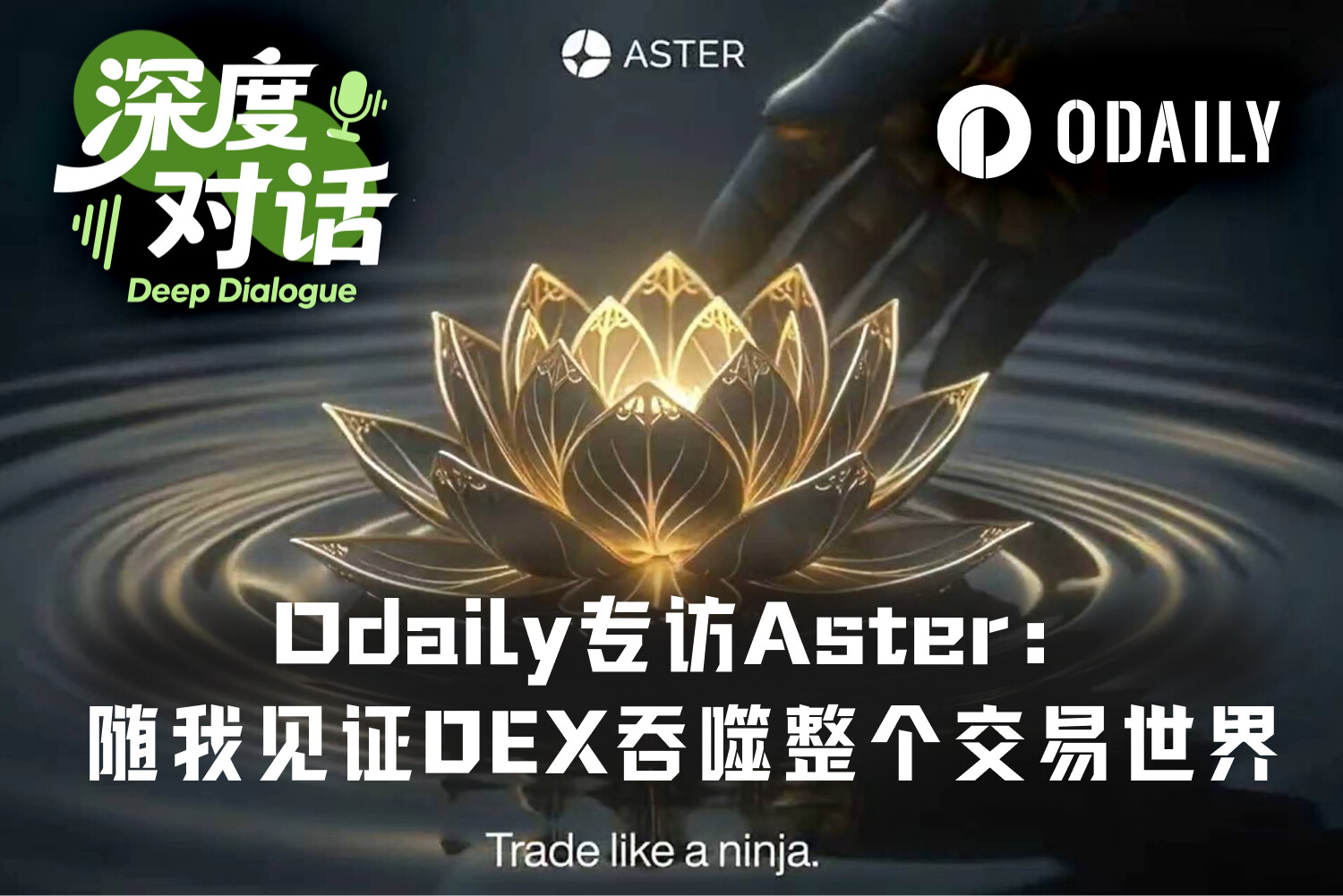
Odaily Interviews Aster: DEX Will Ultimately Devour the Entire Trading World, Optional Privacy is the Key Ladder

Odaily星球日报Pubblicato 2026-03-31Pubblicato ultima volta 2026-03-31

Introduzione

Odaily Interview with Aster: DEX Will Ultimately Devour the Trading World, Optional Privacy is the Key Ladder Aster has initiated key steps to build institutional-grade private DeFi infrastructure, marked by the launch of its Layer 1 mainnet, Aster Chain, on March 17. The mainnet offers traders fair ordering and optional privacy. This was followed by the launch of its native staking function on March 20. The project has rapidly evolved from an innovative Perp DEX into a complete infrastructure layer, achieving record-breaking trading volumes in late 2025 and a successful TGE. In an interview, CEO Leonard explained their core logic: launching a mainnet *after* securing users and revenue, not with a "cold start." This ensures every step is validated by real market demand. Aster's key differentiator is its unique "optional privacy" value proposition, implemented through a ZK + Stealth Address architecture. This allows for automatic privacy for each transaction while maintaining verifiability. The team believes this feature is a prerequisite for mass adoption and will be a primary driver for institutional use of DEXs, forming the core of their moat. Looking ahead, Aster predicts the DEX landscape will evolve into an oligopoly dominated by a few major players. The project is actively pursuing partnerships with both Web2 and Web3 entities, with significant interest from financial firms looking to build markets or list assets on its chain. For the immediate future, Aster's Q2 fo...

Recently, Aster marked its first anniversary as a new starting point, initiating key steps to build institutional-grade privacy DeFi infrastructure. On March 17, the Aster Chain mainnet officially launched, dedicated to providing traders with fair sequencing and optional privacy trading experiences. Shortly after, on March 20, Aster Chain's native staking feature went live, deeply binding network security with ecosystem growth through a dual reward mechanism.

From repeatedly breaking trading volume records in the second half of 2025, to successfully completing the brand upgrade and TGE, to the current L1 mainnet launch, Aster is rapidly evolving from an innovative Perp DEX into a more complete infrastructure layer.

However, in the current context of L1 oversaturation, cold market sentiment, major macro changes, and severely fragmented attention, is launching an L1 the best timing? What are the differentiated advantages of Aster Chain? And what are the upcoming roadmap plans?

To answer these questions, Odaily Planet Daily specially interviewed Aster CEO Leonard, delving into its key decisions over the past year, insights into industry challenges, and the long-term vision of building "trusted Infrastructure".

I found that the core logic lies in: "First have users and revenue, then launch the mainnet," rather than a "cold start." This ensures that every step Aster takes is grounded in real demand and market validation. Simultaneously, Aster Chain's unique "optional privacy" value proposition will be the source of its moat.

There is much in Aster's story worth pondering for Web3 entrepreneurs. Below, the story will be told in the first person by Aster CEO Leonard, enjoy~
What Did Aster Do Right in the Past Year?

Starting in the second half of 2025, the platform's 24h trading volume kept breaking records, from $1 billion in June to reaching $11 billion in September, feeling the project's rapid development. Also in September, during Aster's TGE, achievements like a 24h trading volume breakthrough of $345 million, 330,000 new wallet addresses, and platform TVL exceeding $1 billion solidified Aster's position in the DEX market. When trading volumes broke records, it made us realize that we entered the right track at the right time.

Alongside the TGE, the brand also successfully transitioned from APX to Aster.

And when we launched the L1 mainnet with truly "optional privacy" functionality, it was a unique product unavailable on the market and a prerequisite for on-chain trading moving towards mass adoption.

How Did We Get Through the Darkest Times?

When we initially underwent the rebranding, the market was almost monopolized by Hyperliquid, and no one thought anyone could challenge their position. For a long time before our TGE, the general public thought this was impossible. Before the Aster TGE, the estimated FDV (Fully Diluted Valuation) wasn't high, but we ultimately received a valuation far exceeding expectations, which also triggered a re-evaluation of Perp DEX (Perpetual Contract Decentralized Exchange) projects by the market.

In fact, we once postponed the TGE plan because we felt there was room for product improvement before the official launch. However, we later decided to choose "execution speed" over "pursuing perfection". Looking back, this was the right decision.

The lesson learned is: In an emerging market like Perp DEX, there is no so-called "standard playbook" for handling the toughest problems. Most consensus advice only applies to normal conditions. There's no magic here, only believing in what you do and working hard.

And the core belief that can lead the team to "embrace hardship" is: DEX will ultimately devour the entire trading world, and "optional privacy" is the key to achieving this process.

Behind the High-Speed Growth, Which Team Growth Experiences Can Be Reused?

As the project scaled, we proactively moved away from the early decision-making model reliant on intuition, instead deeply relying on data. Aster's current organizational structure is more refined, decision-making is more systematic, and team metrics are clearer to achieve quantifiable, trackable growth.

Although the organization is growing, some underlying logic remains constant: the owner consciousness of all members, taking full responsibility for the final outcome; rejecting hesitation, action first; result-oriented, processes must ultimately translate into substantive value for users and the protocol.

To maintain the early team's execution and judgment, we adopted three major strategies: Extreme flatness, rejecting internal friction, minimizing management layers as much as possible, reducing ineffective communication links, ensuring transparent and symmetric information; Decision delegation, full authorization: Give teams clear KPIs and Ownership, delegate decision-making power to those closest to the action; Land first, perfect later, emphasizing "quick delivery, small steps fast running", letting the market provide first-hand correction feedback, completing iteration and optimization in a real environment.

The Hardest Time for a New L1? How Does Aster Chain Define Itself?

First, let's talk about the differentiated technical design. Aster Chain adopts a ZK + Stealth Address architecture: Stealth Address makes every transaction automatically private, ZKproof makes every private transaction verifiable. (Friends interested in the technical details of how Aster Chain balances on-chain fund transparency and transaction privacy, please refer to the Gitbook.)

For developers, we launched Aster Code, which is an ecosystem for fee sharing. The core benefit is allowing developers to build their own trading interfaces and directly automate revenue generation from them.

Furthermore, Aster Code also improves developers' integration efficiency, provides a transparent and controlled authorization mechanism, and supports data monitoring and instant settlement.

The Real Challenge of L1: After the Mainnet Launch, How to Make Developers and Users Stay?

The L1 battle is a competition for liquidity.

Technical solutions are basic requirements; users should not feel the difference between centralized and decentralized architectures when trading. Users of Aster Perp DEX are inherently users of Aster Chain. We had users, even revenue, before launching the mainnet. This is the model for successful projects in this cycle, not building a chain first and then looking for a business model.

Regarding ecosystem growth, I believe the privacy option will drive substantive adoption of decentralized trading by institutions, which has always been a past obstacle. Now that we provide privacy features, institutions will at least start trying to move part of their trading flow on-chain. The reasoning is sound: they want diversification, and many institutions already believe the future of trading lies in DEXs. They just needed a viable solution. And now, that solution has emerged: Aster Chain.

What Will the Future Industry Landscape Be? And What is Aster's Moat?

Privacy and core trading experience are our core. In the liquidity competition track, network effects mean capital will inevitably concentrate towards the top players. I believe it's highly likely that an "oligopoly"格局 dominated by the top three players will form in the future; for DEXs, this concentration could be even higher.

Because for DEXs, geographical region or market segment limitations barely exist. Competitive differentiation mainly comes from different design principles and philosophies. Just like Aster always focuses on privacy and is willing to make necessary trade-offs for this core value, this反而 constitutes our moat, allowing us to survive in the long-term competition.

When Contacting B-end, What Point Most Impresses Potential Partners?

Aster Chain is actively promoting cooperation in both Web2 and Web3 fields.

Web3 companies have huge potential for product collaboration with us. For example, we are talking with other stablecoin projects, exploring cooperation models similar to the World Liberty Financial architecture. Additionally, we are also focusing on prediction markets because there is high overlap between prediction market users and perp DEX traders, and the cross-selling opportunities are obvious.

On the Web2 side, most conversations focus on financial companies. The most common point of interest is: building markets on Aster or getting assets listed. This type of cooperation is the easiest阶段性 goal for them to achieve. Although the cycle for establishing cooperation with large companies, especially regulated financial institutions, is long, once confirmed, we will announce it publicly.

What Should We Do Now? Backcasting Based on Judgments About the Future

After the mainnet launch, Aster's Q2 priorities include:

  • Attracting users, professional traders, and institutional traders with privacy needs;
  • Increasing asset types and liquidity;
  • Expanding the ecosystem through Aster Code and Aster Chain;
  • Strengthening token utility and governance;
  • Optimizing the trading interface (UI/UX)......

Crypto Market Downturn, External AI Hype, Any Rhythm Adjustments or Countermeasures from Aster?

Aster cannot predict the market, can only focus on building, surviving the winter and continuously creating value is the only certain path to the next ATH.

As for the AI trend, Aster has already provided relevant skill interfaces for AI Agents. Although not AI experts, we can empower AI developers and Agents, allowing them to build tools on Aster and provide us feedback on how to optimize the product, making Aster not only human-friendly but also attractive to AI Agents.

Years later, I hope the industry's evaluation of Aster is: infrastructure that users can trust long-term and can carry funds and strategies.

Domande pertinenti

QWhat is the core belief driving Aster's vision for the future of trading?

AThe core belief is that DEX will eventually consume the entire trading world, and 'optional privacy' is the key enabler to achieve this vision.

QWhat was Aster's strategy for launching its L1 mainnet, and why was it considered successful?

AAster adopted a 'users and revenue first, then launch the mainnet' approach instead of a 'cold start.' This ensured each step was validated by real market demand and user needs, making the launch successful.

QHow does Aster Chain achieve a balance between on-chain transparency and transaction privacy?

AAster Chain uses a ZK + Stealth Address architecture: Stealth Address ensures each transaction is private, while ZK-proofs make every private transaction verifiable, maintaining transparency and privacy.

QWhat is Aster Code, and how does it benefit developers on the Aster Chain ecosystem?

AAster Code is a fee-sharing ecosystem that allows developers to build their own trading interfaces and automatically earn revenue from it. It also improves integration efficiency with transparent authorization mechanisms and real-time settlement.

QWhat does Aster identify as its main competitive advantage or 'moat' in the DEX landscape?

AAster's moat is its focus on privacy and core trading experience. By prioritizing optional privacy and making necessary trade-offs, it creates a defensible position in the long-term competitive DEX market.

Letture associate

Can DeepSeek Save China One Trillion Dollars?

"DeepSeek and the $1 Trillion Infrastructure Question" The article examines whether DeepSeek's AI optimization breakthroughs could potentially save China $1 trillion in future AI infrastructure costs. The analysis begins with Nvidia's upcoming Vera Rubin AI platform, costing ~$7.8 million, where memory (HBM4/LPDDR5X) constitutes $2 million—a 435% cost increase in one year, highlighting how AI hardware spending is shifting toward expensive memory components. DeepSeek's approach works in the opposite direction. Through three key technical innovations showcased in DeepSeek V4, the company dramatically improves hardware efficiency: 1. **Memory Compression (MLA)**: Re-engineers the attention mechanism to compress long-context memory (KV Cache) by over 90%, drastically reducing expensive HBM usage. 2. **Selective Activation (MoE)**: Employs Mixture-of-Experts architecture where only a small fraction of parameters (e.g., 49B out of 1.6T in V4-Pro) are activated per token, allowing most parameters to reside in cheaper memory/SSD. 3. **Computation Caching**: Reuses previously computed results via cache hits, replacing expensive GPU computations with cheap memory reads. Combined, these optimizations allow the same hardware to produce approximately 4x more tokens, effectively reducing required hardware investment by 75%. DeepSeek's pricing reflects this: a 10-billion token workload costs ~$522 monthly versus ~$9,000-$10,000 for competitors. The $1 trillion savings projection stems from McKinsey's estimate that global AI infrastructure will require ~$5.2 trillion investment by 2030. As China's daily token consumption grows toward quadrillions, even marginal efficiency gains scale massively. With a conservative 4x throughput improvement, China could avoid building tens of thousands of AI data centers equivalent to ~7 trillion RMB ($1 trillion) in saved investment. Critically, this strategy shifts dependency from scarce, expensive GPU/HBM—where China lags—toward more accessible storage, caching, and systems engineering where domestic suppliers like CXMT are gaining strength. Rather than "replacing Nvidia," DeepSeek rebalances AI's value chain away from monolithic hardware dependency. Ultimately, DeepSeek's technical breakthroughs could lower the barrier to AI adoption across Chinese industries by making advanced capabilities affordable at scale—transforming who can access next-generation AI.

marsbit53 min fa

Can DeepSeek Save China One Trillion Dollars?

marsbit53 min fa

Overturning the Mainstream Approach to Hallucinations: Metacognition is the New Solution for Large Models to Break the Hallucination Barrier

This paper, "Hallucinations Undermine Trust; Metacognition is a Way Forward," proposes a paradigm shift in combating AI hallucination. It argues that the current mainstream approaches—striving for omniscience by scaling data/models or having AI abstain from uncertain answers—are fundamentally flawed. The former has inevitable knowledge gaps, while the latter imposes a crippling "utility tax," requiring the rejection of many correct answers to achieve high accuracy, due to models' poor "discrimination" (the ability to distinguish correct from incorrect answers internally). The core contribution is redefining hallucination not as "being wrong," but as "expressing false information with unwarranted certainty." The proposed solution is **Faithful Uncertainty** or **Metacognition**: enabling AI to accurately perceive its internal uncertainty and honestly express it in its language (e.g., using hedging phrases when unsure). This creates a more reliable assistant that provides useful information while signaling its confidence, minimizing harm from errors. The paper emphasizes that metacognition is critical for the era of AI Agents. Without it, Agents cannot intelligently decide when to use tools like search engines, leading to inefficiency and misuse. Key implementation challenges are highlighted: the "bootstrapping paradox" of training with static uncertainty data, the "alignment distortion signal" where human preference training suppresses internal uncertainty cues, and the difficulty of causally evaluating true metacognition vs. its superficial imitation. The paper concludes that the goal should not be an infallible AI, but one that is honest about the limits of its knowledge, thereby building user trust through transparent communication of its certainty.

marsbit57 min fa

Overturning the Mainstream Approach to Hallucinations: Metacognition is the New Solution for Large Models to Break the Hallucination Barrier

marsbit57 min fa

Hedge by Buying Gold and Oil, Chase Soaring Returns with AI. ‘Dated’ Bitcoin Enters a Bear Market

Bitcoin has recently declined, hitting a two-month low near $66,123, while Ethereum fell to a three-month low around $1,837. Analysts suggest the drop is not merely due to factors like ETF outflows or MicroStrategy's selling but reflects a deeper issue: Bitcoin is losing a broader asset competition. In a near-zero interest rate environment, Bitcoin previously thrived as an outlet for investor dissatisfaction with inflation and limited options. However, the market landscape has shifted. Bitcoin now occupies an "awkward middle ground," facing competition on three fronts. For inflation hedging, investors prefer gold, energy stocks, and commodity producers—assets with tangible backing and clearer pricing power. For growth exposure, AI-related companies with actual revenues and profits are more attractive. Even within crypto, investors can choose stablecoins, exchanges, or infrastructure firms tied directly to adoption, offering clearer business models and leverage. Thus, Bitcoin is no longer the top choice for hedging, growth, or crypto exposure. This shift is evident in market reactions: despite recent warnings about persistent inflation from a Fed official, Bitcoin did not rally as it might have in the past. Instead, capital flowed to assets with direct commodity or energy exposure. The recent ETF outflows and MicroStrategy sales are symptoms, not causes, of this new reality. Investors are becoming more selective, demanding clearer value propositions beyond mere scarcity. The emerging bear case for Bitcoin is not about it being a bubble or failed technology, but that scarcity alone is no longer sufficient.

华尔街日报1 h fa

Hedge by Buying Gold and Oil, Chase Soaring Returns with AI. ‘Dated’ Bitcoin Enters a Bear Market

华尔街日报1 h fa

Trading

Spot
Futures

Articoli Popolari

Come comprare ASTER

Benvenuto in HTX.com! Abbiamo reso l'acquisto di Aster (ASTER) semplice e conveniente. Segui la nostra guida passo passo per intraprendere il tuo viaggio nel mondo delle criptovalute.Step 1: Crea il tuo Account HTXUsa la tua email o numero di telefono per registrarti il tuo account gratuito su HTX. Vivi un'esperienza facile e sblocca tutte le funzionalità,Crea il mio accountStep 2: Vai in Acquista crypto e seleziona il tuo metodo di pagamentoCarta di credito/debito: utilizza la tua Visa o Mastercard per acquistare immediatamente AsterASTER.Bilancio: Usa i fondi dal bilancio del tuo account HTX per fare trading senza problemi.Terze parti: abbiamo aggiunto metodi di pagamento molto utilizzati come Google Pay e Apple Pay per maggiore comodità.P2P: Fai trading direttamente con altri utenti HTX.Over-the-Counter (OTC): Offriamo servizi su misura e tassi di cambio competitivi per i trader.Step 3: Conserva Aster (ASTER)Dopo aver acquistato Aster (ASTER), conserva nel tuo account HTX. In alternativa, puoi inviare tramite trasferimento blockchain o scambiare per altre criptovalute.Step 4: Scambia Aster (ASTER)Scambia facilmente Aster (ASTER) nel mercato spot di HTX. Accedi al tuo account, seleziona la tua coppia di trading, esegui le tue operazioni e monitora in tempo reale. Offriamo un'esperienza user-friendly sia per chi ha appena iniziato che per i trader più esperti.

663 Totale visualizzazioniPubblicato il 2025.09.25Aggiornato il 2026.06.02

Come comprare ASTER

Discussioni

Benvenuto nella Community HTX. Qui puoi rimanere informato sugli ultimi sviluppi della piattaforma e accedere ad approfondimenti esperti sul mercato. Le opinioni degli utenti sul prezzo di ASTER ASTER sono presentate come di seguito.

活动图片