
Overturning the Mainstream Approach to Hallucinations: Metacognition is the New Solution for Large Models to Break the Hallucination Barrier

marsbitPubblicato 2026-06-03Pubblicato ultima volta 2026-06-03

Introduzione

This paper, "Hallucinations Undermine Trust; Metacognition is a Way Forward," proposes a paradigm shift in combating AI hallucination. It argues that the current mainstream approaches—striving for omniscience by scaling data/models or having AI abstain from uncertain answers—are fundamentally flawed. The former has inevitable knowledge gaps, while the latter imposes a crippling "utility tax," requiring the rejection of many correct answers to achieve high accuracy, due to models' poor "discrimination" (the ability to distinguish correct from incorrect answers internally). The core contribution is redefining hallucination not as "being wrong," but as "expressing false information with unwarranted certainty." The proposed solution is **Faithful Uncertainty** or **Metacognition**: enabling AI to accurately perceive its internal uncertainty and honestly express it in its language (e.g., using hedging phrases when unsure). This creates a more reliable assistant that provides useful information while signaling its confidence, minimizing harm from errors. The paper emphasizes that metacognition is critical for the era of AI Agents. Without it, Agents cannot intelligently decide when to use tools like search engines, leading to inefficiency and misuse. Key implementation challenges are highlighted: the "bootstrapping paradox" of training with static uncertainty data, the "alignment distortion signal" where human preference training suppresses internal uncertainty cues, and the diff...

A recent paper from Google Research has a core idea that can be summarized in one sentence: Instead of stubbornly pursuing "making AI omniscient and omnipotent", it's better to teach it to say "I'm not sure".

This paper, titled "Hallucinations Undermine Trust; Metacognition is a Way Forward", was jointly completed by Google Research and Tel Aviv University and has been accepted by the ICML 2026 Position Track. The paper suggests that the mainstream industry approach to combating "hallucinations" might be fundamentally misguided—everyone is busy pumping more knowledge into models, overlooking a more crucial and underestimated capability: enabling AI to perceive and express its own confidence level for each answer.

(Paper address: [2605.01428] Hallucinations Undermine Trust; Metacognition is a Way Forward)

The Utility Tax: The Real Cost of Eliminating Hallucinations

Let's start with a scenario everyone encounters.

You ask an AI assistant a question, and it gives an answer with an unshakeably confident tone, its wording precise, logic complete, seemingly flawless. Later, you check, and that answer is completely fabricated. What's even more infuriating is that it said it without any hesitation, as if it had witnessed it firsthand.

This is AI "hallucination"—the model outputs factually incorrect content but presents it to the user in an unquestionable manner. This problem is particularly fatal in high-stakes scenarios like healthcare, law, and scientific research.

The industry's approach to hallucinations essentially follows two paths. The first path: Make the AI know more, by expanding training data and increasing model parameters to cover more facts. The second path: Make the AI stay silent when uncertain, refusing to answer questions it's unsure about.

Both paths have obvious shortcomings. Facts in the world are endless; models cannot possibly memorize everything, so the first path will always have uncovered blind spots. The problem with the second path is that once AI starts refusing to answer on a large scale, it turns from a "useful assistant" into a "scaredy-cat that dares not say anything"—users ask ten questions, eight get rejected, leading to a terrible experience.

The paper gives the cost of the second path an apt name: "utility tax"—to reduce the hallucination rate, you must sacrifice a large amount of information that could have been answered correctly.

Why is this tax so heavy? The root cause is the lack of a key ability in AI. For the "refuse-to-answer" strategy to work precisely, the model needs to accurately distinguish between "I got this question right" and "I got this question wrong"—refusing only the wrong ones while keeping the right ones. But in reality, models cannot make this precise distinction. The paper distinguishes two easily confused but fundamentally different concepts to illustrate this problem.

Calibration measures whether the AI's overall confidence level matches its overall accuracy. For example, the AI answers 100 questions, each time saying "I'm 60% confident," and exactly 60 out of 100 are correct—this is perfect calibration.

Discrimination measures whether the AI can accurately distinguish "I'm right" from "I'm wrong" on each specific question. An AI that gives 60% confidence for all questions, with an overall accuracy of exactly 60%, is perfectly calibrated but has zero discrimination—it completely fails to distinguish which ones to trust and which to guard against. Good calibration does not equal strong discrimination, and this is precisely the crux of the problem.

After reviewing extensive literature, the paper finds that current mainstream large models' discrimination metric AUROC on factual question-answering tasks is concentrated between 0.70 and 0.85. This number might sound decent but is far from sufficient. Using AUROC=0.71 as a parameter, the paper conducts a set of simulations with startling results: assuming a base error rate of 25%, to reduce the error rate to 5%, the AI must refuse to answer over 52% of correct questions. Even if discrimination improves to 0.85, which is near the literature ceiling, it still requires sacrificing 28% of correct answers. Only when discrimination reaches above 0.95 does the cost become negligible—and currently, no method comes close to this number on knowledge-intensive tasks.
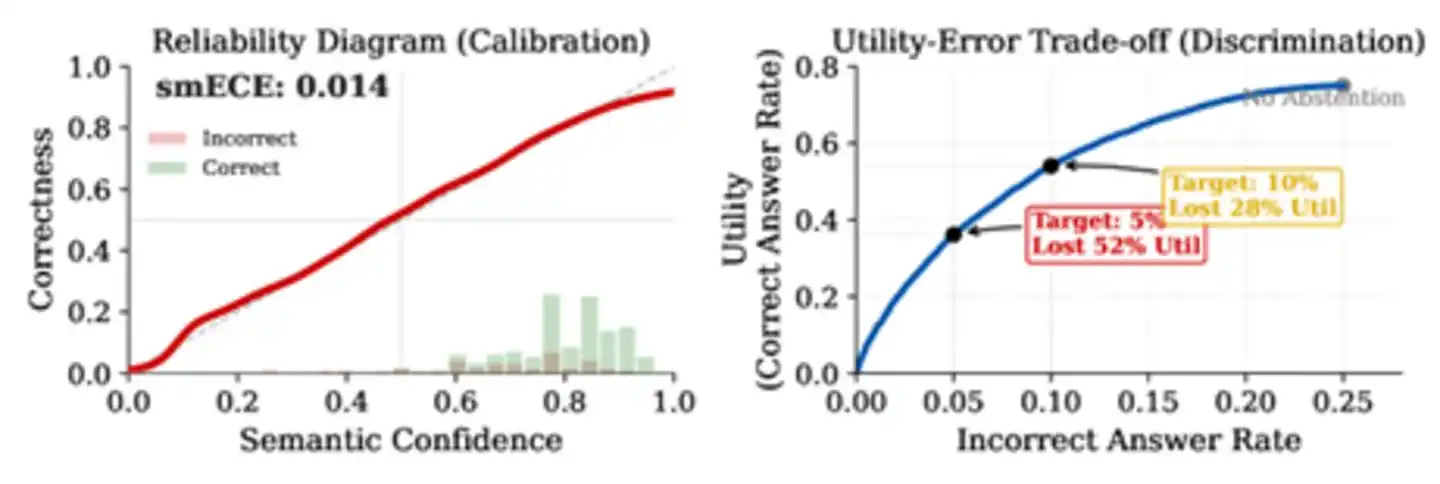
Figure: The difference between calibration and discrimination. The left plot shows the model is well-calibrated (red line close to the diagonal), while the right plot reveals the harsh reality—even with perfect calibration, to reduce the error rate from 25% to 5%, 52% of correct answers must be sacrificed.

Real data confirms this assessment. The paper analyzes the performance of various state-of-the-art models on the SimpleQA Verified benchmark, with results clear and somewhat brutal: most models distribute along the "answer more, err more" diagonal, while a few models pursuing high accuracy achieve higher per-question accuracy by refusing many answers, but at the expense of a huge utility cost. That ideal "upper-right corner" region—answering many and erring few—is currently empty. This blank space is precisely the "discrimination gap" mentioned in the paper.
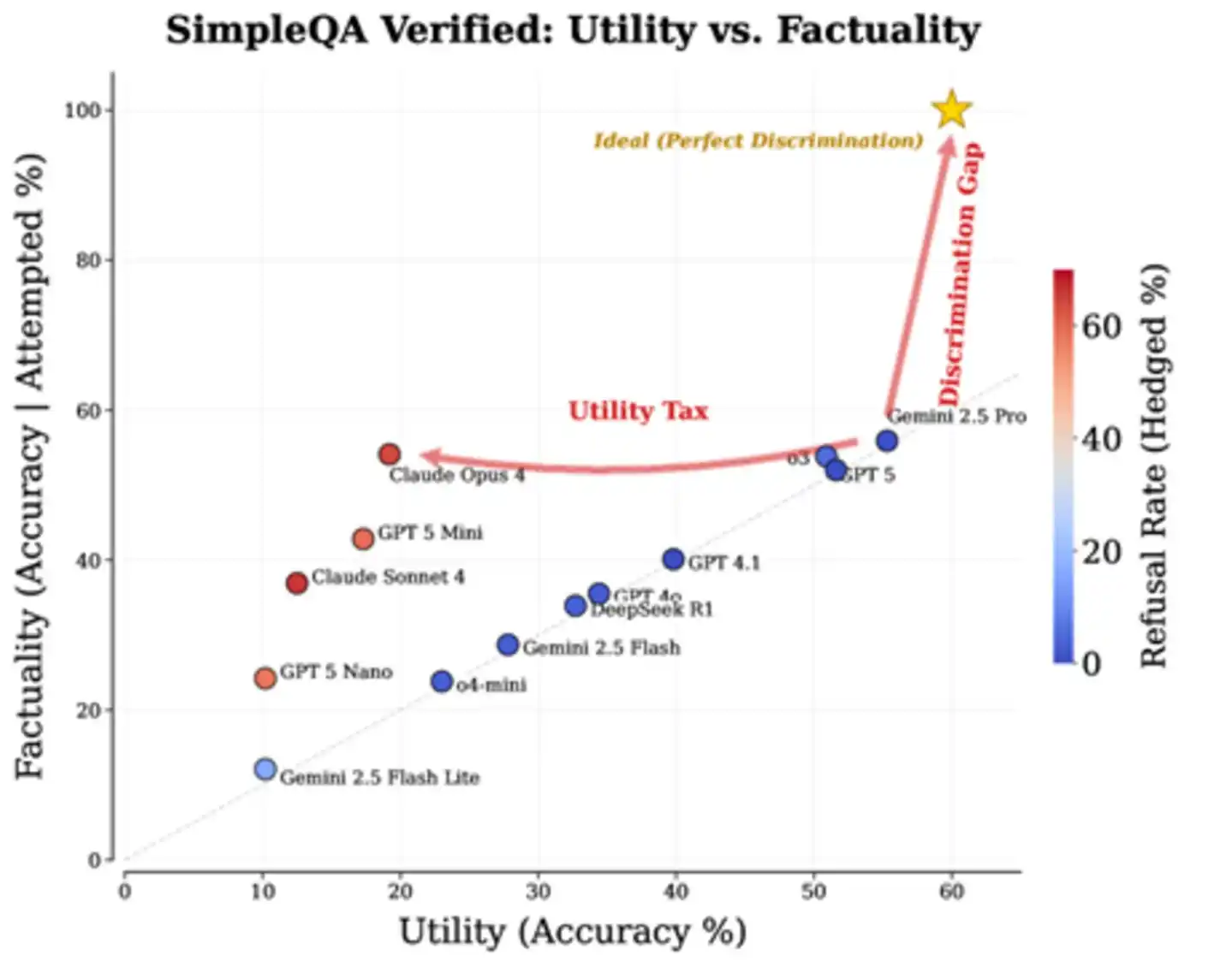
Figure: Measured performance of mainstream models on SimpleQA Verified. The five-pointed star in the upper right is the ideal target, "Discrimination Gap" marks the chasm between current models and the ideal, and "Utility Tax" indicates the utility price Claude Opus 4 pays for its high accuracy.

Since "stuffing more knowledge" has blind spots, and "staying silent when unsure" is too costly, is there a third way?

Redefining Hallucination: Not "Saying It Wrong", but "Claiming Certainty Without the Right to Be Certain"

The paper's core contribution lies not in diagnosing the problem, but in redefining the problem itself.

For a long time, the industry has defined "hallucination" as "AI outputting wrong information," implying a premise: eliminating hallucinations = eliminating all errors. But the paper proposes looking at it from another angle—hallucination is not "AI saying something wrong," but "AI having no right to be certain, yet giving wrong information with a tone of certainty".

This distinction seems subtle but has profound implications. For example: A doctor looks at test results and says, "You have disease X." If he's just guessing based on intuition, this is irresponsible. But if he says, "Current symptoms point to X, but further tests are needed for confirmation," even if the initial assessment direction is slightly off, this way of expression is honest in itself—he's telling the patient, "Please treat this judgment with caution." Errors are not unacceptable; what's unacceptable is pretending to be certain when uncertain.

Based on this new definition, the third way emerges: faithful uncertainty—enabling AI to express confidence levels at the linguistic level that truly correspond to its internal state's confidence level.

Specifically, an AI's "internal uncertainty" can be objectively measured through repeated sampling: ask the same question a hundred times; if it gives the same answer every time, it's internally certain; if answers vary widely, it's internally uncertain. "Linguistic uncertainty" is the sense of confidence reflected in the AI's wording—"August 4, 1961" versus "I seem to recall it was 1961, but I'm not entirely sure" give readers completely different signals.

Faithful uncertainty requires aligning the two: using tentative wording when internally uncertain, and using a definite tone only when internally certain. The paper emphasizes that this goal is more feasible than "eliminating all errors." The reason is that faithful uncertainty only requires the AI's language output to correspond to its own internal state—this is a closed-loop problem, the signal is inside the model, not dependent on external truth. Eliminating errors requires the AI's output to completely correspond to the truth of the external world; the paper cites the Halting Problem and computational theory, indicating this has fundamental theoretical limits.

The paper summarizes this capability into a higher-level concept: metacognition—AI can both perceive its own uncertainty and adjust its behavior based on that perception. This concept is borrowed from psychology, originally meaning "cognition about one's own cognitive processes." In the AI context, it means AI has a clear awareness of what it knows and what it doesn't know.
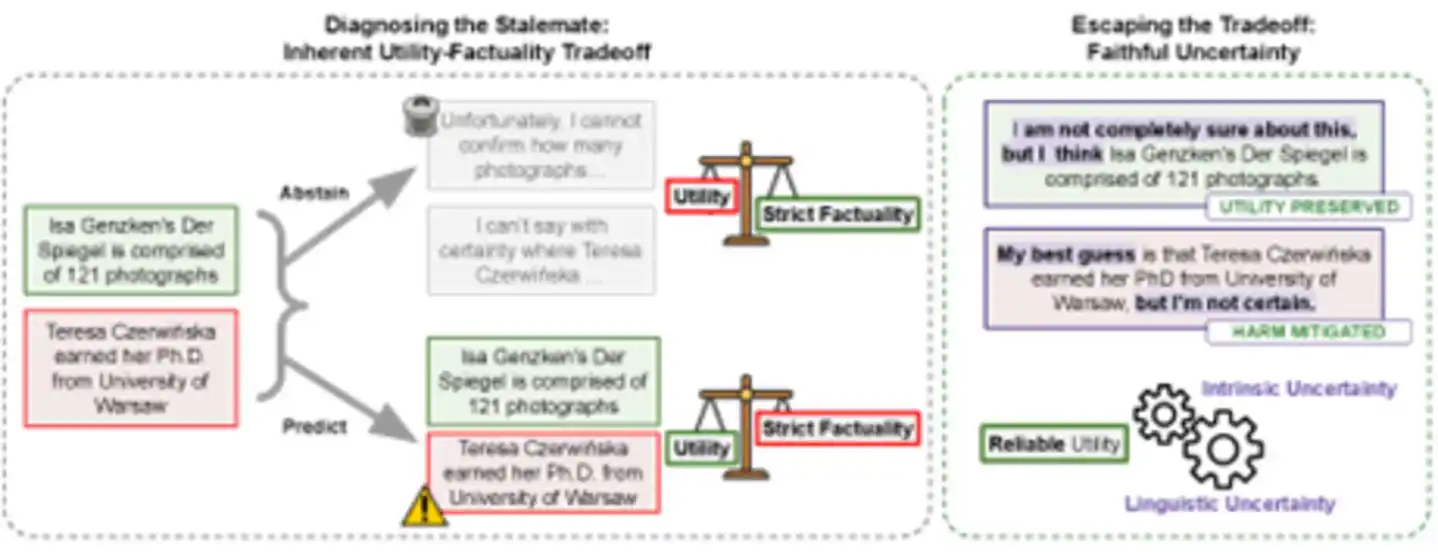
Figure: The left side shows the traditional dilemma—"answering" risks hallucinations, "refusing to answer" imposes a utility cost. The right side shows the new path—by faithfully expressing uncertainty, both retaining useful information and minimizing the harm of wrong information, achieving "reliable utility."

The Agent Era: Agents Without Metacognition Are "Flying Blind"

The value of metacognition is not limited to conversational scenarios. In the era of AI Agents, it becomes even more critical.

On the surface, equipping AI with a search engine seems to solve the lack of knowledge problem—just look it up when you don't know, what's there to fear about hallucinations? But the paper points out that tools introduce not a "storage solution," but a "control problem".

With tools, AI faces a series of new decisions: Do I know this myself, or do I need to search? Is the information found credible? If search results contradict what I know, which do I trust? When should I stop searching?

All these decisions depend on the AI's accurate perception of its own internal confidence level. An AI agent without metacognitive ability is like a pilot without an instrument panel—the engine is already alarming, and he's still accelerating.
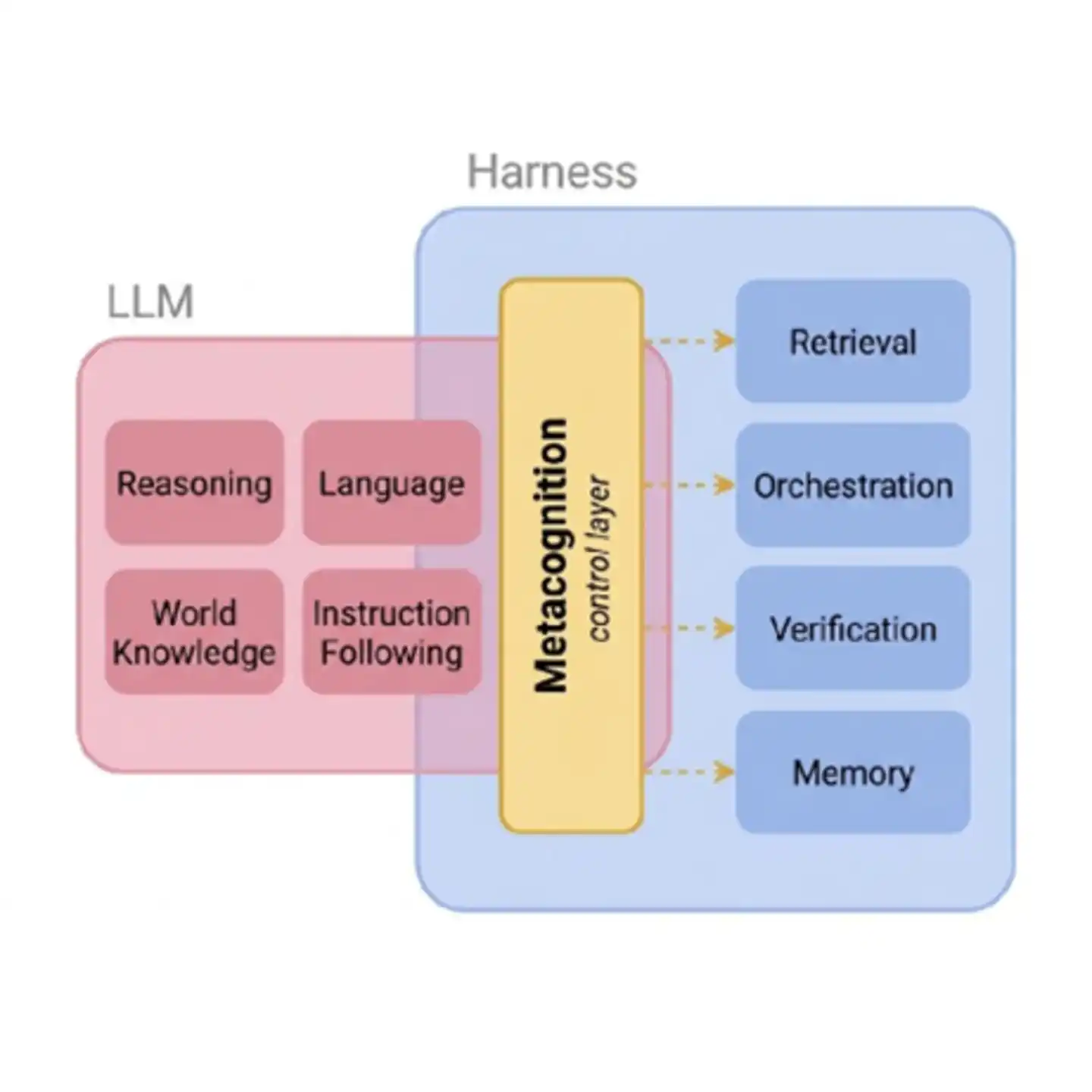
Figure: The metacognitive control layer serves as a bridge between the AI's foundational capabilities and the external tool system. Without this layer, an Agent's scheduling of external tools is like "flying blind"—not knowing whether to search, whether to believe the results, or to what extent.

Research cited by the paper indicates that current search-enhanced AI agents commonly suffer from tool overuse—searching for questions that don't need searching at all, leading to inefficiency and introducing unnecessary noise. The reason is simple: AI without metacognition simply cannot judge "Do I need extra information?"

On the Road to Metacognition, Several Hard Challenges Remain

The paper also frankly points out key challenges on the path to realization.

"Bootstrapping Paradox": Teaching AI to express uncertainty requires training data demonstrating "when to hesitate," but the AI's knowledge boundaries are dynamic. A training sample labeled "I'm not sure" might become something the model confidently knows after evolution. Using static data to teach a dynamic ability would train AI that "pretends to be uncertain." This requires developing dynamic data infrastructure that reflects the model's current knowledge boundaries.

"Alignment Destroys the Signal": Research finds that AI after pre-training actually has decent internal uncertainty signals—its internal state can distinguish "confident about this question" from "unsure about this question." But alignment training like RLHF erases this signal. The reason is that humans prefer answers with a certain tone, forcing the AI to learn to appear confident externally no matter how uncertain it is internally.

"Causality in Evaluation": A deeper challenge is ensuring the AI is genuinely reading internal signals, not just learning superficial patterns like "say I'm unsure when encountering rare words." Distinguishing "real metacognition" from "performance of metacognition" is a fundamental scientific evaluation problem.

The paper also offers specific suggestions to the research community: Stop evaluating anti-hallucination methods with only a single accuracy number. Instead, visualize the complete "utility-error rate trade-off curve" to see clearly whether a method genuinely improves underlying discrimination ability or merely raises the refusal threshold on the same curve. Simultaneously, detect "collateral damage"—whether reducing error rates in knowledge Q&A comes at an unexpected cost to tasks like reasoning, coding, and writing.

Ultimately, the core message this paper wants to convey is: AI doesn't have to be omniscient and omnipotent, but it must have an honest understanding of what it knows and doesn't know, and communicate that understanding to the user.

We trust professionals not because they never make mistakes, but because they can honestly distinguish "I'm certain" from "I'm guessing"—it is this distinction that separates the professional from the unprofessional. AI should also move down this road. Instead of endlessly chasing the illusion of perfect infallibility, it's more practical to teach AI one more thing: knowing when it's talking nonsense, and honestly telling the user. (This article first appeared on Titanium Media APP, author | Silicon Valley Tech_news, editor | Jiao Yan)


Crypto di tendenza

Domande pertinenti

QAccording to the article, what is the core limitation of the current two mainstream approaches (scaling up knowledge and refusing to answer) to combating AI hallucinations?

AThe core limitation is the 'utility tax'—the high cost of sacrificing many correct answers. Scaling knowledge has inherent blind spots, while refusing to answer lacks precision because current models have poor 'discrimination'—they cannot accurately tell which specific answers they got right or wrong, forcing them to reject many correct responses to lower error rates.

QWhat key concept does the paper borrow from psychology and propose as a new solution to the hallucination problem?

AThe paper proposes the concept of 'metacognition,' borrowed from psychology, as a new solution. In the AI context, it means the AI's ability to perceive its own uncertainty (knowing what it knows and doesn't know) and adjust its behavior accordingly, primarily through 'faithful uncertainty' in its language.

QHow does the paper redefine the problem of 'hallucination'?

AThe paper redefines 'hallucination' not simply as 'the AI saying something wrong,' but as 'the AI outputting wrong information with unwarranted certainty.' It shifts the focus from eliminating all errors to ensuring the AI's expressed certainty in language faithfully corresponds to its internal state of certainty.

QWhy is metacognition particularly critical for AI Agents, according to the article?

AMetacognition is critical for AI Agents because it acts as the essential control layer for using external tools like search engines. Without it, Agents face a 'control problem': they cannot determine when they need to search, whether to trust the results, or when to stop, leading to tool abuse and inefficient 'blind flying.'

QWhat are two of the key technical challenges mentioned in the article for achieving faithful uncertainty in AI models?

ATwo key challenges are: 1) The 'Bootstrapping Paradox': Training models on static data to express uncertainty doesn't account for their dynamic, evolving knowledge boundaries, risking models that only 'perform' uncertainty. 2) 'Alignment Destroys the Signal': RLHF and other alignment training can erase the model's inherent internal uncertainty signals by rewarding confident-sounding responses, teaching the AI to appear certain even when it's not.

Letture associate

Wall Street's Most Famous 'Cassandra' Now Has His Sights Set on Nvidia

Michael Burry, the famed "Big Short" investor, has once again captured Wall Street's attention with a series of short positions against major tech and semiconductor stocks, most notably Nvidia. In late June and July, through his "Cassandra Unchained" newsletter, Burry disclosed short bets against Nvidia, Tesla, Applied Materials, Caterpillar, the SOXX semiconductor ETF, and later, Micron Technology. His core thesis revolves around potential distortions in the AI infrastructure boom, specifically questioning whether extended depreciation schedules (e.g., 6 years vs. a realistic 2-3 years for AI chips) by cloud giants like Microsoft and Google artificially inflate profits. He also raises concerns about possible "off-balance-sheet circular financing," where chip demand might be propped up by vendor-backed funding to clients. Nvidia's stock experienced volatility following these disclosures, briefly dipping but largely holding near Burry's reported entry points, leaving his positions roughly flat or slightly underwater as of late July. This move is part of a pattern for Burry, whose track record since his legendary 2008 bet is mixed. He has faced notable losses, such as on Tesla in 2021, while scoring on broader market turns like the 2020 pandemic crash. His methodology focuses intensely on free cash flow and scrutinizing original financial documents to spot overvaluation and structural risks, but it often struggles with timing the market. The article contrasts Burry's stance with other prominent investors. Steve Eisman, another "Big Short" figure, is not shorting Nvidia, citing strong fundamentals but expressing nervousness about sustainability. Jim Chanos agrees with the broad "accounting mismatch" concern—comparing it to the dot-com bubble—but targets financial leverage in private equity firms rather than the chip stocks themselves. While Nvidia's short interest remains relatively low at 1.3-1.4% of float, the massive stock size means absolute short losses have been significant, exceeding $5 billion earlier this year. The piece concludes that for ordinary investors, the key takeaway is not replicating specific short bets but learning from the critical frameworks these investors use: questioning rosy accounting, identifying structural vulnerabilities, and maintaining skepticism during market euphoria, even if pinpointing the exact catalyst for a downturn remains elusive.

marsbit9 min fa

Wall Street's Most Famous 'Cassandra' Now Has His Sights Set on Nvidia

marsbit9 min fa

Weekly Selection丨Epic Stock Market Volatility, Changxin Tech's IPO Reshapes Storage Landscape, Saylor Aims to Re-Anchor STRC Around September 8th

PANews Weekly Digest: Market Turmoil, Tech Breakthroughs, and Crypto Developments. The week saw significant volatility across global markets. South Korea's KOSPI index experienced extreme turbulence, including multiple trading halts, largely driven by sharp declines in AI hardware stocks like SK Hynix. In contrast, China's Changxin Xinqiao (CXC) achieved a landmark IPO with a market cap surpassing 4 trillion yuan, marking a major success for the domestic DRAM industry after a decade of losses. In the crypto and Web3 space, several key narratives emerged. AI is driving demand for new infrastructure, with projects like AI agent wallets and programmable payments gaining traction, attracting interest from firms like Coinbase. The Bitcoin mining sector is pivoting, with companies like MARA focusing on energy management as electricity becomes a core AI-era asset. Meanwhile, the RWA (Real World Assets) sector faces a "utilization puzzle," with hundreds of billions in on-chain assets remaining dormant. Notable market movements included a historic single-day surge of over 17% for the KOSPI index and a significant migration of $16.5 billion in staked ETH within the Lido ecosystem. Michael Saylor announced a target to re-peg the STRC stablecoin around September 8th. Other highlights include discussions on Ethereum's ambitious 2030 roadmap for scaling and privacy, analysis showing high protocol revenues not always translating to token price gains, and warnings from Citi about potential extreme commodity price shocks by late 2026.

marsbit14 min fa

Weekly Selection丨Epic Stock Market Volatility, Changxin Tech's IPO Reshapes Storage Landscape, Saylor Aims to Re-Anchor STRC Around September 8th

marsbit14 min fa

When the Market Begins to Question AI Capex: A Full Analysis of Q2 Earnings Reports from Five Tech Giants

In late July 2026, five major US tech giants—Alphabet, Intel, Microsoft, Meta, and Apple—released their Q2 earnings reports. While all companies exceeded revenue and profit expectations, driven by strong AI-related business growth, investor reactions diverged sharply due to concerns over escalating AI capital expenditures (capex) and their impact on free cash flow. Alphabet reported strong revenue growth and a surging cloud business, but its stock fell after announcing a doubled year-on-year capex and negative quarterly free cash flow for the first time. Intel posted its strongest revenue growth in over 15 years, but its stock experienced volatile trading after significantly raising its full-year capex guidance. Microsoft saw its stock surge after beating estimates and, crucially, lowering its capex forecast while projecting positive free cash flow. Meta faced the most severe sell-off as its profits declined despite revenue beats, with free cash flow plunging over 90% and its capex guidance raised. Apple reported record June-quarter results, but its stock plummeted after providing Q4 revenue guidance that fell short of expectations, citing supply chain constraints and forex headwinds. The overall takeaway is that the market's focus has shifted from validating AI demand to scrutinizing the timeline for returns on massive AI investments. Companies demonstrating a clearer path to managing capex and preserving free cash flow, like Microsoft, were rewarded, while those signaling continued aggressive spending faced investor skepticism.

Odaily星球日报23 min fa

When the Market Begins to Question AI Capex: A Full Analysis of Q2 Earnings Reports from Five Tech Giants

Odaily星球日报23 min fa

a16z: From Companies to DAOs, DUNA May Become the Next Generation Organizational Form

This article, "From Companies to DAOs: How DUNA Could Become the Next Organizational Form," traces the 500-year evolution of business collaboration. It begins with medieval structures like the *commenda* and Florentine *compagnia*, which exposed partners to personal risk. The modern corporation, exemplified by the Dutch East India Company (VOC), was a revolutionary leap, enabling large-scale, capital-intensive ventures by offering limited liability and reducing coordination costs. However, corporations introduced new challenges like principal-agent problems and bureaucratic overhead. The piece argues that software and internet-native protocols are now reducing these traditional overheads. Decentralized Autonomous Organizations (DAOs) emerged as a new model for coordination without centralized management. Yet, DAOs face a significant legal vacuum: they lack legal recognition, leaving members exposed to unlimited personal liability, and their tokens are vulnerable to being classified as securities under unclear regulations (e.g., the Howey Test). This has forced projects into suboptimal workarounds like offshore foundations. The article identifies the Decentralized Unincorporated Nonprofit Association (DUNA) as a potential solution. Recently legalized in states like Wyoming, the DUNA provides a legal wrapper for decentralized networks. It grants key protections—legal personality, limited liability, and perpetual existence—to a group without imposing a traditional hierarchical management structure. This allows token-holder communities to govern, hold assets, and contract as a single legal entity, aligning with their decentralized nature. While DUNA doesn't solve all governance challenges or magically resolve securities law questions, it represents a crucial step. It fills the legal recognition gap, offering a native legal form for internet-scale, decentralized collaboration and extending the separation of personal risk from organizational venture into a new domain.

marsbit1 h fa

a16z: From Companies to DAOs, DUNA May Become the Next Generation Organizational Form

marsbit1 h fa

2026 Mid-Year Report On-Chain RWA: Tokenized Stock Market Cap Doubles in a Year, But 90% of Rights Are Hollow Shells

The 2026 Mid-Year Report on On-Chain RWA highlights a significant growth in tokenized stock market capitalization, which nearly doubled from $951 million in March to $1.89 billion by July. However, the report reveals a fundamental contradiction in this "layer 2.5" ecosystem: products with the strongest legal foundation (like regulated U.S. infrastructure) lack liquidity and distribution, while freely tradable offshored wrapper products often lack substantive ownership rights. The increase is driven largely by a few products (SECZ, FGRS, STRCx) and platforms (Ondo, xStocks, Securitize collectively hold over 85% share). While distributed value across networks like Ethereum, Solana, and BNB Chain has grown, the market remains fragmented. Products referencing the same underlying asset (e.g., Apple stock) are distinct legal liabilities with different intermediaries and jurisdictional rules, offering varying degrees of legal claim. The report cautions that headline numbers are misleading, as they reflect changes in distributed token value—driven by issuance, conversions, and price movements—not pure investor inflows. True "canonical shares" with legal ownership, wide wallet distribution, institutional liquidity, and independent on-chain price discovery do not yet exist at scale. Tokenized treasuries show stronger product-market fit, and ETFs may be easier to scale than single stocks. The core takeaway is a trade-off: legal certainty versus liquidity and composability.

marsbit1 h fa

2026 Mid-Year Report On-Chain RWA: Tokenized Stock Market Cap Doubles in a Year, But 90% of Rights Are Hollow Shells

marsbit1 h fa

Trading

Spot

Articoli Popolari

Come comprare CORE

Benvenuto in HTX.com! Abbiamo reso l'acquisto di CORE (CORE) semplice e conveniente. Segui la nostra guida passo passo per intraprendere il tuo viaggio nel mondo delle criptovalute.Step 1: Crea il tuo Account HTXUsa la tua email o numero di telefono per registrarti il tuo account gratuito su HTX. Vivi un'esperienza facile e sblocca tutte le funzionalità,Crea il mio accountStep 2: Vai in Acquista crypto e seleziona il tuo metodo di pagamentoCarta di credito/debito: utilizza la tua Visa o Mastercard per acquistare immediatamente CORECORE.Bilancio: Usa i fondi dal bilancio del tuo account HTX per fare trading senza problemi.Terze parti: abbiamo aggiunto metodi di pagamento molto utilizzati come Google Pay e Apple Pay per maggiore comodità.P2P: Fai trading direttamente con altri utenti HTX.Over-the-Counter (OTC): Offriamo servizi su misura e tassi di cambio competitivi per i trader.Step 3: Conserva CORE (CORE)Dopo aver acquistato CORE (CORE), conserva nel tuo account HTX. In alternativa, puoi inviare tramite trasferimento blockchain o scambiare per altre criptovalute.Step 4: Scambia CORE (CORE)Scambia facilmente CORE (CORE) nel mercato spot di HTX. Accedi al tuo account, seleziona la tua coppia di trading, esegui le tue operazioni e monitora in tempo reale. Offriamo un'esperienza user-friendly sia per chi ha appena iniziato che per i trader più esperti.

260 Totale visualizzazioniPubblicato il 2024.12.13Aggiornato il 2026.06.02

Come comprare CORE

Discussioni

Benvenuto nella Community HTX. Qui puoi rimanere informato sugli ultimi sviluppi della piattaforma e accedere ad approfondimenti esperti sul mercato. Le opinioni degli utenti sul prezzo di CORE CORE sono presentate come di seguito.

活动图片












