Author: Hayden Adams, Founder @Uniswap
Compiled by: Deep Tide TechFlow
Deep Tide Guide: Uniswap founder Hayden Adams believes that as traditional assets like stocks are tokenized, "correlated trading pairs" such as NVDA/SPY will reduce inventory and hedging costs, giving passive AMMs an opportunity to enter core markets long dominated by traditional market makers. Crypto KOL Cody further analyzed the feasibility of this idea in the current on-chain market by combining historical backtesting with actual LP experience.
Here is the full content:
This is my first blog post since 2019!
Correlated Trading Pairs: How AMMs Win the Biggest Markets
I've been working at the forefront of DeFi for 9 years. It's a fascinating field with infinite depth and the ability to change capital markets.
I've always believed in the huge potential of AMMs, but one big question has haunted me over the past decade: Can this new market structure truly become the core engine for all financial markets?
After years of evolution and growth, a path to global dominance for AMMs is becoming increasingly clear. And the best way to explain it starts in 1976.
Tokenization Changes Who Makes Markets
Index funds celebrated their 50th anniversary this month. When Jack Bogle launched it in 1976, he hoped to raise $150 million. He only raised $11.3 million. Competitors called it "Bogle's Folly" and printed posters calling index funds "un-American." They believed a fund that made no decisions could never beat professionals paid to make decisions. Today, most US fund assets are held in passive vehicles.
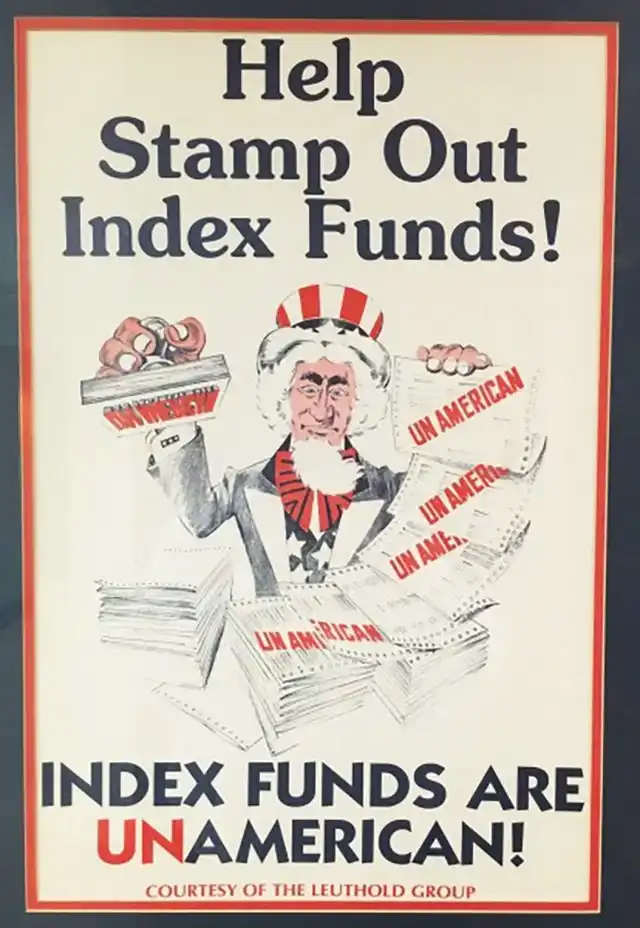
I've been thinking about this recently because the "foolish moment" for tokenization is ending. The SEC has approved Nasdaq and NYSE to trade tokenized stocks. DTCC, the institution that settles nearly every US security, conducted a live test of tokenized trading in July. Almost all this activity has been described as the same thing: tokenization as an infrastructure upgrade.
The same markets, faster, cheaper, operating 24/7. All this is true, but I think the "upgrade" framework obscures a bigger story. Tokenization makes markets programmable: changing which markets exist, who makes them, and what these markets trade against.
In 2018 I built Uniswap. Anyone could deposit two assets into a shared pool, earn fees on every trade, while prices adjusted along a curve with buying and selling activity. Uniswap has operated autonomously since day one, settling over $4.6 trillion in volume, helping drive decentralized exchange share from less than 1% of centralized spot volume to over 20%.
As AMMs like Uniswap grew, their liquidity formed a pattern most of the financial world hasn't yet noticed: correlated trading pairs.
The Easiest Markets to Win
To win everything, you must first win something. AMMs first found product-market fit in long-tail markets, where most assets simply couldn't get professional market maker attention. On Uniswap, anyone could create a market in one transaction, with issuers and early supporters becoming the first LPs.
Stablecoin pairs followed closely: On trading pairs like USDC/USDT, a good passive strategy was close enough to optimal that lower funding costs could bridge the gap. That's why professional trading firms don't bother market-making for these stablecoin swaps today: they've been undercut by passive AMMs.
High Profits, No Competition
Traditional financial markets entirely belong to market-making firms. They bundle capital, trading strategies, execution technology, settlement, and distribution into a vertically integrated business. This architecture evolved for good reasons: assets lived in isolated systems, settlement was slow, every function needed someone to perform it, so one company did it all.
At sufficient scale, all these fixed costs become self-covering. Citadel Securities handles about 25% of US stock trading volume, generating a record $12.2 billion in net trading income last year on about $21 billion in trading capital.
Most people see these numbers as proof the system works. I see it as entrenchment.
Unbundling
Blockchains create competition at every layer, breaking the bundle. Execution happens through code. Custody and settlement become shared services anyone can plug into. What once required proprietary infrastructure now becomes open-source software.
In AMMs, capital is the scarce input, and the advantage goes to those who can hold inventory at the lowest cost. Trading firms need high returns to justify their overhead, so LPs willing to accept lower returns can undercut. Most market makers hedge away all price exposure, and hedging costs money, so investors already holding the assets can take on that exposure for free. And asset issuers have negative funding costs because issuers typically pay professional market makers to make markets for their newly issued assets.
In short, DeFi and AMMs lower barriers to market-making, opening the field to many new participants. Their advantage can come from many different sources: lower funding costs, willingness to hold inventory exposure that professional firms typically hedge, or being the issuer themselves.
But it all hinges on one question: Can automated strategies perform well enough to make this work?
Liquidity Follows Correlation
Recently, I was on a call with one of the largest institutions in finance. They asked me what the most common base trading pairs in DeFi are. I explained that Ethereum-based assets tend to trade against ETH, Solana assets against SOL, stablecoins pair against each other, and a handful of highly liquid trading pairs bridge these clusters.
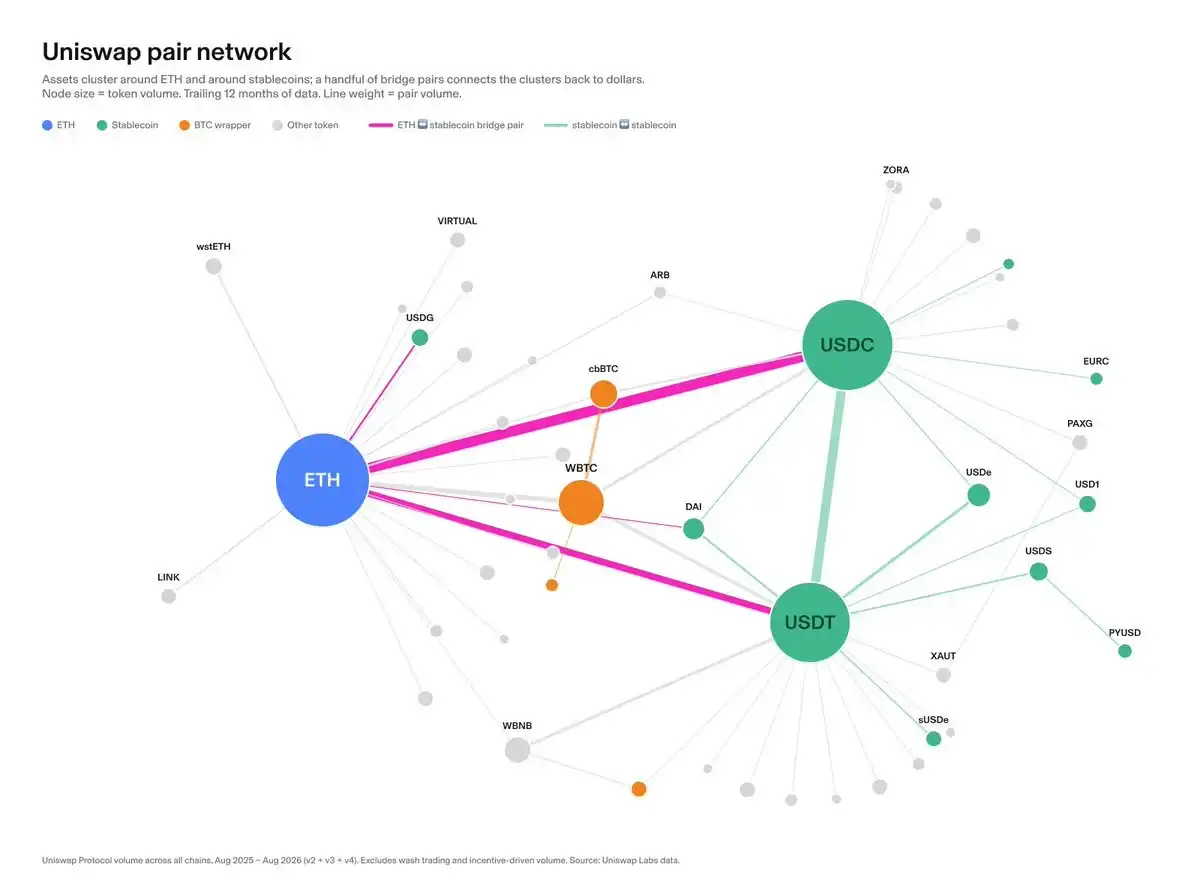
No one designed this pattern. It emerged naturally, partly because LPs perform best when the assets they hold move together. Correlation means lower inventory risk for liquidity providers, deepening liquidity. As assets tokenize, the world's largest markets will reorganize in the same way.
They can't do this today. Traditional markets settle in dollars out of necessity. Assets live in isolated systems, and fiat rails like SWIFT and Fedwire are the glue holding everything together. But blockchains are a much more expressive glue. Tokenize assets, and they share a settlement layer, so any asset can trade directly against any other.
NVDA/USD can become NVDA/SPY, with SPY/USD as the bridge back to dollars. Oil companies can trade against oil ETFs or tokenized oil. Private credit can trade against tokenized treasury funds. Tokenization also enables markets across different asset types, which is extremely difficult, even impossible, in traditional financial infrastructure.
Delta Neutral Is Inefficiency
Traditional market-making firms typically try to stay "delta neutral"—trader jargon for being dollar-denominated and wanting to minimize any non-dollar risk. When market-making for a volatile asset, they spend money to reduce their non-dollar risk (i.e., hedging), usually via options. This is one of the higher-cost parts of traditional market-making.
Pairing assets into low-volatility "correlated trading pairs," connected by a few high-volatility "bridge trading pairs," brings many efficiency gains, but the most important is this: market-making becomes cheaper and more efficient if the people making the markets actually want to hold the underlying assets.
And the higher the correlation of the trading pair, the smaller the gap between today's passive AMM strategy and the most complex active strategy, making it easier to "undercut" with lower inventory costs.
To give a concrete example: If someone is long Nvidia, you might also be long SPY, and the efficiency gap between passive AMM and active strategies on NVDA/SPY is much smaller than on NVDA/USD.
Interconnected Liquidity
If stocks trade against SPY, then every trade starting or ending in dollars would be routed through the same trading pair: SPY/USD. These bridge trading pairs still require professional expertise, but there are far fewer of them, and they carry so much flow that professional attention is justified.
DeFi has already proven this. ETH/USDC is one of the deepest on-chain markets because every cluster routes through it. Passive LPs provide correlated trading pairs, while active LPs compete on bridge trading pairs.
Investors can still buy and sell everything in dollars because cross-pool routing is automatic. Liquidity will concentrate where risk is lowest, not where legacy plumbing requires it to sit. This pushes the deepest markets towards correlated trading pairs—the very terrain where AMMs are already strongest.
Correlated RWA Trading Pairs Already Exist
On-chain correlated liquidity started with crypto-native assets. But the first correlated markets for tokenized stocks already exist: There are ten tokenized stocks trading against SPY in Robinhood's on-chain Uniswap pools.
In the first 12 days, these pools facilitated over $33 million in volume from more than 11,000 traders, a significant portion occurring while US markets were closed. Some trades go directly from one stock to another, completely bypassing dollars.
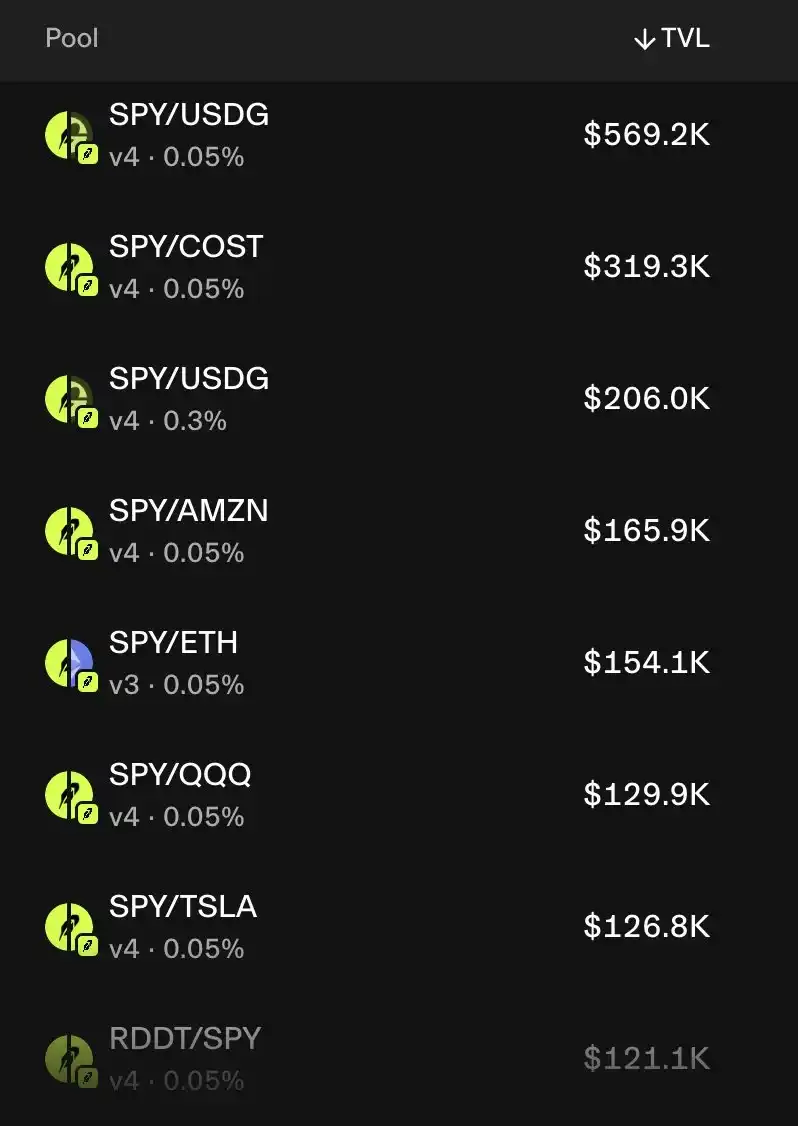
Worth mentioning, we're also starting to see memecoins paired with "correlated" stocks: Elon meme coins against Tesla stock, hot dog meme coins against Costco stock. It's unclear how correlated these are on price, but I guess "vibe" counts as a kind of correlation.
AMMs Will Win
Correlated trading pairs are just one piece of the puzzle. Another piece is AMM design and customization.
Uniswap v4 hooks enable full market customization, which can significantly improve LP returns, like our recently released DualPool hook—when passive AMM capital isn't being used for swaps, it's put to work earning lending yields.
Despite Uniswap having around $4.6 trillion in volume, I believe AMMs are still in their infancy, with many other paths to enhance their competitiveness. There are many other promising methods to improve LP returns being built internally at Labs, as well as by our partners and the ecosystem externally. More to come!
The argument against index funds in 1976 was: A fund that makes no decisions can never beat professionals paid to make decisions. Fifty years later, the fund that makes no decisions beats about 90% of professionals. More importantly, index funds democratized investing and improved ordinary people's lives. I believe passive liquidity will win with a similar strategy and have an even greater impact—by dramatically lowering the barrier to creating and participating in markets.
Opinions from Crypto KOL
Hayden Adams' article also sparked discussion in the Chinese community. Crypto KOL Cody (@Cody_DeFi) subsequently analyzed the "correlated trading pairs" idea from the perspective of actual market-making and historical backtesting. I think it's a pretty good interpretation and analysis of the Uniswap founder's original design idea, so the original post is also included below:
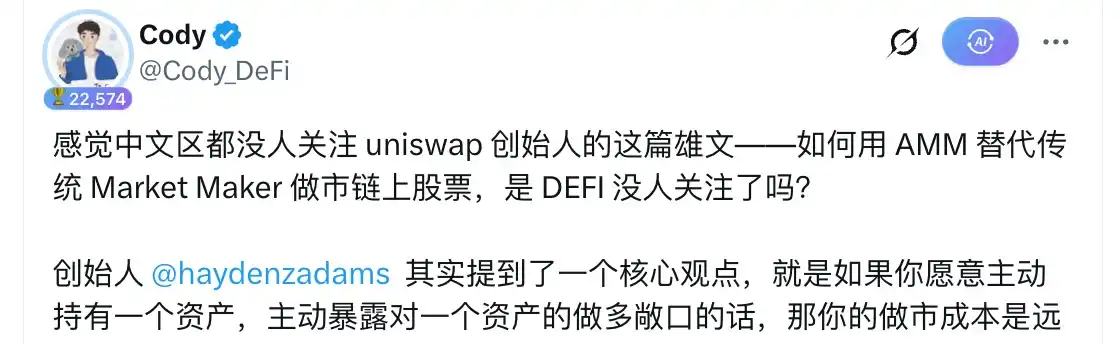
Feels like no one in the Chinese community is paying attention to this significant article by the Uniswap founder, "How to Use AMMs to Replace Traditional Market Makers for On-Chain Stocks." Is DEFI no longer getting attention?
Founder @haydenzadams actually raises a core point: If you are willing to actively hold an asset and take a long exposure to it, your market-making cost is far lower than that of traditional market makers because you don't need to hedge against price fluctuations, while traditional market makers do—they need to maintain a so-called delta neutral state, which incurs high hedging costs.
Because of the AMM mechanism, it can roughly be seen as an asymmetric fee-based grid trading. If you hold a long position, like NVDA, and want to market-make the NVDA-USDC trading pair using an AMM, you face the risk of selling early. As NVDA's price rises, you end up with more USDC and less NVDA in your hands. These losses are typically called "impermanent loss."
To solve this "selling early" risk problem, Hayden introduces the concept of "paired AMM market-making." Simply put, ordinary people can deploy an AMM trading pair like SPY/NVDA, which has correlation, instead of deploying NVDA/USDC. This can reduce impermanent loss while maintaining long exposure to a certain class of correlated assets and earning fees.
This idea comes from his observation of the mainstream deep trading pairs in the crypto space, where ETH and SOL serve as primary paired assets for tokens within their respective ecosystem chains, just as depicted on the cover of this article.
Finally, he believes that this strategy, where those willing to hold long spot positions act as market makers, will eventually occupy an increasing share of tokenized stock market-making strategies, just as Uniswap's AMM has grown from 0 to about 20% of on-chain spot trading volume relative to traditional CEX over the past few years.
Back to my personal view, what I agree with most is that AMMs indeed provide an opportunity for ordinary people willing to hold inventory to act as market makers because if you are willing to hold a certain type of asset, you can indeed execute market-making strategies without hedging.
Beyond that, Hayden proposes a third advantage: the benefits of providing liquidity for paired stock tokens (LP) would be greater than simply holding stocks. Regarding this situation, I did a simple backtest using NVDA and SPY, based on historical data from the past 3 years. The impermanent loss was roughly -10.8% of the principal at the end of the period. Without reinvesting fees, an annual fee return of about 11.5% would be needed to offset this loss by the end.
Looking at current on-chain liquidity and fee situations, it's difficult because tokenized stocks generate basically no fees during non-trading hours, and there are very few SPY/NVDA trading pairs, and those that exist have low APY. This can only be hoped to be resolved over time.
Finally, compared to the paired LP strategy, what I am personally doing on-chain are strategies like USDC/NVDA, USDC/CRCL. The core idea is to use a fee-based grid approach, combined with traditional financial valuation models, to execute LP strategies, converting traditional stock-holding returns into a hybrid return of stock holding + fees + grid high-selling-low-buying.
This set of returns is currently being validated in live trading, and the cycle might be long, but I think AMM market-making strategies are indeed filling a gap in current tokenized stock market-making. The core is still that theory—if you want to hold a position, your market-making cost can avoid hedging. However, impermanent loss must be considered in actual execution. This is a blank, yet-to-be-explored area.