Bitcoin Bear Market Triggers Crypto Layoffs, Yet Fuels Industry's Most Aggressive M&A Wave Ever

marsbitPubblicato 2026-06-26Pubblicato ultima volta 2026-06-26

Introduzione

A prolonged Bitcoin downturn is forcing crypto companies to lay off employees and automate operations, but has simultaneously triggered the industry's most aggressive wave of mergers and acquisitions (M&A). In the first half of 2026, crypto M&A deal value reached $93.7 billion, 26 times higher than the same period last year. This activity is primarily driven by traditional financial institutions—banks, payment processors, and asset managers—who are acquiring compliant crypto infrastructure like custody solutions, payment rails, and regulatory licenses instead of building them internally. Examples include Mastercard's acquisition of stablecoin firm BVNK and Franklin Templeton's launch of a dedicated crypto division via acquisition. This consolidation contrasts sharply with a shrinking crypto labor market, where active job openings have plummeted. Companies like Coinbase are restructuring to become "AI-native," leading to a sharp increase in roles requiring AI skills, while engineering and compliance positions now dominate hiring. Financially pressured crypto firms, such as Messari which was acquired at a fraction of its prior valuation, are becoming prime targets. Capital remains available but is highly selective, flowing overwhelmingly into businesses that bridge digital assets with traditional finance, such as tokenization platforms and regulated trading venues. The trend indicates a market where capital is rewarding compliant, utility-focused infrastructure while weaker m...

Author: Oluwapelumi Adejumo

Compiled by: Deep Chao TechFlow

Deep Chao's Guide: The ongoing decline of BTC is forcing crypto companies to conduct large-scale layoffs, but it is also spawning the most aggressive wave of mergers and acquisitions in the industry's history - with transaction volumes reaching $9.4 billion in the first half of 2026, 26 times the volume from the same period last year. Traditional financial institutions are no longer building their own infrastructure but are instead directly acquiring licenses, custody solutions, and payment rails. This divergence reveals the true direction of capital flow during a bear market.

Bitcoin's prolonged downturn is forcing cryptocurrency companies to cut staff, automate more tasks, and abandon expansion plans formulated during the last bull run. Simultaneously, it is creating one of the busiest periods for acquisitions in the sector's history.

In the second quarter of 2026, cryptocurrency M&A deals reached $7.23 billion, up from $2.14 billion in the first quarter.

The total transaction value for the two quarters reached $9.37 billion. Data from CryptoRank shows that the overall growth in the first half of the year was 26 times higher than the same period last year, highlighting a dramatic acceleration in deal activity even as spot market conditions worsen.
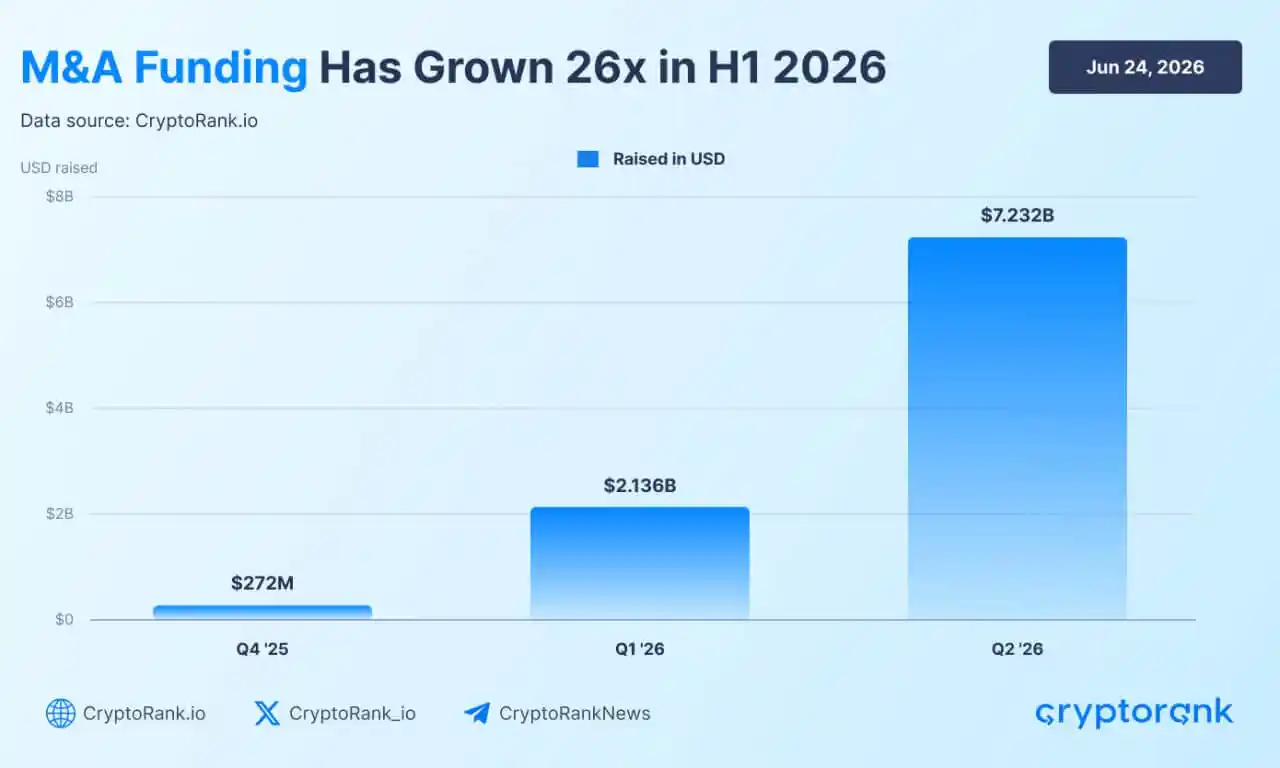
This acceleration is occurring against a backdrop of Bitcoin trading near its lowest levels in nearly two years and continued layoffs at some of the industry's largest employers.

This divergence shows where capital is flowing during the downturn – companies are spending less on broad hiring and speculative growth.

Instead, traditional financial institutions, banks, card networks, trading firms, and well-funded crypto businesses are acquiring payment systems, regulatory licenses, custody businesses, and market infrastructure that could take years to build internally.

The result is a bear market that is weakening many crypto companies but not eliminating institutional demand for their technology.

Traditional Finance Drives Wave of Crypto Infrastructure Acquisitions

Traditional financial institutions are driving the wave of crypto acquisitions, opting to buy fully-fledged digital asset infrastructure rather than building compliance and technical systems from scratch.

Banks, payment processors, and fintech companies are actively targeting startups that already possess custody solutions, payment rails, and regulatory approvals.

This acquisition frenzy is largely driven by the stabilization of global policy. The European Union's Markets in Crypto-Assets (MiCA) framework establishes unified licensing standards, while ongoing stablecoin legislation in the US gives corporate giants the confidence to make long-term bets.

Legal and consulting experts point to this policy support as a primary catalyst. According to Architect Partners' Q1 Crypto M&A and Financing Report, banking and securities industries are fully embracing blockchain, repositioning the technology as a foundational layer for traditional financial markets.

Mastercard's $1.8 billion acquisition of stablecoin company BVNK is a prime example. This acquisition gave the card network immediate access to the technology and licenses needed to process stablecoin payments, bypassing years of internal development.

Other Wall Street giants are also securing strategic footholds through targeted investments. Intercontinental Exchange backed prediction platform Polymarket, Citadel Securities invested in brokerage services provider Alpaca, and Standard Chartered's venture arm funded market maker Keyrock.

Asset managers are also capturing institutional demand through direct acquisitions. Franklin Templeton, which manages $1.7 trillion in assets, recently launched a dedicated digital assets unit called Franklin Crypto.

This move was executed via the acquisition of 250 Digital, which absorbed the firm's investment team and previously managed liquid crypto strategies under CoinFund, to offer actively managed cryptocurrency products directly to Franklin Templeton's global client base.

Overall, private capital strongly favors businesses that connect blockchain to the wider financial system. First-quarter financing data reveals a clear investor preference for stablecoin utility—such as foreign exchange, corporate payments, and cross-border settlement—over speculative crypto-native projects.

In this environment, regulatory credentials have become a major competitive barrier. Acquisition targets with broker-dealer capabilities, federal banking charters, or registered investment advisor qualifications, including Alpaca, Anchorage, and Superstate, attract stronger buyer interest as they provide immediate operational legitimacy.

While traditional finance demonstrates its balance sheet strength, blockchain networks are quietly emerging as a new class of aggressive buyers.

Historically, Layer 1 and Layer 2 networks relied on independent developers to build applications on their chains. Now, faced with fierce competition for users, these networks are directly purchasing consumer-facing applications.

Polygon's recent acquisitions of Coinme and Sequence highlight this shift. By buying payment channels and wallet infrastructure, the blockchain is securing an end-to-end user experience and locking in transaction volume, suggesting that technical capability alone is insufficient to maintain market share.

Crypto Layoffs Deepen, AI and Compliance Reshape Workforce

The pace of corporate acquisitions starkly contrasts with the continued contraction of the digital asset labor market.

According to data compiled by Tiger Research for June 2026, the industry currently has only 2,932 active job openings globally.

This figure pales in comparison to the aggressive hiring sprees of 2021 and early 2022, when trading platforms, DeFi protocols, and NFT markets were all expanding headcount simultaneously.

The employment shrinkage began during the market downturn of 2022 and accelerated after the FTX collapse, leading to roughly a 40% decline in job openings across North America and Europe. The market has not rebounded to previous highs.

Indeed, layoffs have been steadily continuing throughout the first half of this year. Major platforms including Gemini, Coinbase, Kraken, Algorand, Crypto.com, and most recently, the Ethereum Foundation, have initiated new rounds of job cuts.

Executives have attributed the cuts to low token valuations, broader macroeconomic pressures, and AI-driven operational efficiencies. Specifically, Coinbase framed its restructuring as a shift towards an "AI-native" operational model.

This technological pivot is evident in the hiring data: the proportion of crypto jobs requiring AI skills has more than doubled in a year, surging from 23% in early 2025 to over 53% by March 2026.
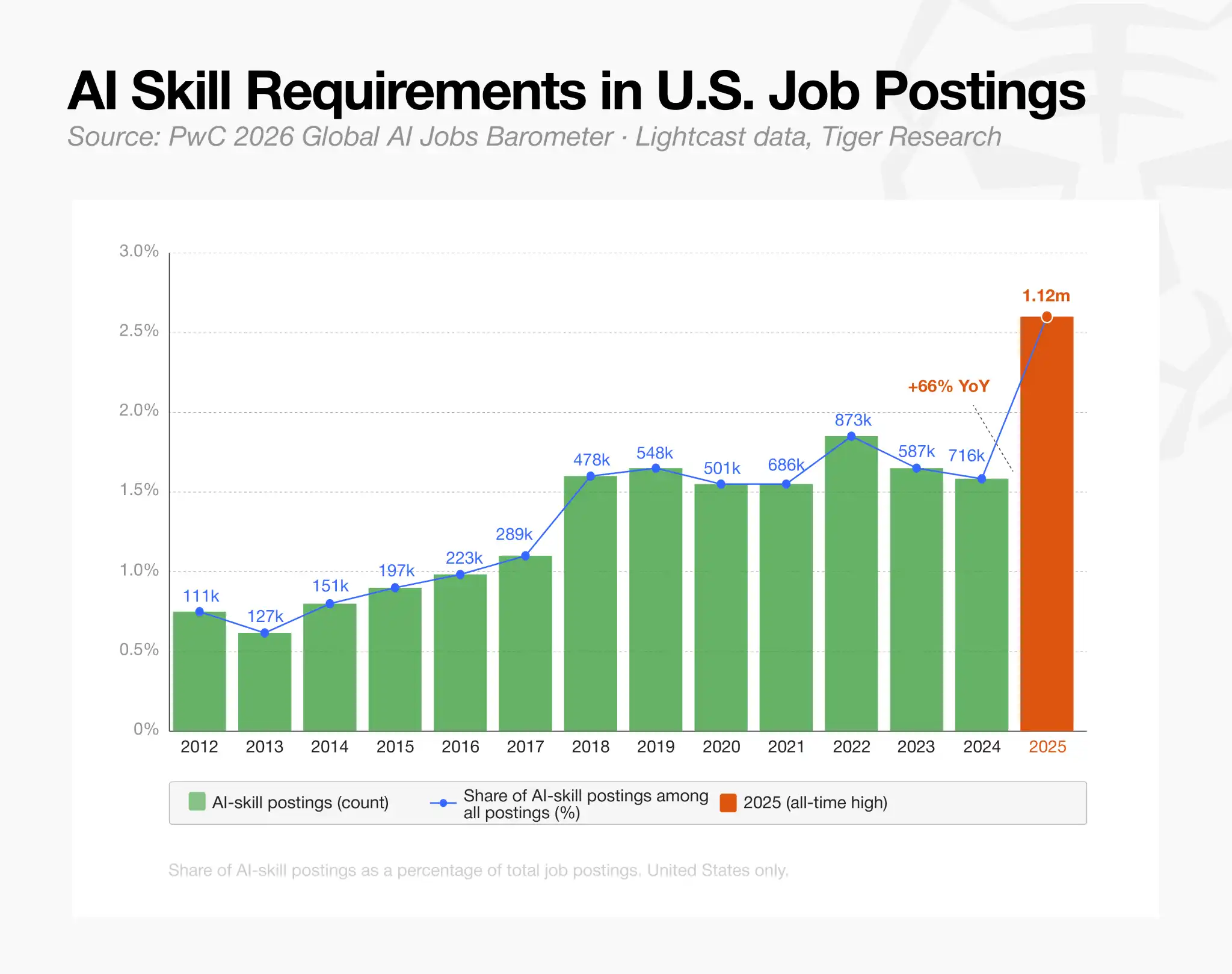
While overall hiring remains sluggish, the composition of the workforce is undergoing a fundamental change. Companies are not implementing a complete hiring freeze. Instead, they are actively narrowing their focus to technical and regulatory expertise.

According to Tiger Research, engineering roles constitute approximately 34% of active openings, while legal and compliance roles account for about 10%. This shift is more pronounced at centralized exchanges, where compliance positions make up 16% of vacancies—more than double the share for sales and business development roles.

This indicates these companies are prioritizing staffing needs to obtain licenses, manage risk, and maintain core infrastructure, while reducing spending on marketing and community growth.

Furthermore, the limited hiring that exists is highly concentrated among a few heavyweights rather than distributed across early-stage startups. Centralized exchanges generate nearly one-third of all open positions.

Stablecoin and payments divisions account for another significant portion, but this activity is highly concentrated. Tether and Ripple alone constitute over 80% of listings in that category.

Ultimately, the data paints a picture of targeted corporate restructuring and a defensive posture, not an industry-wide labor market recovery.

Distressed Crypto Companies Become Acquisition Targets

Blockworks' recent acquisition of Messari perfectly embodies the intersection of large-scale layoffs and accelerated consolidation.

The crypto analytics company Blockworks acquired the analytics provider for approximately $10 million, a significant markdown from its $300 million valuation following a 2022 funding round. Prior to the sale, the research firm underwent three separate rounds of layoffs starting in 2023.

Shortening runways and slow revenue growth are forcing smaller businesses to the negotiating table, enabling well-funded buyers to absorb specialized talent, proprietary data, and distribution channels for a fraction of their former private market valuations.

Industry analysts expect these financial pressures to soon ripple into digital asset treasury sectors. Throughout 2025, many public treasury entities successfully raised capital by trading at a premium relative to their crypto reserves.

Meanwhile, the M&A wave may also eventually encompass Decentralized Autonomous Organizations, thanks to maturing legal frameworks.

Recent legislative progress, such as Wyoming's Decentralized Unincorporated Nonprofit Association (DUNA) structure, provides DAOs with a recognized legal mechanism to hold off-chain assets and intellectual property.

With clearer governance and ownership, protocol treasuries are better positioned to acquire complementary software projects or specialized development teams.

However, compared to the traditional, compliance-driven corporate acquisitions dominating the current market cycle, these decentralized mergers remain highly experimental.

Capital Remains Available, But Has Become Discerning

Despite nearly $10 billion in crypto deal activity in the first half of 2026, capital allocation has become more discerning.

A notable exception to this strict institutional focus is the prediction markets sector. Event-betting platforms have secured significant funding commitments as they vie for mainstream dominance.

For context, Kalshi is reportedly negotiating a funding round that would value the federally regulated exchange at $40 billion, nearly double its previous $22 billion price tag. Polymarket has also absorbed substantial backing as competition for prediction market supremacy intensifies.

However, outside of predictions, the venture capital thesis has narrowed dramatically. Capital is overwhelmingly flowing to businesses acting as bridges between digital assets and the traditional financial system.

Tokenization firms and institutional trading venues secure large checks because they pitch sustainable, isolated revenue models: charging banks, brokerages, and asset managers fees for regulated services, rather than relying on fickle retail crypto traders. Superstate recently closed an $82.5 million funding round to expand its blockchain-based securities issuance, while Alpaca dominates in settling tokenized US stocks and ETFs.

This funding trajectory indicates investors are shifting bets from conceptual tokenization pilots to live, regulated financial products.

Notably, pure DeFi protocols and experimental base-layer blockchains are entirely absent from this quarter's major funding rounds.

This selective deployment of venture capital mirrors the broader M&A trend. Liquidity exists, but it is ring-fenced for startups with regulatory licenses, institutional distribution channels, and specific utility for traditional finance.

The bear market is effectively pruning the industry, forcing weaker models to consolidate or cut staff, while richly rewarding the infrastructure providers built to weather the crypto winter.

Crypto di tendenza

Domande pertinenti

QWhat has been the impact of the prolonged Bitcoin downturn on the crypto industry, according to the article?

AThe prolonged Bitcoin downturn has forced crypto companies to conduct mass layoffs, automate more work, and abandon expansion plans from the previous bull market. However, it has simultaneously created one of the industry's busiest periods for mergers and acquisitions (M&A).

QHow does the scale of crypto M&A activity in the first half of 2026 compare to the previous year?

AThe total value of crypto M&A deals in the first half of 2026 reached $9.37 billion. According to CryptoRank, this represented a growth that was 26 times higher compared to the same period in the previous year.

QWhat is the primary driver behind the wave of crypto infrastructure acquisitions by traditional financial institutions?

AThe primary driver is the stabilization of global crypto policy, such as the EU's MiCA framework and ongoing stablecoin legislation in the US. This provides traditional banks and financial institutions the confidence to make long-term bets by purchasing ready-made digital asset infrastructure (like custody, payment rails, and regulatory licenses) instead of building it internally.

QHow is the composition of the crypto workforce changing during this period of layoffs, as highlighted in the article?

AThe composition is shifting towards a greater emphasis on technical and regulatory expertise. Engineering roles now make up about 34% of active job vacancies, while legal and compliance roles account for about 10%. There is also a significant increase in demand for AI skills, with over 53% of crypto job postings requiring them by March 2026.

QWhat type of companies are currently receiving the majority of venture capital funding, according to the article's analysis?

AVenture capital is overwhelmingly flowing to companies that act as bridges between digital assets and the traditional financial system. This includes tokenization firms and institutional trading venues with regulated, fee-based revenue models, rather than speculative crypto-native projects or pure DeFi protocols.

Letture associate

STRC Must Re-Anchor for a BTC Bull Market to Happen

Title: STRC's Depegging Threatens MicroStrategy's Bitcoin-Buying Machine, and Thus the BTC Bull Run Summary: The sustained depegging of MicroStrategy's priority share STRC (trading ~25% below its $100 target) is severely disrupting the company's core business model and poses a major risk to Bitcoin (BTC) price support. STRC was MicroStrategy's most efficient and low-cost funding tool, designed to allow continuous capital raises near its $100 par value to fuel relentless BTC accumulation. Its depegging has effectively blocked this primary funding channel. The situation creates a severe cash flow crisis. STRC and other priority shares now obligate MicroStrategy to pay approximately $1.7 billion in annual cash dividends, while the company's cash reserves are only about $1.4 billion — insufficient to cover one year of payments. To raise cash, MicroStrategy is increasingly resorting to issuing common stock (MSTR) through ATM offerings. However, recent raises show most proceeds (around 90% in one week) are now used to bolster cash reserves rather than buy Bitcoin. This dilutes the key metric of Bitcoin per MSTR share, eroding the fundamental value proposition for equity investors. The company faces grim alternatives: issuing high-cost debt or selling its massive Bitcoin holdings. The latter, though hinted at, would likely trigger significant negative market reactions. Conclusion: As BTC's largest corporate holder and a major marginal buyer, MicroStrategy's funding woes mean reduced, and potentially reversing, institutional buy-side pressure. The company has shifted from being a guaranteed source of BTC demand to a significant overhang on the market. The article argues that without STRC re-anchoring to restore its funding engine, a sustained BTC bull market is in jeopardy.

marsbit15 min fa

STRC Must Re-Anchor for a BTC Bull Market to Happen

marsbit15 min fa

No Bull Market for BTC Without STRC Re-pegging

Summary: The sustained de-pegging of MicroStrategy's (MSTR) Strategy Preferred Shares (STRC) poses a severe threat to Bitcoin (BTC) and could prevent a bull market. STRC, designed to trade near a $100 target, has plunged to around $75, effectively shutting down MicroStrategy's cheapest and most efficient funding channel. This channel was critical for its "raise funds, buy BTC" business model. More critically, MicroStrategy now faces a massive cash outflow from these preferred shares. With approximately $10.49 billion of STRC outstanding at an 11.5% dividend yield, the annual cash obligation exceeds $1.2 billion. Combined with other preferred shares, the total annual payout nears $1.7 billion, depleting its current ~$1.4 billion cash reserve within a year. To address this, MicroStrategy is increasingly relying on common stock (MSTR) offerings via its ATM program. However, recent sales show most raised capital is now used to bolster cash reserves rather than buy more Bitcoin. This dilutes the key metric of BTC per share for common stockholders, eroding the foundation of its premium valuation. If STRC cannot re-peg, this costly dilution may continue. Worse, if cash pressure intensifies, selling Bitcoin becomes a real risk. As the largest corporate BTC holder (~847,363 BTC), any significant sales could crash the market. Thus, MicroStrategy is transforming from BTC's most reliable institutional buyer into a major potential seller, casting a significant shadow over Bitcoin's price prospects.

Odaily星球日报16 min fa

No Bull Market for BTC Without STRC Re-pegging

Odaily星球日报16 min fa

Tornado Cash Suffers Another Governance Attack: A Fake Proposal Targets $23 Million Community Treasury

On June 25, 2026, a deceptive governance proposal (#67) appeared in the Tornado Cash DAO, masquerading as an upgrade to implement fee adjustments and token burns. Security researchers, including Sergey Shemyakov and Pascal Caversaccio, quickly identified it as malicious. The proposal's unverified code contained a hidden function designed to stealthily replace the protocol's legitimate governance address (0x5efda50f22d34F262c29268506C5Fa42cB56A1Ce) with an attacker-controlled address (0x5efda50f22d34f272c7077689d6abc42f15e285f). If passed, this would have granted the attacker control over the DAO's treasury, containing approximately $23 million in TORN tokens, and the ability to drain all relayers. The attacker's wallet (0xd4eca8c9242b9f9faa3cf19a78defc21dc97a925) was funded via the privacy protocol Railgun four days prior, obscuring the source. The community response was swift, with the proposal receiving 27,163 TORN votes against (100%) and 0 for, far below the 100,000 TORN quorum required for validity. It is set to expire on June 30. This incident marks the second major governance attack on Tornado Cash, following a May 2023 exploit that stole $2.17 million. It highlights persistent vulnerabilities in DAO structures where power derives from token ownership. The article advises users to follow security researchers, vote against unverified proposals, and delegate voting power. For developers, implementing timelocks—a delay between proposal approval and execution—is presented as a critical security measure to allow for community review and intervention.

Foresight News36 min fa

Tornado Cash Suffers Another Governance Attack: A Fake Proposal Targets $23 Million Community Treasury

Foresight News36 min fa

Trading

Spot
Futures

Articoli Popolari

Cosa è DOGE M

Doge Matrix ($doge m): La Nuova Razza di Criptovaluta Guidata dalla Comunità Introduzione Nel panorama in continua evoluzione delle criptovalute, nuovi progetti emergono costantemente, ciascuno con l'obiettivo di catturare l'interesse di investitori ed appassionati. Uno degli ultimi ingressi in questo dominio è Doge Matrix, rappresentato dal simbolo ticker $doge m. Questo progetto ha attirato attenzione grazie alle sue radici nella popolare cultura dei meme che circonda Dogecoin, stabilendo il suo posto all'interno dello spazio web3. Questo articolo mira a fornire un'analisi completa di Doge Matrix, coprendo la sua panoramica, il creatore, gli investitori, la funzionalità, la cronologia e gli aspetti notevoli. Cos'è Doge Matrix ($doge m)? Doge Matrix è un progetto di criptovaluta guidato dalla comunità che apparentemente si basa sull'ampio appeal di Dogecoin, una valuta digitale nota per il suo mascotte Shiba Inu e le sue origini nei meme. Sebbene gli obiettivi generali di Doge Matrix non siano ampiamente definiti, è caratterizzato da un impegno a sfruttare il coinvolgimento e il supporto della comunità. A differenza delle criptovalute tradizionali che spesso enfatizzano l'utilità o il valore intrinseco attraverso tecnologie sottostanti, Doge Matrix si posiziona all'interno di uno spazio che abbraccia il fenomeno culturale delle criptovalute, particolarmente attraente per coloro che risuonano con l'etica degli asset basati sui meme. Attraendo i punti di forza della comunità di Dogecoin, Doge Matrix opera come parte di un ecosistema più ampio, invitando alla partecipazione e all'impegno degli utenti che condividono un interesse per le criptovalute e il panorama digitale. Chi è il Creatore di Doge Matrix ($doge m)? L'identità del creatore di Doge Matrix rimane sconosciuta. Questa mancanza di trasparenza non è un evento raro nello spazio delle criptovalute, dove alcuni progetti vengono lanciati senza rivelare le identità dei loro fondatori. L'assenza di informazioni riguardanti il team fondatore può sollevare domande tra i potenziali investitori sulla responsabilità e la direzione del progetto. Chi sono gli Investitori di Doge Matrix ($doge m)? Al momento, non ci sono informazioni pubblicamente disponibili che dettagliano gli investitori o le fondazioni di investimento che supportano Doge Matrix. Il progetto sembra fare affidamento principalmente sul supporto della comunità piuttosto che su investimenti istituzionali. Questo modello si allinea con la natura guidata dalla comunità dell'iniziativa, favorendo un ambiente in cui la direzione del progetto è plasmata dai suoi partecipanti piuttosto che essere dettata da un selezionato gruppo di finanziatori. Come Funziona Doge Matrix ($doge m)? I dettagli riguardanti i meccanismi operativi di Doge Matrix sono piuttosto vaghi, riflettendo una tendenza più ampia di progetti nello spazio delle meme coin in cui le funzionalità innovative non sono sempre chiaramente articolate. Tuttavia, Doge Matrix sembra essere progettato per sfruttare l'ecosistema esistente delle criptovalute incoraggiando la partecipazione degli utenti mentre attinge ai riferimenti culturali familiari associati a Dogecoin. Le sue potenzialmente uniche caratteristiche derivano dalle interazioni della comunità piuttosto che dai progressi tecnologici, enfatizzando esperienze condivise e collaborazione tra i detentori di token. Sebbene le esatte innovazioni non siano state esplicitamente delineate, il progetto sembra creare uno spazio in cui i membri della comunità possono impegnarsi, condividere idee e promuovere il potenziale del progetto. Cronologia di Doge Matrix ($doge m) Riflettendo sulla cronologia del progetto, emergono eventi notevoli che hanno definito il suo percorso fino ad ora: 25 Novembre 2024: Doge Matrix ha raggiunto il suo valore massimo storico, segnando un traguardo significativo nella sua storia iniziale. 1 Gennaio 2025: Al contrario, Doge Matrix ha toccato il suo valore minimo storico, illustrando la volatilità spesso associata alle criptovalute, specialmente nelle prime fasi del ciclo di vita di un progetto. In Corso: Il progetto continua ad essere attivamente scambiato e supportato dalla sua comunità, sebbene specifici traguardi o obiettivi futuri debbano ancora essere divulgati. Punti Chiave su Doge Matrix ($doge m) Focus sulla Comunità Al centro di Doge Matrix c'è un impegno per il coinvolgimento della comunità. Il progetto prospera sulla premessa della collaborazione e degli obiettivi condivisi tra i suoi membri, enfatizzando l'importanza dello sforzo collettivo. A differenza dei progetti centralizzati che spesso hanno una struttura di leadership definita, Doge Matrix attualmente mostra un approccio più fluido alla governance, dove la voce di ogni membro della comunità conta. Volatilità Il mercato delle criptovalute è noto per la sua volatilità, e Doge Matrix non fa eccezione. La sua storia dei prezzi riflette fluttuazioni significative tra valori alti e bassi, il che è tipico di molte nuove criptovalute ma sottolinea i rischi associati all'investimento in token emergenti. Mancanza di Informazioni Dettagliate Una delle caratteristiche più sorprendenti di Doge Matrix è la scarsità di informazioni dettagliate riguardanti le sue fondamenta tecnologiche e i meccanismi operativi. Questa ambiguità richiede che i potenziali investitori conducano un'accurata due diligence prima di impegnarsi con il progetto. Conclusione In sintesi, Doge Matrix ($doge m) illustra una nuova ondata di progetti di criptovaluta che si basano fortemente sul coinvolgimento della comunità e sulla rilevanza culturale. Sebbene manchi di alcuni dettagli—come una leadership chiara, obiettivi definiti e funzionalità dettagliate—il progetto è riuscito a generare interesse all'interno della comunità crypto, sfruttando l'appello consolidato della cultura dei meme. Come per qualsiasi investimento nello spazio delle criptovalute, comprendere i rischi intrinseci e condurre una ricerca approfondita è essenziale per i potenziali partecipanti. Doge Matrix si erge come un promemoria della natura dinamica, a volte imprevedibile, dell'industria crypto, caratterizzata da un'evoluzione costante e dall'entusiasmo per le iniziative guidate dalla comunità.

396 Totale visualizzazioniPubblicato il 2025.02.03Aggiornato il 2025.02.03

Cosa è DOGE M

Cosa è $M

Comprendere Mantis ($M): Una Nuova Era nell'Interoperabilità Cross-Chain Nel panorama in continua evoluzione del Web3 e delle criptovalute, nuovi progetti si sforzano di offrire soluzioni innovative mirate a migliorare l'esperienza dell'utente e ad ampliare le possibilità funzionali all'interno dell'ecosistema finanziario decentralizzato. Uno di questi progetti che sta attirando attenzione è Mantis ($M), un protocollo pionieristico fondato sui principi dell'interoperabilità cross-chain e dei pagamenti basati sull'intento. Questo articolo esplora gli aspetti essenziali di Mantis, inclusa la sua funzionalità principale, i creatori, il supporto agli investimenti, le caratteristiche innovative e le tappe fondamentali. Che cos'è Mantis ($M)? Mantis è descritto come un protocollo di regolamento dell'intento multi-dominio che semplifica le interazioni cross-chain, consentendo agli utenti di eseguire transazioni finanziarie complesse su varie piattaforme blockchain senza soluzione di continuità. Il protocollo opera attraverso tre livelli principali: Espressione dell'Intento: Gli utenti possono articolare i loro obiettivi di transazione utilizzando un linguaggio naturale facilitato dal DISE LLM, un avanzato modello di linguaggio AI. Ad esempio, un utente potrebbe esprimere il desiderio di scambiare Ethereum (ETH) con Solana (SOL) con una tolleranza di slippage specifica dell'1%. Esecuzione: Questo livello impiega una rete di risolutori che competono per soddisfare gli intenti degli utenti. Le transazioni vengono eseguite utilizzando meccanismi come la Coincidenza dei Desideri (CoWs) e le Aste sul Flusso degli Ordini (OFAs), che garantiscono che le richieste degli utenti siano soddisfatte in modo ottimale. Regolamento: Sfruttando il protocollo di Comunicazione Inter-Blockchain (IBC), Mantis consente transazioni atomic cross-chain, permettendo agli utenti di operare su varie catene supportate, tra cui Ethereum, Solana e Cosmos. Mantis è progettato per introdurre generazione di rendimento nativa per asset inattivi, impiegando prove crittografiche per mantenere l'integrità delle transazioni durante l'intero processo. Creatori e Team di Sviluppo Mantis è stato concepito dalla Composable Foundation, un'organizzazione orientata alla ricerca nota per il suo focus sulle soluzioni di interoperabilità blockchain. Questa fondazione collabora con istituzioni accademiche di prestigio, tra cui l'Università di Harvard e l'Università di Lisbona, contribuendo a sforzi di ricerca e sviluppo estesi che informano l'architettura e la funzionalità di Mantis. L'impegno della Composable Foundation a promuovere l'innovazione nello spazio blockchain posiziona Mantis come una soluzione robusta per la crescente domanda di interoperabilità tra più reti blockchain. Investitori e Supporto Sebbene i dettagli specifici sugli investitori individuali non siano stati resi pubblici, Mantis gode di un sostegno sostanziale da parte di vari enti, tra cui: Sovvenzioni ecosistemiche da catene abilitate IBC, che supportano la crescita e l'integrazione del protocollo all'interno degli ecosistemi finanziari decentralizzati. Partnership strategiche con fornitori di infrastrutture che migliorano le capacità di rete e le strategie di distribuzione di Mantis. Finanziamenti attraverso il tesoro della Composable Foundation, garantendo un supporto finanziario sostenuto per lo sviluppo continuo e i costi operativi. Questi sforzi collaborativi riflettono un consenso tra le parti interessate sull'importanza di migliorare la funzionalità cross-chain e il potenziale utilizzo delle innovazioni infrastrutturali di Mantis. Innovazioni Chiave Mantis si distingue attraverso diverse innovazioni pionieristiche che migliorano la sua funzionalità e utilità: Intenti Agnostici alla Catena: Gli utenti possono avviare transazioni da qualsiasi catena supportata mentre si regolano su un'altra. Questa flessibilità potenzia gli utenti, aumentando l'interazione tra diverse piattaforme. Interfaccia Potenziata dall'AI: L'integrazione del DISE LLM consente agli utenti di condurre operazioni DeFi complesse utilizzando un linguaggio naturale, semplificando così le interazioni e rendendo la tecnologia blockchain accessibile a un pubblico più ampio. Cattura MEV Cross-Domain: Mantis crea un mercato interno per il valore massimamente estraibile (MEV) attraverso competizioni tra risolutori. Questo approccio innovativo consente una maggiore efficienza e estrazione di valore in transazioni complesse. Strato di Regolamento Modulare: Il protocollo supporta vari metodi di verifica, comprese le prove a conoscenza zero e i rollup ottimistici, fornendo un framework versatile che può adattarsi alle tecnologie blockchain emergenti. Cronologia Storica Lo sviluppo di Mantis è contrassegnato da diverse tappe fondamentali che tracciano la sua traiettoria e crescita: | Anno | Tappa | |————|————————————————————————| | 2022 | Sviluppo del concetto iniziale all'interno della divisione di ricerca della Composable Foundation. | | Q3 2024 | Lancio del testnet con capacità di bridging tra Solana ed Ethereum. | | Q1 2025 | Evento di Generazione di Token (TGE) previsto insieme al lancio della mainnet. | | Q2 2025 | Integrazione attesa del DISE LLM e espansione delle capacità cross-chain. | | 2025 H2 | Supporto pianificato per oltre 15 catene attraverso ulteriori aggiornamenti IBC. | Questa cronologia delinea l'evoluzione di Mantis, dalle discussioni concettuali all'implementazione attiva e alle fasi di crescita future. Strategia di Crescita dell'Ecosistema La strategia di Mantis per la crescita dell'ecosistema include diverse iniziative progettate per incoraggiare la partecipazione degli utenti e il coinvolgimento degli sviluppatori: Sistema di Crediti: Gli utenti possono guadagnare crediti del protocollo fornendo liquidità e partecipando a programmi di referral. Questi crediti sono riscattabili per incentivi futuri, promuovendo una comunità utente robusta. Kit di Sviluppo Software Modulare (SDK): Questo toolkit consente agli sviluppatori di creare applicazioni basate su modelli guidati dall'intento utilizzando l'infrastruttura di Mantis, promuovendo così l'innovazione all'interno del suo ecosistema. Modello di Governance: Man mano che il protocollo matura, i detentori di token $M avranno voce in capitolo nella governance del protocollo, consentendo loro di votare su aggiornamenti e modifiche proposti, migliorando così il coinvolgimento della comunità e la decentralizzazione. Mantis rappresenta un significativo avanzamento nel campo dell'architettura cross-chain. Integrando senza soluzione di continuità algoritmi AI avanzati con un robusto framework di regolamento, Mantis cerca di affrontare i problemi di frammentazione all'interno degli ecosistemi multi-chain. Il suo approccio innovativo prioritizza il miglioramento delle esperienze degli utenti, mantenendo i principi fondamentali di decentralizzazione e sicurezza, stabilendo un nuovo standard per l'interoperabilità futura delle tecnologie blockchain. Man mano che Mantis continua il suo percorso di crescita e implementazione, promette di essere un progetto da seguire da vicino nel competitivo panorama del Web3 e della finanza decentralizzata. Con il suo focus sul superamento dei confini e sull'elevazione del coinvolgimento degli utenti, Mantis è destinato a diventare una parte integrante dei futuri sviluppi nel campo delle criptovalute.

52 Totale visualizzazioniPubblicato il 2025.03.18Aggiornato il 2025.03.18

Cosa è $M

Come comprare M

Benvenuto in HTX.com! Abbiamo reso l'acquisto di MemeCore (M) semplice e conveniente. Segui la nostra guida passo passo per intraprendere il tuo viaggio nel mondo delle criptovalute.Step 1: Crea il tuo Account HTXUsa la tua email o numero di telefono per registrarti il tuo account gratuito su HTX. Vivi un'esperienza facile e sblocca tutte le funzionalità,Crea il mio accountStep 2: Vai in Acquista crypto e seleziona il tuo metodo di pagamentoCarta di credito/debito: utilizza la tua Visa o Mastercard per acquistare immediatamente MemeCoreM.Bilancio: Usa i fondi dal bilancio del tuo account HTX per fare trading senza problemi.Terze parti: abbiamo aggiunto metodi di pagamento molto utilizzati come Google Pay e Apple Pay per maggiore comodità.P2P: Fai trading direttamente con altri utenti HTX.Over-the-Counter (OTC): Offriamo servizi su misura e tassi di cambio competitivi per i trader.Step 3: Conserva MemeCore (M)Dopo aver acquistato MemeCore (M), conserva nel tuo account HTX. In alternativa, puoi inviare tramite trasferimento blockchain o scambiare per altre criptovalute.Step 4: Scambia MemeCore (M)Scambia facilmente MemeCore (M) nel mercato spot di HTX. Accedi al tuo account, seleziona la tua coppia di trading, esegui le tue operazioni e monitora in tempo reale. Offriamo un'esperienza user-friendly sia per chi ha appena iniziato che per i trader più esperti.

484 Totale visualizzazioniPubblicato il 2025.07.02Aggiornato il 2026.06.02

Come comprare M

Discussioni

Benvenuto nella Community HTX. Qui puoi rimanere informato sugli ultimi sviluppi della piattaforma e accedere ad approfondimenti esperti sul mercato. Le opinioni degli utenti sul prezzo di M M sono presentate come di seguito.

活动图片