One Year After the Crash of Crypto Treasury Companies, Copycats Are Already Making a Comeback

marsbitPubblicato 2026-06-29Pubblicato ultima volta 2026-06-29

Introduzione

One year after the collapse of digital asset treasury (DAT) companies, which wiped out up to 99% for early investors, the scheme has returned in a new guise. Recently, Triller Group announced it would become a "SpaceX treasury company," causing its market cap to surge. This follows the rebranding of another firm, LGHL, now targeting a token called HYPE. The original model, popularized by MicroStrategy (MSTR) and its "Bitcoin yield" narrative, saw companies trading at massive premiums to their underlying crypto holdings. However, most followers like TwentyOne, Metaplanet, and Nakamoto have crashed 80-95%+ from their peaks, erasing nearly all value for late investors. The author argues these structures have no fundamental reason to trade at premiums when low-fee Bitcoin ETFs or direct ownership exist. The cycle persists due to speculative demand driven by FOMO, gamification, and a belief the system is rigged, met by insiders and promoters who profit from the pump-and-dump dynamics. Drawing a parallel to the 1637 Tulip Mania, the piece concludes that such frenzies are not a bug but a recurring product of markets, where greater fools provide demand and insiders supply the schemes. Despite holding Bitcoin personally, the author condemns this specific packaging of assets into leveraged corporate vehicles marketed as innovation, a cycle seemingly unstoppable until a major crash.

Author: Rasheed Saleuddin

Compiled by: Deep Tide TechFlow

Deep Tide Guide: Last summer, the frenzy for Digital Asset Treasury (DAT) companies ended in a spectacular crash, with early investors losing up to 99%. One year later, the same scam is back under a new guise—this time packaged with SpaceX stock and the HYPE token. The cycle of greed and fear never ends, as retail investors continue to foot the bill for insiders' feasts.

Last Tuesday, the Triller Group (who?) announced it would become the world's first SpaceX treasury company. That is, it will use newly raised funds to buy and hold SpaceX stock. That's its business model: holding SpaceX. This news sent Triller's market cap soaring from $15 million to $63 million.

Matt Levine noticed this, and it caught my attention too. This announcement closely followed the rebranding of an "established" treasury company, LGHL—they previously bought crypto assets like SOL and SUI, and now they're buying the HYPE token. Because, well, hype.

We've seen this movie before. Just last summer. The ending was so bad you'd think it would never happen again. Worse, it was blatantly one of the most obvious scams, one I could see coming from a mile away.

The sequel is already showing. Because global speculators need their "spiritual opium," and pump-and-dump insiders are happy to supply it. Supply meets demand. When will they ever learn?

The Pioneer Made the Wrong Headlines

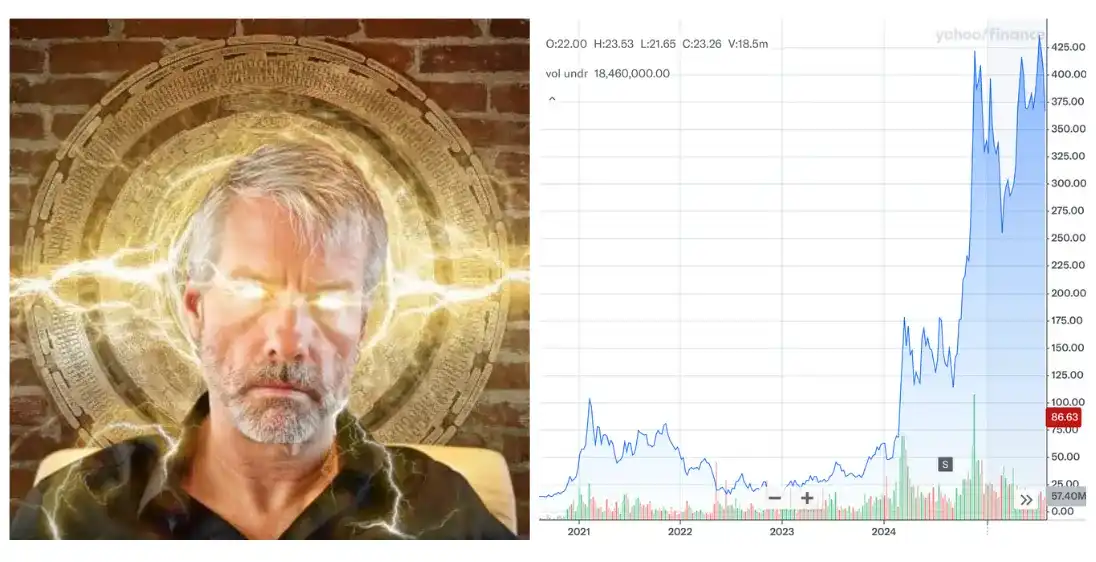
MicroStrategy/Strategy (MSTR) CEO Michael Saylor pioneered the concept of "Bitcoin yield." Through alchemy, a bitcoin held by a corporation somehow became worth more than a bitcoin held by someone not named Michael Saylor.

For a long and awkward period, the market agreed with him.

Not long ago, MSTR traded at 200% of the value of the Bitcoin on its balance sheet (Net Asset Value, NAV). You paid two dollars for one dollar's worth of Bitcoin. The sage Saylor, hailed as Satoshi Nakamoto reincarnated, frantically bought up all the Bitcoin he could, issuing expensive stock and even more complex financial instruments to new believers. The stock price looked like it would rise to infinity.
The Copycats

The premium on Strategy's stock attracted competitors, just as premiums always do. I documented this last May:

SPACs became Bitcoin buyers. Unprofitable operating companies ditched their original businesses to raise funds and buy BTC, ETH, or even more obscure crypto assets.

Spoiler alert: None performed as well as MSTR. And MSTR itself wasn't exactly a success story.

One year later, here's the situation:

Strategy (MSTR): Down 79% from its peak. This is the combined result of BTC falling 45% over the same period and the NAV premium compressing from 2x to 1x. Leverage magnifies gains and losses—that's how leverage works.

TwentyOne (XXI): Reached 5x NAV at its peak. Credit where it's due, it still trades above 1x NAV, though it's down 85% from its peak. Even some insiders got caught.

Metaplanet: Down 87% from a year ago, and down another 50% since the crash.

Nakamoto (NAKA) (formerly KindlyMD): Down 87% since October, after already falling 95% from its all-time high. If you put $100,000 into this stock a year ago, you'd have $650 left.
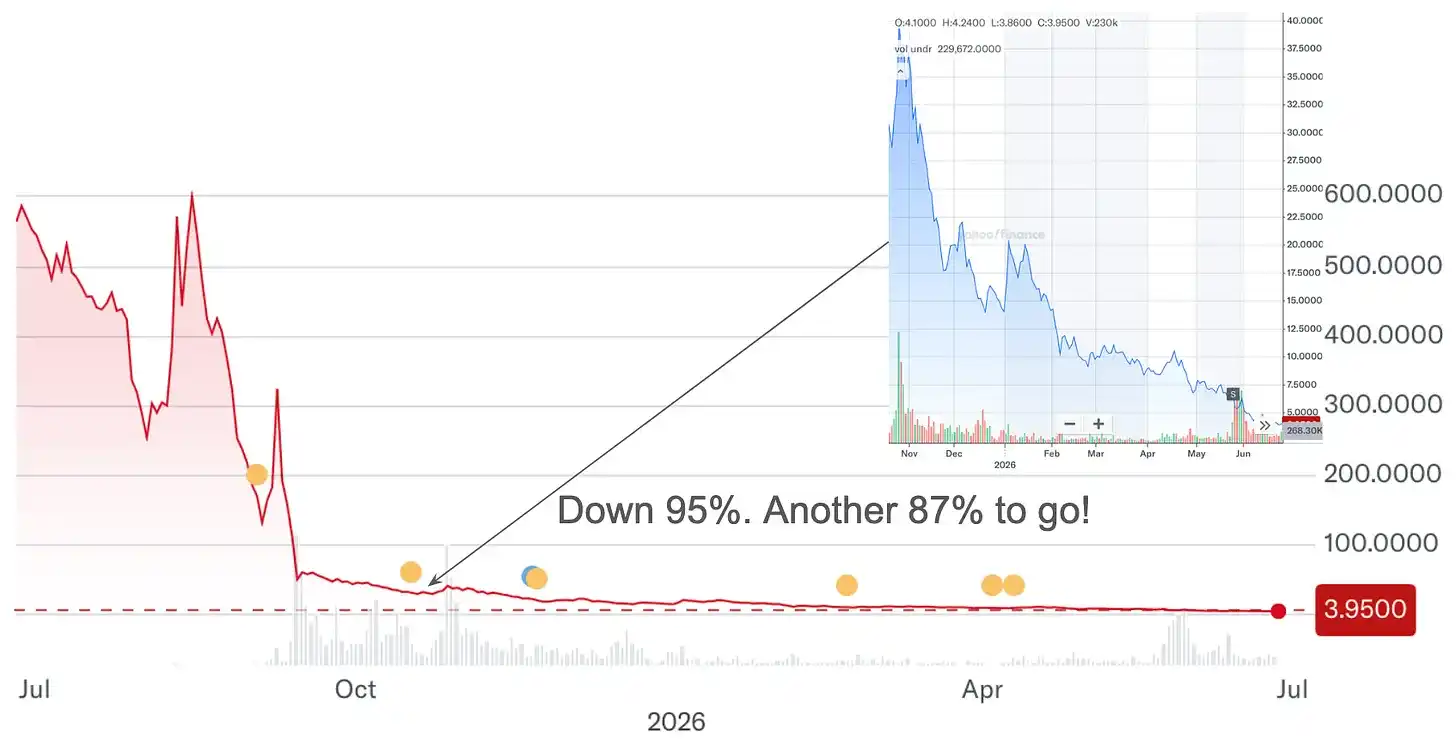
From $100,000 to $650. Enough for a (very) nice dinner. Speculators who "bought the dip," thinking "how much lower can it go," didn't fare much better than the original believers. The answer to "how much lower can it go" is often "quite a bit."

Why This Was Bound to Happen

Bitcoin ETFs exist. They charge only 9 basis points. Bitcoin itself exists. You can hold it yourself. There is no structural reason for DATs to trade at a premium—only greater fool theory, momentum trading, and a particular brand of financial nihilism where retail speculators, convinced the system is rigged, conclude they might as well play the rigged game with maximum aggression.

If you believe the traditional investment system doesn't work for you, the expected value of speculation looks different. FOMO plus dopamine plus gamification plus GameStop: Each alone is a manageable psychological condition. Together, they become a significant part of today's market structure.

Needless to say, insiders are always incentivized to meet the demand. They profit no matter which way the stock moves—another thing worth remembering.

About Tulips

The sad conclusion here is that no one cares when the market is irrational. This is a shame because the DAT crash is a perfect fable for the consequences of fear and greed. It should be a central case study for all bubble reporting. This is the Tulip Mania, only real and recent.

The 1637 dialogue "Waermondt and Gaergoedt" depicts two fictional Dutch weavers watching tulip prices collapse in real-time. One passage, spanning nearly four centuries, reads as if it were written last month:

"Things had gotten to the point that what used to be thrown into the dung heap to kill weeds in baskets was now selling for high prices. I thought I was rich enough. I thought I'd never have to weave again."

Polishing turds didn't work back then either. A flower that sold for 22 ducats in 1637 was trading at 400 ducats at its peak the year before. Then the liquidation came:

"I wish this country had never had flowers!"

I wonder how many retail investors, like those who turned an initial $100,000 into $650, wish they had never heard of Metaplanet, Nakamoto, or the phrase "Bitcoin yield."

One More Thing

I hold some Bitcoin. My venture fund holds crypto investments. I'm not against digital assets. I'm against this specific frenzy of packaging digital assets into companies, charging privileged fees, issuing debt for leverage, and then marketing the result as financial innovation.

I thought this frenzy was killed by the 2025 DAT crash. But the Golden Age of scams continues (with thanks to Shrubstack).

History repeats itself. Always. The pump-and-dump isn't a bug in the system; for those operating it, it's the product. Speculators provide the demand, insiders provide the product. Until we get the mother of all tulip crashes.

The pump-and-dump is the end in itself.

Crypto di tendenza

Domande pertinenti

QWhat is a 'vault company' in the context of this article, and how did the first wave of such companies end?

AA 'vault company' in this article refers to a firm whose business model is to raise funds and use them primarily to buy and hold a specific asset, like Bitcoin (e.g., MicroStrategy) or other cryptocurrencies. The first wave of such companies, following the model of MicroStrategy's 'Bitcoin yield,' saw their stocks trade at huge premiums over the net asset value (NAV) of the crypto they held. This ended in a 'catastrophic crash' in the summer of 2025, where early investors in many Digital Asset Treasury (DAT) companies lost up to 99% of their money.

QAccording to the author, why did DAT companies trade at a large premium over the value of their underlying assets, and what eventually happened to that premium?

AThe author argues that DAT companies traded at a large premium to their Net Asset Value (NAV) not for any structural reason, but due to 'greater fool theory, momentum trading,' and a form of financial nihilism where retail speculators, believing the system is rigged, try to play the 'rigged game' aggressively. This premium eventually collapsed as the bubble burst, with stocks like MSTR seeing their premium compress from 200% to around 100%, contributing to their massive decline from peak prices.

QWhat are the two new examples of 'vault company' schemes mentioned in the article, and what assets do they plan to hold?

AThe article mentions two new 'vault company' schemes: 1) Triller Group announced it would become the world's first 'SpaceX vault company,' using newly raised funds to buy and hold SpaceX stock. 2) LGHL (a previously established vault company) rebranded to focus on buying HYPE tokens instead of its previous crypto assets (SOL and SUI).

QWhat historical event does the author compare the DAT crash to, and what is the key similarity?

AThe author compares the DAT crash to the 17th-century Dutch Tulip Mania. The key similarity is the extreme and irrational speculation on an asset (tulip bulbs then, shares of companies holding crypto now), where prices soared based on hype and greed before collapsing catastrophically, leaving investors with massive losses. The author cites a 1637 dialogue about the tulip crash that sounds 'like it was written last month.'

QWhat is the author's main argument about the relationship between retail speculators and insiders in these schemes?

AThe author's main argument is that a symbiotic cycle exists between retail speculators and insiders/promoters. Retail speculators, driven by FOMO and a belief the system is unfair, provide the demand for highly speculative products. Insiders and 'pump-and-dump' traders then meet this demand by creating and promoting these schemes (like vault companies), from which they profit regardless of the outcome for retail investors. The author concludes that for those running it, 'the pump-and-dump is the product itself.'

Letture associate

"King of Pump Calls" Arthur Hayes Strikes Again, This Time Targeting Deribit

On June 29, BitMEX co-founder Arthur Hayes purchased approximately 6.16 million SYN tokens via OTC platform Flowdesk for around $2.2 million. Hayes subsequently declared on X that SYN represents one of the most asymmetric investments he has seen since HYPE, stating it's time for an options DEX to challenge the dominant platform Deribit, and identifying Hypercall as that challenger. SYN's price surged over 40% following his comments, with a tenfold increase in June 2026 alone, bringing its FDV to roughly $110 million. The article details Synapse Protocol's evolution from a cross-chain messaging and liquidity network into the chain-based options trading protocol Hypercall. Hypercall, built on the Hyperliquid ecosystem's HyperEVM, aims to be a universal options exchange supporting any asset size with capped loss (limited to premium paid) and no forced liquidations. Deribit, established in 2016, remains the centralized leader in crypto options with an estimated 85% market share in BTC and ETH options and $3.588 billion in assets. Its strengths include deep liquidity and professional tools, but it faces criticisms over custody risk, KYC requirements, and regulatory uncertainty. The analysis positions Hypercall not as an immediate replacement for Deribit's entrenched network effects, but as a potential complementary and differentiated competitor, particularly for DeFi-native assets and new asset classes like RWA. The article concludes by noting Hayes's recent mixed "call" record, including fully exiting and later re-buying HYPE, and the controversial price target for CARDS from his family office Maelstrom, which was followed by a significant price drop.

marsbit11 min fa

"King of Pump Calls" Arthur Hayes Strikes Again, This Time Targeting Deribit

marsbit11 min fa

AI is Sweeping the Globe, So Why is Crypto + AI in a Slump?

AI Booms, But Crypto + AI Remains Sluggish: A Demand-Side Analysis Despite the AI industry's explosive growth and massive investment, the convergence of blockchain and AI (Crypto + AI) has seen limited traction. The core issue is a severe supply-demand mismatch, not a flawed premise. Analyzing four key sub-sectors reveals specific gaps: 1. **Decentralized Compute/Storage:** Offer logical benefits like data sovereignty and cost savings but lack a decisive technical advantage over entrenched cloud giants (AWS, GCP). Enterprises prioritize performance and stability and are unwilling to bear the switching risk and uncertainty of decentralized networks. 2. **Model Verification/Privacy (e.g., ZKML):** Address important long-term issues like auditability and data privacy, but these are not urgent operational pain points for most businesses today. Widespread demand will likely follow regulatory mandates (like the EU AI Act), not precede them. 3. **AI Agent Infrastructure:** Projects are building infrastructure for a future of autonomous, interacting agents. However, the current market focus is on internal process automation within corporate firewalls. The technology is ahead of market readiness. 4. **AI Agent Payments:** This is the only sub-sector where blockchain is on a level playing field with traditional finance. Both are trying to solve the unsolved problem of real-time, micro-transactions for machines, making it the most immediately competitive area. The overarching problem is that the AI industry invests heavily in solutions that solve immediate bottlenecks (e.g., faster memory, more power). Most Crypto + AI solutions target secondary, longer-term concerns (decentralization, transparency) and often come with performance trade-offs. The lack of a flagship, large-scale commercial success case further hinders mainstream capital inflow. The path forward requires either aligning more closely with the current industry's performance demands or patiently building the foundational infrastructure for the next phase of AI.

Foresight News21 min fa

AI is Sweeping the Globe, So Why is Crypto + AI in a Slump?

Foresight News21 min fa

Continuous Net Outflows from ETFs, Are Institutions Exiting?

US spot Bitcoin ETFs have experienced approximately $6 billion in net outflows over the past six weeks, marking the longest consecutive weekly withdrawal streak since their launch in 2024. The iShares Bitcoin Trust (IBIT) from BlackRock has been particularly affected, accounting for over 70% of recent outflows. On-chain analysis indicates that long-term Bitcoin holders (holding for over 155 days), who control about 83% of the circulating supply, remain steadfast. The selling pressure is primarily coming from allocators who entered through ETF brokerage accounts. This represents the first major collective capitulation since Bitcoin gained mainstream Wall Street recognition, driven more by risk-off portfolio adjustments than a fundamental rejection of the asset. Factors such as rising inflation, a hawkish shift in Federal Reserve policy, massive capital inflows into AI infrastructure, and attractive IPO opportunities have redirected speculative funds. Bitcoin, treated as a high-beta risk asset, was among the first to be sold. While the pace of outflows has slowed significantly—from $1.72 billion in early June to $226.8 million mid-month—the structural issue remains. IBIT's large size means its outflows alone exert substantial market pressure. With spot market volume thin, new capital inflows absent, and ETF buying muted, the market lacks sufficient buying support to absorb this selling. The coming sessions are critical. If IBIT outflows decelerate and Bitcoin reclaims $60,000, this phase could be seen as a healthy reset. However, if heavy IBIT redemptions resume and the price falls below $58,000, it would signal a more sustained institutional exit, requiring non-ETF buyers to shoulder the entire selling pressure alone. The ETF, while lowering entry barriers, has not removed Bitcoin's inherent volatility.

marsbit1 h fa

Continuous Net Outflows from ETFs, Are Institutions Exiting?

marsbit1 h fa

Introduction to the Concept of World Models: A Story from Psychology to the Main Battlefield of AI

**World Models: From Psychology to AI's Core Concept** "World model" is a trending but often confusing term in AI, describing a system that allows machines to internally simulate, predict, and rehearse potential outcomes before taking real-world action—like a mental "sandbox." While definitions vary—Yann LeCun emphasizes physical understanding, OpenAI's Sora is a video-based "world simulator," Google DeepMind's Genie 3 creates interactive 3D environments, and companies like Alibaba and Tesla focus on practical applications—the core goal is consistent: reduce reliance on vast real-world data by creating an internal, predictive model for safer and more efficient AI. The concept has deep roots, tracing back to psychologist Kenneth Craik (1943). In AI, it was revitalized by researchers like David Ha and Jürgen Schmidhuber (2018). Major technical approaches include: 1) generative video models (e.g., Sora) for visual realism; 2) abstract predictive models (e.g., LeCun's JEPA) for efficiency and physical reasoning; and 3) explicit 3D simulators (e.g., NVIDIA Omniverse) for precision. Fei-Fei Li proposes a classification based on the AI action loop: renderers (output observations), simulators (output world states), and planners (output actions). The emerging "World Action Model" (WAM) paradigm aims to unify future prediction and action generation. An industry framework is forming: upstream (data, compute, sensors), midstream (general and vertical platforms), and downstream applications (autonomous driving, robotics, gaming, etc.). Autonomous driving is currently the most mature use case. The current lack of a unified definition reflects the field's early, dynamic stage, similar to past tech revolutions. Different approaches—focusing on pixels, physics, or behavior—represent parallel explorations of how best to compress and understand the world. This diversity, while seemingly chaotic, signals that world models have moved from an academic idea to a critical industrial battleground, ultimately aiming to give machines the ability to understand, imagine, and reason about the world.

marsbit1 h fa

Introduction to the Concept of World Models: A Story from Psychology to the Main Battlefield of AI

marsbit1 h fa

Building the Bright Path While Secretly Crossing Chencang: Is Walsh Paving the Way for a September "Rate Cut"?

The title "Building the Plank Road Openly While Secretly Crossing at Chencang: Is Walsh Paving the Way for a September 'Rate Cut'?" suggests Federal Reserve Chair Kevin Walsh's hawkish stance may be a deliberate smokescreen. Academy Securities analyst Peter Tchir argues in a report that markets, currently pricing a 75% chance of a September hike, are missing a potential path to a September rate cut that Walsh himself might be quietly preparing. Tchir posits that Walsh's hawkish rhetoric aims to suppress long-term yield risks (with the 10-year Treasury yield falling recently) while creating room for a narrative shift based on upcoming data. The potential political endgame, according to this view, could be rate cuts in September and October, ahead of the midterm elections. This hinges on a political logic where the Trump administration's preference for lower rates remains unchanged. A core part of Tchir's argument involves redefining inflation metrics. He contends the Fed under Walsh may deprioritize the PCE index, criticizing its lagging components like Owners' Equivalent Rent (OER). Instead, he points to alternative, more real-time indicators like the New Tenant Repeat Rent Index (NTRR) and the Truflation daily index, which shows core inflation around 1.45%. He suggests the Fed could shift its data narrative to justify policy easing. Furthermore, Tchir downplays AI-driven inflation fears. He argues that consumer price sensitivity, evidenced by negative market reactions to price hikes (e.g., Apple), contradicts persistent inflation narratives. He also separates AI/data center spending—which he sees as relatively rate-insensitive—from broader consumer affordability issues, implying rate hikes are misdirected. Based on this analysis, Tchir sees a re-pricing of rate cut expectations as likely, creating opportunities in short-duration Treasuries. He maintains a neutral-to-slightly-bullish view on the long end of the yield curve. For equities, he recommends a significant overweight in energy (especially global nuclear assets) and, within defense/security themes, an overweight in biotech/pharma versus an underweight in semiconductors, expressing caution on AI/data center valuations.

marsbit1 h fa

Building the Bright Path While Secretly Crossing Chencang: Is Walsh Paving the Way for a September "Rate Cut"?

marsbit1 h fa

Trading

Spot

Articoli Popolari

Come comprare ONE

Benvenuto in HTX.com! Abbiamo reso l'acquisto di Harmony (ONE) semplice e conveniente. Segui la nostra guida passo passo per intraprendere il tuo viaggio nel mondo delle criptovalute.Step 1: Crea il tuo Account HTXUsa la tua email o numero di telefono per registrarti il tuo account gratuito su HTX. Vivi un'esperienza facile e sblocca tutte le funzionalità,Crea il mio accountStep 2: Vai in Acquista crypto e seleziona il tuo metodo di pagamentoCarta di credito/debito: utilizza la tua Visa o Mastercard per acquistare immediatamente HarmonyONE.Bilancio: Usa i fondi dal bilancio del tuo account HTX per fare trading senza problemi.Terze parti: abbiamo aggiunto metodi di pagamento molto utilizzati come Google Pay e Apple Pay per maggiore comodità.P2P: Fai trading direttamente con altri utenti HTX.Over-the-Counter (OTC): Offriamo servizi su misura e tassi di cambio competitivi per i trader.Step 3: Conserva Harmony (ONE)Dopo aver acquistato Harmony (ONE), conserva nel tuo account HTX. In alternativa, puoi inviare tramite trasferimento blockchain o scambiare per altre criptovalute.Step 4: Scambia Harmony (ONE)Scambia facilmente Harmony (ONE) nel mercato spot di HTX. Accedi al tuo account, seleziona la tua coppia di trading, esegui le tue operazioni e monitora in tempo reale. Offriamo un'esperienza user-friendly sia per chi ha appena iniziato che per i trader più esperti.

331 Totale visualizzazioniPubblicato il 2024.12.12Aggiornato il 2026.06.02

Come comprare ONE

Discussioni

Benvenuto nella Community HTX. Qui puoi rimanere informato sugli ultimi sviluppi della piattaforma e accedere ad approfondimenti esperti sul mercato. Le opinioni degli utenti sul prezzo di ONE ONE sono presentate come di seguito.

活动图片