The First to Ride the Hype of Robinhood Chain: Arbitrum, Up Nearly 20%

marsbitPubblicato 2026-07-11Pubblicato ultima volta 2026-07-11

Introduzione

ARB rose nearly 20% recently, becoming one of the top-performing major L2 tokens. The catalyst was the launch of Robinhood Chain, an RWA-focused Layer 2 built on Arbitrum's Orbit tech. A key driver is the revived "Arbitrum Expansion Program" (AEP), a revenue-sharing rule from 2024 requiring independent Orbit chains to give 10% of their net protocol revenue to the Arbitrum ecosystem. While smaller chains already paid this, Robinhood Chain, with its significant TradFi backing, is the first large-scale tenant to make the mechanism economically meaningful. Despite impressive early metrics (over 35k addresses, $2.5B TVL, $1B+ DEX volume in its first week), Robinhood Chain's current contribution to Arbitrum's treasury is minor (~$14.7k net revenue). The price surge reflects a narrative-driven premium on AEP's future potential, given Robinhood's vast off-chain assets. The situation mirrors Optimism's "landlord" model with OP Stack, which is now facing a decline as its major tenant, Base, plans to leave. Similarly, analysts question if the high-earning Robinhood Chain will eventually follow Base's path and seek independence from Arbitrum's tech stack, especially as its activity already benefits Ethereum more directly through ETH fee burns.

Author:angelilu, Foresight News

ARB hit $0.094 intraday today, up nearly 20% in the past week, making it one of the best-performing mainstream L2 tokens over that period.

The catalyst for this rally is the launch of "Robinhood Chain"—Robinhood's RWA (Real World Asset) Layer2 built on Arbitrum technology, which officially went live on mainnet at a launch event in London on July 1.

A more subtle logic behind this is that a year-and-a-half-old rule has been brought back into the spotlight: A portion of Robinhood Chain's revenue will automatically flow back into the Arbitrum ecosystem, with a significant chunk going directly to the ArbitrumDAO treasury. This isn't a new policy, but a previously lukewarm revenue-sharing mechanism that is now being seriously priced in by the market for the first time, thanks to the entry of the heavyweight TradFi brand Robinhood.

The First Major Tenant in a Year and a Half

This rule is called the Arbitrum Expansion Program (AEP), launched jointly by the Arbitrum Foundation and Offchain Labs in January 2024. Simply put, it allows Arbitrum to open up its technology for others to build their own chains, with the condition of revenue sharing.

The sharing logic is straightforward: Any independent chain built using Arbitrum Orbit technology but not settling on Arbitrum One/Nova (e.g., settling directly to Ethereum or Base) must share 10% of its net protocol revenue with the Arbitrum ecosystem—8% to the DAO treasury and 2% to the Developer Guild. However, L3s that settle back to Arbitrum One/Nova, like Xai and Sanko, are exempt from this share and retain their status as first-tier ecosystem members.
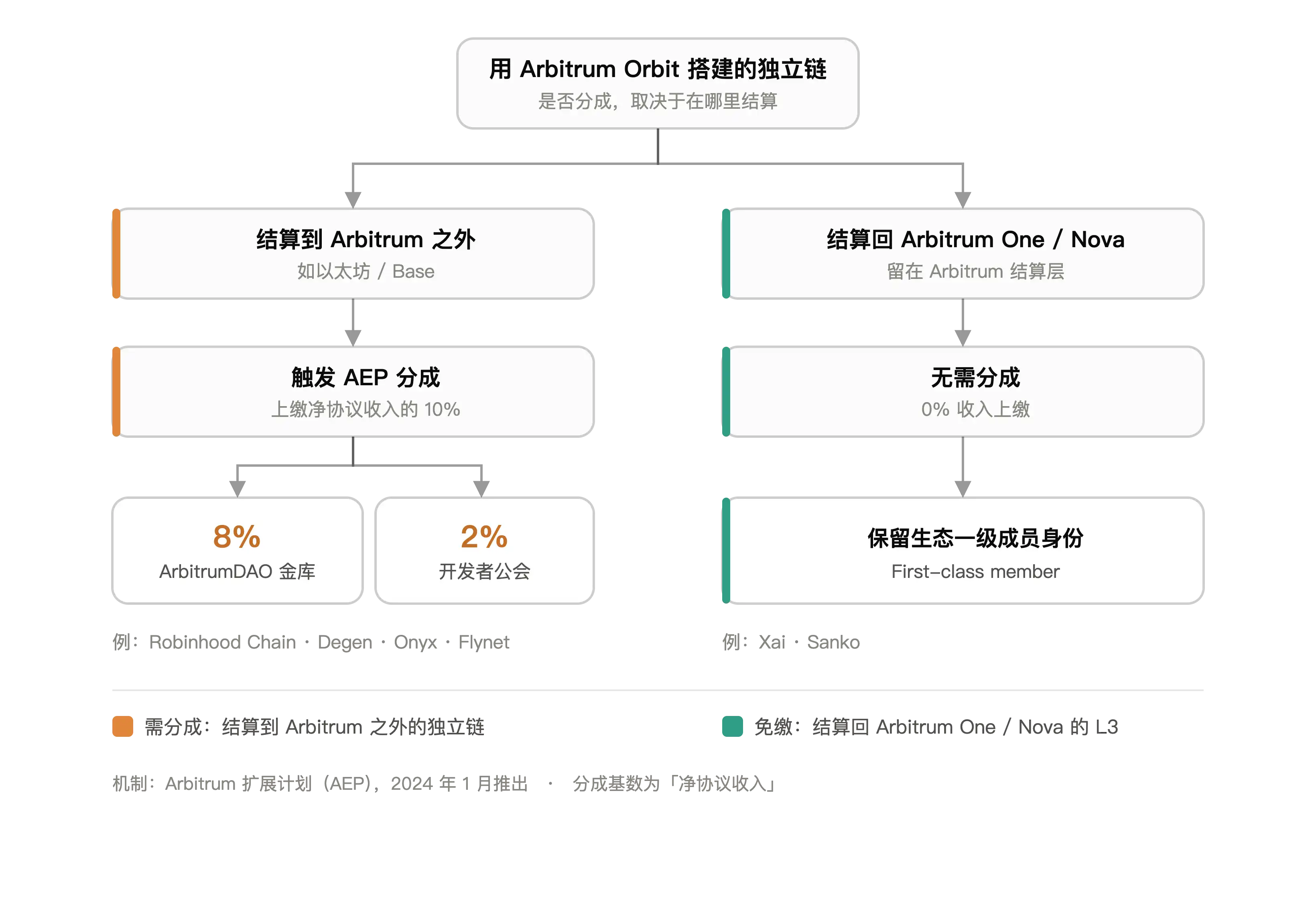
The key point is that Robinhood Chain is not the first chain to trigger the AEP. Smaller chains settling on Base, like Degen Chain, Onyx, and Flynet, have been paying this share for a while, but their volumes were too small to draw attention. What sets Robinhood Chain apart is simply that it's the first heavyweight chain to bring scale to this shared revenue amount.

Impressive Data, but the Rent Plate is Still Small

According to the latest data disclosed by Johann, Robinhood's Head of International & Crypto Business: As of July 10, just over a week after launch, Robinhood Chain has processed over 17 million transactions, has over 350,000 addresses, a TVL of approximately $250 million, and DEX trading volume exceeding $1 billion. For a newly launched chain, this report card is indeed impressive.

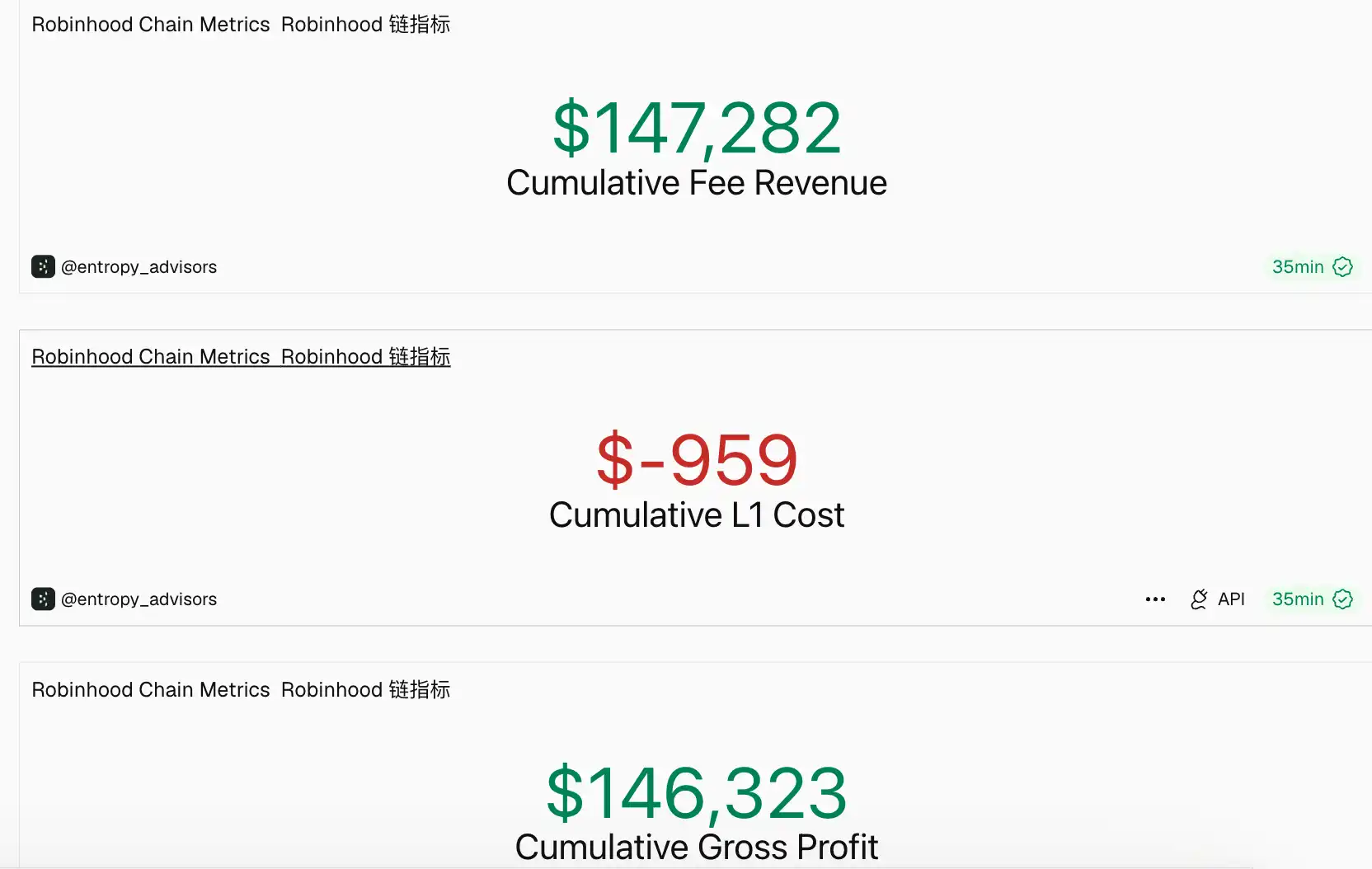
But the rent plate is far from this large. According to Dune data, as of the time of writing, Robinhood Chain's current protocol revenue is about $147,000. After deducting the cost of data settlement back to Ethereum L1, it's only $146,000. Even if 10% of this is shared with Arbitrum DAO, the amount is pitifully small. ARB's current rally reflects the market's premium valuation on the future scaling boundaries of the AEP protocol—a typical narrative-driven market move.
Looking at the potential upside, the ceiling for AEP is indeed not low: The Robinhood platform holds total assets of approximately $324 billion, custodies assets of about $143.6 billion, and its tokenized stocks have expanded to over 2,000 tokens covering 120 countries—most of these assets are not yet on-chain today. Once settlement gradually migrates, the $57,000 sharing base will stand at a completely different scale.

Old Landlord About to Lose Biggest Tenant, New Landlord Just Landed a Big Deal

Arbitrum's "rent collection" model isn't actually new. Optimism has been running the "landlord" business for a long time.

The Optimism Collective collects rent from all Superchain member chains (Base, Zora, Mode, Unichain, etc.) through OP Stack—charging 2.5% of sequencer revenue or 15% of net profit (whichever is higher), and OP Mainnet itself also contributes its net revenue to the treasury. However, its rental income has been gradually shrinking, falling further to about $2.9 million in Q1 2026 (with Base alone contributing about $1.4 million), down 21.5% quarter-on-quarter from $3.7 million in the previous quarter.
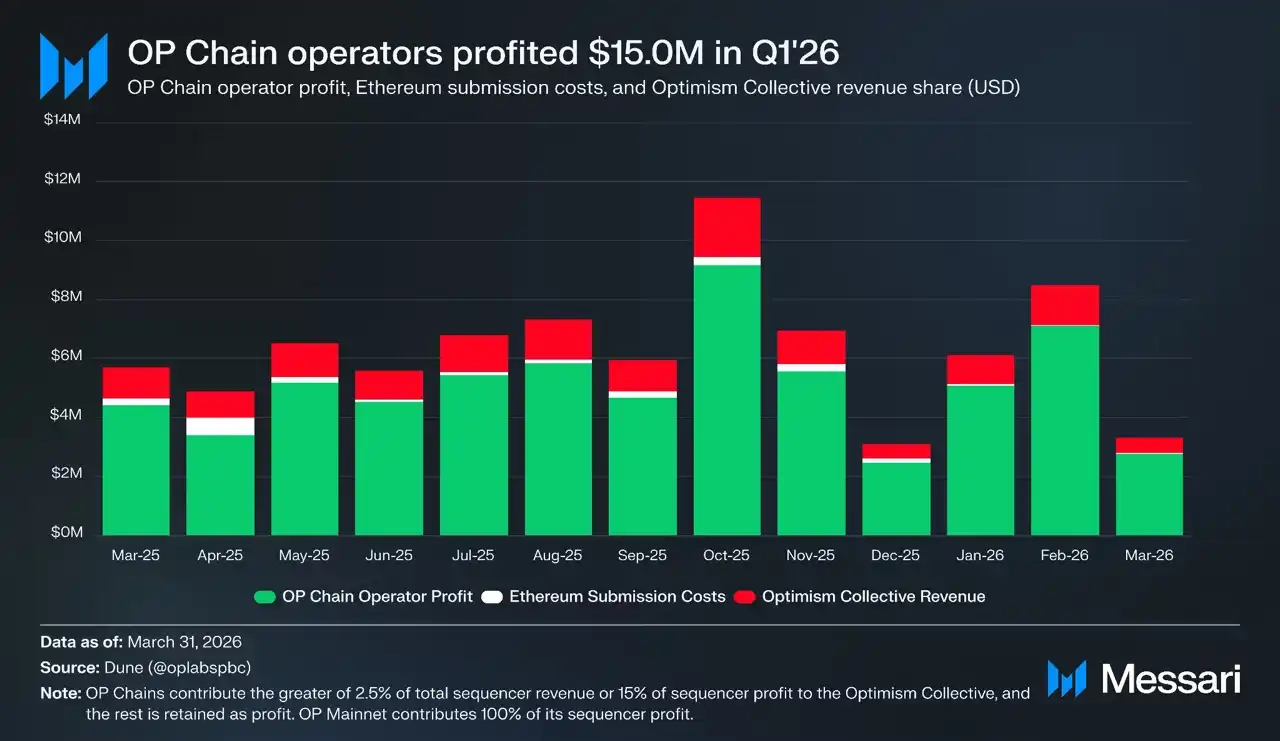
In February of this year, Base officially announced plans to leave OP Stack—Base accounted for about 96.5% of revenue flowing into the Collective on a gas fee basis. Upon the news, the OP token fell 28% within two days.

Meanwhile, Arbitrum just managed to revitalize its own landlord business from zero, thanks to Robinhood Chain. Their structures are completely parallel—both are underlying technologies charging rent from external chains, with the money going into their own DAO treasuries (ArbitrumDAO vs. Optimism Collective). The only difference is that Arbitrum's AEP, although the rules were written in 2024, never had a major tenant until this week, finally giving its "rent collection" a sense of scale for the first time.

But Can This Big Tenant Be Kept?

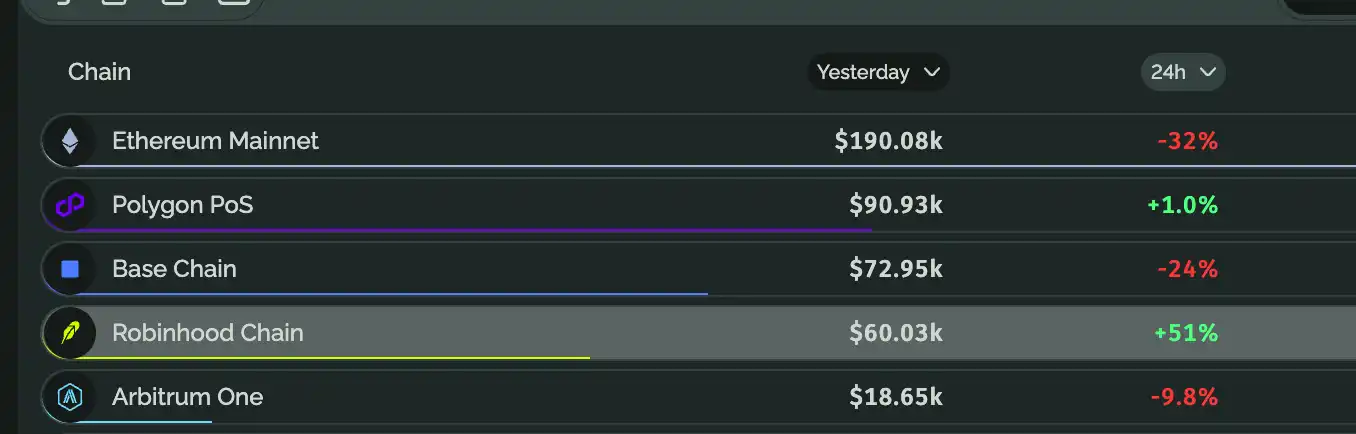
It's precisely this history with Base that some analysts are using to throw cold water. Some believe that, following the same script, Robinhood Chain will eventually leave Arbitrum Orbit just as Base left OP Stack and align directly with Ethereum. According to growthepie data, Robinhood Chain's daily sequencer revenue is already nearly $60,000, second only to Base's $72,000 among Ethereum L2s, approaching three times that of its parent chain, Arbitrum.
Even more delicate is the question of the beneficiary. In its first week, Robinhood Chain has become the second-largest demand source for Ethereum DA after Base, with its sequencer paying blob fees, settling in ETH, and permanently burning it. Some analysts argue that if this chain can only have one ecosystem currency, it's more likely to be ETH than ARB.

Crypto di tendenza

Domande pertinenti

QWhat is the primary reason behind Arbitrum (ARB) token's recent price surge of nearly 20% according to the article?

AThe primary reason is the launch of 'Robinhood Chain,' a Layer 2 for Real World Assets (RWA) built by Robinhood using Arbitrum technology. This event brought significant market attention to Arbitrum's revenue-sharing model for the first time.

QWhat is the name of Arbitrum's program that mandates revenue sharing from chains built with its technology, and what are the specific terms?

AThe program is called the Arbitrum Expansion Plan (AEP). It requires independent chains built with Arbitrum Orbit technology, which do not settle back to Arbitrum One/Nova (e.g., those settling directly to Ethereum or Base), to share 10% of their net protocol revenue with the Arbitrum ecosystem (8% to the DAO Treasury, 2% to the Developer Guild).

QWhy is Robinhood Chain's launch significant for Arbitrum's revenue-sharing model, unlike previous users of the AEP like Degen Chain?

AWhile other small chains like Degen Chain have been paying under AEP, their volume was too insignificant to matter. Robinhood Chain is significant because it is the first major, heavyweight chain from a major TradFi brand to trigger the AEP, bringing substantial potential scale and market credibility to the revenue-sharing model.

QWhat historical event from the Optimism ecosystem is cited as a cautionary tale regarding the sustainability of such revenue-sharing models?

AThe article cites Base's announcement in February (2026) to break away from the OP Stack as a cautionary tale. Base was the largest contributor (providing ~96.5% of revenue) to the Optimism Collective's treasury, and its departure caused the OP token price to drop 28% over two days.

QAccording to analysts in the article, what are the potential risks that Robinhood Chain might pose to Arbitrum's long-term benefits from the AEP?

AAnalysts suggest Robinhood Chain might eventually follow Base's example and break away from Arbitrum Orbit to align directly with Ethereum, especially as its sequencer revenue grows rapidly. Furthermore, the chain's economic activity primarily benefits Ethereum (ETH) through blob fee payments and burning, not necessarily the ARB token.

Letture associate

BPI: Digital Gold Least Popular Bitcoin Narrative, as Implementation Methods Defy Concepts

A national study by the Bitcoin Policy Institute (BPI) reveals that the "digital gold" narrative for Bitcoin holds little appeal for everyday Americans. The research, conducted with Cygnal and Neighborhood Bitcoin, involved surveys and focus groups with registered voters. Key barriers to adoption included concerns over control of the asset, security, accessibility, and ease of use. Messaging focused on personal control (e.g., "you decide how much") or Bitcoin as "freedom money" (savings that can't be frozen by banks or governments) resonated much more strongly than the "digital gold" concept. The study also found potential buyers are more influenced by stories from peers like friends, family, or financial advisors than by abstract narratives. After exposure to effective messages, the share of those "extremely" or "very" interested in owning Bitcoin rose from 19% to 24%. A separate Federal Reserve Bank of Cleveland research paper analyzed household data from 2018-2025. It found that expectations of Bitcoin's returns were a stronger driver of ownership than all demographic factors combined. For example, in 2021, Bitcoin holders expected a 22% annual return versus just 7% for non-holders. An experiment in 2025 showed that informing participants about Bitcoin's past performance (14.3% return) increased their planned crypto investments by 47% and raised their likelihood of purchasing by 23%. U.S. household crypto ownership grew from under 2% in 2018 to about 12% in 2025.

cryptonews.ru51 min fa

BPI: Digital Gold Least Popular Bitcoin Narrative, as Implementation Methods Defy Concepts

cryptonews.ru51 min fa

Trading

Spot

Articoli Popolari

Come comprare HYPE

Benvenuto in HTX.com! Abbiamo reso l'acquisto di Hyperliquid (HYPE) semplice e conveniente. Segui la nostra guida passo passo per intraprendere il tuo viaggio nel mondo delle criptovalute.Step 1: Crea il tuo Account HTXUsa la tua email o numero di telefono per registrarti il tuo account gratuito su HTX. Vivi un'esperienza facile e sblocca tutte le funzionalità,Crea il mio accountStep 2: Vai in Acquista crypto e seleziona il tuo metodo di pagamentoCarta di credito/debito: utilizza la tua Visa o Mastercard per acquistare immediatamente HyperliquidHYPE.Bilancio: Usa i fondi dal bilancio del tuo account HTX per fare trading senza problemi.Terze parti: abbiamo aggiunto metodi di pagamento molto utilizzati come Google Pay e Apple Pay per maggiore comodità.P2P: Fai trading direttamente con altri utenti HTX.Over-the-Counter (OTC): Offriamo servizi su misura e tassi di cambio competitivi per i trader.Step 3: Conserva Hyperliquid (HYPE)Dopo aver acquistato Hyperliquid (HYPE), conserva nel tuo account HTX. In alternativa, puoi inviare tramite trasferimento blockchain o scambiare per altre criptovalute.Step 4: Scambia Hyperliquid (HYPE)Scambia facilmente Hyperliquid (HYPE) nel mercato spot di HTX. Accedi al tuo account, seleziona la tua coppia di trading, esegui le tue operazioni e monitora in tempo reale. Offriamo un'esperienza user-friendly sia per chi ha appena iniziato che per i trader più esperti.

517 Totale visualizzazioniPubblicato il 2024.12.11Aggiornato il 2026.06.02

Come comprare HYPE

Discussioni

Benvenuto nella Community HTX. Qui puoi rimanere informato sugli ultimi sviluppi della piattaforma e accedere ad approfondimenti esperti sul mercato. Le opinioni degli utenti sul prezzo di HYPE HYPE sono presentate come di seguito.

活动图片