Strategy’s $66B Bitcoin machine hinges on capital markets, not BTC price: Report

cointelegraphPubblicato 2026-08-25Pubblicato ultima volta 2026-08-25

Introduzione

A recent analysis highlights that the main risk to Strategy's (MSTR) $66.7 billion Bitcoin treasury is not a crash in BTC's price, but a prolonged loss of access to capital markets. The firm holds 840,447 BTC behind $22 billion in debt and preferred claims, requiring it to continually raise fresh capital to service roughly $1.76 billion in annual obligations. A stress test found Bitcoin would need to fall 96% before its holdings couldn't cover its convertible notes. However, the company must still meet its fixed annual charges regardless of Bitcoin's price. If financing conditions worsen, Strategy's accumulation model could reverse, forcing greater reliance on reserves and Bitcoin sales. The company has sold BTC this year to meet obligations but has accumulated far more than it has sold.

Strategy’s Bitcoin treasury may be less vulnerable to a crypto market crash than to a prolonged loss of capital-market access, a risk that could threaten its ability to fund roughly $1.76 billion in annual obligations without selling Bitcoin, according to a recent analysis from Regime Intelligence.

According to the report, Strategy’s 840,447 BTC stash sits behind roughly $22 billion in debt and preferred claims, meaning the company’s Bitcoin accumulation model depends on its ability to continually raise fresh capital to meet obligations.

Contrary to popular belief, Strategy’s (MSTR) biggest vulnerability isn’t a Bitcoin-driven price drop or liquidity event, but its continued dependence on access to capital markets. The report noted that Strategy’s debt does not function like a conventional Bitcoin-backed margin loan, with no BTC-linked margin call that would force the company to liquidate its holdings as prices fall.

Regime Intelligence’s stress test found that Bitcoin would need to fall roughly 96% before Strategy’s Bitcoin holdings and reserves would no longer cover its convertible notes. However, that shifts the risk to the other side of the balance sheet, as Strategy must continue servicing roughly $1.76 billion in annual preferred dividends and interest regardless of Bitcoin’s price.

“In my opinion, MSTR’s principal challenge is to keep the flywheel running in order to cover the annual debt and preferred charges,” the report’s author, Sherif Saad, told Cointelegraph.

He said investors should watch Strategy’s preferred share price and cash reserves, which currently cover about 2.6 times its annualized charges.

If financing conditions deteriorate, its Bitcoin accumulation strategy could reverse, forcing greater reliance on reserves and Bitcoin sales to meet its obligations.

“During a prolonged BTC decline, the problem becomes more serious if MSTR’s share price and mNAV decline at the same time,” he said, adding that raising capital would then become “progressively more difficult or expensive.”
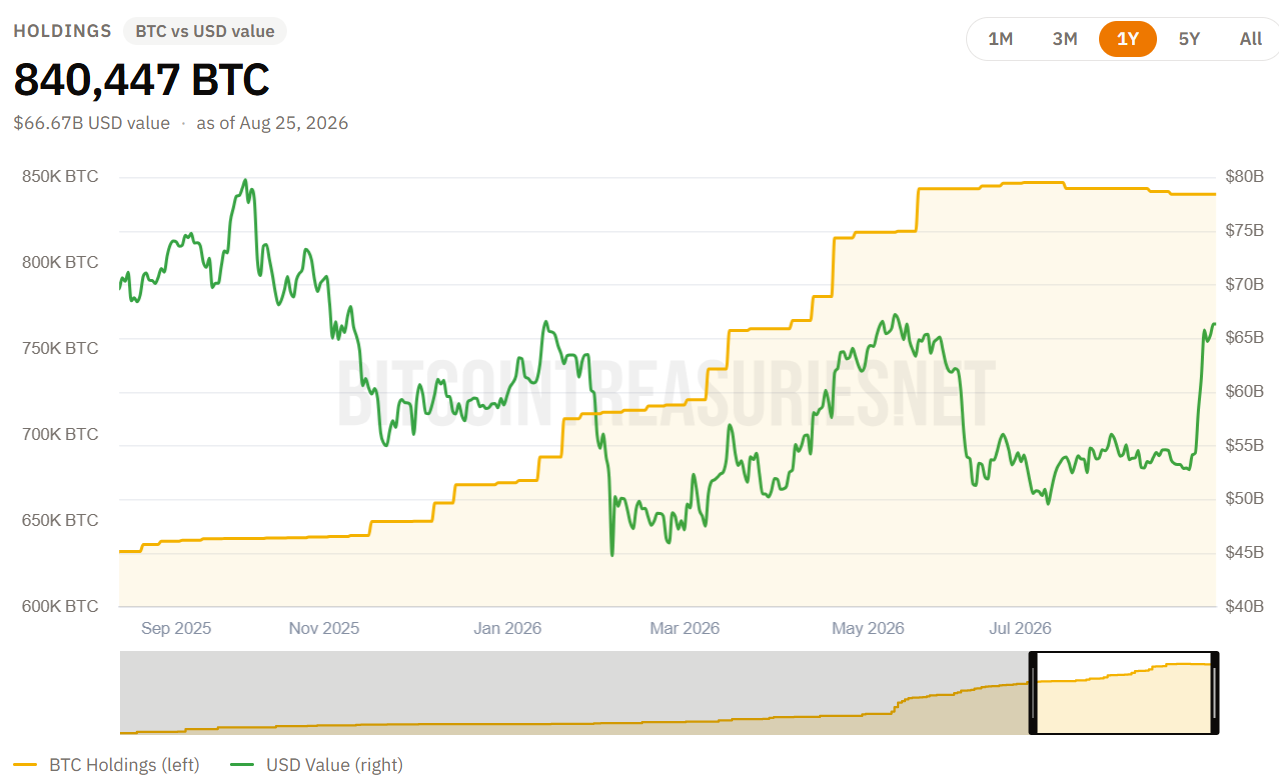
Following Bitcoin’s recent recovery, Strategy’s BTC stash is now worth $66.7 billion, higher than the company’s $63.36 billion cost basis. Source: BitcoinTreasuries.NET

Related: Standard Chartered analyst eyes $100K BTC as US Treasury doubles long-end buybacks

Michael Saylor’s juggling act

Much of the perceived risk surrounding Strategy centers on its willingness to tap the Bitcoin on its balance sheet, especially after executive chairman Michael Saylor spent years promoting a “never-sell” approach. So, it came as a surprise to some Bitcoiners when Strategy began selling BTC this year to meet its other business obligations.

The company has sold Bitcoin four times since May, including a recent sale of 1,690 BTC, with proceeds from recent sales used to fund preferred stock dividends, share repurchases and its growing US dollar reserve.

Despite the sales, Strategy CEO Phong Le reminded investors that the company has accumulated “about 25 times more” Bitcoin than it has sold this year. He told CNBC earlier this month that the company plans to resume Bitcoin purchases later this year.

Related: Crypto Biz: Bitcoin’s $116M self-custody wake-up call


Domande pertinenti

QAccording to the report, what is MicroStrategy's (MSTR) primary vulnerability instead of a Bitcoin price drop?

AMicroStrategy's primary vulnerability is its continued dependence on access to capital markets to raise fresh capital, not a Bitcoin-driven price drop or liquidity event.

QHow much does Bitcoin need to fall before MicroStrategy's holdings wouldn't cover its convertible notes, based on the stress test?

AAccording to Regime Intelligence's stress test, Bitcoin would need to fall roughly 96% before MicroStrategy's Bitcoin holdings and reserves would no longer cover its convertible notes.

QWhat annual charges must MicroStrategy service regardless of Bitcoin's price?

AMicroStrategy must service roughly $1.76 billion in annual preferred dividends and interest, regardless of Bitcoin's price.

QWhat metrics does the report's author, Sherif Saad, suggest investors should watch?

ASherif Saad suggests investors should watch MicroStrategy's preferred share price and its cash reserves, which currently cover about 2.6 times its annualized charges.

QWhy was it surprising to some Bitcoiners that MicroStrategy sold Bitcoin this year?

AIt was surprising because MicroStrategy's executive chairman, Michael Saylor, had spent years promoting a "never-sell" approach for the company's Bitcoin holdings.

Letture associate

BPI: Digital Gold Least Popular Bitcoin Narrative, as Implementation Methods Defy Concepts

A national study by the Bitcoin Policy Institute (BPI) reveals that the "digital gold" narrative for Bitcoin holds little appeal for everyday Americans. The research, conducted with Cygnal and Neighborhood Bitcoin, involved surveys and focus groups with registered voters. Key barriers to adoption included concerns over control of the asset, security, accessibility, and ease of use. Messaging focused on personal control (e.g., "you decide how much") or Bitcoin as "freedom money" (savings that can't be frozen by banks or governments) resonated much more strongly than the "digital gold" concept. The study also found potential buyers are more influenced by stories from peers like friends, family, or financial advisors than by abstract narratives. After exposure to effective messages, the share of those "extremely" or "very" interested in owning Bitcoin rose from 19% to 24%. A separate Federal Reserve Bank of Cleveland research paper analyzed household data from 2018-2025. It found that expectations of Bitcoin's returns were a stronger driver of ownership than all demographic factors combined. For example, in 2021, Bitcoin holders expected a 22% annual return versus just 7% for non-holders. An experiment in 2025 showed that informing participants about Bitcoin's past performance (14.3% return) increased their planned crypto investments by 47% and raised their likelihood of purchasing by 23%. U.S. household crypto ownership grew from under 2% in 2018 to about 12% in 2025.

cryptonews.ru52 min fa

BPI: Digital Gold Least Popular Bitcoin Narrative, as Implementation Methods Defy Concepts

cryptonews.ru52 min fa

Trading

Spot
活动图片