Crypto’s next altseason may have fewer winners: Wintermute

cointelegraphPubblicato 2026-07-31Pubblicato ultima volta 2026-07-31

Introduzione

The next altcoin season in crypto may yield fewer winners as institutional investors increasingly concentrate their trading in a narrower set of digital assets, according to a report from market maker Wintermute. Their data shows institutional clients generated a record 72% of spot OTC flow in H1 2026, up from 61% in H2 2025. This activity is focused on fewer tokens and fades faster after price surges compared to retail trading. The findings indicate capital is clustering in favored assets, weakening the "long tail" of the market. Broader industry data from CryptoQuant and Kaiko supports this trend, showing altcoin trading volume concentrating in top assets and a decline in the traditional rotation of Bitcoin profits into smaller coins. Analysts suggest future rallies will be more selective, with institutions focused on major tokens like Bitcoin and Ether.


Crypto’s next altcoin season may produce fewer winners as institutional investors concentrate their activity in a narrower group of digital assets, according to crypto market maker Wintermute.

In its over-the-counter (OTC) flow report for the first half of 2026, Wintermute said institutional counterparties generated 72% of spot flow across all tokens on its OTC desk, the highest share on record. That was up from 61% in the second half of 2025 and 59% in the first half of last year.

With institutional activity concentrated in fewer tokens and fading faster after price surges, the findings suggest future altcoin rallies could become narrower and more selective. Wintermute said liquidity was concentrating in the assets institutions favored while activity across the market’s “long tail” weakened.

Between the first half of 2024 and the first half of 2026, the number of unique tokens traded by Wintermute’s institutional counterparties grew by just 24%, compared with 76% among retail clients. The firm also found that institutional activity following a surge in a token’s price and volume faded after roughly one day. In contrast, retail activity typically remained elevated for about three days.
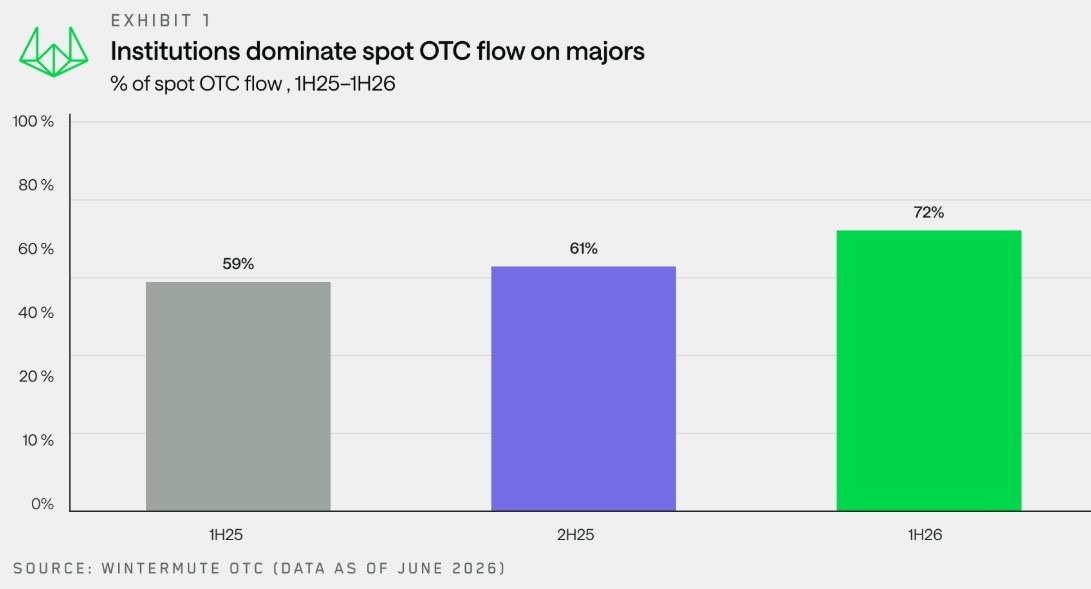
Percentage of institutional spot OTC flow. Source: Wintermute

Altcoin capital was already becoming more concentrated

Wintermute’s findings add proprietary OTC data to signs that capital has been clustering around a smaller group of altcoins across the wider market.

On June 20, CryptoQuant CEO Ki Young Ju said the traditional rotation of Bitcoin profits into smaller crypto assets had “basically disappeared.” CryptoQuant data showed trading volume in Bitcoin-denominated altcoin pairs near its weakest level since 2021.

Meanwhile, the 10 largest non-stablecoin altcoins accounted for about 80.5% of the non-Bitcoin, non-stablecoin market’s capitalization.

Related: Crypto altseason unlikely in 2026 as ‘blue-chip survivors’ to win out: Analyst

Kaiko identified a similar concentration in exchange trading. In July 2025, the data provider said that the 10 largest altcoins accounted for 63% of altcoin trading volume, up from about 50% several months earlier, as activity in smaller tokens weakened.

DWF Labs managing partner Andrei Grachev also argued that broad altcoin rallies were giving way to selective sector moves. On March 15, Grachev said too many tokens were competing for limited capital, while institutional investors remained focused on Bitcoin, Ether and tokenized real-world assets.

Magazine: The 100x obsession: Fundamentals grow in importance as crypto matures

Domande pertinenti

QAccording to Wintermute's report, what percentage of spot flow on its OTC desk was generated by institutional counterparties in H1 2026?

AInstitutional counterparties generated 72% of spot flow across all tokens on Wintermute's OTC desk in the first half of 2026.

QHow does the duration of institutional activity following a token's price surge compare to retail activity, based on Wintermute's findings?

AInstitutional activity faded after roughly one day following a token's price and volume surge, whereas retail activity typically remained elevated for about three days.

QWhat evidence from CryptoQuant's CEO and Kaiko supports the idea of capital concentration in a narrower group of altcoins?

ACryptoQuant's CEO noted the traditional rotation of Bitcoin profits into smaller altcoins had 'basically disappeared,' with Bitcoin-denominated altcoin pair volume near its weakest since 2021. Kaiko reported that the 10 largest altcoins accounted for 63% of altcoin trading volume in July 2025, up from about 50% months earlier.

QWhat reason did DWF Labs' Andrei Grachev give for broad altcoin rallies giving way to selective sector moves?

AAndrei Grachev argued that too many tokens were competing for limited capital, while institutional investors remained focused on Bitcoin, Ether, and tokenized real-world assets.

QWhat is the main implication of Wintermute's findings for the next altcoin season, as suggested in the article?

AThe main implication is that the next altcoin season may produce fewer winners, with rallies becoming narrower and more selective, as institutional activity concentrates in fewer tokens and liquidity clusters in assets favored by institutions.

Letture associate

Has Bitcoin Bottomed, or Is a 'Shakeout' Approaching? What's the Situation with XRP?

Cryptocurrency analytics platform Santiment shared key insights on Bitcoin and altcoin markets, highlighting significant signals from on-chain data. Analysis shows Bitcoin's 365-day MVRV ratio has fallen to -26%, indicating substantial losses for long-term holders, a level historically associated with market bottom formations and long-term buying opportunities. While short-term MVRV is near breakeven, suggesting no clear directional signal, the annual perspective points to a bottom before bullish cycles. On-chain data reveals divergent behavior: large wallets (10-10,000 BTC) have been accumulating, adding ~18,500 BTC in 10 days, while smaller retail investors continue buying dips. Analysts caution that high retail demand can sometimes create a risk of a final market shakeout or correction. The altcoin market shows a mixed picture. Ethereum's 365-day MVRV is around -33%, but recent monthly gains combined with overly optimistic social sentiment pose a short-term correction risk. XRP is in oversold territory with 30-day and 365-day MVRVs at -57.5% and -45.5% respectively, signaling potential for a strong mid-to-long term rebound. Social activity and optimism are rising for Solana, while investor sentiment remains calmer towards Cardano. Future direction for Bitcoin and altcoins depends not only on on-chain metrics but also on macroeconomic and regulatory developments. The Federal Reserve's interest rate decision and upcoming policy rulings are increasing market volatility expectations, while uncertainty around the U.S. Congressional clarity process continues to pressure pricing. *This is not investment advice.

cryptonews.ru1 h fa

Has Bitcoin Bottomed, or Is a 'Shakeout' Approaching? What's the Situation with XRP?

cryptonews.ru1 h fa

Bank of Korea Reveals Results of Tokenized Deposit Testing

The Bank of Korea has announced the results of its pilot test for tokenized deposits. Involving 28 central banks and international financial organizations, the project saw participation from major South Korean banks including KB Kookmin Bank, NH NongHyup Bank, Shinhan Bank, Woori Bank, and Hana Bank. Transactions, from payment orders to final settlement, were completed in real time, averaging just 80 seconds. The test involved 30 transactions across 17 different scenarios—such as corporate and interbank transfers—and was conducted in six currencies, including the Korean won, US dollar, and euro, with a total transaction value reaching approximately $995,000. The central bank reported that the platform operated stably throughout, despite being only partially connected to the existing banking infrastructure. Settlements using tokenized deposits were executed seamlessly, quickly, and transparently. An internal transfer of 20 million won (about $13,890) between NH NongHyup Bank and Shinhan Bank was also successfully processed via the Project Agora platform, which involved connecting to the Bank of Korea's CBDC test platform, Project Hangang. Additionally, KB Kookmin Bank and Japan's MUFG Bank tested cross-border payments using these deposit tokens—digital certificates issued by commercial banks within the pilot, not directly by the central bank. The Bank of Korea plans to continue testing payments with tokenized deposits. This follows last year's pledge by South Korean authorities to tighten regulations for won-based stablecoins, which will require approval from both the central bank and the Financial Services Commission.

cryptonews.ru3 h fa

Bank of Korea Reveals Results of Tokenized Deposit Testing

cryptonews.ru3 h fa

Trading

Spot
活动图片