
Here’s what happened in crypto today: 1 sell-off, 4 major shocks

ambcryptoPubblicato 2026-02-02Pubblicato ultima volta 2026-02-02

Introduzione

The cryptocurrency market experienced a significant sell-off, with Bitcoin dropping to around $76K. Despite the decline, historical patterns suggest such downturns—like those following Mt. Gox, the ICO bubble burst, COVID-19, and the FTX collapse—are often temporary, with Bitcoin historically recovering from losses as high as 80%. In other major developments: - World Liberty Financial (WLFI), linked to former President Trump, sold a 49% stake to UAE-based Aryam Investment in a $500 million deal. The transaction occurred just before Trump’s second inauguration, though WLFI had no live products at the time. - Igor Runets, CEO of Russian Bitcoin mining firm BitRiver, was detained in Moscow on tax evasion charges. The company, once worth hundreds of millions, has faced challenges since U.S. sanctions in 2022. - CrossCurve’s cross-chain bridge was exploited due to a smart contract flaw, resulting in an estimated $3 million loss. The team has offered a 10% reward for the return of funds and warned of potential legal action. Despite short-term concerns, Bitcoin’s long-term resilience remains a key theme.

Crypto had one of those days. The market was hit by a big sell-off that saw Bitcoin [BTC] lose key levels, alongside many other unsettling headlines piling up.

Here’s a quick rundown.

BTC falls, history repeats

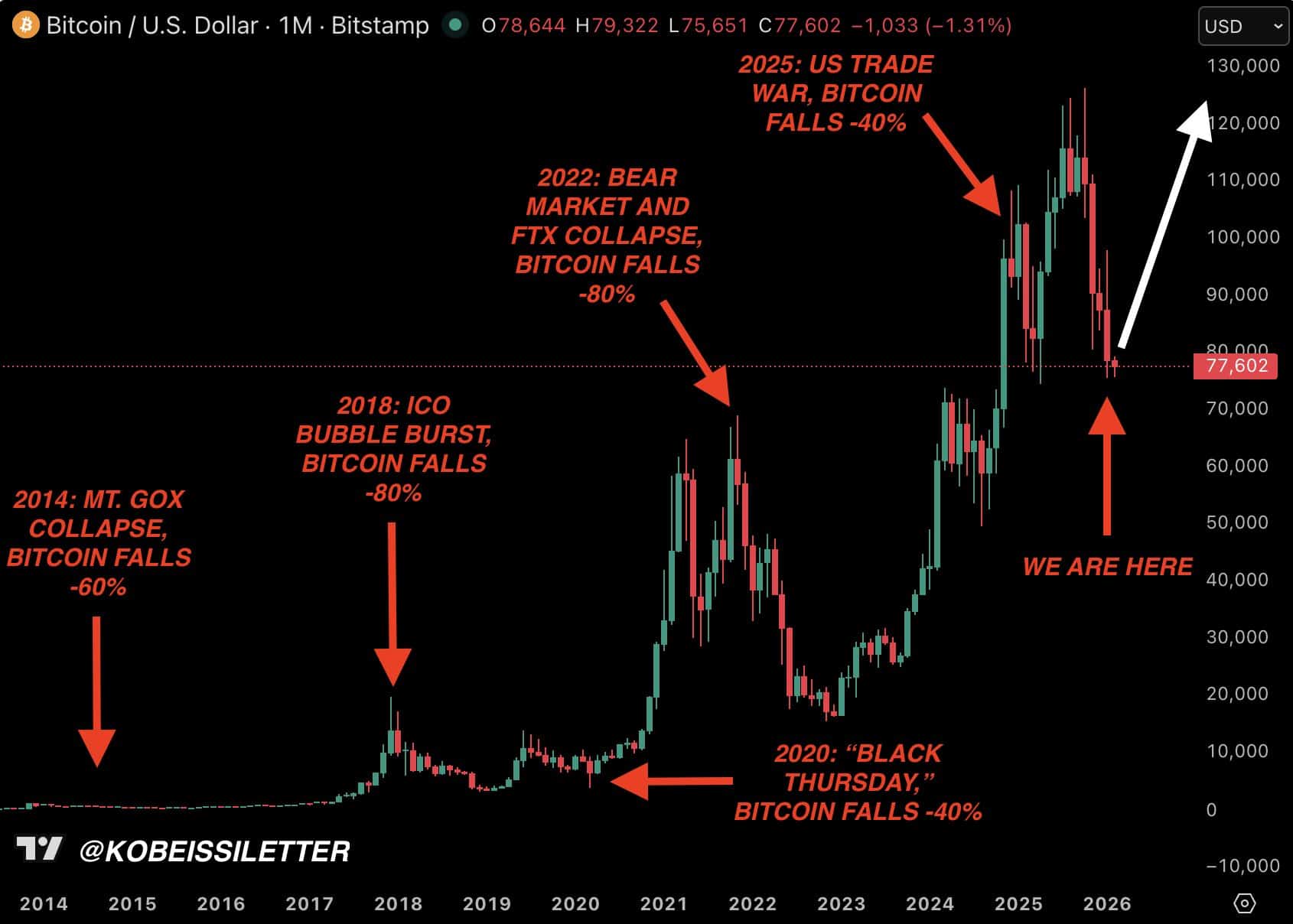
Bitcoin slid to around $76K at press time, with a market sell-off dragging major tokens lower in a matter of hours. While this seems like a reason to panic, zooming out will give you the real picture.

Source: X

The Kobeissi Letter’s recent X post puts this drop in familiar company.

Bitcoin has lived through far deeper falls: the Mt. Gox collapse in 2014, the ICO bubble burst in 2018, the Covid-era crash in 2020, and the 2022 bear market caused by FTX.

Each time, losses ranged from 40% to as much as 80%. Each time, Bitcoin eventually recovered. Every major crypto crash feels terminal in the moment but becomes a rounding error over time.

49% of Trump-linked WLFI bought out

The Wall Street Journal has reported that World Liberty Financial sold a 49% stake to UAE-based Aryam Investment. The deal is said to be worth $500 million.

The agreement was allegedly signed just days before President Trump’s second inauguration, despite the company having no live products at the time. Notably, Aryam does not receive any rights tied to the WLFI token.

Source: X

Aryam is backed by Sheikh Tahnoon bin Zayed Al Nahyan, the UAE’s national security advisor and brother of the country’s president. Sheikh Tahnoon also chairs AI-focused firms MGX and G42.

Earlier this year, MGX invested $2 billion into Binance, settling the transaction using WLF’s newly launched stablecoin, USD1.

This was without disclosing its indirect ownership in WLF.

Russian Bitcoin mining firm CEO detained

Igor Runets, founder and CEO of Russian Bitcoin mining firm BitRiver, has reportedly been detained by authorities in Moscow on allegations of tax evasion.

Local media reports say Runets was taken into custody on Friday and formally charged the following day with three counts related to hiding assets to avoid paying taxes.

A Moscow court has ordered him to remain under house arrest, a decision his legal team can still appeal before it takes full effect later this week.

Runets built BitRiver into one of Russia’s largest Bitcoin mining operators after founding the company in 2017. At its peak, his crypto mining business was reported to be worth hundreds of millions of dollars.

Since being sanctioned by the U.S. in 2022, the firm has lost key clients, faced lawsuits, and struggled with delayed employee payments.

Cross-chain bridge breach causes emergency stop

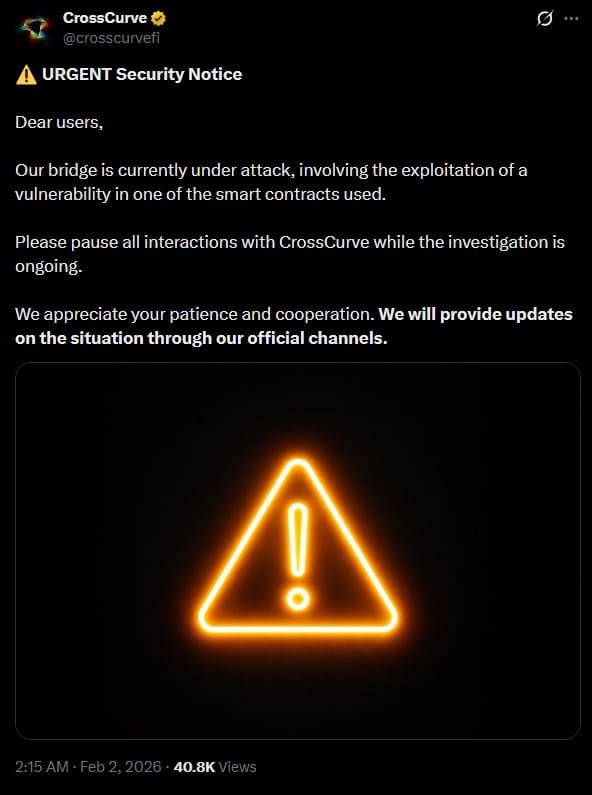
Crypto protocol CrossCurve has asked users to stop interacting with its platform after confirming that its cross-chain bridge was compromised in a smart contract attack.

An estimated $3 million was reportedly drained across multiple blockchain networks.

The team said the issue stemmed from a flaw in one of the contracts used by the bridge. This allowed unauthorized transactions to slip through normal checks.

Blockchain security trackers flagged the exploit shortly after it happened. They warned that the vulnerability could be used to unlock tokens without proper validation.

Source: X

The incident prompted partner protocol Curve Finance to caution users who had exposure to CrossCurve-related pools. They’ve asked users to reassess their positions and consider withdrawing support.

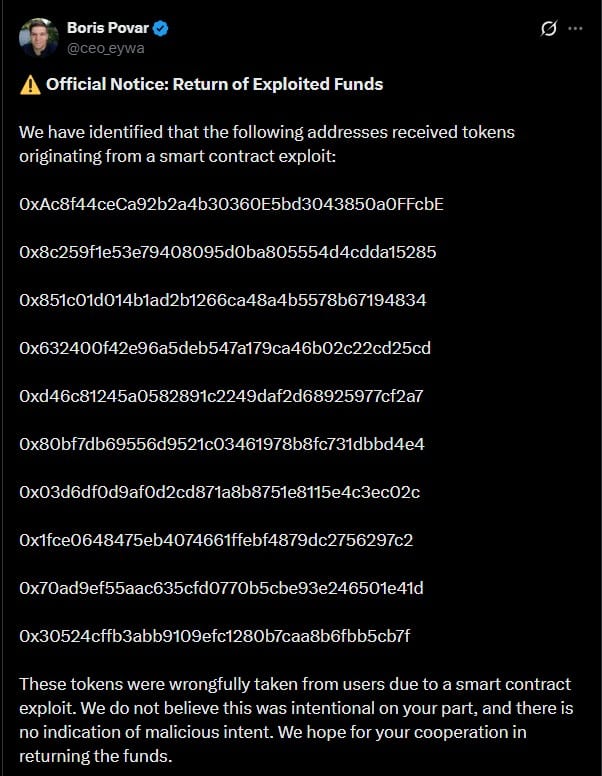
In response, CrossCurve CEO Boris Povar publicly addressed the wallets believed to have received the stolen funds. If the assets are returned in 72 hours, he’s offered a reward of up to 10%.

Source: X

The team has stated that it is prepared to involve law enforcement and pursue legal action if needed.


Final Thoughts

  • Bitcoin slipped to $76K, but patterns say the worries won’t last long.
  • In other news, WLFI has sold a major chunk of equity while the CEO of BitRiver got detained.
Next: Uniswap breaks multi-year support: Will UNI see a larger crash?
Share
  • Share
  • Tweet

Domande pertinenti

QWhat was the main event that caused Bitcoin to drop to around $76K?

AA market sell-off dragged major tokens lower, causing Bitcoin to slide to around $76K.

QWhich company sold a 49% stake to UAE-based Aryam Investment, and what was the deal's value?

AWorld Liberty Financial sold a 49% stake to Aryam Investment in a deal worth $500 million.

QWhy was Igor Runets, CEO of BitRiver, detained by authorities in Moscow?

AIgor Runets was detained on allegations of tax evasion, specifically for hiding assets to avoid paying taxes.

QWhat was the cause of the CrossCurve cross-chain bridge breach, and how much was estimated to be drained?

AThe breach was caused by a flaw in one of the smart contracts used by the bridge, allowing unauthorized transactions, and an estimated $3 million was drained.

QWhat did CrossCurve CEO Boris Povar offer to the wallets that received the stolen funds if they returned the assets within 72 hours?

ABoris Povar offered a reward of up to 10% if the stolen assets were returned within 72 hours.

Letture associate

Bitcoin's Bull-Bear Range Battle Continues, HYPE Faces Critical Test of Wave V Support | Exclusive Analysis

This market analysis covers Bitcoin (BTC) and HYPE, highlighting key levels and trading strategies for the week. HYPE is currently testing a critical support level at $40.17. A hold above this level could lead to consolidation between $40.17–$45.76, while a break below it may signal the end of its current V-wave uptrend from the April 2 low. The short-term strategy is to look for long entries near $40.17 if support holds, using 30% leverage and strict stop-loss discipline. Bitcoin is interpreted to be in a larger D-wave rebound from the February 6 low of $60,000, currently trading within a $73,500–$79,000 range. Key resistance lies at $79,000–$80,600 and $83,500–$84,500, with supports at $73,500, $69,500, and $65,000–$66,000. The medium-term strategy maintains a 60% short position from $89,000. Short-term tactics include selling into rallies near $76,500–$79,000 (Scenario A) or breaking below $73,500 (Scenario B), using 30% leverage. Last week, a 1x leveraged long trade in HYPE yielded a 6.80% gain, and the BTC short from $89,000 is currently up approximately 17.08%. Risk management is emphasized: set stop-losses at entry, move to breakeven at +1% profit, and trail stops to lock in gains thereafter. All views are based on technical analysis and are not investment advice. Traders are urged to exercise caution and adapt to market changes.

marsbit16 min fa

Bitcoin's Bull-Bear Range Battle Continues, HYPE Faces Critical Test of Wave V Support | Exclusive Analysis

marsbit16 min fa

Bitcoin's Bull-Bear Range Battle Continues, HYPE Faces Critical Test of Wave V Support | Invited Analysis

The market is experiencing directional uncertainty with both opportunities and risks. HYPE's daily V-wave structure is at a critical juncture, with the $40.17 support level being pivotal for its future trajectory. A break below this level, followed by an inability to surpass the recent high of $45.76, could signal the end of the current upward structure. The short-term strategy for HYPE is to "follow the trend and buy on dips," using a 30% position size and a 30/60-minute trading cycle, entering long upon confirmed support holds with model signals. Bitcoin's market structure is reinterpreted, with the rally from the $60,000 low now considered a larger D-wave rebound within a medium-term correction, facing a key test between $73,500 and $79,000. A break above the upper bound may lead to limited upside, while a drop below could see a decline toward $69,500. Core resistance lies at $79,000–$80,600 and $83,500–$84,500, with support at $73,500, $69,500, and $65,000–$66,000. The medium-term strategy maintains a 60% short position from $89,000, to be exited if price stabilizes above the multi-empty band. Short-term tactics involve 30% positions for "spread" opportunities, with two scenarios: selling on rallies near $76,500–$79,000 (Scheme A) or shorting on a breakdown below $73,500 (Scheme B), both with strict stop-losses. A复盘 of HYPE's recent short trade showed a 6.80% gain from a long entry at $41.59 (based on model buy signals) and exit at $44.42 (triggered by top signals). Key reminders include setting initial stops at entry, moving to breakeven at +1% profit, and trailing stops thereafter. All views are for reference only; market conditions change rapidly, and caution is advised.

Odaily星球日报23 min fa

Bitcoin's Bull-Bear Range Battle Continues, HYPE Faces Critical Test of Wave V Support | Invited Analysis

Odaily星球日报23 min fa

On the Same Day Aave Introduced rsETH, Why Did Spark Choose to Exit?

On April 18, Kelp DAO's cross-chain bridge was exploited, resulting in the malicious minting of 116,500 unbacked rsETH. The attacker deposited these into Aave and borrowed WETH, creating a potential bad debt of approximately $195 million. Aave’s Guardian quickly froze the market, but the protocol’s insurance could only cover about 25% of the loss. In contrast, SparkLend, a lending protocol in the MakerDAO ecosystem, suffered no direct losses. This was not due to superior foresight but rather a preemptive governance decision. On January 29, Spark executed a governance action to discontinue new rsETH supply, citing low usage and high concentration from a single wallet. The same day, Aave expanded its rsETH market by enabling E-Mode with a 93% LTV to attract more deposits. Spark’s risk management framework is designed to remove assets with low usage or poor risk-adjusted returns, regardless of external security concerns. Aave’s decision was growth-oriented, aiming to boost WETH utilization and attract capital. Spark also employs additional safeguards: rate-limited supply and borrow caps that would have limited the scale of such an attack, and a robust oracle system using the median of three price feeds. These mechanisms systemically contain the maximum exposure to any single risk event, demonstrating a fundamentally different approach to risk than Aave’s growth-first model.

marsbit24 min fa

On the Same Day Aave Introduced rsETH, Why Did Spark Choose to Exit?

marsbit24 min fa

Strategy's 'Money Printer': Is STRC Bitcoin's Savior or Destroyer?

Bitcoin's recent price movement is being heavily influenced by Michael Saylor and his company, MicroStrategy, through a new financial instrument: STRC (Variable Rate Series A Perpetual Stretch Preferred Stock). This Nasdaq-listed perpetual preferred stock offers an 11.5% annual dividend, attracting significant capital. Crucially, funds raised from STRC are used to purchase Bitcoin, with a 3x leverage effect—for every $1 from STRC, MicroStrategy adds $2 from MSTR equity to buy $3 worth of BTC. This creates a powerful "flywheel": more STRC sales fuel massive BTC buying, supporting its price and improving MicroStrategy's credit, which in turn makes STRC more attractive to investors. However, this mechanism introduces risks. A significant "ex-dividend arbitrage" pattern has emerged, where traders buy STRC before its monthly dividend, collect the payout, and quickly sell, causing price volatility and potentially driving up Bitcoin's cost basis for MicroStrategy. In response, Saylor has proposed shifting STRC to a semi-monthly dividend to smooth out these effects. Furthermore, STRC's high yield is being integrated into DeFi protocols like Apyx Protocol and Saturn Credit, offering new on-chain yield opportunities. The central concern remains: as MicroStrategy aggressively accumulates over 3.5% of all BTC, it challenges Bitcoin's foundational principle of decentralization, creating a system where a single public company significantly influences the market.

marsbit31 min fa

Strategy's 'Money Printer': Is STRC Bitcoin's Savior or Destroyer?

marsbit31 min fa

Trading

Spot
Futures

Articoli Popolari

Come comprare 4

Benvenuto in HTX.com! Abbiamo reso l'acquisto di 4 (4) semplice e conveniente. Segui la nostra guida passo passo per intraprendere il tuo viaggio nel mondo delle criptovalute.Step 1: Crea il tuo Account HTXUsa la tua email o numero di telefono per registrarti il tuo account gratuito su HTX. Vivi un'esperienza facile e sblocca tutte le funzionalità,Crea il mio accountStep 2: Vai in Acquista crypto e seleziona il tuo metodo di pagamentoCarta di credito/debito: utilizza la tua Visa o Mastercard per acquistare immediatamente 44.Bilancio: Usa i fondi dal bilancio del tuo account HTX per fare trading senza problemi.Terze parti: abbiamo aggiunto metodi di pagamento molto utilizzati come Google Pay e Apple Pay per maggiore comodità.P2P: Fai trading direttamente con altri utenti HTX.Over-the-Counter (OTC): Offriamo servizi su misura e tassi di cambio competitivi per i trader.Step 3: Conserva 4 (4)Dopo aver acquistato 4 (4), conserva nel tuo account HTX. In alternativa, puoi inviare tramite trasferimento blockchain o scambiare per altre criptovalute.Step 4: Scambia 4 (4)Scambia facilmente 4 (4) nel mercato spot di HTX. Accedi al tuo account, seleziona la tua coppia di trading, esegui le tue operazioni e monitora in tempo reale. Offriamo un'esperienza user-friendly sia per chi ha appena iniziato che per i trader più esperti.

304 Totale visualizzazioniPubblicato il 2025.10.20Aggiornato il 2025.10.20

Come comprare 4

Discussioni

Benvenuto nella Community HTX. Qui puoi rimanere informato sugli ultimi sviluppi della piattaforma e accedere ad approfondimenti esperti sul mercato. Le opinioni degli utenti sul prezzo di 4 4 sono presentate come di seguito.

活动图片