2026 Crypto Funding Reshuffle: Game and DePIN Are Dead, Prediction Market Duo Takes 18% of All Year's Funding with Two Deals

marsbitPubblicato 2026-05-08Pubblicato ultima volta 2026-05-08

Introduzione

Cryptocurrency Funding in 2026: Gaming & DePIN Falter as Prediction Markets Dominate Data from the first four months of 2026 reveals a stark shift in crypto venture funding. The gaming and DePIN (Decentralized Physical Infrastructure Networks) sectors have seen capital nearly dry up. In contrast, the "Consumer" category, led by two massive deals for prediction market platforms Kalshi ($1B) and Polymarket ($600M), captured a significant share. These two deals alone accounted for 18% of the year's total $8.65 billion raised and exceeded the combined funding of all 47 DeFi projects. Overall, the $8.65B across 305 deals is misleading. A March surge to $4.57B was largely due to two major acquisitions (BVNK at $1.8B and Kalshi). Excluding these, the underlying monthly funding rate is approximately $1B, indicating continued softness. The "Payments" and "Consumer" sectors together consumed 72% of all capital. Another notable trend is the rise of mergers and acquisitions (M&A), with 48 deals nearly matching the 57 seed-round investments. This signals a market pivot from funding new ideas to consolidating around established leaders. The most active investors so far in 2026 are Coinbase Ventures (18 deals), Tether (13 deals), Animoca Brands (11 deals), and GSR (11 deals). Notably, a16z's pace has slowed significantly compared to previous years.

Author:Memento Research

Compiled by: Deep Tide TechFlow

Deep Tide TechFlow Introduction: Crypto funding data for the first four months of 2026 reveals a harsh reality: the Game and DePIN sectors are nearly starved of capital, while Kalshi and Polymarket, two prediction market companies, have taken more money than all DeFi projects combined for the entire year. More alarmingly, the number of M&A deals has already matched seed rounds, indicating a shift in capital from betting on new ideas to acquiring existing leaders.

Funding Overview: March's Surge Was an Illusion

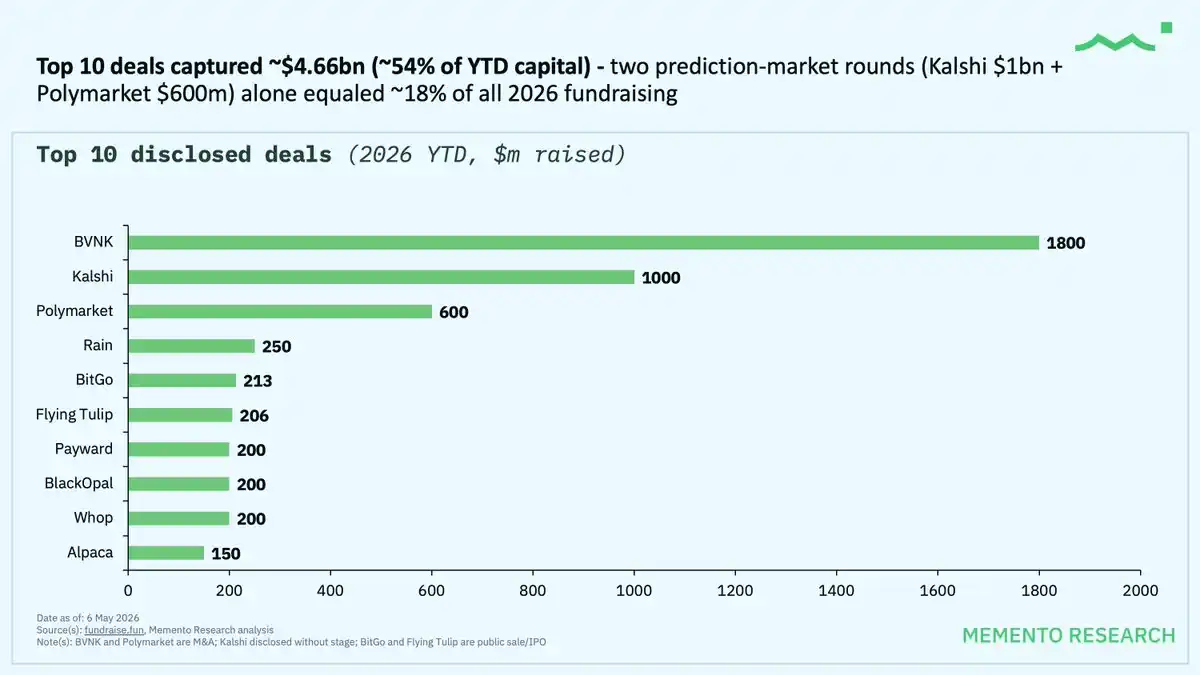
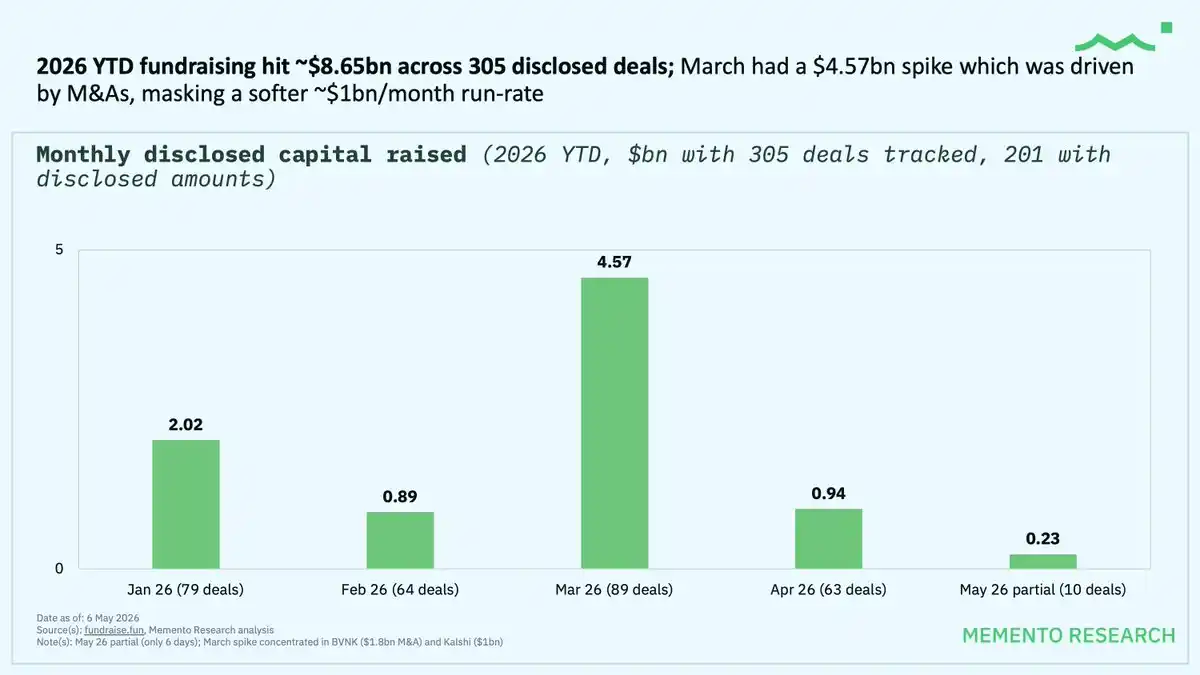
From January 1st to May 6th, 2026, the crypto industry completed 305 funding rounds, totaling $8.65 billion. However, the "surge" to $4.57 billion in March was actually just two massive M&A deals: BVNK's $1.8 billion and Kalshi's $1.0 billion.

Excluding these two deals, the real funding pace is about $1 billion per month, even weaker than at the end of 2025.

Capital Flow: Payments and Consumer Absorb 72%

By sector breakdown:

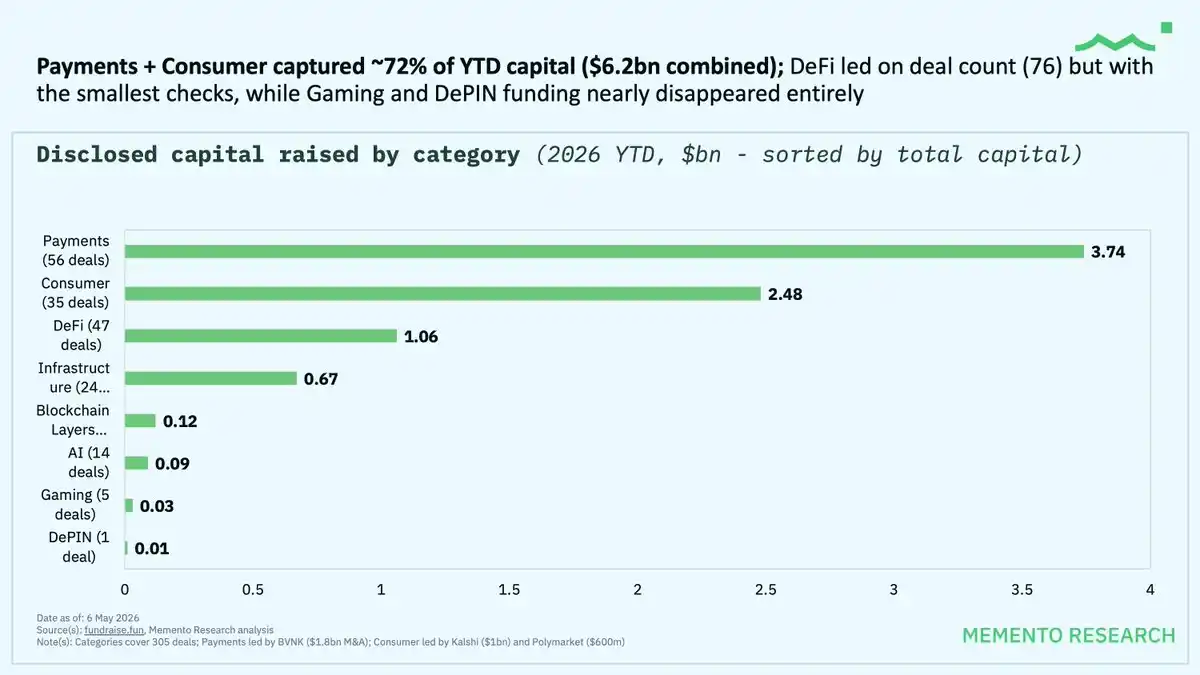
Payments: $3.74 billion (56 deals)

Consumer: $2.48 billion (35 deals)

DeFi: $1.06 billion (47 deals, the highest number of transactions)

The Payments and Consumer sectors combined account for 72% of the year's total funding. Funding for Game and DePIN has nearly vanished.

Prediction Markets Dominate the Consumer Sector

Two prediction market companies accounted for 18% of the year's total funding:

Kalshi: $1.0 billion

Polymarket: $600 million

These two deals totaling $1.6 billion exceed the sum of all 47 DeFi funding rounds.

M&A Becomes Mainstream

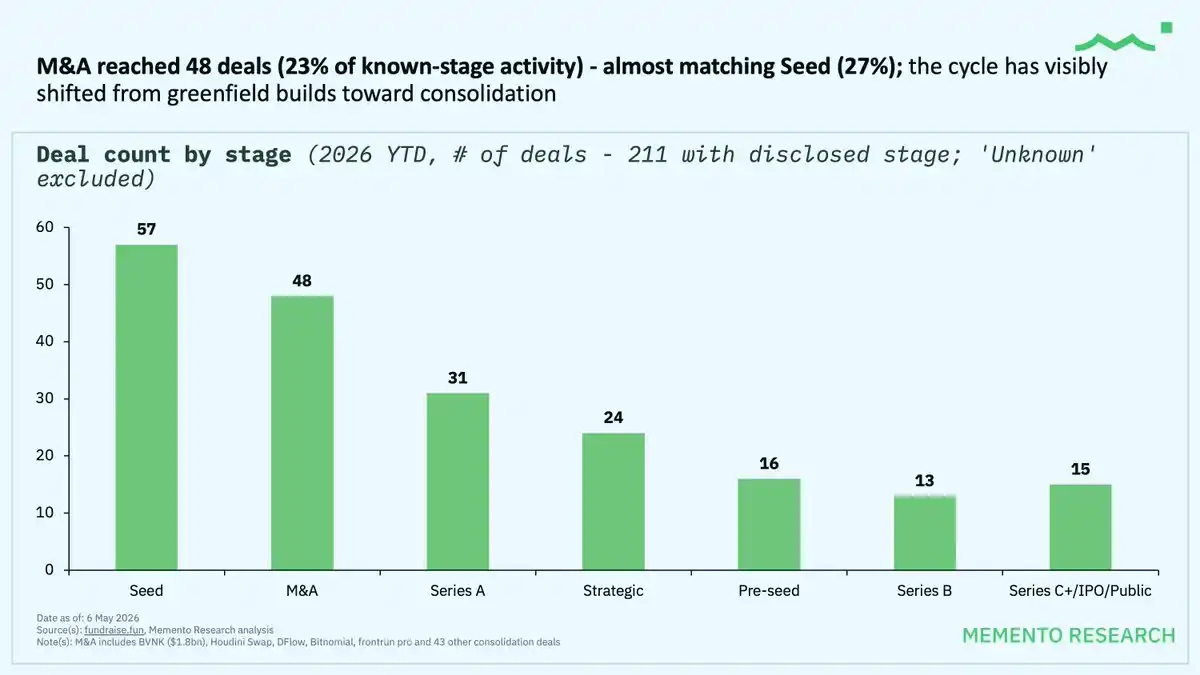
M&A deals reached 48 (accounting for 23% of known-stage transactions), nearly matching the 57 seed rounds (27%). This cycle has shifted from investing in new ideas in early stages to acquiring industry leaders.
Investor Rankings Reshuffled

Most active funds in 2026:

Coinbase Ventures: 18 deals (ranked second during 2021-26 period)

Tether: 13 deals (new top lead investor)

Animoca Brands: 11 deals (ranked first during 2021-26 period)

GSR: 11 deals

a16z: 7 deals (a significant drop compared to ~200 deals during 2021-26 period)

Domande pertinenti

QAccording to the article, which two sectors took the majority of crypto funding in early 2026?

AThe Payments and Consumer sectors took the majority of crypto funding, together accounting for 72% of the total capital raised.

QWhat significant trend does the data reveal about mergers and acquisitions (M&A) compared to seed funding?

AThe data shows that M&A deals reached 48 (23% of known-stage deals), almost catching up to seed rounds at 57 deals (27%). This indicates a shift in the investment cycle from funding new ideas to acquiring established industry leaders.

QWhy was the spike in funding for March 2026 described as an 'illusion'?

AThe spike to $4.57 billion in March was largely an illusion because it was driven by just two mega-deals: an $1.8 billion acquisition of BVNK and a $1 billion deal with Kalshi. Removing these two transactions reveals a slower, more sluggish monthly funding pace of around $1 billion.

QHow did the funding for prediction market companies compare to the total funding for all DeFi projects in the period covered?

AThe two prediction market companies, Kalshi ($1 billion) and Polymarket ($600 million), together raised a combined $1.6 billion. This amount exceeded the total raised by all 47 DeFi projects, which was $1.06 billion.

QWhich investment firms were the most active in terms of deal count during early 2026, and how did this compare to their historical activity?

AIn early 2026, the most active investors by deal count were Coinbase Ventures (18 deals, historically ranked 2nd from 2021-26), Tether (13 deals, new top investor), Animoca Brands (11 deals, historically ranked 1st), GSR (11 deals), and a16z (7 deals, showing a significant decline from its historical ~200 deals between 2021-26).

Letture associate

The Night Before the AI Model Shakeout

China's large language model (LLM) industry is entering a critical consolidation phase. In a concentrated wave of funding in May 2026, leading players Kimi, StepFun, and DeepSeek reportedly secured over $70 billion combined, signaling a dramatic capital rush towards the few remaining independent contenders. This frenzy masks an impending shakeout. The core dynamic has shifted from a pure technology race to a battle for survival and strategic positioning. LLM capabilities are rapidly commoditized; gaps between top models are narrowing. Consequently, investment logic has pivoted from betting on future potential to prioritizing cash flow, user access, and ecosystem integration. The economic model poses a fundamental challenge: while user growth previously meant profits, in the AI era, it drives soaring inference costs. Startups, lacking the cross-subsidy ability of tech giants like ByteDance or Tencent, face immense pressure to achieve financial sustainability. DeepSeek's open-source, high-performance, low-cost strategy has further compressed industry profit margins. Facing this reality, the top players are scrambling to lock in their status before the window closes. StepFun is accelerating its港股 IPO, embedding itself in hardware supply chains. Kimi is aggressively showcasing revenue growth (ARR doubling to $2 billion in a month) to prove viability. DeepSeek, with new state-backed investment, is solidifying its role as a strategic national asset. The parallel to China's previous AI "Four Dragons" is stark. The industry is witnessing extreme capital concentration at the top, while mid-tier companies face a funding winter. The narrative has evolved from "who can build the best model" to "who can survive." For independent LLM companies, securing a public listing or a definitive strategic identity is no longer about expansion—it's about securing the very right to exist in the impending era of industry clearance.

marsbit14 min fa

The Night Before the AI Model Shakeout

marsbit14 min fa

TACO Is Outdated, Wall Street Is Betting Heavily on NACHO

The article discusses a shift on Wall Street from the "TACO" (Trump Always Chickens Out) trading theme to a new one called "NACHO" (Not A Chance Hormuz Opens). This change reflects the market's adaptation to a prolonged closure of the Strait of Hormuz following U.S.-Israel airstrikes on Iran in late February. Unlike TACO, which bet on former President Trump de-escalating crises, NACHO bets on a protracted stalemate keeping the vital oil chokepoint shut. Key evidence for the NACHO regime includes a fundamental decoupling of oil prices and the S&P 500 since late March. While Brent crude has remained elevated (around $109 in May), the stock index has rallied to new highs. The market is pricing in a long but finite period of high oil prices, as seen in the steep futures curve. This theme is backed by real money in three derivatives markets: soaring war risk insurance for ships, an inverted oil futures structure, and evaporating expectations for Federal Reserve rate cuts in 2026. Within the equity market, the NACHO dynamic has caused a sharp divergence, with the energy sector (XLE) vastly outperforming the transportation sector (IYT), which is highly sensitive to fuel costs. The article notes a concrete deadline for this trade: early June. Analysts warn that global commercial oil inventories could approach critical "operational pressure" levels by then, potentially triggering more severe market disruptions if the Strait remains closed. Prediction markets currently assign a very low probability to the Strait reopening normally before June.

marsbit47 min fa

TACO Is Outdated, Wall Street Is Betting Heavily on NACHO

marsbit47 min fa

How Significant a Variable Will the CLARITY Act Be for the 2026 Midterm Elections?

Title: "The CLARITY Act" as a New Variable in the 2026 Midterm Elections Encryption regulation is emerging as a new variable in the 2026 U.S. midterm elections. According to a HarrisX survey, a bipartisan majority of registered voters supports the U.S. maintaining leadership in digital finance and the passage of the CLARITY Act. This legislation aims to define regulatory boundaries between the SEC and CFTC for digital assets, establish registration rules for exchanges and custodians, and enhance consumer protection. Political impact is significant: 37% of voters said they would be more inclined to support a senator who votes for the bill, resulting in a net electoral gain of +20 percentage points. Notably, 47% of voters indicated they would consider voting for a candidate outside their preferred party if that candidate supports the CLARITY Act while their own party does not. This cross-party appeal is even stronger among cryptocurrency holders and voters familiar with digital assets. The survey found that while general awareness of digital assets is limited, there is strong, bipartisan voter demand for clear federal rules. 70% of voters believe the U.S. should have passed clear crypto legislation already, and 62% deem it important for the U.S. to set global digital finance rules. Concerns about national security and the offshore concentration of crypto exchanges (8 of the top 10 are headquartered outside the U.S.) further drive support for federal action. Currently, 52% of voters support the CLARITY Act after hearing a neutral description, versus 11% opposed. Support is bipartisan, with net approval rates of +48 among Republicans, +43 among Democrats, and +32 among independents. The findings suggest that for candidates, supporting the CLARITY Act is a net political positive, offering a pathway to engage young voters, crypto holders, and swing voters. The core question in crypto regulation for U.S. politics is shifting from "whether to regulate" to "who can mobilize votes with it."

marsbit1 h fa

How Significant a Variable Will the CLARITY Act Be for the 2026 Midterm Elections?

marsbit1 h fa

Trading

Spot
Futures
活动图片