A Year Later, 'Lean Ethereum' Moves Forward: What Is Ethereum Aiming to Achieve?

marsbitPubblicato 2026-07-15Pubblicato ultima volta 2026-07-15

Introduzione

A year after its initial proposal, "Lean Ethereum" is resurfacing as a core focus, signaling a potential fundamental shift in Ethereum's development narrative. While recent years prioritized scalability (e.g., Rollups, blobs), current discussions center on long-term sustainability and decentralization. This shift is evident on multiple fronts. Organizationally, the Ethereum Foundation (EF) is becoming "leaner and more focused," while key responsibilities like R&D (Ethlabs) and institutional outreach (Ethereum Institution) are being distributed to independent organizations. This aims to reduce systemic reliance on a single entity. Technologically, "Lean Ethereum," described by Vitalik Buterin as Ethereum's "third major iteration," outlines a 3-4 year roadmap. Its goals extend beyond raw throughput to emphasize protocol properties for a "long-term trust infrastructure." Key directions include: protocol simplification via "light verification" (using recursive STARKs instead of heavy re-execution); prioritizing quantum resistance; integrating privacy as a first-class protocol goal; and consensus-layer improvements for faster finality and reduced validator burden. Complementing this, the proposed 0x02 compounding validators feature seeks to make staking rewards more sustainable and equitable for smaller participants by allowing native reinvestment, improving capital efficiency and reducing network overhead. Together, these changes represent a move towards "subtraction": reduci...

By: imToken

Over the past few years, most of Ethereum's upgrades could be explained by a relatively clear goal: scaling.

From Rollup, Blob, and data availability to the continuous increase in the Gas Limit, the discussions have all been about how to enable Ethereum to handle more transactions and reduce costs. Therefore, even if ordinary users don't understand every EIP, they can intuitively grasp that these upgrades ultimately aim to make the chain faster and cheaper.

However, recently, Ethereum has begun to frequently discuss issues that are less easily priced by the market. Especially on July 4th, Vitalik Buterin, based on the updated long-term roadmap for Ethereum, re-summarized the core directions of Lean Ethereum, calling it the "third major iteration" of Ethereum after The Merge.

At the same time, another piece of research on 0x02 compounding validators provided a supplementary clue from the perspective of staking rewards. For smaller-scale stakers, a native compounding mechanism could bring about a 5% relative increase in the consensus layer APR.

On the surface, these are different topics, but when placed together, one might find that Ethereum is undergoing a deeper narrative reconstruction: it is starting to reconsider, how to support its operation over the next decade or even longer through a more decentralized organizational structure, a protocol base that is easier to verify, and a more sustainable revenue model.
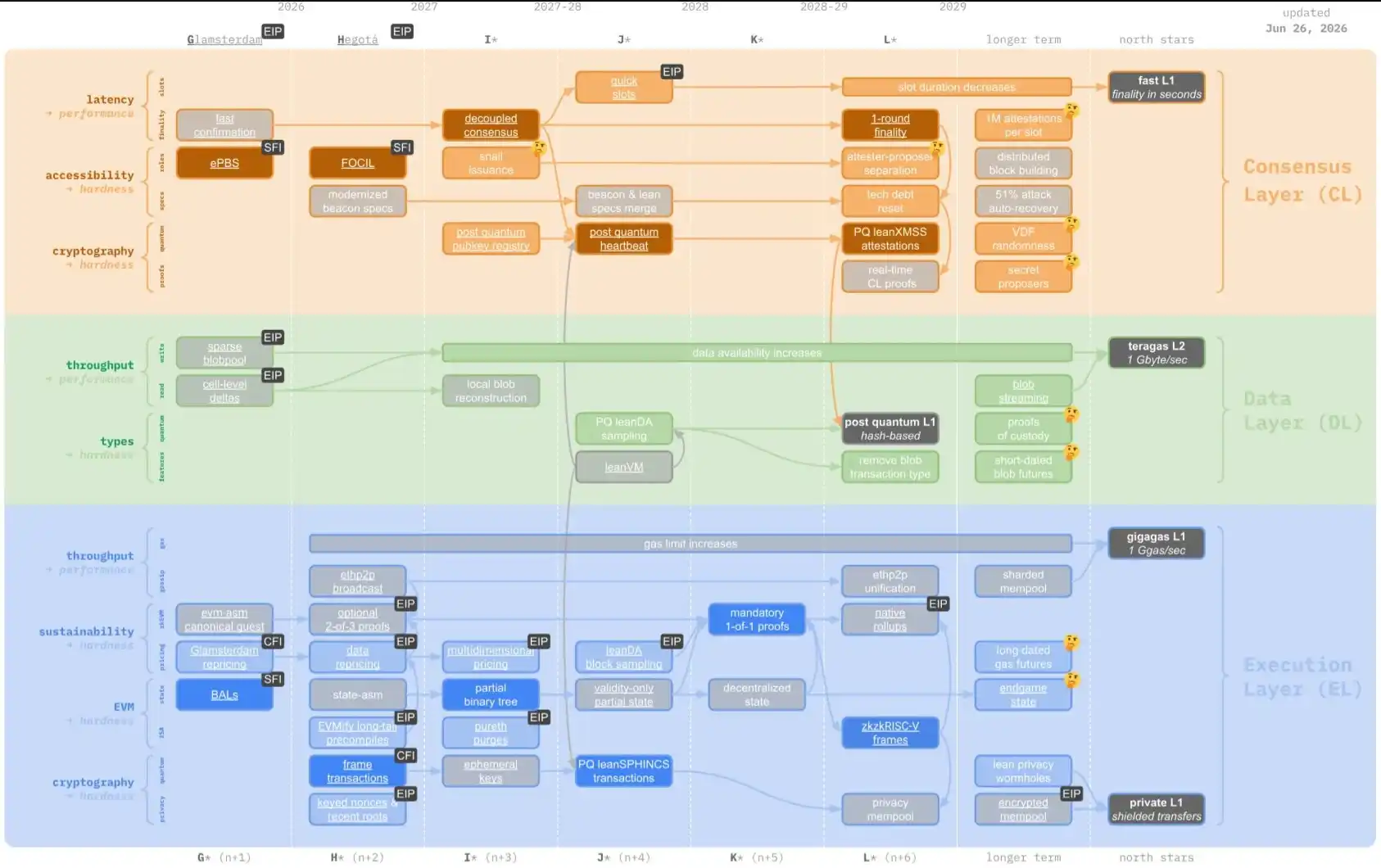
I. From 'One Foundation' to Multiple Responsibility Nodes

For a long time in the past, the outside world has been accustomed to equating the Ethereum Foundation (EF) with Ethereum itself.

Whether it's protocol upgrades, research directions, ecosystem funding, or external communication, many questions ultimately boil down to one phrase: What does EF plan to do?

But as is well known, the Ethereum Foundation is not an ordinary company. It does not have traditional shareholders, does not use market share and quarterly profits as its goals, and does not "actually own" the Ethereum network. This has also left EF facing an inherent tension.

On one hand, Ethereum needs long-term commitment to protocol R&D, organizing upgrades, and public goods construction. On the other hand, if research, funding, talent, and decision-making become increasingly concentrated within the foundation, then EF itself would become Ethereum's biggest centralization risk source.

But recent organizational changes are intentionally breaking this perception. In the latest round of adjustments, EF reduced its personnel by approximately 20% on one hand, while refocusing internal work on different levels such as protocol, users, and institutions. According to EF's self-description, it is to become "leaner and more focused," prioritizing core tasks that only the foundation can and must undertake.

Meanwhile, some capabilities previously concentrated within EF are starting to shift to external independent organizations, as discussed in the previous article (extended reading: 'From "One Foundation" to "Multi-Node Governance": Is Ethereum Undergoing a Silent Power Restructuring?'):

  • On June 22nd, five former core researchers from the Ethereum Foundation announced the establishment of Ethlabs, an independently operated non-profit R&D lab, taking on protocol research, infrastructure, and institutional-level technical needs;
  • On July 1st, another independent non-profit organization, Ethereum Institutional, officially launched, taking over the institutional cooperation work previously handled by EF's business development team, becoming an independent contact window for traditional financial institutions entering the Ethereum ecosystem;

These two respectively correspond to technical R&D and institutional adoption, forming a new specialization division of labor. It also marks that Ethereum is attempting to split the research, ecosystem, and market functions previously concentrated in one organization among multiple relatively independent responsibility nodes—with EF focusing more on the protocol base and self-sovereignty, Ethlabs driving long-term R&D, Ethereum Institutional handling institutional communication, and other organizations continuing to undertake education, developer support, and application deployment.
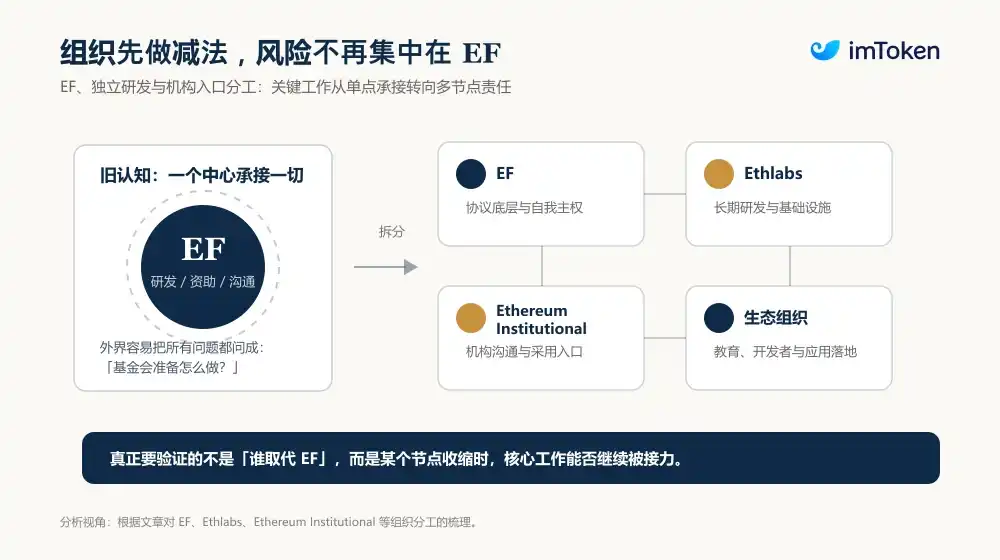
From an organizational structure perspective, this model will undoubtedly increase coordination costs. After all, different organizations have different funding sources, priorities, and execution rhythms, and future disagreements on roadmaps or even resource competition may arise.

But on the other hand, if a decentralized protocol relies long-term on a single foundation to handle almost all key work, that in itself is a structural risk.

Therefore, the changes at the Ethereum organizational level are not truly answering "who will replace EF," but rather whether Ethereum can establish a collaborative structure where, even if one organization scales down, pivots, or disappears, core work can still be taken over by other nodes.

This "organizational subtraction" also sets the stage for the upcoming protocol shift.

II. The Turn in Technical Narrative: What Exactly Is Lean Ethereum Trying to Do?

Strictly speaking, Lean Ethereum is not a concept that first appeared last week.

As early as July 2025, EF researcher Justin Drake released a vision for "lean Ethereum" development over the next decade, proposing directions such as Lean Consensus, Lean Execution, and Lean Data. The main goals included scaling the base layer TPS to 10,000 transactions per second, L2 networks to 10 million, while maintaining decentralization and 100% uptime.

It was already clear then that Ethereum would undergo major upgrades in the consensus layer, data layer, and execution layer, including upgrading the beacon chain to version 2.0, introducing post-quantum era blobs 2.0, and potentially an EVM 2.0 based on the open-source RISC-V instruction set; in terms of cryptography, the system would fully rely on hash-based signatures, hash-root data commitments, and a native hash-based zero-knowledge virtual machine to achieve quantum-resistant capabilities.
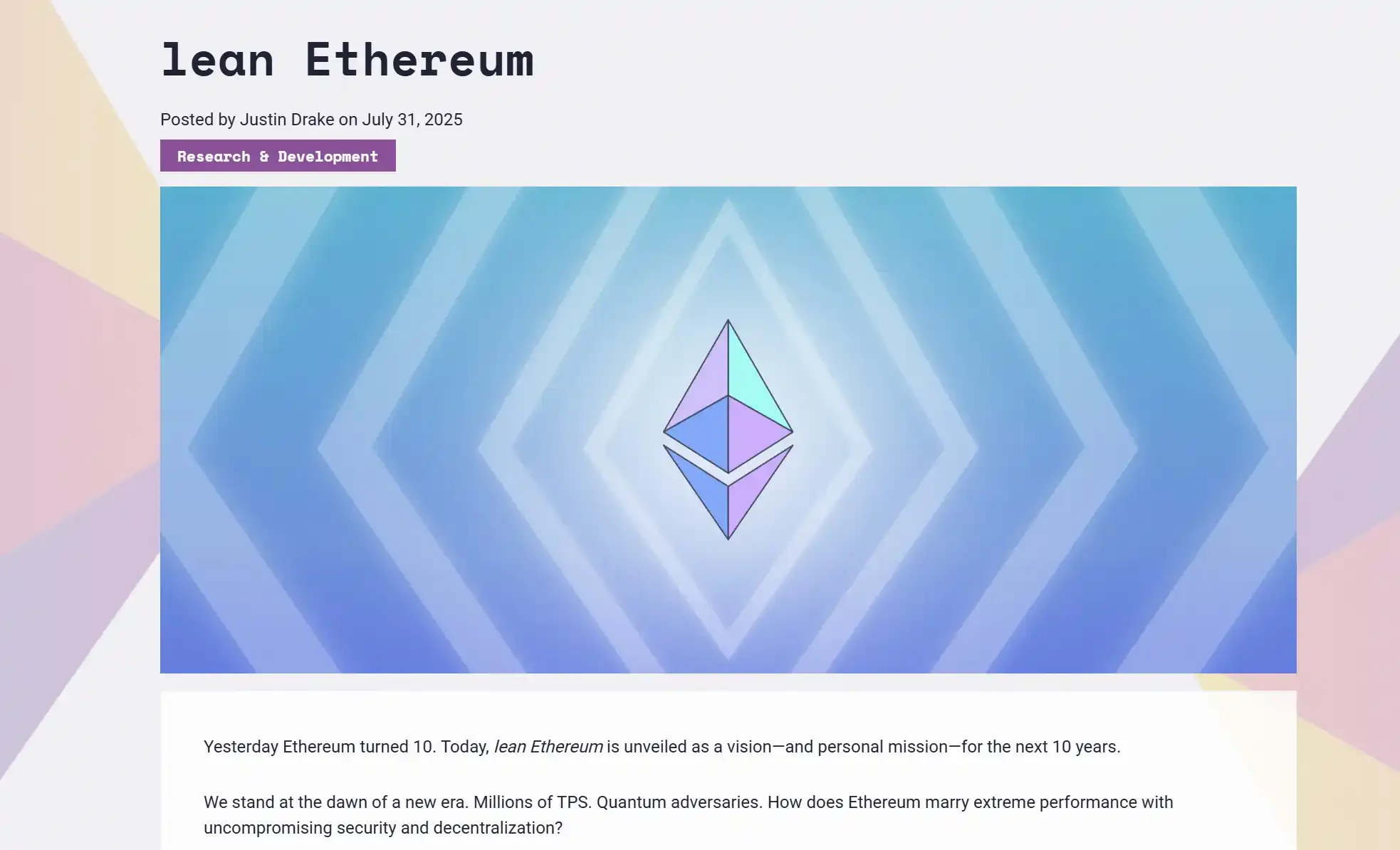
Therefore, the truly important change this week is that Vitalik, based on the latest strawmap, elevated these scattered research directions to a more defined position—Lean Ethereum is not a single hard fork, but a series of transformations gradually rolled out over the next three to four years, and what he defines as Ethereum's "third major iteration."

According to Vitalik's summary, Lean Ethereum touches almost all core parts of the protocol, reflected in several directions:

  • Protocol Simplification, shifting from "Heavy Execution" to "Light Verification": Using recursive STARKs as a core, native component, replacing direct transaction re-execution with proof verification. Client architecture, state model, and Gas multi-dimensionality will be adjusted accordingly. The goal is to make the protocol itself leaner and more formally verifiable;
  • Quantum-Resistance Priority: Quantum safety has been significantly advanced from a "long-term consideration." Existing cryptographic components vulnerable to quantum computing threats will gradually be replaced with quantum-resistant schemes, and the quantum-safe design of blobs has also been listed as an urgent matter;
  • Privacy is no longer seen as a function requiring additional application-layer supplements, but becomes a first-class goal in protocol design: No longer an afterthought patch, but a native protocol capability. New Frames, mempool, and state tree designs will support quantum-safe, intermediary-free private transactions;
  • The Consensus layer will attempt to decouple block availability from finality: Aiming to achieve second-level finality (1–2 rounds of voting), while significantly reducing the burden on validators and light clients through state redesign (dynamic state coexisting with new scalable state types);
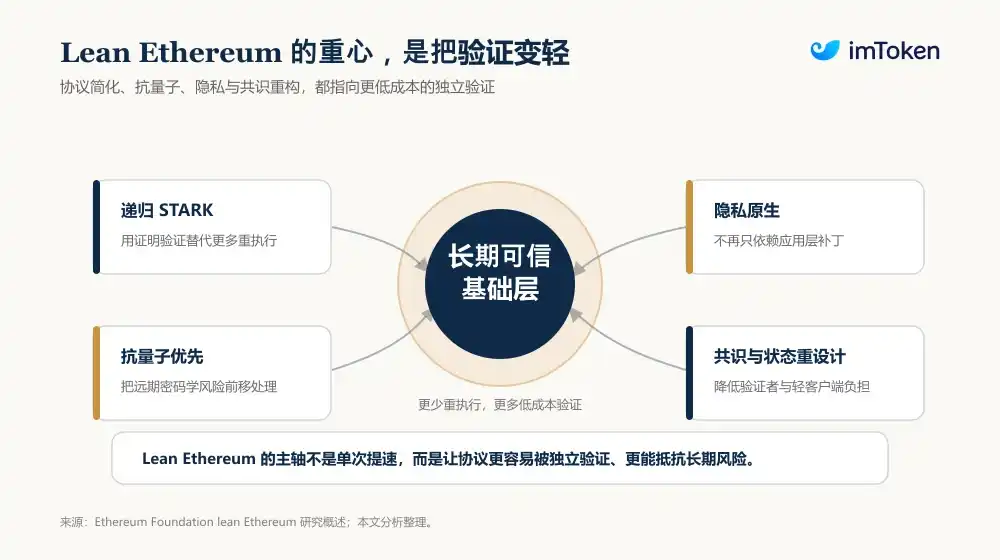
These directions may seem very complex, but they share a common logic: concentrating computation and complexity on a few nodes responsible for generating proofs, allowing more participants to verify results at a lower cost.

Ultimately, Ethereum is no longer treating "short-term TPS" or "L2 compatibility" as its only narrative axis, but is re-emphasizing the underlying attributes of the protocol as "long-term trusted infrastructure." This naturally includes verifiability, censorship resistance, quantum resistance, privacy friendliness, and lightweight verification. This is also the massive shift over the next decade for Ethereum, moving from "engineering iteration" back to "principles."

Against this backdrop, 0x02 compounding validators also embodies a similar long-term perspective.

In the past, discussions about ETH Staking mainly revolved around APR and DeFi composite yields. However, under the traditional 0x01 mode, each validator's effective balance cap is 32 ETH. Consensus layer rewards exceeding 32 ETH are periodically withdrawn and no longer continue to participate in staking.

Thus, for small stakers with only one or a few validators, they need to wait for rewards to accumulate back to 32 ETH to activate a new validator and start earning staking rewards again, which naturally places them at a disadvantage in compounding efficiency; whereas large service providers can aggregate rewards from many validators to quickly activate new nodes.
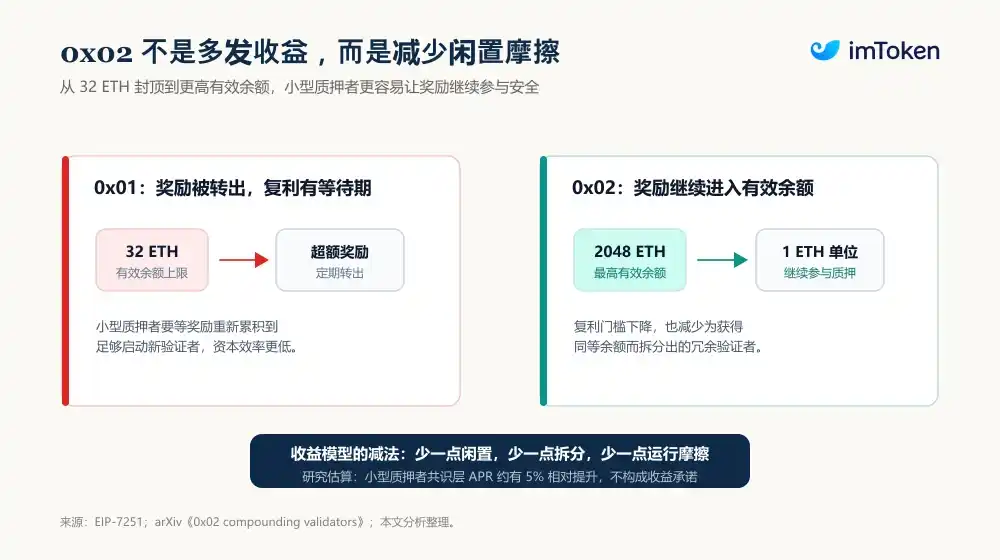
Therefore, Pectra introduces the 0x02 mode, raising the maximum effective balance for a single validator to 2048 ETH and allowing rewards to continue participating in staking in units of 1 ETH. This lowers the threshold for small stakers to achieve compounding, narrowing the capital efficiency gap between participants of different scales while reducing redundant validators and network operational burden.

Of course, it cannot simply be equated to "validator count becoming more dispersed." More accurately, 0x02 improves the operational efficiency of the validator set at the protocol level on one hand, and on the other, enhances the capital efficiency and relative position of small stakers, allowing participants of different scales to obtain protocol-native yields with lower friction.

This is not disconnected from the direction of Lean Ethereum. What they both emphasize is the same thing—maintaining an Ethereum that can operate long-term with less redundancy and friction.

III. The Next Decade: What Kind of Ethereum Should We Expect?

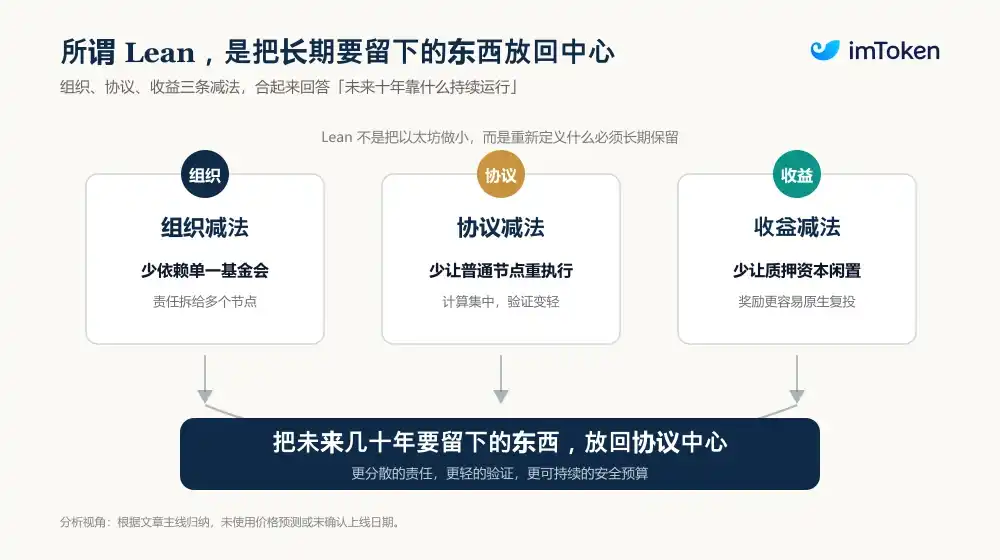
From EF scaling down, to the emergence of independent organizations like Ethlabs and Ethereum Institutional; from prioritizing scaling, to Lean Ethereum re-emphasizing protocol simplification, quantum resistance, privacy, and light verification; to 0x02 validators gradually transforming staking rewards from periodic withdrawals into a sustainable, natively reinvested income—these changes are not isolated from each other.

They are all doing similar subtraction: for example, reducing Ethereum's dependence on a single organization, reducing the cost ordinary participants need to bear to verify the protocol, and reducing the idle and redundant overhead of staking capital during operation.

Correspondingly, what Ethereum hopes to achieve is a more decentralized responsibility system, a protocol base that is easier to independently verify, and a revenue structure more suitable for long-term holders and network security participants.

These changes are difficult to become an immediately effective price catalyst.
After all, Lean Ethereum will take three to four years or even longer to be gradually implemented; the new organizational structure needs to prove that multi-node collaboration does not lead to directional fragmentation; the compounding advantages of 0x02 validators also need to go through a full cycle to fully manifest.

But what Ethereum truly needs to prove in its next phase is perhaps not just how many more upgrades it can complete.

More importantly, as the value borne by the protocol increases and the external environment becomes more complex, can it become less dependent on any single organization, easier to verify by ordinary devices, and provide more stable, sustainable long-term returns for capital participating in network security?

What Lean means is not making Ethereum smaller, but putting back at the center of the protocol what will truly be needed for the next several decades.

Crypto di tendenza

Domande pertinenti

QWhat is the 'third major iteration' of Ethereum according to Vitalik Buterin, as mentioned in the article?

AAccording to Vitalik Buterin's updated long-term roadmap, the 'third major iteration' of Ethereum is 'Lean Ethereum,' which is a series of protocol improvements to be rolled out over the next three to four years.

QHow is the Ethereum Foundation (EF) changing its organizational structure, and what are the goals of this change?

AThe Ethereum Foundation is reducing its staff by about 20% and refocusing its work on core tasks like the protocol layer. Simultaneously, some of its former responsibilities are being transferred to independent organizations like Ethlabs and Ethereum Institutional. The goal is to become 'leaner and more focused' and to create a more decentralized governance and operational structure that reduces reliance on a single entity.

QWhat are the key technical directions or goals of the 'Lean Ethereum' vision as outlined by Vitalik Buterin?

AThe key technical directions of 'Lean Ethereum' include: protocol simplification through 'light verification' using recursive STARKs; quantum resistance as a priority, replacing vulnerable cryptography; making privacy a first-class, protocol-native goal; and decoupling block availability from finality for faster finality while reducing validator and client burdens.

QWhat problem does the proposed '0x02 compounding validators' (Pectra) upgrade aim to solve for smaller-scale stakers?

AThe '0x02 compounding validators' upgrade aims to solve the capital efficiency disadvantage for small-scale stakers. In the traditional 0x01 mode, rewards above 32 ETH per validator are periodically withdrawn, not restaked. The new mode raises the effective balance limit to 2048 ETH and allows rewards in 1 ETH increments to be restaked, enabling native compounding and reducing the friction for small stakers to achieve efficient returns.

QWhat overarching narrative shift does the article suggest Ethereum is undergoing?

AThe article suggests Ethereum is undergoing a deeper narrative shift from a primary focus on short-term scalability (like TPS and L2 compatibility) to re-emphasizing its foundational attributes as a 'long-term credible infrastructure.' This includes priorities like verifiability, censorship resistance, quantum resistance, privacy, and light verification to support the network's operation for the next decade or more.

Letture associate

Nobel Laureate Hassabis Shocks with Statement: AGI Impact Will Be 10 Times That of the Industrial Revolution

Nobel laureate and DeepMind CEO Demis Hassabis declares that Artificial General Intelligence (AGI), matching human cognitive abilities, is likely just a few years away. He states its impact could be ten times greater than the Industrial Revolution and unfold ten times faster, heralding an age of unprecedented abundance where resource scarcity may end. AGI promises transformative benefits, accelerating breakthroughs in medicine, clean energy, and advanced materials. However, its rapid development, driven by intense commercial and geopolitical competition, outpaces our understanding and increases risks in cybersecurity, bio-threats, and controlling autonomous, self-improving systems. To manage this, Hassabis proposes a U.S.-led framework: a new "Frontier AI Standards Body," modeled after organizations like FINRA. It would define "frontier-class" models through dynamic benchmarks. Labs creating such models would voluntarily submit them for a 30-day pre-release review, later formalized into mandatory assessments. This body would conduct rigorous evaluations on security and safety, update tests regularly, and, if necessary, coordinate a global slowdown in development. While technical challenges are surmountable, Hassabis emphasizes that profound economic and philosophical questions about post-scarcity societies, human values, and purpose remain. He concludes that responsibly navigating AGI's arrival is our defining task, offering a chance to shape a future of immense scientific progress and human flourishing.

marsbit19 min fa

Nobel Laureate Hassabis Shocks with Statement: AGI Impact Will Be 10 Times That of the Industrial Revolution

marsbit19 min fa

GPT-5.6 Sol Suddenly Gets Dumber Overnight? Thinking Budget Slashed from 960 to 128, No More Fixed-Intelligence Models?

The article discusses widespread user reports that OpenAI's GPT-5.6 Sol model, specifically its "Max" reasoning tier, has become less capable at complex, deep reasoning tasks. Users noted faster but shallower responses. Community investigation revealed an unpublicized internal parameter called "juice value," representing computational budget for reasoning. Observations indicated this value for the Max tier dropped dramatically from 960 to 128. In response, OpenAI's Thibault Sottiaux stated there was no intentional reduction in model capability ("nerf"). He explained the changes were part of an experiment to investigate unexpected high token usage following GPT-5.6's launch, which introduced features like longer reasoning and larger context windows. The experiment temporarily adjusted the "juice" parameter and rolled back the context window from 372k to 272k tokens to diagnose the usage spike. Sottiaux asserted these settings have been reverted and highlighted ongoing optimizations. The controversy highlights a tension between AI as a reliable, fixed-capability tool and its reality as a cloud service where providers can adjust performance parameters. The article argues that for AI to be trusted enterprise infrastructure, providers need clearer, transparent guarantees about the specific performance boundaries associated with service tiers.

marsbit24 min fa

GPT-5.6 Sol Suddenly Gets Dumber Overnight? Thinking Budget Slashed from 960 to 128, No More Fixed-Intelligence Models?

marsbit24 min fa

Trading

Spot

Articoli Popolari

Cosa è ETH 3.0

ETH3.0 e $eth 3.0: Un'Analisi Approfondita del Futuro di Ethereum Introduzione Nel panorama in rapida evoluzione delle criptovalute e della tecnologia blockchain, ETH3.0, spesso indicato come $eth 3.0, è emerso come un argomento di considerevole interesse e speculazione. Il termine comprende due concetti principali che warrantono chiarimenti: Ethereum 3.0: Questo rappresenta un potenziale futuro aggiornamento volto ad aumentare le capacità dell'attuale blockchain di Ethereum, concentrandosi principalmente sul miglioramento della scalabilità e delle prestazioni. ETH3.0 Meme Token: Questo progetto di criptovaluta distinto cerca di sfruttare la blockchain di Ethereum per creare un ecosistema incentrato sui meme, promuovendo il coinvolgimento all'interno della comunità delle criptovalute. Comprendere questi aspetti di ETH3.0 è essenziale non solo per gli appassionati di criptovalute, ma anche per coloro che osservano tendenze tecnologiche più ampie nello spazio digitale. Che cos'è ETH3.0? Ethereum 3.0 Ethereum 3.0 è pubblicizzato come un aggiornamento proposto per la rete Ethereum già stabilita, che è stata la spina dorsale di molte applicazioni decentralizzate (dApps) e contratti smart sin dalla sua nascita. I miglioramenti previsti si concentrano principalmente sulla scalabilità, integrando tecnologie avanzate come lo sharding e le prove a conoscenza zero (zk-proofs). Queste innovazioni tecnologiche mirano a facilitare un numero senza precedenti di transazioni al secondo (TPS), potenzialmente raggiungendo milioni, affrontando così una delle limitazioni più significative della tecnologia blockchain attuale. Il miglioramento non è meramente tecnico, ma anche strategico; è volto a preparare la rete Ethereum per un'adozione e un'utilità diffuse in un futuro contrassegnato da un aumento della domanda di soluzioni decentralizzate. ETH3.0 Meme Token Al contrario di Ethereum 3.0, l'ETH3.0 Meme Token si avventura in un dominio più leggero e giocoso, combinando la cultura dei meme di internet con la dinamica delle criptovalute. Questo progetto consente agli utenti di acquistare, vendere e scambiare meme sulla blockchain di Ethereum, fornendo una piattaforma che promuove il coinvolgimento della comunità attraverso la creatività e interessi condivisi. L'ETH3.0 Meme Token mira a dimostrare come la tecnologia blockchain possa intersecarsi con la cultura digitale, creando casi d'uso che siano sia divertenti che finanziariamente praticabili. Chi è il Creatore di ETH3.0? Ethereum 3.0 L'iniziativa verso Ethereum 3.0 è principalmente propulsa da un consorzio di sviluppatori e ricercatori all'interno della comunità di Ethereum, tra cui Justin Drake. Conosciuto per le sue intuizioni e contributi all'evoluzione di Ethereum, Drake è stato una figura di spicco nelle discussioni riguardanti la transizione di Ethereum verso un nuovo livello di consenso, chiamato “Beam Chain.” Questo approccio collaborativo allo sviluppo significa che Ethereum 3.0 non è il prodotto di un creatore singolo, ma piuttosto una manifestazione di ingegno collettivo focalizzato sul progresso della tecnologia blockchain. ETH3.0 Meme Token I dettagli riguardanti il creatore dell'ETH3.0 Meme Token sono attualmente non rintracciabili. La natura dei token meme conduce spesso a una struttura più decentralizzata e guidata dalla comunità, il che potrebbe spiegare la mancanza di attribuzione specifica. Questo si allinea con l'etica della comunità crypto più ampia, dove l'innovazione spesso nasce da sforzi collaborativi piuttosto che individuali. Chi sono gli Investitori di ETH3.0? Ethereum 3.0 Il supporto per Ethereum 3.0 proviene principalmente dalla Ethereum Foundation insieme a una comunità entusiasta di sviluppatori e investitori. Questa associazione fondamentale fornisce un considerevole grado di legittimità e migliora le prospettive di implementazione di successo poiché sfrutta la fiducia e la credibilità costruite nel corso degli anni di operazioni della rete. Nel clima in rapida evoluzione delle criptovalute, il supporto della comunità gioca un ruolo cruciale nello sviluppo e nell'adozione, posizionando Ethereum 3.0 come un serio contenditore per i futuri progressi della blockchain. ETH3.0 Meme Token Sebbene le fonti attualmente disponibili non forniscano informazioni esplicite riguardo ai fondamenti o alle organizzazioni di investimento che sostengono l'ETH3.0 Meme Token, ciò è indicativo del modello di finanziamento tipico per i token meme, che spesso si basa sul supporto di base e sul coinvolgimento della comunità. Gli investitori in tali progetti sono tipicamente individui motivati dal potenziale per innovazioni guidate dalla comunità e dallo spirito di cooperazione trovato all'interno della comunità crypto. Come Funziona ETH3.0? Ethereum 3.0 Le caratteristiche distintive dell'Ethereum 3.0 risiedono nella sua proposta di implementazione della tecnologia di sharding e zk-proof. Lo sharding è un metodo di partizionamento della blockchain in pezzi più piccoli e gestibili o “shard,” che possono elaborare transazioni in modo concorrente piuttosto che sequenziale. Questa decentralizzazione dell'elaborazione aiuta a prevenire la congestione e garantisce che la rete rimanga reattiva anche sotto un carico pesante. La tecnologia delle prove a conoscenza zero (zk-proof) contribuisce con un ulteriore livello di sofisticazione consentendo la validazione delle transazioni senza rivelare i dati sottostanti coinvolti. Questo aspetto non solo migliora la privacy, ma aumenta anche l'efficienza complessiva della rete. Si parla anche di incorporare una macchina virtuale Ethereum a conoscenza zero (zkEVM) in questo aggiornamento, amplificando ulteriormente le capacità e l'utilità della rete. ETH3.0 Meme Token L'ETH3.0 Meme Token si distingue capitalizzando sulla popolarità della cultura dei meme. Stabilisce un mercato per gli utenti che desiderano partecipare al trading di meme, non solo per divertimento, ma anche per potenziale guadagno economico. Integrando funzioni come lo staking, la fornitura di liquidità e meccanismi di governance, il progetto promuove un ambiente che incentiva l'interazione e la partecipazione della comunità. Offrendo una miscela unica di intrattenimento e opportunità economica, l'ETH3.0 Meme Token mira ad attrarre un pubblico variegato, che va dagli appassionati di crypto ai semplici intenditori di meme. Timeline di ETH3.0 Ethereum 3.0 11 Novembre 2024: Justin Drake accenna al prossimo aggiornamento ETH 3.0, incentrato sui miglioramenti della scalabilità. Questo annuncio segna l'inizio delle discussioni formali riguardo l'architettura futura di Ethereum. 12 Novembre 2024: La proposta attesa per Ethereum 3.0 dovrebbe essere svelata a Devcon a Bangkok, preparando il terreno per un feedback più ampio della comunità e potenziali passi successivi nello sviluppo. ETH3.0 Meme Token 21 Marzo 2024: L'ETH3.0 Meme Token viene ufficialmente elencato su CoinMarketCap, segnando il suo ingresso nel dominio pubblico delle criptovalute e aumentando la visibilità per il suo ecosistema basato sui meme. Punti Chiave In conclusione, Ethereum 3.0 rappresenta una significativa evoluzione all'interno della rete Ethereum, concentrandosi sul superamento delle limitazioni riguardanti scalabilità e prestazioni attraverso tecnologie avanzate. I suoi aggiornamenti proposti riflettono un approccio proattivo alle future esigenze e usabilità. D'altra parte, l'ETH3.0 Meme Token incarna l'essenza della cultura guidata dalla comunità nello spazio delle criptovalute, sfruttando la cultura dei meme per creare piattaforme coinvolgenti che incoraggiano la creatività e la partecipazione degli utenti. Comprendere gli scopi e le funzionalità distinte di ETH3.0 e $eth 3.0 è fondamentale per chiunque sia interessato ai continui sviluppi nello spazio crypto. Con entrambe le iniziative che tracciano percorsi unici, esse sottolineano collettivamente la natura dinamica e multifacetica dell'innovazione blockchain.

207 Totale visualizzazioniPubblicato il 2024.04.04Aggiornato il 2024.12.03

Cosa è ETH 3.0

Cosa è ETHEREUM

HarryPotterTrumpHomerSimpson777Inu: Panoramica di un Progetto Crypto Web3 Introduzione Nel mondo in rapida evoluzione delle criptovalute e della finanza decentralizzata, progetti innovativi emergono frequentemente, catturando l'interesse della comunità degli investitori e degli appassionati di crypto. Uno di questi progetti è HarryPotterTrumpHomerSimpson777Inu, una criptovaluta che si trova all'incrocio tra cultura popolare e tecnologia blockchain. Questo token guidato dalla comunità mescola personaggi e figure politiche ben noti, con l'obiettivo di creare una piattaforma coinvolgente e promuovere un'adozione diffusa. Che cos'è HarryPotterTrumpHomerSimpson777Inu? HarryPotterTrumpHomerSimpson777Inu è un token costruito sulla blockchain di Ethereum, progettato per essere accessibile e divertente per un pubblico diversificato. L'unicità di questo progetto deriva dal suo approccio tematico, che intreccia elementi di fantasia, politica e intrattenimento. Sfruttando il fascino nostalgico di personaggi amati, il progetto cerca di creare un'esperienza di criptovaluta coinvolgente, incoraggiando il coinvolgimento e la partecipazione della comunità. L'obiettivo principale di HarryPotterTrumpHomerSimpson777Inu è stabilire un token che risuoni con gli utenti a livello personale, promuovendo sia il divertimento che il coinvolgimento nell'ambito crypto. Questo branding distintivo mira ad attrarre individui che in precedenza potrebbero non essersi interessati alle criptovalute, facilitando un nuovo punto di ingresso per utenti potenziali. Creatore di HarryPotterTrumpHomerSimpson777Inu L'identità del creatore dietro HarryPotterTrumpHomerSimpson777Inu rimane sconosciuta. Questa non è una pratica rara nel dominio delle criptovalute, dove l'anonimato è spesso preferito dai fondatori come mezzo di protezione della privacy e promozione di un ethos decentralizzato. Questa oscurità non diminuisce il valore del progetto; al contrario, riflette una tendenza più ampia all'interno del settore, dove molti progetti di successo sono emersi da origini anonime. Investitori di HarryPotterTrumpHomerSimpson777Inu Le informazioni pubbliche riguardo agli investitori di HarryPotterTrumpHomerSimpson777Inu sono limitate. La natura del progetto, incentrata sul coinvolgimento della comunità, suggerisce una dipendenza da investimenti di piccole dimensioni da parte di singoli appassionati piuttosto che da sostegni sostanziali da fondazioni di investimento consolidate o corporation. Questo livello di trasparenza nel finanziamento è tipico di molti progetti di criptovaluta guidati dalla comunità, dove il supporto spesso proviene da movimenti di base piuttosto che da investitori istituzionali. Come Funziona HarryPotterTrumpHomerSimpson777Inu? Operando sulla blockchain di Ethereum, HarryPotterTrumpHomerSimpson777Inu sfrutta la sua solida infrastruttura per facilitare transazioni e promuovere interazioni tra gli utenti all'interno della comunità. Ciò che distingue questo progetto è il suo posizionamento tematico: canalizzando il carisma di personaggi iconici provenienti da diversi ambiti culturali, crea un'identità di marca distintiva. Questo approccio non solo attrae gli utenti, ma coltiva anche una comunità fedele attorno al token. Le meccaniche operative del progetto si concentrano sul coinvolgimento della comunità. Adotta un modello decentralizzato che incoraggia la partecipazione, consentendo agli utenti di interagire attraverso vari canali mentre promuovono lo scambio di idee e esperienze. Inoltre, il progetto abbraccia i principi del Web3, privilegiando la sovranità degli utenti e la decentralizzazione, che sono i pilastri del futuro di Internet. Timeline di HarryPotterTrumpHomerSimpson777Inu La storia di HarryPotterTrumpHomerSimpson777Inu è segnata da diversi eventi decisivi: 12 agosto 2023: L'inizio di HarryPotterTrumpHomerSimpson777Inu, segnando il suo ingresso nell'ecosistema delle criptovalute. Fase di Sviluppo: Un periodo focalizzato sulla costruzione di una strategia completa per stimolare la crescita guidata dalla comunità e il coinvolgimento degli utenti. Listing sugli Scambi: Sebbene i dettagli specifici di listing non siano stati divulgati, il progetto è stato reso accessibile su vari scambi di criptovalute, migliorando la sua visibilità nel mercato. Coinvolgimento della Comunità: Sforzi continui per coinvolgere attivamente la comunità, stabilendo canali di dialogo e promuovendo la partecipazione attraverso varie attività, tra cui concorsi, discussioni e votazioni comunitarie. Aspetti Chiave di HarryPotterTrumpHomerSimpson777Inu Focus sulla Comunità Un tratto distintivo di HarryPotterTrumpHomerSimpson777Inu è la sua forte enfasi sul coinvolgimento della comunità. Il progetto incoraggia attivamente gli utenti a partecipare a discussioni, condividere idee e contribuire all'evoluzione del progetto. Questa interazione coltiva un senso di appartenenza e di ownership tra i membri della comunità, essenziale per la sostenibilità a lungo termine del token. Utilizzo della Blockchain di Ethereum La scelta di costruire sulla blockchain di Ethereum consente a HarryPotterTrumpHomerSimpson777Inu di sfruttare le sue caratteristiche di sicurezza ben consolidate e architettura decentralizzata. Questa base garantisce affidabilità per le transazioni e fornisce un framework affidabile su cui sviluppare varie funzionalità. Approccio Tematico Unico Fusione di elementi della cultura pop nella sua identità, HarryPotterTrumpHomerSimpson777Inu crea una narrazione coinvolgente che lo differenzia da altre criptovalute. L'amalgama di personaggi e temi genera riconoscimento e intrigo immediati, rendendo il token relazionabile a un'ampia gamma di utenti potenziali. Anonimato nello Sviluppo Il creatore anonimo del progetto rimane una caratteristica ricorrente in molte iniziative di criptovaluta. Questo aspetto evidenzia un ethos di decentralizzazione, introducendo anche un livello di mistero che potrebbe affascinare un segmento della comunità crypto, attirando l'attenzione sul progetto e invitando l'impegno da parte di utenti che supportano l'idea di un'iniziativa decentralizzata e gestita dalla comunità. Conclusione HarryPotterTrumpHomerSimpson777Inu si presenta come un'aggiunta distintiva al panorama delle criptovalute, combinando il fascino della cultura popolare con le meccaniche innovative della tecnologia blockchain. Sebbene i dettagli riguardanti il creatore e gli investitori specifici rimangano non divulgati, il focus del progetto sulla comunità e il suo approccio tematico lo contraddistinguono come un potenziale attore influente nel contesto del Web3 e delle criptovalute. Man mano che l'ecosistema delle criptovalute continua ad espandersi, iniziative come HarryPotterTrumpHomerSimpson777Inu ci ricordano le molteplici modalità in cui la blockchain può connettere le comunità globali attraverso narrazioni e valori condivisi.

1.0k Totale visualizzazioniPubblicato il 2024.04.06Aggiornato il 2024.12.03

Cosa è ETHEREUM

Come comprare ETH

Benvenuto in HTX.com! Abbiamo reso l'acquisto di Ethereum (ETH) semplice e conveniente. Segui la nostra guida passo passo per intraprendere il tuo viaggio nel mondo delle criptovalute.Step 1: Crea il tuo Account HTXUsa la tua email o numero di telefono per registrarti il tuo account gratuito su HTX. Vivi un'esperienza facile e sblocca tutte le funzionalità,Crea il mio accountStep 2: Vai in Acquista crypto e seleziona il tuo metodo di pagamentoCarta di credito/debito: utilizza la tua Visa o Mastercard per acquistare immediatamente EthereumETH.Bilancio: Usa i fondi dal bilancio del tuo account HTX per fare trading senza problemi.Terze parti: abbiamo aggiunto metodi di pagamento molto utilizzati come Google Pay e Apple Pay per maggiore comodità.P2P: Fai trading direttamente con altri utenti HTX.Over-the-Counter (OTC): Offriamo servizi su misura e tassi di cambio competitivi per i trader.Step 3: Conserva Ethereum (ETH)Dopo aver acquistato Ethereum (ETH), conserva nel tuo account HTX. In alternativa, puoi inviare tramite trasferimento blockchain o scambiare per altre criptovalute.Step 4: Scambia Ethereum (ETH)Scambia facilmente Ethereum (ETH) nel mercato spot di HTX. Accedi al tuo account, seleziona la tua coppia di trading, esegui le tue operazioni e monitora in tempo reale. Offriamo un'esperienza user-friendly sia per chi ha appena iniziato che per i trader più esperti.

3.0k Totale visualizzazioniPubblicato il 2024.12.10Aggiornato il 2026.06.02

Come comprare ETH

Discussioni

Benvenuto nella Community HTX. Qui puoi rimanere informato sugli ultimi sviluppi della piattaforma e accedere ad approfondimenti esperti sul mercato. Le opinioni degli utenti sul prezzo di ETH ETH sono presentate come di seguito.

活动图片