After Tokenizing Assets, How to Exit?

链捕手Pubblicato 2026-06-16Pubblicato ultima volta 2026-06-16

Introduzione

After tokenization, a key unresolved issue is providing holders with a reliable exit mechanism, as underlying asset settlement (taking days to months) lags far behind on-chain token settlement. Three primary models for instant liquidity have emerged, differing in their capital structure and efficiency: 1. **Balance Sheet Model (e.g., Grove Basin):** A single, well-capitalized entity (like Sky) provides immediate liquidity from its own reserves. This offers simplicity and deep initial liquidity but is constrained by that single balance sheet's capacity and risk appetite, limiting scalability. 2. **Dedicated Vault Model (e.g., Upshift Clear):** Independent liquidity providers (LPs) fund separate vaults for each supported asset. This decentralizes capital sources but isolates liquidity and capital, which becomes inefficient as the number of tokenized assets grows. 3. **Shared Liquidity Layer Model (Symbiotic Liquid Lane):** Independent capital providers fund shared vaults that can support multiple tokenized assets simultaneously. Capital remains productive between redemptions (e.g., earning yield in DeFi markets). Exits are settled via a competitive RFQ market where market makers bid. The article argues that the shared layer model offers superior capital efficiency and scalability. It transforms exit liquidity from an asset-specific patch into shared market infrastructure, allowing liquidity capacity to grow with overall market participation rather than being fragmented per...

Author: Symbiotic

Compiled by: Hu Tao, ChainCatcher

 
Summary:
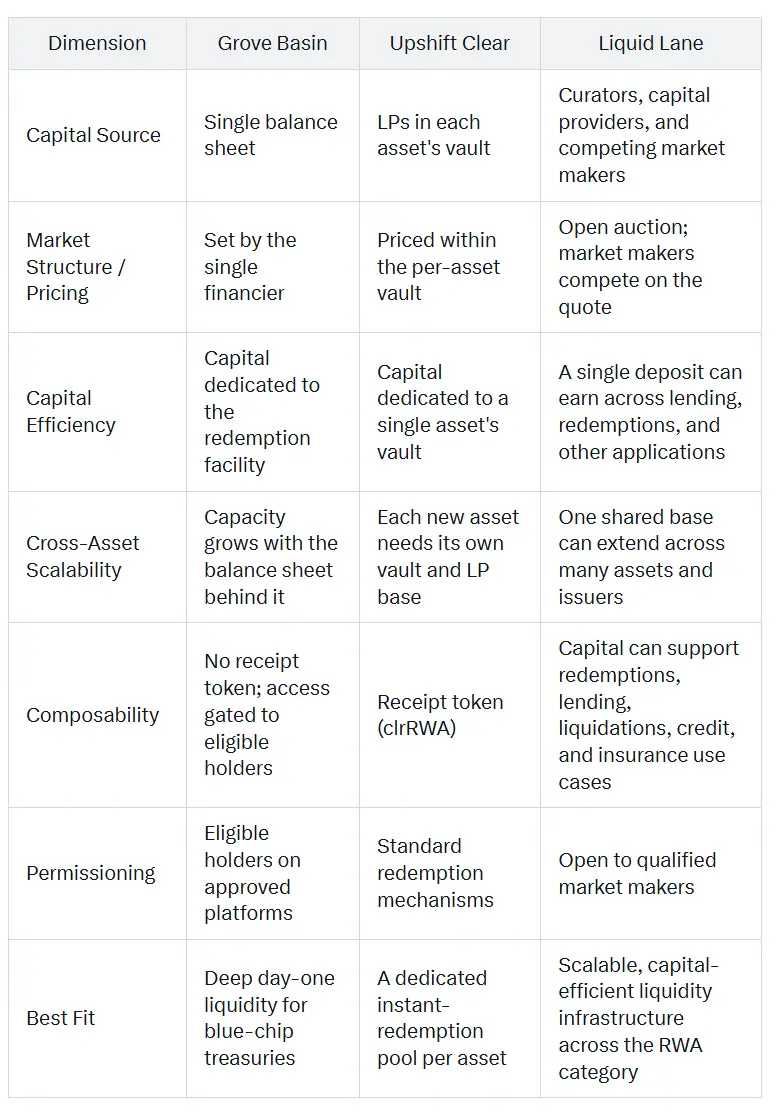
  • All three methods allow holders to exit immediately, so speed is similar. The real difference lies in the capital structure behind the exit.

  • The key difference is how each model handles redemption capital: Grove Basin uses a single balance sheet, Upshift Clear establishes dedicated vaults for each asset, while Symbiotic's Liquid Lane settles through a shared liquidity layer in the open market.

  • Grove Basin provides instant liquidity for tokenized vaults, funded from Sky's balance sheet and launched in partnership with institutional partners. Upshift Clear extends this model to independent liquidity provider (LP) capital, with each supported asset equipped with a dedicated vault.

  • Liquid Lane, launched by Symbiotic, is based on shared capital, can support multiple assets simultaneously, continues to earn yields from multiple sources between redemptions, and settles through an open RFQ market where qualified market makers compete.

  • The result is higher capital efficiency per deposit, and the capacity of the liquidity layer grows as market participation increases, which is precisely where providing a reliable exit mechanism is most difficult and most valuable.


Exit is the Unsolved Half of Tokenization

Tokenization addresses how assets come on-chain, but barely addresses how holders redeem them. Tokenized treasuries or private credit funds can be issued, transferred, and distributed on-chain efficiently, while the underlying redemption process takes about T+1 day for treasuries and 60 to 180 days for private credit, real estate, and structured products. The time gap between token settlement in one block and fund settlement over months is this longstanding problem.

This gap is crucial because DeFi markets need confidence that tokenized assets can transform into liquid value when needed. With reliable liquidity infrastructure, RWAs can evolve beyond simple asset representation into efficient financial primitives: they can serve as credit collateral, leverage support, debt coverage, and assets for underwriting risk in on-chain markets.


Emerging Instant Liquidity Architectures

Three models have emerged aiming to provide instant exit pathways for tokenized real-world assets, differing in their funding sources and structure:

  1. Balance Sheet Model. In this model, a well-capitalized single entity provides liquidity immediately from its own reserves when an eligible holder redeems for stablecoins, then waits for the underlying settlement in the background. Grove's Basin project is an example, funded from Sky's balance sheet.

  2. Dedicated Vault Model. Independent liquidity providers supply separate capital pools for each supported asset and earn the redemption spread. Upshift Clear, initially launched in partnership with Superstate, follows this model.

  3. Shared Liquidity Layer Model. Independent capital providers fund a common capital base that supports multiple assets simultaneously, settling through an open, competitive market. Symbiotic's Liquid Lane is built on this model.

The question worth exploring is which architecture is best suited for liquidity that must scale across assets, issuers, and risk profiles while remaining capital-efficient.


How to Evaluate a Liquidity Layer for Tokenized Assets

Exit speed itself is nearly equal and not very telling. What truly matters is comparing everything that happens afterward in the five-dimensional space.

  1. Who funds it and who bears the risk? Where does the liquidity come from? Who bears the duration and credit risk of the underlying asset during redemption settlement?

  2. How redemption is priced. The mechanism that determines the discount a holder pays for early redemption, whether it's a single provider's quote, fixed parameters for a dedicated pool, or bidding among multiple participants.

  3. Capital Efficiency and Cost of Supply. How much committed capital a model needs to support redemptions, and the opportunity cost of using that capital for settlement events. This cost ultimately shows up in the spread holders pay and whether liquidity providers can sustain the model.

  4. How the model scales across asset types. What does extending coverage to new assets and issuers require as the market grows?

  5. Composability. Whether holders' claims and providers' funds can be used elsewhere in on-chain finance, and under what conditions. This determines whether liquidity is confined to a single venue or can support other uses.

These five categories describe how reliable and scalable a liquidity model will be as the tokenization market grows in size and variety. The next sections apply them to each model in turn.


Balance Sheet Liquidity for Tokenized Treasuries and Credit

Grove Basin provides instant stablecoin liquidity for RWAs by prefunding when eligible holders initiate approved redemptions via supported tokenization platforms. Grove Basin acts as a programmable credit facility against pending settlement proceeds.

The design's strengths:

  • Immediate balance sheet depth. Since Basin is funded from an existing reserve base, it can offer substantial liquidity from day one.

  • Simple user experience. Basin operates through supported tokenization platforms, so eligible holders can exit faster while the traditional redemption process continues in the background.

  • The balance sheet bridge is ideal for bonds and money market funds with short settlement cycles. These often settle in T+1 to T+2, so the balance sheet bridge effectively covers the gap.

These trade-offs stem from the same design choices:

  • Capacity depends on a single balance sheet. The liquidity ceiling ultimately depends on the size and risk appetite of the funding balance sheet. This means capacity growth relies on a single reserve base, not a broader capital market forming around the opportunity.

  • Access is restricted. Basin is only open to eligible holders, approved transactions, and supported platforms. This allows the model to control how liquidity expands but limits how accessible and reusable it becomes for the broader market.

  • The first use case is the most liquid part of the market. Tokenized treasury bills and money market funds have relatively short settlement cycles to begin with.

Grove Basin is a powerful vertically integrated solution for improving exits from tokenized treasuries. Its main drawback is that liquidity depth, risk allocation, and economics are tied to a single balance sheet model.


Upshift Clear: Asset-Specific Vaults for Instant Liquidity

Upshift Clear, initially launched with Superstate, applies the instant redemption model to independent USDC liquidity providers through dedicated vaults. LPs deposit USDC into a vault in exchange for backing an RWA and receive a composable receipt token, clrRWA, while earning fees from the redemption spread.

The model's reach:

  • Independent capital. Liquidity comes from LPs who choose to participate, so capacity can grow with the market without depending on any single institution's reserves.

  • General-purpose design. The platform aims to support any RWA with a standard redemption mechanism, offering issuers a repeatable path to instant liquidity.

  • Clear, voluntary risk-taking. Upshift Clear prices the settlement spread as a yield opportunity that LPs knowingly and willingly take on, achieving clear alignment of risk and reward.

  • Composable receipts. The clrRWA token can circulate in DeFi, so LP positions are usable beyond the vault itself.

Where the model is more constrained:

  • Capital is siloed by asset. Each supported asset has its dedicated funding pool, so each new asset must attract its own liquidity. As coverage expands, the number of pools grows with the number of assets, potentially fragmenting market liquidity coordination.

  • Capital serves one asset at a time. Funds in a specific vault are committed to that specific asset, limiting what each dollar can do between redemptions.

  • The launch asset tests a more specific liquidity problem. Superstate's USCC is a ~$267 million crypto arbitrage fund with the advantage of near-instant exits, but its liquidity challenge differs from longer-duration private credit or structured assets. It provides a solid starting point for the model while raising a broader question: how does the same design perform for less liquid, longer-term assets?

Upshift Clear offers a flexible option for issuers wanting dedicated instant redemption pools for specific assets. Its main drawback is that liquidity, risk, and capital efficiency are allocated asset-by-asset.

Liquid Lane: Shared, Efficient, Cross-Asset Liquidity

Symbiotic Liquid Lane is a shared liquidity layer for tokenized assets. Redemption funding comes from Symbiotic vaults that can back multiple tokenized assets simultaneously, not tied to a single balance sheet or isolated in pools dedicated to one asset. Between settlement events, these funds continue earning yields from multiple sources and are available when holders need to exit.

Vault managers decide how the funds are used. They choose which issuers and assets to support, set risk parameters, and design vault strategies for different asset types, redemption patterns, and yield opportunities. This makes the liquidity layer configurable, not one-size-fits-all: different managers can build different strategies on the same shared infrastructure.

When a holder wants to redeem, qualified market makers bid on the redemption discount through a request-for-quote layer. Once an offer is accepted, vault funds settle the redemption on-chain atomically and immediately, while the issuer's redemption proceeds in the background.

The resulting model has four structural advantages:

  • Shared capital across many assets. A single vault can back redemptions for multiple RWA types. New assets can tap the same capital base, so liquidity capacity grows with market participation rather than fragmenting asset-by-asset.

  • Funds earn between redemptions. Collateral doesn't sit idle waiting for redemption demand. It can earn underlying lending yields in whitelisted lending markets like Morpho and Aave, earn redemption spreads when settling redemptions, and back financial obligations in other Symbiotic applications like credit and insurance. Thus, a single deposit can generate yield from multiple sources, maximizing capital efficiency and making it composable with DeFi.

  • Configurable risk and yield strategies. Managers can tailor vault strategies by selecting supported assets, issuers, limits, and risk parameters. This means liquidity can be deployed according to different risk appetites and market views, not forced into a one-size-fits-all pool design.

  • Open competition for settlement. Liquid Lane uses a competitive request-for-quote (RFQ) market where qualified market makers bid to settle exit trades. Redemption discounts are set by market competition, and earnings are split among market makers, capital providers, and managers.

This design aims to serve the part of the market where providing a reliable exit is hardest and thus most valuable: tokenized private credit, structured assets, and other products with long redemption windows. These can have 60- to 180-day windows, and reliable exit infrastructure transforms how the assets are held, financed, and used on-chain.

Liquid Lane's initial integrations include Fasanara (first vault manager) and Midas (first issuer via mGLOBAL and mF-ONE), alongside other vault managers such as Avantgarde Finance, Barter, and Kpk.


Side-by-Side Comparison

Conclusion: From Liquidity Patches to Shared Infrastructure

Tokenized assets need reliable exit mechanisms to reach mass adoption. The question is whether those exits are built as one-off solutions or as infrastructure that scales with the market.

If every asset needs its own separate liquidity pool, every issuer needs its own funding line, or every exit relies on a separate reserve, the market gets faster exits but not truly scalable liquidity. A sustainable liquidity model is different: it's shared, efficient, flexible liquidity that grows with market participation and doesn't fragment capital every time coverage expands.

That's what Symbiotic Liquid Lane aims to provide. It transforms redemption liquidity from single-purpose mechanisms into a shared layer for the tokenized market: a capital base that can back multiple assets, multiple obligations, and multiple sources of yield.

For issuers, this means increased demand, distribution, and AUM because tokenized assets become easier to hold and use as collateral. For market makers, it means participating in RWA settlement without holding idle inventory upfront. For capital providers, it means earning from lending, redemption, and Symbiotic applications with a single deposit.

Liquid Lane is the shared liquidity infrastructure for RWAs: cross-asset, capital-efficient, T+0.


Domande pertinenti

QWhat is the core issue regarding tokenized real-world assets (RWA) that the article addresses?

AThe core issue is that while tokenization solves how assets are placed on-chain (the "on-ramp"), it largely fails to solve how holders can redeem or exit their positions (the "off-ramp"). There is a significant time gap between the instantaneous settlement of a token trade and the much slower underlying redemption process for assets like treasuries, private credit, or real estate, which can take days to months. This gap hinders the broader use of RWA in DeFi.

QWhat are the three main models for providing immediate exit liquidity for tokenized assets, as described in the article?

AThe three models are: 1) Balance Sheet Model, where a single, well-capitalized entity provides liquidity from its own reserves (e.g., Grove Basin). 2) Dedicated Vault Model, where independent liquidity providers fund isolated pools for each supported asset (e.g., Upshift Clear). 3) Shared Liquidity Layer Model, where independent capital providers fund a shared base that supports multiple assets and settles through an open, competitive market (e.g., Symbiotic's Liquid Lane).

QAccording to the article, what are the key criteria for evaluating a liquidity layer for tokenized assets?

AThe key evaluation criteria are: 1) Source of capital and risk bearers. 2) Mechanism for pricing redemptions. 3) Capital efficiency and cost of supply. 4) Scalability to different asset types. 5) Composability (whether holder claims and provider funds can be used elsewhere in on-chain finance).

QWhat is the primary structural advantage of the Shared Liquidity Layer model (Symbiotic Liquid Lane) over the other two models?

AIts primary structural advantage is that a single pool of capital can support redemptions for multiple tokenized asset types simultaneously. This shared capital base allows liquidity capacity to grow with overall market participation rather than being fragmented asset-by-asset. Furthermore, this capital can earn yield from multiple sources between redemption events, maximizing capital efficiency.

QWhat specific type of tokenized assets does the Symbiotic Liquid Lane model primarily target, and why?

AIt primarily targets the most challenging and valuable part of the market: tokenized private credit, structured assets, and other products with long redemption windows (e.g., 60 to 180 days). Reliable exit infrastructure is hardest to provide for these assets, but it would fundamentally change how they are held, financed, and used on-chain.

Letture associate

Ethereum Reaches the Milestone of One Million Developers, Sharplink CEO Delves Deep into Ethereum's Future Possibilities

Ethereum Surpasses One Million Developers Milestone: A Look at Its Unshakeable Dominance and Future Joseph Chalom, CEO of Sharplink, reflects on his recent Asia trip where he engaged deeply with Ethereum developers and ecosystem leaders. The most striking takeaway was not just the industry's vibrancy, but the rigorous, long-term vision of local builders. This context brings to life a pivotal statistic: Ethereum has now surpassed one million cumulative developers (1,012,824), with approximately 232,000 remaining active in the past year—a talent pool unmatched by any other crypto ecosystem. The critical question isn't which blockchain is fastest, but where top developers choose to build long-term. Ethereum's answer is unequivocal. Its decade-long lead stems from a unique convergence of technology, institutional culture, economic systems, and composability, cementing its role as the foundational operating system for programmable finance. This massive developer base is tackling the industry's hardest problems, continuously strengthening Ethereum's moat. Key initiatives include: * **The Glamsterdam Upgrade (planned 2026):** Introducing ePBS and Block-level Access Lists for parallel execution and higher throughput while preserving core values like credible neutrality and fair MEV distribution. * **Synchronous Composability:** Projects are working to enable atomic transactions across dozens of Rollups, making them function as one unified chain and eliminating ecosystem fragmentation. * **Post-Quantum Security:** Ethereum is far ahead in preparing for quantum computing threats, with a dedicated foundation working group and testnets targeting a full migration by ~2029—a crucial factor for institutional adoption. Beyond developers, Ethereum's core network effects are its unparalleled composability and unified standards (like EVM and Solidity), which create a powerful flywheel: more developers → better tools → greater liquidity → more institutional participation. Its other decisive advantages include credible neutrality (over 900k validators), a secure modular architecture with interconnected Rollups, and a deeply entrenched culture shaped by top-tier researchers. Ultimately, there's a vast difference between generating short-term activity and becoming the trusted, long-term coordination layer for global native finance. Major institutions prioritize security, trust, and liquidity—areas where Ethereum holds dominant mindshare. The industry's trajectory shows resources consolidating around unified standards, deep liquidity, and developer consensus. After meeting the builders in Seoul and Hong Kong, Chalom is more convinced than ever: Ethereum's unshakeable future is being built right now.

Foresight News11 min fa

Ethereum Reaches the Milestone of One Million Developers, Sharplink CEO Delves Deep into Ethereum's Future Possibilities

Foresight News11 min fa

Saylor's Latest Long Read: Bitcoin is Not Money, It's Digital Capital, and Money is Built Upon It

Michael Saylor presents his "Digital Asset Stack" theory, positioning Bitcoin as the foundational layer of digital capital. He argues Bitcoin itself should remain unchanged—no staking, inflation, or protocol alterations. Instead, a five-layer financial architecture should be built atop it: Digital Capital (BTC), Digital Credit (e.g., yield instruments like STRC), Digital Currency (stable, yield-bearing instruments pegged to fiat), Digital Yield (leveraged/structured products), and Digital Equity (e.g., MSTR stock, absorbing residual volatility). Saylor asserts this stack transforms Bitcoin's high-volatility, high-energy capital into tailored products: stable currencies for payments/savings, yield instruments for income seekers, and equity for growth investors. This approach meets diverse needs—corporate treasuries, banks, retirees, emerging market users—without compromising Bitcoin's core properties (scarcity, decentralization). The "killer use case" is rebuilding global money, credit, and capital markets on Bitcoin, bridging the fiat world with a superior digital asset foundation. The system leverages traditional finance principles (risk layering, structured products) while using Bitcoin as the ultimate collateral. This expands Bitcoin's utility, drives adoption, and offers a better monetary experience: digital, yield-bearing, stable-value tools for everyday use.

marsbit24 min fa

Saylor's Latest Long Read: Bitcoin is Not Money, It's Digital Capital, and Money is Built Upon It

marsbit24 min fa

Can SK Hynix's Stock Double Again in This Rally?

The article discusses the highly optimistic price target of approximately $3,500 for SK Hynix stock, set by Aletheia Capital. This target is significantly above the consensus range of $2,000-$2,520 from major brokerages. The core debate is whether SK Hynix deserves a fundamental re-rating beyond its traditional cyclical discount, based on the long-term impact of AI-driven demand. The $3,500 target hinges on three key assumptions holding simultaneously until at least 2027: 1) Continued shortage and high pricing for HBM (High Bandwidth Memory), a critical component for AI chips; 2) Sustained high prices for standard DRAM, as HBM production consumes capacity and constrains general supply; and 3) Strong AI server demand generating substantial, above-expectation free cash flow. SK Hynix's leading ~58% market share in HBM and its early certification with key clients like Nvidia provide a competitive advantage, allowing it to capture significant supply chain premiums. The HBM shortage is seen not just as a niche growth driver but as a catalyst that amplifies profitability across the entire memory business by tightening overall DRAM supply. However, the article cautions that this target represents an optimistic "tail scenario." Key risks include potential supply increases from competitors (Samsung, Micron) by 2027, a possible slowdown in HBM price growth, and high capital expenditures that could erode the projected free cash flow. The divergence in analyst targets reflects the market's uncertainty over whether the current AI-driven boom will temporarily elevate earnings or permanently raise the memory industry's profit baseline.

marsbit27 min fa

Can SK Hynix's Stock Double Again in This Rally?

marsbit27 min fa

Has the Cryptocurrency Market Hit Bottom? Here's What Institutions Think

"Has the crypto market bottomed out? Major institutions are divided on the outlook, according to a recent analysis by Matt Hougan, Chief Investment Officer of Bitwise. Three prominent research firms published in-depth reports on the topic with differing conclusions. Galaxy Digital argues Bitcoin has not yet found its bottom, pointing to only 4 out of 13 historical bottoming indicators being met. Their analysis suggests a potential bottom range of $30,000 to $54,000. NYDIG adopts a more cautious stance, noting that while metrics are close to historical bear market lows, a classic panic-selling capitulation event is missing. They acknowledge the possibility of a bottom but consider it unlikely, citing structural changes from institutional adoption. In contrast, Standard Chartered Bank asserts the bottom is already in at around $59,000. Their revised bullish view, predicting a year-end target of $100,000, hinges on anticipated reductions in ETF selling pressure linked to events like a potential SpaceX IPO. Despite the surface-level disagreement on the exact price floor, the reports share significant common ground crucial for long-term investors. All three institutions agree that a market bottom will likely form within the current year, that current prices are closer to the bottom than to previous cycle highs, and that Bitcoin is poised for another major bull cycle in the future. The core takeaway is that while the precise bottom level remains debated, the long-term value proposition for Bitcoin remains strong and may even be strengthening. Key supportive trends include rising global debt, persistent inflation, declining trust in traditional institutions, accelerating digitization, and improving market infrastructure. Therefore, for investors with a long-term horizon, the focus should shift from pinpointing the exact bottom to recognizing that the cycle's peak is likely still ahead, making current levels an attractive entry point for substantial potential upside."

Foresight News48 min fa

Has the Cryptocurrency Market Hit Bottom? Here's What Institutions Think

Foresight News48 min fa

Trading

Spot
Futures
活动图片