Has the Cryptocurrency Market Hit Bottom? Here's What Institutions Think

Foresight NewsPubblicato 2026-06-16Pubblicato ultima volta 2026-06-16

Introduzione

"Has the crypto market bottomed out? Major institutions are divided on the outlook, according to a recent analysis by Matt Hougan, Chief Investment Officer of Bitwise. Three prominent research firms published in-depth reports on the topic with differing conclusions. Galaxy Digital argues Bitcoin has not yet found its bottom, pointing to only 4 out of 13 historical bottoming indicators being met. Their analysis suggests a potential bottom range of $30,000 to $54,000. NYDIG adopts a more cautious stance, noting that while metrics are close to historical bear market lows, a classic panic-selling capitulation event is missing. They acknowledge the possibility of a bottom but consider it unlikely, citing structural changes from institutional adoption. In contrast, Standard Chartered Bank asserts the bottom is already in at around $59,000. Their revised bullish view, predicting a year-end target of $100,000, hinges on anticipated reductions in ETF selling pressure linked to events like a potential SpaceX IPO. Despite the surface-level disagreement on the exact price floor, the reports share significant common ground crucial for long-term investors. All three institutions agree that a market bottom will likely form within the current year, that current prices are closer to the bottom than to previous cycle highs, and that Bitcoin is poised for another major bull cycle in the future. The core takeaway is that while the precise bottom level remains debated, the long-term value prop...


Authored by: Matt Hougan, Chief Investment Officer, Bitwise

Compiled by: Chopper, Foresight News


Over the past two weeks, three cryptocurrency research firms I have long followed—other than Bitwise—have published in-depth reports addressing the same issue: Has the cryptocurrency market reached its bottom?


  • Galaxy Digital: Bitcoin has not bottomed yet; data points to a potential bottoming zone.
  • NYDIG: What factors are currently suppressing Bitcoin's price performance?
  • Standard Chartered: The market bottom has already occurred.


The three reports are detailed, containing a wealth of data and complete logical reasoning, and are worth reading in full. However, if you're looking for a simple, unified answer, you might be disappointed: the judgments given by these three authoritative institutions are completely different.


Has the Market Bottomed?


  • Galaxy Digital: No
  • NYDIG: Possibly, but not very likely
  • Standard Chartered: Yes


Below, we break down the core logic of each institution one by one.


Three Institutions, Three Views


Galaxy Digital


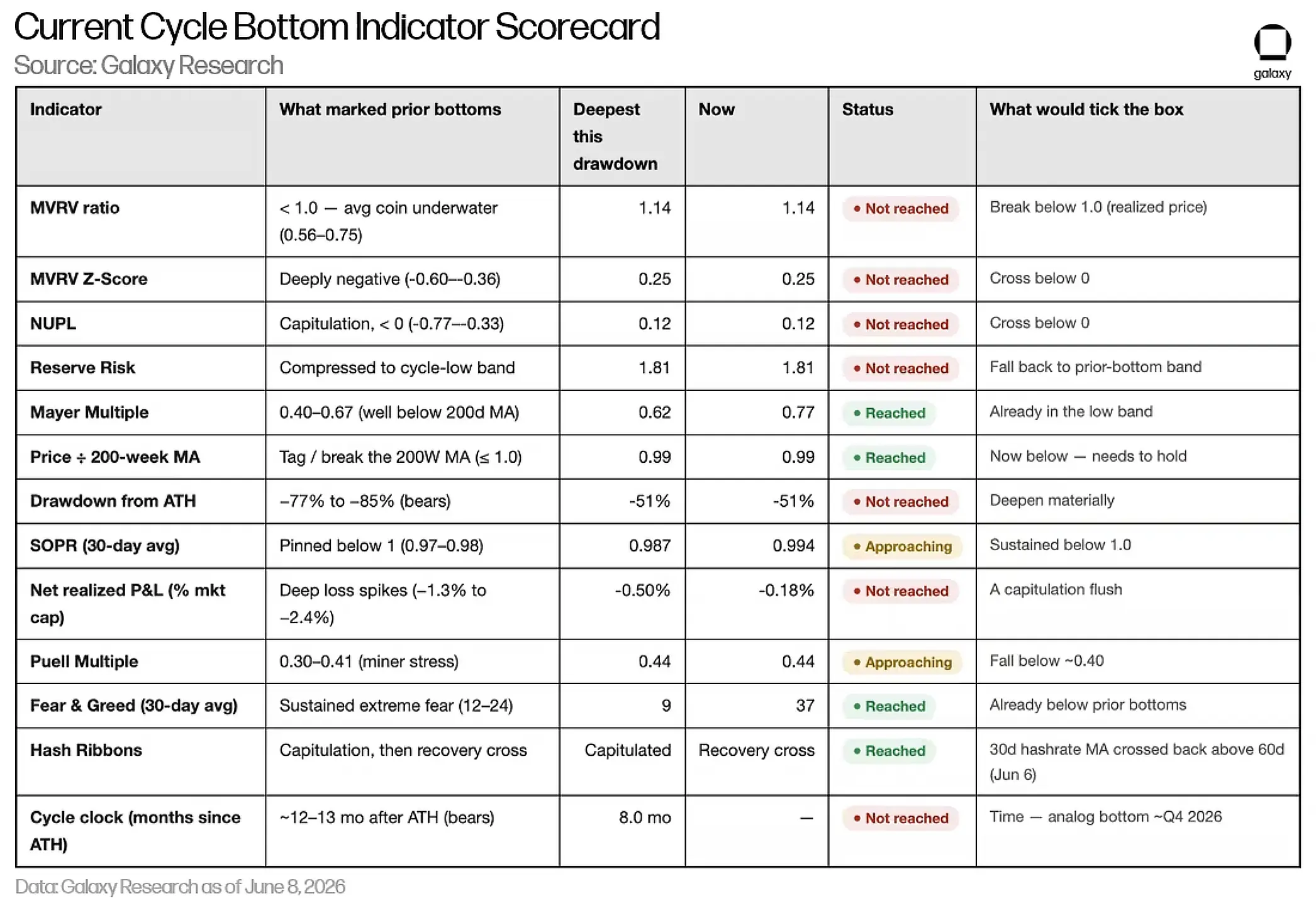
Galaxy Digital reviewed Bitcoin's full 17-year price history and summarized 13 indicators that typically appear simultaneously when the market truly bottoms out. These cover six dimensions: valuation, profit-taking, miner pressure, price trends, bull/bear cycles, and market sentiment. Long-term Bitcoin investors are familiar with these indicators, including the 200-week moving average, Fear & Greed Index, Mayer Multiple, etc.


Galaxy found that currently only 4 indicators fully meet the criteria, 2 are partially met, and the remaining 7 have not triggered a bottom signal. The report concludes that the bottom range for this Bitcoin cycle is between $30,000 and $54,000, with a neutral baseline bottom of $40,000 to $46,000.


NYDIG


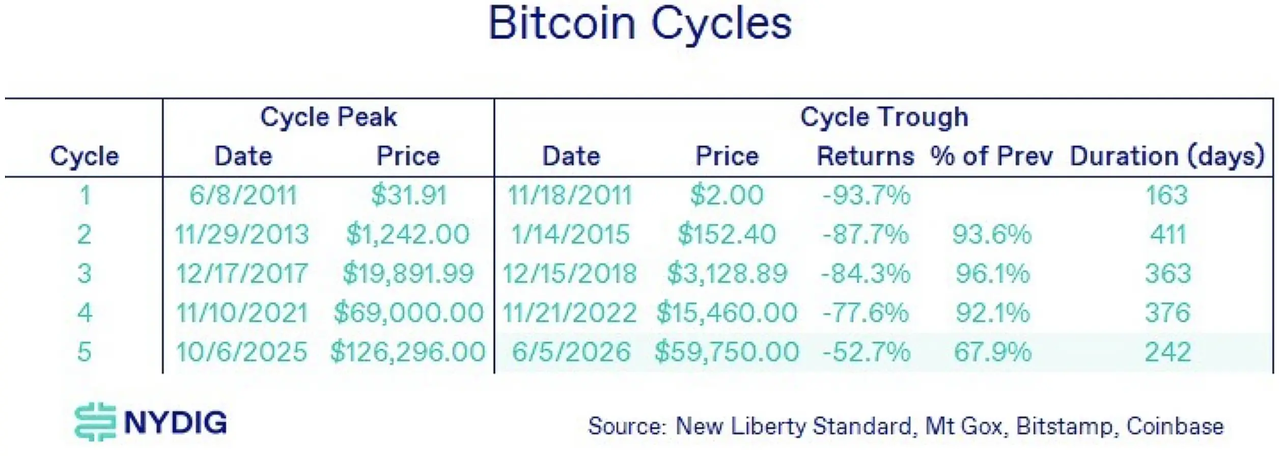
NYDIG also adopts a multi-indicator comprehensive analysis framework, comparing the current market with historical cycles, assessing the market status from dimensions such as the duration of maximum drawdown and holder profit/loss (what Bitcoin users call 'MVRV,' or the market value to realized value ratio).


NYDIG believes that current indicators are very close to the extreme ranges of historical major bottoms, but the hallmark widespread panic selling seen in past major bear markets has not yet occurred. However, the report introduces a variable: the entry of institutional funds has fundamentally changed Bitcoin's cycle logic. The magnitude of this correction might be smaller than in historical bear markets. From this perspective, the bottom might also have already appeared.


Standard Chartered


Standard Chartered is not unwaveringly bullish on Bitcoin. Back in February when Bitcoin was at $67,000, the bank lowered its full-year price forecast, warning that the price could fall to $50,000, citing a weaker macroeconomic environment and sustained selling pressure from Bitcoin ETFs.


But last Friday, Standard Chartered updated its view, identifying $59,000 as the bottom of this cycle. The two main logics supporting this view are: a potential diplomatic agreement between the US and Iran, and the highly anticipated upcoming SpaceX IPO. Standard Chartered believes that the substantial selling by ETF holders was to raise funds for participating in the SpaceX listing, and this selling pressure will gradually subside. Standard Chartered's latest forecast is that Bitcoin will challenge $100,000 within the year.


Consensus Far Outweighs Differences in the Three Reports


You might wonder, what useful information can be extracted from three reports with seemingly opposing views? In fact, the underlying consensus in these three reports far outweighs the surface differences. For long-term investors, the conclusions they agree on are far more valuable than their disagreements:


  • All three judge that the market bottom for this cycle will occur within this year.
  • All three believe the current price is closer to the bottom than to the previous high.
  • All three unanimously remain bullish, expecting Bitcoin to usher in a new bull market in the future.


At the time of writing this article, Bitcoin is trading around $67,000. One report claims the bottom at $59,000 has already occurred, one sees a potential drop to $50,000, and another a neutral baseline bottom of $43,000. But the core conclusion is highly unified: a bottom will definitely be reached within the year.


This is the key point long-term investors should focus on. Whether the bottom is at $40,000, $50,000, or $60,000, the difference is actually limited. What truly matters is whether Bitcoin can subsequently surge to $100,000, $200,000, or even $1 million. As long as it reaches those levels, entering and holding long-term at the current price offers considerable upside potential.


A rather ironic phenomenon in the current market is that everyone is obsessing over whether the market has bottomed, while overlooking a more important question—has the top already appeared? In my view, as long as the peak has not arrived, Bitcoin retains its long-term allocation value.


The core logic supporting Bitcoin's long-term value has not only persisted but continues to strengthen: government debt continues to accumulate worldwide with no effective resolution in sight; inflation constantly erodes the real purchasing power of wealth; public trust in centralized institutions like governments and banks continues to decline; the global digitalization process keeps accelerating; Bitcoin's trading and investment channels are constantly improving; and the early crypto-native demographic is aging, with their assets and industry influence growing simultaneously.


Of course, potential risks remain in the market, including threats from quantum computing and tightening global regulation. However, on balance, the current situation looks better than in any previous crypto winter.


Domande pertinenti

QWhat are the three major research institutions mentioned in the article and their respective views on whether the crypto market has bottomed?

AThe three institutions are Galaxy Digital, NYDIG, and Standard Chartered. Their views are: Galaxy Digital believes the market has not bottomed yet. NYDIG considers it possible but unlikely that the bottom has been reached. Standard Chartered asserts that the bottom has already appeared at $59,000.

QAccording to Galaxy Digital, how many out of its 13 identified bottoming indicators are currently signaling a market bottom?

AAccording to Galaxy Digital's analysis, only 4 of the 13 indicators are fully met, 2 are partially met, and 7 have not yet signaled a bottom.

QWhat is the core consensus shared by the three research reports despite their differing views on the exact bottom price?

AThe core consensus is threefold: 1) The market bottom will occur within this year. 2) The current price is closer to the bottom than to the previous all-time high. 3) All three institutions are optimistic that Bitcoin will experience a new bull market in the future.

QWhat two specific reasons did Standard Chartered give for revising its view and declaring that the market bottomed at $59,000?

AStandard Chartered based its revised view on two primary reasons: 1) A potential diplomatic agreement between the US and Iran. 2) The upcoming, highly anticipated SpaceX IPO, which they believe led to ETF selling pressure as investors raised funds to participate, and this pressure is expected to subside.

QWhat does Matt Hougan, the author and Bitwise CIO, suggest is a more important question for long-term investors than whether the market has bottomed?

AMatt Hougan suggests that a more important question for long-term investors is whether the market top has already appeared. He argues that as long as the peak has not been reached, Bitcoin retains its value as a long-term investment.

Letture associate

a16z: From Companies to DAOs, DUNA May Become the Next Generation Organizational Form

This article, "From Companies to DAOs: How DUNA Could Become the Next Organizational Form," traces the 500-year evolution of business collaboration. It begins with medieval structures like the *commenda* and Florentine *compagnia*, which exposed partners to personal risk. The modern corporation, exemplified by the Dutch East India Company (VOC), was a revolutionary leap, enabling large-scale, capital-intensive ventures by offering limited liability and reducing coordination costs. However, corporations introduced new challenges like principal-agent problems and bureaucratic overhead. The piece argues that software and internet-native protocols are now reducing these traditional overheads. Decentralized Autonomous Organizations (DAOs) emerged as a new model for coordination without centralized management. Yet, DAOs face a significant legal vacuum: they lack legal recognition, leaving members exposed to unlimited personal liability, and their tokens are vulnerable to being classified as securities under unclear regulations (e.g., the Howey Test). This has forced projects into suboptimal workarounds like offshore foundations. The article identifies the Decentralized Unincorporated Nonprofit Association (DUNA) as a potential solution. Recently legalized in states like Wyoming, the DUNA provides a legal wrapper for decentralized networks. It grants key protections—legal personality, limited liability, and perpetual existence—to a group without imposing a traditional hierarchical management structure. This allows token-holder communities to govern, hold assets, and contract as a single legal entity, aligning with their decentralized nature. While DUNA doesn't solve all governance challenges or magically resolve securities law questions, it represents a crucial step. It fills the legal recognition gap, offering a native legal form for internet-scale, decentralized collaboration and extending the separation of personal risk from organizational venture into a new domain.

marsbit24 min fa

a16z: From Companies to DAOs, DUNA May Become the Next Generation Organizational Form

marsbit24 min fa

2026 Mid-Year Report On-Chain RWA: Tokenized Stock Market Cap Doubles in a Year, But 90% of Rights Are Hollow Shells

The 2026 Mid-Year Report on On-Chain RWA highlights a significant growth in tokenized stock market capitalization, which nearly doubled from $951 million in March to $1.89 billion by July. However, the report reveals a fundamental contradiction in this "layer 2.5" ecosystem: products with the strongest legal foundation (like regulated U.S. infrastructure) lack liquidity and distribution, while freely tradable offshored wrapper products often lack substantive ownership rights. The increase is driven largely by a few products (SECZ, FGRS, STRCx) and platforms (Ondo, xStocks, Securitize collectively hold over 85% share). While distributed value across networks like Ethereum, Solana, and BNB Chain has grown, the market remains fragmented. Products referencing the same underlying asset (e.g., Apple stock) are distinct legal liabilities with different intermediaries and jurisdictional rules, offering varying degrees of legal claim. The report cautions that headline numbers are misleading, as they reflect changes in distributed token value—driven by issuance, conversions, and price movements—not pure investor inflows. True "canonical shares" with legal ownership, wide wallet distribution, institutional liquidity, and independent on-chain price discovery do not yet exist at scale. Tokenized treasuries show stronger product-market fit, and ETFs may be easier to scale than single stocks. The core takeaway is a trade-off: legal certainty versus liquidity and composability.

marsbit1 h fa

2026 Mid-Year Report On-Chain RWA: Tokenized Stock Market Cap Doubles in a Year, But 90% of Rights Are Hollow Shells

marsbit1 h fa

Coldcard Hardware Wallet Hacked: 594 Bitcoin Withdrawn in 25 Minutes

The Coldcard hardware wallet has been compromised, with hackers stealing approximately 594.5 Bitcoin (~$40 million) from 500 addresses in just 25 minutes. The root cause was a critical software bug, undetected for five years, which disabled the device's secure chip for generating true random numbers. This led to the creation of private keys based on predictable data like the processor's serial number, drastically reducing cryptographic security. The attackers exploited this offline by brute-forcing possible seed phrases, finding active addresses on the public ledger, and signing transactions. Initially, Coinkite (Coldcard's maker) claimed only older models were at risk but later admitted all devices running the compromised firmware were vulnerable. CEO Rodolphe Novak (NVK) apologized but ruled out financial compensation for affected users. To secure funds, owners must urgently update their firmware to specific safe versions, generate a completely new seed phrase on the updated device, and transfer all assets to new addresses created with that new seed. While a BIP-39 passphrase can help, it does not replace this migration process. Other Coinkite products like TAPSIGNER were not affected. This incident underscores that even specialized hardware requires rigorous, independent code audits, especially for cryptographic functions. It parallels past failures, like a 2006 OpenSSL bug in Debian, and raises questions about whether automated code analysis can ever fully replace human scrutiny in critical security areas.

cryptonews.ru3 h fa

Coldcard Hardware Wallet Hacked: 594 Bitcoin Withdrawn in 25 Minutes

cryptonews.ru3 h fa

Trading

Spot
活动图片




