Netting $2.4 Million: These 9 Insider Addresses Knew the US-Iran War Best

marsbitPubblicato 2026-05-25Pubblicato ultima volta 2026-05-25

Introduzione

On May 18th, Bubblemaps investigators disclosed the discovery of nine highly correlated anonymous accounts on Polymarket that netted over $2.4 million from prediction markets tied to US military actions, with a 98% win rate. The accounts focused almost exclusively on the 2026 US-Iran conflict, placing bets with uncanny precision days before key events like the "Operation Epic Fury" strike on February 28th, which eliminated Iran's Supreme Leader. Bubblemaps' analysis linked four core accounts—each profiting around $400k—and five others through synchronized timing, transaction patterns, and fund flows. The money moved through shared wallet networks, suggesting professional obfuscation. This case is six times larger than the earlier prosecution of US Army Sergeant Gannon Van Dyke for insider trading on Polymarket. While platforms like Polymarket have established AI monitoring and explicit rules against trading on stolen or confidential information, the incident has spurred controversial "insider copy-trading" services that help users follow high-success accounts, raising new regulatory questions.

Written by: Mahe, Foresight News

On May 18, Nicolas Vaiman, founder of Bubblemaps, and lead investigator Deebs (a pseudonym used by a former U.S. military officer for safety reasons) disclosed to the public: they discovered nine highly correlated anonymous accounts on Polymarket that collectively netted over $2.4 million from prediction markets related to U.S. military actions, with a winning rate as high as 98%.
Bubblemaps provided a detailed analysis of these accounts on Twitter. They almost exclusively bet on military events related to the US-Iran conflict in 2026, with timing so precise it was chilling—often placing bets just days before key actions occurred, and favoring long-odds, low-probability options.

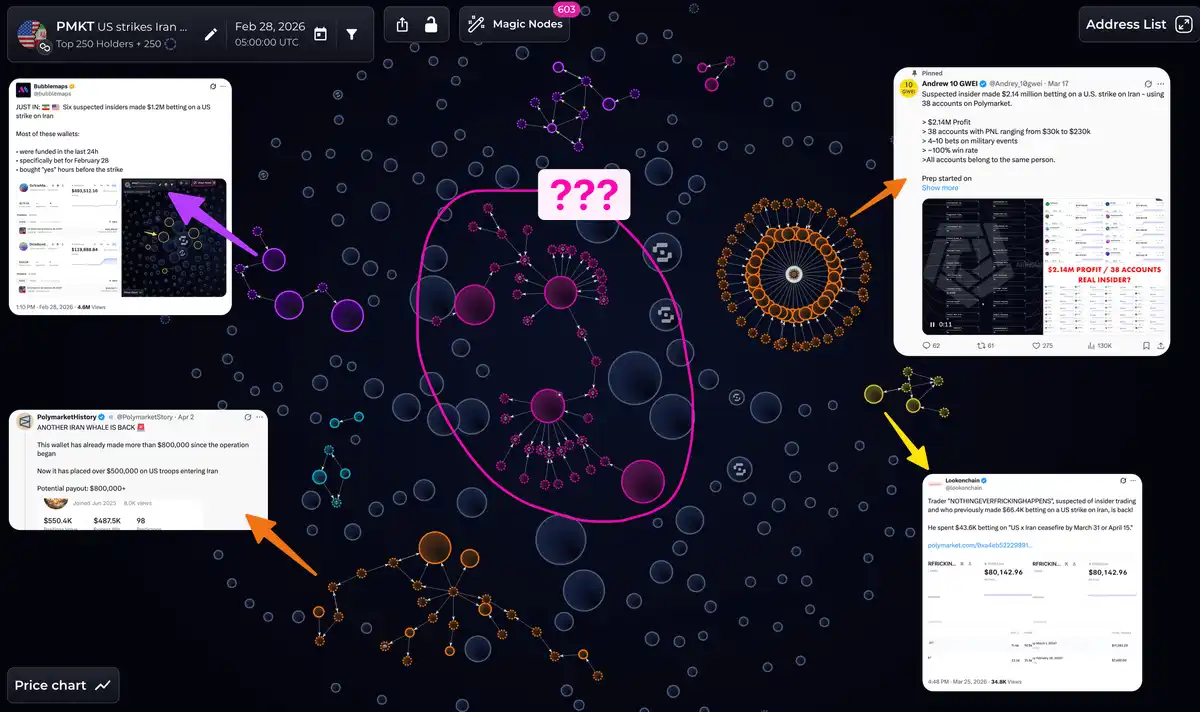
This wasn't simply "good luck." After visualizing the trades in the "Will the US strike Iran for the first time before February 28?" market on Polymarket, Bubblemaps discovered a massive pink cluster previously unmentioned on the X platform.
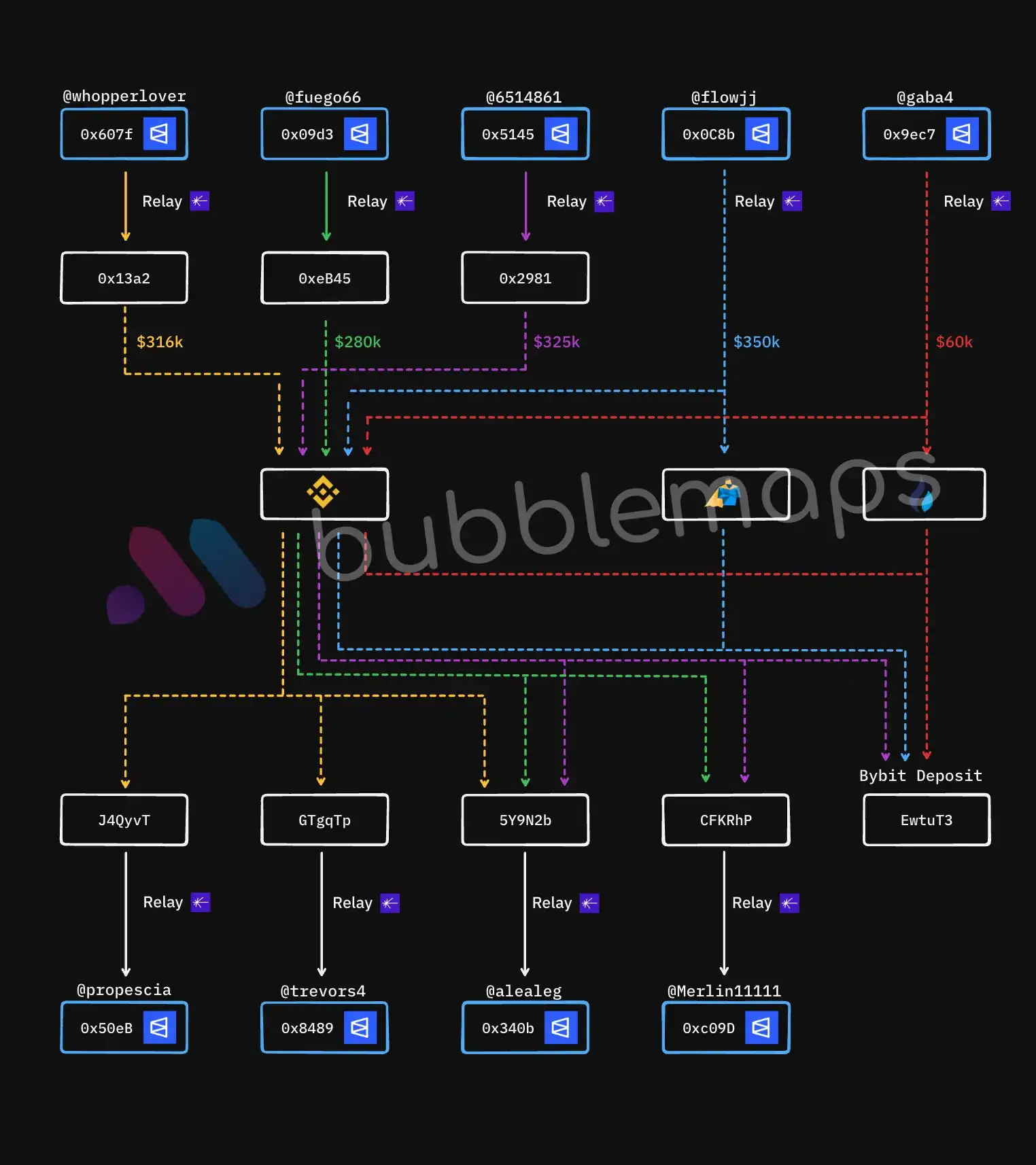
Further investigation linked the initial 4 accounts to another 5 through identical time windows, trade sizes, and fund flow paths. The nine accounts followed highly consistent funding paths: funds were transferred via centralized exchanges into a shared wallet network within an extremely short timeframe, with suspected use of professional services to hide traces.

4 Core Accounts Each Earned $400,000

In the early morning of February 28, 2026, the United States and Israel launched large-scale joint strikes codenamed "Operation Epic Fury" and "Lion's Roar." US-Israeli forces conducted nearly 900 strikes against Iran within 12 hours, targeting nuclear facilities, missile bases, military command centers, and hideouts of senior leaders. Iran's Supreme Leader Ali Khamenei and several of his family members, along with senior commanders of the Revolutionary Guard Corps, were killed in the initial strikes.

As early as the day of the February 28 strikes, Bubblemaps had publicly flagged six "fresh" accounts. Most of these accounts were created and funded within 24 hours before the strike, accurately betting on "the US will strike Iran before February 28," collectively netting about $1 million (some reports said $1.2 million). At the time, market odds were extremely low, yet these accounts heavily bet on them. Bubblemaps called it "suspected insider trading."

Five months later, the nine-account cluster they discovered was larger and had a higher win rate.
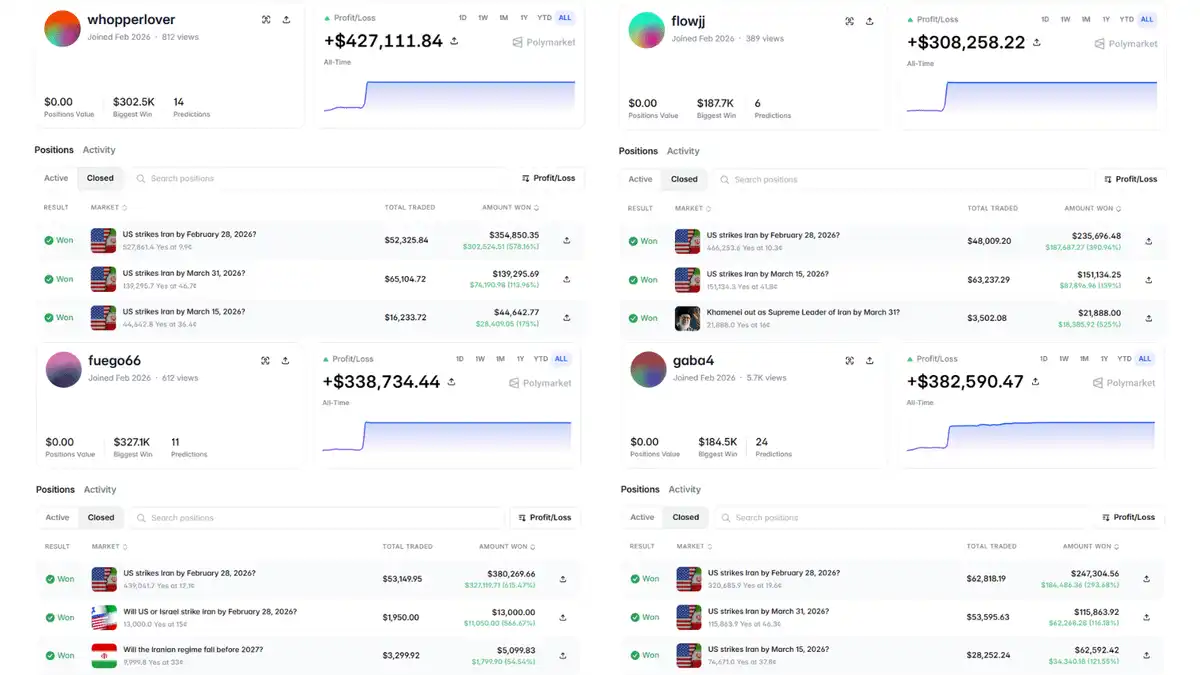
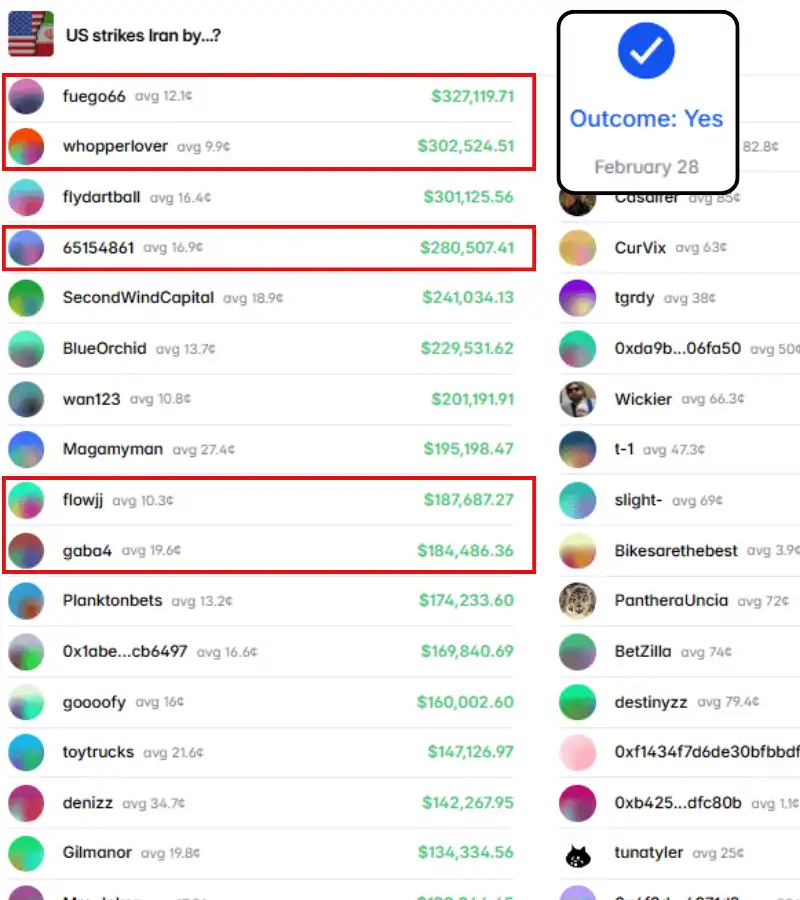
The four core accounts were created a few days before February 28, each earning about $400,000; the subsequent five accounts were linked through fund flows and trade overlaps. The nine accounts placed over 80 bets, almost all on US military actions: the first strike on February 28, the specific timing of Khamenei's elimination, the announcement of a ceasefire agreement, etc. They even placed bets spread across multiple dates to maximize gains, while occasionally placing one or two small losing bets (like on February 20), likely as cover.
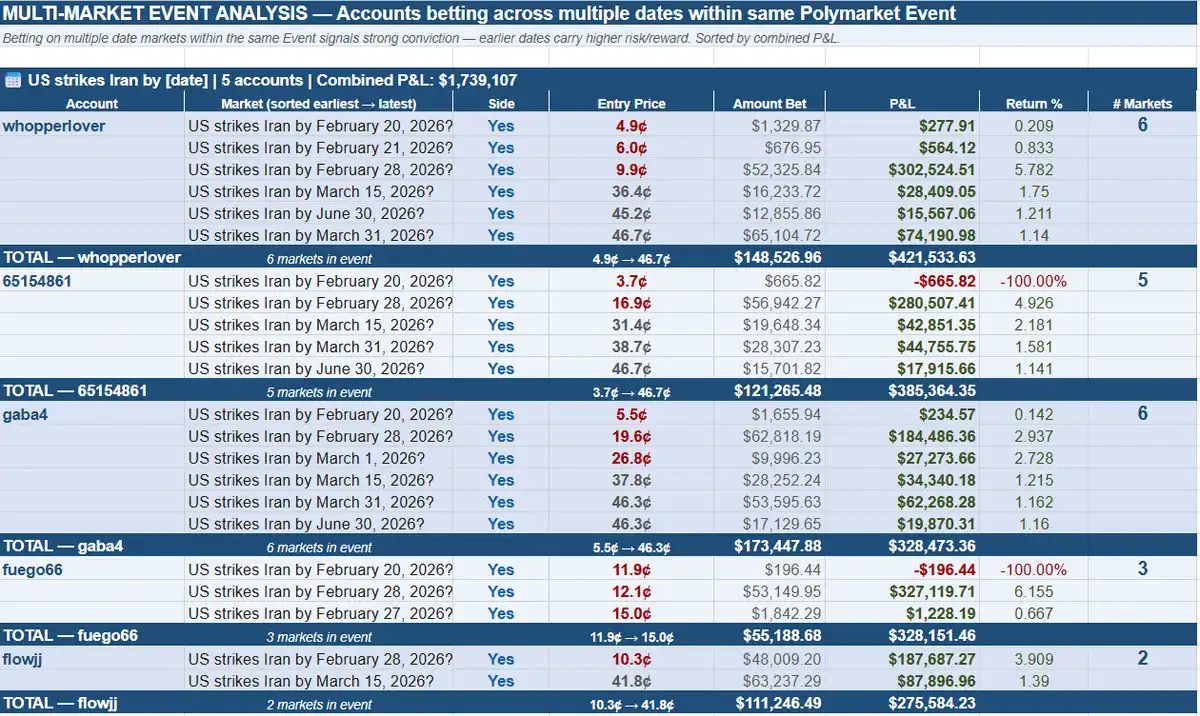
Bubblemaps listed the nine Polymarket wallet addresses (including 0x09d3273fa76282ce09f4f35a87d6f087c05f4e84, etc.), emphasizing that these accounts have long dominated the profit/loss leaderboards. Funds ultimately flowed to a shared wallet network, showing signs of professionalized money laundering or service use.
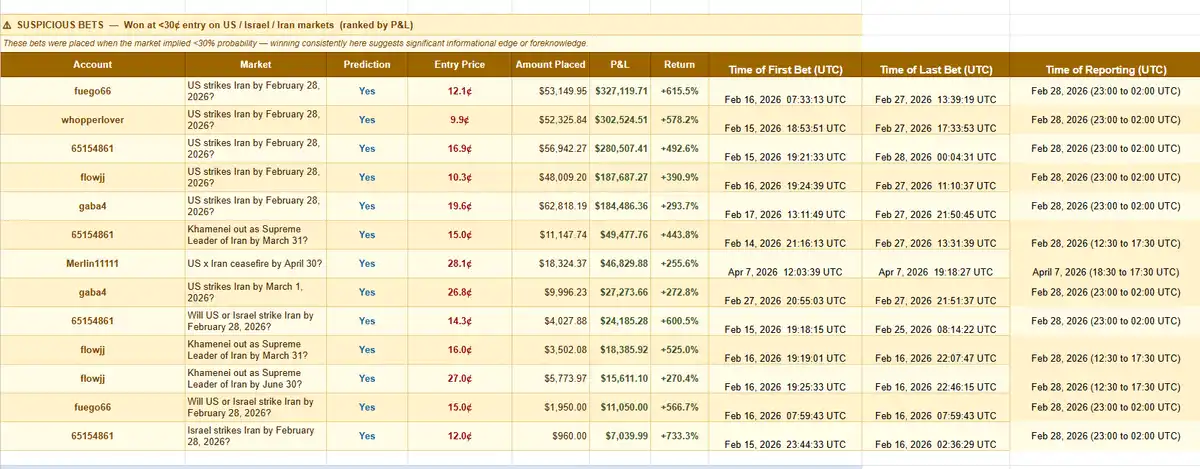
Vaiman stated bluntly: "Luck cannot explain these numbers." Deebs added that potential insider sources are numerous—government officials, military planners, intelligence analysts, even family members of military personnel.
Earlier this year, US Army Staff Sergeant Gannon Ken Van Dyke was charged with using classified intelligence to bet on special operations in Venezuela on Polymarket, investing $34,000 to profit $400,000 before quickly withdrawing funds and attempting to delete the account. Polymarket cooperated closely with law enforcement, ultimately leading to the prosecution. The Van Dyke case is seen as a landmark case for insider trading in prediction markets.

This nine-account cluster's profit is six times that amount, with a higher win rate, and is entirely concentrated on US-Iran military events.
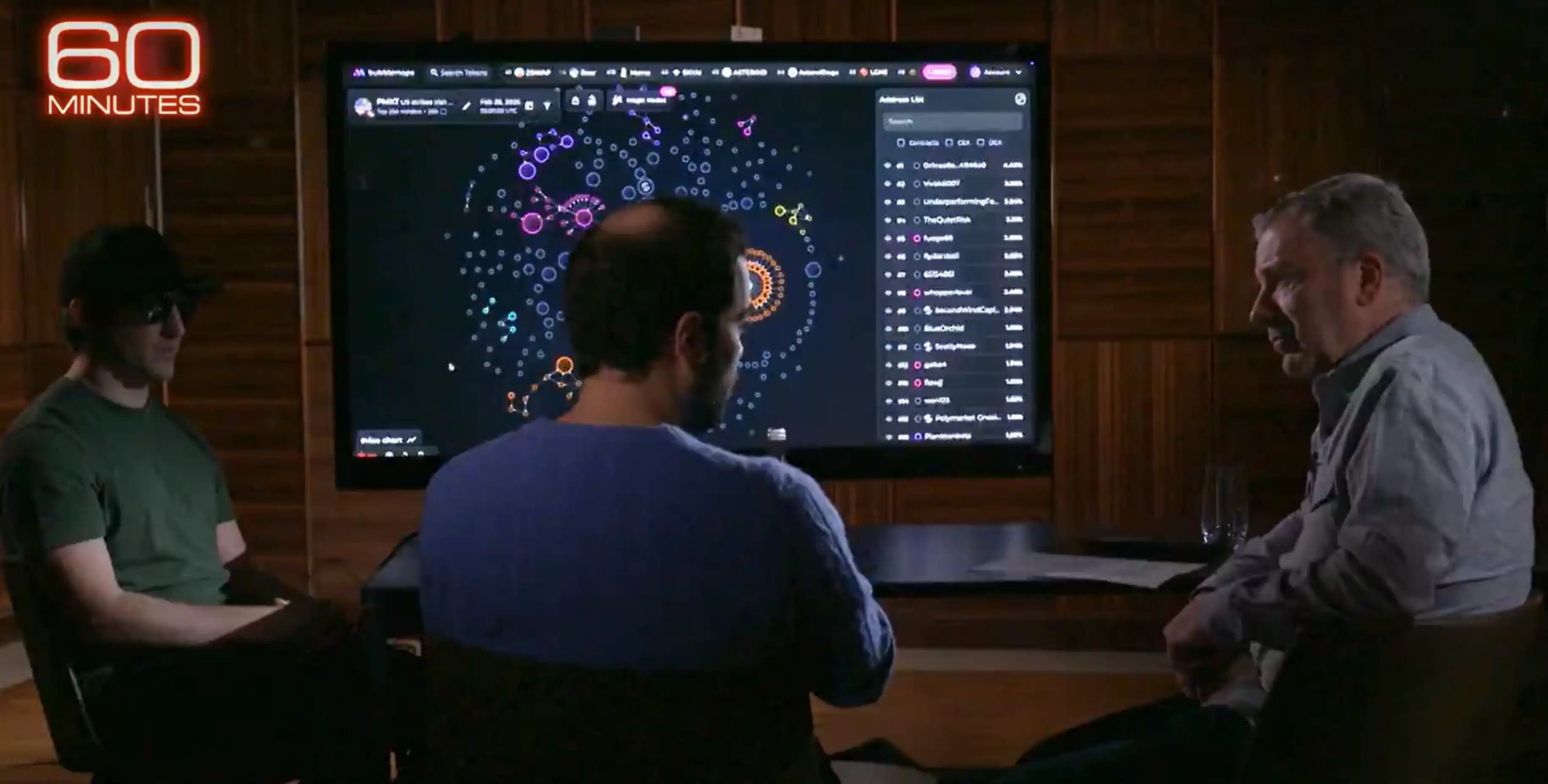
Bubblemaps exclusively shared the investigation with "60 Minutes." The segment aired on the evening of May 17, garnering significant attention. The CBS report noted that Polymarket has established AI monitoring and blockchain forensics systems, reporting suspicious activities to law enforcement authorities once detected, and emphasized that "insider trading is not welcome on the platform."

As of publication, Bubblemaps has not directly linked the nine accounts to any specific entity or government agency, stating only that "the correlation and near-perfect win rate raise serious suspicions."

Fighting Insider Trading vs. Copying Insider Trading

Insider trading makes many market participants feel the game is unfair. Prediction market platforms, including Kalshi and Polymarket, are taking more measures to combat it.

In late March this year, Polymarket updated its market integrity rules for its DeFi platform and its US exchange regulated by the U.S. Commodity Futures Trading Commission (CFTC). The updated rules clarify three core prohibited insider trading behaviors:

  • Trading using stolen confidential information—Participants may not trade any contracts if they possess confidential information about the outcome or likely outcome of an underlying event, and using that information would breach a pre-existing duty of trust or confidence owed to another person or entity.
  • Prohibition on trading using illegal insider tips—Participants may not trade using confidential information provided to them by another person, if the information was provided by someone who owed a pre-existing duty of trust or confidence to another, and the participant knows or has reason to know that the person providing the information themselves would be prohibited from trading on it.
  • Trading by those able to influence the outcome—Participants may not trade any contracts if they have authority or influence sufficient to affect the outcome of the underlying event.

However, rules always have loopholes. Since insider trading cannot be completely eradicated, some ill-intentioned so-called "insider copy-trading projects" have also sparked controversy. These applications compile trading accounts with abnormally high win rates for users, or flag suspiciously timed, abnormally sized trades, helping users copy these trades with one click.

Kreo's selling point is helping users "find insider traders before others." Polycool directly posts a "Polymarket Insider Trading Guide" on its website, stating "This isn't the stock market, betting with non-public information won't land you in jail, the rules for decentralized prediction markets are completely different."

A question then arises: does copying trades from insider trading addresses constitute a violation?

There has been no official response yet.

However, so-called "insider copy-trading platforms" like PolyGUN and Polycule have suffered hacker attacks this year, incurring losses ranging from tens of thousands to hundreds of thousands of dollars.


Domande pertinenti

QWhat did Bubblemaps investigators discover about a group of anonymous accounts on Polymarket?

ABubblemaps investigators discovered nine highly correlated anonymous accounts that collectively netted over $2.4 million from prediction markets related to US military actions, with a win rate of 98%. They were primarily focused on US-Iran conflict events in 2026.

QAccording to the article, what characteristics made the trading activity of these nine accounts highly suspicious?

AThe accounts were highly suspicious because they placed bets almost exclusively on US-Iran military events, their timing was unnervingly precise (often days before key actions), they preferred low-odds, long-term options, and they used shared wallet networks and professional services to obscure fund flows.

QWhat is the name of the US soldier mentioned in the article who was charged for insider trading on Polymarket, and what was his profit?

AThe US soldier mentioned is US Army Staff Sergeant Gannon Ken Van Dyke. He was charged for using classified intelligence to bet on a Venezuelan special operations event on Polymarket, investing $34,000 and making a profit of $400,000.

QWhat are the three core types of prohibited insider trading behaviors outlined in Polymarket's updated market integrity rules?

AThe three core prohibited behaviors are: 1) Trading using stolen confidential information. 2) Trading using illegal insider information provided by someone who breached a duty of trust. 3) Trading by individuals who have the authority or influence to affect the outcome of the event.

QWhat controversial practice related to potential insider trading has emerged on prediction market platforms according to the article?

AThe controversial practice is the emergence of 'insider copy-trading' platforms or applications. These services identify accounts with suspiciously high win rates or anomalous trades, allowing users to copy their bets, essentially attempting to profit from potential insider information.

Letture associate

After $HYPE Hits a New High, Is It Worth Considering the Stock of "HYPE Version MicroStrategy" $PURR?

**HYPE Hits New Highs: Is $PURR, the "HYPE Version of MicroStrategy," Worth Considering?** The stock of Hyperliquid Strategies (NASDAQ: $PURR), a publicly-traded company that exclusively buys and holds the cryptocurrency HYPE, has gained over 100% year-to-date, mirroring HYPE's own 150% surge to new all-time highs. This has sparked discussions about PURR being a more "capital-efficient" play than MicroStrategy's bitcoin strategy, given its reported ~$1 billion unrealized gain on a ~$220 million investment. The article clarifies that PURR is essentially a pure-play wrapper for HYPE, with no other business. It resulted from a 2025 SPAC merger led by firms like Paradigm and Atlas Merchant Capital, bringing traditional finance veterans to its board. Its value is entirely derived from the price of HYPE. While PURR offers a crucial compliance bridge for US-based institutional and retirement accounts unable to access HYPE directly, the analysis questions the "capital efficiency" narrative. The outsized gains are attributed to HYPE's exceptional performance, not superior corporate strategy. For investors who can buy HYPE directly, holding PURR introduces unnecessary risks: potential shareholder dilution from future stock offerings, incomplete passthrough of staking rewards, market hour mismatches, and counterparty risk via its single custodian. A key metric is its mNAV (modified net asset value). Current calculations show PURR trades at a discount to its HYPE holdings, but this could flip to a premium depending on the execution of registered share issuances. The article concludes that PURR is primarily a "conduit product." The investment thesis hinges entirely on one's bullishness on HYPE itself, not on the PURR wrapper, which adds friction and risk for those with direct crypto access.

marsbit12 min fa

After $HYPE Hits a New High, Is It Worth Considering the Stock of "HYPE Version MicroStrategy" $PURR?

marsbit12 min fa

The Real Progress and Investment Opportunities of Decentralized AI Computing Power Networks in 2026

In 2026, the AI compute market is marked by centralized GPU consolidation and a significant GPU shortage for smaller players. In this context, Decentralized Physical Infrastructure Networks (DePIN), valued at $9.4B+, have emerged as a viable, revenue-generating alternative. Leading protocols like Aethir ($150M ARR), io.net (130k+ GPUs), Akash, Bittensor, and Render are carving out distinct niches, moving beyond hype to deliver verifiable income primarily from non-crypto-native clients. The key advantage of decentralized GPU networks lies in serving latency-tolerant, cost-sensitive workloads like AI inference, fine-tuning, data preprocessing, and agent operations, offering substantial cost savings (45-80%) compared to major cloud providers. However, reliability variance, lack of robust SLAs, and fragmented tech stacks remain significant adoption hurdles. The sector is maturing with critical 2026 shifts: 1) Evolution of tokenomics towards demand-driven, revenue-linked models (e.g., Render's BME, io.net's IDE), and 2) Clearer enterprise adoption pathways, with traditional firms integrating decentralized compute. For new entrants, opportunities are now concentrated in specialized tooling layers (orchestration, verification, SLA management), vertical applications (e.g., bio-med, content generation), and innovative token designs tied to real usage, rather than generic GPU aggregation. The convergence with the emerging AI Agent economy presents a significant future growth vector.

marsbit13 min fa

The Real Progress and Investment Opportunities of Decentralized AI Computing Power Networks in 2026

marsbit13 min fa

We Captured Thousands of Job Postings and Discovered ByteDance is Reviving Smartphone R&D

This article analyzes ByteDance's recent hiring activities, revealing a potential restart of smartphone hardware development. By scraping and analyzing thousands of ByteDance job postings, the authors identify three key categories: roles for the "Doubao Phone Assistant" (an AI agent), for a "Mobile OS" (system-level development), and for hardware/engineering positions in Shenzhen (a manufacturing hub). The piece traces the context to the 2025 launch of the "Doubao Phone," a concept device that integrated an AI agent directly into a smartphone, allowing it to see the screen, operate apps, and perform tasks like shopping or booking tickets. While innovative as an early AI Agent prototype, it faced operational restrictions from major platforms like WeChat and Alipay. The new hiring signals a deeper commitment. "Doubao Phone Assistant" roles focus on core Agent capabilities (task execution, memory, cross-app operation). "Mobile OS" positions involve deep system work (kernel, chip adaptation, power/thermal management) necessary for a responsive, always-on AI. Shenzhen-based hardware roles (structure design, testing, production) suggest preparation for physical device manufacturing. The article concludes that in the AI era, where phones may become an Agent's "body," controlling the operating system and hardware is critical. For a company like ByteDance, being merely an app within others' ecosystems is no longer sustainable if it aims to own the next-generation user interface. Therefore, while a consumer phone brand isn't confirmed, ByteDance is decisively moving beyond app development into the complex domain of system-level and hardware-integrated AI.

marsbit43 min fa

We Captured Thousands of Job Postings and Discovered ByteDance is Reviving Smartphone R&D

marsbit43 min fa

AI Impact on SaaS Software Stocks: Deconstructing the Bottom-Fishing Logic of Salesforce, ServiceNow, and Snowflake

"AI Nightmare for SaaS Stocks: Unpacking the Bottom-Fishing Logic for Salesforce, ServiceNow, and Snowflake" A deep dive analysis argues that the recent collapse in SaaS software stocks, dubbed the "SaaS Doom," presents a contrarian buying opportunity. The market panic, triggered by fears that AI will disrupt traditional per-user subscription models through "seat compression" and AI agents bypassing software UIs, has led to extreme selling in the software sector. The analysis evaluates three major players under a unified framework: 1. **Salesforce (CRM):** Positioned as a "margin of safety" play. Trading at historically low valuations (13-14x forward P/E), with strong cash flow and a massive buyback, it offers value. Its key challenge is transitioning from a "seat economy" to an AI-driven "task economy" with its Agentforce platform. 2. **ServiceNow (NOW):** The "clearest AI narrative" play. Its "AI Control Tower" strategy aims to become the governance and orchestration layer for enterprise AI agents, benefiting from AI proliferation. Backed by Nvidia's CEO, it trades at a relatively low valuation post-correction. 3. **Snowflake (SNOW):** The "high-risk, high-reward" bet. Its consumption-based model aligns with rising AI workloads, and its RPO growth is strong. However, it faces intense competition (e.g., Databricks), is not yet GAAP profitable, and carries the highest valuation. The conclusion counters the simplified "AI kills software" narrative. AI is eliminating software that sells only functional interfaces but rewarding platforms that provide essential infrastructure, data, and governance. The current sell-off may have created a buying opportunity for resilient software leaders positioned as future AI infrastructure platforms.

marsbit1 h fa

AI Impact on SaaS Software Stocks: Deconstructing the Bottom-Fishing Logic of Salesforce, ServiceNow, and Snowflake

marsbit1 h fa

Trading

Spot
Futures

Articoli Popolari

Come comprare WAR

Benvenuto in HTX.com! Abbiamo reso l'acquisto di WAR (WAR) semplice e conveniente. Segui la nostra guida passo passo per intraprendere il tuo viaggio nel mondo delle criptovalute.Step 1: Crea il tuo Account HTXUsa la tua email o numero di telefono per registrarti il tuo account gratuito su HTX. Vivi un'esperienza facile e sblocca tutte le funzionalità,Crea il mio accountStep 2: Vai in Acquista crypto e seleziona il tuo metodo di pagamentoCarta di credito/debito: utilizza la tua Visa o Mastercard per acquistare immediatamente WARWAR.Bilancio: Usa i fondi dal bilancio del tuo account HTX per fare trading senza problemi.Terze parti: abbiamo aggiunto metodi di pagamento molto utilizzati come Google Pay e Apple Pay per maggiore comodità.P2P: Fai trading direttamente con altri utenti HTX.Over-the-Counter (OTC): Offriamo servizi su misura e tassi di cambio competitivi per i trader.Step 3: Conserva WAR (WAR)Dopo aver acquistato WAR (WAR), conserva nel tuo account HTX. In alternativa, puoi inviare tramite trasferimento blockchain o scambiare per altre criptovalute.Step 4: Scambia WAR (WAR)Scambia facilmente WAR (WAR) nel mercato spot di HTX. Accedi al tuo account, seleziona la tua coppia di trading, esegui le tue operazioni e monitora in tempo reale. Offriamo un'esperienza user-friendly sia per chi ha appena iniziato che per i trader più esperti.

189 Totale visualizzazioniPubblicato il 2024.12.11Aggiornato il 2026.04.28

Come comprare WAR

Discussioni

Benvenuto nella Community HTX. Qui puoi rimanere informato sugli ultimi sviluppi della piattaforma e accedere ad approfondimenti esperti sul mercato. Le opinioni degli utenti sul prezzo di WAR WAR sono presentate come di seguito.

活动图片