Harmony plans rollback, wiping 109,000 transactions after ONE exploit

cointelegraphPubblicato 2026-08-17Pubblicato ultima volta 2026-08-17

Introduzione

Harmony plans to roll back its blockchain to August 11th after an exploit created forged ONE tokens, discarding over 109,000 confirmed transactions. The network will revert to a specific block from that date and build a new chain, as selectively restoring transactions was deemed unsafe. The move follows reports of unauthorized ONE minting and distribution to exchanges, with investigators tracing most of the forged tokens. This rollback strategy places Harmony alongside networks like Ravencoin, which also sought to reverse confirmed blockchain activity after an exploit. Ravencoin recently faced a potential chain reorganization due to a consensus flaw.

Harmony plans to roll back its blockchain to Aug. 11 following an exploit that created forged ONE tokens, discarding more than 109,000 transactions confirmed after its chosen checkpoint.

The layer-1 network said Monday that validators would revert to blocks recorded at 11:25 pm UTC on Aug. 11. New blocks will be produced from the next heights using replacement databases.

The discarded window includes 109,126 regular transactions and 315 staking transactions. Harmony said selectively restoring transactions was unsafe because balances, contract states, nonces and other conditions would differ on the replacement chain.

Harmony was considering a rollback last week after reports that unauthorized ONE had been minted and sent to exchanges.

It said Monday that investigators had traced nearly all of the forged ONE to wallets or service boundaries and were working with exchanges, bridges and law enforcement. At last look, the token had a market cap of roughly $10.8 million, according to Coingecko data.

Harmony’s plan puts it alongside Ravencoin among networks seeking to reverse already confirmed blockchain activity after an exploit.

Ravencoin faced a potential three-day blockchain reorganization after a consensus flaw was exploited. Mining pools controlling most of Ravencoin’s hash rate began building a competing chain that could reverse previously confirmed transactions.

Ravencoin recent price of $0.002819 showed a market cap of $46.3 million.

Related: Ethereum devs to narrow 66 proposals tied to Hegotá upgrade

Crypto di tendenza

Domande pertinenti

QWhat action is Harmony planning to take following the exploit that created forged ONE tokens?

AHarmony plans to roll back its blockchain to a checkpoint from August 11th, discarding over 109,000 transactions confirmed after that point.

QTo what specific date and time does Harmony plan to revert its blockchain?

AHarmony's validators will revert to blocks recorded at 11:25 pm UTC on August 11.

QWhy is Harmony not selectively restoring transactions after the rollback?

AHarmony stated that selectively restoring transactions would be unsafe because balances, contract states, nonces, and other conditions would differ on the replacement chain.

QWhat other blockchain network is mentioned as having considered a similar action after an exploit?

AThe article mentions Ravencoin as another network that sought to reverse already confirmed blockchain activity after an exploit, specifically facing a potential three-day blockchain reorganization.

QAccording to the article, what was the approximate market cap of the ONE token at the time of reporting?

AAccording to Coingecko data mentioned in the article, the ONE token had a market cap of roughly $10.8 million.

Letture associate

Crypto Funding Halves in Q1, Why Is Stablecoin Payment Still Attracting Money Against the Trend?

Crypto venture capital funding fell roughly 50% quarter-over-quarter in Q1 2026, yet the stablecoin payments sector was a notable exception, continuing to secure significant funding rounds. This shift signals that capital is moving away from speculative "token narratives" toward companies generating real revenue, as stablecoins evolve from a trading tool into payment infrastructure. Despite the overall funding slowdown, companies like Rain, OpenFX, and RedotPay completed major raises, focusing on areas such as card issuance, cross-border payments, and banking connectivity. Investors are attracted to the sector's potential to address long-standing inefficiencies in traditional cross-border payments through 24/7 settlement and clearer revenue models like transaction fees and FX spreads. However, the momentum may be overstated. On-chain stablecoin transaction volume does not equate to real-world payments for goods and services, and funding is concentrated in a few leading firms with reported volumes and customers. Key challenges remain, including compliance, fiat on/off-ramps, local banking relationships, and the risk of core services becoming commoditized. Looking ahead, capital is likely to flow into areas like cross-border B2B payments, bank-to-stablecoin connectivity, stablecoin-linked cards, multi-chain payment orchestration, and payments for AI agents. Ultimately, the investor interest reflects a bet on the necessary infrastructure to integrate stablecoins into the traditional financial system, with future valuations hinging on demonstrable payment volume, real revenue, and profitable market expansion.

marsbit10 min fa

Crypto Funding Halves in Q1, Why Is Stablecoin Payment Still Attracting Money Against the Trend?

marsbit10 min fa

South Korean Retail Investors 'Move from Seoul to Wall Street': Buying SK Hynix ADR, Betting on Triple-Leverage ETF

A surge of Korean retail investors is shifting funds from the volatile Seoul market to Wall Street, intensifying their bets on the AI theme through unconventional and high-risk instruments. Data shows Korean investors were net buyers of about $4.5 billion in US stocks in July, nearing a yearly peak. A notable trend is their purchase of approximately $840 million worth of SK Hynix American Depositary Receipts (ADRs), despite a significant 10% premium over the company's domestic shares, leading analysts to label the move as speculative and irrational. Simultaneously, Korean traders are heavily favoring leveraged ETFs. The triple-leveraged semiconductor ETF SOXL was the most-bought US product in July, with leveraged products occupying four of the top ten spots. Experts note that this shift in geography does not represent a diversification of risk; instead, investors are merely expressing the same concentrated bet on AI hardware through different, often riskier, US-listed vehicles. Analysts warn that while this capital inflow is unlikely to systemically impact the vast US institutional market, it risks creating localized distortions and amplifying volatility, particularly in the targeted sectors and instruments. The move follows a sharp correction in the Korean market, where high leverage in semiconductor stocks and related ETFs had previously led to significant losses, prompting this search for alternative avenues to chase the AI narrative.

marsbit1 h fa

South Korean Retail Investors 'Move from Seoul to Wall Street': Buying SK Hynix ADR, Betting on Triple-Leverage ETF

marsbit1 h fa

Bithumb's First Half Report: Net Loss Exceeds $76 Million, Where Did the Profits Go?

**Title: Bithumb H1 2026 Report: Net Loss Exceeds $76M – Where Did the Profits Go?** Despite a headline net loss of approximately 108.7 billion KRW (~$76.44 million) for the first half of 2026, a detailed breakdown reveals Bithumb's core exchange business remained profitable. The significant loss was primarily driven by two major non-operating items: substantial losses on the disposal and valuation of the company's own cryptocurrency holdings (net loss ~$48.21 million) and a sharp increase in litigation provisions (~$25.93 million), largely linked to a regulatory fine. Operating revenue fell 48.7% year-on-year to ~$119 million, almost entirely from transaction fees, as market activity cooled. While the company drastically cut marketing and subsidy expenses by ~70% to protect margins, more rigid costs like payment processing and salaries declined only modestly. This highlights the vulnerability of its highly fee-dependent revenue model in a down market. Total assets decreased by ~$584 million, but this was largely attributable to an ~86% drop in client KRW deposits. The market value of client crypto assets under custody also fell (~32.7%), partly influenced by declining cryptocurrency prices rather than solely client withdrawals. In summary, the report indicates underlying exchange profitability was eroded by significant crypto asset losses and mounting regulatory/legal costs, against a backdrop of declining trading revenue. Future focus should be on revenue recovery, managing crypto-related损益, and the ongoing impact of regulatory challenges.

marsbit1 h fa

Bithumb's First Half Report: Net Loss Exceeds $76 Million, Where Did the Profits Go?

marsbit1 h fa

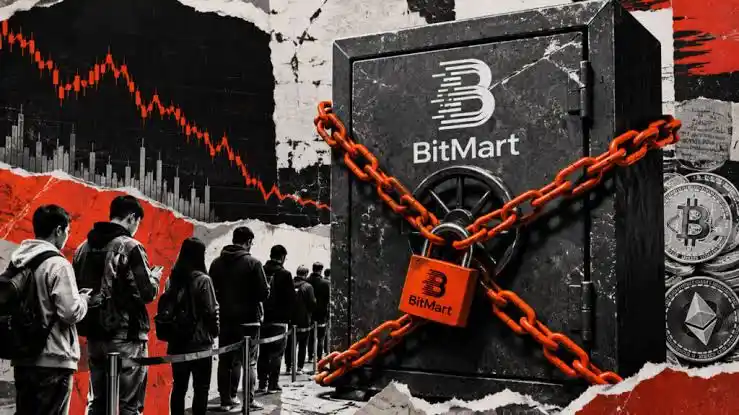
BitMart's Final 9 Days: A True Exchange Crisis Is Never About Shutting Down

BitMart's Final 9 Days: A True Exchange Crisis Is Not About Shutting Down On August 17, 2026, with just 9 days until BitMart's scheduled cessation of trading, the focus shifted from the platform's orderly closure to serious questions about user withdrawals, platform solvency, employee payments, and reserve transparency. Stakeholders, claiming to represent users and staff, publicly demanded asset/liability disclosures, explanations for withdrawal delays, a user repayment plan, and an independent audit, setting an August 19 deadline. While BitMart CEO Sheldon Lee denied allegations of insolvency or wrongdoing, the controversy highlighted a core vulnerability of centralized exchanges (CEXs). When an exchange announces its shutdown, normal user behavior changes dramatically, triggering a mass withdrawal event—the ultimate stress test for its liquidity and custodial integrity. The key question becomes not whether the platform has assets, but whether it holds sufficient *liquid* assets to cover all user liabilities on demand. The article argues that the trust placed in CEXs is based on the convenience they provide, abstracting users from direct control of their private keys. This trust is rarely questioned during normal operations but becomes critically exposed during a wind-down. The situation underscores the limitations of simple Proof of Reserves, which shows "what we have" but not the crucial "what we owe." True financial credibility requires transparent, auditable data on assets, liabilities, and segregated user funds. BitMart's situation reflects a broader, often overlooked issue in the crypto industry: while there is extensive focus on growth mechanisms for exchanges, there is little discussion or established protocol for a safe and transparent "exit mechanism." The final measure of an exchange's integrity, the article concludes, is not its user count or trading volume during a bull market, but its ability to ensure every last user can successfully withdraw their assets when the doors are closing. The outcome will be determined not by statements, but by whether the final user's funds securely leave the platform.

marsbit2 h fa

BitMart's Final 9 Days: A True Exchange Crisis Is Never About Shutting Down

marsbit2 h fa

Don't Speculate on 100x Coins, Just Bet on 'Cash Cows': Which Projects Are Worth Dollar-Cost Averaging in the Bear Market?

In a bearish crypto market, finding sustainable investments is more prudent than chasing speculative meme coins. This article analyzes projects generating consistent revenue, highlighting them as potential "cash cows" for long-term dollar-cost averaging (DCA). The top performers are "picks-and-shovels" plays. **Pump.fun**, a Solana-based meme coin launchpad, leads with $415.3M in monthly revenue, profiting from a 1.25% fee on token transactions. Despite market volatility, it has averaged tens of millions in monthly income in 2024. Perpetual DEX **Hyperliquid** stands out as a "bear market star," accumulating ~$352M in revenue over seven months. Its model funnels ~99% of fees into buying back and permanently burning its HYPE token. Established giants are also adapting. **Uniswap**, after enabling its fee switch, now earns protocol revenue (e.g., $5.6M recently), which is used to buy back and burn UNI, giving the token direct value accrual. Similarly, oracle provider **Chainlink** generates stable monthly revenue (~$4.57M recently) from its essential data, cross-chain, and automation services. Its new Payment Abstraction feature automatically converts service fees into LINK, accruing value in its treasury. The core thesis is clear: in a downturn, focus on projects with proven, resilient business models—those acting as essential infrastructure or capturing consistent transaction fees—rather than speculative narratives.

marsbit2 h fa

Don't Speculate on 100x Coins, Just Bet on 'Cash Cows': Which Projects Are Worth Dollar-Cost Averaging in the Bear Market?

marsbit2 h fa

Trading

Spot

Articoli Popolari

Come comprare ONE

Benvenuto in HTX.com! Abbiamo reso l'acquisto di Harmony (ONE) semplice e conveniente. Segui la nostra guida passo passo per intraprendere il tuo viaggio nel mondo delle criptovalute.Step 1: Crea il tuo Account HTXUsa la tua email o numero di telefono per registrarti il tuo account gratuito su HTX. Vivi un'esperienza facile e sblocca tutte le funzionalità,Crea il mio accountStep 2: Vai in Acquista crypto e seleziona il tuo metodo di pagamentoCarta di credito/debito: utilizza la tua Visa o Mastercard per acquistare immediatamente HarmonyONE.Bilancio: Usa i fondi dal bilancio del tuo account HTX per fare trading senza problemi.Terze parti: abbiamo aggiunto metodi di pagamento molto utilizzati come Google Pay e Apple Pay per maggiore comodità.P2P: Fai trading direttamente con altri utenti HTX.Over-the-Counter (OTC): Offriamo servizi su misura e tassi di cambio competitivi per i trader.Step 3: Conserva Harmony (ONE)Dopo aver acquistato Harmony (ONE), conserva nel tuo account HTX. In alternativa, puoi inviare tramite trasferimento blockchain o scambiare per altre criptovalute.Step 4: Scambia Harmony (ONE)Scambia facilmente Harmony (ONE) nel mercato spot di HTX. Accedi al tuo account, seleziona la tua coppia di trading, esegui le tue operazioni e monitora in tempo reale. Offriamo un'esperienza user-friendly sia per chi ha appena iniziato che per i trader più esperti.

620 Totale visualizzazioniPubblicato il 2024.12.12Aggiornato il 2026.06.02

Come comprare ONE

Discussioni

Benvenuto nella Community HTX. Qui puoi rimanere informato sugli ultimi sviluppi della piattaforma e accedere ad approfondimenti esperti sul mercato. Le opinioni degli utenti sul prezzo di ONE ONE sono presentate come di seguito.

活动图片