Author: Wu Blockchain
Compiled by: Deep Tide TechFlow
Deep Tide Introduction: Crypto venture capital funding halved quarter-on-quarter in Q1, yet stablecoin payments have become one of the few sectors still able to complete large funding rounds consecutively. For practitioners, this signals that capital is shifting from 'token narratives' to 'real revenue,' and also indicates that stablecoins are evolving from trading tools into payment infrastructure. However, on-chain transaction volume does not equal real payment volume. Compliance, on/off ramps, and banking relationships remain key bottlenecks.

Overall Funding Has Cooled: In Q1 2026, crypto VC funding fell by approximately 50% quarter-on-quarter. Capital is increasingly concentrated in mature companies with existing customers, revenue, and substantial transaction volume.
Stablecoin Payments Grow Against the Trend: Companies like Rain, OpenFX, RedotPay, Mesh, Conduit continue to secure large funding rounds in areas such as card issuance, cross-border payments, FX liquidity, wallets, banking connectivity, and settlement.
VCs Focus on Infrastructure: Stablecoins support round-the-clock cross-border settlement. Infrastructure providers can generate revenue from transaction fees, FX spreads, card services, and APIs.
Don't Exaggerate the Momentum: On-chain stablecoin transaction volume does not equal real-world payment volume. Funding is still concentrated in a few leading companies. Compliance, fiat on/off ramps, local banking relationships, and service commodification remain key challenges.
Where Capital May Flow Next: Cross-border B2B payments, stablecoin-linked cards, bank-to-stablecoin connectivity, multi-chain payment orchestration, and AI agent payments are likely to continue attracting investment.
Crypto venture capital funding slowed sharply in Q1 2026. According to Galaxy Research data, crypto VCs invested approximately $4 billion across 355 deals. This represents a 50% quarter-on-quarter drop in funding amount and a 16% decrease in deal count. Meanwhile, the number of newly established crypto VC funds fell to its lowest level since Q3 2020.
However, the slowdown did not affect all companies equally. Galaxy Research noted that the overall funding decline was primarily due to a reduction in ultra-large late-stage rounds, while seed and early-stage activity continued. Simultaneously, 57% of capital flowed to later-stage companies, indicating investors have become more selective. They are no longer supporting companies heavily reliant on tokens and market sentiment. Instead, they are increasingly willing to fund businesses with existing customers, revenue, and substantial payment volume.
Strictly speaking, stablecoin payments are not the largest category for crypto VC investment. In Q1 2026, companies in trading, exchanges, investment, and lending sectors collectively raised about $2.6 billion, continuing to lead other sectors significantly.
A more accurate statement is that stablecoin payments have become one of the few sectors still able to consistently generate large funding rounds. In a challenging overall funding environment, it continues to complete financings one after another.
Stablecoins Are Evolving from Trading Tools to Payment Infrastructure
VC interest in stablecoin payments originates from the continuous expansion of stablecoins themselves.
A study released by the Federal Reserve in April 2026 showed that as of April 6, the total market capitalization of stablecoins had reached approximately $317 billion. This represents over 50% growth since the beginning of 2025.
Adjusted data from Visa and Artemis indicates that stablecoins processed about $10.2 trillion in transaction volume over the past 12 months, a 63% year-on-year increase. However, approximately 36% of the adjusted stablecoin transaction volume in 2025 came from deposits and withdrawals on centralized exchanges. This means this overall figure cannot be equated with payments for goods and services.
Historically, stablecoins were primarily used to move funds between exchanges or as temporary safe-haven assets during crypto market volatility. Today, companies are attempting to connect this on-chain liquidity with the traditional financial system. They achieve this through cross-border B2B payments, remittances, payroll, corporate treasury management, card payments, bank accounts, and FX settlement.
This shift has also changed the structure of stablecoin investment. Investors are no longer just supporting stablecoin issuers. They are seeking opportunities across the entire payment stack, including dedicated blockchains, stablecoin issuance & orchestration, wallets, fiat on/off-ramps, FX liquidity, card issuance, banking connectivity, clearing, and redemption.
Each layer has already formed a distinct startup category.
Recent Stablecoin Payment Fundings
The following is not complete industry data but highlights representative funding rounds announced since 2025. These companies operate at different layers of the stablecoin payment stack and should not be viewed as having the same business model.
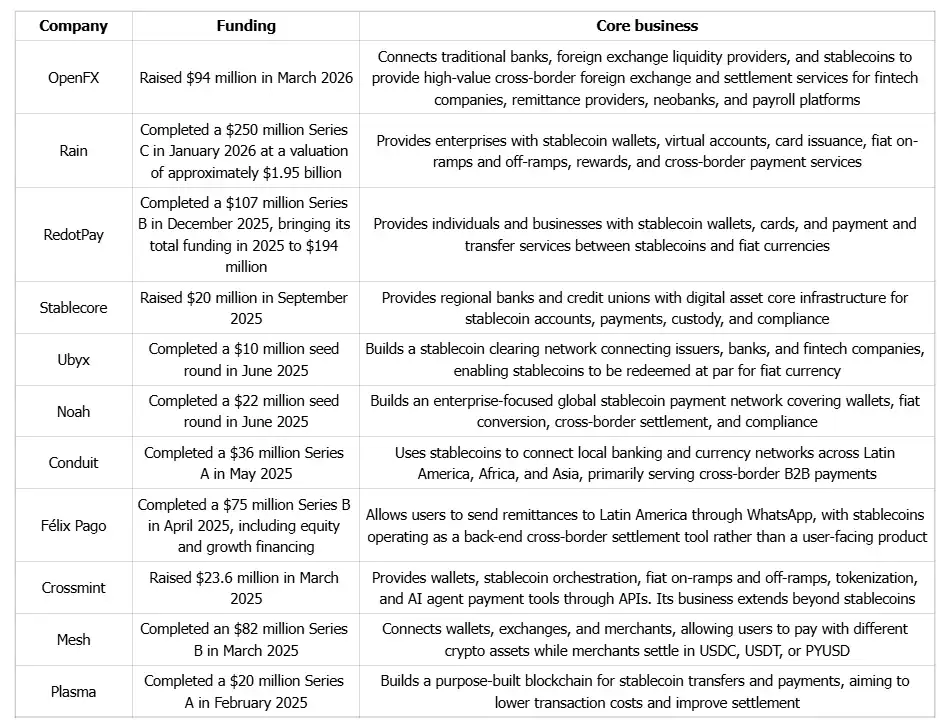
These companies demonstrate that stablecoin payments encompass several distinct business models.
Rain, RedotPay, and Félix Pago are closer to the application and distribution layer, solving how users remit, hold, and spend stablecoins. OpenFX, Conduit, and Noah focus on cross-border payments, FX liquidity, and international settlement. Mesh and Crossmint provide wallet and payment orchestration tools. Stablecore and Ubyx connect banks, issuers, and stablecoin clearing systems, while projects like Plasma attempt to redesign the underlying blockchain infrastructure supporting stablecoin payments.
Therefore, this wave of investment is not merely a bet on one particular stablecoin. It is a broader bet on infrastructure that will be indispensable if stablecoins are widely adopted as payment and settlement tools.
Capital is Favoring Companies with Tangible Business Metrics
Unlike early crypto companies that primarily relied on future narratives, stablecoin payment companies securing funding recently increasingly disclose transaction volume, customer numbers, and revenue.
Rain completed a $250 million Series C round in January 2026, about four months after its Series B and about ten months after its Series A. The company stated its active card users grew 30x in a year, and annualized payment volume grew 38x. Rain currently processes approximately $3 billion in annualized transaction volume for over 200 partners.
OpenFX completed a $23 million seed round in 2025 and raised another $94 million roughly ten months later. The company told Reuters its annualized payment volume had grown from $4 billion a year ago to over $45 billion. The company also said over 98% of transactions are completed within 60 minutes, compared to the two-to-five business days typical for traditional FX settlement.
RedotPay stated that as of November 2025, it had over 6 million registered users across 100+ markets. The company reported annualized payment volume exceeding $10 billion, annualized revenue over $150 million, and profitability.
Most of this data is self-reported and may not be independently audited. Definitions of payment volume, transaction volume, and annualized revenue may also differ between companies, making direct comparisons difficult.
Nonetheless, these disclosures reflect a broader shift. Stablecoin payment companies are attempting to prove their value with traditional fintech metrics, rather than relying solely on wallet addresses, token prices, and community size.
Why Are Stablecoin Payments Attracting VC Attention?
1. Persistent Inefficiencies in Cross-Border Payments
Traditional cross-border payments typically involve a sending bank, correspondent bank, clearing network, receiving bank, and local payment institution. Each participant operates according to its own business hours, ledger, and compliance processes. Settlement can therefore take several days.
Payment companies hoping to offer instant multi-country transfers may also need to pre-fund bank accounts in each market. Although funds are not yet used, they must be held in different jurisdictions to ensure timely customer withdrawals. This creates a heavy working capital burden.
Stablecoins cannot automatically solve every step of this process. But they can provide a unified settlement asset that operates 24/7. Payment companies can move stablecoins on-chain, then rely on local partners to convert them into local currency.
This applies to cross-border B2B payments, remittances, global payroll, and intra-company fund transfers. Faster settlement and lower pre-funding requirements directly create business value.
2. Relatively Clear Revenue Models for Payment Infrastructure
Stablecoin payment companies typically do not rely on token appreciation for revenue. Instead, they can charge transaction fees, FX spreads, card issuance fees, account management fees, API subscription fees, and fiat on/off-ramp fees.
These revenue models are not new. They are largely similar to those of traditional payment processors and fintech companies. The difference is that stablecoins are used as the backend settlement tool, reducing friction between countries, currencies, and financial institutions.
For VCs, this means companies can be evaluated with familiar metrics. For example, payment volume, net revenue, gross margin, customer retention, and cost per transaction. Compared to projects heavily dependent on market cycles and token prices, these businesses are easier to assess. They are also easier to explain to traditional tech and fintech investors.
3. Stablecoins Are Becoming an Invisible Backend Tool
Early stablecoin payment processes often required users to first buy stablecoins, transfer them to a wallet, and then find merchants willing to accept cryptocurrency. This required users to understand blockchain, wallet addresses, networks, and gas fees. This constituted a significant adoption barrier.
Companies securing funding recently are trying to hide these steps.
Félix Pago users can initiate remittances via WhatsApp. Rain and RedotPay connect stablecoins to payment cards. Mesh allows users to pay with one crypto asset while merchants receive another stablecoin. OpenFX primarily serves fintech and remittance companies; end-users may not even know settlement involves stablecoins.
Therefore, VCs are not necessarily betting that consumers will actively choose to pay with stablecoins. Instead, they are betting that stablecoins can replace parts of traditional payment and clearing processes in the background. Users may still use cards, bank accounts, local currency, or messaging apps.
4. Regulatory Changes Expand the Potential Customer Base
Previously, regulatory uncertainty limited the ability of banks and large payment institutions to adopt stablecoins.
Regulation increased costs associated with reserves, audits, AML controls, and licensing. Meanwhile, clearer rules make it easier for banks, businesses, and payment companies to determine which activities they can undertake.
For institution-facing companies like Stablecore, Ubyx, and Rain, regulatory clarity expands the potential customer base from crypto-native companies to banks, fintech platforms, and traditional enterprises.
This also helps explain why recent investor lists include not only crypto-native firms like Dragonfly, Galaxy Ventures, and Paradigm, but also traditional tech and fintech investors like ICONIQ, Accel, Lightspeed, QED Investors, and Norwest.
5. Payment Company Acquisitions Improve Exit Visibility
In February 2025, Stripe completed its acquisition of stablecoin infrastructure company Bridge. Media reports valued the deal at approximately $1.1 billion. Bridge helps businesses issue, manage, and transfer stablecoins. Stripe subsequently integrated these capabilities into its payment products.
In March 2026, Mastercard announced an agreement to acquire stablecoin infrastructure company BVNK for up to $1.8 billion, including $300 million in contingent consideration. BVNK connects stablecoins, fiat, banks, and multiple blockchains. It provides cross-border payment and settlement services for enterprises.
These acquisitions are important for VCs. Because potential exit paths for stablecoin payment companies are no longer limited to token launches or IPOs. They could also be acquired by card networks, payment companies, banks, or large fintech platforms.
These deals also prove the value of licenses, local banking relationships, and existing customer networks. Traditional payment companies can develop blockchain technology in-house. But building compliant operations and liquidity networks in multiple countries can take years. Acquiring a company that has already built such infrastructure can be faster.
Why Might the Stablecoin Payment Hype Be Overestimated?
Stablecoin payments present clear opportunities. But certain parts of the funding narrative may be exaggerated.
1. Stablecoin Transaction Volume Does Not Equal Payment Volume
On-chain stablecoin activity includes exchange transfers, market making, arbitrage, DeFi, smart contract interactions, institutional fund flows, and ordinary payments. Even after filtering out some bot activity and duplicate transactions, the remaining volume cannot all be categorized as payments for goods and services.
Visa previously pointed out that as of March 2025, retail-grade transactions accounted for less than 1% of adjusted stablecoin transaction volume over the prior 12 months.
Stablecoin transaction volume exceeding card network volume does not prove stablecoin payment activity has surpassed Visa or Mastercard. These data measure different types of activity and are not directly comparable.
2. Funding Concentrated in a Few Companies
Rain alone raised $250 million in a single round. RedotPay raised a total of $194 million in 2025. OpenFX raised $94 million in one round. A few large deals significantly inflate the sector's total funding amount. This does not mean every stablecoin payment startup can easily secure capital.
Rain, RedotPay, and OpenFX all report rapid growth. Investors are supporting companies that have already achieved some scale. Early-stage projects without licenses, local payment channels, or real customers still face a tough funding environment.
In other words, this looks more like capital concentrating toward market leaders, rather than a full-blown boom across the entire stablecoin payments industry.
3. Core Services May Commoditize Quickly
Technical barriers for wallets, stablecoin on/off-ramps, cross-border transfers, and payment APIs are falling. More and more companies can offer similar features. Banks, exchanges, stablecoin issuers, and traditional payment companies are also building their own products.
If multiple platforms can handle USDC or USDT transfers, merely offering an on-chain payment API may not create a lasting competitive advantage. Companies ultimately need to compete on licenses, local bank connections, FX pricing, payment success rates, risk control, customer service, and cost.
As competition intensifies, transaction fees and FX spreads may narrow. Payment volume growth won't automatically translate into high margins.
4. Global Expansion Still Requires Market-by-Market Landing
Blockchains can operate cross-border, but bank accounts, licenses, and fiat currencies are not automatically global.
Every stablecoin payment company entering a new market still needs to establish relationships with local banks, payment institutions, and liquidity providers. It must also comply with local KYC, AML, sanctions screening, data protection, and consumer protection requirements.
If a local bank terminates cooperation, or if on/off-ramp channels become unavailable, on-chain funds may have arrived. But they still cannot be converted into the fiat currency the customer needs.
Stablecoins primarily improve the intermediate settlement layer. They do not completely replace the traditional financial system.
5. Traditional Financial Institutions Are Both Customers and Competitors
Banks and card networks are currently investing in or acquiring stablecoin infrastructure companies. They want to gain these capabilities quickly. However, as technology and regulatory frameworks mature, these institutions may also build their own systems. They will also integrate stablecoin functionality into existing products.
Stripe, Visa, Mastercard, PayPal, and major banks already have merchants, accounts, trusted brands, and regulatory resources. Startups may become their suppliers or acquisition targets, but they could also be pushed into lower-margin backend service roles.
Where Might Capital Flow Next?
Recent funding activity suggests investment is shifting from issuing more stablecoins toward introducing stablecoins into bank, business, and user accounts.
Several areas may continue to attract attention.
The first is cross-border B2B payments. Compared to consumer payments, corporate transactions are larger in size and more sensitive to settlement speed, working capital needs, and FX costs. Businesses are also more willing to pay for measurable efficiency gains.
The second is connectivity between banks and stablecoins. The opportunity represented by Stablecore and Ubyx is enabling banks to receive, send, clear, and redeem stablecoins issued by different entities and operating on different blockchains.
The third is stablecoin-linked cards and local payments. Users don't need to find merchants that directly accept stablecoins. They can spend via existing card networks and acquiring networks. Successive fundraisings by Rain and RedotPay indicate that payment cards remain one of the most direct paths for stablecoins to enter everyday payment scenarios.
The fourth is multi-stablecoin, multi-chain orchestration layers. Businesses typically don't want to integrate USDT, USDC, multiple blockchains, and various national on/off-ramp providers separately. Platforms that can manage asset selection, routing, fees, compliance, and conversion through a unified interface may attract more institutional clients.
The fifth is AI agent payments. Processes like CAPTCHAs, card verification values (CVV), and manual authorizations in traditional payment systems are often not designed for AI agents. Stablecoin wallets and programmable payments can offer an alternative settlement mechanism.
However, this field is still largely driven by infrastructure development and expectations. Actual payment demand and revenue still need to be proven.
VC interest in stablecoin payments does not mean the crypto funding winter is over. It also does not mean stablecoins have replaced traditional payment systems on a large scale.
More accurately, as the funding environment tightens, investors are starting to look for a category of companies that can operate independently of token prices, solve real financial problems, and generate recurring revenue.
Stablecoins offer a globally programmable settlement asset that operates 24/7. The opportunity for startups lies in connecting stablecoins to bank accounts, FX markets, payment cards, local currencies, and compliance systems.
The next stage of valuation will depend not only on funding rounds or on-chain transaction volume. It will also depend on how much of that volume represents real customer payments and how much net revenue it generates. It depends on how many regulated markets a company can enter and whether it remains profitable after deducting liquidity, distribution, and compliance costs.
Crypto VCs are not necessarily betting that one particular stablecoin will win. They are betting that the vast infrastructure needed to integrate stablecoins into the real-world financial system is not yet fully built and mature.