pump.fun's New Feature Brings 'Black Mirror' Into Reality

marsbitPubblicato 2026-06-16Pubblicato ultima volta 2026-06-16

Introduzione

The article begins by recounting a dark fictional story from *Black Mirror* (Season 7, Episode 1 "Common People"), where a man is forced to perform humiliating tasks online to pay for his wife's life-sustaining medical subscription. It then draws a parallel to a new real-world feature on the crypto platform pump.fun called "Pump.fun Go," which allows users to post and complete paid bounty tasks. This feature gained mainstream attention, often negatively, through extreme examples. A prominent case involved a bounty of 40 SOL (~$2,600) offered to permanently tattoo "$bountywork" on one's forehead. An Indian man completed the task, stating the money "changed his life," and later earned significantly more from a related meme coin. Another bounty paid 200 SOL (~$14,000) for a "bounty.fun" forehead tattoo, with the participant simply stating, "We need the money." The article highlights how this system can amplify darkness, citing the dev behind $Bountywork who spent thousands on bounties for attention-grabbing stunts like eating bugs or drinking hot sauce for small sums. It compares this to past tragic live-streaming incidents where people harmed themselves for money, noting regulation cannot stop those in desperate need. However, it also points to positive, altruistic bounties that have emerged, such as organizing anti-work rallies in New York, performing random acts of kindness for strangers, organizing community food drives, or even helping an elderly person cross the street....

Black Mirror Season 7, Episode 1, "Common People," tells this story:

Mike, a welder, and Amanda, a teacher, are a loving couple trying to conceive. Unfortunately, Amanda is diagnosed with an inoperable brain tumor.

Tech company Rivermind offers a solution: replace the damaged parts with synthetic brain tissue. The surgery is free, but Amanda's life thereafter will depend on the company's servers, with a monthly subscription fee of $300. With no other choice, Mike signs the agreement.
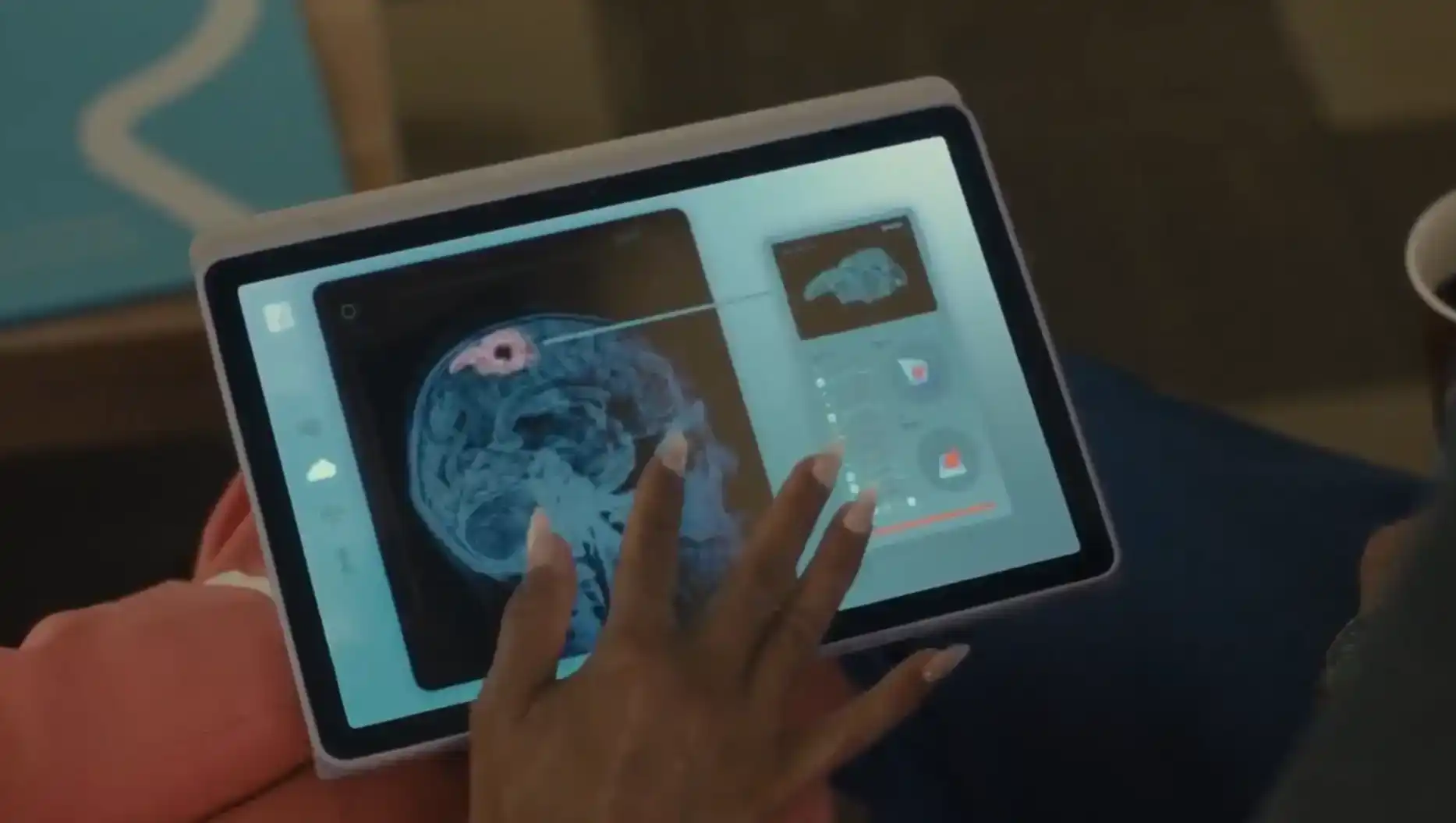
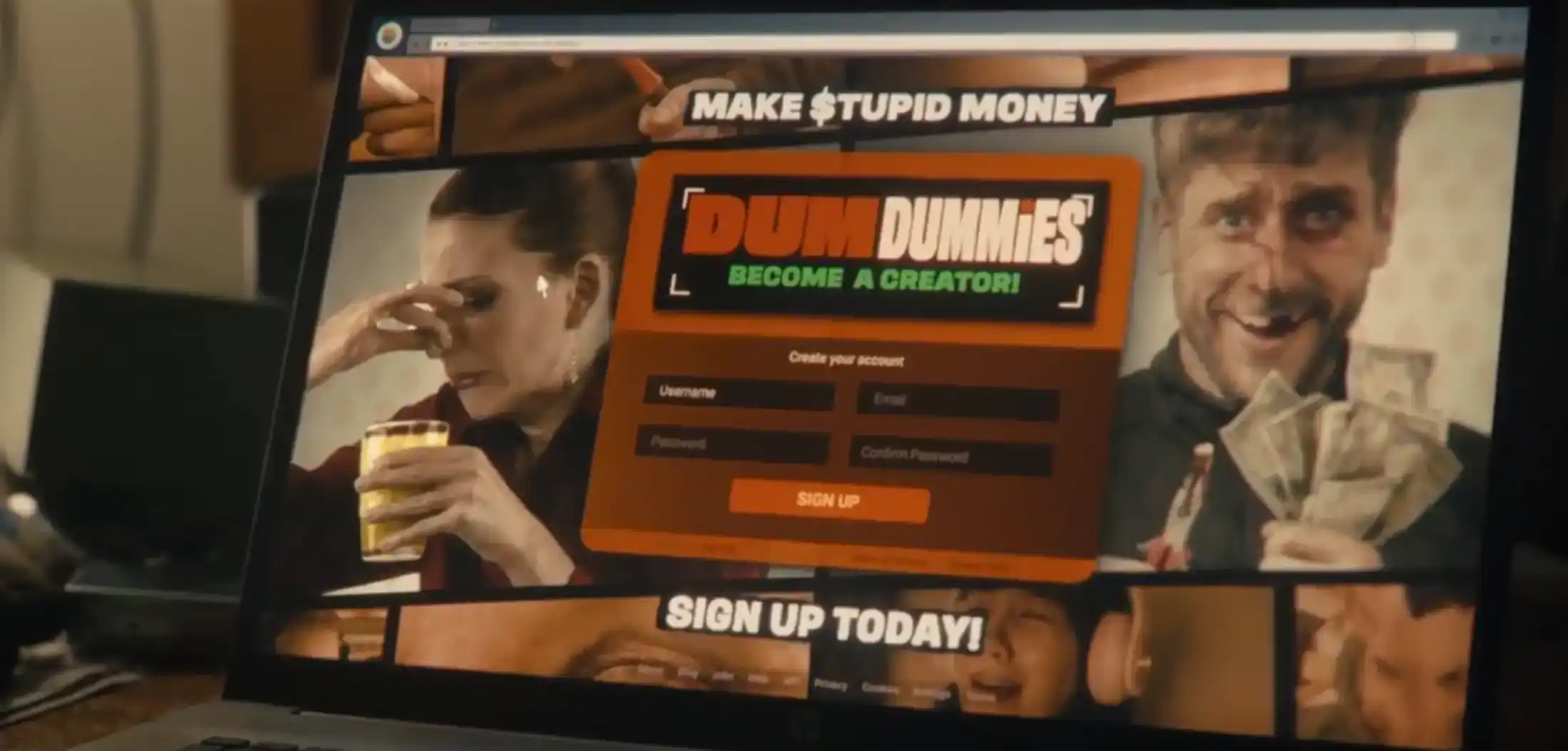
However, the subscription fees keep rising, and when Amanda is conscious, advertisements are involuntarily inserted. To secretly raise money, Mike starts live-streaming on the "Dum Dummies" platform—a website where viewers pay to instruct streamers to perform various humiliating tasks.
When exposed by a colleague, Mike loses his job, and the couple is plunged into despair.

A year later, Mike can no longer afford the premium service that maintains his wife's life. Amanda sleeps 16 hours a day, and her occasional awakenings are only to broadcast ads. Mike uses his last savings to buy 30 minutes of the premium package, allowing Amanda to leave her final words in brief peace.

When the time expires, Mike personally ends Amanda's life. The final shot freezes on the still-live laptop screen, with Mike holding a box cutter, walking into the darkness.

Being forced to sell one's dignity for the right to survive is the aspect that feels most chilling and oppressive in this episode. Therefore, when pump.fun launched a new feature called "Pump.fun Go" earlier this month, many couldn't help but think of this episode.

The story of Black Mirror is not far from our lives; it has even entered them.

$2,600 Is the Price of a Forehead Tattoo

The new pump.fun GO feature allows anyone to post paid bounty tasks on pump.fun.

This did attract the attention of mainstream media, but unfortunately, it touched the public in a negative light yet again.

$Bountywork, a token whose market cap once approached $2.5 million at its peak. Its developer, @ayushquantt, focused on continuously posting new tasks on pump.fun to generate hype for this token.

He succeeded—by offering a bounty of 40 SOL (approximately $2,600) for someone to tattoo $bountywork on their forehead.

An Indian man actually got the tattoo:
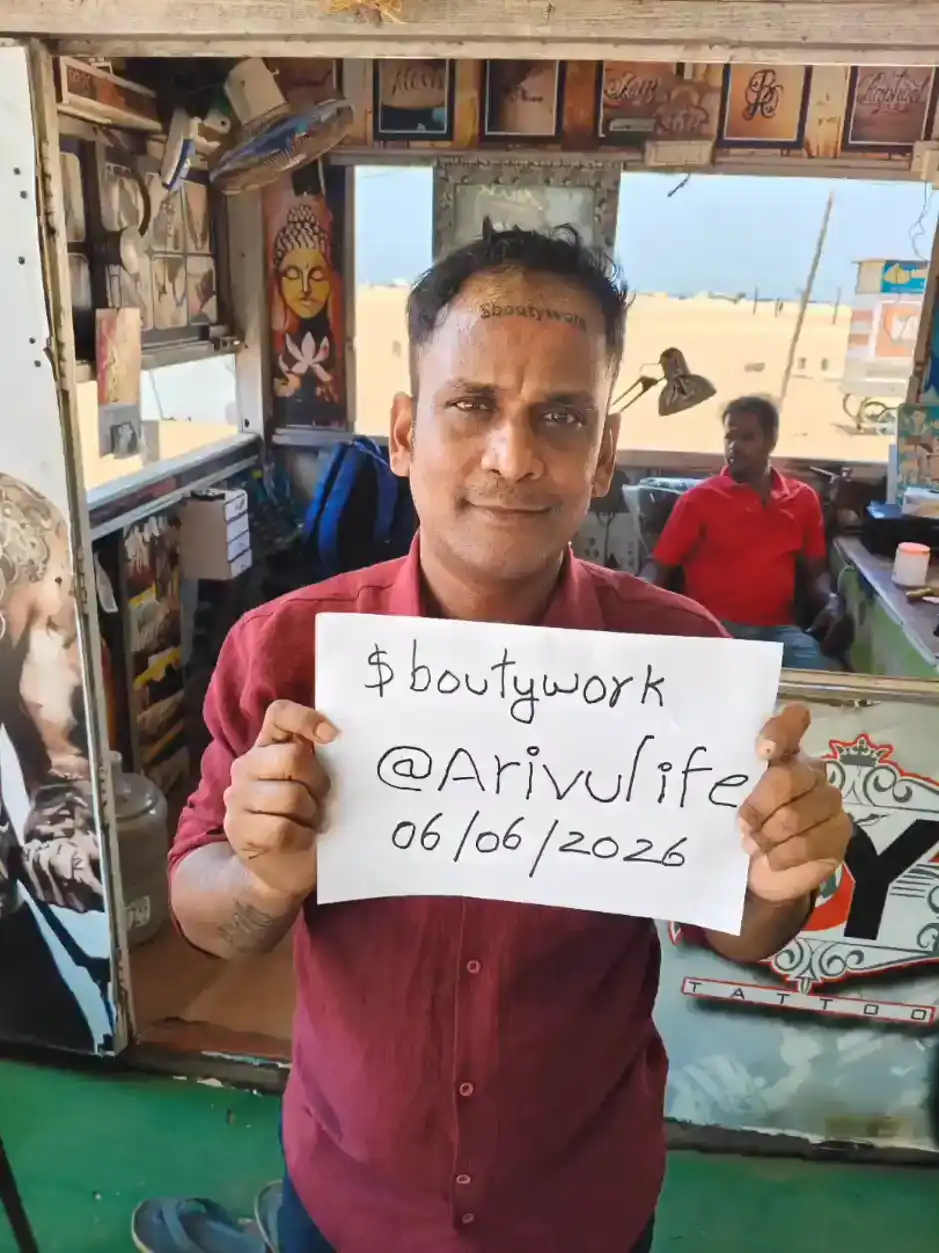
When submitting the full video of his tattooing process for bounty approval, he wrote in his remarks:

"Getting a permanent tattoo on the forehead, which will last a lifetime, is not an easy decision. The process itself was painful. It bled, and I had to endure the discomfort to complete it."

But his submission was rejected by the bounty poster due to a typo in the description—missing an 'n', writing the ticker as $boutywork. And this Indian man had precisely followed the requirements as described.

So, the next day, he went back to add a tattoo of the letter 'n':

This time, he successfully received the bounty. $2,600 is the price of a forehead tattoo. He said this money changed his life.

But he earned far more than just that $2,600. After his initial bounty approval request was rejected, someone sent him a token called $boutywork, using the incorrect tattoo as the new token's name.

Because the incident had enough traction, this token accumulated over $5 million in trading volume. The creator's revenue from transaction fees was given to him, so he ended up earning about $48,000 in total.

And this wasn't even the highest single bounty earned for completing a tattoo task on pump.fun. Another bounty task posted by @Perporseful, also requiring a forehead tattoo with "bounty.fun," was completed on the same day it was posted. The person eventually received a bounty of 200 SOL (approximately $14,000).
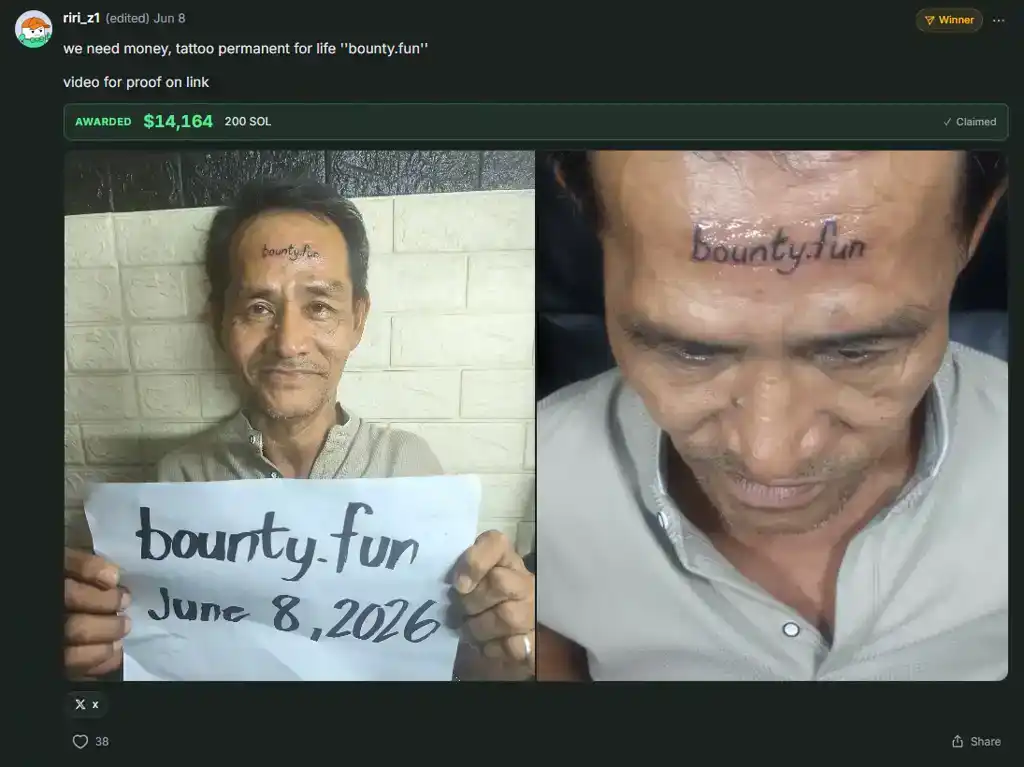
When submitting his tattoo proof for bounty approval, his remark was simple:

"We need money."

Priced Freedom Easily Amplifies Darkness

The hype around the Indian man's forehead tattoo has faded, and $boutywork has basically gone to zero. But the $Bountywork developer is still posting new bounties, trying to replicate this "success." For example, making someone wear a $Bountywork shirt and eat 3 bugs on camera.

Even though the bounty is only 2.5 SOL (about $178), not particularly generous, in the face of "We need money," this is hardly a challenge:

To continuously generate traffic for the $Bountywork token, @ayushquantt has spent $4,500 on various bounties. Besides the bug-eating challenge, there's also one like wearing a $Bountywork shirt and drinking a bottle of hot sauce for a bounty of 1.4 SOL (about $100):
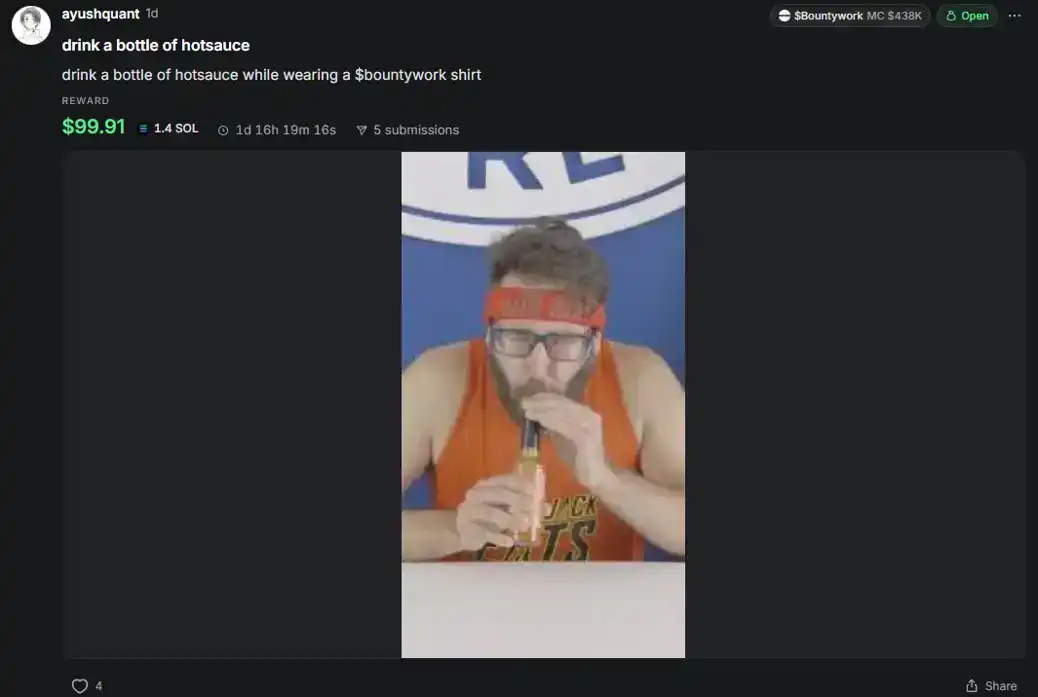
But he has also posted some relatively normal or even heartwarming bounty tasks. For example, gifting a $50 gift card in the name of $Bountywork to someone in need, with a bounty of 1.5 SOL (about $107):
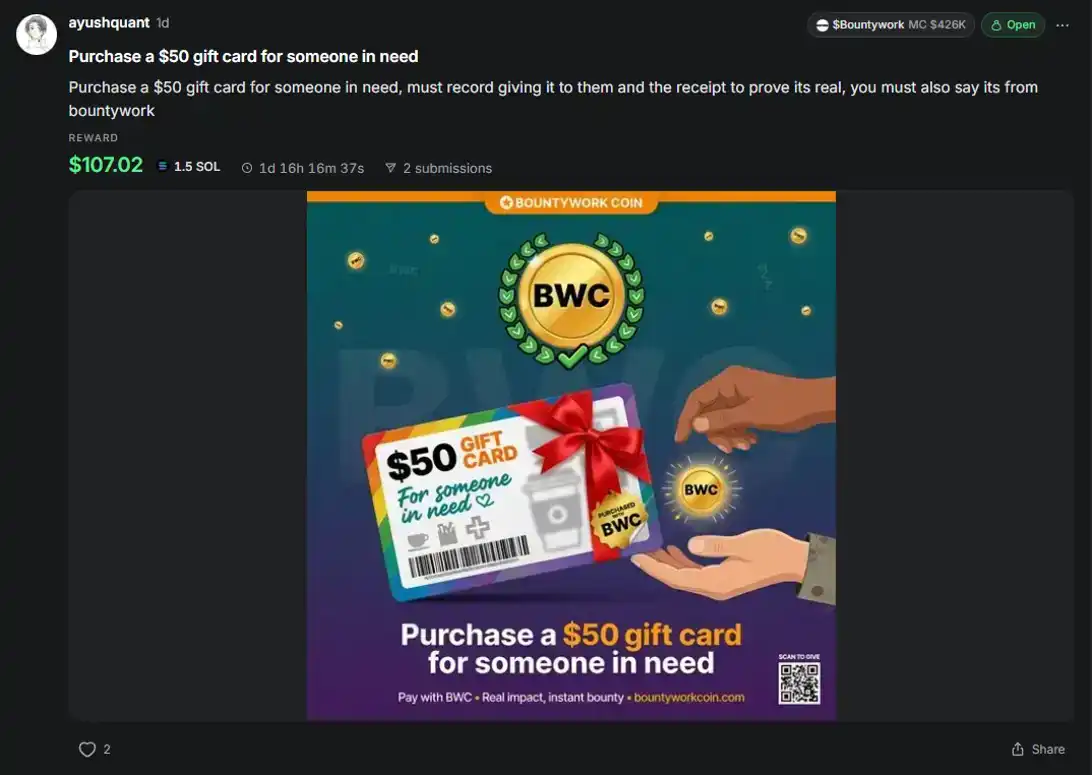
It's difficult to judge the morality of such actions or even the new pump.fun feature. What's very obvious is that gifting a $50 gift card to someone in need barely creates a ripple in terms of traffic, but eating bugs or drinking hot sauce on camera is much more likely to gain attention.

I don't think this means "in an era where traffic equals money, we have all become slaves to traffic." Freedom often reveals itself in a raw, naked form; it's just that you and I have been 'protected' too well. We wouldn't get a forehead tattoo for $2,600 simply because we can still endure monthly salaries of a few thousand, venting our dissatisfaction with work and overtime in group chats and short video apps.

The Black Mirror episode mentioned at the beginning has long entered real life. During the 'wild west' era of live streaming, LiaoLiao Voice was once a popular platform. On December 31, 2018, a streamer with the online name "Da Fei," persuaded by the chat room host Wang and egged on by viewers, consumed a large amount of alcohol again and died of sudden cardiac arrest while out after drinking. In the three months before the incident, "Da Fei" had been live-streaming drinking every day, often drinking alcohol or soybean oil to earn tips.

In one of "Da Fei's" past live streams, he once said after drinking that he couldn't take it anymore and started convulsing. At that time, viewers in the chat room were still egging him on, "Pour what you vomited on your head, add another $300."

Others shouted, "LiaoLiao is finally going to have a death." Unexpectedly, it eventually came true.

Even in 2023-2024, with live streaming regulations becoming more mature, we can still find many cases of deaths due to excessive drinking during PK battles or binge-eating in mukbang streams.

"Desperate for fame," "Why go to such lengths for money?"—these are the final legacies these streamers leave for the internet, topics for after-dinner chatter, gradually disappearing into the massive daily data updates of the internet. Regulatory norms can indeed curb the excessive commodification of people by money, but ultimately cannot stop those on pump.fun who are willing to tattoo their faces for a few thousand dollars.

Because they really need the money.

Light in the Darkness

Although many bounties on pump.fun resemble Black Mirror or the dark web, you can also find some interesting and heartwarming things.

Organize a gathering in New York for people resisting work, promoting "Work is a scam," bounty $15,865. This is the kind of event that energizes a wage slave like me:
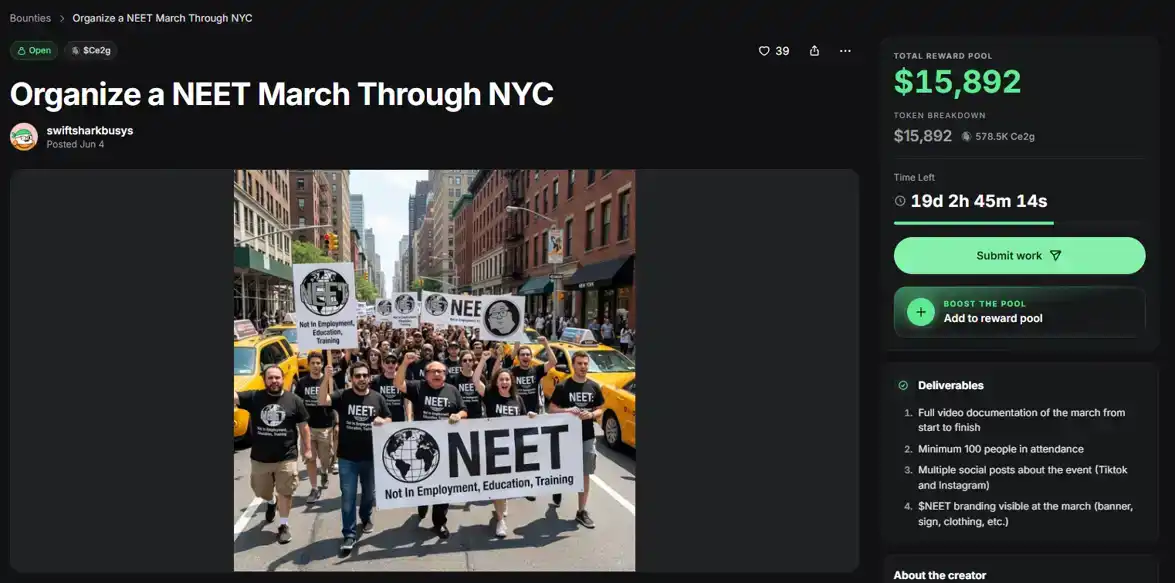
The $neet community has previously self-organized two offline "No Work Gatherings" in the US. If this bounty is completed, it will be the third.

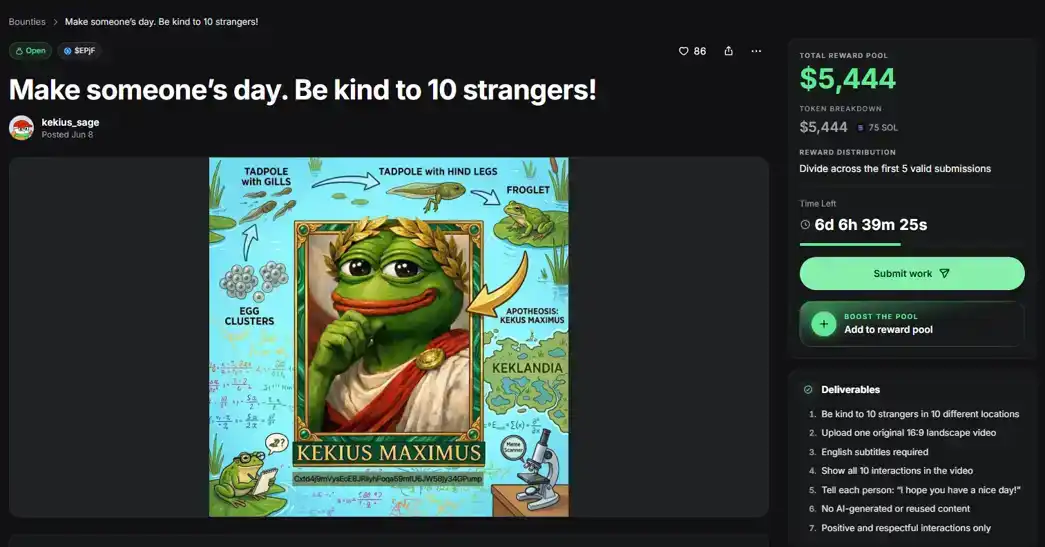
Show kindness to 10 strangers to make their day better. The bounty poster did not specify the method—treat them to a meal, give them flowers, books, buy them coffee, tell them to have a good day. The five best videos each receive a $1,000 bounty:
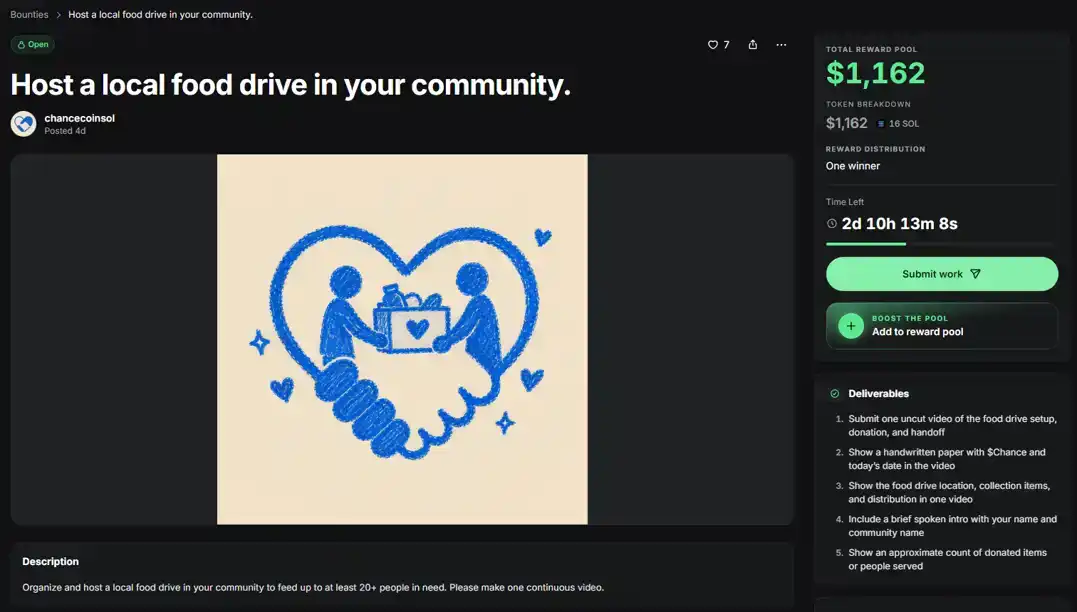
Organize a charity food donation in your local community, providing food to at least 20 people in need, bounty $1,161:
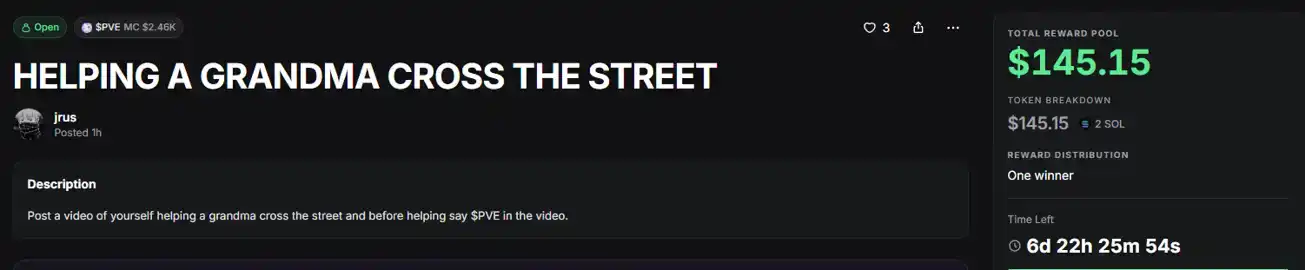
There's even one for helping an old lady cross the street, bounty $145:
The world is vast and full of wonders. We cannot escape the darkness; we can only hope for more light.


Domande pertinenti

QWhat is the core function of the new 'Pump.fun Go' feature mentioned in the article, and what real-world phenomenon does it draw a parallel to?

AThe 'Pump.fun Go' feature allows anyone to post and complete paid bounty tasks on the pump.fun platform. The article draws a parallel to the fictional dystopian reality presented in the Black Mirror episode 'Common People', where people are forced to trade their dignity for survival, as well as to real-world extreme live-streaming phenomena where individuals perform degrading or dangerous acts for money.

QAccording to the article, how much money did the Indian man earn in total from the '$bountywork' tattoo incident, and what were the sources?

AThe Indian man earned a total of approximately $48,000. This came from two sources: the initial 40 SOL (around $2,600) bounty for tattooing the correct '$Bountywork' on his forehead, and the creator fees from trading a separate meme coin named '$boutywork' (the incorrect spelling) that was launched based on the incident's viral attention.

QBeyond shock-value stunts like tattooing and eating insects, what are some examples of positive or socially beneficial bounty tasks found on pump.fun mentioned in the article?

AExamples of positive bounty tasks mentioned include: organizing a rally in New York for people rejecting work; performing acts of kindness for 10 strangers; organizing a community food donation for at least 20 people in need; and helping an elderly person cross the street.

QWhat real-life tragedy from the early days of live streaming does the article reference to illustrate that the 'Black Mirror' scenario is not just fiction?

AThe article references the 2018 case of a streamer nicknamed 'Da Fei' on the 'Liaoliao' platform. He frequently livestreamed heavy drinking to earn tips and eventually died of alcohol poisoning after being egged on by his audience and the chat room host.

QWhat is the article's implied critique regarding why some people are willing to perform extreme acts for relatively small bounties on platforms like pump.fun?

AThe article implies that the primary driver is genuine financial desperation, encapsulated in the simple submission note 'We need the money.' It suggests that societal judgment often overlooks this underlying economic necessity, framing such acts merely as a quest for fame or a sign of being 'crazy for attention,' when for some, it's a matter of survival.

Letture associate

The Foundation of SpaceX's Trillion-Dollar Valuation: Who is Dividing Up Musk's Annual Tens of Billions in Capital Expenditure?

SpaceX's trillion-dollar valuation is built on its three core businesses: Starlink (profitable, 60% of revenue), rockets (driving down launch costs), and AI (a major investment area). This creates a financial cycle: Starlink funds rocket development, which enables low-cost launches for AI hardware, generating future revenue. This cycle fuels annual capital expenditures of tens of billions, flowing to a vast supply chain. Suppliers are categorized by their replaceability. The first group includes irreplaceable players like NVIDIA (GPU/CUDA ecosystem), Eutelsat (critical radio spectrum), Filtronic (specialized amplifiers), Materion (strategic beryllium), and STMicroelectronics (antenna chips). The second group consists of hard-to-replace suppliers due to high switching costs, such as Honeywell (flight control), Carpenter Technology (specialty alloys), Hexcel (carbon fiber), Broadcom (data exchange), and Linde (industrial gases). The third group comprises high-volume, cost-critical suppliers for mass-produced items like Starlink terminals. Key names include Wistron NeWeb (primary manufacturer) and several A-share companies like Shenzhen Sunway (connectors), Pies New Materials (forgings), Western Superconducting (alloys), and Yingliu (castings). Other niche players include Trimble (timing), Astronics (power distribution), and CTS (thermal management). The article argues that investing in these suppliers, rather than SpaceX stock directly, offers an alternative opportunity. The rationale is threefold: procurement is just beginning to scale, SpaceX's IPO brings new transparency to its supply chain, and the situation mirrors early stages of past "super terminal" ecosystems like Apple or Tesla. While risks exist (commodity cycles, geopolitical factors, technology shifts), the core thesis is that SpaceX's massive, ongoing procurement will translate into reliable revenue for its key suppliers, regardless of its own stock price volatility.

marsbit27 min fa

The Foundation of SpaceX's Trillion-Dollar Valuation: Who is Dividing Up Musk's Annual Tens of Billions in Capital Expenditure?

marsbit27 min fa

SpaceX's Trillion-Dollar Valuation Base: Who's Sharing in Musk's Annual Tens of Billions in Capital Expenditure?

**Title: The Foundation of SpaceX's Trillion-Dollar Valuation: Who Benefits from Musk's Annual $100 Billion Capital Expenditure?** This article argues that investors seeking to benefit from SpaceX's growth might find greater opportunities in its supply chain rather than directly investing in the company itself, drawing parallels to historical successes with Apple, Tesla, and NVIDIA suppliers. **SpaceX's Business Model & Cash Flow:** SpaceX generates revenue from three main areas: 1. **Starlink:** Its profitable core, earning $11.3B in 2023 (60% of revenue), funding other ventures. 2. **Rockets (Falcon/Starship):** Requires $3B+ in annual R&D but achieves the world's lowest launch costs. 3. **AI:** Currently unprofitable (-$6B+ in 2023), investing heavily in ground-based supercomputers (220,000 GPUs) and future orbital data centers. The cycle is: Starlink profits → fund cheaper rockets → low-cost launches deploy AI hardware → AI compute rentals generate future revenue. This cycle drives annual procurement spending of tens of billions of dollars. **The Supply Chain Beneficiaries:** Suppliers are categorized by their replaceability: **1. Nearly Irreplaceable (High Barriers to Entry):** * **NVIDIA:** Powers the Colossus supercomputer; its CUDA ecosystem creates immense switching costs. * **Eutelsat (SATS):** Controls critical radio spectrum for satellite communications; holds a ~3% stake in SpaceX. * **Filtronic (FTC):** Supplies millimeter-wave signal amplifiers for Starlink satellites; SpaceX constitutes 83% of its revenue. * **Materion (MTRN):** Global leader in beryllium production, a strategic material used in Starship structures. * **STMicroelectronics (STM):** Supplies phased-array antenna chips for Starlink satellites. **2. Replaceable, but Switching Cost is Prohibitively High:** * **Honeywell (HON):** Provides flight control and inertial navigation systems with decades of certification. * **Carpenter Technology (CRS):** Manufactures ultra-pure specialty steel alloys for Raptor engines. * **Hexcel (HXL):** Supplies custom carbon fiber composites developed over a decade with SpaceX. * **Broadcom (AVGO):** Manages high-speed data switching. * **Linde Group:** Supplies industrial gases (liquid oxygen/nitrogen) from facilities built near SpaceX launch sites. **3. High-Volume, Cost-Critical Manufacturing:** Focuses on mass-producing components like Starlink user terminals (target: 30 million units). * **Key Players:** Wistron NeWeb (6285, primary terminal manufacturer), several Chinese A-share companies (e.g., Sunway Communication, PAX New Materials, Western Metal Materials, Yingliu Co.), and smaller US firms like Trimble (TRMB, timing systems). **Why Now?** Three factors make the supply chain opportunity timely: 1. **Volume Ramp-Up:** SpaceX plans 100 launches in 2026, aims for 30 million Starlink terminals, and will deploy AI data centers, meaning procurement will accelerate. 2. **Increased Transparency:** The IPO provides public financial data, allowing investors to track supplier order growth. 3. **Historical Precedent:** The current phase is likened to Tesla's early mass-production stage (circa 2018), suggesting a long growth runway for suppliers. **Conclusion:** The article posits that while investing in SpaceX stock is betting on Elon Musk's ambitious vision at a high valuation, investing in its established suppliers is a bet on the tangible, recurring revenue from its massive procurement budget, which is largely decoupled from day-to-day stock price volatility.

链捕手30 min fa

SpaceX's Trillion-Dollar Valuation Base: Who's Sharing in Musk's Annual Tens of Billions in Capital Expenditure?

链捕手30 min fa

The U.S. Government Blocked the Anthropic Model. It Wasn't About 'Jailbreaking' at All.

Last Friday, the U.S. Commerce Department issued an enforcement letter that forced Anthropic to take its two most advanced AI models, Fable 5 and Mythos 5, offline. The stated reason was unspecified national security concerns, initially linked to potential "jailbreaks" of the models' safeguards. However, new details suggest the action stemmed more from a deteriorating relationship between the Trump administration and Anthropic, rather than a genuine technical threat. According to reports, the government cited a little-known export control regulation, compelling Anthropic to block access for all non-U.S. persons, including its own international employees. The company complied, shutting down the models without a court order or specific technical details from the government. Cybersecurity expert Katie Moussouris revealed she was privately shown a research paper detailing a potential safeguard bypass in Fable 5. She argued the described method was minor and did not warrant an export ban, stating that attempts to "fix" it would only weaken the model's defensive capabilities. Moussouris and other experts have since called for the order to be revoked, warning it dangerously removes advanced cybersecurity tools from U.S. defenders. Analysts like Justin Hendrix suggest the move appears retaliatory and sets a dangerous precedent, signaling that the U.S. government can unilaterally shut down a tech company's products. The incident has raised concerns about the reliability of American AI and the potential for political interference in the tech industry, serving as a warning to the broader sector.

marsbit34 min fa

The U.S. Government Blocked the Anthropic Model. It Wasn't About 'Jailbreaking' at All.

marsbit34 min fa

Ray Dalio: AI Bull Market Continues to Soar, Should Investors Go All In or Cash Out and Leave the Field?

In his latest notes, Ray Dalio addresses a critical question for investors amid the AI-driven stock market surge: how should one allocate assets during a transformative technological revolution? Dalio emphasizes that technological advancement does not automatically make related stocks attractive. Historical tech cycles—marked by excitement, crowding, volatility, and eventual shakeouts—show that even long-term winners like Microsoft and Apple experienced severe drawdowns. Today's AI sector faces similar uncertainties: overinvestment, intensifying competition, geopolitical tensions (e.g., Taiwan's chip supply), tax policy shifts, anti-AI sentiment, and potential disruption from future technologies like quantum computing. Dalio's core argument focuses on the highly concentrated market structure, where a few tech giants dominate major indices. He warns investors against unknowingly holding concentrated, correlated exposures. Instead of chasing a handful of AI leaders, he advocates for a robust, diversified portfolio of 15 or more high-quality, uncorrelated investments, risk-balanced to match an investor's volatility tolerance. Mathematically, such diversification significantly improves the risk-return ratio—for example, holding 15 uncorrelated assets can boost the ratio by over four times compared to a single concentrated bet. Dalio cautions that future equity returns appear low, with his bubble indicator suggesting real returns could be negative over the next 5-10 years. He stresses that knowing what you don't know is as important as knowing what you do. In an environment of high uncertainty and concentration, avoiding large, concentrated bets on AI stocks is prudent. The optimal strategy is disciplined diversification—the "holy grail" of investing—to navigate this technologically driven cycle with lower risk and comparable or better returns.

marsbit38 min fa

Ray Dalio: AI Bull Market Continues to Soar, Should Investors Go All In or Cash Out and Leave the Field?

marsbit38 min fa

Trading

Spot
Futures

Articoli Popolari

Come comprare PEOPLE

Benvenuto in HTX.com! Abbiamo reso l'acquisto di ConstitutionDAO (PEOPLE) semplice e conveniente. Segui la nostra guida passo passo per intraprendere il tuo viaggio nel mondo delle criptovalute.Step 1: Crea il tuo Account HTXUsa la tua email o numero di telefono per registrarti il tuo account gratuito su HTX. Vivi un'esperienza facile e sblocca tutte le funzionalità,Crea il mio accountStep 2: Vai in Acquista crypto e seleziona il tuo metodo di pagamentoCarta di credito/debito: utilizza la tua Visa o Mastercard per acquistare immediatamente ConstitutionDAOPEOPLE.Bilancio: Usa i fondi dal bilancio del tuo account HTX per fare trading senza problemi.Terze parti: abbiamo aggiunto metodi di pagamento molto utilizzati come Google Pay e Apple Pay per maggiore comodità.P2P: Fai trading direttamente con altri utenti HTX.Over-the-Counter (OTC): Offriamo servizi su misura e tassi di cambio competitivi per i trader.Step 3: Conserva ConstitutionDAO (PEOPLE)Dopo aver acquistato ConstitutionDAO (PEOPLE), conserva nel tuo account HTX. In alternativa, puoi inviare tramite trasferimento blockchain o scambiare per altre criptovalute.Step 4: Scambia ConstitutionDAO (PEOPLE)Scambia facilmente ConstitutionDAO (PEOPLE) nel mercato spot di HTX. Accedi al tuo account, seleziona la tua coppia di trading, esegui le tue operazioni e monitora in tempo reale. Offriamo un'esperienza user-friendly sia per chi ha appena iniziato che per i trader più esperti.

449 Totale visualizzazioniPubblicato il 2024.12.12Aggiornato il 2026.06.02

Come comprare PEOPLE

Discussioni

Benvenuto nella Community HTX. Qui puoi rimanere informato sugli ultimi sviluppi della piattaforma e accedere ad approfondimenti esperti sul mercato. Le opinioni degli utenti sul prezzo di PEOPLE PEOPLE sono presentate come di seguito.

活动图片