Quantum Threat Becomes Key Narrative, Privacy Coin Sector Defies Trend with Capital Siphon

比推Pubblicato 2026-01-29Pubblicato ultima volta 2026-01-29

Introduzione

Quantum Threat Emerges as Key Narrative, Privacy Coins Defy Market Downturn with Capital Inflow Privacy coins like ZEC, XMR, and DASH have surged significantly since September 2025, outperforming the broader crypto market. ZEC rose from around $50 to over $700 in two months, a 12x return, despite a post-halving correction. Monero (XMR) climbed from $300 to a record $800, bolstered by its decentralized nature and real-world usage, even after being delisted from 73 exchanges. Dash also saw a 7x increase, peaking at $150 before settling around $62. A major catalyst is growing concern over quantum computing threats to Bitcoin. Although experts believe quantum computers cannot yet break Bitcoin's ECDSA algorithm by 2026, fears have driven institutional and whale investors toward privacy coins, which use zero-knowledge proofs and ring signatures to resist quantum attacks. Reports indicate large-scale fund shifts from BTC to privacy assets, with ZEC and XMR attracting significant hedging interest. Market dynamics and high-profile endorsements, such as from Arthur Hayes, have amplified the trend. Additionally, privacy coins are being used to launder stolen funds, with one day seeing $282 million in mixed Bitcoin transactions. While Bitcoin market remains stagnant around $85,000, privacy coins continue to benefit from both quantum anxiety and practical demand for anonymity. The sector's future may depend on broader market recovery and macroeconomic factors, including Fed policy and...

Author: Ma He, Foresight News

Original Title: Under the Quantum Threat, Are Privacy Coins About to Break the "Last Dance" Curse?


Privacy coins use zero-knowledge proofs, ring signatures, or coin mixing technology to ensure untraceable transactions. Against the backdrop of increasing global regulation, they have become the preferred choice for investors seeking refuge and privacy.

Starting from September 2025, the privacy coin sector began to break away from the broader market's slump and entered an accelerated upward trend.

Taking ZEC, the leading coin in the privacy sector surge, as an example, its price was around $50 in October 2025. Within just 2 months, it broke through $700, yielding a return of over 12 times.
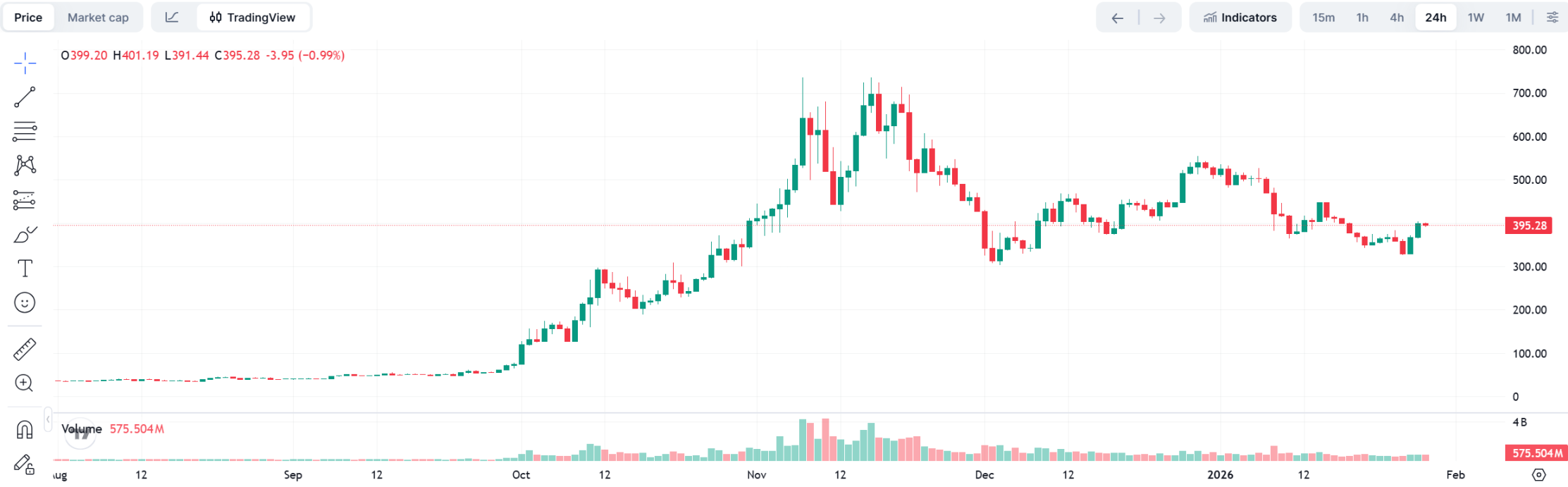
This trend is not an isolated case but a sector-wide explosion.

On November 18th, after the ZEC halving event, which reduced the block reward from 3.125 coins to 1.5625 coins, the price experienced short-term fluctuations before starting to decline and hover erratically.

Monero (XMR), the "big brother" of privacy coins, also showed a strong performance. From around $300 at the end of 2025, it skyrocketed to a high of $800, setting a new historical record.
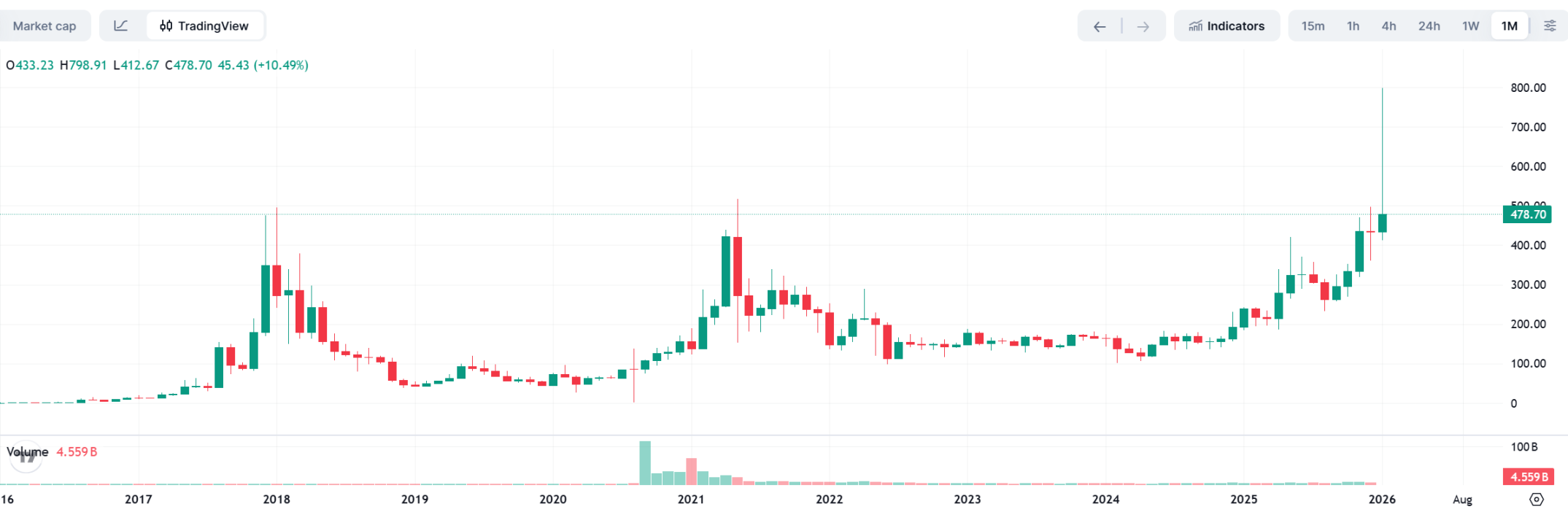
Unlike ZEC's halving-driven rise, XMR's increase relies more on its inherent decentralized nature and actual adoption rate. Despite being delisted from 73 exchanges previously, XMR's transaction volume grew against the trend, with a single-day mixing volume of stolen BTC reaching $282 million, proving the reliability of its privacy technology.

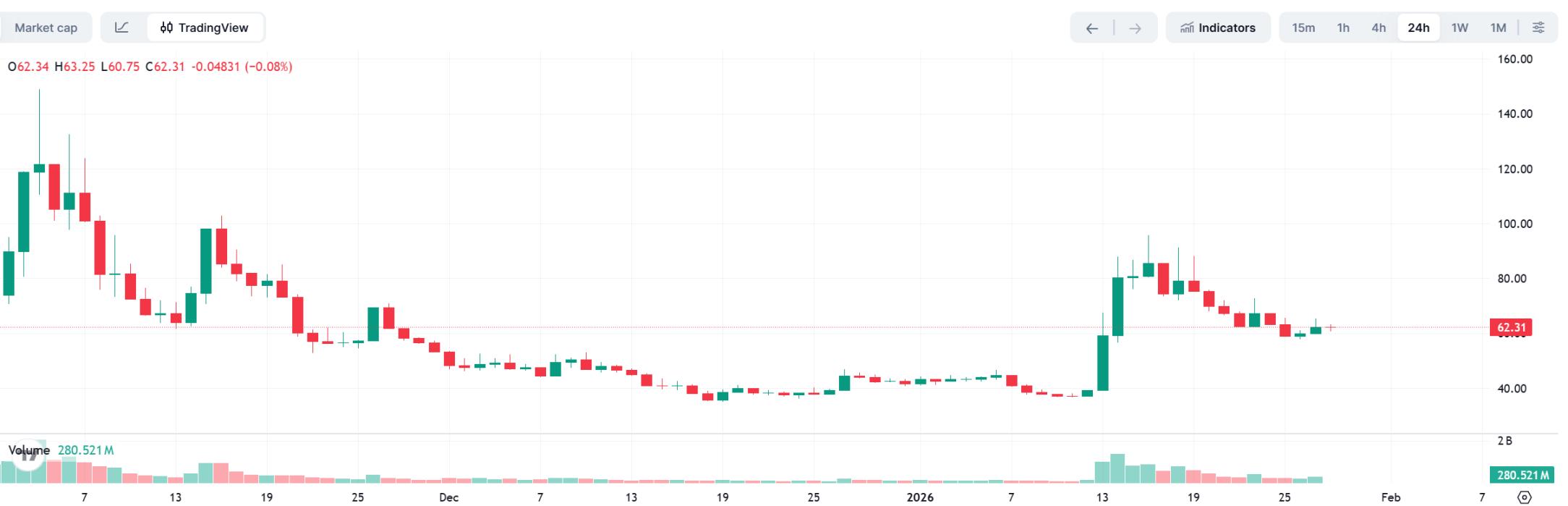
Another privacy coin, DASH, rose from nearly $20 to a high of $150, an increase of over 7 times, and has currently pulled back to $62.
Quantum Computing Threat and the Rise of the Privacy Narrative

The potential threat of quantum computing to Bitcoin became a significant catalyst for the surge in privacy coins from late 2025 to early 2026. Although experts generally believe that quantum computers cannot practically crack Bitcoin's ECDSA signature algorithm by 2026, this risk has already sparked market panic, driving capital away from BTC and towards privacy coins with better quantum resistance.

According to a report by Grayscale Research, although quantum computing is seen as a "false threat to the 2026 market," it amplified investors' concerns about exposed Bitcoin public keys in Q4 2025, leading institutional funds to reassess risk exposure and shift towards coins like ZEC and XMR. These privacy coins use zero-knowledge proofs and ring signature technology, which can better resist Shor's algorithm attacks and theoretically provide higher long-term security.

A CoinDesk report showed that the quantum upgrade discussed at the Bitcoin developer conference in December 2025 would take 5-10 years. During this window, whale investors moved hundreds of millions of dollars from BTC to privacy coins.

Secondly, market rotation and the amplification effect of capital inflows. In Q4 2025, the overall crypto market corrected, but privacy coins rose against the trend, attracting whales and large funds. BitMEX co-founder Arthur Hayes heavily invested in ZEC through the Maelstrom fund, calling it the "next BTC."

Additionally, multiple hacking incidents in 2025 (involving billions of dollars in theft) prompted funds to turn to privacy coins: stolen BTC was quickly converted to XMR, with a single-day mixing volume reaching $282 million. A CoinDesk report pointed out that 80% of privacy coins rose in 2026, with 14 out of 18 coins doubling in market capitalization.

Arthur Hayes warned that the "quantum ghost" would accelerate the privacy supercycle, predicting that ZEC and XMR would attract more hedging funds in 2026.

With the strong rise of privacy coins, some investors are happy while others are worried. Past market trends have often seen privacy coins gradually fade after their "last dance."

Wintermute stated that BTC's current price range shows fatigue, but the market structure is not bearish; instead, it is in a stalemate. The $85,000 support level has been tested multiple times—it is either a solid bottom or a trap waiting to be sprung. Although U.S. fund flows show net outflows and volatility continues to compress, this support level has held, indicating buying interest below (albeit mild). Gold is playing the role that Bitcoin should be playing. The stock market is waiting for earnings reports to validate valuation rationality. Bitcoin is stuck in "no man's land"—not weak enough to break support, nor strong enough to regain upward momentum. The macro environment is poised for a trending move, but the crypto market has been slow to follow.

This situation could change due to a reversal in ETF fund flows or shifts in the U.S. dollar's movement. If the Federal Reserve intervenes in the yen exchange rate and the dollar continues to weaken, it will become a clear catalyst for risk assets. If the "Magnificent Seven" tech stocks report better-than-expected earnings and the AI narrative continues to develop, it will drive the Nasdaq index higher, thereby boosting the crypto market. Conversely, if Powell sends hawkish signals or tariff conflicts escalate, the $85,000 support level will face severe tests. A 60-day consolidation period combined with such密集的事件风险, the market will eventually choose a direction.

If BTC's trend can stabilize and recover, privacy coins may perform well driven by the broader market.


Twitter:https://twitter.com/BitpushNewsCN

Bitpush TG Discussion Group:https://t.me/BitPushCommunity

Bitpush TG Subscription: https://t.me/bitpush

Original link:https://www.bitpush.news/articles/7607020

Domande pertinenti

QWhat is the main reason for the recent surge in privacy coins like ZEC and XMR according to the article?

AThe surge is primarily driven by concerns over quantum computing threats to Bitcoin's security, leading investors to shift funds to privacy coins which offer better quantum resistance through technologies like zero-knowledge proofs and ring signatures.

QHow much did ZEC's price increase from October 2025 to its peak, as mentioned in the article?

AZEC's price increased over 12 times, from around $50 in October 2025 to over $700 within two months.

QWhat event specifically impacted ZEC's price in November 2025, causing short-term volatility?

AZEC underwent a halving event in November 2025, which reduced the block reward from 3.125 to 1.5625 coins, leading to price fluctuations.

QWhy did XMR's value rise despite being delisted from many exchanges, as per the article?

AXMR's value rose due to its strong decentralized attributes and practical adoption, evidenced by increased transaction volumes, including a single-day mixing volume of $282 million for stolen BTC, proving the reliability of its privacy technology.

QWhat broader market condition is suggested as necessary for privacy coins to maintain their positive performance?

AThe article suggests that if Bitcoin's price stabilizes and recovers, privacy coins could perform well under the broader market's upward momentum.

Letture associate

The $290 Million Deficit: A Three-Way Game Between Aave, L0, and Kelp—Who Should Foot the Bill?

An incident involving the theft of 116,500 rsETH (worth approximately $290 million) from Kelp DAO’s cross-chain bridge contract has triggered a complex dispute over responsibility and compensation among Kelp DAO, LayerZero, and Aave. The attack occurred due to a compromised RPC provider used by LayerZero’s Decentralized Verifier Network (DVN). Since Kelp DAO’s bridge used a 1/1 DVN configuration—a single point of failure—the attacker successfully forged a cross-chain message, leading to the unauthorized release of rsETH tokens from the mainnet. These genuine tokens were then deposited into Aave and other lending platforms to borrow WETH, enabling the attacker to exit with the funds. Responsibility is attributed primarily to Kelp DAO for its risky 1/1 DVN setup. LayerZero bears secondary responsibility for permitting such a vulnerable configuration in its protocol layer. Aave also shares indirect blame for over-collateralizing rsETH and other Liquid Restaking Token (LRT) assets without adequate ongoing risk oversight. Kelp DAO lacks sufficient funds to cover the loss, shifting focus to the deeper-pocketed players: LayerZero, whose cross-chain ecosystem and reputation are at risk, and Aave, which faces massive bad loans and declining Total Value Locked (TVL). Aave has asserted that mainnet rsETH remains fully backed, implying it expects Kelp DAO to allow redemption of underlying ETH. This approach would preserve Aave’s mainnet positions but invalidate Layer2 rsETH, damaging LayerZero’s cross-chain credibility. Potential solutions include: - A universal 18.5% haircut on all rsETH holders, causing significant Aave bad debt. - Writing off Layer2 rsETH entirely, protecting Aave mainnet but harming LayerZero and Kelp DAO. - Negotiating a bounty with the hacker for partial fund return. - A joint bailout, possibly led by LayerZero’s ecosystem fund, given its long-term stake in the cross-chain ecosystem. The situation remains unresolved as the parties negotiate, but prolonged delay risks broader DeFi instability, including potential liquidity crises and loss of confidence in LRT and cross-chain infrastructures.

Odaily星球日报13 min fa

The $290 Million Deficit: A Three-Way Game Between Aave, L0, and Kelp—Who Should Foot the Bill?

Odaily星球日报13 min fa

Bitcoin's Bull-Bear Range Battle Continues, HYPE Faces Critical Test of Wave V Support | Exclusive Analysis

This market analysis covers Bitcoin (BTC) and HYPE, highlighting key levels and trading strategies for the week. HYPE is currently testing a critical support level at $40.17. A hold above this level could lead to consolidation between $40.17–$45.76, while a break below it may signal the end of its current V-wave uptrend from the April 2 low. The short-term strategy is to look for long entries near $40.17 if support holds, using 30% leverage and strict stop-loss discipline. Bitcoin is interpreted to be in a larger D-wave rebound from the February 6 low of $60,000, currently trading within a $73,500–$79,000 range. Key resistance lies at $79,000–$80,600 and $83,500–$84,500, with supports at $73,500, $69,500, and $65,000–$66,000. The medium-term strategy maintains a 60% short position from $89,000. Short-term tactics include selling into rallies near $76,500–$79,000 (Scenario A) or breaking below $73,500 (Scenario B), using 30% leverage. Last week, a 1x leveraged long trade in HYPE yielded a 6.80% gain, and the BTC short from $89,000 is currently up approximately 17.08%. Risk management is emphasized: set stop-losses at entry, move to breakeven at +1% profit, and trail stops to lock in gains thereafter. All views are based on technical analysis and are not investment advice. Traders are urged to exercise caution and adapt to market changes.

marsbit43 min fa

Bitcoin's Bull-Bear Range Battle Continues, HYPE Faces Critical Test of Wave V Support | Exclusive Analysis

marsbit43 min fa

Bitcoin's Bull-Bear Range Battle Continues, HYPE Faces Critical Test of Wave V Support | Invited Analysis

The market is experiencing directional uncertainty with both opportunities and risks. HYPE's daily V-wave structure is at a critical juncture, with the $40.17 support level being pivotal for its future trajectory. A break below this level, followed by an inability to surpass the recent high of $45.76, could signal the end of the current upward structure. The short-term strategy for HYPE is to "follow the trend and buy on dips," using a 30% position size and a 30/60-minute trading cycle, entering long upon confirmed support holds with model signals. Bitcoin's market structure is reinterpreted, with the rally from the $60,000 low now considered a larger D-wave rebound within a medium-term correction, facing a key test between $73,500 and $79,000. A break above the upper bound may lead to limited upside, while a drop below could see a decline toward $69,500. Core resistance lies at $79,000–$80,600 and $83,500–$84,500, with support at $73,500, $69,500, and $65,000–$66,000. The medium-term strategy maintains a 60% short position from $89,000, to be exited if price stabilizes above the multi-empty band. Short-term tactics involve 30% positions for "spread" opportunities, with two scenarios: selling on rallies near $76,500–$79,000 (Scheme A) or shorting on a breakdown below $73,500 (Scheme B), both with strict stop-losses. A复盘 of HYPE's recent short trade showed a 6.80% gain from a long entry at $41.59 (based on model buy signals) and exit at $44.42 (triggered by top signals). Key reminders include setting initial stops at entry, moving to breakeven at +1% profit, and trailing stops thereafter. All views are for reference only; market conditions change rapidly, and caution is advised.

Odaily星球日报50 min fa

Bitcoin's Bull-Bear Range Battle Continues, HYPE Faces Critical Test of Wave V Support | Invited Analysis

Odaily星球日报50 min fa

On the Same Day Aave Introduced rsETH, Why Did Spark Choose to Exit?

On April 18, Kelp DAO's cross-chain bridge was exploited, resulting in the malicious minting of 116,500 unbacked rsETH. The attacker deposited these into Aave and borrowed WETH, creating a potential bad debt of approximately $195 million. Aave’s Guardian quickly froze the market, but the protocol’s insurance could only cover about 25% of the loss. In contrast, SparkLend, a lending protocol in the MakerDAO ecosystem, suffered no direct losses. This was not due to superior foresight but rather a preemptive governance decision. On January 29, Spark executed a governance action to discontinue new rsETH supply, citing low usage and high concentration from a single wallet. The same day, Aave expanded its rsETH market by enabling E-Mode with a 93% LTV to attract more deposits. Spark’s risk management framework is designed to remove assets with low usage or poor risk-adjusted returns, regardless of external security concerns. Aave’s decision was growth-oriented, aiming to boost WETH utilization and attract capital. Spark also employs additional safeguards: rate-limited supply and borrow caps that would have limited the scale of such an attack, and a robust oracle system using the median of three price feeds. These mechanisms systemically contain the maximum exposure to any single risk event, demonstrating a fundamentally different approach to risk than Aave’s growth-first model.

marsbit51 min fa

On the Same Day Aave Introduced rsETH, Why Did Spark Choose to Exit?

marsbit51 min fa

Strategy's 'Money Printer': Is STRC Bitcoin's Savior or Destroyer?

Bitcoin's recent price movement is being heavily influenced by Michael Saylor and his company, MicroStrategy, through a new financial instrument: STRC (Variable Rate Series A Perpetual Stretch Preferred Stock). This Nasdaq-listed perpetual preferred stock offers an 11.5% annual dividend, attracting significant capital. Crucially, funds raised from STRC are used to purchase Bitcoin, with a 3x leverage effect—for every $1 from STRC, MicroStrategy adds $2 from MSTR equity to buy $3 worth of BTC. This creates a powerful "flywheel": more STRC sales fuel massive BTC buying, supporting its price and improving MicroStrategy's credit, which in turn makes STRC more attractive to investors. However, this mechanism introduces risks. A significant "ex-dividend arbitrage" pattern has emerged, where traders buy STRC before its monthly dividend, collect the payout, and quickly sell, causing price volatility and potentially driving up Bitcoin's cost basis for MicroStrategy. In response, Saylor has proposed shifting STRC to a semi-monthly dividend to smooth out these effects. Furthermore, STRC's high yield is being integrated into DeFi protocols like Apyx Protocol and Saturn Credit, offering new on-chain yield opportunities. The central concern remains: as MicroStrategy aggressively accumulates over 3.5% of all BTC, it challenges Bitcoin's foundational principle of decentralization, creating a system where a single public company significantly influences the market.

marsbit58 min fa

Strategy's 'Money Printer': Is STRC Bitcoin's Savior or Destroyer?

marsbit58 min fa

Trading

Spot
Futures
活动图片