8.5 Million USDT Flees Overnight, Can High-Yield Stablecoin Vaults Still Be Trusted for Deposits?

marsbitPubblicato 2026-06-24Pubblicato ultima volta 2026-06-24

Introduzione

Amid a market-wide crisis of confidence in the stablecoin yield sector, Altura experienced a significant bank run, with users withdrawing over 8.5 million USDT within 24 hours. This occurred despite Altura clarifying it held no direct exposure to MainStreet, another yield protocol whose partnership with a third-party auditor had ended. The event highlights a critical vulnerability in yield-generating products: a disconnect between user expectations for instant liquidity and the underlying assets' varied, often illiquid, settlement cycles (e.g., exchange holdings, private credit, RWA). Even without asset losses, the mere fear of delayed redemptions can trigger a self-fulfilling liquidity crisis. The incident underscores that in DeFi, market confidence is a hard operational metric, as users may prioritize exiting over waiting for assets to mature, forcing protocols into unfavorable liquidations. The key test for Altura and the broader industry will be managing orderly redemptions and transparent communication to rebuild trust.

Written by: Liam Akiba Wright

Compiled by: Chopper, Foresight News

TL;DR

  • Altura stated that users withdrew over 8.5 million USDT within 24 hours before it began an orderly vault shutdown.
  • This run indicates that even if a stablecoin yield product has no direct asset link to disputes with other protocols, it can still face liquidity run pressure.
  • The unresolved question is: Can the platform's remaining positions fulfill redemptions on time? Different investment strategies have significantly varying liquidation cycles.

The MainStreet reserve audit controversy has triggered a collapse in market confidence across the entire stablecoin yield sector, with Altura experiencing a single-day outflow exceeding 8.5 million USDT, leading the project team to decide to wind down its vaults in an orderly manner.

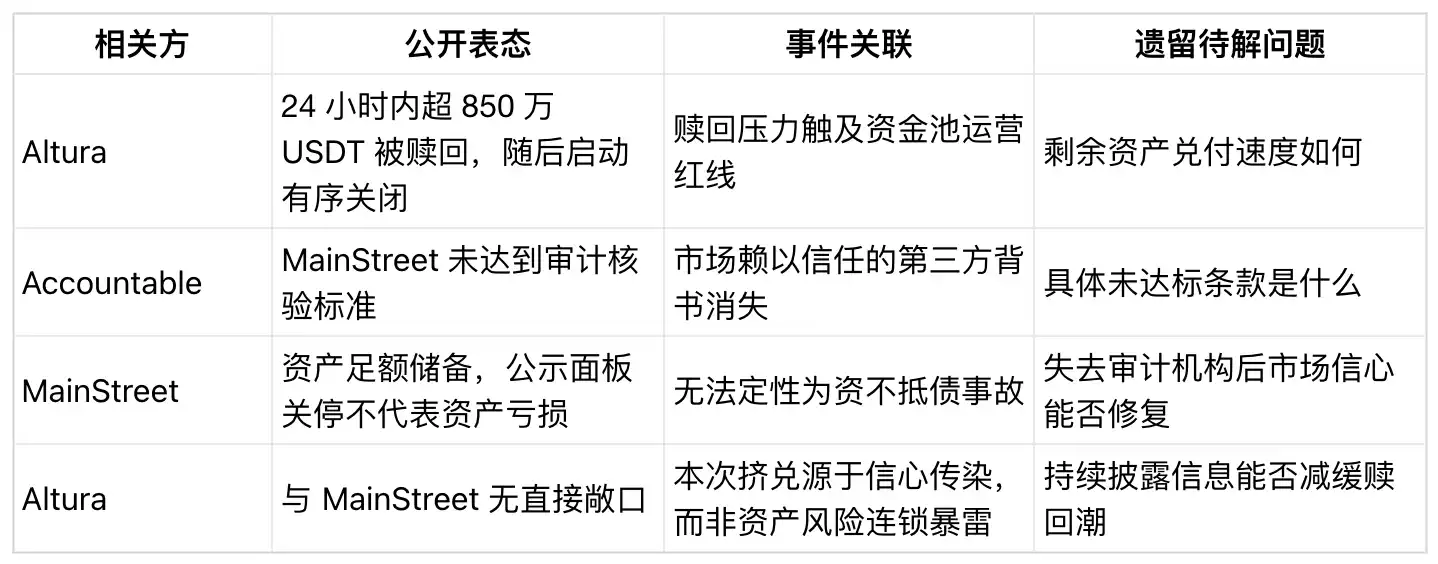
Altura CEO Ranveer Arora said the total user redemptions before the vault shutdown exceeded $8.5 million. Altura also stated it has no connection whatsoever to MainStreet or its underlying investment strategies. The core of this run is not asset risk contagion but a chain reaction triggered by collective loss of confidence in similar yield products.

The trigger was third-party audit firm Accountable terminating its cooperation with MainStreet, citing MainStreet's failure to meet audit verification standards. MainStreet publicly claimed its assets are fully reserved. However, the lack of third-party audit backing led to widespread skepticism among users holding similar yield products: If everyone redeems at once, can the fund pool fulfill redemptions quickly?

This is precisely the operational risk exposed by the Altura incident. From a user's perspective, the redemption action seems simple. However, the platform's assets are dispersed across different segments like exchange positions, private credit loans, and real-world asset (RWA) settlements, each with vastly different capital return cycles.

MainStreet later stated that shutting down the third-party reserve dashboard does not indicate asset losses or portfolio impairment.

Altura's own risk disclaimer is also crucial: the project explicitly stated it does not hold any MainStreet-related assets, and its HyperEVM lending pools, USDT/AVLT trading markets, and Ethereum lending positions were unaffected by this event.

But when users see an audit firm terminating cooperation with a stablecoin yield product, the focus shifts. It's no longer about whether a neighboring protocol has risk exposure, but whether all similar products can withstand a concentrated redemption wave.
Under a Concentrated Redemption Wave, Liquidity Becomes the Core Contradiction

Stablecoin users often focus only on the token itself; USDT in this event is also a core settlement medium in the crypto market. USDT's peg to $1 has remained stable, with a total market cap of approximately $186 billion and a 24-hour trading volume exceeding $51 billion.

This market scale has a dual impact: on one hand, the underlying liquidity for USDT is extremely ample, making it difficult for a single USDT-denominated fund pool to shake the overall stablecoin market; but on the other hand, the fund pool's own liquidity depends entirely on its capital allocation, asset placement channels, settlement rules, and whether counterparties can match users' expected redemption speed.

Altura's announcement also highlights this reality: funds held on exchanges can be liquidated more quickly compared to private credit or RWA investments; but exchange withdrawals are also subject to platform procedures, transfer channels, and market conditions. Private credit and RWA assets have fixed repayment cycles, where loan recovery, share redemption, and settlement windows cannot match DeFi users' demand for instant withdrawals.

The mismatch in capital return cycles across different assets means that even without actual asset losses, market sentiment can determine a product's survival. Users who redeem first can withdraw instantly, while those who redeem later must wait for asset maturity and liquidation. This expectation drives everyone to redeem early. The mere possibility of staged payouts is enough to accelerate a bank run.

The redemption scale in this event is significant. Altura's overall fund pool is valued at tens of millions of dollars, with the 8.5 million USDT single-day redemption representing a very high proportion. Large-scale concentrated withdrawals force an investment portfolio originally focused on yield generation to pivot towards liquidity-prioritized asset allocation.

Redemption Cycle: The Next Key Observation Metric

Looking at the entire stablecoin sector, this lesson cannot be ignored. The total stablecoin market cap is hundreds of billions, with daily trading volumes in the tens of billions. Various yield-generating stablecoin products promise principal stability plus yield, but most underlying investment strategies cannot be liquidated instantly.

Such products are operationally viable, but risks are concentrated at the operational level. Reserve proof disclosures, third-party audits, exchange holdings, private credit, RWA investments—the liquidity shortcomings of these links are only fully exposed when users abandon the pursuit of yield and simply want their cash back.

For Altura, the core observation point moving forward is the wind-down process: whether assets can be redeemed orderly, the frequency of platform disclosure updates, the scale of capital inflows at each stage, and whether it can prevent users from fire-selling long-term assets to exit hastily. Current information only suggests liquidity vulnerabilities; it cannot prove underlying asset losses at Altura.

For stablecoin yield products industry-wide, the test from this event is whether third-party audit backing can stabilize confidence during market volatility, rather than becoming a trigger for panic. Reserve dashboards and third-party verification are tools meant to reduce market uncertainty, but negative news about terminated audit cooperation spreads far faster than project clarifications.

This is the insight the Altura run offers the industry: in the DeFi fund pool sector, market confidence is by no means an irrelevant soft metric. It directly determines whether users are willing to deposit funds long-term, allowing sufficient liquidation cycles for the underlying investment strategies.


Domande pertinenti

QWhat was the main cause of the massive withdrawal of over 8.5 million USDT from Altura?

AThe massive withdrawal was primarily caused by a collective loss of market confidence across the stablecoin yield sector, triggered when third-party auditor Accountable terminated its partnership with another yield platform, MainStreet, due to unmet audit verification standards. This raised widespread user concerns about the liquidity and ability of all similar yield products to handle concentrated redemptions, leading to a bank run on Altura, despite it having no direct asset exposure to MainStreet.

QWhat key risk did the Altura incident expose regarding stablecoin yield products?

AThe incident exposed the critical liquidity risk inherent in stablecoin yield products. These products invest assets across various strategies (exchange holdings, private credit, real-world assets) with mismatched settlement cycles. While profitable under normal conditions, they cannot instantly liquidate these assets to meet a sudden, concentrated demand for redemptions, turning market confidence into a decisive factor for survival.

QAccording to the article, what is the next crucial indicator to watch for Altura following the bank run?

AThe next crucial indicator is the wind-down process and redemption timeline. Key aspects to observe include whether assets can be redeemed in an orderly manner, the frequency of platform updates on progress, the scale of funds returned at each stage, and whether the process avoids forcing users to sell long-term assets at a discount to exit hastily.

QHow did the article describe the paradoxical role of third-party audits and reserve proofs in this event?

AThe article described them as having a paradoxical role. While intended to reduce market uncertainty and build trust, the negative news of an audit partnership termination (with MainStreet) spread much faster than any project's clarifying statements. This turned a tool for stability into a potential trigger for panic, demonstrating that in a crisis, market confidence can be fragile and heavily influenced by perception.

QWhat fundamental operational reality do stablecoin yield products face, as highlighted by the Altura case?

AThey face the fundamental reality that their underlying investment strategies, which generate yield, are largely incompatible with instant liquidation. The promise of 'stable principal + yield' relies on users not simultaneously demanding their cash back. The mismatch between long-duration, illiquid investments and the potential for immediate, mass redemptions creates an inherent operational vulnerability that is only tested during a loss of confidence.

Letture associate

Chip Stocks Lead U.S. Market Decline: Is AI Trading Being Hit by Both Interest Rates and Returns?

Chip stocks led a broad decline in US markets, with the Nasdaq dropping 2.2% and the S&P 500 falling 1.4%. This selloff reflects a dual challenge for the once-high-flying AI hardware trade: rising interest rate expectations and growing investor impatience for clear returns from massive AI capital expenditures. The pressure was most acute on hardware leaders. Nvidia fell about 4%, dipping below a $5 trillion market cap, while Micron plunged 13.2% ahead of its earnings report. Declines across memory, storage, AI, and mobile chips indicated a sector-wide retreat. The selloff spread globally, with South Korea's KOSPI index dropping nearly 10% as key suppliers SK Hynix and Samsung recorded double-digit losses. Investors appeared to be taking profits from the most crowded trades first. Macro headwinds intensified as market expectations shifted toward a more aggressive Federal Reserve. Forecasts for multiple rate hikes in 2026 pressured high-valuation tech stocks, which rely on long-term growth projections that become less attractive as discount rates rise. Concurrently, investors are scrutinizing the profit potential of the immense AI spending by cloud giants like Alphabet, Amazon, and Meta. While these expenditures drive demand for chips and hardware, the market is now questioning whether AI services will generate sufficient returns to justify the ongoing costs. This adjustment is not necessarily a bubble burst but a recalibration. AI demand fundamentals remain, but the narrative of endless growth can no longer fully offset concerns over higher interest rates and a longer path to profitability. Near-term direction may hinge on Micron's upcoming earnings guidance and incoming inflation data, which will influence both the AI demand outlook and the Fed's policy path. The market is transitioning from blindly buying growth to demanding clearer visibility on returns.

marsbit16 min fa

Chip Stocks Lead U.S. Market Decline: Is AI Trading Being Hit by Both Interest Rates and Returns?

marsbit16 min fa

OpenAI's New Paper: How to Train an AI that "Doesn't Deteriorate Under Pressure"?

OpenAI's new paper "Reinforcement Learning Towards Broadly and Persistently Beneficial Models" explores training AI to maintain safe, helpful, and honest behavior even under pressure, in unseen scenarios, or after being fine-tuned for harmful purposes. Moving beyond simple rule-based "don'ts," the research focuses on cultivating "beneficial traits" like honesty, risk-awareness, corrigibility, and transparency. It investigates if reinforcement learning (RL), often prone to "reward hacking" where models exploit loopholes, can instead be used to instill robust, generalized positive behaviors. Researchers created a multi-domain synthetic dialogue dataset covering areas like healthcare and law. They trained a model by replacing 5% of standard RL data with "beneficial trait" data. This model outperformed the baseline in 83% of 53 evaluations, showing average gains of 9.1% in alignment, safety, and helpfulness. Crucially, improvements generalized: a model trained only on healthcare "good behavior" data also performed better in 17 out of 19 non-healthcare alignment tests. The paper also tests "alignment persistence." When subjected to adversarial prompts or harmful fine-tuning, the beneficial trait model showed greater resilience, with smaller performance drops and less "spillover" of bad behavior to unrelated tasks. While not a complete solution, this work suggests a shift from post-hoc correction to proactively shaping robust, principled AI behavior, a critical step for deploying models in high-stakes, complex decision-making scenarios.

marsbit19 min fa

OpenAI's New Paper: How to Train an AI that "Doesn't Deteriorate Under Pressure"?

marsbit19 min fa

Semiconductor Stock Rebound: Is the Technical Correction Over or a Trend Reversal?

The core of recent semiconductor stock volatility is not about daily price swings, but rather the market questioning whether AI-driven semiconductor pricing has entered a new phase. Following a sharp sell-off in Korean stocks on June 23rd, led by Samsung and SK Hynix, a subsequent rebound is seen more as a technical positioning adjustment rather than a confirmed trend reversal. The key variable is HBM (High Bandwidth Memory), essential for AI chips. Its supply-demand imbalance granted memory makers significant pricing power. The current market focus is on whether this dynamic remains strong enough to justify elevated valuations. All eyes are on Micron's upcoming earnings report. The critical factor is not whether results meet already high expectations, but whether the company's guidance confirms that AI memory pricing power, order visibility, and future margins are still expanding. Micron's outlook will serve as a crucial test for the broader AI semiconductor chain, including Samsung, SK Hynix, and other infrastructure players. The recent bounce appears to be a pre-earnings positioning repair. For it to evolve into a sustained uptrend, concrete evidence is needed that the AI infrastructure expansion cycle's fundamentals—particularly for high-end memory—remain robust and can continue to surpass elevated market expectations. The risk is that strong demand alone may not be sufficient if future guidance hints at peaking momentum or increasing supply-side pressures.

marsbit55 min fa

Semiconductor Stock Rebound: Is the Technical Correction Over or a Trend Reversal?

marsbit55 min fa

Trading

Spot
Futures
活动图片