Making the Silent Oracle Bones Speak for Three Thousand Years: The First AI-Assisted Interpretation System Mimicking Human Expert Workflow

marsbitPubblicato 2026-08-03Pubblicato ultima volta 2026-08-03

Introduzione

Breaking the silence of three-thousand-year-old oracle bone inscriptions (OBI) poses immense challenges for researchers, who traditionally rely on laborious cross-referencing across fragmented historical materials. To address this, researchers from Huazhong University of Science and Technology and collaborating institutions have developed AlphaOracle, the first AI system designed to simulate the expert workflow for deciphering OBI. The system integrates a four-step, evidence-based pipeline: 1) parsing and reading-order reconstruction of oracle bone rubbings; 2) morphological analysis of character evolution across historical scripts; 3) contextual verification using large-scale OBI corpora and a specialized masked language model; and 4) literature validation against classical texts and modern scholarly works. AlphaOracle generates comprehensive, traceable reports with candidate interpretations, confidence scores, and source citations for expert review, functioning as an intelligent assistant rather than a final arbiter. In evaluations involving 86 domain experts, 78.7% found the system helpful, estimating an average 64% reduction in analysis time. The system achieved a top-1 accuracy of 23.1% on deciphering withheld known characters and significantly outperformed general-purpose large language models in contextual reasoning tasks. AlphaOracle successfully analyzed several controversial characters, with some results incorporated into authoritative OBI databases. This work demon...

A piece of turtle plastron or ox scapula lies on the desk, cracks running through the inscribed characters, a few words missing strokes.

To confirm one unfamiliar character, researchers often have to sift through hundreds or even thousands of rubbings, compare forms found in bronze inscriptions, Warring States period scripts, and small seal script, and then search for usage examples in ancient texts and modern research papers. Evidence is scattered across different eras, different media, and different databases; one round of verification can take days.

Recently, a joint team from Huazhong University of Science and Technology and others has introduced AlphaOracle, the first artificial intelligence system that simulates the expert interpretation workflow, to assist scholars in the arduous task of deciphering oracle bone inscriptions.
Paper link: https://doi.org/10.1016/j.xinn.2026.101462

Supplementary materials: https://arxiv.org/abs/2607.17849

Code repository: https://github.com/Yuliang-Liu/AlphaOracle

Demo link: http://vlrlabmonkey.xyz:7685/?lan=zh

AlphaOracle first examines the historical evolution trajectory of the oracle bone character's form, then returns to the complete textual context and similar divination records for contextual verification, and finally consults ancient texts and research literature for further evidence, forming a complete chain of evidence.

Each step of AlphaOracle's interpretation analysis is accompanied by source citations, candidate answers, and confidence levels, facilitating expert review item by item, providing convenient, efficient, and reliable intelligent assistance. The paper has been accepted by *The Innovation*.

Research Background

Oracle bone inscriptions preserve the Shang Dynasty's wars, agricultural activities, illnesses, sacrifices, celestial phenomena, and daily decisions on bones over three thousand years old. More than 150,000 oracle bone fragments have been discovered, containing at least 4,500 distinct character forms, of which about 1,500 have received relatively reliable interpretations.

The remaining approximately 3,000-plus characters are like an unopened door, behind which lie the lexicon, place names, clan names of early Chinese, as well as the details of Shang Dynasty social operations. Deciphering oracle bone inscriptions makes the language, concepts, and social life of ancestors over three millennia ago clear and visible once more, and vividly illuminates the continuous historical thread of Chinese civilization.
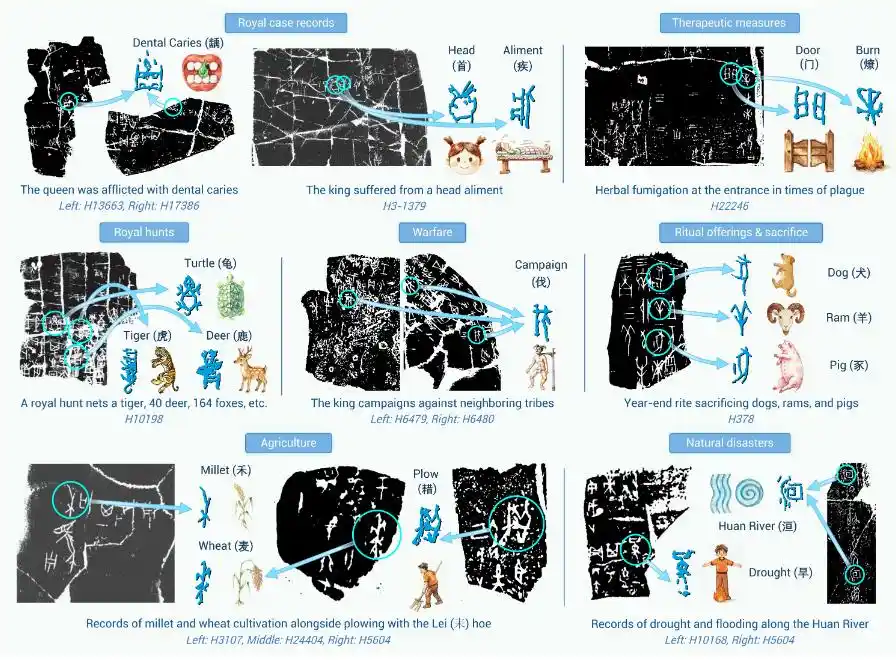
Oracle bone inscriptions record the tapestry of Shang Dynasty social life, serving as a precious cultural treasure of the Chinese nation and a crucial basis for exploring the origins of Chinese civilization.

However, the process of deciphering and interpreting oracle bone inscriptions is difficult and tedious. When interpreting undeciphered characters, experts typically analyze the character's historical variant forms, retrieve contextual and textual corroborative materials from vast reference corpora, and verify related hypotheses by combining multiple inscriptions and transmitted texts. This process demands that researchers possess extensive knowledge accumulation and rich research experience, and also requires long-term collection, organization, and repeated comparison of large volumes of documentary materials.

While expert-led independent research has yielded many important results, this model consumes significant time and manpower, and the evaluation process often relies on subjective expert judgment, heavily dependent on the individual scholar's erudition. This makes it difficult to reach consistent conclusions and challenging to scale up the work.

The rapid development of artificial intelligence technology brings new possibilities for assisting experts in interpreting ancient scripts. Previous research often predicted the corresponding modern Chinese character based on the isolated glyph of an oracle bone character.

However, such methods primarily rely on visual information, seldom incorporating textual contextual usage and transmitted texts for cross-verification. Consequently, although some output results may seem plausible at the glyph level, they lack linguistic and historical evidence, offering limited assistance to experts.

These challenges indicate an urgent need to construct a computational framework capable of integrating all stages of decipherment, simulating expert reasoning processes, and scaling it for large-scale corpus analysis, thereby basing inferences on comprehensive and verifiable evidence.

Highlights of the Work

The team proposes AlphaOracle, the first AI system to fully simulate the expert interpretation workflow, partially transforming the unscalable, experience-dependent process of ancient script analysis into a reviewable, repeatable, and collaborative computational framework.

AlphaOracle integrates large-scale oracle bone rubbings, facsimiles, transmitted ancient texts, and over twenty thousand related research papers. The candidate results and evidence sources generated during the analysis process are completely retained, ultimately compiled into an auxiliary interpretation report that is traceable and verifiable, available for experts to inspect and discuss item by item.

By helping scholars quickly discover clues, gather evidence, and compare different interpretations from scattered and voluminous materials, this technical approach enables AI to potentially enter the core processes of ancient script research.

In an evaluation involving 86 domain experts and doctoral researchers, 78.7% of participants gave AlphaOracle a positive or highly positive evaluation, estimating it could save approximately 64% of analysis time on average.

Research Methodology

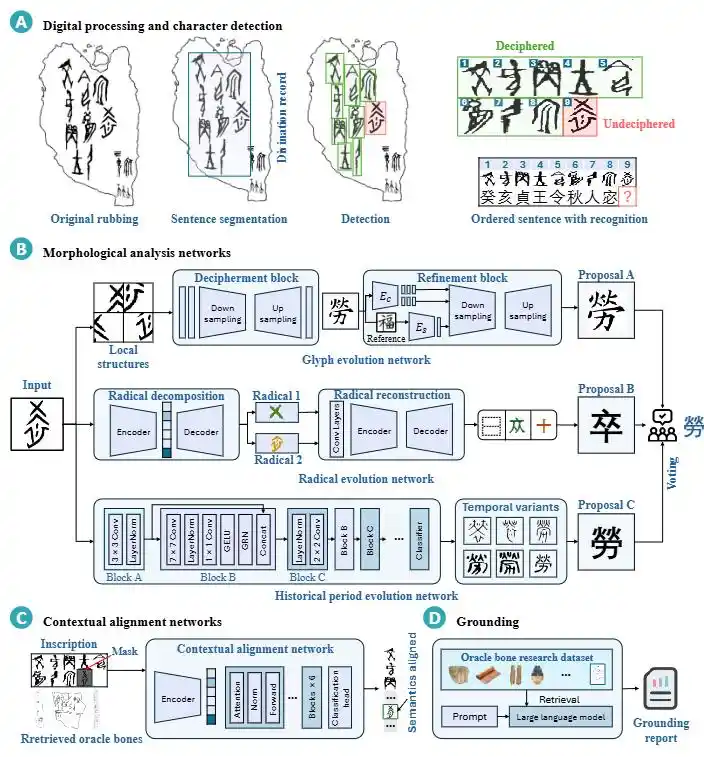
Following the reasoning of experts conducting real paleographic analysis, AlphaOracle sequentially links the steps of oracle bone rubbing parsing, character form evolution analysis, textual context retrieval and judgment, and verification against transmitted texts and modern research.

The system first proposes multiple candidate interpretations based on whole-character evolution, component structure, and cross-era character relationships. It then tests these candidates in the context of their sentences and searches for similar cases in large-scale oracle bone materials. Finally, it seeks further support or challenges from ancient texts and modern academic research, forming a complete evidence chain.
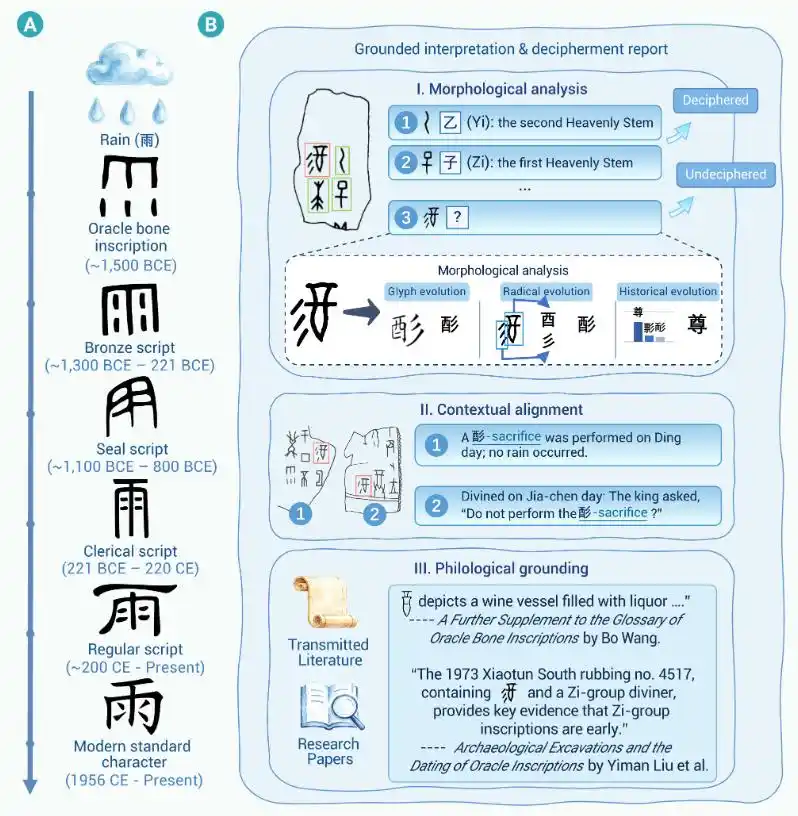
AlphaOracle interpretation workflow: First parsing the rubbing, then sequentially completing morphological analysis, context alignment, and literature verification, ultimately forming an evidence report for expert review.

Step One: Rubbing Parsing

Upon input of an original oracle bone rubbing, the system first performs character detection, classification, and sentence reconstruction. A detection model locates each oracle bone character, a classifier identifies already-interpreted characters, and leaves contested, undeciphered characters for subsequent modules.

Next, treating each character as a node, the system uses a graph neural network combined with spatial information to simultaneously determine the sentence's start, end, and connection relationships between characters, then reconstructs the reading order accordingly. Ultimately, the parsing model breaks down the oracle bone rubbing into several independent statements with reading order and preliminary character recognition results.

Step Two: Morphological Analysis

With clear single-character images and reading order, the system begins proposing several possible decipherment hypotheses for undeciphered characters from two directions: diachronic evolution and internal structure.

A Glyph Evolution Network uses a diffusion model to simulate the transformation of ancient forms into later script styles, recognizing and summarizing the results of multiple generations.

A Component Evolution Network decomposes oracle bone glyphs into constituent elements, mapping them to Ideographic Description Sequences (IDS), and infers corresponding Chinese characters based on component combinations.

A Historical Period Evolution Network compares similarities along a timeline covering stages like oracle bone script, bronze inscription script, Warring States script, small seal script, and clerical script.

These three expert models each provide candidates and probabilities. The system weights them according to model reliability, determines if the character has a generally accepted interpretation, and retains multiple possible decipherment answers with corresponding confidence levels for undeciphered characters.

Step Three: Context Alignment

Decipherment hypotheses from morphological analysis must be tested within their sentence context, and similar cases must be sought from other related rubbings.

The system first retrieves all known occurrences of the target character from digitized materials like *Jiaguwen Heji* (Collected Oracle Bone Inscriptions), *Jiaguwen Moben Daxi* (Compendium of Oracle Bone Rubbing Facsimiles), and *Jiaguwen Jiaoshi Zongji* (Complete Collated Interpretations of Oracle Bone Inscriptions), based on image and text information. It then analyzes collocations using a Masked Language Model trained specifically on oracle bone texts.

During training, the model learns to predict masked characters based on known oracle bone context. During inference, it re-ranks the multiple candidates from the morphology module to determine which fits the sentence most coherently, and also independently proposes semantic candidates.

Context alignment also includes an explanation model, fine-tuned via supervised learning and reinforcement learning from feedback, used to summarize the usage of the same character in different divination records and generate modern Chinese explanations convenient for researcher review.

Step Four: Literature Verification

Decipherment candidates filtered through form and context are then further verified using transmitted ancient texts and modern research papers.

The system's materials include 25 ancient transmitted texts and 23,755 authoritative modern research papers, covering works like *Shuowen Jiezi*, pre-Qin and Han dynasty classics, and specialized reference books such as *Guwenzi Gulin*, *Jiaguwen Gulin*, and *Jiaguwen Zilin*.

During retrieval, it incorporates variant forms and near-synonyms into queries, simultaneously searching for relevant materials through both textual semantics and glyph images.

The relevance of different texts, source authority, literature type, and chronological order all influence the weight of evidence. Each piece of material retains bibliographic information and retrieval rationale, facilitating researcher tracing to the original source.

The final comprehensive report sequentially presents glyph-based evidence, contextual usage examples, and literature evidence. It indicates the currently most supported reading and its credibility, while also clearly retaining unresolved disagreements.

In summary, AlphaOracle generates hypotheses itself, collects relevant evidence for each hypothesis, and then presents it to the researcher.

Throughout the process, the system makes only the minimal necessary judgments but does not replace the expert in making the final decision. Its core function is to help researchers discover clues, verify evidence, and compare different interpretations more efficiently, leaving the ultimate adjudication to the researcher.

Experimental Results and Expert Evaluation

Oracle bone interpretation lacks a universally accepted benchmark. Therefore, the paper breaks down the larger problem into several measurable tasks and evaluates AlphaOracle from both component performance and expert utility perspectives.
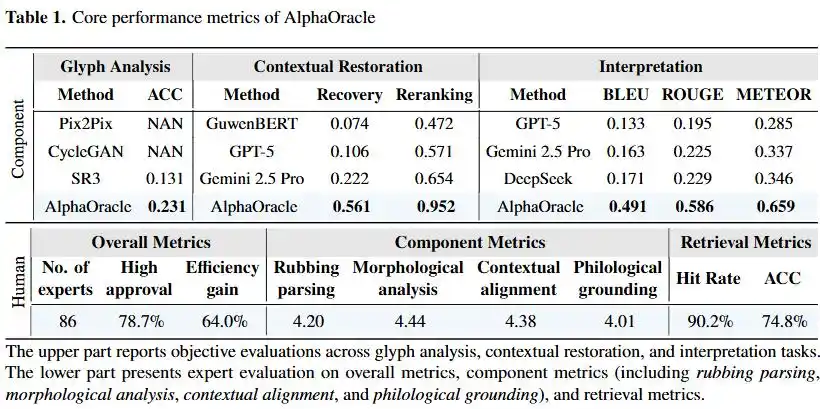
In the glyph analysis experiment, using a "simulated undeciphered character" setting with a test set of 88 known characters never seen during training, AlphaOracle achieved a Top-1 accuracy of 23.1%.

In context analysis, the system achieved 56.1% accuracy in recovering masked characters from incomplete divination texts, and could select the interpretation more consistent with context from candidates provided by the glyph analysis with 95.2% accuracy, surpassing the best general large model baselines of 22.2% and 65.4%, respectively.

In a comprehensive explanation evaluation using modern Chinese explanations as a proxy task, AlphaOracle achieved BLEU, ROUGE, and METEOR scores of 0.491, 0.586, and 0.659, respectively.

It should be noted that general models like GPT-5, Gemini 2.5 Pro, and DeepSeek were used in the paper with a zero-shot setting, without fine-tuning on oracle bone domain data. Therefore, these results highlight the importance of specialized corpora and domain-specific workflows for this task.
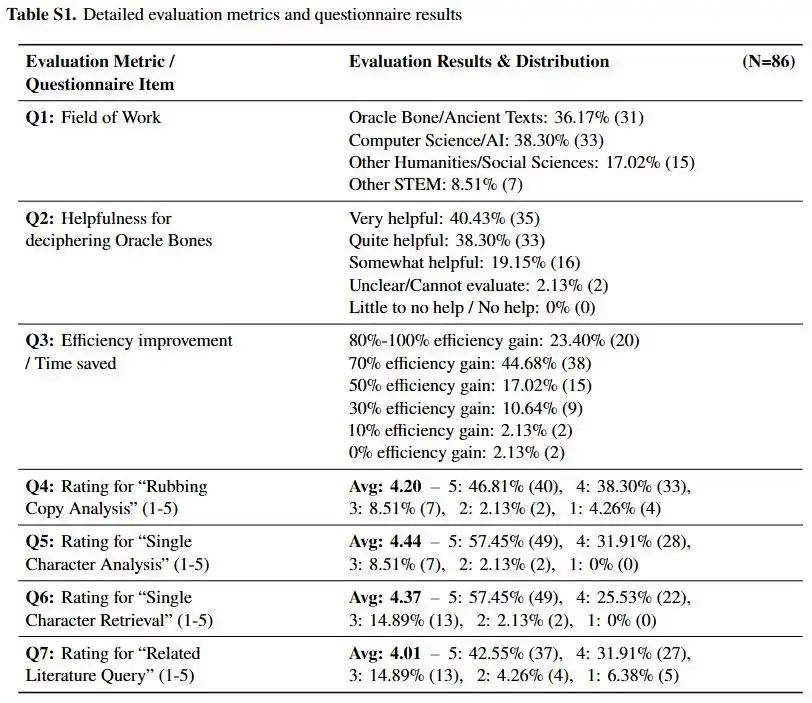
Specific Findings from Human Expert Evaluation

In the practical usage evaluation by experts, 86 experts and doctoral researchers from oracle bone studies, AI, and related fields anonymously participated in the system assessment.

Among them, 78.7% of participants found the system "helpful" or "very helpful," and estimated an average time saving of about 64%. In a modular evaluation on a 5-point scale, the average scores for the four parts—rubbing parsing, glyph analysis, context alignment, and literature evidence retrieval—were 4.20, 4.44, 4.38, and 4.01, respectively.

For the literature retrieval component, a manual check was performed on a random sample of 42 oracle bone characters, resulting in a recall rate (hit rate) of 90.2% and a precision rate of 74.8%. This means the system presents most of the valuable materials but still includes some literature that experts need to filter out.

For researchers, this reduces the cost of sifting through literature, freeing up more time saved for evidence judgment.

The paper also organized a blind "human arena" evaluation, where senior oracle bone scholars from institutions including the Palace Museum, Shanghai Museum, Chinese Academy of Social Sciences, Tsinghua University, Fudan University, Nanjing University, Jilin University, Zhengzhou University, Henan University, Henan Normal University, Capital Normal University, Southwest University, Ocean University of China, the Ministry of Education Key Laboratory for Oracle Bone Information Processing, and related academic groups from South Korea, Japan, and the United States completed 210 blind tests on context explanation tasks.

Results showed AlphaOracle received the highest preference rate at 45.2%, followed by DeepSeek at 34.8%, Gemini 2.5 Pro at 12.9%, and GPT-5 at 7.1%.

Interpretation of Specific Difficult Characters

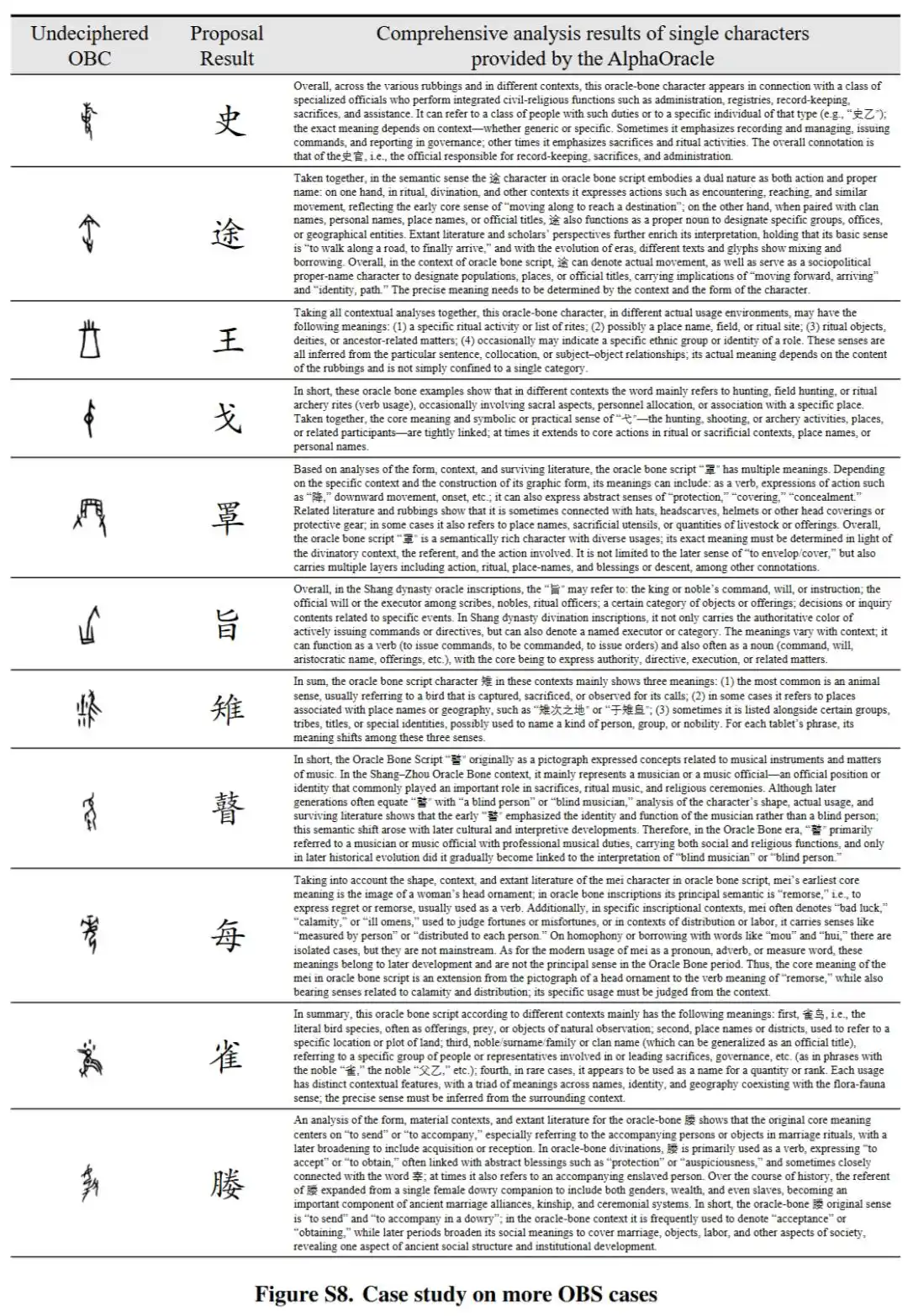
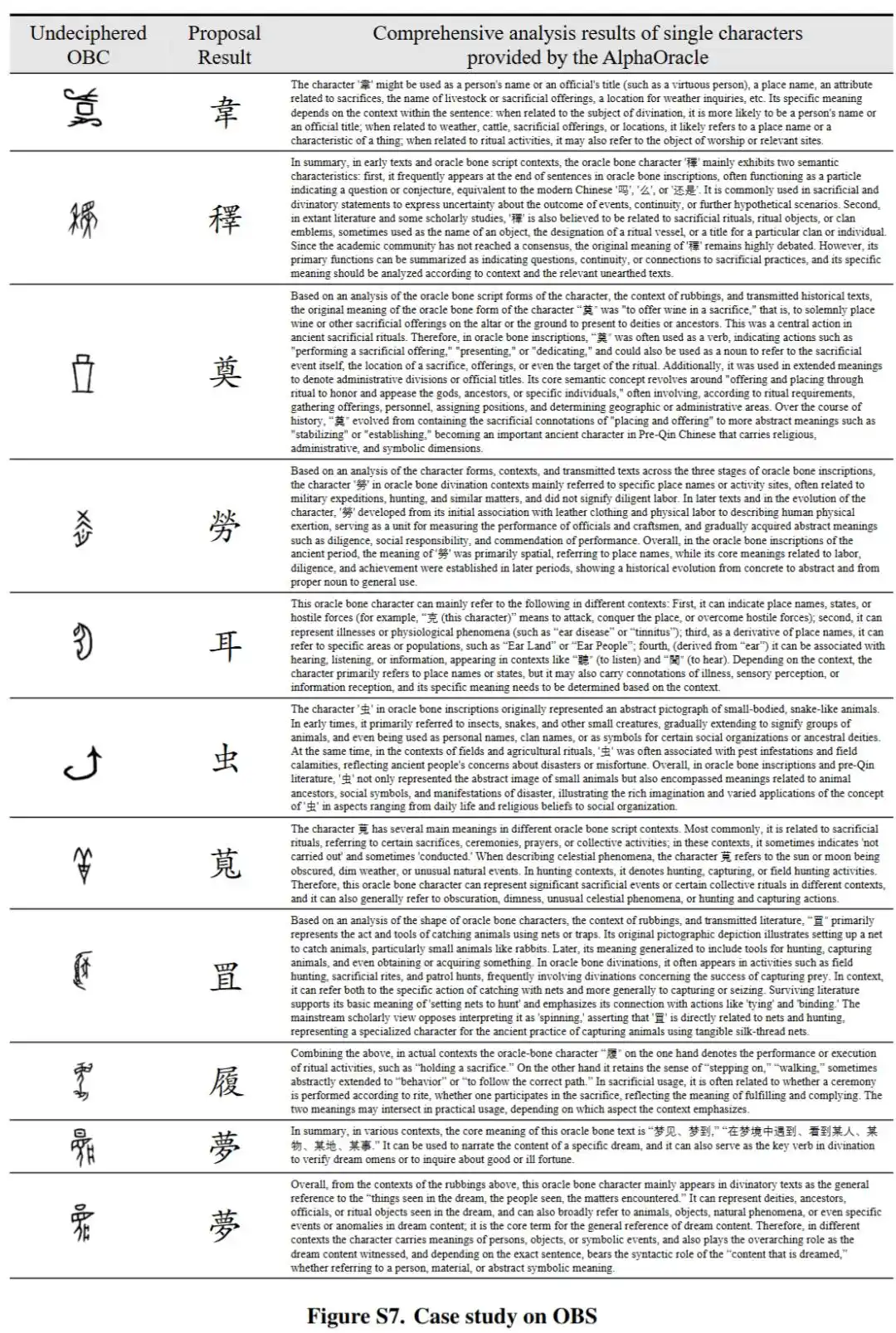
For the long-contested oracle bone character in the "Tunnan 307" rubbing (早期研究常把它释作「卒」), AlphaOracle, integrating glyph, textual context, and literature materials, interpreted it as a variant of "勞" (láo), supplementing evidence for its interpretation as a place name or clan name.

Additionally, the paper reports disambiguation results for 22 controversial variant characters. Some of these analyses have already been incorporated into authoritative oracle bone academic databases, demonstrating the potential of AI-assisted experts to efficiently investigate contested characters and advance academic discussion.

Conclusion

By mimicking the research methods of human experts, AlphaOracle places oracle bone character evolution, textual context distribution, and literature materials into the same evidence chain, helping researchers discover clues, locate literature, and verify materials, thereby improving the efficiency of oracle bone interpretation.

Simultaneously, it opens a path for computational paleography that is closer to real-world practice. Machines should not just provide an end-to-end, unsupported final answer but should instead offer reliable evidentiary assistance at each step of the researcher's workflow.

This approach can similarly extend to other ancient script domains, establishing more systematic AI-assisted methods for organizing and researching the scattered and voluminous field of ancient scripts.

Ancient script research ultimately cannot do without human judgment. Machines excel at rapidly proposing hypotheses, performing searches, conducting comparisons, and making inductions from massive materials, while scholars are responsible for weighing the significance of evidence and making the final decisions.

The more promising future lies precisely in this kind of collaborative research landscape: artificial intelligence expands the breadth of material search, while human scholarship safeguards the depth of academic judgment, allowing more historical information dormant in oracle bones and ancient scripts to be seen anew.

Reference: https://doi.org/10.1016/j.xinn.2026.101462

This article is from the WeChat public account "XinZhiYuan" (New Wisdom Source), author: ASI启示录; Editor: LRST

Crypto di tendenza

Domande pertinenti

QWhat is AlphaOracle and what problem does it aim to solve?

AAlphaOracle is the first AI system designed to simulate the workflow of human experts to assist in the deciphering and interpretation of oracle bone inscriptions (OBI). It addresses the highly time-consuming and labor-intensive nature of traditional OBI research, where experts must manually sift through vast, scattered materials from different eras and mediums. The system helps experts by proposing hypotheses and providing a traceable, verifiable chain of evidence, thereby improving research efficiency.

QWhat are the four main steps in AlphaOracle's interpretation workflow?

AThe four main steps are: 1. Rubbing Parsing: detecting characters, classifying known/unknown ones, and reconstructing sentence reading order. 2. Morphological Analysis: proposing candidate interpretations by analyzing the character's historical evolution and internal structure using different models. 3. Contextual Alignment: testing candidate hypotheses by retrieving and analyzing usage contexts from other known OBI materials and employing a specialized language model. 4. Literature Verification: searching and evaluating supporting evidence from ancient texts and modern academic papers to build a comprehensive evidence report.

QHow was AlphaOracle evaluated, and what were the key results from expert assessments?

AAlphaOracle was evaluated through component-level performance tests and a practical usage survey involving 86 domain experts and researchers. In the survey, 78.7% found it 'helpful' or 'very helpful', estimating it could save about 64% of analysis time. In a blind 'human arena' test on context explanation tasks, AlphaOracle achieved a 45.2% preference rate, outperforming models like DeepSeek (34.8%), Gemini 2.5 Pro (12.9%), and GPT-5 (7.1%).

QAccording to the article, what is the core philosophy behind AlphaOracle's design regarding the role of AI in paleography?

AThe core philosophy is that AI should not just provide an end-to-end, unsubstantiated final answer. Instead, it should integrate into the researcher's actual workflow at each step, offering reliable, traceable evidence and assistance. It is designed to augment human expertise by efficiently proposing hypotheses, retrieving materials, and performing comparisons, while leaving the final judgment and interpretation of evidence to the human scholar.

QWhat specific example of a disputed character's interpretation is provided in the article to demonstrate AlphaOracle's capability?

AThe article highlights the interpretation of a long-disputed character from the 'Tunnan 307' oracle bone rubbing. While earlier research often interpreted it as '卒' (zú, soldier), AlphaOracle, by synthesizing evidence from glyph evolution, contextual usage, and classical literature, proposed it as a variant form of '勞' (láo, toil/labor), thereby adding evidence for its interpretation as a place name or clan name.
Letture associate

In-depth: The Foreign Guest Genspark

The article "The Foreign Guest: Genspark" investigates the identity and business practices of AI startup Genspark, which presents itself as a Palo Alto-based "AI Costco" offering a subscription bundle of over 70 models and numerous AI agent tools. Despite its official Silicon Valley narrative, Genspark's founding team has deep roots in Chinese tech giant Baidu, a history systematically downplayed in its branding. The company actively cultivates an image as an elite US firm, heavily publicizing partnerships and endorsements from OpenAI, Anthropic, and Microsoft, while distancing itself from the Chinese AI community and obscuring its connections to Chinese investors and open-weight models (like those from DeepSeek, Moonshot AI, and MiniMax) that power its services. Genspark's core strategy involves rapidly cloning and integrating successful AI product concepts (e.g., from Perplexity, Manus, Plaud) into its unified platform, supported by aggressive marketing, including Super Bowl ads and paid native content in publications like The Wall Street Journal. Critically, the article suggests a significant portion of its engineering and product development is conducted by a team in Beijing, operating outside its official US corporate structure. This duality allows Genspark to leverage Chinese talent and models for efficiency and cost reduction while constructing a public facade as a purely American success story. The piece concludes that Genspark's most effective agent is its own corporate identity, meticulously engineered to obscure its Chinese underpinnings and be perceived solely as a Silicon Valley company.

marsbit37 min fa

In-depth: The Foreign Guest Genspark

marsbit37 min fa

Debate: Korean Workers Fear Unemployment, While Musk Envisions a Society 'Without Work'?

While South Korean auto workers fear job losses from robotics, Elon Musk envisions a future where AI and robots render most work optional. This article explores the growing tension between immediate anxieties over automation and long-term visions of a post-work society. The piece begins with recent strikes at Hyundai's Korean plants, where unions, amid standard wage negotiations, also sought job guarantees against advancing robotics—specifically mentioning Boston Dynamics' Atlas. This reflects how anxiety about technological displacement is emerging even before robots are fully capable of replacing skilled labor on assembly lines. The author argues that while current robotics still struggle with the nuanced, experiential knowledge of veteran workers, the *perception* of imminent replacement is fueling social conflict prematurely. This modern "Luddite" sentiment is compared to the 19th-century English textile workers who smashed machines. Historically, Luddites weren't simply anti-technology; they were protesting the rapid devaluation of their skills and the unequal distribution of productivity gains. Similarly, today's workers ask who will bear the cost of transition and share in the new wealth created by machines. In contrast, figures like Elon Musk propose an optimistic endpoint: with AI and robotics driving extreme abundance, the link between work and survival could break. He suggests concepts like "Universal High Income" could allow society to share the technological bounty, transforming work from a necessity into a choice. The core challenge, however, lies in the transition. The author notes that technology's benefits diffuse slowly, while its disruptive costs—job losses, skill obsolescence—can be concentrated and immediate. The risk is a painful interim period where productivity gains are captured by a few before new social contracts, safety nets, and retraining systems are established. The conclusion calls for proactive governance. Just as past industrial revolutions gave rise to labor standards and social safety nets, the robotics era needs its own frameworks. These should address job transition support, distribution of productivity gains, safety liability, and ethical deployment. Embracing such "constraints" is not opposition to progress but a necessary step to ensure technology benefits society broadly. The discussion sparked by Hyundai's workers, therefore, is not premature but essential.

marsbit50 min fa

Debate: Korean Workers Fear Unemployment, While Musk Envisions a Society 'Without Work'?

marsbit50 min fa

Trading

Spot

Articoli Popolari

Cosa è GROK AI

Grok AI: Rivoluzionare la Tecnologia Conversazionale nell'Era Web3 Introduzione Nel panorama in rapida evoluzione dell'intelligenza artificiale, Grok AI si distingue come un progetto notevole che collega i domini della tecnologia avanzata e dell'interazione con l'utente. Sviluppato da xAI, un'azienda guidata dal rinomato imprenditore Elon Musk, Grok AI cerca di ridefinire il modo in cui interagiamo con l'intelligenza artificiale. Mentre il movimento Web3 continua a prosperare, Grok AI mira a sfruttare il potere dell'IA conversazionale per rispondere a query complesse, offrendo agli utenti un'esperienza che è non solo informativa ma anche divertente. Cos'è Grok AI? Grok AI è un sofisticato chatbot di intelligenza artificiale conversazionale progettato per interagire dinamicamente con gli utenti. A differenza di molti sistemi di intelligenza artificiale tradizionali, Grok AI abbraccia un'ampia gamma di domande, comprese quelle tipicamente considerate inappropriate o al di fuori delle risposte standard. Gli obiettivi principali del progetto includono: Ragionamento Affidabile: Grok AI enfatizza il ragionamento di buon senso per fornire risposte logiche basate sulla comprensione contestuale. Supervisione Scalabile: L'integrazione dell'assistenza degli strumenti garantisce che le interazioni degli utenti siano sia monitorate che ottimizzate per la qualità. Verifica Formale: La sicurezza è fondamentale; Grok AI incorpora metodi di verifica formale per migliorare l'affidabilità delle sue uscite. Comprensione del Lungo Contesto: Il modello di IA eccelle nel trattenere e richiamare una vasta storia di conversazione, facilitando discussioni significative e consapevoli del contesto. Robustezza Adversariale: Concentrandosi sul miglioramento delle sue difese contro input manipolati o malevoli, Grok AI mira a mantenere l'integrità delle interazioni degli utenti. In sostanza, Grok AI non è solo un dispositivo di recupero informazioni; è un partner conversazionale immersivo che incoraggia un dialogo dinamico. Creatore di Grok AI Il cervello dietro Grok AI non è altri che Elon Musk, un individuo sinonimo di innovazione in vari campi, tra cui automotive, viaggi spaziali e tecnologia. Sotto l'egida di xAI, un'azienda focalizzata sull'avanzamento della tecnologia AI in modi benefici, la visione di Musk mira a rimodellare la comprensione delle interazioni con l'IA. La leadership e l'etica fondamentale sono profondamente influenzate dall'impegno di Musk nel superare i confini tecnologici. Investitori di Grok AI Sebbene i dettagli specifici riguardanti gli investitori che sostengono Grok AI rimangano limitati, è pubblicamente riconosciuto che xAI, l'incubatore del progetto, è fondato e supportato principalmente dallo stesso Elon Musk. Le precedenti imprese e partecipazioni di Musk forniscono un robusto sostegno, rafforzando ulteriormente la credibilità e il potenziale di crescita di Grok AI. Tuttavia, al momento, le informazioni riguardanti ulteriori fondazioni di investimento o organizzazioni che supportano Grok AI non sono facilmente accessibili, segnando un'area per potenziali esplorazioni future. Come Funziona Grok AI? Le meccaniche operative di Grok AI sono innovative quanto il suo framework concettuale. Il progetto integra diverse tecnologie all'avanguardia che facilitano le sue funzionalità uniche: Infrastruttura Robusta: Grok AI è costruito utilizzando Kubernetes per l'orchestrazione dei container, Rust per prestazioni e sicurezza, e JAX per il calcolo numerico ad alte prestazioni. Questo trio garantisce che il chatbot operi in modo efficiente, si scaldi efficacemente e serva gli utenti prontamente. Accesso alla Conoscenza in Tempo Reale: Una delle caratteristiche distintive di Grok AI è la sua capacità di attingere a dati in tempo reale attraverso la piattaforma X—precedentemente nota come Twitter. Questa capacità consente all'IA di accedere alle informazioni più recenti, permettendole di fornire risposte e raccomandazioni tempestive che altri modelli di IA potrebbero perdere. Due Modalità di Interazione: Grok AI offre agli utenti la scelta tra “Modalità Divertente” e “Modalità Normale”. La Modalità Divertente consente uno stile di interazione più giocoso e umoristico, mentre la Modalità Normale si concentra sulla fornitura di risposte precise e accurate. Questa versatilità garantisce un'esperienza su misura che soddisfa varie preferenze degli utenti. In sostanza, Grok AI sposa prestazioni con coinvolgimento, creando un'esperienza che è sia arricchente che divertente. Cronologia di Grok AI Il viaggio di Grok AI è segnato da traguardi fondamentali che riflettono le sue fasi di sviluppo e distribuzione: Sviluppo Iniziale: La fase fondamentale di Grok AI si è svolta in circa due mesi, durante i quali sono stati condotti l'addestramento iniziale e il perfezionamento del modello. Rilascio Beta di Grok-2: In un significativo avanzamento, è stata annunciata la beta di Grok-2. Questo rilascio ha introdotto due versioni del chatbot—Grok-2 e Grok-2 mini—ognuna dotata delle capacità per chattare, programmare e ragionare. Accesso Pubblico: Dopo lo sviluppo beta, Grok AI è diventato disponibile per gli utenti della piattaforma X. Coloro che hanno account verificati tramite un numero di telefono e attivi per almeno sette giorni possono accedere a una versione limitata, rendendo la tecnologia disponibile a un pubblico più ampio. Questa cronologia racchiude la crescita sistematica di Grok AI dall'inizio all'impegno pubblico, enfatizzando il suo impegno per il miglioramento continuo e l'interazione con gli utenti. Caratteristiche Chiave di Grok AI Grok AI comprende diverse caratteristiche chiave che contribuiscono alla sua identità innovativa: Integrazione della Conoscenza in Tempo Reale: L'accesso a informazioni attuali e rilevanti differenzia Grok AI da molti modelli statici, consentendo un'esperienza utente coinvolgente e accurata. Stili di Interazione Versatili: Offrendo modalità di interazione distinte, Grok AI soddisfa varie preferenze degli utenti, invitando alla creatività e alla personalizzazione nella conversazione con l'IA. Avanzata Struttura Tecnologica: L'utilizzo di Kubernetes, Rust e JAX fornisce al progetto un solido framework per garantire affidabilità e prestazioni ottimali. Considerazione del Discorso Etico: L'inclusione di una funzione di generazione di immagini mette in mostra lo spirito innovativo del progetto. Tuttavia, solleva anche considerazioni etiche riguardanti il copyright e la rappresentazione rispettosa di figure riconoscibili—una discussione in corso all'interno della comunità AI. Conclusione Come entità pionieristica nel campo dell'IA conversazionale, Grok AI incarna il potenziale per esperienze utente trasformative nell'era digitale. Sviluppato da xAI e guidato dall'approccio visionario di Elon Musk, Grok AI integra conoscenze in tempo reale con capacità di interazione avanzate. Si sforza di spingere i confini di ciò che l'intelligenza artificiale può realizzare, mantenendo un focus su considerazioni etiche e sicurezza degli utenti. Grok AI non solo incarna il progresso tecnologico, ma rappresenta anche un nuovo paradigma conversazionale nel panorama Web3, promettendo di coinvolgere gli utenti con sia conoscenze esperte che interazioni giocose. Man mano che il progetto continua a evolversi, si erge come testimonianza di ciò che l'incrocio tra tecnologia, creatività e interazione simile a quella umana può realizzare.

565 Totale visualizzazioniPubblicato il 2024.12.26Aggiornato il 2024.12.26

Cosa è GROK AI

Cosa è ERC AI

Euruka Tech: Una Panoramica di $erc ai e delle sue Ambizioni in Web3 Introduzione Nel panorama in rapida evoluzione della tecnologia blockchain e delle applicazioni decentralizzate, nuovi progetti emergono frequentemente, ciascuno con obiettivi e metodologie uniche. Uno di questi progetti è Euruka Tech, che opera nel vasto dominio delle criptovalute e del Web3. L'obiettivo principale di Euruka Tech, in particolare del suo token $erc ai, è presentare soluzioni innovative progettate per sfruttare le crescenti capacità della tecnologia decentralizzata. Questo articolo si propone di fornire una panoramica completa di Euruka Tech, un'esplorazione dei suoi obiettivi, della funzionalità, dell'identità del suo creatore, dei potenziali investitori e della sua importanza nel contesto più ampio del Web3. Cos'è Euruka Tech, $erc ai? Euruka Tech è caratterizzato come un progetto che sfrutta gli strumenti e le funzionalità offerte dall'ambiente Web3, concentrandosi sull'integrazione dell'intelligenza artificiale nelle sue operazioni. Sebbene i dettagli specifici sul framework del progetto siano piuttosto sfuggenti, è progettato per migliorare l'engagement degli utenti e automatizzare i processi nello spazio crypto. Il progetto mira a creare un ecosistema decentralizzato che non solo faciliti le transazioni, ma incorpori anche funzionalità predittive attraverso l'intelligenza artificiale, da cui il nome del suo token, $erc ai. L'obiettivo è fornire una piattaforma intuitiva che faciliti interazioni più intelligenti e un'elaborazione delle transazioni più efficiente all'interno della crescente sfera del Web3. Chi è il Creatore di Euruka Tech, $erc ai? Attualmente, le informazioni riguardanti il creatore o il team fondatore di Euruka Tech rimangono non specificate e piuttosto opache. Questa assenza di dati solleva preoccupazioni, poiché la conoscenza del background del team è spesso essenziale per stabilire credibilità nel settore blockchain. Pertanto, abbiamo classificato queste informazioni come sconosciute fino a quando dettagli concreti non saranno resi disponibili nel dominio pubblico. Chi sono gli Investitori di Euruka Tech, $erc ai? Allo stesso modo, l'identificazione degli investitori o delle organizzazioni di supporto per il progetto Euruka Tech non è prontamente fornita attraverso la ricerca disponibile. Un aspetto cruciale per i potenziali stakeholder o utenti che considerano di impegnarsi con Euruka Tech è la garanzia che deriva da partnership finanziarie consolidate o dal supporto di società di investimento rispettabili. Senza divulgazioni sulle affiliazioni di investimento, è difficile trarre conclusioni complete sulla sicurezza finanziaria o sulla longevità del progetto. In linea con le informazioni trovate, anche questa sezione rimane allo stato di sconosciuto. Come funziona Euruka Tech, $erc ai? Nonostante la mancanza di specifiche tecniche dettagliate per Euruka Tech, è essenziale considerare le sue ambizioni innovative. Il progetto cerca di sfruttare la potenza computazionale dell'intelligenza artificiale per automatizzare e migliorare l'esperienza dell'utente all'interno dell'ambiente delle criptovalute. Integrando l'IA con la tecnologia blockchain, Euruka Tech mira a fornire funzionalità come operazioni automatizzate, valutazioni del rischio e interfacce utente personalizzate. L'essenza innovativa di Euruka Tech risiede nel suo obiettivo di creare una connessione fluida tra gli utenti e le vaste possibilità presentate dalle reti decentralizzate. Attraverso l'utilizzo di algoritmi di apprendimento automatico e IA, mira a ridurre le sfide degli utenti alle prime armi e semplificare le esperienze transazionali all'interno del framework Web3. Questa simbiosi tra IA e blockchain sottolinea l'importanza del token $erc ai, fungendo da ponte tra le interfacce utente tradizionali e le avanzate capacità delle tecnologie decentralizzate. Cronologia di Euruka Tech, $erc ai Sfortunatamente, a causa delle limitate informazioni disponibili riguardo a Euruka Tech, non siamo in grado di presentare una cronologia dettagliata dei principali sviluppi o traguardi nel percorso del progetto. Questa cronologia, tipicamente preziosa per tracciare l'evoluzione di un progetto e comprendere la sua traiettoria di crescita, non è attualmente disponibile. Man mano che le informazioni su eventi notevoli, partnership o aggiunte funzionali diventano evidenti, gli aggiornamenti miglioreranno sicuramente la visibilità di Euruka Tech nella sfera crypto. Chiarimento su Altri Progetti “Eureka” È importante sottolineare che più progetti e aziende condividono una nomenclatura simile con “Eureka.” La ricerca ha identificato iniziative come un agente IA della NVIDIA Research, che si concentra sull'insegnamento ai robot di compiti complessi utilizzando metodi generativi, così come Eureka Labs ed Eureka AI, che migliorano l'esperienza utente nell'istruzione e nell'analisi del servizio clienti, rispettivamente. Tuttavia, questi progetti sono distinti da Euruka Tech e non dovrebbero essere confusi con i suoi obiettivi o funzionalità. Conclusione Euruka Tech, insieme al suo token $erc ai, rappresenta un attore promettente ma attualmente oscuro nel panorama del Web3. Sebbene i dettagli sul suo creatore e sugli investitori rimangano non divulgati, l'ambizione centrale di combinare intelligenza artificiale e tecnologia blockchain si erge come un punto focale di interesse. Gli approcci unici del progetto nel promuovere l'engagement degli utenti attraverso l'automazione avanzata potrebbero distinguerlo mentre l'ecosistema Web3 progredisce. Con l'evoluzione continua del mercato crypto, gli stakeholder dovrebbero tenere d'occhio gli sviluppi riguardanti Euruka Tech, poiché lo sviluppo di innovazioni documentate, partnership o una roadmap definita potrebbe presentare opportunità significative nel prossimo futuro. Così com'è, attendiamo ulteriori approfondimenti sostanziali che potrebbero svelare il potenziale di Euruka Tech e la sua posizione nel competitivo panorama crypto.

593 Totale visualizzazioniPubblicato il 2025.01.02Aggiornato il 2025.01.02

Cosa è ERC AI

Cosa è DUOLINGO AI

DUOLINGO AI: Integrare l'apprendimento delle lingue con Web3 e innovazione AI In un'era in cui la tecnologia rimodella l'istruzione, l'integrazione dell'intelligenza artificiale (AI) e delle reti blockchain annuncia una nuova frontiera per l'apprendimento delle lingue. Entra in scena DUOLINGO AI e la sua criptovaluta associata, $DUOLINGO AI. Questo progetto aspira a fondere la potenza educativa delle principali piattaforme di apprendimento delle lingue con i benefici della tecnologia decentralizzata Web3. Questo articolo esplora gli aspetti chiave di DUOLINGO AI, esaminando i suoi obiettivi, il framework tecnologico, lo sviluppo storico e il potenziale futuro, mantenendo chiarezza tra la risorsa educativa originale e questa iniziativa indipendente di criptovaluta. Panoramica di DUOLINGO AI Alla sua base, DUOLINGO AI cerca di stabilire un ambiente decentralizzato in cui gli studenti possono guadagnare ricompense crittografiche per il raggiungimento di traguardi educativi nella competenza linguistica. Applicando smart contracts, il progetto mira ad automatizzare i processi di verifica delle competenze e le allocazioni di token, aderendo ai principi di Web3 che enfatizzano la trasparenza e la proprietà da parte degli utenti. Il modello si discosta dagli approcci tradizionali all'acquisizione linguistica, facendo forte affidamento su una struttura di governance guidata dalla comunità, che consente ai detentori di token di suggerire miglioramenti ai contenuti dei corsi e alle distribuzioni delle ricompense. Alcuni degli obiettivi notevoli di DUOLINGO AI includono: Apprendimento Gamificato: Il progetto integra traguardi blockchain e token non fungibili (NFT) per rappresentare i livelli di competenza linguistica, promuovendo la motivazione attraverso ricompense digitali coinvolgenti. Creazione di Contenuti Decentralizzati: Apre opportunità per educatori e appassionati di lingue di contribuire con i propri corsi, facilitando un modello di condivisione dei ricavi che beneficia tutti i collaboratori. Personalizzazione Guidata dall'AI: Utilizzando modelli avanzati di machine learning, DUOLINGO AI personalizza le lezioni per adattarsi ai progressi individuali, simile alle funzionalità adattive presenti nelle piattaforme consolidate. Creatori del Progetto e Governance A partire da aprile 2025, il team dietro $DUOLINGO AI rimane pseudonimo, una pratica comune nel panorama decentralizzato delle criptovalute. Questa anonimato è inteso a promuovere la crescita collettiva e il coinvolgimento degli stakeholder piuttosto che concentrarsi su sviluppatori individuali. Lo smart contract distribuito sulla blockchain di Solana annota l'indirizzo del wallet dello sviluppatore, che segna l'impegno verso la trasparenza riguardo alle transazioni, nonostante l'identità dei creatori sia sconosciuta. Secondo la sua roadmap, DUOLINGO AI mira a evolversi in un'Organizzazione Autonoma Decentralizzata (DAO). Questa struttura di governance consente ai detentori di token di votare su questioni critiche come l'implementazione di funzionalità e le allocazioni del tesoro. Questo modello si allinea con l'etica dell'empowerment della comunità presente in varie applicazioni decentralizzate, enfatizzando l'importanza del processo decisionale collettivo. Investitori e Partnership Strategiche Attualmente, non ci sono investitori istituzionali o capitalisti di rischio identificabili pubblicamente legati a $DUOLINGO AI. Invece, la liquidità del progetto proviene principalmente da scambi decentralizzati (DEX), segnando un netto contrasto con le strategie di finanziamento delle aziende tradizionali di tecnologia educativa. Questo modello di base indica un approccio guidato dalla comunità, riflettendo l'impegno del progetto verso la decentralizzazione. Nel suo whitepaper, DUOLINGO AI menziona la formazione di collaborazioni con “piattaforme educative blockchain” non specificate, mirate ad arricchire la sua offerta di corsi. Sebbene partnership specifiche non siano ancora state divulgate, questi sforzi collaborativi suggeriscono una strategia per mescolare innovazione blockchain con iniziative educative, ampliando l'accesso e il coinvolgimento degli utenti attraverso diverse vie di apprendimento. Architettura Tecnologica Integrazione AI DUOLINGO AI incorpora due componenti principali guidate dall'AI per migliorare la sua offerta educativa: Motore di Apprendimento Adattivo: Questo sofisticato motore apprende dalle interazioni degli utenti, simile ai modelli proprietari delle principali piattaforme educative. Regola dinamicamente la difficoltà delle lezioni per affrontare le sfide specifiche degli studenti, rinforzando le aree deboli attraverso esercizi mirati. Agenti Conversazionali: Utilizzando chatbot alimentati da GPT-4, DUOLINGO AI offre una piattaforma per gli utenti per impegnarsi in conversazioni simulate, promuovendo un'esperienza di apprendimento linguistico più interattiva e pratica. Infrastruttura Blockchain Costruito sulla blockchain di Solana, $DUOLINGO AI utilizza un framework tecnologico completo che include: Smart Contracts per la Verifica delle Competenze: Questa funzionalità assegna automaticamente token agli utenti che superano con successo i test di competenza, rinforzando la struttura di incentivi per risultati di apprendimento genuini. Badge NFT: Questi token digitali significano vari traguardi che gli studenti raggiungono, come completare una sezione del loro corso o padroneggiare competenze specifiche, consentendo loro di scambiare o mostrare digitalmente i loro successi. Governance DAO: I membri della comunità dotati di token possono partecipare alla governance votando su proposte chiave, facilitando una cultura partecipativa che incoraggia l'innovazione nell'offerta di corsi e nelle funzionalità della piattaforma. Cronologia Storica 2022–2023: Concettualizzazione I lavori per DUOLINGO AI iniziano con la creazione di un whitepaper, evidenziando la sinergia tra i progressi dell'AI nell'apprendimento delle lingue e il potenziale decentralizzato della tecnologia blockchain. 2024: Lancio Beta Un lancio beta limitato introduce offerte in lingue popolari, premiando i primi utenti con incentivi in token come parte della strategia di coinvolgimento della comunità del progetto. 2025: Transizione DAO Ad aprile, avviene un lancio completo della mainnet con la circolazione di token, stimolando discussioni nella comunità riguardo a possibili espansioni nelle lingue asiatiche e ad altri sviluppi dei corsi. Sfide e Direzioni Future Ostacoli Tecnici Nonostante i suoi obiettivi ambiziosi, DUOLINGO AI affronta sfide significative. La scalabilità rimane una preoccupazione costante, in particolare nel bilanciare i costi associati all'elaborazione dell'AI e nel mantenere una rete decentralizzata reattiva. Inoltre, garantire la creazione e la moderazione di contenuti di qualità in un'offerta decentralizzata presenta complessità nel mantenere standard educativi. Opportunità Strategiche Guardando al futuro, DUOLINGO AI ha il potenziale per sfruttare partnership di micro-credentialing con istituzioni accademiche, fornendo validazioni verificate dalla blockchain delle competenze linguistiche. Inoltre, l'espansione cross-chain potrebbe consentire al progetto di attingere a basi utenti più ampie e a ulteriori ecosistemi blockchain, migliorando la sua interoperabilità e portata. Conclusione DUOLINGO AI rappresenta una fusione innovativa di intelligenza artificiale e tecnologia blockchain, presentando un'alternativa focalizzata sulla comunità ai sistemi tradizionali di apprendimento delle lingue. Sebbene il suo sviluppo pseudonimo e il modello economico emergente comportino alcuni rischi, l'impegno del progetto verso l'apprendimento gamificato, l'istruzione personalizzata e la governance decentralizzata illumina un percorso per la tecnologia educativa nel regno di Web3. Man mano che l'AI continua a progredire e l'ecosistema blockchain evolve, iniziative come DUOLINGO AI potrebbero ridefinire il modo in cui gli utenti interagiscono con l'istruzione linguistica, potenziando le comunità e premiando il coinvolgimento attraverso meccanismi di apprendimento innovativi.

548 Totale visualizzazioniPubblicato il 2025.04.11Aggiornato il 2025.04.11

Cosa è DUOLINGO AI

Discussioni

Benvenuto nella Community HTX. Qui puoi rimanere informato sugli ultimi sviluppi della piattaforma e accedere ad approfondimenti esperti sul mercato. Le opinioni degli utenti sul prezzo di AI AI sono presentate come di seguito.

活动图片