Editor's Note: On May 25, 2026, the Vatican released Pope Leo XIV's first encyclical, 'Magnifica Humanitas: Guarding Humanity in the Age of Artificial Intelligence.' The timing of this document, coinciding with the 135th anniversary of Pope Leo XIII's 'Rerum Novarum,' is clearly not coincidental. If 'Rerum Novarum' was the Catholic Church's response to the Industrial Revolution, then 'Magnifica Humanitas' is seen as the Church's formal stance on the AI era.
What is most noteworthy about this release is not just the Pope comparing AI to nuclear weapons and calling for 'AI to be disarmed,' nor is it just the presence of Anthropic co-founder Christopher Olah on stage at the Vatican. It is the first time that religion, philosophy, and a cutting-edge AI lab have stood so directly before the same question: As AI transforms labor, warfare, wealth distribution, and human self-understanding, are technology companies and market competition alone sufficient to determine its future?
This article outlines the 11 most significant details from this event: from the historical metaphor behind the name 'Leo XIV' to how the Church once again responds to a major technological shift following the Industrial Revolution, nuclear weapons, and the climate crisis; from Olah's description of AI models as 'grown from human language' to his admission that AI labs cannot answer alone questions such as how poor countries can benefit, what human flourishing means, and what exactly we are creating.
Original text follows:
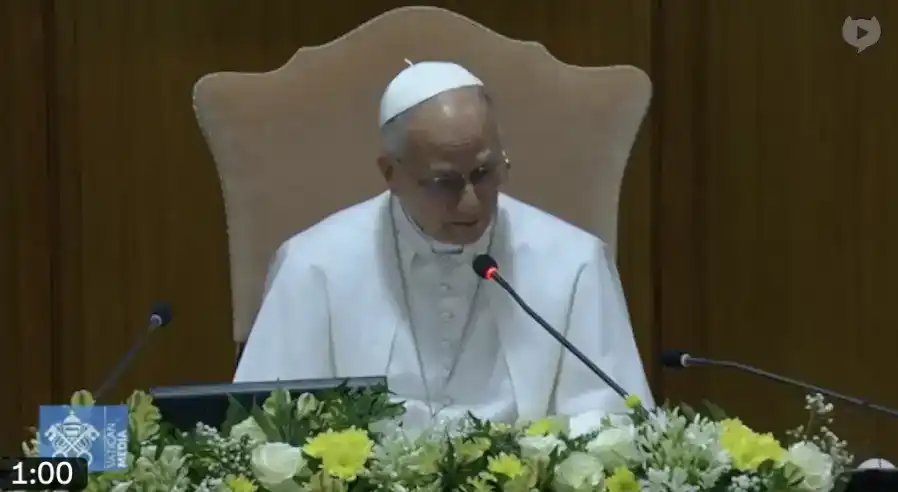
The Pope and the Anthropic co-founder just stood together at the Vatican to release 'Magnifica Humanitas'—the first official doctrinal document on artificial intelligence in Catholic history.
Yes, you read that correctly. The entire release ceremony lasted two hours.
Here are the key points of note:
1. This is the most significant response from the religious world to AI to date. A Pope typically issues only a handful of such weighty formal documents during his entire pontificate. That one of them is specifically about AI itself shows that the Church is viewing the coming changes with the utmost seriousness.
2. A small but significant detail is this Pope's deliberate choice of the name 'Leo XIV.' The last Pope named Leo was Leo XIII in 1891. His most famous act was writing the Catholic Church's response to the Industrial Revolution. Choosing the same name again today is a very clear signal: this Pope sees AI as a new Industrial Revolution.
3. Whenever a major technology reshapes human society, the Catholic Church responds. In 1891, they responded to the Industrial Revolution with 'Rerum Novarum'; in the 1960s, when nuclear weapons threatened the world, they wrote 'Pacem in Terris'; in 2015, climate change and runaway technology issues gave rise to 'Laudato Si'.' Now, it is AI's turn, with the document titled 'Magnifica Humanitas.' Such documents are not common.
4. The Pope's core statement is: 'AI needs to be disarmed.' He effectively places AI in the same category as nuclear weapons. He stated that the Church spent decades promoting nuclear disarmament because such technology is too dangerous to be held by only a few. Now, he believes AI has entered the same class of problem.
5. Anthropic co-founder Christopher Olah, on stage at the Vatican, told the Pope that Anthropic's own research teams constantly find things inside AI models that 'mirror joy, satisfaction, fear, sorrow, and unease.'
6. Olah reframed the nature of AI: these things are not simply manufactured; they are more like something that 'grows.' They are trained on systems roughly mimicking the human brain's structure and fed almost everything humans have ever written. In his own words: 'They are made of us, and of our language.' He also stated that even the people building these systems do not fully understand what is happening inside them.
7. Olah publicly admitted that all AI labs, including Anthropic, face pressures that may conflict with 'doing the right thing': the commercial pressure to keep releasing products, competitive pressure from other labs, and the older forces of arrogance and ambition. His proposed solution: we urgently need external critics with no vested interests to directly point out problems when labs go astray.
8. Olah believes there are three huge questions that AI labs cannot answer alone, and the world needs religion and philosophy to engage with:
How do we ensure poor countries genuinely benefit from AI?
In this new world, what does human flourishing actually mean?
And what exactly are these things we are creating?
9. One of the sharpest lines in the entire encyclical is: 'The promise of automatic and universal prosperity often proves in the end to be an illusion.' In other words, the belief that AI will automatically make everyone rich is itself an illusion. Someone must actually design a system to share the technological dividends.
10. The Pope also quoted a century-old statement: 'Modern man is not yet well-trained in the good use of power.' These words come from a theologian in the 1920s. Almost the entire encyclical revolves around a core argument: before this power begins to dominate us, we must first learn how to use it.
11. The Pope repeatedly emphasized that he does not hold the technical answers. But he stated that the Church possesses millennia of wisdom concerning 'what it means to be human,' and this wisdom is precisely what is most lacking in the current AI development process. He concludes by writing that this technology should serve 'human flourishing and human dignity, not the control of human conscience.'