Meme Coin Reappears, Does the Bitcoin Ecosystem Really Have Something New?

marsbitPubblicato 2026-05-26Pubblicato ultima volta 2026-05-26

Introduzione

The Bitcoin ecosystem is heating up again with new projects and substantial price surges. Key developments include: **Bound Exchange:** Merging former entities radfi and Bound, this platform has gained attention after its $BOUND token surged ~46x. It simplifies trading by allowing deposits in various cryptocurrencies (SOL, ETH, etc.) for conversion to BTC to trade Runes, avoiding long Bitcoin confirmation waits. It features a 2-of-2 multi-signature wallet with a timelock for user asset security and a price protection mechanism for launchpad tokens to manage sell pressure. **Tacit:** This privacy-focused protocol for Bitcoin assets remains active, with its $TAC token holding a stable ~$5.5M market cap. Developers recently implemented double-blind tokens and are working on a permissionless ETH-BTC bridge using zero-knowledge proofs. **Alkanes & $DIESEL:** While not new, the Alkanes protocol's $DIESEL token has risen ~17x since late April. Its limited circulating supply (under 10% of the total 1.562 million) and a revised mining mechanism—where participants bid for block rewards—contribute to its volatile "meme coin" status. These projects, featuring simplified UX, security innovations, and speculative assets, are driving renewed excitement and questions about substantial new developments in the Bitcoin ecosystem.

The recent emergence of the new Bitcoin asset protocol Tacit has reignited market interest in the Bitcoin ecosystem. And lately, a new 10x "golden dog" has appeared in the Bitcoin ecosystem, making everyone exclaim that the familiar "ordi" flavor is back. Why has the Bitcoin ecosystem been so hot recently? Has something genuinely new emerged?

Bound Exchange

The predecessor of this platform was radfi, which previously gained attention due to the "Node Monkey" strategy coin $NODESTRAT. $NODESTRAT is similar to $PUNKSTR on Ethereum, both utilizing trading fees to repurchase NFTs, then listing them for sale with different profit targets. The profits from selling these NFTs are then partially used to buy back and burn the token, creating a flywheel effect.

Previously, radfi and Bound operated separately. radfi handled Bitcoin/Rune AMM and Launchpad, while Bound focused on stablecoins. Now, the two have merged into Bound. The merged platform offers comprehensive features, including trading, lending, Launchpad, and an NFT marketplace.

Bound recently attracted market attention because its token $BOUND has surged approximately 46 times since May 21st.
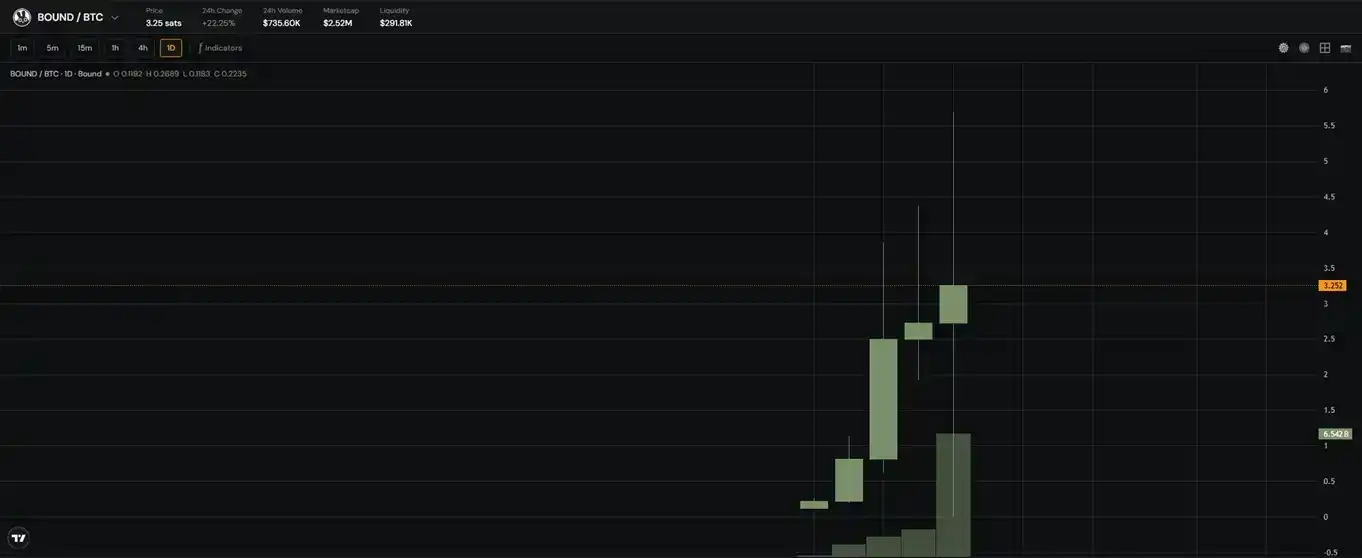
Returning to the project itself, the main points praised by the community about Bound are as follows:

Greatly simplified trading process. Traditional Rune AMMs typically require depositing Bitcoin first, then waiting for several block confirmations. This confirmation time can be as short as half an hour, but longer if block production is slow, potentially taking over an hour. On Bound, besides depositing Bitcoin, users can also deposit SOL, ETH, HYPE, or BNB. These are swapped to BTC via corresponding BTC trading pairs, allowing users to directly trade Rune tokens on the platform. The overall time required is significantly reduced, naturally enhancing the user experience.

Instant trade confirmation. Avoiding long waits for Bitcoin block confirmations has been a goal for platforms dealing with Runes in the Bitcoin ecosystem. This isn't inherently difficult; once funds are deposited and confirmed on the platform, trades can be processed internally/off-chain first, using the Bitcoin mainnet as a confirmation layer. However, the key issue is solving the security problem. Previous platforms like odin.fun also gained popularity but eventually faded after repeated asset theft incidents. Bound's solution is to add a 2-of-2 multisig to user asset deposit addresses. One signature is held by the user (stored as a passkey on the user's device), and the other is held by the platform's backend.

This means even if the Bound platform is hacked, assets cannot be stolen because the hacker can only satisfy one signature layer. There's another question: what if the platform runs away? Therefore, Bound added a timelock. If Bound's signature expires after 3 months, users can directly withdraw their assets using their own passkey.

Price protection mechanism. Bound's official Twitter account retweeted an explanation by @SkyAAmen regarding this mechanism: "For Rune tokens launched via Launchpad, the post-launch token price is calculated based on the average minting price. 75% of the raised liquidity is placed below this price to act as a floor against potential selling pressure, while the remaining 25% is paired above this price."
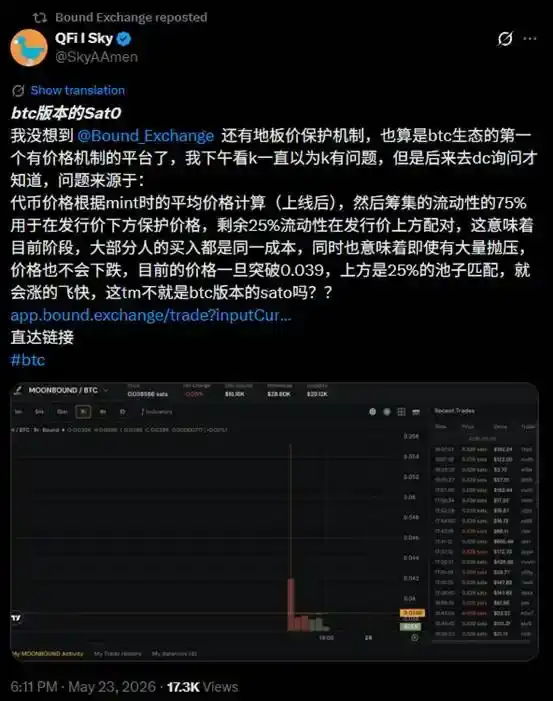
Regarding token issuance, Bound also introduced a virtual mempool, which can be understood as a virtual chain tracking Bitcoin mainnet block production. Users minting new Rune tokens on the Launchpad don't pay fees to miners; the money is instead used for the aforementioned price protection and liquidity provision. Additionally, to reward holders, those who mint 1 million tokens or more and do not sell can share 50% of the trading fees.

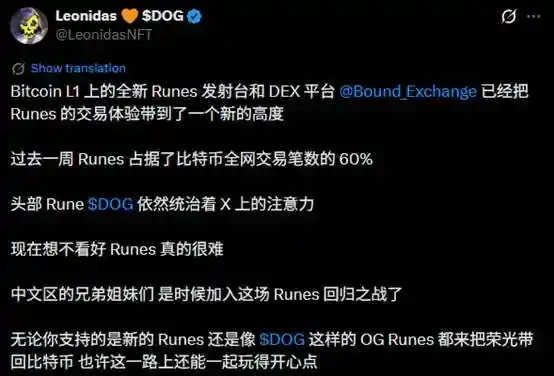
The above three points are the main advantages. Furthermore, Leonidas, a well-known figure in the Bitcoin ecosystem, has also expressed support for Bound:
Tacit

BlockBeats previously published a detailed article introducing Tacit:

New Protocol Tacit: The ZEC of the Bitcoin Ecosystem?

Currently, the price of Tacit's leading token $TAC remains stable, with a corresponding market cap of approximately $5.5 million. The developer @z0r0zzz continues to maintain a high update frequency. On May 23rd, they implemented double-blind tokens on Bitcoin, further strengthening the protocol's privacy features. Additionally, work is ongoing on a permissionless ETH-BTC bridge implemented via SP1 zero-knowledge proofs.

Alkanes

We have also previously introduced Alkanes: Another 10x Runner in Bitcoin Ecosystem, What is the New Asset Protocol Alkanes? This protocol gained attention because $DIESEL has risen approximately 17 times since late April and is still climbing:
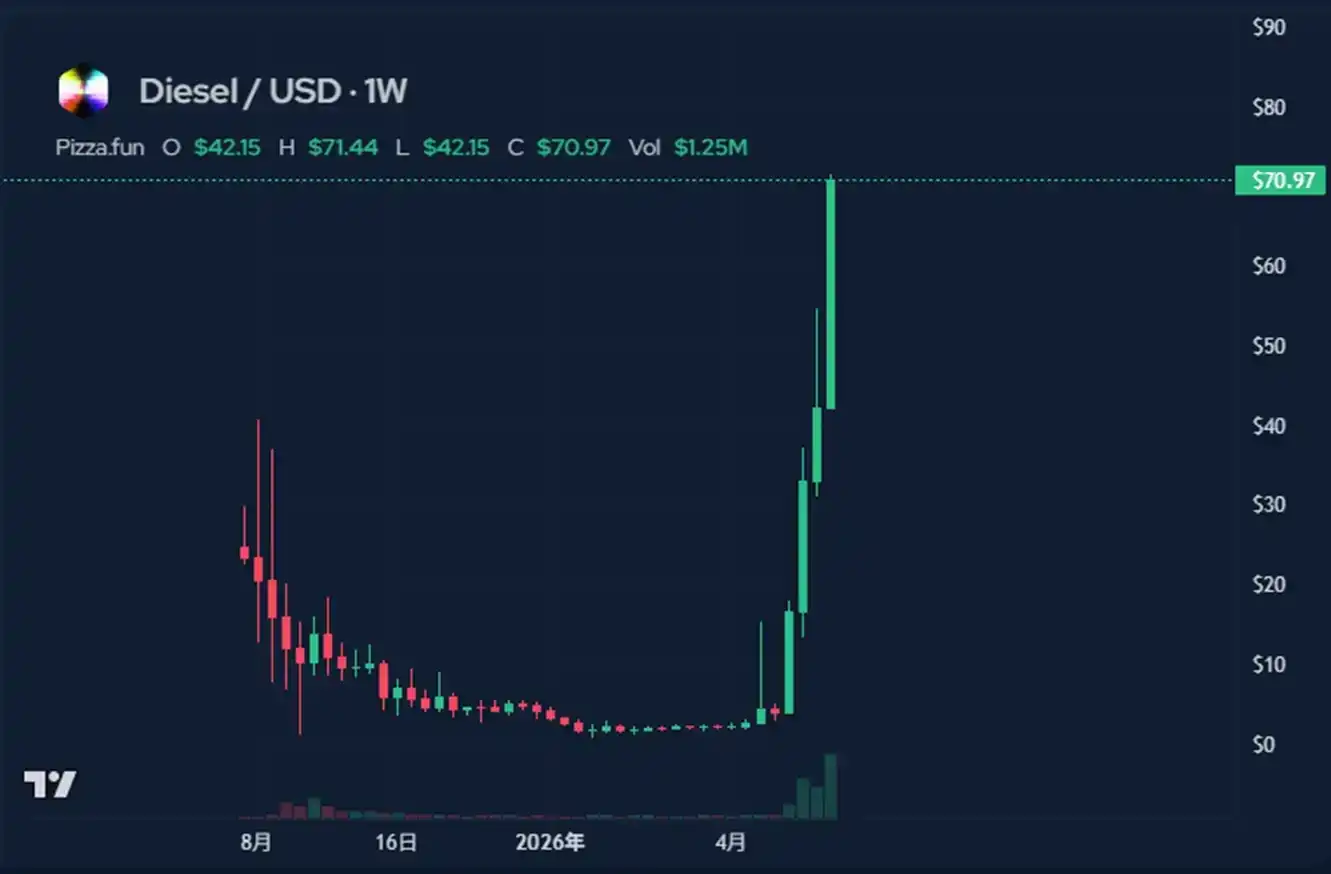
Alkanes isn't a new protocol. In fact, Oyl Wallet, which initially led it, is no longer active. The subfrost team now responsible for protocol updates and maintenance consists of the original technical team from Oyl Wallet that handled Alkanes. Despite Oyl's disbandment, the subfrost team has been consistently updating, implementing significant performance optimizations such as embedding contracts into the indexer.

However, the substantial rise of $DIESEL is likely due to its very small actual circulating supply. The previous mining mechanism for $DIESEL awarded the entire block's $DIESEL reward to the single minting transaction that paid the highest miner fee within that block. This essentially allowed "scientists" (automated traders/bots) to dominate, making it difficult for ordinary users to participate. In August last year, the mining mechanism was updated. Now, all successful minting transactions in a block share the $DIESEL reward proportionally based on their bid amount. This means those who believe in $DIESEL's value can mine more. Mining has become a small "beast" (auction) occurring every block, with a fixed total reward (currently about 3.125 $DIESEL per block, synchronized with Bitcoin's halving cycle), but the bidding situation within each block changes.

Simultaneously, 50% of all funds bid for minting $DIESEL within a block are converted into $DIESEL and directed to the project's treasury for protocol development. Therefore, although the $DIESEL production per block is about 3.125 tokens, the amount users actually receive from minting is less, as a portion goes directly to the project team.

The total supply of $DIESEL is 1,562,000 tokens. Currently, approximately 640,000 tokens have been mined and are potentially circulating, but the actual amount available for trading might be less than 10% of the total supply. Combined with the recent massive price surge, I'd call it the "meme coin" of the Bitcoin ecosystem.


Domande pertinenti

QWhat is the Bound platform, and why has it recently gained significant attention in the Bitcoin ecosystem?

ABound is a comprehensive financial platform formed by merging radfi and Bound's previous services. It offers trading, lending, Launchpad, and an NFT marketplace. It gained significant attention because its token $Bound surged approximately 46 times since May 21st. Key praised features include a simplified trading process using multiple cryptocurrencies, instant transaction confirmations via a 2-of-2 multi-sig security model, and a price protection mechanism for new token launches.

QHow does the Bound platform address the security concerns associated with off-chain trading confirmations?

ABound addresses security by implementing a 2-of-2 multi-signature setup for user deposit addresses. One signature key is held by the user (a passkey on their device), and the other is held by the platform's backend. This means even if the platform is hacked, assets cannot be stolen as the hacker only controls one signature. Additionally, a timelock feature is added: if Bound's signature expires after 3 months, users can withdraw their assets directly using their own passkey.

QWhat is the Alkanes protocol, and what is notable about its token $DIESEL?

AAlkanes is a Bitcoin-native asset protocol. Its notable token, $DIESEL, has increased in price by about 17 times since late April and is still rising. It is considered a 'weird coin' or '妖币' in the Bitcoin ecosystem. This dramatic rise is attributed to its very small circulating supply (likely less than 10% of its total 1.562 million supply is tradeable). Its mining mechanism was updated to allow proportional reward distribution based on bidding, making it more accessible than its previous 'scientist-dominated' model.

QWhat recent update did the Tacit protocol implement, and what is its primary focus?

AOn May 23rd, the Tacit protocol implemented dual-blind tokens on Bitcoin, significantly enhancing the protocol's privacy features. Tacit's primary focus is on privacy, aiming to be a privacy-preserving asset protocol within the Bitcoin ecosystem, similar to Zcash (ZEC). The developer is also working on a permissionless ETH-BTC bridge using SP1 zero-knowledge proofs.

QAccording to the article, what is a major user experience improvement offered by the Bound platform for trading Runes?

AA major user experience improvement is the significant simplification and speed-up of the trading process. Instead of only depositing Bitcoin and waiting for multiple block confirmations (which can take 30 minutes to over an hour), users on Bound can deposit various cryptocurrencies like SOL, ETH, HYPE, or BNB. These are converted to BTC via corresponding trading pairs on the platform, allowing users to trade Rune tokens almost immediately without the long Bitcoin network confirmation wait, greatly enhancing the user experience.

Letture associate

China's AI Fronts: From Yan'an to Midway

This article analyzes the competitive landscape of China's AI industry through a dual-front war analogy: the "Eastern Front" of business model competition and the "Western Front" of global strategic positioning. **The Eastern Front: The Scramble for Supply Lines and Monetization** The "Eastern Front" examines the contrasting strategies of three Chinese tech giants—Tencent, Alibaba, and ByteDance—in the face of AI's high marginal costs. Tencent integrates AI as a catalyst within its existing ecosystems (advertising, gaming, cloud) for monetization, prioritizing high-value scenarios over user growth. Alibaba bets on a full-stack, self-developed approach from chips to applications, aiming to control costs and ecosystem, though this requires immense patience and resources. ByteDance, with Doubao as its flagship, pursues a traditional traffic-driven, "super app" strategy but faces severe monetization challenges as its massive user base incurs unsustainable operational costs. The central challenge for all is building a reliable "supply line" (sustainable funding/profit) and achieving efficient monetization, moving beyond being mere "token factories." **The Western Front: "Preserving Land" vs. "Preserving People"** The "Western Front" frames a global strategic divergence. The U.S. model ("preserving land") focuses on closed-source, high-premium models (e.g., Anthropic) targeting lucrative enterprise markets. China's strategy ("preserving people") leverages open-source models (e.g., Alibaba's Qwen, DeepSeek) and extremely low pricing to attract global developers and capture long-tail markets, akin to a "surround the cities from the countryside" approach. The goal is to make Chinese models the default infrastructure, locking in future ecosystem value. However, the critical test is whether this open-source ecosystem can achieve a commercial闭环, converting developer adoption into tangible revenue (e.g., via cloud services), and bridging the monetization gap with Western models that charge for value, not just tokens. **Conclusion: The Long March from Factory to Brand** The article concludes that China's AI industry possesses technology, users, and scenarios but must integrate them to create and capture value. Its ultimate success depends on navigating both fronts: companies must establish sustainable monetization on the Eastern Front, while the industry's Western strategy must evolve from simply "preserving people" (developer adoption) to truly "preserving both people and land" — transforming open-source ecosystem dominance into commercial success and premium brand value. This journey from being a "token factory" to a "value highland" will require strategic patience and the ability to outlast competitors in a prolonged contest.

marsbit16 min fa

China's AI Fronts: From Yan'an to Midway

marsbit16 min fa

A History of Technological Evolution Powered by Electricity: Aluminum, Bitcoin, and AI

The journey from the Rockdale aluminum smelter in Texas to space-based data centers illustrates a core economic principle: whoever controls the cheapest electricity dictates the use of computing power. The evolution is clear. Old industrial sites with pre-existing, high-capacity power grids are being repurposed. In Rockdale, a former Alcoa plant now houses vast Bitcoin mining rigs, which are increasingly being replaced by AMD chips for AI training. The logic is purely financial: while smelting aluminum yields $0.17–0.27 per kWh and Bitcoin mining $0.05–0.11, AI inference on H100 GPUs generates $1.27–3.67 per kWh. Recent deals confirm the rush for power infrastructure. Riot Platforms leases space to AMD; TeraWulf bought an old Kentucky aluminum plant for its grid; NYDIG secured a New York site for its cheap hydropower to mine Bitcoin. As AI giants like Anthropic, Microsoft, Google, and Amazon aggressively expand, they now directly compete with crypto miners for the same industrial power resources, often outbidding them. This has led to a decline in Bitcoin's global hash rate and a wave of miner conversions to AI data centers. This "digital resource curse" extends globally. Gulf nations, long offering subsidized power to attract heavy industry like aluminum, are now pivoting to become AI and cloud computing hubs—exporting computational power instead of physical commodities. Similarly, Bhutan halted its sovereign Bitcoin mining to sell hydropower directly to India for a steadier return. The frontier is space. Projects like Starcloud plan orbital solar-powered data centers, leveraging constant sunlight and natural cooling, with Bitcoin mining as a secondary use for surplus power. Even consumer brands are transforming; Allbirds shifted from footwear to AI infrastructure, causing its stock to surge. Meanwhile, crypto projects like Bittensor, Render, and Akash propose a decentralized alternative, creating markets to aggregate distributed, idle computing resources from individual hardware. The underlying infrastructure—the power grid—remains constant. As profit margins shift, the facilities built upon it will continue to evolve, from aluminum to Bitcoin to AI and beyond, always chasing the highest yield per kilowatt-hour, whether in Texas, Abu Dhabi, or low Earth orbit.

marsbit26 min fa

A History of Technological Evolution Powered by Electricity: Aluminum, Bitcoin, and AI

marsbit26 min fa

Conquering is easy, governing is hard: Polymarket must bow to regulations to plant its flag globally

Polymarket, a decentralized prediction market platform, faces significant regulatory hurdles in its global expansion. Its "permissionless" model, which bypasses traditional identity and financial controls, has led to widespread crackdowns. India recently blocked the site, categorizing it as illegal online gambling under new 2025 laws. Brazil also banned it and similar platforms, though it simultaneously authorized a regulated, investor-only version on its national exchange. Across Europe, countries like France, Portugal, and the Netherlands are enforcing bans based on existing gambling and financial regulations. To enter key markets, Polymarket is adopting a pragmatic, compliant approach. In the U.S., it paid a $1.12 million fine, acquired a CFTC-licensed exchange, and now operates a regulated, KYC-mandatory platform for American users. It also secured a major investment from Intercontinental Exchange (ICE), which will distribute its prediction data to institutional investors. In Japan, where gambling laws are strict, Polymarket has begun a long-term lobbying effort, aiming for legalization by 2030 through building institutional partnerships and community presence. Despite these challenges, the prediction market industry is booming, with global volume projected to surge from $51 billion to potentially $1 trillion by 2030. Polymarket's core dilemma remains: adapting its decentralized, anonymous model to fit within sovereign regulatory frameworks focused on licensing, consumer protection, and anti-money laundering rules. Its survival in each market depends on navigating this complex political and legal landscape.

marsbit28 min fa

Conquering is easy, governing is hard: Polymarket must bow to regulations to plant its flag globally

marsbit28 min fa

It's Easier to Conquer than to Govern: Polymarket Must Bend to Every Rule to Plant Its Flag Globally

Polymarket, a decentralized prediction market platform, is facing significant regulatory hurdles as it expands globally, illustrating the tension between permissionless, crypto-native platforms and national legal frameworks. The platform, which allows users to bet on event outcomes, was recently blocked in India under new online gambling laws and faces similar outright bans in Brazil and Ukraine, the latter citing moral objections to wagering on active war events. In Europe, countries like France, the Netherlands, and the UK are restricting access by enforcing existing gambling and financial derivatives regulations, forcing Polymarket to geo-block users or operate in view-only modes. To navigate this complex landscape, Polymarket is adopting a market-by-market, compliant strategy. In the U.S., it paid a $1.4 million CFTC fine, acquired a licensed exchange (QCEX) for $112 million, and now operates a regulated U.S. entity with strict KYC, abandoning anonymity. It also secured a major investment from Intercontinental Exchange (ICE), which will distribute its prediction data to institutional investors. In Japan, a high-potential market, it has begun a long-term lobbying effort aiming for legalization by 2030, acknowledging the country's strict anti-gambling laws and slow regulatory processes. The article concludes that while the global prediction market is growing rapidly—projected to reach $2.4 trillion by 2030—Polymarket's core challenge is transforming its decentralized model to fit sovereign regulatory systems built on licensing, consumer protection, and anti-money laundering rules. Its survival depends on proving its legitimacy in each jurisdiction.

链捕手33 min fa

It's Easier to Conquer than to Govern: Polymarket Must Bend to Every Rule to Plant Its Flag Globally

链捕手33 min fa

Trading

Spot
Futures

Articoli Popolari

Cosa è MEME 2.0

Memecoin 2.0: L'Ascesa di $MEME 2.0 nel Mondo delle Criptovalute Introduzione Nel panorama in continua evoluzione delle criptovalute, è emerso un nuovo contendente. Memecoin 2.0, simboleggiato come $MEME 2.0, porta il concetto di meme coin a un livello emozionante. Come prodotto derivato dal Memecoin originale, questo progetto ha catturato l'attenzione della comunità crypto spostando il focus da incentivi finanziari tipici a un'esperienza coinvolgente e divertente. Operando sulla blockchain di Ethereum, Memecoin 2.0 ridefinisce audacemente l'impegno della comunità nella sfera crypto. Che cos'è Memecoin 2.0, $MEME 2.0? Alla base, Memecoin 2.0 è un progetto di criptovaluta che dà priorità allo spirito di comunità e al divertimento associato alla cultura meme. A differenza delle criptovalute convenzionali, che si concentrano su casi d'uso pratici e benefici tangibili, Memecoin 2.0 si distingue abbracciando il lato più leggero della moneta digitale. Il progetto esiste senza promesse di utilità, una roadmap strutturata o ritorni finanziari, concentrandosi invece sulla creazione di una comunità vibrante incentrata sui meme e sul divertimento condiviso. Facendo così, attinge alla crescente tendenza della cultura meme nello spazio online, rendendola un giocatore unico nel mondo degli asset digitali. Creatore di Memecoin 2.0, $MEME 2.0 Nonostante ricerche approfondite sulle origini di Memecoin 2.0, l'identità esplicita del suo creatore rimane sconosciuta. Questa anonimità non è rara nella comunità crypto, dove molti progetti sono guidati da individui o gruppi che preferiscono rimanere dietro le quinte. La mancanza di informazioni pubblicamente disponibili sul creatore potrebbe essere vista come una mossa strategica, mettendo in evidenza l'impegno della comunità piuttosto che la notorietà individuale all'interno dello spazio. Investitori di Memecoin 2.0, $MEME 2.0 Le informazioni riguardanti gli investitori o il supporto finanziario per Memecoin 2.0 sono scarse. Questa assenza di dettagli potrebbe suggerire che il progetto sia autofinanziato o che il suo focus sulla comunità piuttosto che sulle strutture d'investimento tradizionali abbia attratto un tipo diverso di sostenitore. Poiché il mondo delle meme coin coinvolge tipicamente un maggior coinvolgimento di base piuttosto che investimenti istituzionali, questo approccio si allinea con l'etica dei progetti guidati dalla comunità. Come funziona Memecoin 2.0, $MEME 2.0? Memecoin 2.0 opera interamente sulla blockchain di Ethereum, capitalizzando le sue robuste caratteristiche di sicurezza e scalabilità. Sfruttando i punti di forza di Ethereum, Memecoin 2.0 può offrire un ambiente sicuro per le interazioni degli utenti garantendo che le transazioni siano sia efficienti che convenienti. Uno degli attributi unici di Memecoin 2.0 risiede nella sua struttura guidata dalla comunità. Il valore e la popolarità del token $MEME 2.0 derivano dalla partecipazione attiva dei suoi utenti, piuttosto che dalla utilità intrinseca. Questo design rinforza il focus del progetto sull'aspetto dell'intrattenimento delle criptovalute, implicando che la risata e l'impegno della comunità siano le vere monete che guidano il suo successo. Inoltre, il progetto si inserisce all'interno dell'ecosistema più ampio delle meme coin, dove il valore di ciascuna meme coin oscilla in base alla cultura, alle tendenze e all'impegno della comunità piuttosto che ai principi economici tradizionali. Cronologia di Memecoin 2.0, $MEME 2.0 Per comprendere meglio l'evoluzione e le pietre miliari di Memecoin 2.0, ecco una cronologia che evidenzia eventi significativi nella sua storia: 2024: L'inizio di Memecoin 2.0 è riconosciuto come un ramo del Memecoin originale, affermandosi all'interno del contesto fiorente delle meme coin mentre opera sulla blockchain di Ethereum. 13 luglio 2024: Memecoin 2.0 si posiziona ufficialmente come una meme coin incentrata sulla comunità sulla rete Ethereum, enfatizzando il suo approccio centrato sull'intrattenimento che invita gli utenti a impegnarsi e partecipare alla sua crescita. Punti Chiave su Memecoin 2.0, $MEME 2.0 Diverse caratteristiche critiche definiscono Memecoin 2.0: Approccio Centrico alla Comunità: La missione principale di Memecoin 2.0 è creare un'esperienza comunitaria divertente e coinvolgente, capitalizzando il piacere collettivo derivante dalla cultura memetica. Costruita su Ethereum: Operare sulla blockchain di Ethereum fornisce al progetto un'infrastruttura essenziale che garantisce sicurezza e scalabilità. Mancanza di Utilità o Roadmap: In una marcata deviazione dalle criptovalute tradizionali, Memecoin 2.0 non promette alcuna caratteristica utilitaria o ritorni finanziari, riaffermando il suo impegno per il coinvolgimento della comunità e l'impegno sociale. Focus sulla Cultura Memetica: Abbracciando gli aspetti umoristici e culturali del fenomeno meme, Memecoin 2.0 offre una piattaforma per gli utenti per interagire con la crypto offline e online. Ulteriore Contesto: L'Importanza delle Meme Coin Le meme coin sono emerse come una classe distinta di criptovaluta, spesso guidata dall'umorismo e da un approccio spensierato al trading. Queste monete generalmente mancano di significative utilità o roadmap di sviluppo, attirando gli utenti con la promessa di divertimento, interazione comunitaria e rilevanza culturale. Nel panorama del più ampio ecosistema crypto, le meme coin rianimano l'importanza dell'impegno della comunità, opponendosi ad approcci esclusivamente orientati al profitto. Progetti come Memecoin 2.0 danno il via a un'era in cui l'intrattenimento può armonizzarsi con le aspirazioni finanziarie, trasformando la blockchain in un parco giochi per la creatività e l'interazione sociale. Conclusione Memecoin 2.0, o $MEME 2.0, incarna una nuova ondata di criptovaluta che dà priorità all'impegno della comunità rispetto a rigidi strutture finanziarie. Con un focus sull'umorismo e l'interazione sociale, capitalizza sulla fascinazione circondante la cultura meme. Operando sulla blockchain di Ethereum, Memecoin 2.0 sfrutta le capacità della tecnologia mantenendo fermo il suo impegno per il valore ricreativo della valuta digitale. Mentre lo spazio delle criptovalute continua a evolversi, Memecoin 2.0 serve come testimonianza della nozione che il futuro degli asset digitali potrebbe ben dipendere da esperienze condivise, risate e solidi legami comunitari. Nel mondo imprevedibile delle crypto, forse la gioia può essere altrettanto preziosa quanto il guadagno finanziario tradizionale.

93 Totale visualizzazioniPubblicato il 2024.04.04Aggiornato il 2024.12.03

Cosa è MEME 2.0

Come comprare MEME

Benvenuto in HTX.com! Abbiamo reso l'acquisto di Memeland (MEME) semplice e conveniente. Segui la nostra guida passo passo per intraprendere il tuo viaggio nel mondo delle criptovalute.Step 1: Crea il tuo Account HTXUsa la tua email o numero di telefono per registrarti il tuo account gratuito su HTX. Vivi un'esperienza facile e sblocca tutte le funzionalità,Crea il mio accountStep 2: Vai in Acquista crypto e seleziona il tuo metodo di pagamentoCarta di credito/debito: utilizza la tua Visa o Mastercard per acquistare immediatamente MemelandMEME.Bilancio: Usa i fondi dal bilancio del tuo account HTX per fare trading senza problemi.Terze parti: abbiamo aggiunto metodi di pagamento molto utilizzati come Google Pay e Apple Pay per maggiore comodità.P2P: Fai trading direttamente con altri utenti HTX.Over-the-Counter (OTC): Offriamo servizi su misura e tassi di cambio competitivi per i trader.Step 3: Conserva Memeland (MEME)Dopo aver acquistato Memeland (MEME), conserva nel tuo account HTX. In alternativa, puoi inviare tramite trasferimento blockchain o scambiare per altre criptovalute.Step 4: Scambia Memeland (MEME)Scambia facilmente Memeland (MEME) nel mercato spot di HTX. Accedi al tuo account, seleziona la tua coppia di trading, esegui le tue operazioni e monitora in tempo reale. Offriamo un'esperienza user-friendly sia per chi ha appena iniziato che per i trader più esperti.

286 Totale visualizzazioniPubblicato il 2024.12.12Aggiornato il 2025.03.21

Come comprare MEME

Discussioni

Benvenuto nella Community HTX. Qui puoi rimanere informato sugli ultimi sviluppi della piattaforma e accedere ad approfondimenti esperti sul mercato. Le opinioni degli utenti sul prezzo di MEME MEME sono presentate come di seguito.

活动图片