Insurance Veteran Re-Entrepreneurship, Re Opens the Door to Reinsurance with On-Chain Protocols

Foresight NewsPubblicato 2026-06-15Pubblicato ultima volta 2026-06-15

Introduzione

Insurance veteran Karn Saroya leads Re, a protocol aiming to digitize the global reinsurance market by bridging it on-chain. It tackles high regulatory barriers by using a licensed reinsurer, Cover Re SPC, to handle compliant contracts, separating legal risk from the protocol layer. Users can deposit stablecoins into two tokenized tranches: reUSD (senior, principal-protected with fixed yield) and reUSDe (junior, higher-yield, first-loss). The protocol has secured $409 million in underlying premiums across low-volatility commercial lines like auto and workers' compensation. Re has raised $21 million from investors including Tribe Capital and Electric Capital. Its fixed-supply 1 billion RE governance token, part of an ongoing points program, is planned for a Coinbase listing. Re differentiates itself by offering non-correlated real-world asset yields, a compliant structure, and substantial scaled capital compared to peers like Nexus Mutual or Ensuro.


Author:angelilu,Foresight News


Reinsurance might be the last major financial market that has not yet been digitized. Last year, the global scale of RWA tokenization grew by more than 10 times, and the market value of stablecoins exceeded $320 billion, but the reinsurance sector has seen almost no substantial deployment of on-chain infrastructure.


One reason is the extremely high regulatory barriers. Reinsurance entities need to obtain licenses in jurisdictions, meet solvency requirements, and achieve segregated custody standards—which are difficult for ordinary DeFi teams to bypass.
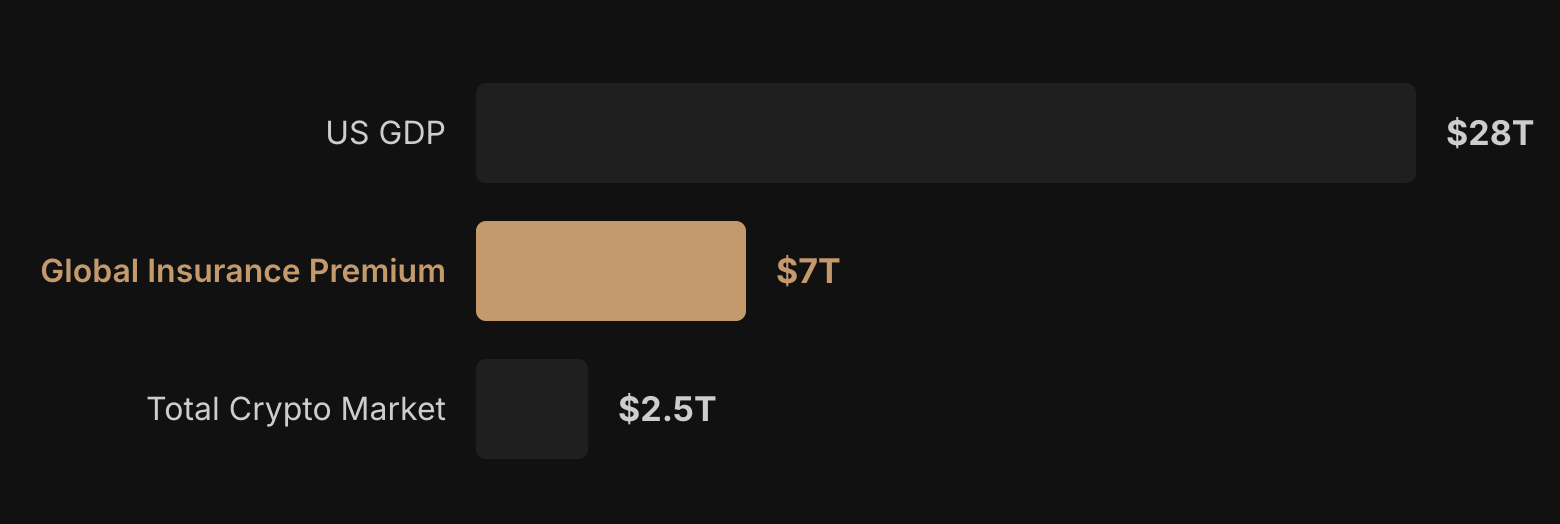


A team composed of insurance technology veterans and on-chain developers is prying open this door to the 'global reinsurance market'.


Moving Reinsurance Companies' Capital Pools On-Chain


The global reinsurance market is dominated by a few giants like Munich Re and Swiss Re, where external capital cannot enter, underwriting conditions are opaque, and solvency cannot be verified. What the Re protocol does is to move reinsurance companies' capital pools on-chain, allowing anyone to deposit money into them and earn premium income.


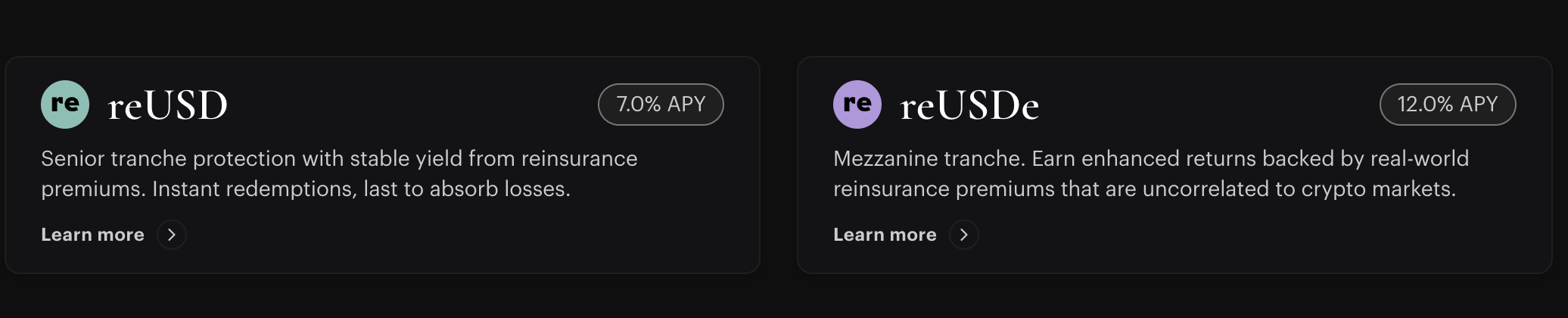
Its core model is not complicated: Insurance companies bundle part of their risks into reinsurance contracts, which are compliantly underwritten by their licensed reinsurance entity Cover Re. Decentralized liquidity providers can then deposit stablecoins into two types of tokenized tranches to earn insurance underwriting income, with the two product forms corresponding to different risk appetites:


reUSD is the senior (stable) tranche, offering principal-protected fixed income (benchmark rate + 250 basis points), with risks absorbed first by the junior tranche; reUSDe is the high-yield tranche, bearing first-loss risk, with a current highest annualized yield of about 23%. The loss absorption order is: first by reUSDe holders and Re Capital, then by reUSD.


To address the regulatory barriers, Re's solution is to separate the operation of the on-chain protocol from the licensed entity: Cover Re SPC (Cayman Islands) acts as an independent reinsurance entity to undertake compliant contracts, while the Resilience Foundation is responsible for issuing the governance token. This achieves legal separation of compliance risk from the technical risk at the protocol layer through an independent licensed entity.


Points and TGE


Re is about to launch its governance token RE. The core role of the token is to enable market participants to formulate protocol rules, but specific revenue, profits, or insurance fund flows are still operated by the licensed entity.


Re's points program aims to reward wallets that provide and store funds within the ecosystem. Its Season 1 points event recently concluded, with 7% of the total RE supply allocated to Season 1 participants. Specific claim windows and vesting mechanisms have not yet been announced. Season 2 started on June 1, 2026, currently with 2,904 active users and a total of 41.2 billion points.


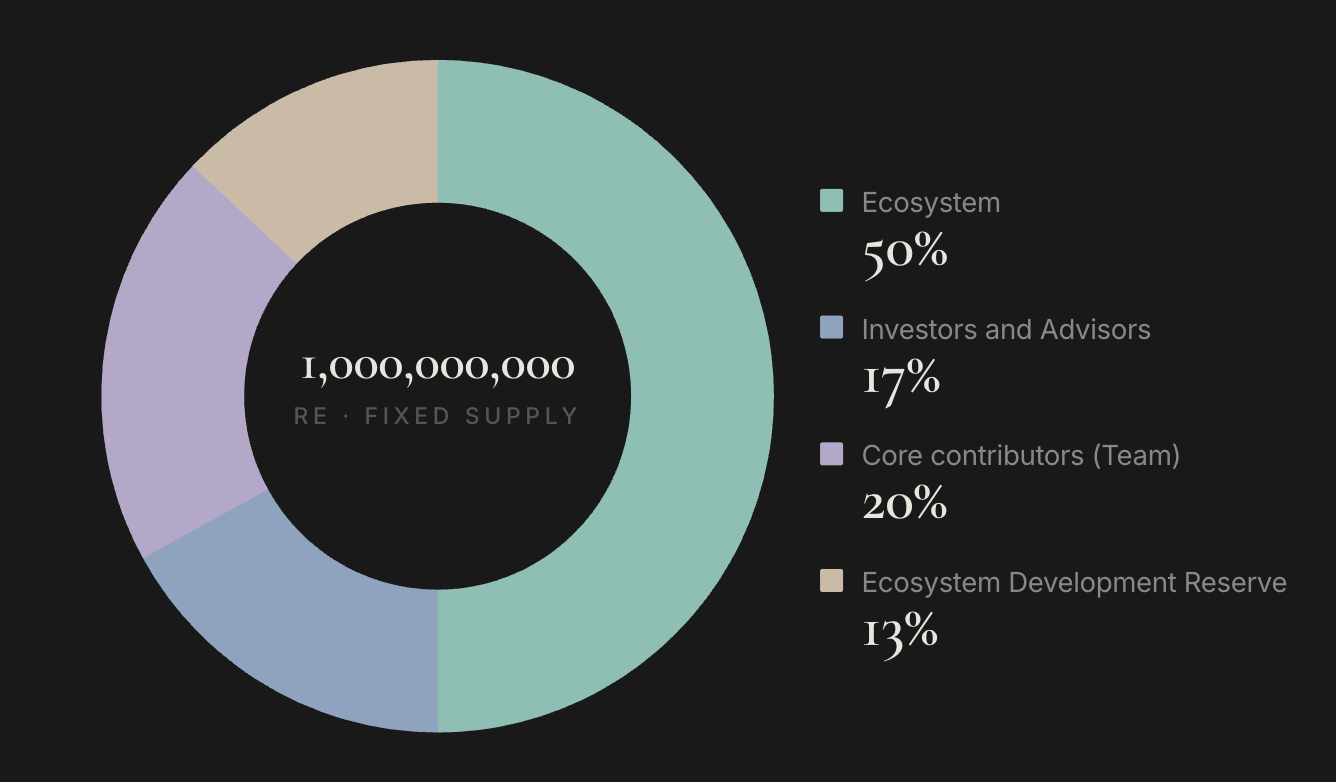
The total supply of RE is fixed at 1 billion tokens, divided into four parts:


  • Ecosystem 50%: 500 million tokens, for community incentives, points program redemptions, and other ecosystem allocations. The 7% supply for Season 1 is allocated from here.
  • Core Contributors / Team 20%: 200 million tokens, team allocation, typically with a vesting period; specific lock-up arrangements have not been announced.
  • Investors and Advisors 17%: 170 million tokens, corresponding to seed round and strategic round investors, also expected to have lock-up periods.
  • Ecosystem Development Reserve 13%: 130 million tokens, for future partnerships, protocol development, etc., managed by the foundation.


RE has been included in Coinbase's listing roadmap, but the specific TGE date has not been announced.


Re Reinsurance Data


Another major feature of Re is the low correlation of its assets. The income source of reinsurance comes from car accident rates, workplace injury occurrence rates, and property damage frequency—these numbers do not fluctuate with BTC price. When the crypto market oscillates repeatedly under geopolitical conflicts and macro policy pressures, the scarcity value of truly non-correlated assets is being repriced.


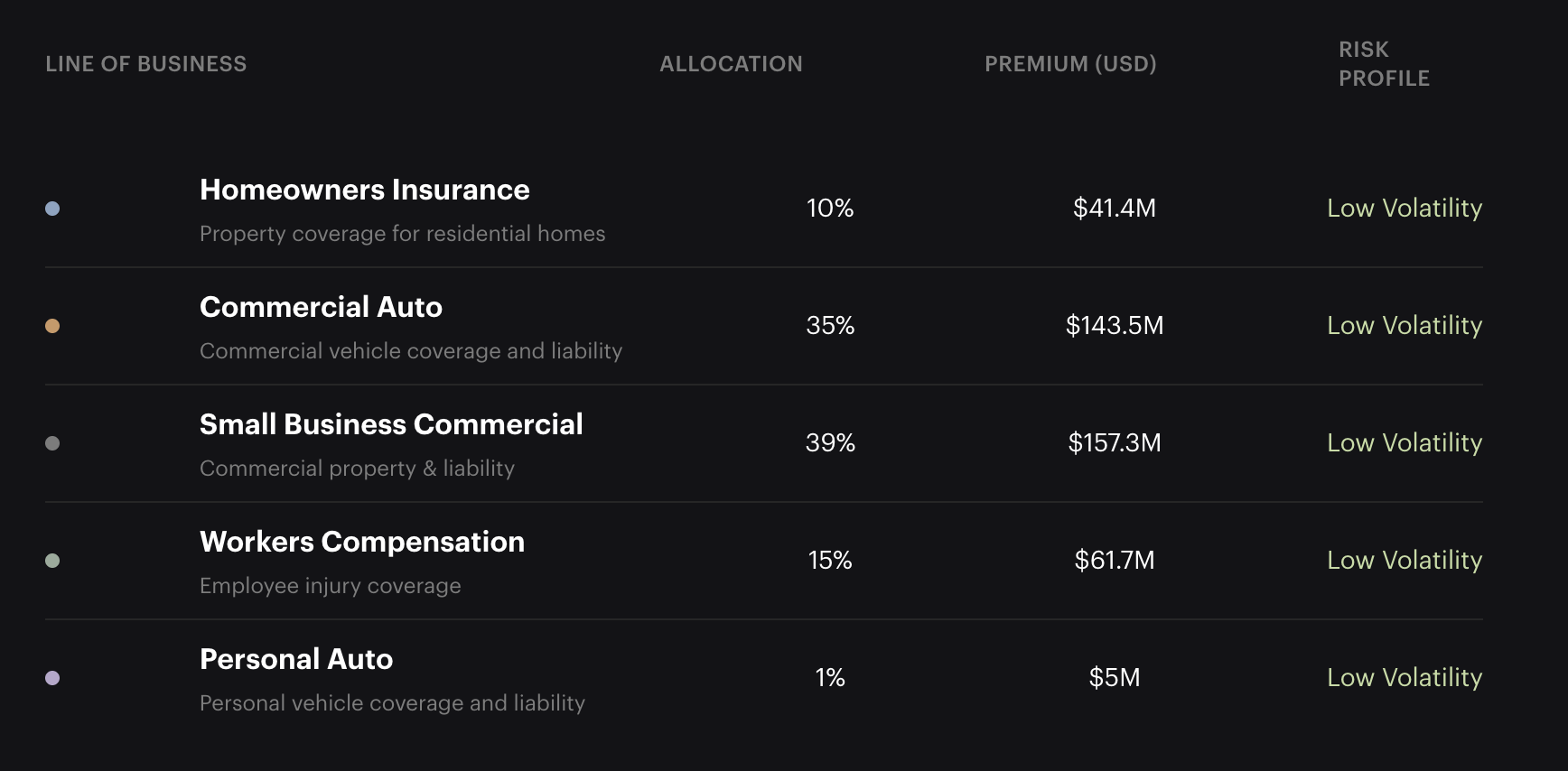
According to its official website data, as of early June 2026, its underlying underwriting portfolio totals $409 million, distributed across commercial auto insurance (35%), small business commercial insurance (39%), workers' compensation (15%), residential insurance (10%), and personal auto insurance (1%). All are in low-volatility daily insurance types, with no high-volatility catastrophic risk exposure. Each reinsurance contract is fully collateralized, with 100% cash or investment-grade assets deposited into segregated Regulation 114 trusts, and solvency can be verified on-chain.


Team and Funding


Re's CEO Karn Saroya has gone through a full round of entrepreneurial experience in the insurtech space. He previously co-founded the insurtech platform Cover, which launched in 2016, raised a total of $27 million from institutions like Exor and Tribe Capital, and later shut down due to business adjustments. Even earlier, he founded the fashion app Stylekick, which was acquired by Shopify.


Other co-founders include Anand Dhillon, Ben Aneesh, Cliff White, and Tribe Capital co-founder Arjun Sethi (the project started under the Tribe Capital crypto incubation system). The specific roles of team members have not been fully disclosed through official channels.


Re completed a $14 million seed round in September 2022, with investors including Tribe Capital, Framework Ventures, Morgan Creek Digital, global reinsurer SiriusPoint, Exor, and Stratos. Post-seed valuation was approximately $100 million. In May 2024, an additional $7 million strategic round was raised, led by Electric Capital, with participation from Nexus Mutual and Avalanche Labs, bringing total funding to about $21 million.


Competitors in the Sector


Comparable projects in the same sector have different directions.


Nexus Mutual is the longest-standing protocol in the on-chain insurance field, but it covers crypto-native risks like DeFi smart contract vulnerabilities and hacker attacks, not involving real-world insurance contracts.


Neptune Mutual focuses on parametric insurance (automatic payouts based on predefined trigger conditions), with a TVL of about $13 million. Its scale is significantly different from Re's, mainly targeting DeFi protocol security scenarios, and has not entered the real-world insurance market.


Ensuro's positioning is closest to Re's—obtaining a regulatory license in Bermuda, partnering with Nexus Mutual to connect on-chain capital with real insurance risks—but publicly disclosed scale data is limited, and it has not yet gained visibility in the mainstream market.


The core differences from the above three are: Re covers insurance types like commercial auto and workers' compensation, which have extremely low correlation with the crypto market; the compliant structure of the licensed reinsurance entity Cover Re allows institutional funds to enter legally; and the $400 million in already underwritten premium volume makes it the only on-chain protocol in this sector that has reached a real commercial scale.


Domande pertinenti

QWhat is the main business model and value proposition of the Re protocol?

AThe Re protocol aims to digitize and open up the traditionally opaque global reinsurance market. Its core model involves transferring a reinsurance company's capital pool onto the blockchain. This allows anyone to deposit stablecoins to earn premium income from underwriting real-world insurance risks. It offers two tokenized positions: reUSD (senior/stable tranche with principal protection and fixed yield) and reUSDe (high-yield/junior tranche that absorbs first losses for higher returns). The protocol uses a licensed reinsurance entity, Cover Re SPC, to handle compliant contracts, separating regulatory risk from the protocol's technical layer.

QHow does Re protocol address the high regulatory barriers in the reinsurance industry?

ARe protocol addresses regulatory barriers by implementing a legal separation between its on-chain protocol and licensed operational entities. A licensed reinsurance entity, Cover Re SPC based in the Cayman Islands, independently underwrites compliant reinsurance contracts. The Resilience Foundation handles governance token issuance. This structure isolates the compliance and regulatory risks associated with the insurance business from the technical and operational risks of the decentralized protocol layer.

QWhat are the key characteristics of RE token's distribution and its planned use?

AThe total fixed supply of the RE governance token is 1 billion. It is distributed across four categories: 50% to the Ecosystem for community incentives and point program rewards; 20% to Core Contributors/Team; 17% to Investors and Advisors; and 13% to an Ecosystem Development Reserve managed by the foundation. Its core function is to allow market participants to govern protocol rules, while the actual insurance cash flows and income are managed by the separate, licensed operating entity. 7% of the total supply is allocated for Season 1 point program participants.

QAccording to the article, what makes the assets underlying Re protocol valuable, especially in the context of the crypto market?

AThe assets underlying Re protocol are valuable due to their low correlation with the crypto market. The protocol's yield is derived from real-world risk events like car accident rates, workplace injury frequency, and property damage—factors that do not fluctuate with Bitcoin's price. As of June 2026, its underwriting portfolio of $409 million is spread across low-volatility, everyday insurance lines like commercial auto, small business commercial, workers' compensation, and residential insurance, with no exposure to high-volatility catastrophe risks. This provides a source of non-correlated yield.

QHow does Re protocol compare to other projects in the on-chain insurance space, such as Nexus Mutual, Neptune Mutual, and Ensuro?

ARe protocol differs from competitors in several key ways: 1) It covers real-world, low-correlation insurance lines (e.g., commercial auto, workers' comp), unlike Nexus Mutual and Neptune Mutual which focus on crypto-native risks like smart contract exploits. 2) It operates through a licensed reinsurance entity (Cover Re SPC), enabling institutional participation. 3) With a $409 million underlying portfolio, it has achieved a significant commercial scale not yet seen by other protocols in this niche. Ensuro has a similar real-world insurance focus and a license, but Re currently has greater market visibility and scale.

Letture associate

The Value Distribution of Stablecoins

**Summary: The Value Distribution of Stablecoins** The article argues that stablecoins are evolving from mere trading tools into broader channels for dollar access. It divides the stablecoin ecosystem into four layers to analyze how value is distributed: 1. **Issuance Layer:** Mints stablecoins, holds reserve assets, and captures the spread between reserve yield and user costs (e.g., Tether, Circle). This layer currently earns the largest profit margin. 2. **Infrastructure Layer:** Connects stablecoins to the traditional financial system, handling fiat on/off-ramps, banking integration, compliance (KYC/AML), and asset management (e.g., Bridge, BVNK). This is the "unglamorous" but critical work, building the essential bridges between crypto and real-world finance. 3. **Acquiring/Distribution Layer:** Integrates stablecoins into merchant systems, manages payment flows, and provides enterprise financial software (e.g., Stripe, Coinbase). They act as the access point for businesses. 4. **Application Layer:** The end-users and businesses that ultimately use stablecoins for payments, settlements, or as a store of value. They benefit from convenience but have little pricing power. The core thesis is that while the issuance layer currently dominates profits, the often-overlooked **infrastructure layer holds significant long-term potential**. The real challenge and barrier to mass adoption is not the on-chain transfer of stablecoins (which is simple), but the complex "last mile" integration into existing business workflows, banking systems, and regulatory frameworks across different countries. Companies in this layer are currently in a "land grab" phase, investing heavily to build networks, secure bank partnerships, and establish compliance pathways. While their position is currently pressured by the profitable issuers above and distribution platforms below, the article suggests that if stablecoins become a default financial rail for businesses, the infrastructure providers who have done the hard work of integration will ultimately gain strong pricing power and become entrenched, essential players.

marsbit16 min fa

The Value Distribution of Stablecoins

marsbit16 min fa

The Value Distribution of Stablecoins

The Value Distribution of Stablecoins The article argues that stablecoins are evolving from a mere trading tool into a broad "dollar channel." It analyzes the industry's value chain through four layers: 1. **Issuance Layer (e.g., Tether, Circle):** The top layer that mints stablecoins, holds reserve assets, and captures the thickest interest rate spread. 2. **Infrastructure Layer (e.g., Bridge, BVNK):** Connects stablecoins to the traditional financial system, handling critical but complex "dirty work" like fiat on/off-ramps, banking integration, compliance (KYC/AML), and cross-border settlement. 3. **Acquiring/Distribution Layer (e.g., Stripe, Coinbase):** Embeds stablecoins into merchant systems, manages payment flows, and integrates with enterprise software. 4. **Application Layer:** End-users and businesses that ultimately use stablecoins for payments, settlement, or storing value. The author posits that while the issuance layer currently captures the most profit, the most overlooked and potentially critical layer is infrastructure. The core challenge for stablecoin adoption isn't the on-chain transfer (which is simple), but bridging the gap between blockchain and the real-world financial system. This involves solving practical problems for businesses: fiat conversion, reconciliation, tax handling, and user onboarding. Infrastructure companies are currently in a difficult "land-grab" phase—building networks, securing banking relationships, and achieving compliance country-by-country. They face pressure from both the profitable issuance layer above and distribution platforms below. However, the author suggests this layer is building a crucial moat. Once stablecoins become a default business rail, the infrastructure players who have done the hard work of integration may gain significant, durable value and pricing power.

链捕手20 min fa

The Value Distribution of Stablecoins

链捕手20 min fa

How to Do Research Well: Deliberately Practice the Real Skills That Matter

No one truly teaches you how to do research. You're often given a desk, a pre-selected problem, and vague instructions to "create something new." Consequently, many people reverse-engineer the job based on visible outputs—papers, posts, announcements—learning only how to *appear* like a researcher rather than how to *become* one. True research capability is built from stacking small, trainable skills, nearly all of which can be developed through deliberate practice. **Pick Your Own Problem:** Most researchers absorb problems from advisors or trends, lacking the underlying reasoning. Choosing a problem you genuinely care about, as John Schulman advises, leads to original work. Develop "taste" like a muscle: predict experiment outcomes, guess paper results from methods, and track which findings remain important over time. **Upgrade Your Inputs:** Relying on shared reading lists (arXiv hot lists, filtered group chats) leads to unoriginal conclusions. Undervalued old literature often holds crucial insights (e.g., MoE, LSTM, backpropagation). Richard Sutton's "The Bitter Lesson" or Claude Shannon's 1952 talk on creative thinking are more predictive than lengthy modern surveys. Breadth matters as much as depth: draw from neuroscience, mechanism design, hardware knowledge, and honest statistics. Read papers directly, especially appendices and limitations sections. **Write Everything Down:** As Paul Graham noted, writing exposes flaws in seemingly mature ideas. Writing is the cheapest defense against self-deception. Following Feynman's principle, Darwin programmatically wrote down facts contradicting his theory to combat memory bias. Maintain a detailed log of hypotheses, setups, predictions, results, and updated understandings. Reviewing past logs fosters essential humility.

marsbit2 h fa

How to Do Research Well: Deliberately Practice the Real Skills That Matter

marsbit2 h fa

Trading

Spot
Futures
活动图片