Defillama's TVL data, recorded around 10:30 AM ET on August 20th, showed that $83.216 billion was locked in DeFi protocols, significantly surpassing the previous day's figure. Spot DEX trading volume reached $10.886 billion, while decentralized perpetual platforms processed $36.72 billion. The stablecoin market stood at $301.502 billion, significantly below 2026 highs.
Finally Breaking the $10 Billion Barrier
DEX metrics are significant as August 20th became the first day to break above the $10 billion mark since the first week of June. Trading had been sluggish for much of the summer as cryptocurrency prices moved sideways, speculative appetite waned, and liquidity vanished for many small-cap tokens.
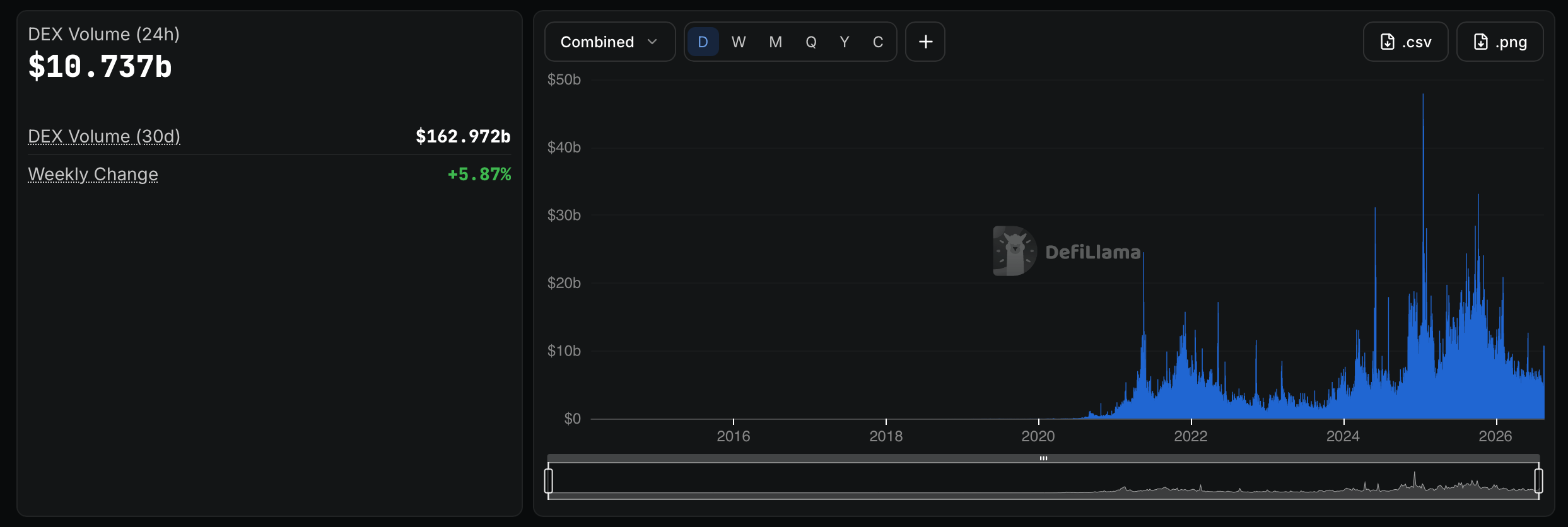
Essentially, a DEX in the DeFi world allows traders to exchange cryptocurrencies without custodian transfer, directly through blockchain-based software, instead of sending their assets to a centralized exchange. When trading volume suddenly spikes, it gives a clear picture of how actively traders are actually deploying capital on-chain.
By volume, Uniswap remains the leader, processing between $3.1 and $3.4 billion across all its platforms in the last 24 hours. Pancakeswap followed with a volume of about $1.2 billion, while Pump, Aerodrome, BisonFi, and the Orca DEX platform contributed to the overall market growth.
Solana continues to lead in spot DEX activity, ranking first according to Defillama data for the last 24 hours, 7 days, and 30 days. It is followed by the BNB Smart Chain, Ethereum, and Base blockchain networks – another sign that decentralized trading is no longer tethered to the Ethereum network, which once dominated the DeFi space.
Capital Flows Back into DeFi
The trading frenzy coincided with a broader cryptocurrency rally. On August 20th, Bitcoin traded in the range of $71,500 to $72,000, while Ethereum (ETH) and other DeFi-focused coins showed more significant percentage gains. The larger price swings gave traders exactly what they needed for momentum trading, arbitrage, and leveraged deals.
Overall, the market remains significantly below the DeFi peak of $180 billion reached during the 2021 boom. Following the 2022 crash, the sector's TVL spent several years recovering, tested higher levels around 2025, and declined again in 2026 before the current rebound.
Hyperliquid Captures the Derivatives Market
Hyperliquid took an even more aggressive stance on perpetual futures – contracts that allow traders to bet on cryptocurrency prices without an expiration date. According to Defillama, Hyperliquid's trading volume was $15.205 billion over the last 24 hours, $41.445 billion over seven days, and $184.906 billion over a 30-day period.
Its cumulative perpetual futures volume reached $5.092 trillion, while open interest – the value of unliquidated positions – fluctuated near $11.94 billion. Hyperliquid often controls roughly 45% of the total decentralized perpetual futures volume, leaving competing platforms to fight for the remaining share.
Hyperliquid's HYPE token also climbed into the low-to-mid $70 range as trading activity intensified. Deep liquidity, an order-book blockchain, and leveraged markets have turned the platform into a magnet whenever cryptocurrency prices start moving fast.
The real test will be DeFi's sustainability. One frenzied trading day does not yet signify a sustained trend, and volumes in this sector can evaporate quickly once volatility subsides. Traders will watch whether DEX volume holds around or above $10 billion, and whether TVL continues to grow.
Data source for the main/title image: defillama.com
end-content