"Unlimited Money Printing" Bug Lurked for Four Years, Privacy Coin ZEC Plummets 50% in One Day

Odaily星球日报Pubblicato 2026-06-05Pubblicato ultima volta 2026-06-05

Introduzione

A critical "unlimited, undetectable counterfeit" vulnerability existed for nearly four years in the Orchard privacy pool of Zcash (ZEC), a privacy-focused cryptocurrency. The bug, which could theoretically allow attackers to create unlimited fake ZEC, was disclosed by founder Zooko Wilcox on June 5th. While officially patched and deemed low-probability for exploitation, the news triggered a market panic. ZEC's price plummeted over 50% in a single day. The core crisis stems from the inability to prove whether any counterfeit ZEC was created during the vulnerability's active period, as Orchard's design inherently hides transaction details. This casts severe doubt on ZEC's total supply integrity. The sell-off accelerated after prominent investor and ZEC narrative supporter Arthur Hayes announced he had sold his entire position, citing the inability to cryptographically prove the impossibility of extra minting. Community trust eroded further upon learning the bug was discovered with AI-assisted auditing, raising questions about Zcash's development and security review processes. The incident has evolved from a price correction into a fundamental crisis of confidence regarding the network's core security promises.

Original | Odaily Planet Daily (@OdailyChina)

Author | Asher (@Asher_0210)

In the early hours of June 5th, Zcash founder Zooko Wilcox published a statement confirming that Orchard, Zcash's next-generation privacy pool enabled in 2022, once contained a critical counterfeiting vulnerability. Although Zcash officials emphasized that the bug has been fixed and believe the probability of its exploitation is low, it still couldn't stop the spread of market panic.

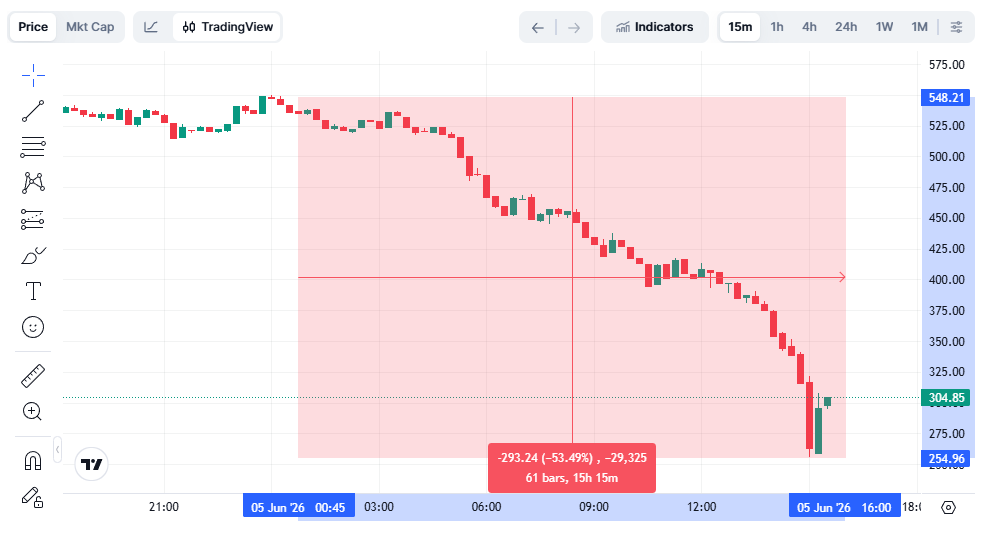
After the news broke, the Zcash token ZEC quickly nosedived, plummeting over 30% in a short time; by the afternoon, the sell-off didn't stop, panic continued to spread, and the price once fell to around $250, with the intraday loss widening to over 50%.
Security researcher Taylor Hornby discovered the issue on May 29th and has completed vulnerability verification in a local environment, generating test counterfeit ZEC, further validating that the vulnerability is an executable attack path. Currently, the two biggest controversies surrounding Zcash are: First, whether counterfeit ZEC has ever appeared in the privacy pool over the past four years; Second, how can officials prove that no counterfeit ZEC has flowed into the privacy pool, an extremely difficult task to disprove.

Where Did the "Unlimited Minting" ZEC Come From?

The security of Orchard (Zcash's privacy-protecting "shielded pool") relies on zero-knowledge proof circuits, with the core rule being asset conservation: the spend of each transaction must come from legitimate inputs, and ZEC cannot be created out of thin air. Users can hide balances and transaction amounts, but the system must verify the transaction's legitimacy.

Security researcher Taylor Hornby discovered that a constraint in the Orchard circuit was incomplete (under-constrained), allowing attackers to input data that should not have passed, yet verification could still return as successful. In other words, without needing administrator privileges or controlling nodes, and not being a backdoor, as long as the system mistakenly deems a transaction legitimate, originally non-existent ZEC could be recorded as legitimate assets within Orchard.

Shielded Labs called it "unlimited, undetectable counterfeit ZEC".

The Bug is Fixed, but Historical Issues Remain Unresolved

For ordinary security incidents, the biggest fear is large losses, but the most troublesome aspect of Zcash's current crisis is that the losses cannot be directly quantified.

If an attack occurred on the transparent chain, the market could at least see the attack address, fund flows, and affected assets. However, Orchard's transaction amounts, balances, and fund paths are inherently hidden. Once counterfeit ZEC might have appeared in the pool, it's difficult for outsiders to judge whether it's still lingering in Orchard or has gradually flowed out through normal transactions.

More critically, Orchard is not a completely isolated black box. Users can migrate assets between different fund pools, and both real ZEC and potential counterfeit ZEC could mix within the pool.

The Zcash ecosystem can emphasize that there is currently no evidence of the vulnerability being exploited and can explain that the probability of malicious exploitation is low. But for traders, "no anomalies have been found" and "it has been proven that nothing happened" are not the same thing.

This is the core reason for ZEC's expanding decline. Until the question of whether counterfeit ZEC ever appeared in Orchard is proven, ZEC's supply credibility will remain under a shadow.

Arthur Hayes Liquidates Position, Igniting Market Confidence Crisis

After the ZEC vulnerability was exposed, BitMEX co-founder Arthur Hayes's public liquidation further amplified market panic.

Arthur Hayes stated on platform X that he has sold his entire ZEC holdings. Hayes said he learned about the attack yesterday but did not realize its conflict with his narrative framework. ZEC's 30% drop prompted him to reconsider and decide to take full profits on that position. He added that while he believes the possibility of additional minting is extremely low, he cannot formally prove its impossibility at the cryptographic level; he will continuously reassess his judgment and, if his assumption is disproven, will repurchase, hoping to build a position at a lower price; privacy is priceless, and he wouldn't mind repurchasing at a higher price.

This was quite damaging for ZEC. Over the past period, Arthur Hayes has been one of the key narrative drivers for ZEC. His bullish view was based on the long-term logic of privacy assets regaining pricing power in the context of AI, government surveillance, and big tech expansion. Therefore, his liquidation wasn't just a major holder taking profits; it resembled a public downgrade of ZEC's current narrative.

When a top narrative supporter chooses to exit first, long positions originally supported by belief and expectations are more likely to turn into collective profit-taking and risk aversion.

Community Sentiment Spiral, ZEC Transforms from Price Correction to Trust Crisis

Perhaps influenced by Arthur Hayes's liquidation, community discussions about ZEC quickly shifted from "whether to buy the dip" to "whether it can still be trusted."

On one hand, the community repeatedly emphasized the severity of the vulnerability itself. Compared to short-term price drops, many users were more concerned that a vulnerability theoretically capable of creating unlimited counterfeit coins had lurked in Orchard for nearly four years. For them, the price drop was just the surface; what truly shook confidence was the question mark placed on Zcash's core security assumptions.

On the other hand, the process of AI-assisted vulnerability discovery further exacerbated distrust. Taylor Hornby, with the aid of AI tools, conducted a targeted review of the Orchard circuit, ultimately discovered the vulnerability, wrote an exploit program, and generated counterfeit ZEC in a local environment. Although AI did not perform the audit independently, what the community more easily remembered was the narrative that "a key vulnerability existing for years was assisted in being found by AI in a short time," which quickly gained traction.

This turned public criticism towards Zcash's development and audit systems. The community questioned why a vulnerability existing since 2022 could go undetected on the mainnet for years? If even the core privacy pool could have constraint omissions, how can users trust Zcash's promises on supply and privacy security again?

Therefore, this decline is no longer just profit-taking. Before Zcash provides more convincing proof, no one is really willing to hold ZEC long-term.


Crypto di tendenza

Letture associate

IOSG: From Hot Storage to Cold Memory – Decentralized Storage in the AI Era's Storage Boom

This article explores the stark contrast between the booming AI storage sector and the currently undervalued decentralized storage market. It argues their core value propositions differ fundamentally: AI storage is a "hot data efficiency" system designed to maximize computational throughput, GPU utilization, and business monetization by accelerating data flow into processors. In contrast, decentralized storage represents a "cold data trust" system, prioritizing data immutability, censorship resistance, and the preservation of long-term human memory. The analysis details the multi-layered AI storage architecture, from high-bandwidth memory (HBM) and enterprise SSDs for high-performance needs to data lakes for capacity. It highlights how AI has repositioned storage from a cost center to a critical efficiency engine. Decentralized storage, exemplified by Filecoin and Arweave, is examined for its distinct philosophies and current challenges, including product-market fit, retrieval latency, and enterprise adoption hurdles. Despite its current quiet phase, the article posits that decentralized storage holds unique future value for AI data provenance, public dataset archiving, compliance, and safeguarding civilizational records against censorship. The conclusion suggests that while the market currently rewards efficiency, the need for trusted, permanent data layers may eventually lead to a revaluation of decentralized storage's role.

marsbit3 min fa

IOSG: From Hot Storage to Cold Memory – Decentralized Storage in the AI Era's Storage Boom

marsbit3 min fa

Exploring ChangXin Technology's Hefei Headquarters: The Rising Campus Ignites Changgang CBD, Grassroots Employees 'Witness' Wealth Creation Myth

"On-the-Ground Visit to CXMT's Hefei Headquarters: Campus Boom Ignites Changgang 'CBD,' While Rank-and-File Employees Watch Wealth Creation Myth from the Sidelines." Following CXMT's (ChangXin Memory Technologies Inc., 688825.SH) explosive stock market debut on July 27, where its share price surged over fivefold, a site visit to its Hefei headquarters reveals a stark contrast. While the company's市值 soared, making it A-share's most valuable firm,基层员工 indicate the wealth creation has largely bypassed them. Employees reveal that股权激励 is restricted to managerial levels (Grade 9科长 and above), with most普通员工 at Grades 11 or 12. Salaries, while considered high for Hefei at around 200,000 RMB annually, fall short of the millions speculated online. Work routines remain demanding, with long hours, phone confiscation in sensitive areas, and strict保密 protocols forbidding unauthorized external communication. Simultaneously, CXMT's expansion is visibly transforming the once-rural Changgang area. Ongoing construction includes multiple new phases, with an industrial chain of supporting companies集聚 around the campus. This growth has spurred local development: housing prices initially skyrocketed, and a vibrant commercial district dubbed "Changgang CBD" now thrives, catering to the潮汐效应 of shift workers. The area has evolved from construction sites to a bustling hub, though the company's stringent安保, including high-voltage perimeter fencing, underscores its sensitive nature. The report concludes that while CXMT's rise fuels regional economic activity, the immediate financial rewards of its上市 are not shared by its frontline workforce.

marsbit4 min fa

Exploring ChangXin Technology's Hefei Headquarters: The Rising Campus Ignites Changgang CBD, Grassroots Employees 'Witness' Wealth Creation Myth

marsbit4 min fa

Huang Xiaoming, Li Bin, Lei Jun, Liang Wenfeng... Changxin IPO Feast, Who's the Biggest Winner?

Changxin Technology's IPO on the Shanghai STAR Market created significant wealth for its stakeholders. Founder Zhu Yiming and his family saw their wealth surge nearly 300%, with his stake in Changxin alone valued at approximately 80 billion RMB. Over 6700 employees benefited, creating at least 237 new millionaires. Several prominent figures also profited. Liang Wenfeng, founder of Deepseek, saw a paper gain of 827 million RMB through his funds' participation. Kong Jianping, founder of Nano Labs, holds an indirect stake worth around 940 million RMB, representing a roughly 44x return on his 2020 investment. Former Midea executive Huang Xiaoming gained approximately 503 million RMB. Strategic investors included industry partners. Nio, represented by founder William Li, pledged 158 million RMB for shares now showing a paper gain of about 740 million RMB. Similarly, a Xiaomi subsidiary acquired shares resulting in an over 736 million RMB gain, though the company clarified this is a corporate investment, not directly attributable to founder Lei Jun's personal wealth. Founder Zhu Yiming further plans to donate shares worth over 37.6 billion RMB for future employee incentives. The IPO solidified Changxin's position as a leading domestic memory chip maker, triggering a widespread wealth creation event for its network of founders, employees, and investors.

Odaily星球日报19 min fa

Huang Xiaoming, Li Bin, Lei Jun, Liang Wenfeng... Changxin IPO Feast, Who's the Biggest Winner?

Odaily星球日报19 min fa

Aave's Stable Vault

This article explores Aave's recently launched "Stable Vaults," a product designed to bridge the gap between traditional finance users and DeFi yield. It argues that while DeFi offers transparency and potentially higher returns, its complexity and volatility are major barriers for mainstream adoption. The core problem is that users pay for convenience and simplicity, often accepting lower returns to avoid decision-making and technical hurdles. Stable Vaults allow fintech apps, neobanks, or payment platforms (operators) to integrate with Aave's lending markets once and offer their users a "savings account" with a fixed, predictable yield (e.g., 4%). The operator absorbs the underlying market volatility; if Aave's pool pays 6%, the operator pockets the 2% difference, but if it pays only 2%, the operator covers the shortfall to maintain the promised 4% for users. The piece analyzes this model from three perspectives: 1. **The User:** Gains simplicity, a fixed rate, and familiar app features (customer support, account recovery). However, they lose potential upside, accept a lower fixed yield, and take on new counterparty risks from the operator and its proprietary backend systems. 2. **The Operator (e.g., a neobank):** Can monetize idle user balances easily, generating significant fee income (the spread between the fixed rate and the actual yield) with minimal integration effort, turning a cost center into revenue. 3. **Aave:** Gains "sticky," loyalty-based deposits that are less likely to flee during minor yield fluctuations, securing a stable revenue stream crucial for its tokenomics (like buybacks). It becomes a back-end infrastructure provider for the broader consumer finance ecosystem. The author acknowledges that while sophisticated users can access higher yields directly on Aave, most people prefer convenience and security over optimization. They reference behavioral studies showing that too many choices lead to inaction. Therefore, Stable Vaults represent an acceptance of human nature—prioritizing safety, predictability, and ease—and a strategic move for Aave to capture stable, large-scale deposits from mainstream finance applications. Examples like Rise (payroll) and Kraken are already using similar embedded yield models.

marsbit24 min fa

Aave's Stable Vault

marsbit24 min fa

Trading

Spot

Articoli Popolari

Come comprare ZEC

Benvenuto in HTX.com! Abbiamo reso l'acquisto di Zcash (ZEC) semplice e conveniente. Segui la nostra guida passo passo per intraprendere il tuo viaggio nel mondo delle criptovalute.Step 1: Crea il tuo Account HTXUsa la tua email o numero di telefono per registrarti il tuo account gratuito su HTX. Vivi un'esperienza facile e sblocca tutte le funzionalità,Crea il mio accountStep 2: Vai in Acquista crypto e seleziona il tuo metodo di pagamentoCarta di credito/debito: utilizza la tua Visa o Mastercard per acquistare immediatamente ZcashZEC.Bilancio: Usa i fondi dal bilancio del tuo account HTX per fare trading senza problemi.Terze parti: abbiamo aggiunto metodi di pagamento molto utilizzati come Google Pay e Apple Pay per maggiore comodità.P2P: Fai trading direttamente con altri utenti HTX.Over-the-Counter (OTC): Offriamo servizi su misura e tassi di cambio competitivi per i trader.Step 3: Conserva Zcash (ZEC)Dopo aver acquistato Zcash (ZEC), conserva nel tuo account HTX. In alternativa, puoi inviare tramite trasferimento blockchain o scambiare per altre criptovalute.Step 4: Scambia Zcash (ZEC)Scambia facilmente Zcash (ZEC) nel mercato spot di HTX. Accedi al tuo account, seleziona la tua coppia di trading, esegui le tue operazioni e monitora in tempo reale. Offriamo un'esperienza user-friendly sia per chi ha appena iniziato che per i trader più esperti.

294 Totale visualizzazioniPubblicato il 2024.12.12Aggiornato il 2026.06.02

Come comprare ZEC

Discussioni

Benvenuto nella Community HTX. Qui puoi rimanere informato sugli ultimi sviluppi della piattaforma e accedere ad approfondimenti esperti sul mercato. Le opinioni degli utenti sul prezzo di ZEC ZEC sono presentate come di seguito.

活动图片