Congress Advances CBDC Ban Until 2030 Through Major Housing Reform Bill

TheNewsCryptoPubblicato 2026-06-17Pubblicato ultima volta 2026-06-17

Introduzione

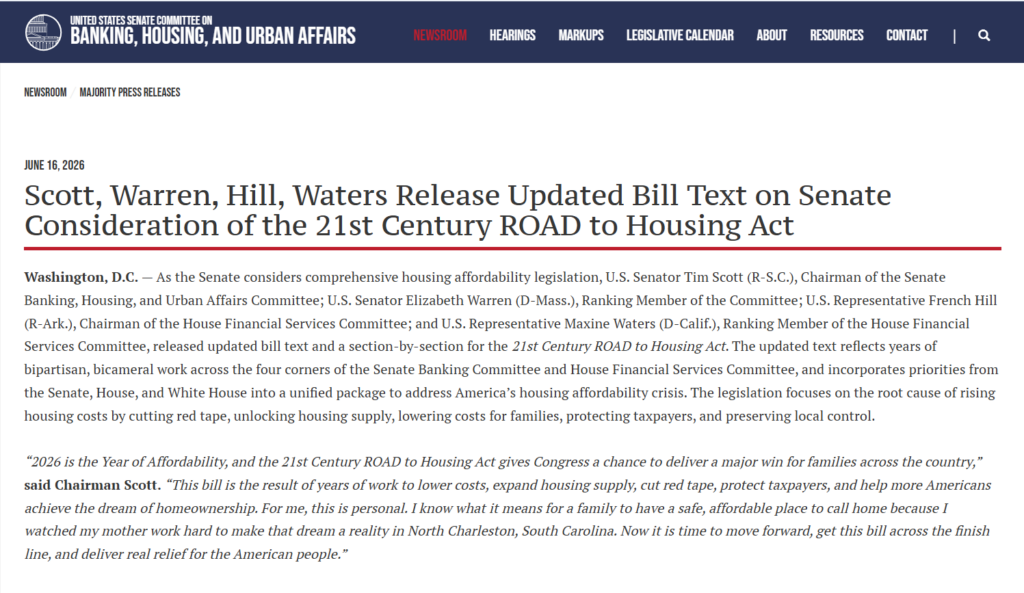
Congress has passed the 21st Century Road to Housing Act, a bipartisan bill primarily focused on housing reform to improve affordability and supply. Included within it is a significant provision that bans the Federal Reserve from issuing a central bank digital currency (CBDC) or "digital dollar" before December 31, 2030. The measure defines a CBDC as a dollar-denominated digital asset, a direct liability of the Fed, accessible to all Americans. Proponents argue the ban allows more time to study a digital dollar's impacts and addresses concerns about privacy, financial surveillance, and government overreach in digital payments. The provision specifically targets a retail CBDC but does not restrict permissionless blockchain networks. This crypto-related language, embedded in broader housing legislation, has drawn considerable attention for its potential to shape the future of digital assets and payments in the U.S. The bill's final passage will determine if the ban takes effect for the next decade.

Legislators have passed a bill aimed at pushing housing reforms that feature a temporary ban on a Federal Reserve CBDC. The ban forms one of the many proposals included in the bipartisan bill, the 21st Century Road to Housing Act. The bill seeks to improve affordable housing, boost the supply of houses, and bring about various reforms.

A proposal in the bill bans the Federal Reserve from creating a digital dollar before December 31, 2030. Lawmakers inserted the provision into the broader housing bill rather than introducing it as a standalone crypto-related measure. Under the proposal, lawmakers classify a CBDC as a dollar-denominated digital asset. This serves as a direct liability of the Federal Reserve and remains accessible to all Americans.
Supporters of the provision argue that it gives policymakers additional time to evaluate the potential impacts of a digital dollar. The ban also reflects concerns that some lawmakers have raised about privacy, financial surveillance, and government involvement in digital payment systems. On the other hand, this proposal does not impose restrictions on permissionless blockchain networks.

Focus on Crypto Policy in Housing Legislation

Lawmakers designed the housing legislation to address housing supply challenges through permitting reforms, regulatory changes, and expanded financing opportunities. Nevertheless, it is the CBDC policy language that caught much attention in the cryptocurrency community. Since it impacts the issuance of the digital dollar in the future. The language was adopted in Congress in light of further discussions. This was regarding the place of digital assets in the country’s financial system.

In accordance with the language, the ban applies to the efforts of the Federal Reserve to issue a retail CBDC regardless of whether it will be issued directly by the institution or by means of intermediaries. In addition, there are some drafts of the bill that have an exception in the case when private digital dollars retain privacy traits comparable to those of physical dollars.

The market analysts are continuing to watch the developments since the legislation could affect further discussions about digital payments and cryptocurrencies. Although the housing bill is what lawmakers are concentrating on, the clause regarding CBDCs can be seen as an important factor in terms of the cryptocurrency sector. The next few steps in the legislation process will decide whether or not the ban will be enforced within the next decade.

Highlighted Crypto News:

Ethereum Advances Glamsterdam Upgrade Ahead of Planned 2026 Launch

TagsBlockchainCBDCcrypto legislationFederal ReserveU.S Congress

Crypto di tendenza

Domande pertinenti

QWhat is the main purpose of the 21st Century Road to Housing Act as mentioned in the article?

AThe main purpose of the 21st Century Road to Housing Act is to improve affordable housing, boost the supply of houses, and bring about various reforms.

QWhat specific restriction does the bill place on the Federal Reserve regarding a Central Bank Digital Currency (CBDC)?

AThe bill bans the Federal Reserve from creating a digital dollar, or retail CBDC, before December 31, 2030.

QWhy did supporters of the CBDC provision include it in the bill according to the text?

ASupporters argue the provision gives policymakers additional time to evaluate the potential impacts of a digital dollar and reflects concerns about privacy, financial surveillance, and government involvement in digital payment systems.

QHow does the article describe the focus of the housing legislation versus the attention it received?

AWhile the housing legislation is designed to address housing supply challenges, it was the CBDC policy language within the bill that caught much attention in the cryptocurrency community.

QAccording to the bill's language, does the CBDC ban apply to private, permissionless blockchain networks?

ANo, the proposal does not impose restrictions on permissionless blockchain networks. Some drafts of the bill even have an exception for private digital dollars that retain privacy traits comparable to physical dollars.

Letture associate

New Huo Research: Dense Bottom Fishing in the $60K BTC Range, a 'High Value-for-Money Zone' Sees a Handover Surge

Bitcoin has shown a significant oversold rebound this week, with extreme panic in the crypto market easing. Multiple data points indicate a notable market bottom is forming. On the market front, the net outflow from Bitcoin spot ETFs has continued to shrink, and the negative premium between Coinbase and USDT is steadily correcting. Industry fundamentals suggest the shutdown cost for mainstream miners is concentrated between $30,000 and $50,000, potentially solidifying a阶段性 industry cost floor—a classic signal of market bottoms in previous cycles. Institutional capital is notably positioning against the trend. For instance, Sinohope Group's weekly OTC trading volume surged over 8 times环比, with active platform users doubling, both reaching record highs. This confirms a sharp increase in large capital transaction activity and a spike in off-exchange funding demand. Sinohope Research also observed on-chain data showing that funds from entities with public company attributes and long-term "whale" wallets are actively accumulating Bitcoin around the key $60,000 price level. The research institute has maintained since mid-May that a high-value investment window has reopened, and the market is now undergoing a shift from panic selling to long-term holding. Looking ahead, the core drivers for an upward market move will be liquidity release and macro policy developments. The successful and strong performance of SpaceX's IPO has reignited market optimism, and the massive liquidity frozen during its subscription period is now being unlocked. This substantial capital is expected to seek new value opportunities, potentially flowing into currently undervalued assets like Bitcoin. On the macro and policy front, the tone set in Kevin Warsh's upcoming speech at the FOMC meeting is crucial for near-term monetary policy expectations. Furthermore, the potential passage of the CLARITY Act by late July could significantly boost institutional confidence for capital entry. Considering these bottoming signals alongside favorable liquidity and policy factors, Sinohope Research remains optimistic about the market's subsequent trajectory.

marsbit6 min fa

New Huo Research: Dense Bottom Fishing in the $60K BTC Range, a 'High Value-for-Money Zone' Sees a Handover Surge

marsbit6 min fa

Uncovering the 'God of Investment Research' Behind Citrini: Perpetual Substack Chart-Topper, a Single Report Evaporated Trillions from US Stocks

Revealing the "Research God" Behind Citrini: A Non-Finance Founder Shaking Up Markets Citrini, an independent research firm consistently ranked #1 on Substack's finance charts with nearly 250,000 subscribers, has gained significant attention in the current bull market. Its founder, James van Geelen, holds dual degrees in biology and psychology from UCLA, with a background as an emergency medical technician and a healthcare entrepreneur before founding Citrini. The firm is known for its deep, narrative-driven analyses focusing on long-term "super trends" like AI, geopolitics, and macro policy. Citrini made headlines in February with its report "The 2028 Global Intelligence Crisis," a thought experiment on AI's potential societal impact. Despite being labeled a scenario analysis, it triggered a widespread sell-off in software and related stocks, briefly wiping hundreds of billions from the US market. Other notable reports include an on-the-ground analysis of the Strait of Hormuz and accurate calls on the copper foil industry's importance for AI/semiconductors. Geelen champions "second-order thinking," focusing on the indirect consequences of events. His investment style is thematic and often contrarian, seeking opportunities others miss. Citrini operates with a founder-driven, anonymous elite team model, recently adding specialists in macroeconomics and semiconductor analysis. The firm also manages a model portfolio, Citrindex, which has reportedly achieved over 200% cumulative returns.

marsbit10 min fa

Uncovering the 'God of Investment Research' Behind Citrini: Perpetual Substack Chart-Topper, a Single Report Evaporated Trillions from US Stocks

marsbit10 min fa

Ethereum Q1 2026 Review: On-chain Activity Hits New Highs, Tokenized Assets Lead the Industry

Ethereum Q1 2026 Review: Chain Activity Hits Record High, Tokenized Assets Lead the Industry In Q1 2026, the Ethereum ecosystem displayed a dual narrative: record-high on-chain activity coincided with declining USD-denominated metrics. User adoption surged, with monthly active addresses reaching 13.2 million (up 53.5% QoQ) and layer-1 transactions hitting 200.4 million (up 38% QoQ). However, the total value locked (TVL) decreased 11% to $316.2B, and protocol revenue fell 16.9% to $2.0B, largely due to a broader crypto market downturn. Tokenized assets emerged as a key strength. Their total market cap reached $203.4B, with significant growth in tokenized funds (+73.1% YoY) and commodities (+325.9% YoY). Ethereum dominated cross-chain comparisons, holding over 61% of stablecoin value and 84% of tokenized commodities value among top chains. A major development was the impact of network scaling. The "Blob" upgrade significantly increased data capacity, causing average transaction fees on layer-1 to plummet 47.9% QoQ despite higher usage. This demonstrates the "Jevons Paradox" in action: cheaper block space stimulates demand. The report highlights Ethereum's established position as the primary settlement layer for institutional tokenization, evidenced by new fund launches from giants like BlackRock and JPMorgan in May. Analysts draw parallels between Ethereum's current stage and the internet in the mid-1990s, suggesting its open, neutral network is poised to become the foundational infrastructure for global finance, outcompeting closed, private alternatives.

Foresight News14 min fa

Ethereum Q1 2026 Review: On-chain Activity Hits New Highs, Tokenized Assets Lead the Industry

Foresight News14 min fa

Trading

Spot
Futures

Articoli Popolari

Come comprare BAN

Benvenuto in HTX.com! Abbiamo reso l'acquisto di Comedian (BAN) semplice e conveniente. Segui la nostra guida passo passo per intraprendere il tuo viaggio nel mondo delle criptovalute.Step 1: Crea il tuo Account HTXUsa la tua email o numero di telefono per registrarti il tuo account gratuito su HTX. Vivi un'esperienza facile e sblocca tutte le funzionalità,Crea il mio accountStep 2: Vai in Acquista crypto e seleziona il tuo metodo di pagamentoCarta di credito/debito: utilizza la tua Visa o Mastercard per acquistare immediatamente ComedianBAN.Bilancio: Usa i fondi dal bilancio del tuo account HTX per fare trading senza problemi.Terze parti: abbiamo aggiunto metodi di pagamento molto utilizzati come Google Pay e Apple Pay per maggiore comodità.P2P: Fai trading direttamente con altri utenti HTX.Over-the-Counter (OTC): Offriamo servizi su misura e tassi di cambio competitivi per i trader.Step 3: Conserva Comedian (BAN)Dopo aver acquistato Comedian (BAN), conserva nel tuo account HTX. In alternativa, puoi inviare tramite trasferimento blockchain o scambiare per altre criptovalute.Step 4: Scambia Comedian (BAN)Scambia facilmente Comedian (BAN) nel mercato spot di HTX. Accedi al tuo account, seleziona la tua coppia di trading, esegui le tue operazioni e monitora in tempo reale. Offriamo un'esperienza user-friendly sia per chi ha appena iniziato che per i trader più esperti.

506 Totale visualizzazioniPubblicato il 2024.12.11Aggiornato il 2026.06.02

Come comprare BAN

Discussioni

Benvenuto nella Community HTX. Qui puoi rimanere informato sugli ultimi sviluppi della piattaforma e accedere ad approfondimenti esperti sul mercato. Le opinioni degli utenti sul prezzo di BAN BAN sono presentate come di seguito.

活动图片