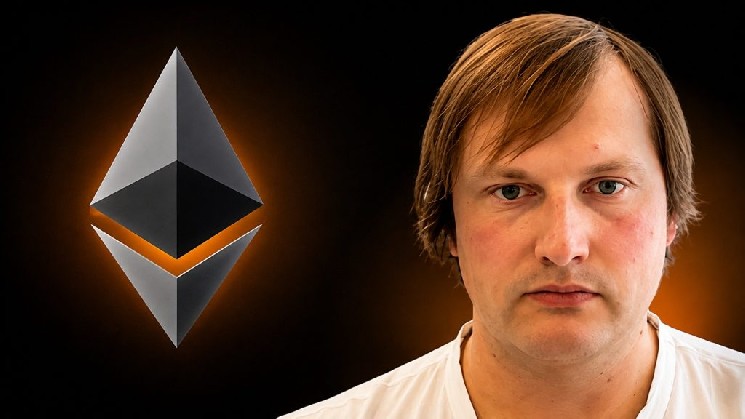
Uncovering the 'God of Investment Research' Behind Citrini: Perpetual Substack Chart-Topper, a Single Report Evaporated Trillions from US Stocks

marsbitPubblicato 2026-06-18Pubblicato ultima volta 2026-06-18

Introduzione

Revealing the "Research God" Behind Citrini: A Non-Finance Founder Shaking Up Markets Citrini, an independent research firm consistently ranked #1 on Substack's finance charts with nearly 250,000 subscribers, has gained significant attention in the current bull market. Its founder, James van Geelen, holds dual degrees in biology and psychology from UCLA, with a background as an emergency medical technician and a healthcare entrepreneur before founding Citrini. The firm is known for its deep, narrative-driven analyses focusing on long-term "super trends" like AI, geopolitics, and macro policy. Citrini made headlines in February with its report "The 2028 Global Intelligence Crisis," a thought experiment on AI's potential societal impact. Despite being labeled a scenario analysis, it triggered a widespread sell-off in software and related stocks, briefly wiping hundreds of billions from the US market. Other notable reports include an on-the-ground analysis of the Strait of Hormuz and accurate calls on the copper foil industry's importance for AI/semiconductors. Geelen champions "second-order thinking," focusing on the indirect consequences of events. His investment style is thematic and often contrarian, seeking opportunities others miss. Citrini operates with a founder-driven, anonymous elite team model, recently adding specialists in macroeconomics and semiconductor analysis. The firm also manages a model portfolio, Citrindex, which has reportedly achieved over 200% cumulat...

Original | Odaily Planet Daily (@OdailyChina)

Author | Wenser(@wenser2010 )
In this bull market for US stocks, besides the white-haired stock god "Serenity" active in public discourse as an individual, another independent investment research firm named Citrini has garnered significant attention—consistently ranking first in Substack's finance category with nearly 250,000 subscribers.

In February of this year, Citrini's publication of "The 2028 Global Intelligence Crisis" once triggered a "sell-off in US software stocks," exacerbating panic psychology surrounding Silicon Valley's unemployment wave. In April, the "Strait of Hormuz Research Report" penned by Citrini's Analyst#3 after an on-site visit generated strong external reactions, cutting through the layers of mist obscuring the true face of this conflict's critical point. Recently, Citrini's semiconductor analyst Jukan accurately highlighted the importance of copper foil in the AI and semiconductor industries, sparking a new wave of investment fervor.

Behind this investment research firm, however, is a founder without a traditional finance background: James van Geelen. Holding dual degrees in Biology and Psychology from UCLA, he has worked as an emergency medical technician, founded a healthcare company, and later ventured into the investment world, now hailed as the "God of Investment Research." In this issue, Odaily Planet Daily will unveil James's cross-border legend.

Citrini Founder: A Narrative Master with "Second-Order Thinking"

Mentioning Citrini, those in the crypto space might have first noticed this research account from a post this May, on the eve of Cerebras (CBRS)'s IPO, where he mentioned "fund managers conducting price discovery in advance on Trade.xyz (within the Hyperliquid ecosystem)." This tweet was later confirmed by a retweet from Trade.xyz founder Shokun.

Citrini: The "Whistleblower to Traditional Finance" for Hyperliquid and Trade.xyz

It is no exaggeration to say that, as a research account that once published the viral article "The 2028 Global Intelligence Crisis," Citrini's radiating influence on traditional financial circles is evident.

Its high regard for the Hyperliquid ecosystem and Trade.xyz's role in pre-market stock pricing has also brought crypto market RWA platforms, pre-market stock contract platforms, and on-chain stock trading platforms into the view of many, to some extent fueling this year's "RWA asset frenzy in US stocks."
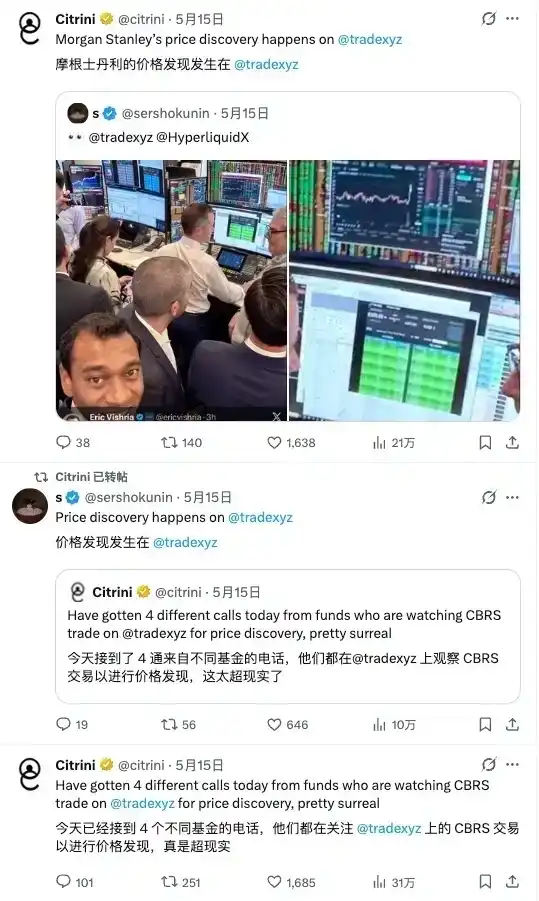
In a sense, Citrini can be considered a bellwether sending "warning signals" to traditional financial circles—it is using accurate information to warn traditional financial markets that previously unnoticed crypto players are setting their sights like barbarians on the "big cake" of traditional finance.

And behind Citrini is a founder who believes in "second-order thinking" and "long-termism"—James van Geelen.

Diverse Persona: Double Major in Biology & Psychology, Emergency Medical Practitioner, "AI Panic Whistleblower"

The 33-year-old James van Geelen (hereinafter Geelen) probably never imagined that an "AI discussion thread" could trigger the rapid evaporation of hundreds of billions of dollars in market value from US stock markets; earlier, his professional resume wasn't even remotely related to AI.

Public information shows Geelen graduated from the prestigious UCLA, earning dual degrees in Biology and Psychology during his studies. He also worked as an Emergency Medical Technician and Paramedic in downtown Los Angeles. Prestigious education and emergency medical experience shaped his character: pursuit of efficiency and adeptness at planning. As he himself said—"If you don't have a plan, you'll have a terrible life." Additionally, he prides himself as a "musical prodigy," though he doesn't have any notable works to show for it.

According to Geelen's original plan, he should have become a life-saving doctor, but by chance, he instead embarked on an entrepreneurial path: first founding a healthcare company and selling it to a private equity fund, successfully breaking free from the "prestigious school-job-professional manager" cycle; then founding the current Citrini.

Another noteworthy point, as mentioned by him in a 2023 Odd Lots podcast, is that he also co-founded one of the earliest medical marijuana dispensaries in Connecticut. From this, one can see he is far from the "proper doctor" perceived as rigid and rule-following.

In 2018, with some startup capital, Geelen began his personal investment career under the name Citrinitas Capital, capturing early opportunities in AI (like Nvidia) and GLP-1 weight-loss drugs (like Ozempic/Wegovy).

In 2023, Geelen formally founded Citrini Research, committed to "cross-asset, multi-dimensional thinking for investment analysis," providing in-depth reports on thematic stock investing and global macro trades. It quickly grew into a top creator in the finance field on the Substack platform. (Odaily Planet Daily Note: It offers both individual and institutional subscription models.)

On May 31, 2023, the model investment portfolio Citrindex, built on personal research, was formally launched with an annual subscription fee of $1250. Statistics show the portfolio has achieved cumulative returns exceeding 200%, with monthly gains repeatedly outperforming the S&P 500.

In March 2024, he boldly predicted Trump would win the election. In July 2025, amid the turmoil over former Fed Chair Powell's departure, he loudly advised over 50,000 subscribers to "buy two-year US Treasuries and short ten-year US Treasuries" to hedge policy risks.

In December 2025, according to PitchBook information, Citrini completed a seed funding round of approximately $5.05 million. With only about 10 employees, the company remains privately held.

Then, in February of this year, he co-authored with Alap Shah, who comes from a traditional finance background, that earth-shaking report for US markets: "The 2028 Global Intelligence Crisis." Although he repeatedly emphasized the report was merely a "thought experiment," a scenario assumption rather than a predictive analysis, the phenomena mentioned—"mass white-collar unemployment, declining consumer spending, economic contraction (Ghost GDP)"—still triggered panic and concern in capital markets, leading to significant declines in delivery, payment, and software stocks. Among them, IBM's stock price on February 23 recorded its largest single-day drop since 2025; American Express and Blackstone Group fell over 8%, the entire software stock sector dropped nearly 5%, while stocks of companies like DoorDash, Uber, Mastercard, Visa, Capital One, and Apollo Global Management Inc. fell up to 3%. Multiple US stock sectors were caught in the selling wave, with the Dow Jones once dropping over 800 points. Alap Shah later publicly stated his investment stance was "talking down while going long," meaning shorting companies they believe will be disrupted by AI while holding semiconductor tech stocks benefiting from AI.

It is no exaggeration to say that Citrini's single report directly caused the US stock market to "bleed profusely" for a time, evaporating hundreds of billions of dollars in market value overnight, triggering follow-up reports from overseas media like Bloomberg and The Wall Street Journal.

On April 6 this year, Citrini team's "Analyst #3" (code name Analyst#3) personally went to the critical strategic point in the US-Iran conflict—the Strait of Hormuz for research, disclosing many little-known frontline observations, revealing on the ground the specific operational model of Iran's "toll booth" in the Strait, and providing a series of counterintuitive conclusions, such as: Regardless of how the situation develops, shipping volume through the Strait will gradually increase; Iran does not wish to close the Strait of Hormuz. First, Strait shipping volume will continue to rise. Second, a diplomatic-style "toll booth"—surprisingly, transit order in the Strait is actually very regulated. Third, the paradox of escalation—even if ground operations commence, shipping volume through the Strait may still continue to increase. Fourth, realignment of power structures, not a decisive victory. This conflict is not a simple "two-party confrontation" but a multi-party game. Geographical disputes within great power games are also key subjects within Citrini's research "range."

When asked why he named the company "citrinitas," Geelen replied:"The naming inspiration comes from financial titan George Soros's 'The Alchemy of Finance.' This is actually a stage in alchemy, but what most people don't know is that in this transitional stage, lead begins to transform into gold, but hasn't fully become gold yet." This is also his favorite time to "make a difference"—seeing the birth of "gold" before others notice the change in lead.

Investment Style: Second-Order Thinking, Narrative-Driven, Reverse Scenario

As for Citrini's investment style, thanks to its cross-border experience and diverse persona, it highly advocates "second-order thinking."

As Geelen himself said:"Most investors only focus on the ball itself, but I focus more on where the ball will bounce next."
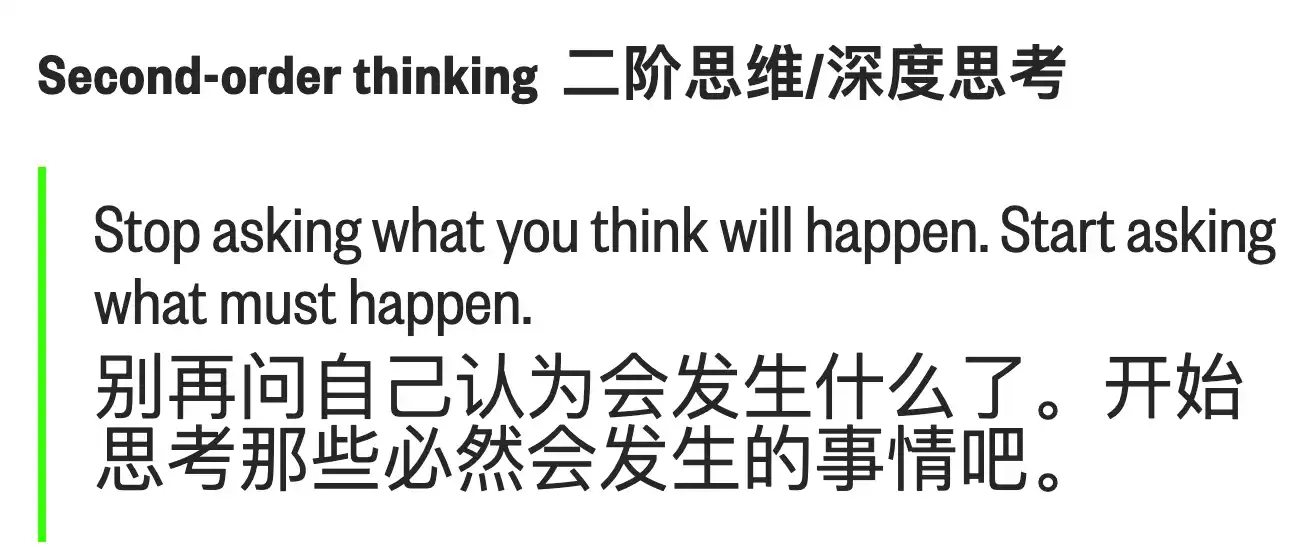
Judging from Citrini's past content and public information, this investment research firm focuses on long-term "super trends," such as AI, robotics, energy demand, fiscal policy, geopolitics, modern warfare, etc. Additionally, the firm is dedicated to providing actionable "bundled investment references" and tactical macro trade ideas, with analysis leaning towards long-term structural changes rather than short-term trades. In its Substack homepage bio, we can see its emphasis on practicality, stating: "You (the reader) will no longer need to ask 'what's the trade?'"
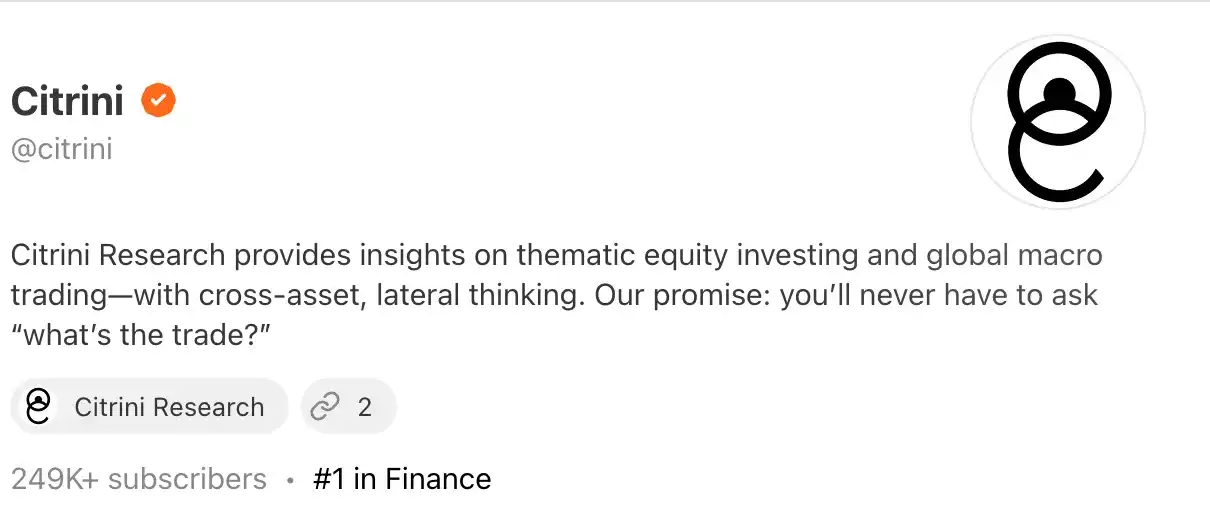
Furthermore, Citrini often uses "scenario assumptions" to help readers understand second/third-order effects. Geelen once mentioned: "Don't always think about what you think will happen. Instead, think about what is bound to happen. How will the market's reaction change the actual situation? What will be the secondary effects? What are the obstacles keeping a certain trend going? Where will capital flow to overcome these obstacles?" Previously, during the collapse of Silicon Valley Bank in March 2023, he boldly purchased overnight funding rate call options, easily reaping nearly 50x returns. Last December, before the US initiated military action in Venezuela, he shared insights on investment opportunities in Venezuelan sovereign bonds.

This year, Citrini has successively absorbed several independent analysts, including macro analyst Nick Reece, South Korean semiconductor industry analyst @jukan05, and AI chip industry analyst @zephyr_z9, to some extent filling gaps in industry details, technical processes, and directional changes.Currently, this investment research firm still maintains a founder-driven + anonymous elite team collaborative production model.


Crypto di tendenza

Domande pertinenti

QWho is the founder of Citrini Research and what are some key aspects of his background?

AThe founder of Citrini Research is James van Geelen. He holds dual degrees in Biology and Psychology from UCLA. His background includes working as an emergency medical technician, founding a healthcare company, and co-founding one of Connecticut's early medical cannabis dispensaries. He is described as a non-finance professional who entered the investment world later in his career.

QWhat major report did Citrini publish in February that significantly impacted the stock market, and what was its claimed effect?

AIn February, Citrini published a report titled 'The 2028 Global Intelligence Crisis'. While presented as a 'thought experiment', its discussion of potential mass white-collar unemployment and economic contraction triggered a panic sell-off in the US stock market. The report is cited as causing software stocks to fall nearly 5%, leading to a single-day drop of over 800 points in the Dow Jones and evaporating hundreds of billions of dollars in market value.

QAccording to the article, what is a core investment philosophy or style emphasized by James van Geelen and Citrini?

AA core investment philosophy emphasized by James van Geelen and Citrini is 'second-order thinking'. This involves focusing not just on immediate events, but on the subsequent consequences and knock-on effects of those events. Geelen analogizes it to looking not at the ball itself, but where the ball will bounce next.

QWhat was a key finding from Citrini's April 2025 on-the-ground research report regarding the Strait of Hormuz?

AA key finding from Citrini's April 2025 on-the-ground 'Strait of Hormuz Research Report' was that, contrary to common perception, Iran does not wish to close the Strait of Hormuz. The report described Iran's operation there more like a diplomatic 'toll booth', with shipping traffic being orderly and actually expected to increase regardless of geopolitical developments.

QWhat is the origin and meaning behind the name 'Citrini' for the research firm?

AThe name 'Citrini' is inspired by the financial term 'citrinitas' from George Soros's book *The Alchemy of Finance*. In alchemy, 'citrinitas' represents a transitional stage where lead begins to turn into gold but is not fully transformed. Geelen chose it to symbolize the firm's focus on identifying the early transformation of an asset or trend into something valuable ('gold') before others notice the change in the 'lead'.

Letture associate

Dylan Patel: Founder of SemiAnalysis, Praised by Jensen Huang, is a 'Beekeeper' and 'Forum Enthusiast'

Dylan Patel, founder of the independent research firm SemiAnalysis, has an unconventional background. A former beekeeper from rural Georgia, he entered the semiconductor world as a self-taught "forum warrior," discussing chip technology anonymously online from a young age. He launched the SemiAnalysis blog in May 2020, which later transitioned to a paid subscription model. The firm has grown from a one-person operation to a global team of around 60, with a dedicated teardown lab. Its detailed, technically-focused analysis on semiconductor supply chains, AI infrastructure, and products has earned significant industry recognition. Notably, NVIDIA founder Jensen Huang has publicly cited their reports. In a landmark case, a critical 2024 report on AMD's MI300X GPU software stack led to a 90-minute call with AMD CEO Lisa Su, who thanked him for the constructive feedback. SemiAnalysis later acknowledged AMD's improvements. The firm's influence on markets was seen when a report on NVIDIA's Rubin memory configuration was partially shared, affecting memory stock prices. Dylan Patel emphasized the importance of context, contrasting the shared excerpt with the report's actual title. SemiAnalysis, now a multi-faceted consultancy with revenue projected to reach $100 million, is known for its deep technical insights that influence major industry players and investment decisions.

marsbit29 min fa

Dylan Patel: Founder of SemiAnalysis, Praised by Jensen Huang, is a 'Beekeeper' and 'Forum Enthusiast'

marsbit29 min fa

Dylan Patel: SemiAnalysis, Praised by Jensen Huang, is Founded by a 'Beekeeper and Forum Warrior'

Dylan Patel, founder of the independent research firm SemiAnalysis, has an unconventional background. Growing up in rural Georgia, he later worked as a beekeeper in Minnesota. His entry into semiconductors began as a self-taught "forum warrior," engaging anonymously in online tech communities from a young age. In May 2020, he started the SemiAnalysis blog on WordPress, later moving it to Substack as a paid subscription service. The firm has since evolved from a one-person operation into a global company with around 60 employees, featuring a dedicated chip teardown lab. Its revenue, reaching $20 million last year, is projected to surpass $100 million this year. SemiAnalysis is highly regarded in the AI and semiconductor industry for its deep technical analysis. NVIDIA founder Jensen Huang has publicly praised its reports. In a notable instance, a critical report on AMD's MI300X GPU software shortcomings prompted a 90-minute call with CEO Lisa Su, who thanked Patel for the "constructive feedback." A later report acknowledged AMD's subsequent improvements. The firm's analyses have significant market impact. For example, a June report discussing potential memory configuration changes in NVIDIA's next-generation servers was cited as a factor in pressure on memory-related stocks. Patel plans to establish a venture capital firm, having already made personal investments in about 20 startups. SemiAnalysis combines roles as a consultancy, model platform, and tech lab, focusing on the practical bottlenecks in AI infrastructure.

Odaily星球日报34 min fa

Dylan Patel: SemiAnalysis, Praised by Jensen Huang, is Founded by a 'Beekeeper and Forum Warrior'

Odaily星球日报34 min fa

Ethereum Q1 Report: On-chain Activity Hits Record High, Tokenized Assets Lead the Industry

Ethereum Q1 2026 Report: On-chain activity hits record high, tokenized assets lead the industry. In Q1 2026, Ethereum's network experienced a unique divergence: on-chain activity soared while USD-denominated metrics declined. Monthly active users reached 13.2 million, transactions hit 200.4 million, and TPS averaged 25.78, all setting new highs. However, total value locked (TVL) fell 11.0% to $316.2B, DEX volume dropped 24.0% to $134.5B, and ETH's fully diluted market cap fell 30.3% to $290B. A key driver was the Blob Parameter Fork (BPO#2) in January, which increased data capacity and caused a sharp 47.9% drop in layer-1 transaction fees despite higher usage. Etherean's tokenized asset market cap reached $203.4B, up 42.9% year-over-year. While stablecoins ($178.9B) saw a slight dip, tokenized funds ($19.4B, +73.1% YoY), commodities ($4.7B, +325.9% YoY), and stocks ($365.1M) grew strongly. Ethereum dominates cross-chain comparisons, holding 71% of TVL, 79.2% of active loans, 61.8% of stablecoins, and 73% of tokenized funds among top chains. The report highlights a "Jevons Paradox" scenario: network expansion reduces per-transaction costs but unleashes latent demand, driving long-term growth. Ethereum's strategy mirrors Amazon's early focus on scale over profit. Its open, neutral foundation is seen as critical for institutional adoption, as evidenced by growing activity from firms like BlackRock and JPMorgan. The roadmap targets further scalability, aiming for thousands of TPS by 2029 to solidify its role as a global financial settlement layer.

marsbit37 min fa

Ethereum Q1 Report: On-chain Activity Hits Record High, Tokenized Assets Lead the Industry

marsbit37 min fa

Trading

Spot
Futures

Articoli Popolari

Come comprare T

Benvenuto in HTX.com! Abbiamo reso l'acquisto di Threshold Network Token (T) semplice e conveniente. Segui la nostra guida passo passo per intraprendere il tuo viaggio nel mondo delle criptovalute.Step 1: Crea il tuo Account HTXUsa la tua email o numero di telefono per registrarti il tuo account gratuito su HTX. Vivi un'esperienza facile e sblocca tutte le funzionalità,Crea il mio accountStep 2: Vai in Acquista crypto e seleziona il tuo metodo di pagamentoCarta di credito/debito: utilizza la tua Visa o Mastercard per acquistare immediatamente Threshold Network TokenT.Bilancio: Usa i fondi dal bilancio del tuo account HTX per fare trading senza problemi.Terze parti: abbiamo aggiunto metodi di pagamento molto utilizzati come Google Pay e Apple Pay per maggiore comodità.P2P: Fai trading direttamente con altri utenti HTX.Over-the-Counter (OTC): Offriamo servizi su misura e tassi di cambio competitivi per i trader.Step 3: Conserva Threshold Network Token (T)Dopo aver acquistato Threshold Network Token (T), conserva nel tuo account HTX. In alternativa, puoi inviare tramite trasferimento blockchain o scambiare per altre criptovalute.Step 4: Scambia Threshold Network Token (T)Scambia facilmente Threshold Network Token (T) nel mercato spot di HTX. Accedi al tuo account, seleziona la tua coppia di trading, esegui le tue operazioni e monitora in tempo reale. Offriamo un'esperienza user-friendly sia per chi ha appena iniziato che per i trader più esperti.

415 Totale visualizzazioniPubblicato il 2024.12.10Aggiornato il 2026.06.02

Come comprare T

Discussioni

Benvenuto nella Community HTX. Qui puoi rimanere informato sugli ultimi sviluppi della piattaforma e accedere ad approfondimenti esperti sul mercato. Le opinioni degli utenti sul prezzo di T T sono presentate come di seguito.

活动图片