Bankless Founder: Why I Sold All My ETH

marsbitPubblicato 2026-05-27Pubblicato ultima volta 2026-05-27

Introduzione

Bankless founder David Hoffman explains his decision to sell all his ETH. He clarifies this is not due to bearishness on Ethereum itself, which he remains extremely optimistic about, but rather because he believes the core "ETH is Money" narrative he championed has already been priced in. Hoffman argues that for ETH to achieve status as a global reserve currency, Ethereum needed to execute perfectly across all layers—governance, technology, L2 coordination, and market dominance—faster than competitors. While Ethereum has performed admirably and earned its current valuation, the window for a fundamental revaluation of ETH upward has likely closed. Key factors include: the clear market correlation between L1 chain revenue/fees and native asset price (evident with SOL and NEAR); the failure of the "strong version" of crypto (ideological, self-sustaining) to maintain lasting mainstream appeal beyond a brief period; and the reality that Ethereum's architecture acts as a "giver," providing security and tokenization at cost, which benefits other monies (like stablecoins) as much as or more than ETH itself. He concludes that Ethereum's success will increasingly accrue to its applications and L2s (following a "fat app" theory), with ETH structurally positioned to capture only minimal value. Therefore, he sold to reallocate capital to other opportunities he finds more compelling.

Author: David Hoffman

Compiled by: Jia Huan, ChainCatcher

If you missed the news last week, I sold my ETH.

For someone who has built a career, community, identity, and business around Ethereum, this was not an easy decision.

The reasons behind the decision to sell require a more thorough explanation than scattered tweets on Twitter.

The "ETH is Money" thesis hasn't failed... it has simply been realized. Ethereum has gotten the ETH price it deserved, and I don't believe ETH as an asset will be revalued, either up or down.
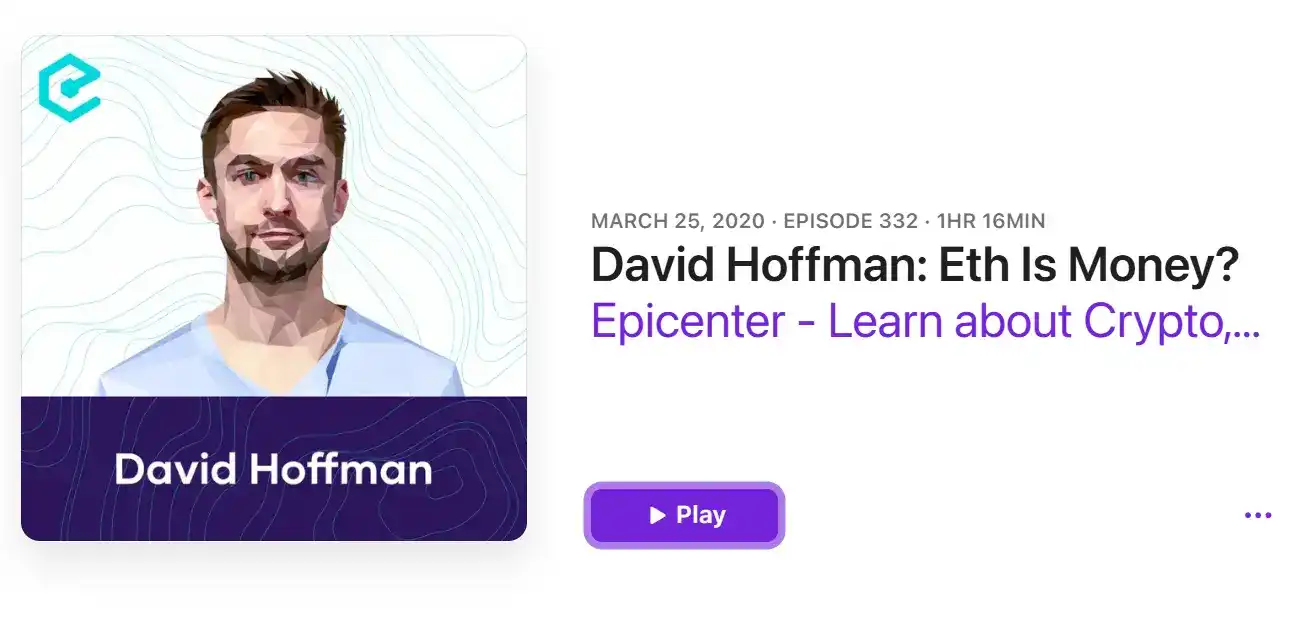
"ETH is Money" is the core narrative proposed by author David Hoffman in 2019 and long promoted through Bankless, arguing that ETH should become a global store of value. It was once one of the most mainstream bullish logics for Ethereum.

P.S.: I am extremely bullish on Ethereum. I expect the Ethereum network to perform exceptionally well from now on. But I believe only a very small portion of that success will be reflected in ETH.

The full article is as follows:

ETH is Money Was Always an Aspiration

Money is a coordination game, and coordination is very difficult.

The Ethereum project itself is a series of coordination challenges stacked on multiple levels, and the "ETH is Money" thesis required success at all these levels, unequivocally.

ETH could become money if and only if every layer of Ethereum's techno-social stack outperformed its competitors.

Given the ambition of the Ethereum project, achieving its most successful version was always a massive challenge. Despite shortcomings, the Ethereum project has performed exceptionally well and fully deserves its existing market capitalization.

Nevertheless, the window of opportunity for the market to "revalue" $ETH appears to be closing.

In some sense, ETH is money. But it's not the maximally successful version we collectively aimed for.

Ethereum is a Coordination Game

Turing-complete blockchain is such a powerful idea that Ethereum's maximum potential is the entire crypto world. To encompass everything.

The only obstacle to Ethereum achieving 100% absolute dominance over all things is coordination.

Ethereum's leadership needs to be sufficiently decentralized, its governance needs "rough consensus" to create credible neutrality, maximizing Ethereum's adoption at the highest level.

Ethereum leadership needs to react swiftly to market dynamics, operating like a startup facing an existential threat of marginalization.

Ethereum L2s need to operate and make their own market choices independently of the base layer, but they also need to be economically bound and constrained by the broader Ethereum economy and brand.

Ethereum's roadmap needs to be executed in a specific sequence to maximize and maintain Ethereum's momentum and market dominance, fully quelling competition and maximizing confidence in Ethereum and ETH.

Key technology R&D and engineering implementation need to be fast enough so that Ethereum can both prove its utility to the outside world and stay ahead of competitors.

The "ETH is Money" thesis was about creating an exceptionally revolutionary and powerful financial asset, attracting otherwise indifferent individuals with its unique properties as the superior global store of value.

Ethereum's brand and ETH's strength need to be so powerful that major traditional capital not only feels safe but actively positions ETH as a significant allocation in their retirement portfolios because of the Ethereum project's dominance.

For "ETH is Money" to happen, everything upstream of ETH needed to function with extreme perfection.

Ethereum is not Bitcoin; it chose the hard path. Bitcoin stripped everything off its blockchain to elevate BTC.

Ethereum chose to add everything to its blockchain to maximize the utility of its block space. Only by doing this in the best possible way before competitors could ETH achieve its status as global money.

We have come a long way, and Ethereum has already achieved the maximum potential market share it deserves.

I fear the window to play this game has closed.

The Macro Environment May Never Allow It to Happen

Looking back over the past few years, I see a large set of macro headwinds that Ethereum needed to overcome.

1. L1 Assets Are Inextricably Linked to Revenue

Say what you will about how difficult it is to evaluate smart contract chains based on fees and revenue, but fees and revenue are clearly how smart contract L1 assets increase their pricing power.

By 2026, we have ample data showing all these factors are closely correlated: L1 activity, L1 fees, and price appreciation of the L1 native asset.

In 2021, when ETH had the highest share of L1 revenue, it dominated.

In 2024, when SOL's share of L1 revenue broke out industry-wide, it dominated.

In 2026, NEAR is undergoing price revaluation while simultaneously seeing fundamental growth in its L1 revenue and NEAR burn.

You can also look at assets like BNB and TRX, which are perhaps the highest cumulative revenue projects of all time. Their price charts look exactly like what I once expected ETH's to look like—if only ETH could have maintained its L1 fee dominance longer than just that stretch in 2022.

2. The Strong Version of Crypto Didn't Work

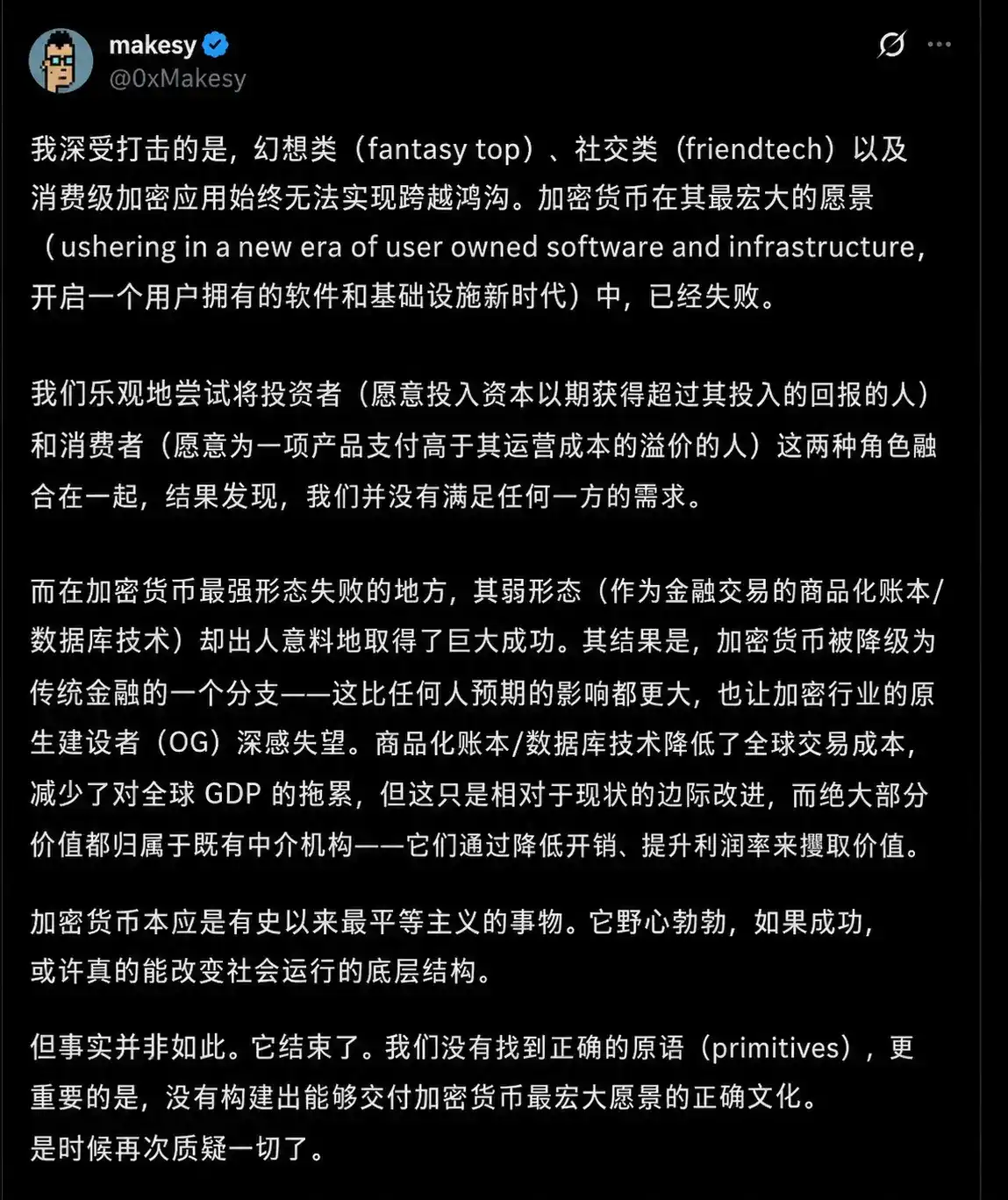
@0xMakesy put it well:

Ethereum represented the strong version of crypto, crypto for crypto's sake, self-sustaining and self-perpetuating. DeFi, NFTs, DAOs, we were the rebels, building a financial system of the people, by the people, plugging imagination into the money system.

Then there was the weak version: efficient ledger infrastructure for the backends of financial institutions. The weak version would fuel the strong version, channeling demand for an internet ledger into inward flowing capital, into crypto, into Ethereum, and finally into ETH.

Maybe if Ethereum executed better, faster, stronger, if crypto hadn't attracted such a large cohort of speculative hustlers and value extractors, the industry could have won the influence and respect I always thought it deserved.

But the only period where crypto maintained a positive brand image with the public was from late 2020 to early 2022. Outside this narrow window, crypto's reputation has been fraud, scams, get-rich-quick schemes, and uselessness to ordinary people.
ETH is Money Relied on "Strong Crypto"

It was at that moment when everyone was forced online that ETH emerged as the internet's money. The world discovered crypto for the first time, and for a brief window, it was very cool.

Money is a coordination game, and the Schelling Point of a money is held together by belief. In 2021, a broad public believed in ETH: it was cool, disruptive, and populist. Bitcoin shared these properties and has retained them better than ETH post-2021.

This raises a disconcerting possibility: the strong version of crypto may never have been a stable equilibrium. Covid was an extremely distortive time for money, and maybe "ETH as money" was only supported because of that distortion.

If so, ETH becoming money always depended on the strong version of crypto working better than it ever did in reality.

3. Ethereum's Utility Benefits Other Moneys Just as Much

Is Bitcoin money? Is the dollar money? Is gold money? It doesn't matter—whatever is money will be tokenized on Ethereum.

In 2020, Nic Carter argued on Bankless that stablecoins would likely parasitize ETH as Ethereum's native unit. Back then, Ethereum had $3B in stablecoins. Today, that number is $163B, a 54x increase.

The utility provided by Ethereum is helping expand the monetary network of whatever is truly money, which is why the US is so bullish on using crypto to proliferate stablecoins. Ethereum is helping America maintain dollar hegemony, and leveraging this fact is explicit government policy.

Clearly, the positive spillover for $ETH as money is far less powerful than what the US government sees in the Ethereum stablecoin ecosystem.

Ethereum is a Giver, Not a Taker

At its core, Ethereum is a giver, not a taker.

It provides the world's most secure block space to L2s at cost.

It tokenizes all the world's assets at cost.

It secures billions in DeFi at cost.

Ethereum charges no markup on anything it does.

This is the nature of open-source software and the power of Ethereum. Ethereum offers its full suite of incredibly important value to the world at cost.

Ethereum is noble. Ethereum is excellent.

Ethereum is the world's most successful non-profit.

Naturally, massive adoption will occur on Ethereum. It was and will continue to be the most impactful open-source software project ever built by humans, and being a "non-profit protocol" is one of its core characteristics.

This is why the path for ETH to become money depended on maintaining sustained, incredibly high market dominance.

Eventually, as block space commoditizes, fees trend to zero. That's fine for Ethereum as long as it's Ethereum, not a competitor, that achieves commoditization and maintains its margins and dominance.

Eventually, Fat Protocol Theory gives way to Fat Application Theory, and applications swallow remaining profits.

That's fine for ETH as long as they're Ethereum's applications, not a competitor's.

It's hard to reconcile "ETH is Money" with "Ethereum is a giver, not a taker." Ethereum's architecture is intentionally designed to give everything back to its ecosystem and take only the bare minimum required to keep the network running.

Architecturally, ETH is not prioritized within Ethereum; this is a feature, not a bug. ETH could only become money if Ethereum won a battle it architecturally refuses to fight.

This could have worked if Ethereum had maintained incredible market dominance.

The Thesis Asks Too Much of Ethereum

"ETH is Money" required everything to go right for Ethereum. The margin for error was far smaller than I originally believed. Ethereum's momentum in 2021 and 2022 made it feel like "ETH is Money" was the default path.

In hindsight, Solana's 2021 rise alongside rising anti-Ethereum sentiment was the first major sign that Ethereum and ETH's coordination game wasn't going according to plan.

The Ethereum Foundation needed to decentralize and allow alternative power structures to emerge. But it also needed to respond to market forces with the urgency and drive of a startup facing existential elimination.

L2 teams needed freedom of self-determination but also needed to operate under the larger umbrella brand of Ethereum and ETH. Technical sync integrations between Ethereum and its L2s needed to be executed much faster.

Smart contract chains are valued by fees, and to break out of that pattern, Ethereum needed to rewrite the rules with overwhelming success.

My Reason for Selling

It just didn't achieve its maximum potential either.

Ethereum did the noble thing, choosing the hardest, most ambitious, most ideologically pure path for its future.

It achieved some incredible victories and failed to win some challenges.

Ethereum has earned the market cap it deserves.

I am very bullish on the Ethereum network and its ecosystem—Ethereum is architected to maximize the success of its applications, L2s, and ecosystem. Fat Application Theory means Ethereum's apps take all the fees, and the rollup-centric roadmap means L2s take 97% of the profits.

As for the ETH asset, I struggle to see how it gets structurally revalued, either up or down.

So, my reason for selling ETH isn't bearish on ETH; it's that I believe the "ETH is Money" thesis has been realized, and I wish to allocate capital to other opportunities in the market that I am bullish on.
Letture associate

Samsung Relies on Technology Cycles, SK Hynix on HBM, How Did Micron Win a Trillion-Dollar Market Cap?

Micron Technology, the third-largest memory chip maker alongside Samsung and SK Hynix, recently saw its market cap surpass $1 trillion. Founded in 1978 in Boise, Idaho, Micron survived brutal industry cycles while American peers and Japan's memory sector faltered. Its survival is attributed to a dual strategy: leveraging political and legal avenues for critical breathing room, coupled with relentless manufacturing cost control. Historically, Micron sought U.S. government intervention three times. In 1985, it filed an anti-dumping complaint against Japanese firms, leading to the U.S.-Japan Semiconductor Agreement. Ironically, this created an opening for Samsung, which later became its toughest competitor. In 2002, Micron turned "whistleblower" in a DRAM price-fixing investigation, escaping penalties while rivals were fined. In 2017, it sued China's Fujian Jinhua, contributing to its placement on a U.S. entity list, stifling a nascent competitor. However, a major strategic misstep occurred in 2013 with the acquisition of bankrupt Japanese firm Elpida. Integrating Elpida's mobile-DRAM-focused technology diverted resources, causing Micron to miss the critical early decade of development for High Bandwidth Memory (HBM)—the high-performance memory essential for AI chips like NVIDIA GPUs. By the time AI demand exploded in 2022, SK Hynix, which launched the first HBM in 2013, held about 85% of the HBM3 market, leaving Micron with roughly 3%. Micron now faces a triple squeeze. In the high-end HBM market, it lags significantly behind SK Hynix and Samsung. In the mid-to-low end DRAM market, it faces aggressive price competition from China's CXMT. Furthermore, a 2023 Chinese cybersecurity ban on its products slashed its revenue from China, a once-core market, from over 10% to just 7.1% by FY2025, causing it to exit China's data center server business. Beneath its political maneuvering lies Micron's core strength: exceptional manufacturing efficiency and cost control. Decades of engineering have yielded DRAM chips with a smaller cell area than rivals, meaning more chips per wafer and lower unit costs. This efficiency, not subsidies, has allowed it to withstand price wars. While political leverage bought time, Micron is now paying a "time debt" in the HBM race. It is racing to ramp up HBM3E production and develop HBM4, but catching up to competitors who started a decade earlier is a monumental challenge. Its future hinges on whether its expertise in cost control and political strategy can compensate for the lost time in a technology race where early-mover advantage is decisive.

链捕手25 min fa

Samsung Relies on Technology Cycles, SK Hynix on HBM, How Did Micron Win a Trillion-Dollar Market Cap?

链捕手25 min fa

New AMD Paper Overturns Conventional Wisdom: FP4 Training Instability's Cause Is Not Insufficient Randomness

AMD's new research challenges the conventional understanding of FP4 training instability. While reducing precision from FP8 to FP4 promises doubled computational throughput and is supported by new hardware like NVIDIA Blackwell and AMD MI350 series, training large language models natively with FP4 has been notoriously unstable, often attributed to insufficient stochasticity. The paper "Pretraining large language models with MXFP4 on Native FP4 Hardware" demonstrates successful end-to-end FP4 pre-training of Llama 3.1-8B on AMD MI355X GPUs using the MXFP4 format, achieving a 9-10% overall speedup over FP8. Crucially, it identifies the root cause of instability: not randomness, but the accumulation of *structural micro-scaling errors* along the sensitive weight gradient (Wgrad) path. Through controlled experiments, researchers found that quantizing the Wgrad operation to FP4 caused significant convergence degradation. Counterintuitively, common stochasticity-based mitigation techniques like stochastic rounding and randomized Hadamard transforms worsened performance. In contrast, applying a *deterministic* Hadamard transform successfully stabilized training by ensuring consistent error patterns, reducing the extra token cost from 26-27% to just 8-9%. This work has significant implications: 1) It provides a clear diagnostic for low-precision training instability, steering focus towards structural errors. 2) It pushes FP4 from a primarily inference-focused format into the realm of viable training. 3) It leverages the open OCP Microscaling (MX) standard, promoting cross-vendor compatibility. The research marks a critical step towards more economical large model training by further pushing the boundaries of low-precision computation.

marsbit44 min fa

New AMD Paper Overturns Conventional Wisdom: FP4 Training Instability's Cause Is Not Insufficient Randomness

marsbit44 min fa

Will ONDO's 'Tokenization Narrative' Change After Its CEO's Unexpected Passing?

Ondo Finance founder and CEO Nathan Allman has passed away unexpectedly. Allman, a Brown University graduate with a background in private credit and Goldman Sachs' digital asset team, was a key architect of Ondo's pivot from DeFi structured yield products to becoming a leading Real-World Asset (RWA) protocol. He drove the strategy to tokenize traditional financial assets like US Treasuries (OUSG), yield-generating dollar assets (USDY), and US stocks/ETFs (Ondo Global Markets) for on-chain accessibility. The company announced that President Ian De Bode, a former McKinsey partner with a strong institutional strategy and operations background, will succeed Allman as CEO. While Allman's sudden departure presents a near-term challenge, testing market confidence and Ondo's continuity, the project is seen as more than a founder-driven narrative. It has an established product suite and a management team with deep traditional finance experience. The long-term impact hinges on the new leadership's ability to execute. De Bode's expertise in compliance, distribution, and institutional partnerships aligns with RWA's next phase of scaling infrastructure. The core question is whether Ondo can maintain its product momentum and institutional relationships. Ondo's native ONDO token represents governance and RWA narrative value, not direct revenue from the underlying assets. Its future as a "top tokenization play" will depend on the team's continued delivery of product growth, asset scale, and real-world demand, moving beyond the initial emotional shock.

marsbit1 h fa

Will ONDO's 'Tokenization Narrative' Change After Its CEO's Unexpected Passing?

marsbit1 h fa

Bankless Co-founder's Confession on Selling Off ETH: Ethereum Did the Right Thing, but 'ETH as Money' Has No Future

Bankless co-founder David Hoffman recently sold his remaining ETH holdings, sparking debate within the Ethereum community. In a detailed explanation, Hoffman clarifies that his decision was not based on bearish sentiment towards Ethereum itself, which he remains highly optimistic about, but rather on the conclusion that the "ETH is Money" narrative has largely run its course. Hoffman argues that for ETH to achieve its envisioned status as global money, Ethereum needed to execute flawlessly across multiple layers—governance, technology, and market dominance—in a highly coordinated manner. He acknowledges Ethereum's significant successes and current justified valuation but suggests the window for a major revaluation based on this monetary narrative is closing. The post examines several challenges: the strong correlation between L1 chain activity/fees and native token value; the perceived failure of the "strong version" of crypto (user-owned, egalitarian systems) versus the rise of a "weak version" (efficient ledger technology for traditional finance); and the possibility that ETH's momentum as money was uniquely tied to the distorted conditions of the 2020-2021 period. Crucially, Hoffman highlights a structural tension: Ethereum is architected as a "giver, not a taker," providing critical infrastructure like secure block space and tokenization at cost. This ethos benefits the broader ecosystem (applications, L2s) but doesn't prioritize extracting maximum value for ETH itself. The "ETH is Money" thesis required Ethereum to win a war of overwhelming market dominance—a war its design philosophy refuses to explicitly fight. Therefore, while he sees continued immense success for the Ethereum network and its ecosystem (following a "fat application" theory where value accrues to apps and L2s), Hoffman finds it increasingly difficult to foresee a structural upward revaluation for the ETH asset based on the monetary narrative. His capital reallocation reflects a belief that this particular investment thesis has played out.

Odaily星球日报1 h fa

Bankless Co-founder's Confession on Selling Off ETH: Ethereum Did the Right Thing, but 'ETH as Money' Has No Future

Odaily星球日报1 h fa

Trading

Spot
Futures

Articoli Popolari

Cosa è ETH 3.0

ETH3.0 e $eth 3.0: Un'Analisi Approfondita del Futuro di Ethereum Introduzione Nel panorama in rapida evoluzione delle criptovalute e della tecnologia blockchain, ETH3.0, spesso indicato come $eth 3.0, è emerso come un argomento di considerevole interesse e speculazione. Il termine comprende due concetti principali che warrantono chiarimenti: Ethereum 3.0: Questo rappresenta un potenziale futuro aggiornamento volto ad aumentare le capacità dell'attuale blockchain di Ethereum, concentrandosi principalmente sul miglioramento della scalabilità e delle prestazioni. ETH3.0 Meme Token: Questo progetto di criptovaluta distinto cerca di sfruttare la blockchain di Ethereum per creare un ecosistema incentrato sui meme, promuovendo il coinvolgimento all'interno della comunità delle criptovalute. Comprendere questi aspetti di ETH3.0 è essenziale non solo per gli appassionati di criptovalute, ma anche per coloro che osservano tendenze tecnologiche più ampie nello spazio digitale. Che cos'è ETH3.0? Ethereum 3.0 Ethereum 3.0 è pubblicizzato come un aggiornamento proposto per la rete Ethereum già stabilita, che è stata la spina dorsale di molte applicazioni decentralizzate (dApps) e contratti smart sin dalla sua nascita. I miglioramenti previsti si concentrano principalmente sulla scalabilità, integrando tecnologie avanzate come lo sharding e le prove a conoscenza zero (zk-proofs). Queste innovazioni tecnologiche mirano a facilitare un numero senza precedenti di transazioni al secondo (TPS), potenzialmente raggiungendo milioni, affrontando così una delle limitazioni più significative della tecnologia blockchain attuale. Il miglioramento non è meramente tecnico, ma anche strategico; è volto a preparare la rete Ethereum per un'adozione e un'utilità diffuse in un futuro contrassegnato da un aumento della domanda di soluzioni decentralizzate. ETH3.0 Meme Token Al contrario di Ethereum 3.0, l'ETH3.0 Meme Token si avventura in un dominio più leggero e giocoso, combinando la cultura dei meme di internet con la dinamica delle criptovalute. Questo progetto consente agli utenti di acquistare, vendere e scambiare meme sulla blockchain di Ethereum, fornendo una piattaforma che promuove il coinvolgimento della comunità attraverso la creatività e interessi condivisi. L'ETH3.0 Meme Token mira a dimostrare come la tecnologia blockchain possa intersecarsi con la cultura digitale, creando casi d'uso che siano sia divertenti che finanziariamente praticabili. Chi è il Creatore di ETH3.0? Ethereum 3.0 L'iniziativa verso Ethereum 3.0 è principalmente propulsa da un consorzio di sviluppatori e ricercatori all'interno della comunità di Ethereum, tra cui Justin Drake. Conosciuto per le sue intuizioni e contributi all'evoluzione di Ethereum, Drake è stato una figura di spicco nelle discussioni riguardanti la transizione di Ethereum verso un nuovo livello di consenso, chiamato “Beam Chain.” Questo approccio collaborativo allo sviluppo significa che Ethereum 3.0 non è il prodotto di un creatore singolo, ma piuttosto una manifestazione di ingegno collettivo focalizzato sul progresso della tecnologia blockchain. ETH3.0 Meme Token I dettagli riguardanti il creatore dell'ETH3.0 Meme Token sono attualmente non rintracciabili. La natura dei token meme conduce spesso a una struttura più decentralizzata e guidata dalla comunità, il che potrebbe spiegare la mancanza di attribuzione specifica. Questo si allinea con l'etica della comunità crypto più ampia, dove l'innovazione spesso nasce da sforzi collaborativi piuttosto che individuali. Chi sono gli Investitori di ETH3.0? Ethereum 3.0 Il supporto per Ethereum 3.0 proviene principalmente dalla Ethereum Foundation insieme a una comunità entusiasta di sviluppatori e investitori. Questa associazione fondamentale fornisce un considerevole grado di legittimità e migliora le prospettive di implementazione di successo poiché sfrutta la fiducia e la credibilità costruite nel corso degli anni di operazioni della rete. Nel clima in rapida evoluzione delle criptovalute, il supporto della comunità gioca un ruolo cruciale nello sviluppo e nell'adozione, posizionando Ethereum 3.0 come un serio contenditore per i futuri progressi della blockchain. ETH3.0 Meme Token Sebbene le fonti attualmente disponibili non forniscano informazioni esplicite riguardo ai fondamenti o alle organizzazioni di investimento che sostengono l'ETH3.0 Meme Token, ciò è indicativo del modello di finanziamento tipico per i token meme, che spesso si basa sul supporto di base e sul coinvolgimento della comunità. Gli investitori in tali progetti sono tipicamente individui motivati dal potenziale per innovazioni guidate dalla comunità e dallo spirito di cooperazione trovato all'interno della comunità crypto. Come Funziona ETH3.0? Ethereum 3.0 Le caratteristiche distintive dell'Ethereum 3.0 risiedono nella sua proposta di implementazione della tecnologia di sharding e zk-proof. Lo sharding è un metodo di partizionamento della blockchain in pezzi più piccoli e gestibili o “shard,” che possono elaborare transazioni in modo concorrente piuttosto che sequenziale. Questa decentralizzazione dell'elaborazione aiuta a prevenire la congestione e garantisce che la rete rimanga reattiva anche sotto un carico pesante. La tecnologia delle prove a conoscenza zero (zk-proof) contribuisce con un ulteriore livello di sofisticazione consentendo la validazione delle transazioni senza rivelare i dati sottostanti coinvolti. Questo aspetto non solo migliora la privacy, ma aumenta anche l'efficienza complessiva della rete. Si parla anche di incorporare una macchina virtuale Ethereum a conoscenza zero (zkEVM) in questo aggiornamento, amplificando ulteriormente le capacità e l'utilità della rete. ETH3.0 Meme Token L'ETH3.0 Meme Token si distingue capitalizzando sulla popolarità della cultura dei meme. Stabilisce un mercato per gli utenti che desiderano partecipare al trading di meme, non solo per divertimento, ma anche per potenziale guadagno economico. Integrando funzioni come lo staking, la fornitura di liquidità e meccanismi di governance, il progetto promuove un ambiente che incentiva l'interazione e la partecipazione della comunità. Offrendo una miscela unica di intrattenimento e opportunità economica, l'ETH3.0 Meme Token mira ad attrarre un pubblico variegato, che va dagli appassionati di crypto ai semplici intenditori di meme. Timeline di ETH3.0 Ethereum 3.0 11 Novembre 2024: Justin Drake accenna al prossimo aggiornamento ETH 3.0, incentrato sui miglioramenti della scalabilità. Questo annuncio segna l'inizio delle discussioni formali riguardo l'architettura futura di Ethereum. 12 Novembre 2024: La proposta attesa per Ethereum 3.0 dovrebbe essere svelata a Devcon a Bangkok, preparando il terreno per un feedback più ampio della comunità e potenziali passi successivi nello sviluppo. ETH3.0 Meme Token 21 Marzo 2024: L'ETH3.0 Meme Token viene ufficialmente elencato su CoinMarketCap, segnando il suo ingresso nel dominio pubblico delle criptovalute e aumentando la visibilità per il suo ecosistema basato sui meme. Punti Chiave In conclusione, Ethereum 3.0 rappresenta una significativa evoluzione all'interno della rete Ethereum, concentrandosi sul superamento delle limitazioni riguardanti scalabilità e prestazioni attraverso tecnologie avanzate. I suoi aggiornamenti proposti riflettono un approccio proattivo alle future esigenze e usabilità. D'altra parte, l'ETH3.0 Meme Token incarna l'essenza della cultura guidata dalla comunità nello spazio delle criptovalute, sfruttando la cultura dei meme per creare piattaforme coinvolgenti che incoraggiano la creatività e la partecipazione degli utenti. Comprendere gli scopi e le funzionalità distinte di ETH3.0 e $eth 3.0 è fondamentale per chiunque sia interessato ai continui sviluppi nello spazio crypto. Con entrambe le iniziative che tracciano percorsi unici, esse sottolineano collettivamente la natura dinamica e multifacetica dell'innovazione blockchain.

173 Totale visualizzazioniPubblicato il 2024.04.04Aggiornato il 2024.12.03

Cosa è ETH 3.0

Cosa è ETHEREUM

HarryPotterTrumpHomerSimpson777Inu: Panoramica di un Progetto Crypto Web3 Introduzione Nel mondo in rapida evoluzione delle criptovalute e della finanza decentralizzata, progetti innovativi emergono frequentemente, catturando l'interesse della comunità degli investitori e degli appassionati di crypto. Uno di questi progetti è HarryPotterTrumpHomerSimpson777Inu, una criptovaluta che si trova all'incrocio tra cultura popolare e tecnologia blockchain. Questo token guidato dalla comunità mescola personaggi e figure politiche ben noti, con l'obiettivo di creare una piattaforma coinvolgente e promuovere un'adozione diffusa. Che cos'è HarryPotterTrumpHomerSimpson777Inu? HarryPotterTrumpHomerSimpson777Inu è un token costruito sulla blockchain di Ethereum, progettato per essere accessibile e divertente per un pubblico diversificato. L'unicità di questo progetto deriva dal suo approccio tematico, che intreccia elementi di fantasia, politica e intrattenimento. Sfruttando il fascino nostalgico di personaggi amati, il progetto cerca di creare un'esperienza di criptovaluta coinvolgente, incoraggiando il coinvolgimento e la partecipazione della comunità. L'obiettivo principale di HarryPotterTrumpHomerSimpson777Inu è stabilire un token che risuoni con gli utenti a livello personale, promuovendo sia il divertimento che il coinvolgimento nell'ambito crypto. Questo branding distintivo mira ad attrarre individui che in precedenza potrebbero non essersi interessati alle criptovalute, facilitando un nuovo punto di ingresso per utenti potenziali. Creatore di HarryPotterTrumpHomerSimpson777Inu L'identità del creatore dietro HarryPotterTrumpHomerSimpson777Inu rimane sconosciuta. Questa non è una pratica rara nel dominio delle criptovalute, dove l'anonimato è spesso preferito dai fondatori come mezzo di protezione della privacy e promozione di un ethos decentralizzato. Questa oscurità non diminuisce il valore del progetto; al contrario, riflette una tendenza più ampia all'interno del settore, dove molti progetti di successo sono emersi da origini anonime. Investitori di HarryPotterTrumpHomerSimpson777Inu Le informazioni pubbliche riguardo agli investitori di HarryPotterTrumpHomerSimpson777Inu sono limitate. La natura del progetto, incentrata sul coinvolgimento della comunità, suggerisce una dipendenza da investimenti di piccole dimensioni da parte di singoli appassionati piuttosto che da sostegni sostanziali da fondazioni di investimento consolidate o corporation. Questo livello di trasparenza nel finanziamento è tipico di molti progetti di criptovaluta guidati dalla comunità, dove il supporto spesso proviene da movimenti di base piuttosto che da investitori istituzionali. Come Funziona HarryPotterTrumpHomerSimpson777Inu? Operando sulla blockchain di Ethereum, HarryPotterTrumpHomerSimpson777Inu sfrutta la sua solida infrastruttura per facilitare transazioni e promuovere interazioni tra gli utenti all'interno della comunità. Ciò che distingue questo progetto è il suo posizionamento tematico: canalizzando il carisma di personaggi iconici provenienti da diversi ambiti culturali, crea un'identità di marca distintiva. Questo approccio non solo attrae gli utenti, ma coltiva anche una comunità fedele attorno al token. Le meccaniche operative del progetto si concentrano sul coinvolgimento della comunità. Adotta un modello decentralizzato che incoraggia la partecipazione, consentendo agli utenti di interagire attraverso vari canali mentre promuovono lo scambio di idee e esperienze. Inoltre, il progetto abbraccia i principi del Web3, privilegiando la sovranità degli utenti e la decentralizzazione, che sono i pilastri del futuro di Internet. Timeline di HarryPotterTrumpHomerSimpson777Inu La storia di HarryPotterTrumpHomerSimpson777Inu è segnata da diversi eventi decisivi: 12 agosto 2023: L'inizio di HarryPotterTrumpHomerSimpson777Inu, segnando il suo ingresso nell'ecosistema delle criptovalute. Fase di Sviluppo: Un periodo focalizzato sulla costruzione di una strategia completa per stimolare la crescita guidata dalla comunità e il coinvolgimento degli utenti. Listing sugli Scambi: Sebbene i dettagli specifici di listing non siano stati divulgati, il progetto è stato reso accessibile su vari scambi di criptovalute, migliorando la sua visibilità nel mercato. Coinvolgimento della Comunità: Sforzi continui per coinvolgere attivamente la comunità, stabilendo canali di dialogo e promuovendo la partecipazione attraverso varie attività, tra cui concorsi, discussioni e votazioni comunitarie. Aspetti Chiave di HarryPotterTrumpHomerSimpson777Inu Focus sulla Comunità Un tratto distintivo di HarryPotterTrumpHomerSimpson777Inu è la sua forte enfasi sul coinvolgimento della comunità. Il progetto incoraggia attivamente gli utenti a partecipare a discussioni, condividere idee e contribuire all'evoluzione del progetto. Questa interazione coltiva un senso di appartenenza e di ownership tra i membri della comunità, essenziale per la sostenibilità a lungo termine del token. Utilizzo della Blockchain di Ethereum La scelta di costruire sulla blockchain di Ethereum consente a HarryPotterTrumpHomerSimpson777Inu di sfruttare le sue caratteristiche di sicurezza ben consolidate e architettura decentralizzata. Questa base garantisce affidabilità per le transazioni e fornisce un framework affidabile su cui sviluppare varie funzionalità. Approccio Tematico Unico Fusione di elementi della cultura pop nella sua identità, HarryPotterTrumpHomerSimpson777Inu crea una narrazione coinvolgente che lo differenzia da altre criptovalute. L'amalgama di personaggi e temi genera riconoscimento e intrigo immediati, rendendo il token relazionabile a un'ampia gamma di utenti potenziali. Anonimato nello Sviluppo Il creatore anonimo del progetto rimane una caratteristica ricorrente in molte iniziative di criptovaluta. Questo aspetto evidenzia un ethos di decentralizzazione, introducendo anche un livello di mistero che potrebbe affascinare un segmento della comunità crypto, attirando l'attenzione sul progetto e invitando l'impegno da parte di utenti che supportano l'idea di un'iniziativa decentralizzata e gestita dalla comunità. Conclusione HarryPotterTrumpHomerSimpson777Inu si presenta come un'aggiunta distintiva al panorama delle criptovalute, combinando il fascino della cultura popolare con le meccaniche innovative della tecnologia blockchain. Sebbene i dettagli riguardanti il creatore e gli investitori specifici rimangano non divulgati, il focus del progetto sulla comunità e il suo approccio tematico lo contraddistinguono come un potenziale attore influente nel contesto del Web3 e delle criptovalute. Man mano che l'ecosistema delle criptovalute continua ad espandersi, iniziative come HarryPotterTrumpHomerSimpson777Inu ci ricordano le molteplici modalità in cui la blockchain può connettere le comunità globali attraverso narrazioni e valori condivisi.

874 Totale visualizzazioniPubblicato il 2024.04.06Aggiornato il 2024.12.03

Cosa è ETHEREUM

Come comprare ETH

Benvenuto in HTX.com! Abbiamo reso l'acquisto di Ethereum (ETH) semplice e conveniente. Segui la nostra guida passo passo per intraprendere il tuo viaggio nel mondo delle criptovalute.Step 1: Crea il tuo Account HTXUsa la tua email o numero di telefono per registrarti il tuo account gratuito su HTX. Vivi un'esperienza facile e sblocca tutte le funzionalità,Crea il mio accountStep 2: Vai in Acquista crypto e seleziona il tuo metodo di pagamentoCarta di credito/debito: utilizza la tua Visa o Mastercard per acquistare immediatamente EthereumETH.Bilancio: Usa i fondi dal bilancio del tuo account HTX per fare trading senza problemi.Terze parti: abbiamo aggiunto metodi di pagamento molto utilizzati come Google Pay e Apple Pay per maggiore comodità.P2P: Fai trading direttamente con altri utenti HTX.Over-the-Counter (OTC): Offriamo servizi su misura e tassi di cambio competitivi per i trader.Step 3: Conserva Ethereum (ETH)Dopo aver acquistato Ethereum (ETH), conserva nel tuo account HTX. In alternativa, puoi inviare tramite trasferimento blockchain o scambiare per altre criptovalute.Step 4: Scambia Ethereum (ETH)Scambia facilmente Ethereum (ETH) nel mercato spot di HTX. Accedi al tuo account, seleziona la tua coppia di trading, esegui le tue operazioni e monitora in tempo reale. Offriamo un'esperienza user-friendly sia per chi ha appena iniziato che per i trader più esperti.

2.9k Totale visualizzazioniPubblicato il 2024.12.10Aggiornato il 2025.03.21

Come comprare ETH

Discussioni

Benvenuto nella Community HTX. Qui puoi rimanere informato sugli ultimi sviluppi della piattaforma e accedere ad approfondimenti esperti sul mercato. Le opinioni degli utenti sul prezzo di ETH ETH sono presentate come di seguito.

活动图片