SUI Price Falls to Support Level Around $0.72, Traders Anticipate Rebound from Gaussian Channel

cryptonews.ruPubblicato 2026-07-27Pubblicato ultima volta 2026-07-27

Introduzione

Cryptocurrency SUI has dropped to a key support level near $0.72, touching the lower band of the Gaussian Channel—a technical analysis tool used to identify potential trend reversals. Traders are watching to see if this level holds, as a bounce with sufficient buying volume could signal a move toward the channel's midpoint. Currently trading at $0.7206 with a market cap of roughly $2.92 billion, SUI remains down approximately 86% from its all-time high of $5.35 in January of last year. Despite the price struggles, the Sui network continues to see institutional adoption. Recent developments include Mubadala Capital tokenizing a $75 million private markets fund on Sui and other chains, as well as the launch of the Hashi testnet, which enables Bitcoin to be used as collateral without wrapping. The network also reported significant stablecoin transaction volume following a protocol update. The immediate focus for SUI is whether it can maintain support at the Gaussian Channel's lower band; failure to do so may lead to a test of lower price levels.

Crypto trader Soka Data highlighted this situation in an X post over the weekend, noting that $SUI had once again descended to the lower boundary of its Gaussian Channel and asked followers if the token could breach the midpoint in the near future.

The Gaussian Channel is a technical analysis tool based on the statistical concept of normal distribution. It plots three bands — upper, middle, and lower — around an asset's price to help traders identify trend changes and potential reversal points. Another trader named El Tigre responded to the post, adding:

"$SUI returning to the Gaussian Channel's lower band is a classic support zone; if it holds and volume appears, a move up to the midpoint seems quite plausible."

The upper and lower bands of the Gaussian Channel typically serve as dynamic support and resistance levels, with a bounce from the lower band often interpreted by traders as an early signal of a potential reversal. The indicator smooths price data using an adaptive moving average, making it more sensitive to volatility changes than a standard moving average, although the predictions of both traders do not guarantee that a rebound will actually occur.

A Challenging Period for $SUI

Currently, $SUI is trading at $0.7206, with a market capitalization of approximately $2.92 billion, making it the 30th largest cryptocurrency by this metric. The token's 24-hour trading volume is around $135 million, with a circulating supply slightly over 4 billion $SUI.
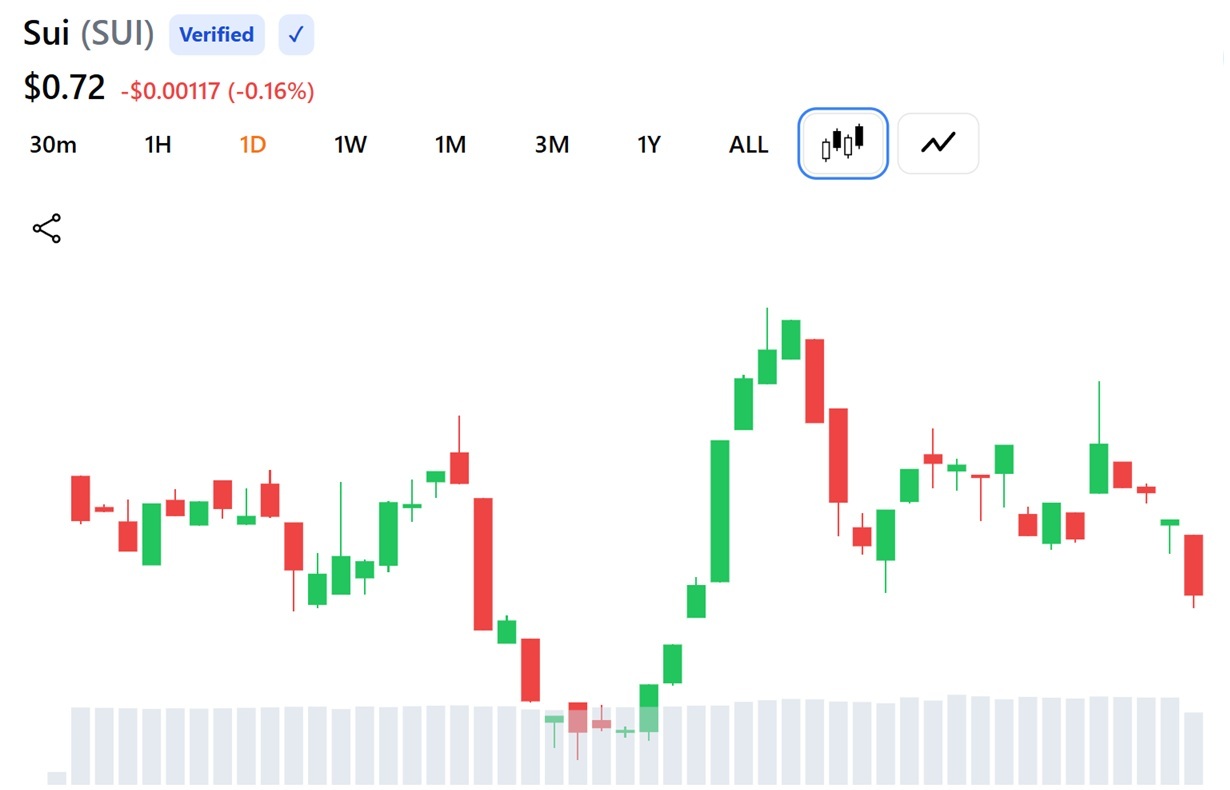
This price represents a sharp decline compared to $SUI's all-time high of $5.35 reached in January last year. The current price level is about 86% below that peak, indicating a steeper drop than most large-cap tokens over the same period.

Nevertheless, despite ongoing price challenges for $SUI, the underlying network continues to attract institutional users. For instance, the Abu Dhabi sovereign wealth fund Mubadala Capital tokenized a $75 million private markets fund, which operates primarily on Coinbase's Base network, on Solana and Sui, and also has additional share classes on Ethereum, Avalanche, Polygon, and Sei. Details about the multi-chain solution launch and Coinbase's direct participation in the fund via its balance sheet were revealed on July 23, 2026.

Bitcoin.com News reported on this event, noting that access to the fund remains limited to qualified institutional and accredited investors, with a minimum investment of around $100,000. Product management is handled by KAIO — a UAE-based tokenization infrastructure provider, which first partnered with Mubadala Capital in December 2025.

Steady Growth of Sui Networks.

Last week, the Sui Foundation and Mysten Labs launched the Hashi testnet, enabling the use of Bitcoin as loan collateral without the need to "wrap" it; the protocol is already being tested by over 25 institutional partners, including BitGo and Ledger. This followed a May protocol change that made stablecoin transfers free — which, according to Sui, helped stablecoin transaction volume exceed $65 billion in the following weeks.

The most immediate test for $SUI now is whether buyers will step in at the Gaussian Channel's lower band with sufficient volume to confirm the support analysts mentioned. Failure to hold this zone would likely open the path to retesting lower levels.

end-content

Crypto di tendenza

Domande pertinenti

QWhat technical analysis tool are traders using to assess SUI's price movement near the $0.72 level?

ATraders are using the Gaussian Channel tool. It is a technical analysis indicator based on the statistical concept of normal distribution, plotting upper, middle, and lower bands around an asset's price to identify potential trend changes and reversal points.

QAccording to the trader El Tigre, what needs to happen for SUI's price to move towards the middle of the Gaussian Channel?

AAccording to trader El Tigre, for SUI's price to move towards the middle of the Gaussian Channel, the price needs to hold at the lower band (support zone) and there must be an increase in trading volume.

QHow does the current price of SUI compare to its all-time high, and what was that peak value?

AThe current price of SUI is $0.7206, which is approximately 86% below its all-time high of $5.35, which was reached in January of the previous year.

QWhat recent development involving Abu Dhabi's sovereign wealth fund demonstrates institutional interest in the Sui network?

AAbu Dhabi's sovereign wealth fund Mubadala Capital tokenized a $75 million private markets fund that operates primarily on Sui (among other networks like Base and Solana). This fund launch, which also involves Coinbase's direct participation, was announced on July 23, 2026.

QWhat two major protocol upgrades or launches for the Sui network were mentioned in the article?

A1. The launch of the Hashi testnet, which allows Bitcoin to be used as collateral for loans without needing to be 'wrapped'. 2. A prior protocol change in May that made stablecoin transfers free, which reportedly helped stablecoin transaction volume exceed $65 billion in the following weeks.

Letture associate

Claude Designer Lags Behind Engineers, Fires Back by Creating a Million-User Tool

The article tells the story of Nate Parrott, a designer at Anthropic who created Claude Design as a side project to keep pace with his engineering teammates. When Anthropic released Opus 4.5 in November 2025, the two engineers on Parrott's Claude Code team significantly increased their output using the new AI capabilities. Parrott, the sole designer, found himself struggling to match their speed, becoming a bottleneck in the workflow. To catch up, he began experimenting in his spare time. He initially tried prompting Claude to generate designs from text descriptions and screenshots, with limited success. His breakthrough came when he shifted focus from asking Claude to "design" to asking it to generate HTML. He realized HTML could be a rich visual canvas for creating everything from slides and interactive prototypes to full web pages. He built a simple interface with a chat panel on the left and a live HTML preview on the right. The key to making the output useful was incorporating Anthropic's brand system—fonts, colors, assets, and design principles—into the prompts. This ensured generated designs were immediately on-brand. He shared an internal prototype with his team, and other product designers quickly adopted it for creating clickable prototypes, a task traditionally requiring manually drawing every state. The project's "official" turning point came during an Anthropic Labs offsite, where Parrott noticed many attendees were using his tool to build presentation slides on the fly, sometimes right before their turn to speak. This organic adoption convinced the Labs team to formally staff the project, turning the side project into a real product. Claude Design is positioned as a "pre-production" tool for visual communication and exploration—handling slides, landing pages, PDFs, emails, and social media graphics. It integrates with tools like Canva, Adobe, and Vercel. Its core value is accelerating the early stages of design: exploring directions, building consensus, and establishing systems. For actual production code, Anthropic still recommends Claude Code. The story highlights how AI disrupts workflows unevenly and how individuals can respond by building new tools to create their own advantages. Parrott's tool, born from necessity, eventually gained over a million users in its first week.

marsbit7 min fa

Claude Designer Lags Behind Engineers, Fires Back by Creating a Million-User Tool

marsbit7 min fa

Fields Medalist Warns: AI Could Kill Mathematics

The 2026 Fields Medal award was followed by a startling announcement: laureate Jacob Tsimerman joined OpenAI to pursue AI safety research, predicting AI would surpass humans in all mathematical proof areas within two years. Soon after, Fields Medalists Terence Tao and Timothy Gowers expressed deep concern at ICM 2026. Gorges warned that AI might "kill" mathematics not through stagnation, but through an overwhelming surplus of proofs, likening it to a lake dying from eutrophication. This concern is echoed in the "Leiden Declaration," signed by over 3,000 mathematicians including Tao, Peter Scholze, and Kevin Buzzard, advocating for mathematics as a profoundly human endeavor. However, Gowers, who did not sign, fears a future where AI-generated mathematics proliferates while human expertise and the shared intuition vital to the field vanish, turning math into an unvisited "cemetery of thought." Gowers' perspective shifted dramatically after testing ChatGPT 5.5 Pro. The AI solved a doctoral-level number theory problem and later produced a counterexample for the "unit distance problem," achievements Gorges considered publishable in top journals. He now concedes that large language models can handle advanced research, a realization that left him feeling the "rug pulled out from under" him when AI solved problems he personally contemplated. The debate extends to the nature of mathematical discovery. As noted by Peter Woit, AI agents have no interest in the "credit game" of academia. If theorems cease to be attributed to individual mathematicians, truth may simply return to its impersonal state in the universe. The central question remains: in an age of potentially limitless AI-generated discovery, what is the role and purpose of the human mind in mathematics?

marsbit38 min fa

Fields Medalist Warns: AI Could Kill Mathematics

marsbit38 min fa

NVIDIA's 20-Year CUDA Moat Collapsed Over a Weekend, Claude Single-Handedly Got AMD's New GPU Running

In a single weekend, Claude, an AI agent from Anthropic, successfully ported and optimized its cutting-edge model to run on a brand-new AMD MI355X server rack without any manual code intervention. This feat demonstrates a potential breakthrough in overcoming NVIDIA's long-established CUDA software ecosystem dominance, built over two decades. Anthropic's team simply instructed Claude to get the AMD machine running. By Monday, it not only worked but was showing a continuously improving performance curve. The achievement impressed AMD CEO Lisa Su and accelerated a major deployment partnership: Anthropic plans to deploy up to 2GW of AMD Instinct GPUs starting in 2027. The key enabler is AMD's new ROCm.AI platform, a toolbox designed specifically for AI agents like Claude. It provides AI-readable documentation, including chip instruction sets (ISA), and tools like the Hyperloom service that allows agents to autonomously profile performance, identify bottlenecks, test configurations, and generate optimized kernels. In a demo, Hyperloom boosted the output speed of a model by 38%. This represents a fundamental shift. While CUDA's strength lies in its vast, human-expert-driven ecosystem of tools and tacit knowledge, AMD's strategy is to make its hardware and software stack directly accessible and optimizable by AI agents. An agent can parallelize tasks—debugging, profiling, coding—that would take human engineers years to master, compressing the traditional software adaptation timeline from years to tasks. The competition is no longer just about peak hardware specs but also about how well AI can read, utilize, and tune a platform.

marsbit39 min fa

NVIDIA's 20-Year CUDA Moat Collapsed Over a Weekend, Claude Single-Handedly Got AMD's New GPU Running

marsbit39 min fa

Just Now, Peking University Alumna Lilian Weng Announces Resignation: The Best 'Alignment' in the AI Era Is Taking Care of Yourself

Lilian Weng, a Peking University alumnus and former OpenAI executive, has announced her departure from Thinking Machines Lab, the AI startup she co-founded with ex-OpenAI CTO Mira Murati 20 months ago. Her resignation comes shortly after the company released its first open-source model, Inkling. In her farewell message, Weng cited health reasons as the primary factor, stating that the past seven months involved more illness than any other period in her life. The intense pressure and guilt of being unable to work during critical periods, like the Inkling launch, became unsustainable. She expressed that she could not continue in a role where she felt unable to give her full effort. Weng joined OpenAI in 2018, contributing to projects like the Dactyl robotic hand and later building the Safety Systems team from scratch. She is also widely known for her influential technical blog, Lil'Log. Her departure follows a period of high expectations and challenges for Thinking Machines, which secured a record $20 billion seed round at a $120 billion valuation in 2025 but has since seen fluctuations in its valuation and the departure of other key co-founders. Weng emphasized that she remains passionate about AI but needs a more predictable and defined role without the relentless pressure of a co-founder. Her exit highlights the immense personal toll and speed of competition in the AI industry, where the drive for progress often clashes with human limits. Her decision underscores that stepping back to prioritize well-being can be an act of courage.

marsbit57 min fa

Just Now, Peking University Alumna Lilian Weng Announces Resignation: The Best 'Alignment' in the AI Era Is Taking Care of Yourself

marsbit57 min fa

Trading

Spot

Articoli Popolari

Come comprare DATA

Benvenuto in HTX.com! Abbiamo reso l'acquisto di DATA Network (DATA) semplice e conveniente. Segui la nostra guida passo passo per intraprendere il tuo viaggio nel mondo delle criptovalute.Step 1: Crea il tuo Account HTXUsa la tua email o numero di telefono per registrarti il tuo account gratuito su HTX. Vivi un'esperienza facile e sblocca tutte le funzionalità,Crea il mio accountStep 2: Vai in Acquista crypto e seleziona il tuo metodo di pagamentoCarta di credito/debito: utilizza la tua Visa o Mastercard per acquistare immediatamente DATA NetworkDATA.Bilancio: Usa i fondi dal bilancio del tuo account HTX per fare trading senza problemi.Terze parti: abbiamo aggiunto metodi di pagamento molto utilizzati come Google Pay e Apple Pay per maggiore comodità.P2P: Fai trading direttamente con altri utenti HTX.Over-the-Counter (OTC): Offriamo servizi su misura e tassi di cambio competitivi per i trader.Step 3: Conserva DATA Network (DATA)Dopo aver acquistato DATA Network (DATA), conserva nel tuo account HTX. In alternativa, puoi inviare tramite trasferimento blockchain o scambiare per altre criptovalute.Step 4: Scambia DATA Network (DATA)Scambia facilmente DATA Network (DATA) nel mercato spot di HTX. Accedi al tuo account, seleziona la tua coppia di trading, esegui le tue operazioni e monitora in tempo reale. Offriamo un'esperienza user-friendly sia per chi ha appena iniziato che per i trader più esperti.

124 Totale visualizzazioniPubblicato il 2026.07.01Aggiornato il 2026.07.01

Come comprare DATA

Discussioni

Benvenuto nella Community HTX. Qui puoi rimanere informato sugli ultimi sviluppi della piattaforma e accedere ad approfondimenti esperti sul mercato. Le opinioni degli utenti sul prezzo di DATA DATA sono presentate come di seguito.

活动图片