Bitcoin treasuries stall in Q4, but largest holders keep stacking sats

cointelegraphPubblicato 2025-12-11Pubblicato ultima volta 2025-12-11

Introduzione

The adoption of Bitcoin treasuries slowed sharply in Q4 2025, with only nine new companies adding BTC to their balance sheets compared to 53 in the previous quarter. While 117 companies adopted Bitcoin in 2025, most hold relatively small amounts. However, the largest corporate holders, such as Strategy, continued accumulating Bitcoin, with Strategy purchasing $962 million worth in a single day. Overall, public companies hold over 1 million BTC ($90.2B), representing 4.7% of the total supply, while spot Bitcoin ETFs hold an additional 1.49 million BTC. Some firms, like Metaplanet, paused purchases, and others, like Satsuma Technology, sold portions of their holdings. Ether treasury investments also declined, with cumulative ETH acquisitions falling 81% over three months.

Bitcoin treasury adoption slowed sharply in the fourth quarter of 2025, even as the biggest corporate holders continued to quietly add to their stacks while smaller players stepped back.

The number of new Bitcoin (BTC) treasury companies declined from its peak of 53 new companies in the third quarter to just nine companies adding Bitcoin to their balance sheet in the fourth quarter of 2025 so far, with a total of 117 new companies adopting Bitcoin this year, according to blockchain data platform CryptoQuant.

“Despite the growth in numbers during 2025, most Bitcoin Treasury companies hold relatively small amounts,” CryptoQuant wrote in a Thursday X post.

Still, the accumulation data shows that the most well-funded corporate treasuries continue to scoop up the Bitcoin supply despite a decline in buying by smaller companies and retail participants.
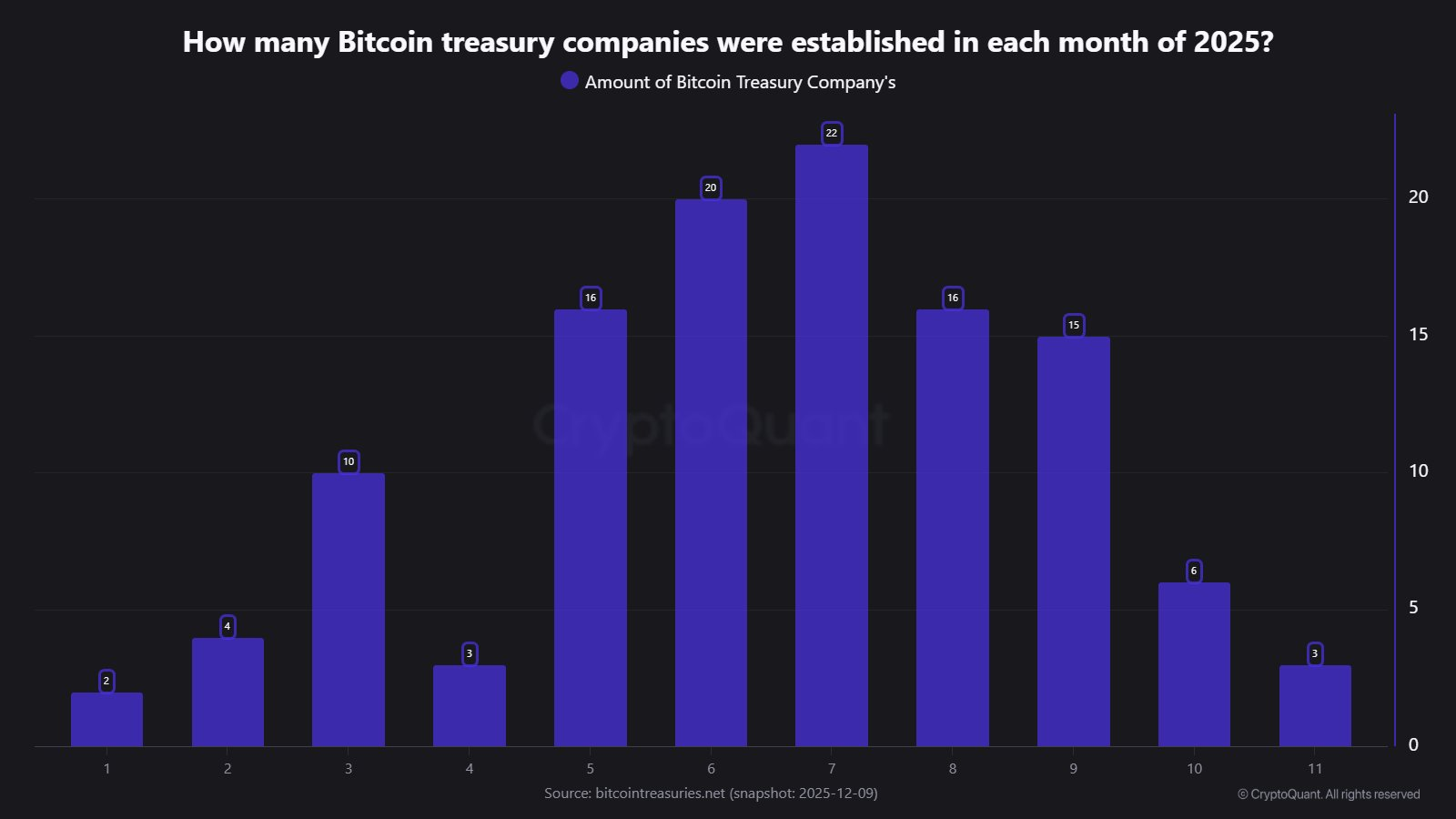
New Bitcoin treasury companies per month, 2025 year-to-date chart. Source: CryptoQuant

Some Bitcoin treasury firms have stopped accumulating this quarter. Japanese investment company Metaplanet, for instance, hasn’t purchased any Bitcoin in over two months.

Some companies are even selling their Bitcoin stacks. United Kingdom-based, Bitcoin-focused tech company Satsuma Technology sold 579 Bitcoin for around $53 million, leaving the company with 620 Bitcoin on its balance sheet, according to a Wednesday announcement.

Related: Bitcoin treads water at $90K as whales eat the Ethereum dip: Finance Redefined

Largest corporate holders continue their quiet Bitcoin accumulation

Despite the broader slowdown, some of the largest corporations continue to scoop up more of the Bitcoin supply.

Strategy, the largest corporate Bitcoin holder, purchased $962 million of BTC on Monday, in its biggest purchase since July. The company is now just $500 million shy of matching the $21.97 billion worth of Bitcoin it acquired in 2024, according to CryptoQuant.
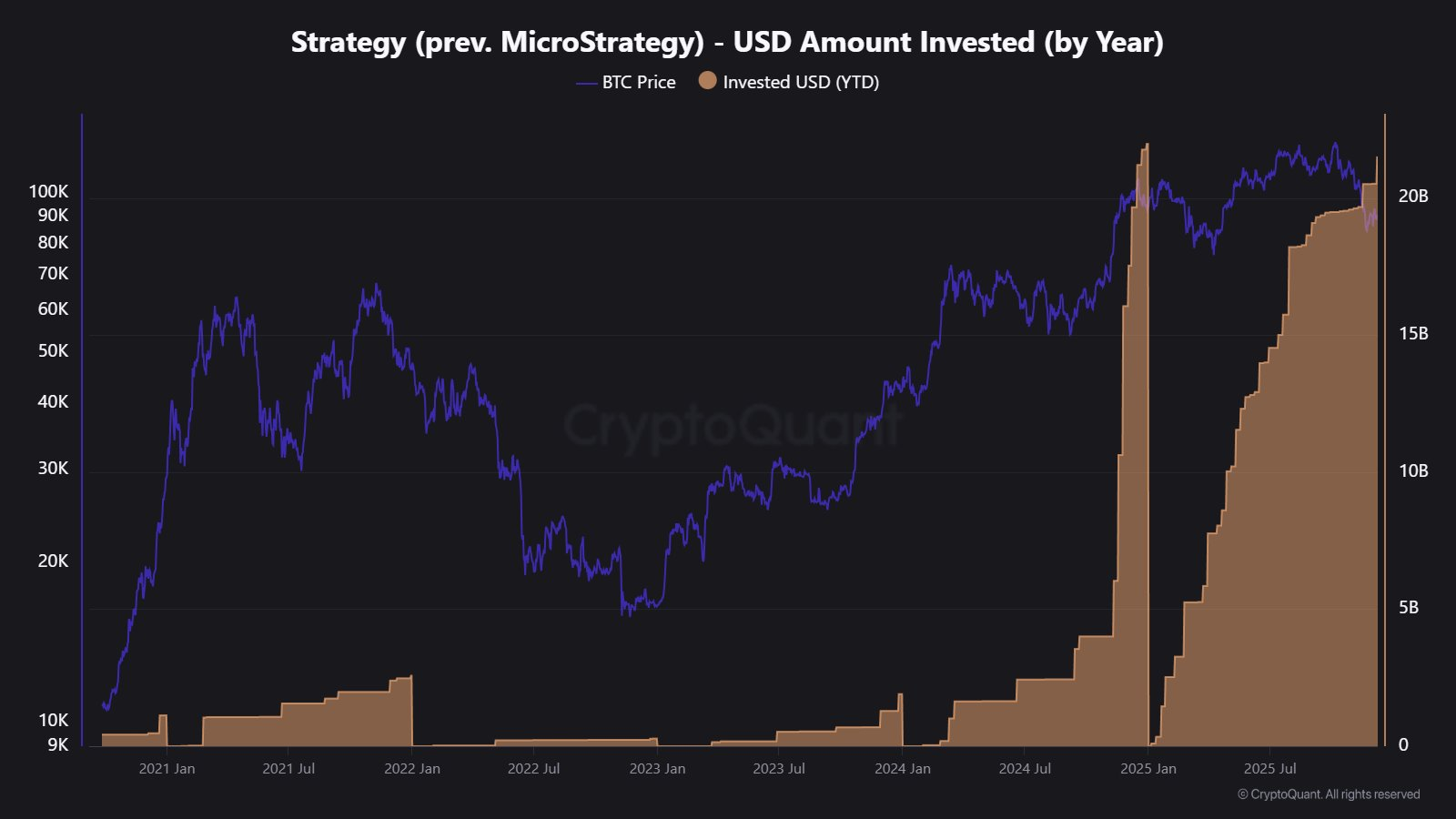
Strategy, US dollar amount invested. Source: CryptoQuant

Over 1 million Bitcoin worth $90.2 billion is already held in public company treasuries, representing 4.7% of the total supply, according to data from BitcoinTreasuries.NET.

An additional 1.49 million Bitcoin, or 7% of the supply, is held by spot Bitcoin exchange-traded funds.
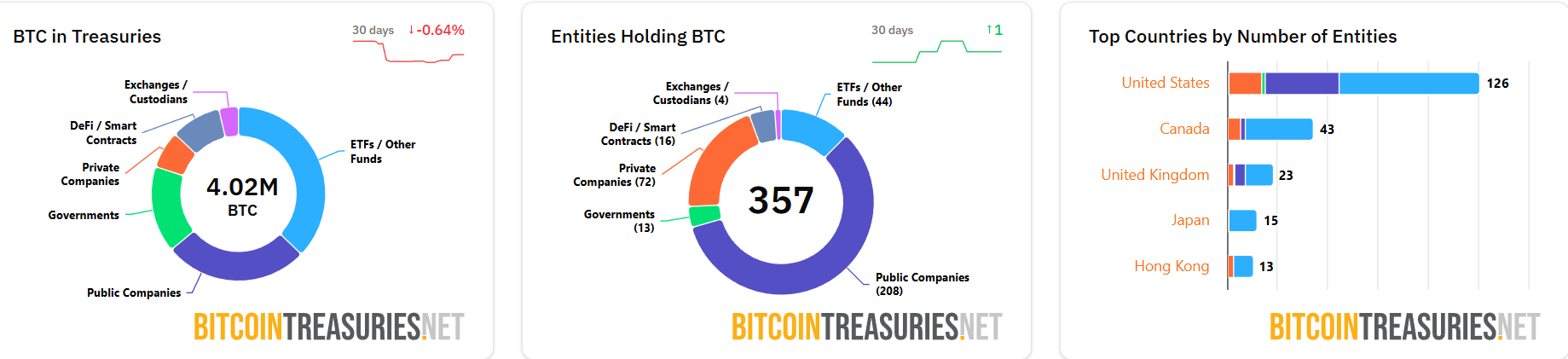
Bitcoin holdings in treasuries. Source: BitcoinTreasuries.NET

Related: Silk Road-linked Bitcoin wallets move $3M to new address

DATs slow crypto purchases as Ether treasury investments fall 81%

Digital asset treasury (DAT) acquisitions are also slowing down. Ripple-backed Evernorth Holdings has been inactive since the end of October, when it acquired $950 million XRP (XRP) tokens.

Evernorth’s XRP holdings were facing nearly $80 million in unrealized losses weeks after the purchases amid the market decline and growing pressure on DATs.

BitMine Immersion Technologies, the largest corporate Ether (ETH) holder, has also slowed its Ether acquisitions in recent months from a peak of $2.6 billion in July to just $296 million of ETH in December.

Cumulative investments from Ether treasury firms fell by 81% in the past three months, from 1.97 million ETH acquired in August to 370,000 ETH in November.

Magazine: Mysterious Mr Nakamoto author — Finding Satoshi would hurt Bitcoin

Letture associate

Dumping US Bonds, Buying Japanese Bonds: Wall Street Prepares for 'Capital Repatriation to Japan'

Wall Street is bracing for a potential "great repatriation" of Japanese capital as yields on Japanese Government Bonds (JGBs) soar to multi-decade highs. The 10-year JGB yield recently hit 2.73%, its highest since 1997, while the 30-year yield broke 4% for the first time. This dramatic shift is causing global asset managers to reassess a long-ignored risk: that Japanese investors, who hold roughly $1 trillion in U.S. Treasury debt, could start bringing that money home. For decades, Japan's ultra-low interest rates pushed domestic insurers, pension funds, and banks to seek yield overseas, primarily in U.S. Treasuries. Now, with the Bank of Japan hiking rates and JGB yields climbing, the incentive is reversing. Firms like BlueBay Asset Management are preparing for this shift, believing new Japanese investments will be directed domestically rather than to foreign bonds. Early signs of repatriation are emerging, with record monthly inflows into Japanese sovereign bond funds in March. Some managers, like Ruffer's Matt Smith, hold yen as a hedge, anticipating that market stress could trigger a rapid acceleration of capital returning to Japan. However, analysts caution that a mass exodus hasn't begun yet. Japanese investors were still net buyers of foreign bonds over the past year. Uncertainty remains high as Japan's government fiscal plans could push JGB yields even higher, making investors hesitant to buy immediately. Furthermore, the Bank of Japan's withdrawal as a dominant bond buyer has increased market volatility. Nevertheless, the potential scale of Japanese selling poses a tangible risk to the U.S. Treasury market. As the largest foreign holder of U.S. debt, any sustained shift by Japanese institutions could materially impact supply and demand dynamics, pushing U.S. yields higher. Wall Street's current positioning is a forward-looking bet on this logic becoming increasingly compelling as Japanese yields continue to rise.

marsbit41 min fa

Dumping US Bonds, Buying Japanese Bonds: Wall Street Prepares for 'Capital Repatriation to Japan'

marsbit41 min fa

How Did Institutions Adjust Their Crypto Asset Holdings in Q1? Who Increased and Who Exited?

The Q1 2026 13F filings reveal a sharply divided picture of institutional activity in crypto assets. Sovereign wealth funds and bank capital increased exposure, while major endowment funds notably de-risked. The most significant buying came from the Abu Dhabi sovereign wealth fund Mubadala, which expanded its position in the iShares Bitcoin Trust (IBIT). JPMorgan Chase dramatically increased its IBIT exposure by 174%, with other global banks like RBC, Scotiabank, and Barclays also adding to Bitcoin ETF holdings, while using options for asymmetric protection. Conversely, the Harvard Management Company (Harvard University's endowment), once a major academic holder, cut its IBIT position by 43% and fully exited a BlackRock Ethereum ETF. The reallocated capital flowed into traditional assets like TSMC, Microsoft, and gold. Other Ivy League endowments showed varied strategies: Brown and Dartmouth maintained Bitcoin positions, with Dartmouth making a nuanced shift by moving Ethereum exposure to a staking ETF and adding a Solana staking ETF to capture yield. Hedge fund Jane Street significantly reduced Bitcoin ETF holdings, locking in profits, while Wells Fargo increased its Ethereum stake. Overall, institutions are deploying traditional capital market tactics—buying, selling, hedging, and rotating—within crypto via spot ETFs. The Q2 reports will be crucial to determine if Harvard's retreat is an outlier or the start of a broader trend among endowments.

marsbit1 h fa

How Did Institutions Adjust Their Crypto Asset Holdings in Q1? Who Increased and Who Exited?

marsbit1 h fa

Blockchain Capital Partner: Most People Have a Narrow Understanding of the On-Chain Economy

Author Spencer Bogart, a partner at Blockchain Capital, argues that most people have a narrow view of the on-chain economy, seeing it primarily as a faster, cheaper version of existing financial systems. While this represents a significant opportunity, he believes it's only a small part of the story. Bogart compares the current state of crypto to the early internet, where email was the obvious "faster mail" application. The truly transformative categories—like search, social media, and cloud computing—were entirely new and unimaginable beforehand. Similarly, the most profound innovations in crypto will not be incremental improvements but entirely new categories enabled by the core properties of public blockchains: atomic execution, shared global state, programmable custody, and composability. He cites the "flash loan" as a prime example of a "new verb"—a financial action structurally impossible before programmable assets and atomic settlement. It allows for uncollateralized, trustless borrowing of any size, provided repayment occurs within the same transaction, enabling novel strategies like arbitrage and collateral swaps. Bogart admits the difficulty in precisely predicting these future innovations, as human imagination tends to extrapolate from the past. He posits that the most exciting applications in ten years will be things that don't exist today and have no precedent—products only possible in a global, composable, always-on environment with programmable assets. While the exploration of this vast design space will involve many failures, the potential for transformative, category-defining breakthroughs is what makes the next decade so promising.

链捕手1 h fa

Blockchain Capital Partner: Most People Have a Narrow Understanding of the On-Chain Economy

链捕手1 h fa

Trading

Spot
Futures

Articoli Popolari

Come comprare SATS

Benvenuto in HTX.com! Abbiamo reso l'acquisto di SATS(SATS) (SATS) semplice e conveniente. Segui la nostra guida passo passo per intraprendere il tuo viaggio nel mondo delle criptovalute.Step 1: Crea il tuo Account HTXUsa la tua email o numero di telefono per registrarti il tuo account gratuito su HTX. Vivi un'esperienza facile e sblocca tutte le funzionalità,Crea il mio accountStep 2: Vai in Acquista crypto e seleziona il tuo metodo di pagamentoCarta di credito/debito: utilizza la tua Visa o Mastercard per acquistare immediatamente SATS(SATS)SATS.Bilancio: Usa i fondi dal bilancio del tuo account HTX per fare trading senza problemi.Terze parti: abbiamo aggiunto metodi di pagamento molto utilizzati come Google Pay e Apple Pay per maggiore comodità.P2P: Fai trading direttamente con altri utenti HTX.Over-the-Counter (OTC): Offriamo servizi su misura e tassi di cambio competitivi per i trader.Step 3: Conserva SATS(SATS) (SATS)Dopo aver acquistato SATS(SATS) (SATS), conserva nel tuo account HTX. In alternativa, puoi inviare tramite trasferimento blockchain o scambiare per altre criptovalute.Step 4: Scambia SATS(SATS) (SATS)Scambia facilmente SATS(SATS) (SATS) nel mercato spot di HTX. Accedi al tuo account, seleziona la tua coppia di trading, esegui le tue operazioni e monitora in tempo reale. Offriamo un'esperienza user-friendly sia per chi ha appena iniziato che per i trader più esperti.

191 Totale visualizzazioniPubblicato il 2024.12.10Aggiornato il 2025.03.21

Come comprare SATS

Discussioni

Benvenuto nella Community HTX. Qui puoi rimanere informato sugli ultimi sviluppi della piattaforma e accedere ad approfondimenti esperti sul mercato. Le opinioni degli utenti sul prezzo di SATS SATS sono presentate come di seguito.

活动图片