Dumping US Bonds, Buying Japanese Bonds: Wall Street Prepares for 'Capital Repatriation to Japan'

marsbitPubblicato 2026-05-18Pubblicato ultima volta 2026-05-18

Introduzione

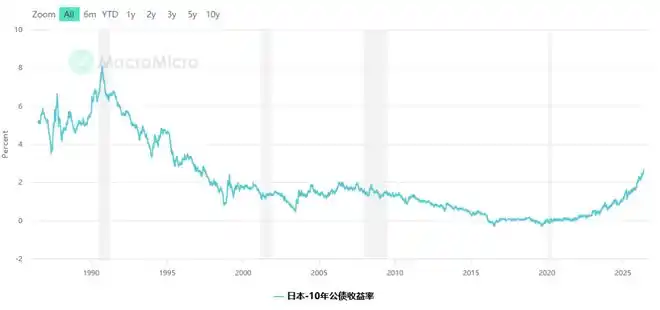
Wall Street is bracing for a potential "great repatriation" of Japanese capital as yields on Japanese Government Bonds (JGBs) soar to multi-decade highs. The 10-year JGB yield recently hit 2.73%, its highest since 1997, while the 30-year yield broke 4% for the first time. This dramatic shift is causing global asset managers to reassess a long-ignored risk: that Japanese investors, who hold roughly $1 trillion in U.S. Treasury debt, could start bringing that money home. For decades, Japan's ultra-low interest rates pushed domestic insurers, pension funds, and banks to seek yield overseas, primarily in U.S. Treasuries. Now, with the Bank of Japan hiking rates and JGB yields climbing, the incentive is reversing. Firms like BlueBay Asset Management are preparing for this shift, believing new Japanese investments will be directed domestically rather than to foreign bonds. Early signs of repatriation are emerging, with record monthly inflows into Japanese sovereign bond funds in March. Some managers, like Ruffer's Matt Smith, hold yen as a hedge, anticipating that market stress could trigger a rapid acceleration of capital returning to Japan. However, analysts caution that a mass exodus hasn't begun yet. Japanese investors were still net buyers of foreign bonds over the past year. Uncertainty remains high as Japan's government fiscal plans could push JGB yields even higher, making investors hesitant to buy immediately. Furthermore, the Bank of Japan's withdrawal as a dominant bo...

Japan's government bond market is experiencing volatility unseen in decades, prompting global asset management institutions to re-examine a long-ignored risk: will Japanese investors, who hold approximately $1 trillion in US Treasury bonds, move their money back home?

According to a recent report by the Financial Times, several investment firms have begun preparing for the potential large-scale repatriation of Japanese capital, betting that Japanese investors will gradually sell US Treasuries and instead buy Japanese Government Bonds (JGBs) with their continuously rising yields.

Soaring JGB Yields Hit Multi-Decade Highs

On Friday, Japan's benchmark 10-year government bond yield rose to 2.73% in intraday trading, its highest level since May 1997.

The yield on 30-year JGBs broke through 4% for the first time—a level never reached since these bonds were first issued in 1999. Yields on 5-year and 20-year bonds also hit record highs earlier this week.
Japanese Finance Minister Satsuki Katayama told reporters on Friday that yields on benchmark bonds in major global markets are rising, "These dynamics influence each other, creating a compounding effect."

Analysts expect JGB yields to continue climbing. The Bank of Japan raised its policy rate to 0.75% in December last year, the highest in thirty years, and the market widely anticipates another 25 basis point hike to 1% this June.

The $1 Trillion 'Repatriation to Japan' Logic

To understand this bet, one must first understand why Japanese investors hold such vast assets overseas.

For decades, Japan maintained ultra-low interest rates, offering almost no return on domestic bonds. To seek yields, Japanese institutional investors such as insurance companies, pension funds, and banks went on a massive overseas buying spree, purchasing US Treasuries, European bonds, and various global assets.

Currently, Japanese investors hold roughly $1 trillion in US Treasury bonds, making them the largest foreign holder of US debt, far surpassing other countries.

Now, with Japanese bond yields rising sharply, this logic is reversing. Mark Dowding, Chief Investment Officer at British asset manager BlueBay, directly highlighted this shift. BlueBay just launched its first Japanese bond fund in March this year.

Dowding stated: "New money will not be deployed overseas. It won't go into US corporate bonds, it won't go into US Treasuries; it will come back and be deployed domestically in Japan."

'Trickle' of Capital Repatriation Has Begun

Market data shows signs of capital returning, although the scale is still small.

According to fund tracker EPFR, investors netted about $700 million into Japanese sovereign bond funds in March, setting a record for the largest monthly inflow in the category's history. April saw a net inflow of $86 million, returning to recent normal levels.

Ruffer fund manager Matt Smith offered a more direct assessment. He said: "The pressure is building—long-end domestic yields keep going up, and the signal at an institutional level is 'please bring your money back to Japan'. We think the yen appreciation will happen slowly at first, then all at once."

Smith also said Ruffer currently holds a long yen position as a core hedging tool. "In a market dislocation, particularly one centered around US credit markets, you will get Japanese investors bringing capital back home, and the yen will strengthen."

Large-Scale Repatriation Not Yet Happening, JGBs Have Their Own Concerns

However, analysts caution that Japanese institutional investors are still net buyers of foreign bonds.

RBC Capital Markets Asia macro strategist Abbas Keshvani pointed out that although JGB yields now "superficially offer better compensation for investors," over the past 12 months, Japanese investors have still been net buyers of about $50 billion in foreign bonds.

The reason lies in the uncertainty within the JGB market itself. Japanese Prime Minister Sanae Takaichi won the election this February, with campaign promises including expanded government spending and subsidies to ease inflation pressures. Analysts increasingly warn that the government will be forced to compile a supplementary budget later this year, which would further depress JGB prices and push yields higher.

Keshvani said: "Both supply and demand dynamics point to yields moving higher. As an investor, it's very difficult to have the will to step in now if you know yields will continue to rise."

Previously, the Bank of Japan, through quantitative easing and yield curve control policies, was the market's most significant buyer of JGBs. As the BOJ gradually exits, the market returns to traditional supply-demand logic, leading to noticeably increased volatility in JGB prices.

Implications for the US Treasury Market

The potential scale of Japanese capital repatriation forces the US Treasury market to take this risk seriously.

Japan is the largest foreign holder of US Treasury bonds, with holdings of approximately $1 trillion. If Japanese institutional investors begin systematically reducing their holdings, the impact on the supply-demand dynamics of US Treasuries would be substantial.

Currently, Wall Street's bet is more of a forward-looking positioning rather than a reaction to an established fact. But as Japanese bond yields continue to climb—with analysts viewing a 10-year JGB yield reaching 3% later this year as a realistic target—the logic behind this bet will become increasingly clear.


Domande pertinenti

QAccording to the article, why are global asset managers beginning to reassess the risk of Japanese capital outflows from foreign bonds?

AThey are reassessing this risk due to unprecedented volatility in the Japanese government bond (JGB) market, where yields are soaring to multi-decade highs. This creates a new incentive for Japanese investors, who hold roughly $1 trillion in US Treasuries, to potentially repatriate capital to buy higher-yielding domestic bonds.

QWhat specific recent yield levels for Japanese government bonds are highlighted in the article as being particularly significant?

AThe article highlights that the 10-year JGB yield rose to 2.73%, its highest since May 1997. The 30-year JGB yield surpassed 4% for the first time since its issuance in 1999. Yields on 5-year and 20-year JGBs also recently hit record highs.

QWhat is the core investment logic behind the potential 'repatriation to Japan' trade, as explained by BlueBay's Mark Dowding?

AThe core logic is reversal. For decades, Japanese investors sought higher yields abroad due to near-zero rates at home. Now, with JGB yields rising sharply, the incentive has flipped. New capital will no longer be allocated to foreign assets like US Treasuries or corporate bonds, but will instead be deployed back into the domestic Japanese bond market.

QWhat evidence does the article provide that some capital is already starting to flow back to Japan, and what counter-evidence suggests a large-scale shift hasn't happened yet?

AEvidence of early flows: In March, Japanese sovereign bond funds saw a record $700 million in net inflows. Evidence against a large-scale shift: Over the past 12 months, Japanese investors have remained net *buyers* of foreign bonds, purchasing about $50 billion worth. Analysts cite ongoing uncertainty in the JGB market, with expectations of further yield increases, as a reason for hesitation.

QWhat is the potential implication for the US Treasury market if Japanese investors begin a systematic sell-off of their holdings?

AThe implication is a substantial and material impact on the supply-demand dynamics of the US Treasury market. Japan is the largest foreign holder of US debt, with approximately $1 trillion in holdings. Systematic selling by Japanese institutions would remove a major source of demand, putting upward pressure on US yields and creating volatility.

Letture associate

The Verdict in Choi Tae-won's Divorce Case: Revealing the Inheritance Undercurrent Behind SK Hynix's Trillion-Won Empire

SK Group Chairman Chey Tae-won's high-profile divorce case, involving a record 1.38 trillion won settlement, has drawn attention to the succession plans for Korea's second-largest conglomerate, especially its crown jewel, SK hynix. Unlike traditional chaebol scripts centered on the eldest son, Chey's three children from his marriage to former President Roh Tae-woo's daughter, Roh Soh-yeong, are carving distinct, non-traditional paths. Eldest daughter Chey Yun-jung (b. 1989) is seen as the most evident successor. With a scientific and consulting background, she holds executive roles at SK bioscience and SK Inc.'s growth support department, focusing on future strategy and biopharma. Her marriage is to an AI infrastructure entrepreneur, not a traditional business alliance. Second daughter Chey Min-jung (b. 1991) took a unique route, voluntarily serving as a South Korean naval officer, including an anti-piracy deployment. She later worked on policy and strategy for SK hynix in Washington D.C. before co-founding an AI-driven healthcare startup. She married a former U.S. Marine Corps officer, connecting her to U.S. defense and policy circles—networks crucial for a global semiconductor giant. The only son, Chey In-geun (b. 1995), who studied physics like his father, worked briefly at SK E&S before joining McKinsey. Despite fitting the traditional "heir" profile as the eldest son, he remains silent and holds no public position or shares in SK, suggesting the old succession playbook is obsolete. As SK hynix's valuation soars, becoming a geopolitical asset in the AI era, the heirs' legitimacy is no longer automatic. They must prove themselves in fields like AI biotech, global policy, and strategic consulting. Their marriages also reflect new elite networks in tech and defense, not old political alliances. Their inheritance is the complex challenge of navigating a globalized, tech-driven world, not just a corporate throne.

marsbit4 h fa

The Verdict in Choi Tae-won's Divorce Case: Revealing the Inheritance Undercurrent Behind SK Hynix's Trillion-Won Empire

marsbit4 h fa

From OpenSea to OpenRouter: Is Alex Atallah Repeating His 'Exit at the Peak' Playbook?

From OpenSea to OpenRouter: Is Alex Atallah Repeating His "Exit at the Peak" Playbook? According to the Wall Street Journal, payments giant Stripe is in talks to acquire the AI model aggregation platform OpenRouter in a potential deal valuing the company near $100 billion. This would mark founder Alex Atallah's second creation of a company reaching a $100 billion valuation, following his co-founding of NFT marketplace OpenSea. OpenRouter, founded just over three years ago, has grown rapidly by acting as a unified gateway for developers to access over 400 AI models. It currently has about 10 million users and processes over 200 trillion tokens monthly. While the platform's annualized revenue is around $50 million, its valuation has skyrocketed from $1.3 billion in March 2026. The potential acquisition by Stripe, a company OpenRouter's founder once likened it to, represents a major expansion into AI infrastructure for the payments leader. This move echoes Atallah's previous timing with OpenSea, where he departed before the NFT market's significant downturn. For OpenRouter, selling now may be strategic. Despite its scale, its business model—charging a 5-5.5% fee on AI inference calls—faces pressure from competition, open-source models, and potential price wars among model providers, limiting its profitability narrative for an IPO. A key asset for potential acquirers like Stripe is OpenRouter's vast repository of real-world AI usage data, which offers unique insights into model performance and developer preferences that are difficult to replicate. Whether this potential deal signifies a new valuation benchmark for AI infrastructure or another market peak signal remains to be seen.

链捕手4 h fa

From OpenSea to OpenRouter: Is Alex Atallah Repeating His 'Exit at the Peak' Playbook?

链捕手4 h fa

Trading

Spot
活动图片




