Grayscale: The Three Evolution Stages of Stock Tokenization and a Review of Core Beneficiary Public Blockchains

marsbitPubblicato 2026-07-14Pubblicato ultima volta 2026-07-14

Introduzione

Grayscale outlines three key phases in the adoption of tokenized stocks, each benefiting different blockchain infrastructures. Phase 1: The "Wrapper Model." Third-party platforms create tokens representing claims on an SPV that holds the underlying stocks. While not conferring direct ownership, these tokens enable DeFi use and retail access. This currently dominant model (~70% by market cap) primarily operates on Ethereum, Solana, and BNB Chain. Phase 2: The "Entitlement Model." Major financial institutions like DTCC tokenize existing, regulated securities through their post-trade infrastructure to enable on-chain settlement and movement. The upcoming DTCC pilot on Canton Network exemplifies this institutional-led approach. Phase 3: The "Issuer-Led Model." Companies natively issue securities directly on a blockchain, as recently demonstrated by Securitize. This model offers the greatest long-term potential but requires more regulatory clarity. It is expected to favor open-architecture blockchains like Ethereum and Solana, as well as hybrid networks like Avalanche. The report posits that all three models will coexist. The primary blockchain networks poised to benefit from tokenized equity growth are Ethereum, Solana, BNB Chain, Avalanche, and Canton Network.

Author| Zach Pandl, Head of Research at Grayscale

Compiled| WuBlockchain

The tokenization process of global stock markets is advancing. Tokenized stocks promise various benefits for users, including 24/7 trading. The next significant development will be DTCC's [1] launch of a tokenization pilot on the Canton Network [2]. This pilot will allow tokenized stocks and other assets to circulate within the regulated financial system via blockchain infrastructure.

We believe stock market tokenization will progress through three stages, each bringing value to different types of blockchain infrastructure (see Chart 1).

The first stage is the third-party "wrapper" model [3]. In this model, an issuer holds stocks through a special purpose vehicle (SPV) [4], and the tokenized stock represents a claim on that SPV. Currently, over 70% of tokenized stocks by market value use this model. Wrapper-type tokenized stocks do not represent true stock ownership but can be used in DeFi and may appeal to retail investors. These assets currently trade on networks such as Ethereum, Solana, and BNB Chain.

The second stage is the "entitlement" model [5], represented by DTCC's pilot. Instead of creating new versions of securities, DTCC will record existing eligible securities on-chain through its regulated post-trade infrastructure, with the Canton Network serving as the initial blockchain network for this pilot.

The third stage is the issuer-led model, where companies directly issue securities natively on-chain. Last week, Securitize [6] became the first publicly listed company to tokenize its own common stock upon listing on the New York Stock Exchange. We believe this model holds the greatest long-term potential but still requires further regulatory clarity. In our view, the issuer-led model will be more favorable to open-architecture blockchains like Ethereum and Solana, as well as hybrid networks like Avalanche.

These three tokenization models are likely to coexist for many years to come.

Core View: Multiple models exist for tokenized stocks. In our view, the blockchain networks most likely to benefit from tokenization growth include Ethereum, Solana, BNB Chain, Avalanche, and the Canton Network.
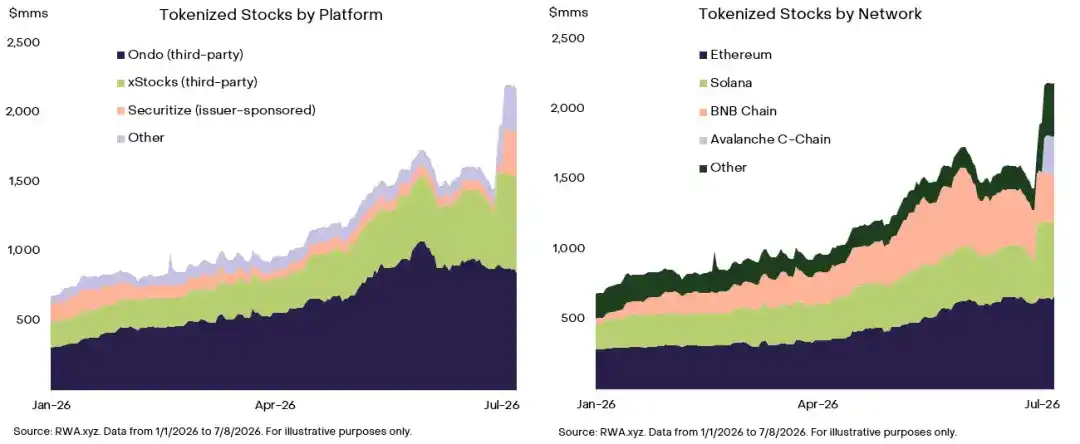
Chart 1: Third-party platforms currently dominate the tokenized stock market, while Ethereum, Solana, and BNB Chain hold the majority of on-chain assets.

Notes:

[1] DTCC: The Depository Trust & Clearing Corporation, a core U.S. post-trade securities infrastructure entity responsible for services such as clearing, settlement, and custody of securities transactions.

[2] Canton Network: A blockchain network for institutional financial assets, emphasizing privacy, compliance, and interoperability of assets among different financial institutions.

[3] Wrapper model: A model where a third-party platform holds underlying stocks through an intermediary structure and issues on-chain tokens representing claims on that structure. Investors hold claims on the structure rather than direct ownership of the stocks themselves.

[4] SPV: Special Purpose Vehicle. In the context of tokenized stocks, it typically refers to an entity established by the issuer to hold the underlying stock assets, with the investors' tokens representing claims on that entity.

[5] Entitlement model: A model that does not re-issue a new security but instead records or maps existing eligible securities onto a blockchain through a regulated post-trade system, enabling them to circulate on blockchain infrastructure.

[6] Securitize: A platform for digital securities and real-world asset tokenization. The article mentions its simultaneous tokenization of its own common stock upon listing on the NYSE.

Crypto di tendenza

Domande pertinenti

QWhat are the three evolutionary stages of stock tokenization as described in the article?

AThe three evolutionary stages are: 1) The third-party 'wrapper' model, 2) The 'entitlement' model, and 3) The issuer-led model, where companies natively issue securities on-chain.

QWhich blockchain networks are currently hosting most of the tokenized stock assets in the wrapper model stage?

AEthereum, Solana, and BNB Chain are currently hosting most of the tokenized stock assets in the wrapper model stage.

QWhat is the Canton Network, and what role does it play in the tokenization pilot mentioned?

ACanton Network is a blockchain network for institutional financial assets, emphasizing privacy, compliance, and interoperability between financial institutions. It is designated to be the first blockchain network for DTCC's tokenization pilot, which will allow tokenized stocks and other assets to flow within the regulated financial system via blockchain infrastructure.

QAccording to the article, which blockchain networks are seen as most likely to benefit from the growth of tokenized stocks in the long term?

AThe article suggests that Ethereum, Solana, BNB Chain, Avalanche, and Canton Network are the blockchain networks most likely to benefit from the growth of tokenized stocks.

QWhat is a key advantage of the 'entitlement model' of tokenization, as represented by the DTCC pilot?

AA key advantage of the 'entitlement model' is that instead of creating new versions of securities, it tokenizes existing, eligible securities through regulated post-trade infrastructure (like DTCC), enabling them to be transacted and settled on-chain while maintaining their established regulatory status and legal framework.

Letture associate

ZORA Plunges 95%, Coinbase Finally Admits Creator Coins Failed

On July 13th, Coinbase CEO Brian Armstrong publicly declared the failure of Base network's year-long "content coins" strategy. Initially launched in 2025 via the Zora platform and integrated into Coinbase's wallet as a core feature, the model aimed to turn every social media post into a tradeable token. Each post or creator account would generate 1 billion ERC-20 tokens, with creators receiving an initial allocation. The concept briefly propelled Base to become the largest L2 by new token issuance. However, the model proved unsustainable. These tokens, explicitly not granting ownership or revenue shares, primarily functioned as speculative assets dependent on new buyers. While activity surged in mid-2025—with millions of tokens minted and billions in trading volume—it failed to build lasting user engagement or value. High-profile token launches, including one by Base's official account, experienced extreme volatility, often crashing shortly after spikes. The supporting infrastructure token, ZORA, plummeted approximately 95% from its August 2025 peak, losing nearly $520 million in market capitalization. Armstrong acknowledged the misstep, stating "it didn't work" and that Base had shifted focus earlier in the year toward its core competencies of trading and stablecoin payments. This pivot follows internal criticism that the content coin experiment consumed excessive resources, harmed other Base projects, and ultimately resulted in significant financial losses for participating users.

Foresight News17 min fa

ZORA Plunges 95%, Coinbase Finally Admits Creator Coins Failed

Foresight News17 min fa

Trading

Spot

Articoli Popolari

Come comprare CORE

Benvenuto in HTX.com! Abbiamo reso l'acquisto di CORE (CORE) semplice e conveniente. Segui la nostra guida passo passo per intraprendere il tuo viaggio nel mondo delle criptovalute.Step 1: Crea il tuo Account HTXUsa la tua email o numero di telefono per registrarti il tuo account gratuito su HTX. Vivi un'esperienza facile e sblocca tutte le funzionalità,Crea il mio accountStep 2: Vai in Acquista crypto e seleziona il tuo metodo di pagamentoCarta di credito/debito: utilizza la tua Visa o Mastercard per acquistare immediatamente CORECORE.Bilancio: Usa i fondi dal bilancio del tuo account HTX per fare trading senza problemi.Terze parti: abbiamo aggiunto metodi di pagamento molto utilizzati come Google Pay e Apple Pay per maggiore comodità.P2P: Fai trading direttamente con altri utenti HTX.Over-the-Counter (OTC): Offriamo servizi su misura e tassi di cambio competitivi per i trader.Step 3: Conserva CORE (CORE)Dopo aver acquistato CORE (CORE), conserva nel tuo account HTX. In alternativa, puoi inviare tramite trasferimento blockchain o scambiare per altre criptovalute.Step 4: Scambia CORE (CORE)Scambia facilmente CORE (CORE) nel mercato spot di HTX. Accedi al tuo account, seleziona la tua coppia di trading, esegui le tue operazioni e monitora in tempo reale. Offriamo un'esperienza user-friendly sia per chi ha appena iniziato che per i trader più esperti.

243 Totale visualizzazioniPubblicato il 2024.12.13Aggiornato il 2026.06.02

Come comprare CORE

Discussioni

Benvenuto nella Community HTX. Qui puoi rimanere informato sugli ultimi sviluppi della piattaforma e accedere ad approfondimenti esperti sul mercato. Le opinioni degli utenti sul prezzo di CORE CORE sono presentate come di seguito.

活动图片