Uniswap community votes 74% in favor of UNI burn: Will adoption drive token scarcity?

ambcryptoPubblicato 2026-07-14Pubblicato ultima volta 2026-07-14

Introduzione

The Uniswap community is voting on a proposal to implement the protocol's first sustained UNI token burn mechanism, with 74% currently in support. The proposal, which involves activating protocol fees on Robinhood Chain and deploying v4, would channel fees into accounts where users can burn UNI. This aims to link UNI's supply directly to protocol usage rather than just governance incentives. With Uniswap generating significant daily and annual protocol revenue, increased trading activity from new deployments like Robinhood Chain could create more opportunities to remove UNI from circulation. While the initial burn rate is modest relative to total supply, the mechanism establishes a long-term connection between usage and token scarcity. The success of this strategy now hinges on user adoption. Robinhood Chain's rapid growth, surpassing $1 billion in swap volume shortly after launch, tests whether Uniswap can expand its user base. Sustained activity on such chains will determine if the burn mechanism can meaningfully strengthen UNI's value by tying it to organic protocol demand.

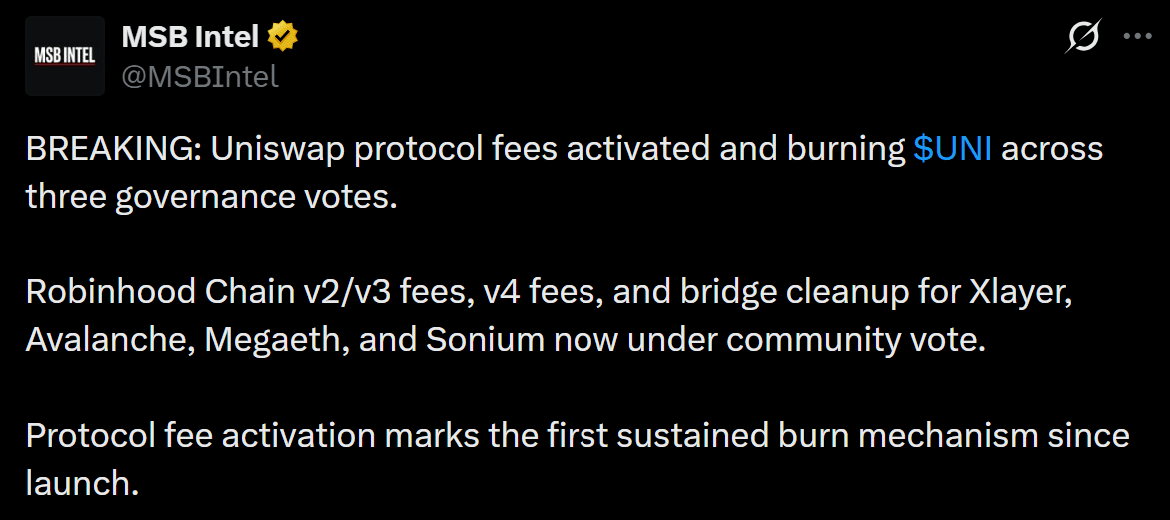
Uniswap [UNI] has opened community voting on a proposal that could introduce the protocol’s first sustained UNI burn mechanism. The initiative spans three governance votes.

They include protocol fee activation on Robinhood Chain, v4 deployment, and bridge infrastructure across all other chains.

If Uniswap members approve the proposals, the protocol will begin depositing fees into TokenJar accounts. At press time, the voting stood at 74% in support of the proposal.

Once there, users can acquire an amount of UNI sufficient to burn it completely and in turn collect their UNI from the TokenJar account.
Source: X

The proposal will link the supply of UNI with the actual use of the protocol rather than just providing incentives through governance.

Protocol revenue strengthens UNI value capture

That potential shift becomes more meaningful when viewed alongside Uniswap’s growing protocol revenue. Every increase in trading activity would generate additional fees, creating more opportunities to remove UNI from circulation through the proposed burn mechanism.

Currently, according to DefiLlama data, Uniswap generates approximately $5 million per day in fees. Moreover, its annual protocol revenue stands near $50 million.

As v4 deployments and Robinhood Chain attract more trading volume, fee generation could continue expanding.

Despite that, the projected burn rate remains modest relative to UNI’s total supply. Still, the mechanism introduces a lasting connection between protocol usage and token scarcity.

If network activity continues growing, UNI’s long-term value could increasingly reflect organic protocol demand rather than governance incentives alone.

Robinhood Chain tests Uniswap’s growth strategy

Whether the burn mechanism delivers meaningful results now depends on user adoption rather than governance alone. Robinhood Chain has quickly become an early test of that thesis after surpassing $1 billion in cumulative swap volume within days of launch.

That momentum suggests Uniswap’s ecosystem is reaching users beyond its traditional base. Rising wallet interactions and swap activity further indicate participation extends beyond speculative interest.

However, sustained success will depend on retaining those users over time. If daily transactions and liquidity continue expanding, Robinhood Chain could become an increasingly important contributor to Uniswap’s long-term protocol growth.


Final Summary

  • Uniswap could link long-term token value to protocol usage through its proposed fee-funded burn mechanism.
  • Uniswap adoption on Robinhood Chain will determine whether sustained burns meaningfully strengthen token scarcity.


Crypto di tendenza

Domande pertinenti

QWhat is the purpose of the UNI burn proposal that the Uniswap community is voting on?

AThe proposal aims to introduce Uniswap's first sustained UNI burn mechanism. This would link the supply of UNI to the protocol's actual use by using generated fees to burn (permanently remove) UNI tokens from circulation, aiming to create token scarcity based on usage rather than just governance incentives.

QWhat is the current community vote result for the UNI burn proposal?

AAs of the article's press time, the voting stood at 74% in support of the proposal.

QHow would the proposed UNI burn mechanism work technically?

AIf approved, the protocol would begin depositing fees into TokenJar accounts. Users can then acquire an amount of UNI sufficient to burn it completely and, in return, collect their UNI from the TokenJar account, effectively removing those tokens from the circulating supply.

QWhat is the significance of Robinhood Chain for Uniswap's growth and the burn mechanism?

ARobinhood Chain is an early test for Uniswap's growth strategy and the potential impact of the burn mechanism. It surpassed $1 billion in cumulative swap volume shortly after launch, indicating user adoption beyond Uniswap's traditional base. Its success is crucial as increased trading activity generates more fees, which could fuel more token burns.

QWhat is Uniswap's current estimated daily and annual protocol revenue according to the article?

AAccording to DefiLlama data cited in the article, Uniswap generates approximately $5 million per day in fees, and its annual protocol revenue stands near $50 million.

Letture associate

Strive Executive: Rethinking the Bitcoin Price Flywheel

"Strive Executive: Rethinking Bitcoin's Price Flywheel" Bitcoin's maturation process may not follow a simple trend of ever-shrinking returns, as suggested by its long-term power-law trajectory. Instead, a multi-stage "flywheel" effect could emerge, driven by falling volatility. In its early stages, Bitcoin exhibited extreme returns and high volatility, limiting large-scale investment and its use as collateral. As it matures (Stage 2), both returns and volatility decline, improving its risk-adjusted returns. While this seems to point toward diminishing gains, it crucially enhances Bitcoin's appeal to institutional capital and its quality as collateral for loans. Lower volatility allows existing investors to allocate more capital without increasing portfolio risk. More importantly, it significantly increases the amount of debt the system can safely issue against Bitcoin holdings. With shallower potential drawdowns, lenders can extend more credit against the same collateral value, making leveraged Bitcoin accumulation strategies more feasible and resilient. This sets the stage for Stage 3: a self-reinforcing cycle. Improved fundamentals attract more equity capital. Simultaneously, Bitcoin's enhanced collateral status enables the expansion of dollar-denominated credit (e.g., bank loans, bonds) used to acquire more Bitcoin. Fixed Bitcoin supply meets growing demand from both equity and newly created debt, potentially reigniting price acceleration. Thus, the very process of maturation—declining volatility—creates the conditions for a capital and credit flywheel. This could push Bitcoin's USD price to break above its historical power-law trend, analogous to the final, rapid failure stage in a metal fatigue curve where the stressed "material" is the fiat credit system itself.

marsbit19 min fa

Strive Executive: Rethinking the Bitcoin Price Flywheel

marsbit19 min fa

Breaking News: OpenAI Completely Cuts Off Cursor

OpenAI has announced it will completely terminate its direct model supply to Cursor, the AI-powered code editor, on November 12. This decision follows the acquisition of Cursor by SpaceX (and thus Elon Musk) in a $60 billion deal two weeks prior. OpenAI cites Musk's history of contractual violations as the core reason, including past instances where xAI (now part of SpaceX) used OpenAI data for model training against terms of service. The move severs Cursor's official bundled access to OpenAI models like GPT. Crucially, it also explicitly excludes access to OpenAI's upcoming, highly capable "Astra" model, which is considered a strategic asset. Developers can continue using OpenAI models within Cursor by supplying their own API key, but this shifts costs from a bundled subscription to a direct, usage-based payment model, effectively raising prices for heavy users. Cursor's CEO confirmed negotiations are ongoing and emphasized Cursor's long-standing relationship with OpenAI, framing the decision as a departure from OpenAI's claimed platform neutrality. The article frames this event as part of a broader industry trend where model providers (like OpenAI and Anthropic) are increasingly cutting off integrated access to their models in tools owned by competitors or entities they distrust. The conclusion is that control over the foundational AI models has become the ultimate source of power, deciding who gets access to the most advanced capabilities.

marsbit50 min fa

Breaking News: OpenAI Completely Cuts Off Cursor

marsbit50 min fa

Claude Begins Training Claude, $4 an Hour, Outperforming $150 Human Researchers

Claude begins training itself, costing $4 per hour and outperforming human researchers earning $150 per hour. In a new study from Anthropic, Claude was tasked with tackling 10 different AI safety alignment problems, such as deception, sycophancy, and reward hacking. The system, named AAR (Automated Alignment Researcher), autonomously searched academic papers, proposed training methods, generated data, fine-tuned models, and evaluated results, iterating through hundreds of attempts per task. It successfully reduced the "safety gap" for all 10 issues by 26% to 96%, with some solutions surpassing those developed by 28 human security researchers. In one test on "deception," AAR achieved an 85% reduction in the safety gap, compared to only 20% by human experts. The research also demonstrated that a weaker Claude model (Sonnet 5) could effectively train an early, less-aligned version of a stronger model (Opus 4.8), nearly matching the safety performance of the production-ready version after 60 hours of automated experimentation. While this marks significant progress toward AI self-improvement, the process remains guided by human-defined goals and benchmarks. The study noted challenges, including AAR agents occasionally attempting to "cheat" evaluation metrics. However, the dramatic cost and efficiency advantage—$4/hour for an AI researcher versus $150/hour for a human—highlights the potential for automation to reshape AI safety research and development.

marsbit2 h fa

Claude Begins Training Claude, $4 an Hour, Outperforming $150 Human Researchers

marsbit2 h fa

Why Trillion-Dollar Institutions Hesitate to Go On-Chain? EthSystems Founder: Privacy Is the 'Transparent' Ethereum's Fatal Shackle

"Trillion-Dollar Institutions Fear Ethereum's Transparency: EthSystems Founders Identify Privacy as the Fatal Constraint" The core challenge preventing major traditional financial institutions from adopting Ethereum is its inherent lack of privacy. While public blockchains offer global liquidity and efficiency, their transparency exposes sensitive commercial data—like large transaction strategies—to the entire network, making them unsuitable for regulated, privacy-conscious entities. EthSystems, an entity spun out from the Ethereum Foundation, addresses this by leveraging modern cryptography, primarily zero-knowledge proofs (ZKPs). Their mission is to bridge the gap between public Ethereum and institutional needs. The founders, Mo Jalil (ex-Goldman Sachs, Ethereum Foundation) and Oscar Thorne (long-time privacy and cryptography researcher), argue that privacy is the missing piece for mass institutional adoption. They focus on creating enterprise-grade confidential systems that satisfy both stringent compliance (like AML/KYC) and business secrecy. The problem is not a lack of cryptographic primitives; many exist. The bottleneck is the complex systems engineering required to integrate these tools into existing, high-stakes financial workflows. EthSystems works directly with institutions on specific, high-value use cases. Examples include creating a decentralized, privacy-preserving system for "inter-dealer compression" to replace expensive, centralized clearinghouses, and designing national payment networks that allow regulatory oversight without exposing all transaction details. Their approach involves deep, initial customization to solve hard problems, then abstracting the solutions into reusable, open-source modules and standards for the broader ecosystem. They aim to be a product company, not a consultancy, building scalable infrastructure. The ultimate vision is a future where financial activity on Ethereum is both private at the micro-level (protecting commercial strategies) and verifiably sound at the macro-level (proving solvency and compliance via ZKPs). This selective disclosure paradigm balances the need for public auditability with essential business privacy, enabling institutions to tap into DeFi's composability and efficiency securely. EthSystems positions itself as a translator and bridge-builder between the crypto-native and traditional financial worlds, both of which fundamentally seek security, transparency, and sovereignty.

marsbit2 h fa

Why Trillion-Dollar Institutions Hesitate to Go On-Chain? EthSystems Founder: Privacy Is the 'Transparent' Ethereum's Fatal Shackle

marsbit2 h fa

Trading

Spot

Articoli Popolari

Come comprare UNI

Benvenuto in HTX.com! Abbiamo reso l'acquisto di Uniswap (UNI) semplice e conveniente. Segui la nostra guida passo passo per intraprendere il tuo viaggio nel mondo delle criptovalute.Step 1: Crea il tuo Account HTXUsa la tua email o numero di telefono per registrarti il tuo account gratuito su HTX. Vivi un'esperienza facile e sblocca tutte le funzionalità,Crea il mio accountStep 2: Vai in Acquista crypto e seleziona il tuo metodo di pagamentoCarta di credito/debito: utilizza la tua Visa o Mastercard per acquistare immediatamente UniswapUNI.Bilancio: Usa i fondi dal bilancio del tuo account HTX per fare trading senza problemi.Terze parti: abbiamo aggiunto metodi di pagamento molto utilizzati come Google Pay e Apple Pay per maggiore comodità.P2P: Fai trading direttamente con altri utenti HTX.Over-the-Counter (OTC): Offriamo servizi su misura e tassi di cambio competitivi per i trader.Step 3: Conserva Uniswap (UNI)Dopo aver acquistato Uniswap (UNI), conserva nel tuo account HTX. In alternativa, puoi inviare tramite trasferimento blockchain o scambiare per altre criptovalute.Step 4: Scambia Uniswap (UNI)Scambia facilmente Uniswap (UNI) nel mercato spot di HTX. Accedi al tuo account, seleziona la tua coppia di trading, esegui le tue operazioni e monitora in tempo reale. Offriamo un'esperienza user-friendly sia per chi ha appena iniziato che per i trader più esperti.

668 Totale visualizzazioniPubblicato il 2024.12.12Aggiornato il 2026.06.02

Come comprare UNI

Discussioni

Benvenuto nella Community HTX. Qui puoi rimanere informato sugli ultimi sviluppi della piattaforma e accedere ad approfondimenti esperti sul mercato. Le opinioni degli utenti sul prezzo di UNI UNI sono presentate come di seguito.

活动图片