Bitcoin continues to slide, slowly but surely, towards the symbolic $70,000 zone. After several failed stabilization attempts, the market now seems to be facing a more uncomfortable reality: waning demand. Behind the price drop, on-chain signals tell a deeper story.
Bitcoin Continues Its Fall and Approaches $70,000
For several weeks, BTC has been moving in a clearly unfavorable trend. Bounces exist, but they lack follow-through. Every recovery attempt is quickly sold, reflecting less a panic and more a lack of conviction. This is precisely what the latest on-chain data highlights.
CryptoQuant indicators show a market that has entered a structural bear mode. The Bull Score Index has fallen to zero, a level rarely seen outside of outright bearish market phases. Unlike a mere technical correction, participation itself is contracting. Spot volumes remain low, and liquidity is gradually tightening.
The reversal of institutional flows weighs heavily in the equation. US spot Bitcoin ETFs, major drivers of demand in 2025, are now net sellers. This shift creates a demand gap measured in tens of thousands of BTC over a year. The signal is all the more concerning as the Coinbase premium remains negative, suggesting a persistent disengagement from US investors.
Even the stablecoin market sends a clear message. The market capitalization of USDT is declining for the first time since 2023, indicating that fresh money is no longer entering the ecosystem at the same pace. Historically, without monetary expansion or an influx of stablecoins, bullish phases struggle to build.
Technically, the picture remains fragile. Bitcoin is trading below its 365-day moving average, and on-chain valuation zones are converging towards a major support level between $70,000 and $60,000. A zone that could attract buyers, but only if the context is right.
When Will the Bearish Movement on BTC End?
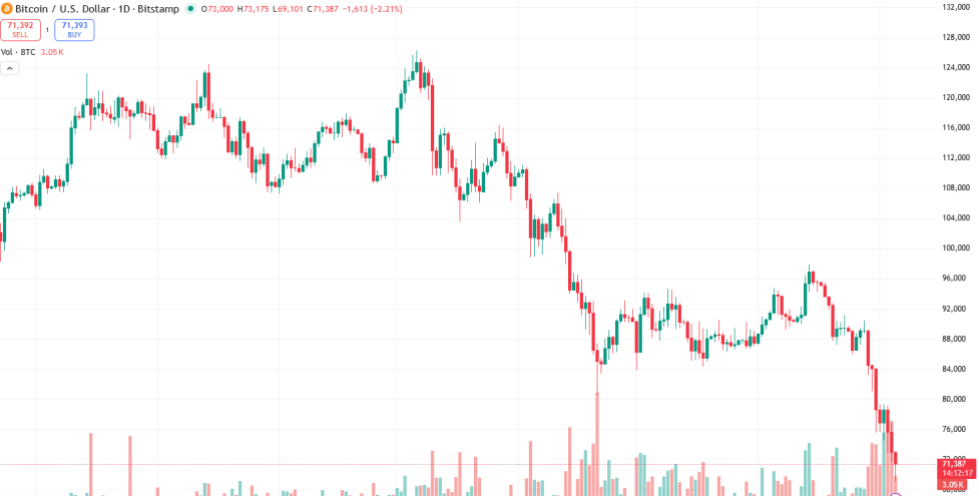
The question is not so much whether Bitcoin can rebound, but under what conditions a lasting floor can form. In the short term, the elements are missing. The market remains dependent on one key factor: overall liquidity.
From a macroeconomic perspective, expectations are clear. Prediction markets largely anticipate a status quo from the Federal Reserve at the April meeting, with little hope for a rate cut before June. This lack of a monetary catalyst limits appetite for risk assets, including Bitcoin.
The political context adds a layer of uncertainty. Recent statements by Donald Trump on monetary policy and his future Fed chair blur the reading of the calendar. Investors hesitate to anticipate a rapid easing, preferring to stay on the sidelines.
In this framework, Bitcoin is behaving more and more like a high-beta technology asset, sensitive to tensions in the stock markets. As long as this correlation persists, every pressure on tech stocks mechanically impacts BTC.
This does not mean an imminent capitulation, however. Glassnode data shows more of a demand vacuum than an excess of selling. In short, the market is not panicking; it is absent. This type of configuration can precede a phase of slow accumulation, especially if prices sink towards long-term value zones.
The end of the bearish movement will therefore depend less on an isolated technical signal and more on a gradual return of liquidity and confidence. On its side, Bitcoin Hyper is a Bitcoin layer-2 in presale that is managing to attract millions of $ in just a few weeks.