Bitcoin Price At $59,000 Is The Line In The Sand, Here’s What You Should Know

bitcoinistPubblicato 2026-03-30Pubblicato ultima volta 2026-03-30

Introduzione

Bitcoin's price is currently consolidating between $60,000 and $74,000, with a decisive breakout direction likely determining the market's next major move. Analysts highlight the critical importance of the 200-Week Moving Average, currently at $59,000, as a key support level. Historically, holding above this level has preceded significant bull runs—such as those in 2015, 2019, and 2023—leading to new all-time highs. Maintaining above $59,000 suggests long-term bullish momentum, with dips viewed as buying opportunities. However, a break below this level could signal a bear market and further declines. The macro structure remains optimistic, urging investors to avoid short-term fear.

Over the last few weeks, the Bitcoin price has ping-ponged between $60,000 and $74,000, suggesting that the direction that the price breaks out of in this range could be determinant of what direction the entire market takes next. After dropping more than 45% already, all attention has now shifted to when the pioneer cryptocurrency will make a new bottom. So far, bulls have held up surprisingly well, but there is still a ‘line in the sand’ that the price must not cross.

Bitcoin Macro Structure Is Still Bullish

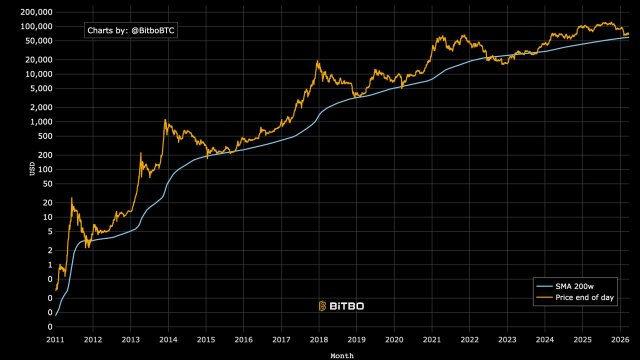
Presently, the Bitcoin price is still holding well above the 200-Week Moving Average, which is very bullish for the price, according to crypto analyst Crypto Patel. The reason for this dates back to the past market cycles, where the 200-Week Moving Average has been the major level to hold or beat.

Digging into the past cycles, Crypto Patel explained that the Bitcoin price had been able to stay above the 200-Week Moving Average back in 2015. The result of this was a major rally that saw the Bitcoin price rally toward $20,000 in the bull market that followed.

Then again, in 2019, the same 200-Week Moving Average held firm, and the resulting bull market led to the 2021 peak of $69,000. Even the third time in 2023, despite the price preciously crashing below $20,000, Bitcoin had managed to hold above the 200-Week Moving Average, and bulls were rewarded as the price would reach $126,000 in 2025.
Source: X

Given this trend, it becomes obvious that the Bitcoin price being above the 200-Week MA is bullish, and likewise, a crash below it would be bearish. This is why it is important for the bulls to maintain a hold on this level.

BTC Price Must Not Fall Below $59,000

Going by the analyst’s post, the current 200-Week Moving Average for Bitcoin lies at $59,000. This immediately makes it the level to defend for the bulls. As Crypto Patel explains, as long as the Bitcoin price stays above this level, then ‘every dip is a gift.’ This means it could be an opportunity to buy.

If historical trends are to be respected, holding the 200W MA would mean that the Bitcoin price would see new all-time highs sometime in 2028. “The Macro Structure Is Still Bullish. Don’t Let Short-Term Fear Shake You Out,” the analyst warns.

Alternatively, a break below this 200-Week Moving Average could be disastrous for Bitcoin, because it would mean that the cryptocurrency has now officially entered bear market territory. It could also bring the harbinger of more decline, sending the cryptocurrency lower before establishing a bottom.

BTC bulls begin to push upward again | Source: BTCUSD on Tradingview.com

Crypto di tendenza

Domande pertinenti

QWhat is the significance of the $59,000 level for the Bitcoin price according to the article?

AThe $59,000 level represents the current 200-Week Moving Average, which is a critical support level. Historically, Bitcoin has entered a bull market after holding above this level. A break below it could signal an official entry into a bear market.

QWhat historical evidence does the analyst, Crypto Patel, provide to support the importance of the 200-Week Moving Average?

ACrypto Patel points to three previous cycles: in 2015, holding above the 200-Week MA led to a rally to $20,000; in 2019, it led to the 2021 peak of $69,000; and in 2023, it preceded a rally to $126,000 in 2025.

QWhat is the potential consequence if the Bitcoin price breaks below the 200-Week Moving Average?

AA break below the 200-Week Moving Average would be disastrous as it would mean Bitcoin has officially entered bear market territory and could lead to further decline before a bottom is established.

QWhat is the analyst's advice for investors if the price holds above the $59,000 level?

AThe analyst advises that as long as the price stays above $59,000, 'every dip is a gift,' meaning it should be seen as a buying opportunity, and investors should not be shaken out by short-term fear.

QWhat is the projected long-term outcome if Bitcoin respects the historical trend and holds the 200-Week MA?

AIf the historical trend is respected and Bitcoin holds the 200-Week MA, the price is projected to reach new all-time highs sometime in 2028.

Letture associate

Michael Saylor: Bitcoin Halved, My Digital Credit is Making Money

Michael Saylor discusses Bitcoin, digital credit, and corporate treasury strategies in a recent roundtable. He explains that while Bitcoin remains "digital capital" with no counterparty risk, its ~40% annual volatility makes it unsuitable for most institutional and retail capital. To attract this capital, he advocates for Bitcoin-backed "digital credit" and "digital currency" products. These offer low volatility against fiat currencies, generate yield, and compete with traditional money market funds, stablecoins, and other yield-bearing crypto assets. Saylor clarifies that these products are not meant to replace direct Bitcoin ownership but to onboard capital that otherwise wouldn't enter the Bitcoin ecosystem. He provides examples: during a period when Bitcoin fell 50%, his company's digital credit products (STRC, SATA) delivered positive returns of 3-4%, demonstrating their ability to strip out ~90% of Bitcoin's volatility. He frames "digital currency" as a fiat-referenced, yield-bearing, stable-value asset backed by Bitcoin, designed to meet the needs of the global capital pool. This approach, he argues, can expand the Bitcoin network's reach by 10x to 100x more effectively than pure education. The discussion also covers corporate finance for Bitcoin treasury companies. Saylor argues that equity issuance is not inherently dilutive if done above net asset value per share and if the acquired asset (Bitcoin or cash) supports future value creation. He distinguishes between debt with maturity dates and hybrid capital like preferred shares (e.g., STRC), which offer issuer options and do not force liquidation. Evaluating these companies requires modeling based on future Bitcoin price and volatility assumptions, not relying on a single metric like mNAV (market-adjusted net asset value). The business models are still evolving, and investors must analyze full disclosures to form a complete view.

marsbit47 min fa

Michael Saylor: Bitcoin Halved, My Digital Credit is Making Money

marsbit47 min fa

Getting Ahead of the Tide and Drowning First: The Fall of 'Crypto x AI' Pioneer ai16z

"ai16z, an early pioneer of the 'crypto x AI' narrative, has officially shut down. In late 2024, its token launch sparked a massive speculative frenzy around AI Agent tokens, briefly propelling the project to a $2.6 billion valuation. However, by 2026, as functional AI agents from companies like Anthropic and OpenAI became mainstream reality, the crypto-native AI projects built largely on hype began to collapse. The founder of its underlying project, Eliza OS, announced the termination in a bitter post, citing legal threats from token holders and a depleted foundation. He expressed disillusionment with the crypto community, contrasting it with the 'optimistic' builders in pure AI. While the Eliza framework itself remains active as open-source software—ironically with contributions from AI like Claude—the token-dependent venture failed. The story highlights a core flaw: the crypto market often prices narratives far ahead of functional technology. When the promised AI future arrived, it was delivered by traditional tech companies with sustainable business models, not token projects. The episode suggests the initial path of 'tokenizing AI concepts' is broken. However, integration may still occur in reverse—with AI tools enhancing crypto analytics and trading—or in coordinating real resources like decentralized compute, as seen in projects like Bittensor and Render."

marsbit1 h fa

Getting Ahead of the Tide and Drowning First: The Fall of 'Crypto x AI' Pioneer ai16z

marsbit1 h fa

Changxin Rejects Apple's Price Pressure, Prices Not Lower Than Samsung and SK Hynix, Apple Loses Pricing Power

Apple recently attempted to negotiate lower-priced DRAM procurement deals with China's CXMT (ChangXin Memory Technologies) compared to its agreements with Samsung and SK Hynix but was rejected. CXMT stated its prices would not be lower, and could even be higher, than those of the South Korean suppliers. This refusal is attributed to CXMT's production capacity being largely secured by long-term contracts with major domestic clients like Huawei, Xiaomi, OPPO, Vivo, and Chinese internet giants. Consequently, CXMT feels no pressure to meet Apple's stringent terms. The backdrop is a significant surge in memory prices driven by the AI boom. As Samsung and SK Hynix shift more production capacity towards high-margin High Bandwidth Memory (HBM) for AI servers, the supply of conventional DRAM has tightened, causing prices to skyrocket. This has drastically increased the bill-of-materials cost for devices like iPhones, pressuring Apple's profits. Apple's traditional strategy of leveraging multiple suppliers for price competition has weakened, as memory makers prioritize more profitable AI-related orders. CXMT's confidence stems from achieving technological parity. Its DDR5 and LPDDR5X products have reached mass-production yields above 90%, closely matching Samsung's performance. With technical gaps closed, CXMT no longer competes solely on low prices. Furthermore, Chinese companies are wary of the risks associated with over-reliance on Apple's supply chain, citing cases like OFILM and Wingtech, which suffered severe losses after being removed from or impacted by US sanctions. This event signals a shift in the semiconductor industry's power dynamics. The AI-driven demand has transformed the market from buyer-centric to supplier-centric, where control over scarce, advanced production capacity grants pricing power. For Chinese semiconductor firms, the episode marks a transition from being low-cost alternatives to becoming equal suppliers with their own pricing authority, backed by domestic demand and technological advancement. Apple's loss of leverage with a mainland supplier underscores this changing era.

marsbit1 h fa

Changxin Rejects Apple's Price Pressure, Prices Not Lower Than Samsung and SK Hynix, Apple Loses Pricing Power

marsbit1 h fa

Trading

Spot

Articoli Popolari

Come comprare SAND

Benvenuto in HTX.com! Abbiamo reso l'acquisto di The Sandbox (SAND) semplice e conveniente. Segui la nostra guida passo passo per intraprendere il tuo viaggio nel mondo delle criptovalute.Step 1: Crea il tuo Account HTXUsa la tua email o numero di telefono per registrarti il tuo account gratuito su HTX. Vivi un'esperienza facile e sblocca tutte le funzionalità,Crea il mio accountStep 2: Vai in Acquista crypto e seleziona il tuo metodo di pagamentoCarta di credito/debito: utilizza la tua Visa o Mastercard per acquistare immediatamente The SandboxSAND.Bilancio: Usa i fondi dal bilancio del tuo account HTX per fare trading senza problemi.Terze parti: abbiamo aggiunto metodi di pagamento molto utilizzati come Google Pay e Apple Pay per maggiore comodità.P2P: Fai trading direttamente con altri utenti HTX.Over-the-Counter (OTC): Offriamo servizi su misura e tassi di cambio competitivi per i trader.Step 3: Conserva The Sandbox (SAND)Dopo aver acquistato The Sandbox (SAND), conserva nel tuo account HTX. In alternativa, puoi inviare tramite trasferimento blockchain o scambiare per altre criptovalute.Step 4: Scambia The Sandbox (SAND)Scambia facilmente The Sandbox (SAND) nel mercato spot di HTX. Accedi al tuo account, seleziona la tua coppia di trading, esegui le tue operazioni e monitora in tempo reale. Offriamo un'esperienza user-friendly sia per chi ha appena iniziato che per i trader più esperti.

366 Totale visualizzazioniPubblicato il 2024.12.10Aggiornato il 2026.06.02

Come comprare SAND

Discussioni

Benvenuto nella Community HTX. Qui puoi rimanere informato sugli ultimi sviluppi della piattaforma e accedere ad approfondimenti esperti sul mercato. Le opinioni degli utenti sul prezzo di SAND SAND sono presentate come di seguito.

活动图片