Toss Brings 30 Million Users Into the AI Data Economy in Partnership With Poseidon

TheNewsCryptoPubblicato 2026-06-26Pubblicato ultima volta 2026-06-26

Introduzione

Poseidon, a data infrastructure company for AI, has partnered with South Korean mobile financial platform Toss (operated by Viva Republica) to integrate its contributor app, Numo, into the Toss app. This partnership allows Toss's approximately 30 million users to contribute real-world voice, image, and video data for AI training and receive direct payment for their contributions. The initiative addresses the AI industry's growing need for high-quality, first-person data not available on the open web, crucial for developing physical intelligence in robotics and autonomous vehicles. Poseidon's infrastructure tracks each contribution's value, while Toss handles user payments. Contributions are registered on the DATA network, which provides verifiable provenance via its Trace audit layer. The partners aim to prove this user-compensated data model in South Korea—a market with dense real-life data and advanced mobile finance—before expanding globally. Poseidon recently raised a $15 million seed round led by Andreessen Horowitz.

Palo Alto, United States, June 26th, 2026, Chainwire

Toss users can now contribute real-world data to train AI and get paid for it, in a first-of-its-kind model launching in Korea ahead of global expansion.

Poseidon, the data infrastructure built to source and license real-world data for AI, today announced a partnership with Toss, the mobile financial platform operated by Viva Republica, to let everyday users contribute to AI training and be paid for what they provide. It is Toss’s first move into AI data, and it opens that market to its roughly 30 million users.

Frontier AI has run out of internet to scrape. The next generation of models depends on real-world data, the kind that captures how people actually speak, move, and react, which does not exist on the open web and has never had a clean way to be sourced, licensed, or paid for. Poseidon is building the infrastructure to change that, and Toss brings the reach to do it at scale.

Through the partnership, Poseidon’s contributor app, Numo, launches inside the Toss app. Toss users can help build Korean-language training data across voice, image, and video, and receive payment tied directly to what they contribute. Poseidon provides the infrastructure that tracks each contribution and its value, while Toss provides the user base and the financial experience that turns participation into payment. Together they offer a working answer to a question the AI industry has struggled with, which is how to compensate the people whose data makes models better.

Every contribution made through Numo is registered on DATA, the AI data network that Poseidon refines data for. DATA gives each record a verifiable provenance trail through Trace, its public audit layer, so a buyer can see where a piece of training data came from and a contributor can see that their work was counted and paid. DATA Foundation, which launched this week from the rebrand of Story, is building this layer alongside integration partners including the human data marketplace Kled, and Poseidon is one of the largest sources of refined data flowing into it.
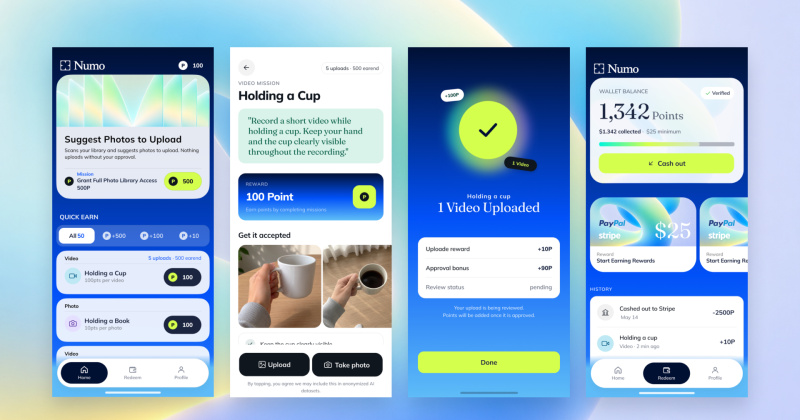
What Numo collects is first-person data, recorded by real people in real environments, which is among the hardest and most valuable categories to obtain. It is the raw material for physical intelligence, the AI that has to operate in the physical world across robotics, autonomous vehicles, and other applications. Demand from global AI labs for this kind of data is climbing, and Korea is positioned to supply it, with its dense real-life data and Toss’s user base. Poseidon and Toss intend to prove the model in Korea, then expand to global markets.

Changhoon Seo, Executive Director of New Business at Toss, said: “As the AI industry grows, demand for high-quality data is rising just as fast. Toss plans to build an environment where users can take part in the data economy more easily and naturally, and to expand a structure in which the value they contribute is rewarded transparently.”

SY Lee, Chief Strategy Officer and Chairman of Poseidon, said: “Korea is one of the few markets where the strategic importance of AI data, a mature financial system, and world-class mobile experience all exist at once. Toss is the right partner to turn user-contributed AI data from an early idea into a standard the rest of the world can adopt.” Lee previously founded the web-novel platform Radish and sold it to Kakao Entertainment, co-founded Story, the IP infrastructure that recently rebranded as DATA Foundation, and was named a Young Global Leader by the World Economic Forum this year.

About Poseidon

Poseidon is the data infrastructure for AI, built to source, refine, and license the real-world data that frontier models need and the open internet cannot supply. Incubated by the team behind The DATA Network, Poseidon bridges the gap between data supply and AI demand by enabling access to high-quality, IP-safe, and composable training datasets. Poseidon raised a $15 million seed round led by Andreessen Horowitz (a16z). Poseidon’s contributor app, Numo, has recorded more than 711,000 data registrations worldwide and is available and is now available on the Toss app.

Contact

HV
henri.vies@piplabs.xyz

Domande pertinenti

QWhat is the key outcome of the partnership between Toss and Poseidon?

AThe partnership allows approximately 30 million Toss users to contribute real-world data for AI training through the Numo app within the Toss platform and receive direct payment for their contributions.

QWhat is the main purpose of the Numo app launched by Poseidon?

ANumo is a contributor app that enables users to help build Korean-language training data across voice, image, and video formats, with each contribution tracked for value and compensation.

QWhy is first-person real-world data considered so valuable for AI development according to the article?

AFirst-person data, recorded by real people in real environments, is among the hardest and most valuable to obtain. It is essential raw material for developing physical intelligence in AI, which operates in the physical world for applications like robotics and autonomous vehicles.

QWhat role does the DATA network play in this data economy model?

AThe DATA network, refined by Poseidon, registers each contribution. It provides a verifiable provenance trail through its public audit layer, Trace, allowing buyers to see a data record's origin and contributors to see their work was counted and paid for.

QWhat are the future plans for the Toss and Poseidon partnership after launching in Korea?

APoseidon and Toss intend to first prove the user-contributed AI data model in the Korean market and then expand it to global markets.

Letture associate

Aave Founder Dismisses Reports Of Payward’s ‘70% Discount’ Stake Purchase

Aave founder Stani Kulechov has dismissed reports claiming that Kraken's parent company, Payward, was negotiating to purchase a 15% stake in Aave Group at a steep 70% discount. The reported deal proposed a $71 million investment at a $385 million valuation, which was framed as a significant discount compared to AAVE's fully diluted token valuation. Kulechov rejected this narrative, stating AAVE would not be sold at such a discount, and highlighted Aave's protocol revenue. The article clarifies the distinction between different entities within the Aave ecosystem—Aave Group, Aave Labs, Aave DAO, and AAVE token holders—noting that an equity discussion in a related company does not equate to selling the protocol or transferring DAO control. It underscores the sensitivity of major DeFi protocols to strategic investment rumors and the importance of accurate terminology to avoid misleading readers. While strategic discussions are common in the crypto sector, Kulechov specifically denied the discounted sale framing. The situation highlights that future developments should be monitored via official Aave channels, and market reactions may depend on whether token holders view the denial as value-supportive or focus on potential future distributions. The key takeaway is the founder's rejection of the 70% discount story, while leaving room for strategic partnerships under different terms.

bitcoinist1 h fa

Aave Founder Dismisses Reports Of Payward’s ‘70% Discount’ Stake Purchase

bitcoinist1 h fa

Trading

Spot
活动图片