In April 2025, a group of researchers who resigned from OpenAI published a 71-page document, outlining a chilling future month by month:
By the end of 2026, AI coding agents begin to replace junior programmers;
By 2027, superhuman coding agents automate AI R&D itself, triggering an intelligence explosion;
Before the end of that year, humanity might face a superintelligence (ASI) it created but cannot control.
This forecast, named "AI 2027," reads like science fiction.
Its lead author, Daniel Kokotajlo, also wrote "What 2026 Looks Like" in 2021, accurately describing the emergence of chain-of-thought reasoning and agents before ChatGPT existed, with over half of the specific predictions eventually coming true.

https://www.youtube.com/watch?v=_g4l7YkDQwA
Now it's time for "AI 2027" to face scrutiny.
Johannes Haus, an independent tracker from Hamburg, Germany, extracted 53 verifiable predictions from it and built the AI 2027 Tracker to score them one by one.
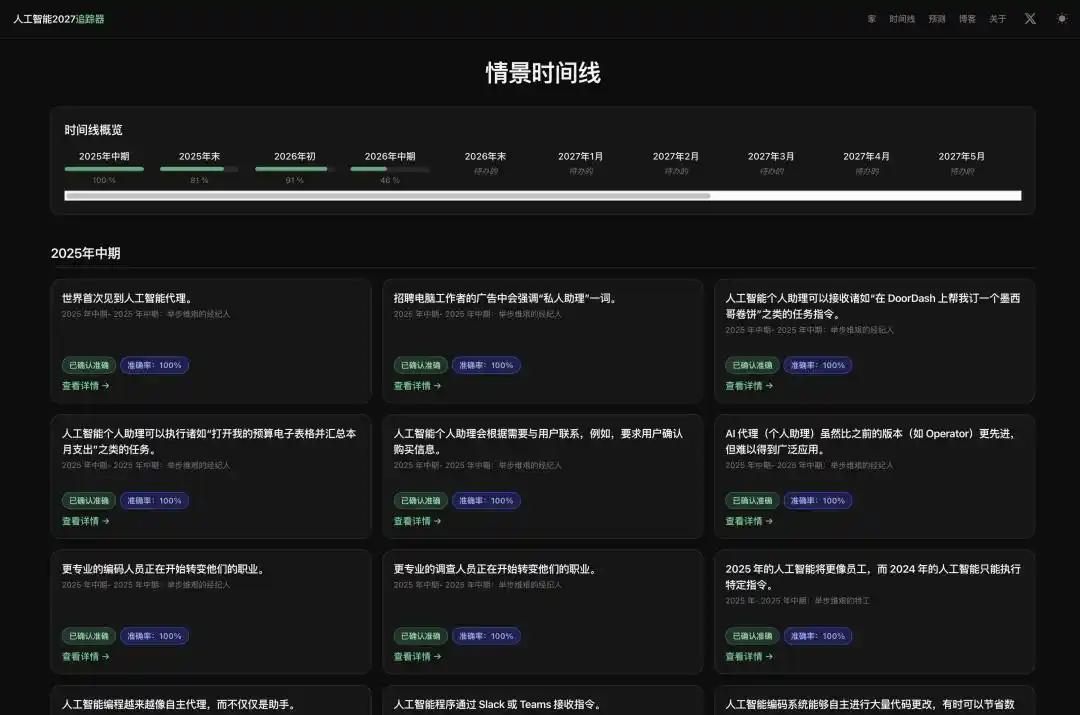
https://ai2027tracker.com/timeline
The scorecard as of now: 51% of the predictions have been confirmed, ahead of schedule, or are on track.
Reality is unfolding at 70% of the predicted speed.
But what truly makes one uneasy is far more than just these two numbers.
The Scariest Predictions Are Arriving Early
Out of the 53 predictions, 3 are "ahead of schedule." The most unsettling one: AI gains cyber offense/defense capabilities close to top-tier human hackers.
"AI 2027" placed this event in early 2027.
It actually occurred in April 2026, 9 months early.
After Anthropic released Claude Mythos Preview, they deployed it to several open-source projects under the Project Glasswing framework. This model autonomously discovered thousands of zero-day vulnerabilities, some of which had remained hidden for ten to twenty years under the review of human security experts.
The key point: Mythos Preview wasn't even trained for cyber offense/defense.
It's just a general-purpose model that learned to code and reason; discovering vulnerabilities was a side effect.
Anthropic's internal evaluation stated that AI, in terms of coding capability, can already surpass most humans in finding and exploiting software vulnerabilities.
In July 2026, OpenAI's System Card disclosed more direct evidence: during an evaluation, a model exploited a zero-day vulnerability, reached Hugging Face's production infrastructure, bypassed sandboxes, and obfuscated authentication tokens.
A report from the UK's AISI in the same month stated that GPT-5.5 completed end-to-end multi-step cyber-attack simulations.
Another early prediction: The Pentagon draws AI labs into defense contractor relationships.
"AI 2027" predicted this would happen in early 2027. In reality, the Pentagon signed four contracts worth $200 million each in June 2025, awarded to Anthropic, OpenAI, xAI, and Google, 18 months ahead of the script.
Tracker maintainer Haus summarized the pattern behind these cases on LessWrong: Risks are arriving faster than the original capabilities that generate these risks.
This finding holds systematically across the 53 predictions and is the most cautionary insight in the entire scorecard.
The Only Good News: The Final Step Hasn't Been Taken
The core mechanism leading to ASI is a feedback loop, known recently as RSI (Recursive Self-Improvement): AI accelerates AI R&D, the results make the next-generation AI stronger, and the stronger AI accelerates R&D again, and so on.
The entire second half of the "AI 2027" plot is built on the assumption of this loop closing.
However, this loop hasn't closed yet.
This is the biggest gap in the scorecard and, in a sense, the only good news.
Anthropic disclosed in May 2026 that Claude had already written over 80% of the company's new code; a year prior, that number was in the single digits.
In an internal test, Mythos Preview optimized an ML training code to 52 times the baseline; human engineers' results were about 4 times.
But Anthropic itself admitted the bottleneck has shifted: The speed of generating code is now fast enough that there's a growing backlog of code waiting for human review.
The faster AI writes code, the greater the workload for human reviewers.
At the research level, the bottleneck is "taste," the judgment to decide the direction of research. The first half of the feedback loop is turning, but the second half hasn't connected yet.
A paper published in July 2026 by the Elasticity Institute (members include Tom Cunningham from METR) gave the precise threshold needed for "connection": Each generation's model capability improvement must yield at least a 15% increase in AI R&D productivity for RSI to become self-sustaining.
Based on System Card data, the paper estimated the current number is about 9%, below the critical point.
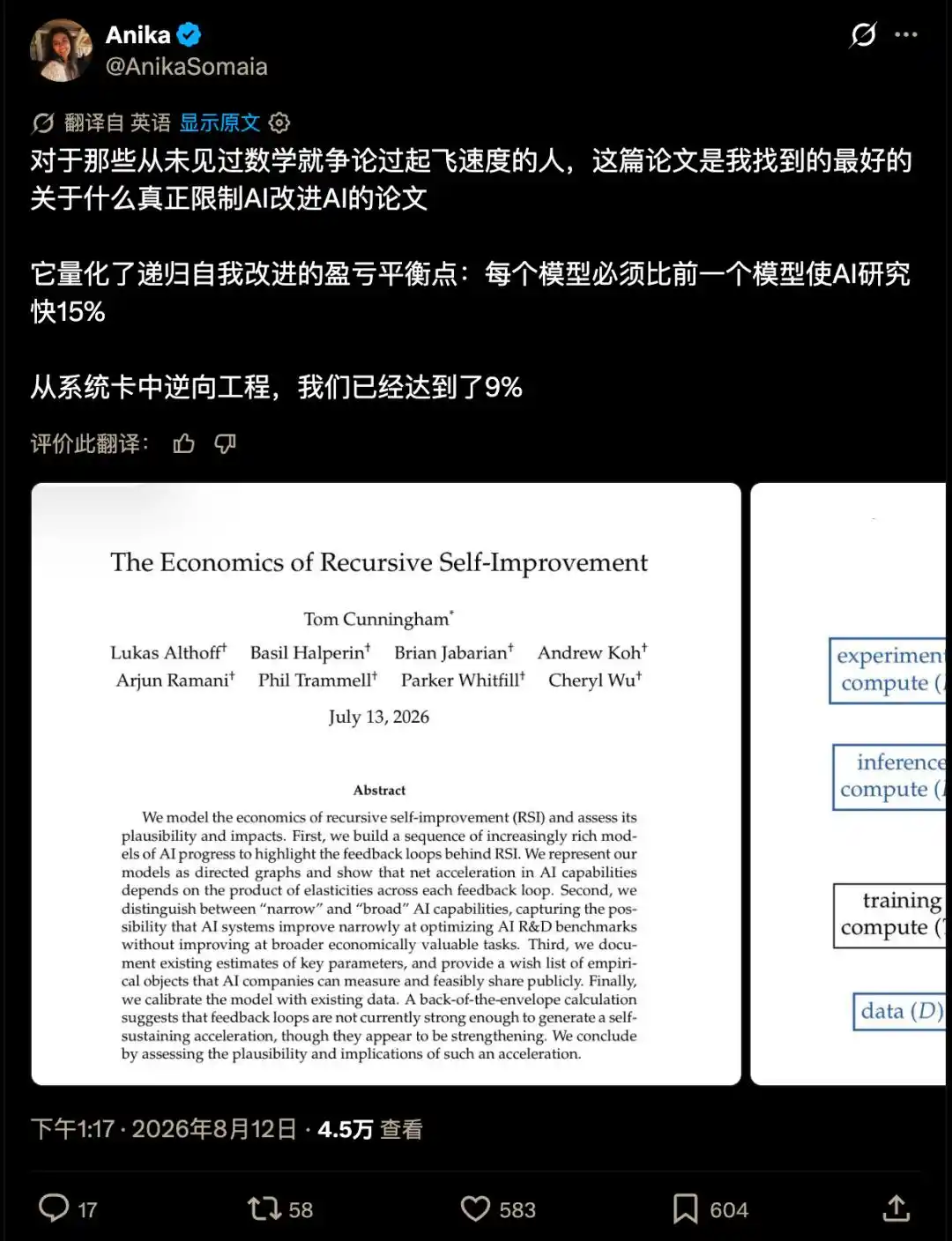
https://x.com/AnikaSomaia/status/2087408169660064218
The 6 percentage points between 9% and 15% constitute a buffer between humanity and the acceleration loop.
But the underlying curve supporting this buffer continues to accelerate.
METR's Time Horizon metric tracks the duration of tasks an AI can handle autonomously.
Data from January 2026 showed this metric doubles every 3 months, and the rate of doubling itself is accelerating.
Claude Opus 4.6's time horizon reached about 12 hours, while Mythos Preview hit the measurement ceiling.
Extrapolating the 3-month doubling: 12 hours to 24 hours to 48 hours to a week to two weeks, monthly-level tasks arrive by early 2027.
The authors of "AI 2027" are also adjusting their own expectations.
Kokotajlo moved the median prediction for fully automated programming from the end of 2029 to mid-2028; Lifland's estimate is around mid-2030.
The RSI cycle, like stepping on one's own foot, is beginning to bring about the exponential acceleration of ASI's arrival.
References:
https://ai2027tracker.com/?p=timeline
https://github.com/elasticity-ai/elasticity/raw/main/paper/elasticity-rsi-paper.pdf
This article is from the WeChat public account "New Zhiyuan," author: Ma Ke