$93 Million Casually Misappropriated? The Truth Behind the Stream Finance Collapse

marsbitPubblicato 2025-12-17Pubblicato ultima volta 2025-12-17

Introduzione

Stream Finance, a DeFi yield protocol with over $200M TVL, collapsed on November 4, 2025, after announcing a $93M loss caused by an "external fund manager." Its stablecoin xUSD plummeted 77%, triggering a $285M contagion across lending protocols like Morpho and Euler, leading to a $1B DeFi outflow. Initially blamed on "Curator" risk managers, the truth emerged from a December 8 lawsuit: founder Caleb McMeans had transferred protocol control to trader Ryan DeMattia with "no formal relationship." On October 10, DeMattia’s personal leveraged positions were liquidated during an ETH crash, and he allegedly used Stream’s funds to cover his losses—weeks before the Balancer hack (November 3) was falsely cited as the cause. The disaster was amplified by xUSD’s recursive lending structure but rooted in unregulated, off-chain asset control without multisig or custody safeguards. The incident highlights DeFi’s vulnerability to opaque operations and personal misconduct, not systemic failure of Curator models or yield strategies.

November 4, 2025, marked a "Black Tuesday" for the DeFi world.

Stream Finance, a yield aggregation protocol with a TVL that once exceeded $200 million and was touted as "The SuperApp DeFi Deserves," suddenly announced that an "external fund manager" had caused approximately $93 million in losses, and all deposit and withdrawal functions were suspended effective immediately.

Upon the news, its issued "stablecoin" xUSD flash-crashed from $1 to $0.26, a 77% drop in 24 hours. More critically, xUSD was widely used as collateral in major lending protocols like Morpho, Euler, Silo, and Gearbox—one bomb detonated, causing severe shockwaves throughout the DeFi lending market.

According to statistics from DeFi research firm Yields And More (YAM), Stream-related debt exposure reached a staggering $285 million:

  • Elixir's deUSD, which had lent 65% of its reserves (about $68 million USDC) to Stream, directly announced its closure. Its price plummeted from $1 to $0.015, nearly zero.

  • Compound suspended its USDC/USDS/USDT markets.

  • Euler froze related liquidity pools.

  • Morpho incurred bad debt.

Within a week, the DeFi market saw a net outflow of about $1 billion. Some compared this to the "Terra moment of 2025," Aave founder Stani Kulechov even warned on social media: "The next Terra Luna might be brewing."

I happened to be researching Curator in depth recently, and because of the Stream Finance incident, Curator was pushed into the spotlight. So I looked into the sequence of events to help everyone understand the full picture as much as possible.

Scapegoat: How Did Curator End Up Taking the Blame?

After the incident, public criticism quickly pointed to one role: Curator.

How was this blame shifted? Looking back at Stream's official statement on November 4th, the loss was caused by an "external fund manager."

This wording easily brings to mind the Curator role in DeFi lending protocols like Morpho and Euler—those "curators" responsible for managing liquidity pools and setting risk parameters.

The chain reaction following Stream's collapse made this narrative seem even more "confirmed":

On November 6th, Lista DAO urgently initiated a governance vote to force liquidate Vaults managed by MEV Capital and Re7 Labs—borrowing rates had soared to 800%, and the borrowers showed no signs of repayment. Re7 Labs subsequently issued a statement admitting it had an exposure of about $14.65 million in its xUSD isolated vault on Euler.

Top Curators' Vaults collectively exploding, emergency votes for forced liquidation—wasn't this a Curator problem?

BlockBeats published a widely circulated article after the event titled "DeFi's Potential $8 Billion Bomb, Only $100 Million Has Exploded So Far," attributing the collapse to "external Curators using user funds for opaque off-chain transactions" and characterizing it as a "systemic crisis of the Curator model."

Meanwhile, another "coincidence" made things even more mysterious—just one day before Stream's collapse (November 3rd), Balancer was hacked, losing approximately $128 million.

Thus, the mainstream narrative became: Curators misappropriated client funds for high-risk strategies, invested in Balancer, Balancer got hacked, money was lost, the Curator model is unreliable.

But there's a key question here: Was Curator really the core cause behind Stream's collapse?

It wasn't until December 8th, when court documents were made public, that we got a glimpse of the full picture.

The Truth Emerges: A Different Story Revealed by Court Documents

On December 8th, Stream Trading Corp. (the original Stream founding team) filed a lawsuit in San Francisco Federal Court against Caleb McMeans (online alias 0xlaw) and Ryan DeMattia.

This lawsuit revealed a completely different story.

Project Handover: A "Acquisition" Without Cash

According to a detailed report by DL News on the court documents:

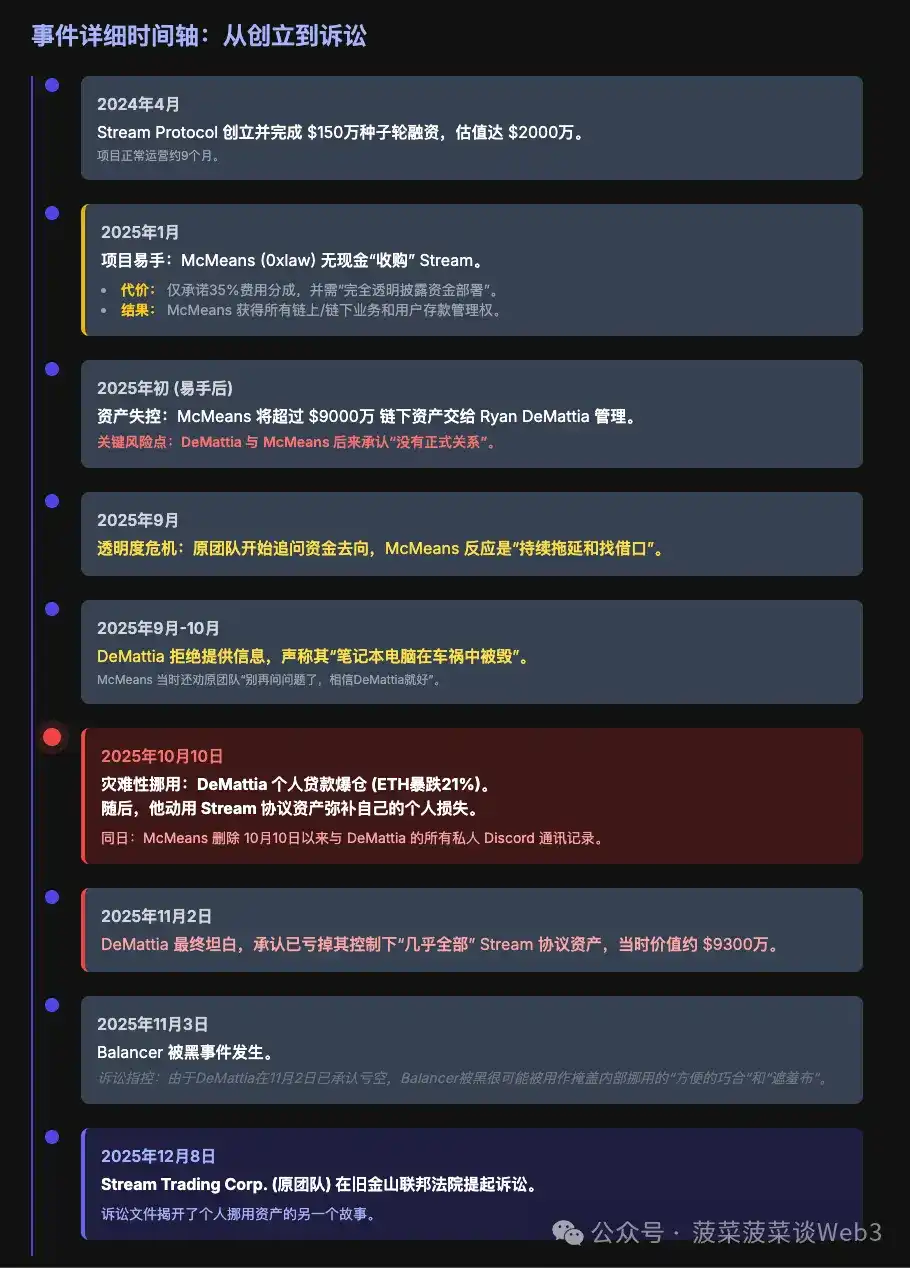
In February 2024, Argentine crypto investor Diogenes Casares founded the Stream Protocol. In April of the same year, the project completed a $1.5 million seed round led by Polychain, with a valuation of $20 million.

However, after just 9 months of operation, by November 2024, the founding team decided to shut down the project due to "operational challenges."

At that moment, trader Caleb McMeans appeared. He proposed acquiring Stream, presenting himself as an "expert in managing complex yield strategies."

In January 2025, both parties signed an agreement:

  • McMeans gained full control of the protocol, including all on-chain transactions, off-chain business agreements, and user deposit management rights.

  • In exchange, he would pay the original team a 35% fee share and promised to "fully transparently disclose the deployment locations of the funds."

Note: This was not a cash acquisition—McMeans did not pay money to buy the protocol but signed a "I operate, you get fees" agreement. The original team retained the role of service provider for the smart contracts, website, and token.

Out-of-Control Assets: $90+ Million Handed to Someone with "No Formal Relationship"

The problem arose after McMeans took over. According to the lawsuit, he handed over more than $90 million in protocol assets to a person named Ryan DeMattia for off-chain management.

Who is DeMattia? The lawsuit's description is quite subtle: McMeans initially called him an "employee" but later admitted to having "no formal relationship" with DeMattia.

No formal relationship, yet he gave this person control over $90+ million in off-chain assets. Outrageous?

It gets even more outrageous.

Laptop Destroyed in a Car Crash

In September 2025, the original founding team began demanding more transparency from McMeans, wanting to know where the funds were. McMeans' response was "continuous delays and excuses."

When the team pressed DeMattia, his response was even more spectacular—direct quote from the lawsuit:

"DeMattia offered a series of patently false excuses for why he could not provide any further information, even claiming at one point that his laptop had been destroyed in a car crash."

The creativity of this excuse is perhaps only matched by "my dog ate my homework."

The lawsuit continues, stating that McMeans at the time advised the original team to "stop asking questions and just trust DeMattia."

October 10th: Personal Liquidation, Misappropriation to Cover Losses

Then, October 10th arrived.

On that day, the price of ETH plummeted 21%, setting a record for the largest single-day liquidation in crypto history, with approximately $20 billion in positions liquidated. The lawsuit describes:

"But upon information and belief, on October 10, 2025, Mr. DeMattia faced a margin call on a personal loan for which he lacked sufficient funds to cover, had his position liquidated, and then used Stream Protocol assets to which he had access to cover his loss."

Translation: DeMattia's own leveraged position was liquidated, he didn't have money to cover the margin call, so he顺手 used Stream's money to fill the hole.

On November 2nd, DeMattia finally "confessed." According to DL News:

"On November 2, he admitted he had lost 'nearly all' of the Stream protocol assets under his control, which were worth about $93 million at the time."

Timeline Mismatch: Balancer Was Just a Smokescreen

Please note this date: November 2nd.

When was Balancer hacked? November 3rd.

If Stream's $93 million was lost in the Balancer hack, the loss should have occurred on November 3rd. But DeMattia admitted on November 2nd that it was "all lost"—the timeline doesn't match.

More crucial evidence: The lawsuit points out that McMeans deleted "all private Discord communication records with DeMattia since October 10th"—exactly the day DeMattia is believed to have started misappropriating funds.

If the loss was truly due to an external event like the Balancer hack, why delete chat records starting from October 10th?

The answer becomes clear: The Balancer hack was likely just a "convenient coincidence," used to divert attention, confuse the timeline, and provide a "force majeure" smokescreen for internal misappropriation.

BlockEden's analysis report also corroborates this: "No evidence of a smart contract hack or exploit has been found."
Essence: Personal Misappropriation, Amateurish Operation

So, was this collapse caused by a systemic failure of the Curator model, or blatant amateurish behavior leading to personal misappropriation of assets?

The lawsuit provides a clear answer: This was personal misappropriation.

DeMattia was not a professional Curator institution; he was an off-chain trader privately hired by McMeans, with "no formal relationship" to the protocol. He was given actual control over $90+ million, with no custody segregation, no multi-signature protection, no on-chain verifiability—when his personal position was liquidated, he directly used users' money to fill his own hole.

The Amplifier: How xUSD Recursive Lending Blew the Hole Wider

This personal misappropriation led to a collapse that, due to xUSD's recursive lending strategy, blew a $285 million hole.

If Stream were just a simple custody protocol, DeMattia misappropriating $93 million would have resulted in at most a $93 million loss. But because xUSD was designed to be a "yield-enhanced stablecoin" that could circulate, be used as collateral, and be re-borrowed across various protocols, this $93 million hole spread like a virus through DeFi's composability, infecting the entire ecosystem.

Recursive lending was not the cause of the disaster, but it was the amplifier of its scale.

Yearn developer Schlag had warned before the collapse: "Using the same 1.9 million USDC, they minted about 14.5 million xUSD"—a 7.6x capital amplification. When the underlying assets failed, this multiplier became an accelerator of destruction.

When the underlying assets (the $93 million held by Stream) disappeared, the entire recursive lending structure instantly collapsed, inflating the debt exposure from $93 million to $285 million.

Conclusion: Review, Reflection, and the Future

Let's梳理 (organize) the complete chain of this collapse:

Starting Point: The Stream Finance project "sold" the protocol to trader McMeans, who then handed $93 million in user assets to DeMattia, with whom he had "no formal relationship," for off-chain management.

Trigger: ETH price crashed on October 10th, DeMattia's personal position was liquidated, and he directly misappropriated Stream's funds to cover his losses.

Amplifier: The xUSD recursive lending structure amplified the $93 million hole into a $285 million debt exposure, infecting the entire DeFi lending market.

Smokescreen: Balancer was hacked for $128 million on November 3rd, becoming the perfect excuse to divert attention—even though DeMattia had already admitted the loss on November 2nd.

Scapegoat: Public opinion pointed the finger at the Curator model, ignoring the real problem of personal misappropriation.

What is the essence of this collapse?

Not a failure of the Curator model

In protocols like Morpho and Euler, Curators have defined boundaries—they can set risk parameters, adjust collateral ratios, decide which assets to accept, but cannot directly transfer user funds. User assets deposited into Vaults are locked in smart contracts; Curators cannot move them.

The problem with the Curators pushed into the spotlight was "negligence": accepting problematic assets like xUSD as collateral without conducting thorough due diligence.

Not the original sin of recursive lending strategy

Recursive borrowing itself is just a tool to amplify returns and risks. Used well, it's efficient capital operation; used poorly, it's suicidal leverage. Stream's recursive lending amplified the scale of the disaster but was not its cause.

The real problem is: One person could control tens of millions of user assets without any constraints

  • No custody segregation

  • No multi-signature protection

  • No on-chain verifiable fund flow

  • No compliance audits whatsoever

  • Not even a formal employment contract

This is the most primitive betrayal of trust—handing money to a person, and that person taking it away.

This is also the current state of the DeFi industry: Amateurish operations are rampant, and regulation is absent. A DeFi protocol can be casually "transferred," user funds can be casually misappropriated, and there are no real institutional constraints at any step of the entire process.

But crisis often breeds turning points.

The Stream collapse is forcing the industry to mature. As regulatory frameworks and legislation continue to be refined and implemented, more transparent, compliant, and professional protocols and service providers represent the real future opportunity for this industry.

References:

  1. DL News: "Stream Finance founders sue business partner, allege $93m used to cover personal losses"https://www.dlnews.com/articles/defi/stream-finance-founders-sue-partner-over-alleged-93m-loss/

  2. The Defiant: "Stream Files Lawsuit Against Operator '0xlaw' Over $93 Million Loss"https://thedefiant.io/news/defi/stream-finance-files-lawsuit-against-0xlaw-mcmeans

  3. The Defiant: "How Stream Finance's Collapse Exposed DeFi's Looping Yield Bubble"https://thedefiant.io/news/defi/how-stream-finance-s-collapse-exposed-defi-s-looping-yield-bubble

  4. Lawsuit Case: Stream Trading Corp. v. McMeans, Case No. 3:25-cv-10524, U.S. District Court for the Northern District of California, filed December 8, 2025

  5. BlockEden: "Anatomy of a $285M DeFi Contagion: The Stream Finance xUSD Collapse"https://blockeden.xyz/blog/2025/11/08/m-defi-contagion/

  6. Tiger Research: "Collapse of the Defi Jenga: The Stream Finance Breakdown"https://reports.tiger-research.com/p/collapse-of-the-defi-jenga-the-stream-eng

  7. The Block: "Analysts map $285M in potential exposure across DeFi after Stream Finance's $93M loss"https://www.theblock.co/post/377491/analysts-map-285m-in-potential-exposure-across-defi-after-stream-finances-93m-loss

  8. BlockBeats: "DeFi's Potential $8 Billion Bomb, Only $100 Million Has Exploded So Far" (《DeFi潜在80亿美金的雷,现在只爆了1个亿》)

  9. Yields And More (YAM): Stream Finance Debt Exposure Analysis

  10. Re7 Labs: Statement on Stream Finance Insolvency and xUSD Exposurehttps://x.com/Re7Labs/status/1985694621251387506


Crypto di tendenza

Domande pertinenti

QWhat was the main reason behind the $93 million loss at Stream Finance according to the lawsuit filed by the original team?

AAccording to the lawsuit filed by Stream Trading Corp., the $93 million loss was primarily due to personal misappropriation of funds by Ryan DeMattia, who used Stream Protocol assets to cover his personal trading losses after his leveraged positions were liquidated during the ETH price crash on October 10, 2025.

QHow did the xUSD stablecoin and its looping strategy amplify the impact of the initial $93 million loss?

AThe xUSD stablecoin was designed as a 'yield-enhanced' stablecoin that could be used as collateral for recursive lending across multiple DeFi protocols like Morpho, Euler, and Silo. This looping strategy amplified the initial $93 million loss into a total debt exposure of $285 million, as the collapse of the underlying asset caused the entire leveraged structure to fail simultaneously.

QWhy was the Balancer hack on November 3rd not the actual cause of Stream's collapse, despite initial narratives?

AThe Balancer hack on November 3rd could not have been the cause because Ryan DeMattia had already admitted to losing 'nearly all' of the $93 million in assets under his control on November 2nd, one day before the Balancer exploit. The timing discrepancy and the hack were likely used as a convenient excuse to obscure the true cause, which was internal misappropriation.

QWhat critical failures in Stream Finance's operational structure allowed this misappropriation to occur?

ACritical failures included: no custody isolation of user funds, no multi-signature protection for asset movements, no on-chain verifiability of fund flows, lack of formal compliance audits, and most notably, entrusting over $90 million to an individual (Ryan DeMattia) with whom the operator (Caleb McMeans) had 'no formal relationship' and no official employment contract.

QDid the lawsuit reveal that the problem was fundamentally a failure of the Curator model or something else?

AThe lawsuit revealed that the problem was not a fundamental failure of the Curator model used in protocols like Morpho or Euler. Instead, it was a case of primitive trust betrayal and irresponsible personal mismanagement. The actual Curators in question were guilty of negligence (e.g., accepting xUSD as collateral without proper due diligence), but they did not have the ability to directly misappropriate user funds, which are locked in smart contracts.

Letture associate

Beyond the Stadium: The Profitable Games Surrounding the World Cup

"Beyond the Pitch: The Profit Game Around the World Cup" The FIFA World Cup transcends being a sporting spectacle, evolving into a massive global arena for speculation and profit-seeking. The 2026 tournament has amplified this dynamic, creating a multi-layered ecosystem of financial opportunism alongside the football. **Prediction markets** have surged into the mainstream. Platforms like Polymarket and Kalshi saw trading volumes for World Cup contracts soar, attracting new users with their financial trading model and high-profile, chain-based wealth stories that overshadow traditional sports betting in terms of growth and narrative. However, **traditional sportsbooks** remain the dominant force, leveraging established user habits, legal markets, and comprehensive product offerings to handle the vast majority of speculative wagers, with projections suggesting record-breaking betting volumes. Capital markets also react. **"Concept stocks"** in countries like South Korea and Japan experience volatile price swings based on team performance and anticipated fan spending on items like chicken, beer, and viewing parties, effectively becoming a stock market reflecting fan sentiment. The **ticket resale market** has become a sophisticated arena for arbitrage. Prices fluctuate wildly based on team draws and star power, with sellers sometimes listing tickets they don't yet own in a practice akin to short-selling, while FIFA's own "Right to Buy" tokens add another layer of speculative trading. **Collectibles and merchandise** offer another avenue. Panini sticker albums, with their inherent scarcity and nostalgic value, can become high-value collectibles. Limited-edition or locally themed jerseys command significant premiums on secondary markets, and even counterfeit vendors profit from fans' desire for affordable match-day identity. The **cryptocurrency** space has seen a frenzy of speculative, unauthorized World Cup-themed meme coins on chains like Solana. These tokens, often exploiting team names and player imagery, experience extreme pump-and-dump cycles, creating stories of massive gains for a few early entrants and steep losses for many others. Finally, an entire industry thrives on **providing information and tools** to other speculators. Developers create platforms like SeatSidekick to track ticket inventory and prices, while paid Telegram groups and subscriptions sell betting tips and predictions, monetizing the widespread desire for an informational edge. In essence, the World Cup has become a compressed, global laboratory for speculation. While the games determine champions on the field, a parallel, complex network of financial transactions—spanning prediction contracts, bets, stocks, tickets, collectibles, crypto, and information services—settles its own scores in the global market.

marsbit32 min fa

Beyond the Stadium: The Profitable Games Surrounding the World Cup

marsbit32 min fa

How Does Codex Use a Computer? Three Entry Points and Permission Boundaries

This article explains the three primary methods for Codex to interact with a computer, each with distinct use cases, permission boundaries, and trust levels. **1. Computer Use:** This offers the broadest access, allowing Codex to visually control and interact with the graphical user interface of authorized macOS/Windows apps, system settings, and even iOS simulators. It's ideal for tasks lacking APIs or structured tools, such as operating legacy software or multi-app workflows. However, it's the slowest method and has the widest permission scope, requiring careful supervision for sensitive actions. **2. Chrome Extension:** This grants Codex access to the user's logged-in Chrome browser state, including cookies, profiles, and open tabs. It's best for tasks requiring user identity across websites like Gmail, LinkedIn, Salesforce, or internal dashboards. Its key advantage is multi-tab control for complex workflows. While more powerful for browser-based tasks than Computer Use, it carries higher sensitivity as actions are performed under the user's identity. **3. In-App Browser:** This is a browser isolated within the Codex thread, separate from the user's personal browsing data. It excels in web development and debugging scenarios—previewing local servers, testing responsive layouts, or annotating designs directly on the page. Its isolation is a strength for development but a limitation for tasks requiring login sessions. The core principle is to choose the narrowest, safest, and most structured interface for the task. Use plugins or MCPs first, resort to visual control (Computer Use) only for GUI-dependent tasks, employ the Chrome extension for identity-reliant browser work, and prefer the In-App Browser for isolated development. **Appshots** are clarified as a fourth, complementary tool for *inputting* context—capturing a screenshot of a window to point Codex to something—rather than a method for Codex to *act*. Together, this layered approach highlights a key to AI agent productization: not granting unlimited permissions, but constraining them within clear boundaries for specific tasks while preserving user oversight.

marsbit2 h fa

How Does Codex Use a Computer? Three Entry Points and Permission Boundaries

marsbit2 h fa

The "Iron Rule" of Chip Equipment Is Being Broken

For years, the semiconductor equipment industry followed an unwritten "iron rule": suppliers offered steep discounts for new tool introductions (Design-in) and faced consistent price pressure during repeat orders, especially during market downturns. This long-standing buyer's market dynamic is now being upended. Recently, SK Hynix's primary equipment suppliers have reportedly requested a 3-4% price *increase*, a nearly unprecedented move. This shift is driven by a severe supply-demand imbalance fueled by the AI compute boom. Securing equipment has become an urgent arms race as chipmakers' expansion speed dictates their ability to fulfill massive AI chip orders. Key areas feeling the strain include: **TCB (Thermal Compression Bonding) Equipment:** Demand is exploding, driven by the simultaneous needs of HBM4 memory stacking, AI chip Chip-on-Substrate (C2S), and logic Chiplet Chip-on-Wafer (C2W) packaging. Players like Hanmi Semiconductor, Hanwha Semitech, and ASMPT are receiving major orders. While hybrid bonding is seen as the future, TCB remains the pragmatic choice for HBM4 mass production, with its lifecycle extended by relaxed specifications and ongoing technological upgrades. **Test Equipment Bottlenecks:** Ironically, AI-driven shortages are now crippling test equipment manufacturing. Critical components like FPGAs, Driver ICs, and CPUs face severe shortages and extended lead times (up to 52 weeks for FPGAs), as AI data center and server vendors prioritize supply. This creates a paradoxical cycle: AI chip shortages drive fab expansion, which requires more test equipment, whose production is delayed because its key parts are diverted to make AI chips. The industry is entering a broad, AI-powered upcycle. SEMI forecasts global semiconductor equipment sales to hit a record $156 billion by 2027, fueled by investment in advanced logic/foundry, HBM-driven DRAM, and advanced packaging (like CoWoS). Major players like TSMC, SK Hynix, and Micron are aggressively ramping capital expenditure. In conclusion, leading equipment vendors are no longer just selling tools; they are selling the critical capability to deliver AI-era capacity. Pricing power is shifting decisively to those with indispensable technology in key process nodes like advanced logic, HBM, and advanced packaging, rewriting the industry's traditional power structure.

marsbit2 h fa

The "Iron Rule" of Chip Equipment Is Being Broken

marsbit2 h fa

Trading

Spot
Futures

Articoli Popolari

Cosa è XAG

Il contratto perpetuo XAGUSDT è il simbolo di trading per l'argento quotato in dollari statunitensi, che rappresenta 1 oncia troy di argento.

6 Totale visualizzazioniPubblicato il 2026.06.18Aggiornato il 2026.06.18

Cosa è XAG

Come comprare XAG

Benvenuto in HTX.com! Abbiamo reso l'acquisto di Silver (XAG) semplice e conveniente. Segui la nostra guida passo passo per intraprendere il tuo viaggio nel mondo delle criptovalute.Step 1: Crea il tuo Account HTXUsa la tua email o numero di telefono per registrarti il tuo account gratuito su HTX. Vivi un'esperienza facile e sblocca tutte le funzionalità,Crea il mio accountStep 2: Vai in Acquista crypto e seleziona il tuo metodo di pagamentoCarta di credito/debito: utilizza la tua Visa o Mastercard per acquistare immediatamente SilverXAG.Bilancio: Usa i fondi dal bilancio del tuo account HTX per fare trading senza problemi.Terze parti: abbiamo aggiunto metodi di pagamento molto utilizzati come Google Pay e Apple Pay per maggiore comodità.P2P: Fai trading direttamente con altri utenti HTX.Over-the-Counter (OTC): Offriamo servizi su misura e tassi di cambio competitivi per i trader.Step 3: Conserva Silver (XAG)Dopo aver acquistato Silver (XAG), conserva nel tuo account HTX. In alternativa, puoi inviare tramite trasferimento blockchain o scambiare per altre criptovalute.Step 4: Scambia Silver (XAG)Scambia facilmente Silver (XAG) nel mercato spot di HTX. Accedi al tuo account, seleziona la tua coppia di trading, esegui le tue operazioni e monitora in tempo reale. Offriamo un'esperienza user-friendly sia per chi ha appena iniziato che per i trader più esperti.

6 Totale visualizzazioniPubblicato il 2026.06.18Aggiornato il 2026.06.18

Come comprare XAG

Come comprare XAU

Benvenuto in HTX.com! Abbiamo reso l'acquisto di Gold (XAU) semplice e conveniente. Segui la nostra guida passo passo per intraprendere il tuo viaggio nel mondo delle criptovalute.Step 1: Crea il tuo Account HTXUsa la tua email o numero di telefono per registrarti il tuo account gratuito su HTX. Vivi un'esperienza facile e sblocca tutte le funzionalità,Crea il mio accountStep 2: Vai in Acquista crypto e seleziona il tuo metodo di pagamentoCarta di credito/debito: utilizza la tua Visa o Mastercard per acquistare immediatamente GoldXAU.Bilancio: Usa i fondi dal bilancio del tuo account HTX per fare trading senza problemi.Terze parti: abbiamo aggiunto metodi di pagamento molto utilizzati come Google Pay e Apple Pay per maggiore comodità.P2P: Fai trading direttamente con altri utenti HTX.Over-the-Counter (OTC): Offriamo servizi su misura e tassi di cambio competitivi per i trader.Step 3: Conserva Gold (XAU)Dopo aver acquistato Gold (XAU), conserva nel tuo account HTX. In alternativa, puoi inviare tramite trasferimento blockchain o scambiare per altre criptovalute.Step 4: Scambia Gold (XAU)Scambia facilmente Gold (XAU) nel mercato spot di HTX. Accedi al tuo account, seleziona la tua coppia di trading, esegui le tue operazioni e monitora in tempo reale. Offriamo un'esperienza user-friendly sia per chi ha appena iniziato che per i trader più esperti.

7 Totale visualizzazioniPubblicato il 2026.06.18Aggiornato il 2026.06.18

Come comprare XAU

Discussioni

Benvenuto nella Community HTX. Qui puoi rimanere informato sugli ultimi sviluppi della piattaforma e accedere ad approfondimenti esperti sul mercato. Le opinioni degli utenti sul prezzo di A A sono presentate come di seguito.

活动图片